
Wake County Public School System officials discussed changes on Wednesday, June 17, 2026, to a draft artificial intelligence policy that would govern how students, teachers, and staff use AI in North Carolina’s largest school district. The local debate is not really about whether AI belongs in classrooms; that argument has already been overtaken by reality. The harder question is whether public schools can teach students to use powerful software without turning every assignment, grade, and data system into an experiment. Wake County is now becoming a useful test case for the rest of K–12 America.
For a while, school systems could treat generative AI as a discipline problem. ChatGPT arrived, students discovered it could draft essays and solve homework, and administrators did what administrators often do when a new technology enters school through the side door: they warned against misuse, leaned on honor codes, and waited for a formal policy to catch up.
That pause is ending. Wake County’s draft policy recognizes what many teachers already know from the front of the classroom: AI is not a single website that can be blocked at the firewall. It is showing up inside search engines, productivity suites, tutoring tools, classroom platforms, accessibility software, and the phones students carry home every afternoon.
The district’s discussion, reported by ABC11, centered on amendments to a draft policy covering students, teachers, and staff. That matters. A student-only policy would frame AI as cheating prevention. A staff-and-student policy acknowledges that generative AI is becoming part of lesson planning, grading support, parent communication, translation, research, and administrative work.
Wake County’s position is still unsettled, and that uncertainty is itself the story. The district is trying to write rules for a technology that changes faster than board policy, procurement cycles, teacher training calendars, and state legislation. If the final policy sounds cautious, that is not necessarily bureaucratic timidity. It may be the only rational response to software that can be a tutor, a plagiarism machine, a hallucination engine, a productivity booster, and a privacy risk in the same browser tab.
It is none of those things anymore. A student does not need to paste an entire prompt into a standalone chatbot to get AI assistance. They can use predictive writing features, AI-enhanced search summaries, grammar tools, coding assistants, math solvers, image generators, translation systems, and app-specific “help me write” buttons. The boundary between “using AI” and “using normal software” is blurring.
That is why Wake County’s reported emphasis on responsible use is more realistic than a blanket crackdown. If students are going to encounter AI in college, the workplace, and daily life, schools have to teach judgment rather than pretend abstinence is a curriculum. The parent quoted by ABC11 put the workforce argument plainly: students who leave school without AI literacy may be less competitive than peers who know how to use the tools well.
Still, the workforce argument can become too easy. Schools should not adopt every workplace technology simply because employers like it. The point of education is not to train children to become prompt engineers before they can write a coherent paragraph on their own. The better case for AI literacy is civic and intellectual: students need to understand when machine-generated output is useful, when it is unreliable, and when relying on it weakens the very skill the assignment is meant to build.
Wake County’s draft-policy conversation appears to be trying to avoid that trap. ABC11 reported that district leaders discussed AI detection, educational support for families, responsible use, age-appropriate guidance, and oversight. Those are not minor details. They are the difference between a policy that sounds modern and one that can survive contact with eighth grade.
The age-appropriate piece is especially important. A high school senior using AI to compare arguments, debug code, or critique a draft is not in the same position as a fourth grader using it to generate a book report. Younger students are still building foundational reading, writing, numeracy, and reasoning skills. If AI is introduced too early as an answer machine, it can short-circuit the struggle that learning requires.
But older students need more than warnings. They need explicit instruction in verification, disclosure, citation, privacy, and restraint. They need to know that an AI-generated paragraph can sound polished and still be false. They need to learn that asking a model for “sources” is not research. They need to understand that entering personal, family, medical, or school information into an unapproved tool can create risks that are not erased when the browser tab closes.
The trouble is that AI detection has always been shaky ground. False positives can punish students for work they actually wrote. False negatives can miss sophisticated or lightly edited AI use. Students who are English-language learners, neurodivergent, or simply formulaic writers may be especially vulnerable when a detector treats statistical patterns as proof of misconduct.
For IT administrators and school leaders, the lesson is familiar: a dashboard is not due process. Schools can use technology to support investigations, but they should be very careful about treating a vendor score as evidence of cheating. If a district policy leans too hard on detection, it risks creating an arms race in which students learn evasion, teachers lose trust, and administrators inherit appeals they cannot fairly adjudicate.
A better policy asks students to disclose and explain AI use. That does not eliminate cheating, but it changes the default from surveillance to accountability. If a student uses AI to brainstorm, summarize, translate, revise, or generate code, the important question becomes whether that use was permitted for the assignment and whether the student can explain the work that resulted.
That approach also gives teachers room to design better assignments. Oral defenses, drafts, in-class writing, process logs, project checkpoints, and reflective notes are harder to fake than a final essay dropped into a learning management system at 11:58 p.m. AI did not create the problem of hollow assignments, but it has made them much easier to exploit.
This is where the classroom conversation becomes an IT conversation. Districts need approved tools, procurement standards, contract language, auditability, access controls, data-loss-prevention thinking, and staff training. The risk is not only that a chatbot says something wrong. The risk is that a school system normalizes casual data sharing before it has the infrastructure to manage it.
In a large district like Wake County, that problem scales quickly. Thousands of teachers and staff may be tempted to use AI for lesson plans, rubrics, emails, individualized supports, translation, meeting notes, or summaries of student work. Some of those uses may be harmless or even beneficial. Others may quietly move protected student information into systems the district never vetted.
The practical distinction is not “AI or no AI.” It is approved versus unapproved use, identifiable versus de-identified data, instructional support versus automated decision-making, and human-reviewed output versus machine output treated as authoritative. A responsible policy must make those boundaries legible to educators who are already overworked and not necessarily trained as software risk managers.
For sysadmins, this is where good intentions become ticket queues. If the district approves AI tools without centralized identity management, logging, retention rules, vendor review, and clear escalation paths, the policy will live on paper while actual practice fragments across classrooms. The same problem has played out for years with apps, extensions, cloud drives, and “free” classroom tools. AI simply raises the stakes.
Professional development is not optional here. A teacher who has never used a generative AI system cannot meaningfully teach students when to trust it, challenge it, or ignore it. At the same time, a teacher who is dazzled by the productivity gains may need guidance on where automation becomes inappropriate.
Grading is the danger zone. AI can help generate rubrics, suggest feedback language, or organize comments, but using it to evaluate student work raises fairness, transparency, and privacy concerns. If a student’s grade is influenced by a machine-generated judgment, families will reasonably ask how that judgment was made, whether it was reviewed, and whether the tool had access to data it should not have seen.
Curriculum development is another gray area. AI can produce lesson ideas quickly, but speed is not the same as quality. A district that allows AI-assisted planning should still require teachers to check accuracy, alignment with standards, accessibility, cultural sensitivity, and age appropriateness. In education, a hallucination is not just an error. It can become tomorrow’s worksheet.
The best policies will treat teachers as professionals rather than endpoints. They will give educators a shared vocabulary, safe sandboxes, examples from real classrooms, and clear lines around student data. They will also admit that some AI use should remain optional. A teacher should not have to become an AI power user to teach well.
That timeline changes the politics of Wake’s draft. If state lawmakers impose a framework, local districts may have less room to experiment or delay. If the state framework is broad, districts like Wake will still need to translate it into classroom rules, staff procedures, technology controls, and parent-facing guidance.
Statewide policy has real advantages. It can prevent a patchwork in which neighboring districts take wildly different approaches to academic integrity, privacy, procurement, and student rights. It can also help smaller districts that lack Wake County’s administrative capacity, legal support, or instructional technology staff.
But a statewide policy can also flatten local nuance. Wake County has the scale and complexity of a major metropolitan district. Rural districts, charter schools, early colleges, and specialized programs may have different infrastructure and staffing realities. A good state framework should set guardrails without pretending one implementation model will fit every school unit.
The July 2027 local adoption horizon, if it survives the legislative process, is not far away in school time. Board policies, procurement reviews, professional development calendars, parent communications, and classroom materials all move slowly. The technology, meanwhile, will not wait.
For Windows-heavy districts, Microsoft’s expanding Copilot ecosystem is an obvious example. AI features are increasingly attached to productivity software, search, coding tools, meeting platforms, and administrative workflows. A district may decide not to “buy an AI chatbot” and still find AI embedded in tools it already licenses.
That complicates governance. Blocking one website does not answer whether a teacher can use AI in Word to rewrite a parent email, whether staff can summarize a Teams meeting, whether students can use AI in a browser sidebar, or whether generated content should be stored in district-managed cloud environments. The policy has to follow the workflow, not the brand name.
Vendor promises will not be enough. Districts should insist on clear contractual terms for data use, retention, training, access, deletion, and compliance with student privacy obligations. They should also distinguish enterprise-managed AI tools from consumer accounts. The same model family can present very different risks depending on identity, logging, data handling, and contractual protections.
This is where school boards often underappreciate the operational burden. A policy that says “use approved tools” requires someone to approve tools, review changes, monitor vendors, communicate updates, and handle exceptions. AI governance is not a one-time board vote. It is a continuing administrative function.
If the only evidence of learning is a polished final product created outside the teacher’s view, AI will be hard to manage. That does not mean every assignment must become an in-class handwritten exam. It means teachers and schools need to care more about process.
Draft histories, conferences, checkpoints, peer review, source trails, annotated bibliographies, oral explanations, and reflection can make learning more visible. In coding classes, students can explain design choices and debug live. In writing classes, they can show revisions and defend claims. In science and social studies, they can compare AI output against primary sources and identify errors.
This approach also avoids treating every student as a suspect. A classroom built around process gives honest students a way to demonstrate authorship and gives teachers better evidence when something seems off. It is more work, yes. But so is fighting endless detector disputes after the fact.
AI also creates a chance to teach integrity more explicitly. Students need to know that there is a difference between using a calculator and submitting someone else’s proof, between asking for feedback and outsourcing thought, between translation support and misrepresenting language ability. The boundaries will vary by assignment, which is why policy must empower teachers to specify them clearly.
Family guidance should be plainspoken. Parents do not need a graduate seminar in transformer architecture. They need to know which tools are approved, what students are allowed to do, what they should not enter into AI systems, how assignments will disclose AI permissions, and whom to contact when something goes wrong.
The Social Institute’s Laura Tierney, quoted by ABC11, emphasized ongoing learning and giving families conversation starters. That is sensible because AI norms will not be settled by a single permission form. Families will need periodic updates as tools change and as student expectations shift by grade level.
There is also an equity issue. Some families already pay for premium AI tools, private tutoring, faster devices, and better connectivity. Others do not. If schools incorporate AI without thinking about access, they may widen gaps under the banner of innovation.
Public schools cannot assume every student has the same toolset at home. If AI use is required or strongly encouraged for assignments, districts need to provide equitable access through managed systems. If AI use is optional, teachers need to design assignments so students are not penalized for lacking access to paid tools.
Wake County’s policy will need to answer practical questions. How will teachers communicate whether AI is allowed on a given assignment? What happens when a student discloses use that was not permitted? Which staff uses are forbidden outright? What student data may never be entered into AI tools? Who approves new AI products? How often is the approved list reviewed?
The district will also need to decide how transparent it wants to be with the public. Parents should not have to file records requests to understand what tools are being used with their children’s work. Teachers should not have to guess whether an app is safe. Students should not be disciplined under rules they never clearly received.
A durable AI policy should be versioned, reviewed, and updated. That may sound like software management because it is. School boards are used to policies that last years. AI governance may need annual, semiannual, or even more frequent review as tools and legal expectations change.
The most important enforcement mechanism will not be punishment. It will be clarity. If students, teachers, and parents understand the rules before a dispute happens, the district has a chance. If the rules emerge only after a suspicious essay or a privacy scare, the policy has already failed.
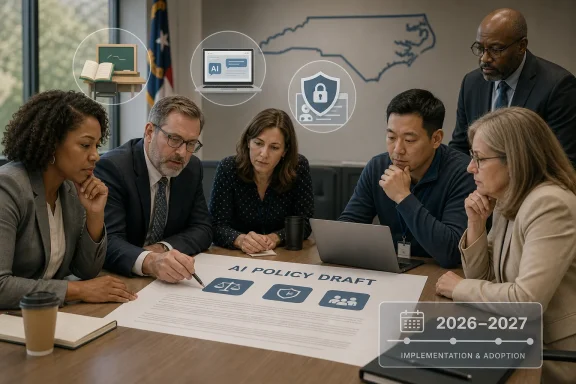 Wake County Is No Longer Debating Whether AI Exists
For a while, school systems could treat generative AI as a discipline problem. ChatGPT arrived, students discovered it could draft essays and solve homework, and administrators did what administrators often do when a new technology enters school through the side door: they warned against misuse, leaned on honor codes, and waited for a formal policy to catch up.That pause is ending. Wake County’s draft policy recognizes what many teachers already know from the front of the classroom: AI is not a single website that can be blocked at the firewall. It is showing up inside search engines, productivity suites, tutoring tools, classroom platforms, accessibility software, and the phones students carry home every afternoon.
The district’s discussion, reported by ABC11, centered on amendments to a draft policy covering students, teachers, and staff. That matters. A student-only policy would frame AI as cheating prevention. A staff-and-student policy acknowledges that generative AI is becoming part of lesson planning, grading support, parent communication, translation, research, and administrative work.
Wake County’s position is still unsettled, and that uncertainty is itself the story. The district is trying to write rules for a technology that changes faster than board policy, procurement cycles, teacher training calendars, and state legislation. If the final policy sounds cautious, that is not necessarily bureaucratic timidity. It may be the only rational response to software that can be a tutor, a plagiarism machine, a hallucination engine, a productivity booster, and a privacy risk in the same browser tab.
The Classroom Ban Was Always a Fantasy
The first generation of school AI rules often began with prohibition. That was understandable, especially in 2022 and 2023, when many districts were blindsided by how quickly students adopted text generators. But bans were built on a fragile assumption: that AI use would be visible, separable, and technically enforceable.It is none of those things anymore. A student does not need to paste an entire prompt into a standalone chatbot to get AI assistance. They can use predictive writing features, AI-enhanced search summaries, grammar tools, coding assistants, math solvers, image generators, translation systems, and app-specific “help me write” buttons. The boundary between “using AI” and “using normal software” is blurring.
That is why Wake County’s reported emphasis on responsible use is more realistic than a blanket crackdown. If students are going to encounter AI in college, the workplace, and daily life, schools have to teach judgment rather than pretend abstinence is a curriculum. The parent quoted by ABC11 put the workforce argument plainly: students who leave school without AI literacy may be less competitive than peers who know how to use the tools well.
Still, the workforce argument can become too easy. Schools should not adopt every workplace technology simply because employers like it. The point of education is not to train children to become prompt engineers before they can write a coherent paragraph on their own. The better case for AI literacy is civic and intellectual: students need to understand when machine-generated output is useful, when it is unreliable, and when relying on it weakens the very skill the assignment is meant to build.
AI Literacy Is Not the Same as Letting Chatbots Do Homework
The phrase AI literacy risks becoming another education slogan unless districts define it carefully. At its best, it means students learn how AI systems generate responses, why they can be wrong, how bias and training data shape outputs, and how to use AI as a tool rather than a substitute for thinking. At its worst, it becomes a permission slip for outsourcing schoolwork to software.Wake County’s draft-policy conversation appears to be trying to avoid that trap. ABC11 reported that district leaders discussed AI detection, educational support for families, responsible use, age-appropriate guidance, and oversight. Those are not minor details. They are the difference between a policy that sounds modern and one that can survive contact with eighth grade.
The age-appropriate piece is especially important. A high school senior using AI to compare arguments, debug code, or critique a draft is not in the same position as a fourth grader using it to generate a book report. Younger students are still building foundational reading, writing, numeracy, and reasoning skills. If AI is introduced too early as an answer machine, it can short-circuit the struggle that learning requires.
But older students need more than warnings. They need explicit instruction in verification, disclosure, citation, privacy, and restraint. They need to know that an AI-generated paragraph can sound polished and still be false. They need to learn that asking a model for “sources” is not research. They need to understand that entering personal, family, medical, or school information into an unapproved tool can create risks that are not erased when the browser tab closes.
The Detector Era Is Already Fading
One of the more consequential details from related local reporting is that Wake’s draft approach reportedly discourages reliance on AI detectors. That is a notable shift because detectors were the first comforting product category to arrive after generative AI disrupted classrooms. They promised a technical fix to a social, pedagogical, and evidentiary problem.The trouble is that AI detection has always been shaky ground. False positives can punish students for work they actually wrote. False negatives can miss sophisticated or lightly edited AI use. Students who are English-language learners, neurodivergent, or simply formulaic writers may be especially vulnerable when a detector treats statistical patterns as proof of misconduct.
For IT administrators and school leaders, the lesson is familiar: a dashboard is not due process. Schools can use technology to support investigations, but they should be very careful about treating a vendor score as evidence of cheating. If a district policy leans too hard on detection, it risks creating an arms race in which students learn evasion, teachers lose trust, and administrators inherit appeals they cannot fairly adjudicate.
A better policy asks students to disclose and explain AI use. That does not eliminate cheating, but it changes the default from surveillance to accountability. If a student uses AI to brainstorm, summarize, translate, revise, or generate code, the important question becomes whether that use was permitted for the assignment and whether the student can explain the work that resulted.
That approach also gives teachers room to design better assignments. Oral defenses, drafts, in-class writing, process logs, project checkpoints, and reflective notes are harder to fake than a final essay dropped into a learning management system at 11:58 p.m. AI did not create the problem of hollow assignments, but it has made them much easier to exploit.
Privacy Is the Part Parents Are Right to Worry About
The parent concern highlighted by ABC11 cuts to the core of the WindowsForum audience’s interest: software governance. It is one thing to tell students to experiment with AI. It is another to let minors paste schoolwork, identifying details, disability information, disciplinary history, or family circumstances into consumer-grade systems with unclear data retention and training practices.This is where the classroom conversation becomes an IT conversation. Districts need approved tools, procurement standards, contract language, auditability, access controls, data-loss-prevention thinking, and staff training. The risk is not only that a chatbot says something wrong. The risk is that a school system normalizes casual data sharing before it has the infrastructure to manage it.
In a large district like Wake County, that problem scales quickly. Thousands of teachers and staff may be tempted to use AI for lesson plans, rubrics, emails, individualized supports, translation, meeting notes, or summaries of student work. Some of those uses may be harmless or even beneficial. Others may quietly move protected student information into systems the district never vetted.
The practical distinction is not “AI or no AI.” It is approved versus unapproved use, identifiable versus de-identified data, instructional support versus automated decision-making, and human-reviewed output versus machine output treated as authoritative. A responsible policy must make those boundaries legible to educators who are already overworked and not necessarily trained as software risk managers.
For sysadmins, this is where good intentions become ticket queues. If the district approves AI tools without centralized identity management, logging, retention rules, vendor review, and clear escalation paths, the policy will live on paper while actual practice fragments across classrooms. The same problem has played out for years with apps, extensions, cloud drives, and “free” classroom tools. AI simply raises the stakes.
Teachers Need Training, Not Another Compliance Memo
The most unfair version of an AI policy is one that tells teachers to manage a technological revolution with a two-page memo and a warning about academic integrity. Teachers need concrete examples, model assignments, approved-use cases, prohibited-use cases, and time to practice. They also need permission to say no when AI weakens the lesson.Professional development is not optional here. A teacher who has never used a generative AI system cannot meaningfully teach students when to trust it, challenge it, or ignore it. At the same time, a teacher who is dazzled by the productivity gains may need guidance on where automation becomes inappropriate.
Grading is the danger zone. AI can help generate rubrics, suggest feedback language, or organize comments, but using it to evaluate student work raises fairness, transparency, and privacy concerns. If a student’s grade is influenced by a machine-generated judgment, families will reasonably ask how that judgment was made, whether it was reviewed, and whether the tool had access to data it should not have seen.
Curriculum development is another gray area. AI can produce lesson ideas quickly, but speed is not the same as quality. A district that allows AI-assisted planning should still require teachers to check accuracy, alignment with standards, accessibility, cultural sensitivity, and age appropriateness. In education, a hallucination is not just an error. It can become tomorrow’s worksheet.
The best policies will treat teachers as professionals rather than endpoints. They will give educators a shared vocabulary, safe sandboxes, examples from real classrooms, and clear lines around student data. They will also admit that some AI use should remain optional. A teacher should not have to become an AI power user to teach well.
State Law Could Turn Local Experimentation Into a Deadline
Wake County is not operating in a vacuum. North Carolina House Bill 301, now framed around social media and AI safety, would require state-level action on artificial intelligence in schools if enacted in its current form. ABC11 reported that the bill could require the Department of Public Instruction to develop a statewide AI policy by the end of 2026, with local districts required to adopt that policy or their own by July 2027.That timeline changes the politics of Wake’s draft. If state lawmakers impose a framework, local districts may have less room to experiment or delay. If the state framework is broad, districts like Wake will still need to translate it into classroom rules, staff procedures, technology controls, and parent-facing guidance.
Statewide policy has real advantages. It can prevent a patchwork in which neighboring districts take wildly different approaches to academic integrity, privacy, procurement, and student rights. It can also help smaller districts that lack Wake County’s administrative capacity, legal support, or instructional technology staff.
But a statewide policy can also flatten local nuance. Wake County has the scale and complexity of a major metropolitan district. Rural districts, charter schools, early colleges, and specialized programs may have different infrastructure and staffing realities. A good state framework should set guardrails without pretending one implementation model will fit every school unit.
The July 2027 local adoption horizon, if it survives the legislative process, is not far away in school time. Board policies, procurement reviews, professional development calendars, parent communications, and classroom materials all move slowly. The technology, meanwhile, will not wait.
Microsoft, Google, and the Platform Vendors Are Already in the Room
Even though the Wake County story is local, the platform backdrop is national. The school AI debate is not only about standalone chatbots. It is about Microsoft, Google, Apple, Adobe, Canva, learning management systems, student information systems, and the rest of the software stack that public education already depends on.For Windows-heavy districts, Microsoft’s expanding Copilot ecosystem is an obvious example. AI features are increasingly attached to productivity software, search, coding tools, meeting platforms, and administrative workflows. A district may decide not to “buy an AI chatbot” and still find AI embedded in tools it already licenses.
That complicates governance. Blocking one website does not answer whether a teacher can use AI in Word to rewrite a parent email, whether staff can summarize a Teams meeting, whether students can use AI in a browser sidebar, or whether generated content should be stored in district-managed cloud environments. The policy has to follow the workflow, not the brand name.
Vendor promises will not be enough. Districts should insist on clear contractual terms for data use, retention, training, access, deletion, and compliance with student privacy obligations. They should also distinguish enterprise-managed AI tools from consumer accounts. The same model family can present very different risks depending on identity, logging, data handling, and contractual protections.
This is where school boards often underappreciate the operational burden. A policy that says “use approved tools” requires someone to approve tools, review changes, monitor vendors, communicate updates, and handle exceptions. AI governance is not a one-time board vote. It is a continuing administrative function.
Academic Integrity Has to Move From Policing to Design
The cheating panic around AI is real but incomplete. Students have always found ways to avoid work they do not value, do not understand, or do not believe matters. Generative AI makes that avoidance cheaper and more convincing, but it also exposes assignments that were already vulnerable.If the only evidence of learning is a polished final product created outside the teacher’s view, AI will be hard to manage. That does not mean every assignment must become an in-class handwritten exam. It means teachers and schools need to care more about process.
Draft histories, conferences, checkpoints, peer review, source trails, annotated bibliographies, oral explanations, and reflection can make learning more visible. In coding classes, students can explain design choices and debug live. In writing classes, they can show revisions and defend claims. In science and social studies, they can compare AI output against primary sources and identify errors.
This approach also avoids treating every student as a suspect. A classroom built around process gives honest students a way to demonstrate authorship and gives teachers better evidence when something seems off. It is more work, yes. But so is fighting endless detector disputes after the fact.
AI also creates a chance to teach integrity more explicitly. Students need to know that there is a difference between using a calculator and submitting someone else’s proof, between asking for feedback and outsourcing thought, between translation support and misrepresenting language ability. The boundaries will vary by assignment, which is why policy must empower teachers to specify them clearly.
Families Cannot Be an Afterthought
ABC11’s report rightly included the family dimension. Parents are asking for structure because the technology is already in homes, on phones, and in students’ social lives. If schools create rules students hear only in class, those rules will collide with a home environment where AI may be treated as a toy, tutor, shortcut, or forbidden fruit.Family guidance should be plainspoken. Parents do not need a graduate seminar in transformer architecture. They need to know which tools are approved, what students are allowed to do, what they should not enter into AI systems, how assignments will disclose AI permissions, and whom to contact when something goes wrong.
The Social Institute’s Laura Tierney, quoted by ABC11, emphasized ongoing learning and giving families conversation starters. That is sensible because AI norms will not be settled by a single permission form. Families will need periodic updates as tools change and as student expectations shift by grade level.
There is also an equity issue. Some families already pay for premium AI tools, private tutoring, faster devices, and better connectivity. Others do not. If schools incorporate AI without thinking about access, they may widen gaps under the banner of innovation.
Public schools cannot assume every student has the same toolset at home. If AI use is required or strongly encouraged for assignments, districts need to provide equitable access through managed systems. If AI use is optional, teachers need to design assignments so students are not penalized for lacking access to paid tools.
The Real Policy Test Will Come After Adoption
The draft policy will matter, but implementation will matter more. School systems are full of policies that read well and fade into inconsistent practice. AI will punish that kind of vagueness because the technology is too accessible, too tempting, and too quickly embedded into everyday software.Wake County’s policy will need to answer practical questions. How will teachers communicate whether AI is allowed on a given assignment? What happens when a student discloses use that was not permitted? Which staff uses are forbidden outright? What student data may never be entered into AI tools? Who approves new AI products? How often is the approved list reviewed?
The district will also need to decide how transparent it wants to be with the public. Parents should not have to file records requests to understand what tools are being used with their children’s work. Teachers should not have to guess whether an app is safe. Students should not be disciplined under rules they never clearly received.
A durable AI policy should be versioned, reviewed, and updated. That may sound like software management because it is. School boards are used to policies that last years. AI governance may need annual, semiannual, or even more frequent review as tools and legal expectations change.
The most important enforcement mechanism will not be punishment. It will be clarity. If students, teachers, and parents understand the rules before a dispute happens, the district has a chance. If the rules emerge only after a suspicious essay or a privacy scare, the policy has already failed.
Wake County’s AI Fight Belongs on Every District’s Summer Agenda
Wake County’s debate is local, but the lessons travel well. The district is large enough to show the operational complexity, early enough in the policy process to reveal the tradeoffs, and public enough to force a conversation many school systems would rather postpone.- Wake County is moving toward a formal AI policy for students, teachers, and staff rather than treating generative AI only as a student cheating issue.
- The district’s policy discussion includes responsible use, family education, age-appropriate guidance, oversight, and the disputed role of AI detection.
- North Carolina House Bill 301 could create a statewide AI-policy timeline, with state guidance by the end of 2026 and local adoption by July 2027 if the proposal becomes law in that form.
- Privacy and procurement may become the hardest parts of implementation because AI tools can expose student data if districts rely on unmanaged consumer services.
- The most effective academic-integrity response will be better assignment design, disclosure rules, and process-based evidence of learning rather than blind faith in AI detectors.
- Teacher training will determine whether the policy becomes a classroom tool or another compliance document.
References
- Primary source: ABC11 News
Published: 2026-06-17T23:50:24.301574
AI in NC classrooms | Wake County Schools weigh pros, cons of how artificial intelligence could impact learning | abc11.com
A%20draft%20policy%20that%20would%20govern%20AI%20usage%20would%20apply%20to%20students%20and%20establish%20expectations%20for%20responsible%20use%20by%20teachers%20and%20staff.abc11.com
- Related coverage: wral.com
No AI detectors, more citations. What's in a new Wake schools' AI policy draft :: WRAL.com
Development of an AI policy is one part of addressing a technology already disrupting education in Wake's classrooms and classrooms across the world, leading to fears of stifled learning and disengagement. www.wral.com
- Related coverage: raleigh.crossmap.com
Wake County Public Schools hold AI policy talks to make official guidance on AI in classrooms
Wake County Public School System (WCPSS) is moving steadily toward adopting a formal policy governing the use of artificial intelligence in its schools, amid growing adoption of generative AI tools, concerns over academic integrity and questions about how to prepare students for a world in which...raleigh.crossmap.com - Related coverage: ednc.org
Wake County Public School System Archives - EdNC
www.ednc.org
- Related coverage: completeaitraining.com
Wake County Schools Drafts AI Policy to Equip Students and Staff for the Future
Wake County schools plan an AI policy to guide use by students 13+ with permission, balancing skill-building and privacy. Concerns remain on ethics and teaching impact.completeaitraining.com
- Related coverage: ed.gov