
Nvidia CEO Jensen Huang visited Sherman, Texas, this week as Coherent broke ground on an expanded indium phosphide semiconductor facility tied to a $2 billion Nvidia partnership, arguing that AI infrastructure can revive American manufacturing while warning that electricity supply may become the industry’s next hard constraint. The event was staged as a factory story, but it was really an argument about national industrial policy. Nvidia wants Washington, Wall Street, and local communities to see the AI boom not as a data-center land grab, but as the beginning of a new manufacturing base. The catch is that this new industrial revolution may consume old-fashioned resources faster than America can build them.
For most of the past two years, Nvidia has been discussed as a chip company, a stock-market phenomenon, or the toll collector of the generative AI era. Huang’s Texas appearance pushed a different frame: Nvidia as the coordinator of a physical supply chain stretching from GPUs to lasers, fiber, photonics, power plants, fabs, construction crews, and trained technicians.
That matters because the politics of AI are changing. A chatbot can be dismissed as software hype; a factory in North Texas promising hundreds of advanced manufacturing roles is harder to wave away. Nvidia is trying to translate demand for AI compute into a language that governors, mayors, labor markets, and economic-development agencies already understand.
The Sherman project sits inside that larger pitch. Coherent’s facility makes indium phosphide, a compound semiconductor material used in optical networking components that move data between chips and systems. In the age of giant GPU clusters, that plumbing is not secondary infrastructure. It is part of the machine.
Huang’s phrase, “AI factories,” has always sounded partly metaphorical and partly marketing-driven. In Texas, Nvidia made the metaphor more literal. The company is saying that the factory of the future is not only the place where cars, aircraft, or appliances are assembled; it is also the data center that produces tokens, models, simulations, robotics instructions, drug candidates, code, and design iterations.
That is an ambitious claim. It is also convenient for Nvidia. If AI infrastructure is now industrial infrastructure, then spending on chips, networking, optics, and power begins to look less like speculative tech capex and more like national rebuilding.
That is not a national jobs revolution by itself. It is a serious regional investment in a high-value supply-chain node. The distinction matters because AI boosters often blur the difference between enabling infrastructure and broad-based labor-market transformation.
The material at the center of the announcement, indium phosphide, is not a household term, but it is exactly the sort of obscure technology that now determines whether AI systems scale efficiently. Modern AI clusters are less like one big computer than like a dense federation of processors that must behave as if they are one machine. The faster those chips communicate, and the less energy they waste doing it, the more useful the cluster becomes.
That makes optical networking a strategic bottleneck. Copper links have limits, and AI systems are growing across racks, rows, and eventually entire campuses. Nvidia’s bet on partners like Coherent reflects a recognition that the GPU alone is no longer the whole story. The performance frontier has moved into the network.
This is where the industrial-policy argument becomes credible. If the United States wants more of the AI stack produced domestically, it cannot stop at final chip packaging or high-profile fabs. It needs the less glamorous parts of the stack: substrates, optics, power electronics, cooling systems, fiber, clean rooms, chemical supply, technicians, and the local permitting competence to build them.
If AI improves design, quality control, robotics, logistics, maintenance, and factory scheduling, some production that once depended on low-cost labor abroad could become more viable closer to customers. Add geopolitical pressure, tariff risk, export controls, pandemic-era supply-chain lessons, and federal subsidies, and reshoring becomes more than a slogan.
But the hard question is not whether AI infrastructure creates jobs. It clearly does. The harder question is whether it creates enough good jobs, in enough places, for enough workers, to offset the disruption AI may bring elsewhere.
A photonics fab hiring engineers and technicians is good news for Sherman. It does not answer what happens to back-office workers, junior developers, call-center staff, paralegals, designers, translators, analysts, and others whose work is more directly exposed to AI substitution. Nvidia’s story is strongest when it describes the supply chain it can see. It is weaker when it gestures toward society-wide job creation.
The better version of Huang’s argument is not that AI will automatically create more jobs than it destroys. It is that AI will reward countries that aggressively build the industries surrounding it. That is a more disciplined claim, and it is the one policymakers should test.
The phrase is not empty. AI data centers do produce something: inference, training runs, embeddings, code, synthetic data, simulations, and model outputs that can feed real economic activity. For enterprises, governments, and software vendors, compute is becoming a production input.
Still, the rebranding deserves scrutiny. Many communities have learned that data centers can be capital-intensive without being labor-intensive after construction ends. They can enlarge the local tax base, but they can also strain grids and water systems while employing fewer permanent workers than traditional manufacturing plants of comparable physical scale.
Nvidia’s Texas story is different because the Coherent facility is a manufacturing site, not merely a server farm. But Huang’s broader “AI factory” concept deliberately blends the two. That blend is politically useful because it lets Nvidia wrap data-center expansion in the imagery of industrial revival.
For WindowsForum readers, especially IT pros who manage infrastructure budgets, the distinction is familiar. A rack of servers does not become a business transformation because the vendor gives it a heroic name. The transformation depends on workloads, utilization, operational discipline, energy cost, integration, and whether the system produces value beyond the demo.
This is not a distant concern. Utilities, grid operators, and large data-center developers are already wrestling with interconnection queues, transmission constraints, transformer shortages, and local opposition to new generation. AI infrastructure is arriving in a power system that was not built for sudden clusters of enormous load appearing wherever land, fiber, incentives, and permitting align.
Huang’s argument that the United States needs more energy production is therefore less controversial than it may sound. The open question is what kind of energy, built where, paid for by whom, and on what timeline. Gas plants can be built faster than nuclear reactors, but they carry emissions and fuel-price consequences. Renewables can scale quickly in some regions, but transmission and storage remain constraints. Nuclear is politically fashionable again in tech circles, but timelines remain stubborn.
Coherent’s optical technology is being positioned as part of the efficiency answer, with claims that better optical networking can reduce power consumption materially. That is plausible in the narrow sense that data movement is a major energy cost inside AI systems. But efficiency gains in computing have a long history of being swallowed by greater demand.
In other words, better optics may reduce watts per unit of compute while the industry increases total compute by orders of magnitude. That is not a reason to dismiss efficiency. It is a reason to stop pretending efficiency alone will solve the power problem.
That means photonics, optical transceivers, advanced networking, switches, memory, packaging, liquid cooling, and software orchestration. The AI cluster is now a system-level product. The individual chip matters, but so does every pathway that keeps data moving fast enough to prevent expensive silicon from sitting idle.
Coherent’s indium phosphide work belongs in that context. Lasers and optical components are not accessories in the same way a monitor cable is an accessory to a PC. At AI scale, interconnect is performance, and performance is money.
This has implications for procurement and architecture. Enterprises dreaming about private AI infrastructure will find that the bottlenecks are not limited to whether they can buy enough GPUs. They will need to think about networking topology, power density, cooling, facility readiness, and vendor lock-in across the whole stack.
That is where Nvidia’s position becomes more formidable. The company is not merely selling chips into an ecosystem. It is shaping the ecosystem, financing parts of it, and encouraging suppliers to expand around Nvidia’s roadmap. If that works, customers get integrated performance. They also get a supply chain with Nvidia’s gravitational pull at the center.
But the story of American manufacturing is not solved by announcements. Fabs and advanced materials plants require skilled labor, stable local infrastructure, environmental compliance, predictable demand, and long operating horizons. They are not pop-up assets.
The promise of 1,000 jobs also needs context. Construction jobs are real but temporary. Direct advanced manufacturing and engineering jobs are more durable but require training pipelines. Indirect jobs depend on supplier ecosystems and local multipliers that can be hard to measure cleanly.
That does not make the investment unimportant. It makes it exactly the kind of project that should be judged over years, not press cycles. The measure of success will be whether Sherman becomes a durable node in AI infrastructure manufacturing, not whether a groundbreaking ceremony produced a convincing sound bite.
Huang is right that AI infrastructure can support domestic production. He is less persuasive when the claim expands into a sweeping social guarantee. A factory can prove that AI creates some jobs. It cannot prove that AI’s total effect on labor will be benign.
That goal is understandable. AI has become entangled with defense, cybersecurity, industrial competitiveness, scientific research, and geopolitical influence. No serious government wants to depend entirely on overseas suppliers for the infrastructure behind such a broad technology shift.
Yet subsidies introduce their own tensions. Public money lowers risk for private firms that may already be benefiting from extraordinary market demand. Communities may offer incentives in exchange for job promises that are difficult to verify until years later. And when the beneficiary ecosystem is anchored by one of the most valuable companies in the world, voters may reasonably ask whether the public is underwriting private leverage.
The best defense of these subsidies is not that Nvidia needs help. It plainly does not need help in the ordinary sense. The stronger argument is that supply-chain geography has strategic value, and markets left alone may optimize for cost and speed rather than national resilience.
That argument deserves a hearing. It also deserves accountability. If public money supports AI infrastructure manufacturing, the public should expect concrete outcomes: durable jobs, domestic capacity, workforce training, environmental transparency, and measurable supply-chain resilience.
Microsoft, Google, Amazon, Meta, OpenAI, Oracle, and others are all competing for compute. That competition affects cloud capacity and the pricing of AI-enabled services. If power and networking become constraints, enterprises should expect uneven availability, regional differences, and continued pressure to justify AI workloads economically.
The practical lesson is that AI adoption cannot be treated as a purely software procurement decision. Behind every Copilot deployment, model API, retrieval system, and automated workflow is a physical stack with real constraints. When those constraints tighten, costs move.
Windows shops will feel this through licensing bundles, cloud commitments, security tooling, developer platforms, and endpoint features that increasingly assume AI services are available somewhere in the background. The infrastructure buildout may be invisible to the end user, but it will not be invisible to budgets.
This also complicates sustainability commitments. Many enterprises have made carbon-reduction pledges while simultaneously embracing AI-heavy workflows. If AI features become default across business software, IT departments may be asked to reconcile productivity gains with rising compute demand they do not directly control.
Communities hosting AI supply-chain projects will want jobs, tax revenue, and prestige. They will also want assurances about power rates, water use, environmental impact, land use, and whether promised employment materializes. The more AI infrastructure resembles heavy industry, the more it will inherit heavy industry’s political obligations.
Workers will hear two messages at once. One says AI will create advanced manufacturing roles, technical jobs, and new opportunities. The other says AI will automate cognitive tasks once thought relatively safe from machines. Both can be true.
That duality is what makes the Texas announcement worth taking seriously without swallowing it whole. It is neither empty hype nor proof of a painless transition. It is evidence that AI is becoming industrialized, and industrialization always redistributes power, capital, labor, and risk.
The question for policymakers is not whether to allow AI infrastructure to grow. It will grow. The question is whether public institutions can shape that growth so that communities capture more than construction traffic, electricity demand, and a ribbon-cutting photo.
The most grounded reading of the announcement is also the most useful one: AI is no longer just a software wave. It is a capital-intensive industrial buildout that will reward regions with power, skills, permissive infrastructure, and supplier depth.
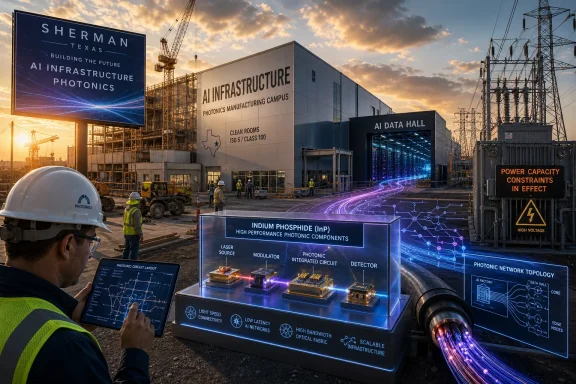 Nvidia Turns the AI Boom Into an Industrial Campaign
For most of the past two years, Nvidia has been discussed as a chip company, a stock-market phenomenon, or the toll collector of the generative AI era. Huang’s Texas appearance pushed a different frame: Nvidia as the coordinator of a physical supply chain stretching from GPUs to lasers, fiber, photonics, power plants, fabs, construction crews, and trained technicians.That matters because the politics of AI are changing. A chatbot can be dismissed as software hype; a factory in North Texas promising hundreds of advanced manufacturing roles is harder to wave away. Nvidia is trying to translate demand for AI compute into a language that governors, mayors, labor markets, and economic-development agencies already understand.
The Sherman project sits inside that larger pitch. Coherent’s facility makes indium phosphide, a compound semiconductor material used in optical networking components that move data between chips and systems. In the age of giant GPU clusters, that plumbing is not secondary infrastructure. It is part of the machine.
Huang’s phrase, “AI factories,” has always sounded partly metaphorical and partly marketing-driven. In Texas, Nvidia made the metaphor more literal. The company is saying that the factory of the future is not only the place where cars, aircraft, or appliances are assembled; it is also the data center that produces tokens, models, simulations, robotics instructions, drug candidates, code, and design iterations.
That is an ambitious claim. It is also convenient for Nvidia. If AI infrastructure is now industrial infrastructure, then spending on chips, networking, optics, and power begins to look less like speculative tech capex and more like national rebuilding.
The Sherman Fab Is Small Compared With the Rhetoric, but Not Symbolic
The numbers around the Coherent expansion are meaningful without being magical. The project is tied to Nvidia’s $2 billion strategic relationship with Coherent, a proposed federal CHIPS Act award, and state and local support. Coherent has said the expansion is expected to create more than 1,000 jobs overall, including more than 550 direct advanced manufacturing, engineering, and technical positions.That is not a national jobs revolution by itself. It is a serious regional investment in a high-value supply-chain node. The distinction matters because AI boosters often blur the difference between enabling infrastructure and broad-based labor-market transformation.
The material at the center of the announcement, indium phosphide, is not a household term, but it is exactly the sort of obscure technology that now determines whether AI systems scale efficiently. Modern AI clusters are less like one big computer than like a dense federation of processors that must behave as if they are one machine. The faster those chips communicate, and the less energy they waste doing it, the more useful the cluster becomes.
That makes optical networking a strategic bottleneck. Copper links have limits, and AI systems are growing across racks, rows, and eventually entire campuses. Nvidia’s bet on partners like Coherent reflects a recognition that the GPU alone is no longer the whole story. The performance frontier has moved into the network.
This is where the industrial-policy argument becomes credible. If the United States wants more of the AI stack produced domestically, it cannot stop at final chip packaging or high-profile fabs. It needs the less glamorous parts of the stack: substrates, optics, power electronics, cooling systems, fiber, clean rooms, chemical supply, technicians, and the local permitting competence to build them.
Huang’s Jobs Argument Is Both Plausible and Incomplete
Huang’s central claim is that AI can create jobs by making new kinds of production possible in the United States. That argument has substance. Automation does not only eliminate tasks; it can also shift the economics of where work happens, especially when labor costs are only one part of a complex manufacturing equation.If AI improves design, quality control, robotics, logistics, maintenance, and factory scheduling, some production that once depended on low-cost labor abroad could become more viable closer to customers. Add geopolitical pressure, tariff risk, export controls, pandemic-era supply-chain lessons, and federal subsidies, and reshoring becomes more than a slogan.
But the hard question is not whether AI infrastructure creates jobs. It clearly does. The harder question is whether it creates enough good jobs, in enough places, for enough workers, to offset the disruption AI may bring elsewhere.
A photonics fab hiring engineers and technicians is good news for Sherman. It does not answer what happens to back-office workers, junior developers, call-center staff, paralegals, designers, translators, analysts, and others whose work is more directly exposed to AI substitution. Nvidia’s story is strongest when it describes the supply chain it can see. It is weaker when it gestures toward society-wide job creation.
The better version of Huang’s argument is not that AI will automatically create more jobs than it destroys. It is that AI will reward countries that aggressively build the industries surrounding it. That is a more disciplined claim, and it is the one policymakers should test.
The “AI Factory” Is a Data Center With a Better Political Name
Nvidia’s branding genius is that “AI factory” makes data centers sound productive in an old industrial sense. A conventional data center often conjures images of windowless buildings, tax abatements, modest staffing, high water use, and heavy electricity demand. A factory implies output, employment, machinery, and national strength.The phrase is not empty. AI data centers do produce something: inference, training runs, embeddings, code, synthetic data, simulations, and model outputs that can feed real economic activity. For enterprises, governments, and software vendors, compute is becoming a production input.
Still, the rebranding deserves scrutiny. Many communities have learned that data centers can be capital-intensive without being labor-intensive after construction ends. They can enlarge the local tax base, but they can also strain grids and water systems while employing fewer permanent workers than traditional manufacturing plants of comparable physical scale.
Nvidia’s Texas story is different because the Coherent facility is a manufacturing site, not merely a server farm. But Huang’s broader “AI factory” concept deliberately blends the two. That blend is politically useful because it lets Nvidia wrap data-center expansion in the imagery of industrial revival.
For WindowsForum readers, especially IT pros who manage infrastructure budgets, the distinction is familiar. A rack of servers does not become a business transformation because the vendor gives it a heroic name. The transformation depends on workloads, utilization, operational discipline, energy cost, integration, and whether the system produces value beyond the demo.
Power Is Becoming the AI Industry’s Reality Check
The most important part of Huang’s message may not be the jobs claim. It may be the warning about electricity. AI demand is moving so quickly that power availability is becoming a gating factor for data-center projects, model training, regional investment, and perhaps national competitiveness.This is not a distant concern. Utilities, grid operators, and large data-center developers are already wrestling with interconnection queues, transmission constraints, transformer shortages, and local opposition to new generation. AI infrastructure is arriving in a power system that was not built for sudden clusters of enormous load appearing wherever land, fiber, incentives, and permitting align.
Huang’s argument that the United States needs more energy production is therefore less controversial than it may sound. The open question is what kind of energy, built where, paid for by whom, and on what timeline. Gas plants can be built faster than nuclear reactors, but they carry emissions and fuel-price consequences. Renewables can scale quickly in some regions, but transmission and storage remain constraints. Nuclear is politically fashionable again in tech circles, but timelines remain stubborn.
Coherent’s optical technology is being positioned as part of the efficiency answer, with claims that better optical networking can reduce power consumption materially. That is plausible in the narrow sense that data movement is a major energy cost inside AI systems. But efficiency gains in computing have a long history of being swallowed by greater demand.
In other words, better optics may reduce watts per unit of compute while the industry increases total compute by orders of magnitude. That is not a reason to dismiss efficiency. It is a reason to stop pretending efficiency alone will solve the power problem.
The New Supply Chain Runs Through Photonics, Not Just GPUs
The public conversation around AI hardware still revolves around GPUs, and understandably so. Nvidia’s accelerators are the visible engine of the boom. But the company’s recent partnerships point to a wider strategy: lock down the components that make enormous AI systems function as coherent wholes.That means photonics, optical transceivers, advanced networking, switches, memory, packaging, liquid cooling, and software orchestration. The AI cluster is now a system-level product. The individual chip matters, but so does every pathway that keeps data moving fast enough to prevent expensive silicon from sitting idle.
Coherent’s indium phosphide work belongs in that context. Lasers and optical components are not accessories in the same way a monitor cable is an accessory to a PC. At AI scale, interconnect is performance, and performance is money.
This has implications for procurement and architecture. Enterprises dreaming about private AI infrastructure will find that the bottlenecks are not limited to whether they can buy enough GPUs. They will need to think about networking topology, power density, cooling, facility readiness, and vendor lock-in across the whole stack.
That is where Nvidia’s position becomes more formidable. The company is not merely selling chips into an ecosystem. It is shaping the ecosystem, financing parts of it, and encouraging suppliers to expand around Nvidia’s roadmap. If that works, customers get integrated performance. They also get a supply chain with Nvidia’s gravitational pull at the center.
American Manufacturing Gets a Boost, Not a Miracle
The Sherman expansion fits neatly into a bipartisan desire to rebuild domestic technology manufacturing. The CHIPS Act created a framework for supporting semiconductor capacity in the United States, and state governments have been eager to land pieces of the supply chain. Texas, with its energy infrastructure, land, business climate, and existing semiconductor footprint, is a natural venue.But the story of American manufacturing is not solved by announcements. Fabs and advanced materials plants require skilled labor, stable local infrastructure, environmental compliance, predictable demand, and long operating horizons. They are not pop-up assets.
The promise of 1,000 jobs also needs context. Construction jobs are real but temporary. Direct advanced manufacturing and engineering jobs are more durable but require training pipelines. Indirect jobs depend on supplier ecosystems and local multipliers that can be hard to measure cleanly.
That does not make the investment unimportant. It makes it exactly the kind of project that should be judged over years, not press cycles. The measure of success will be whether Sherman becomes a durable node in AI infrastructure manufacturing, not whether a groundbreaking ceremony produced a convincing sound bite.
Huang is right that AI infrastructure can support domestic production. He is less persuasive when the claim expands into a sweeping social guarantee. A factory can prove that AI creates some jobs. It cannot prove that AI’s total effect on labor will be benign.
Washington Is Subsidizing a Race It Does Not Fully Control
The federal role in projects like this is not incidental. CHIPS Act support and state-level incentives are part of the economic foundation. The government is effectively trying to make sure that strategic parts of the AI supply chain land inside U.S. borders rather than elsewhere.That goal is understandable. AI has become entangled with defense, cybersecurity, industrial competitiveness, scientific research, and geopolitical influence. No serious government wants to depend entirely on overseas suppliers for the infrastructure behind such a broad technology shift.
Yet subsidies introduce their own tensions. Public money lowers risk for private firms that may already be benefiting from extraordinary market demand. Communities may offer incentives in exchange for job promises that are difficult to verify until years later. And when the beneficiary ecosystem is anchored by one of the most valuable companies in the world, voters may reasonably ask whether the public is underwriting private leverage.
The best defense of these subsidies is not that Nvidia needs help. It plainly does not need help in the ordinary sense. The stronger argument is that supply-chain geography has strategic value, and markets left alone may optimize for cost and speed rather than national resilience.
That argument deserves a hearing. It also deserves accountability. If public money supports AI infrastructure manufacturing, the public should expect concrete outcomes: durable jobs, domestic capacity, workforce training, environmental transparency, and measurable supply-chain resilience.
IT Leaders Should Read This as a Capacity Warning
For sysadmins and enterprise IT leaders, the Texas event may seem far away from daily Windows patching, endpoint management, identity governance, and cloud budgeting. It is not. The AI infrastructure race will shape prices, availability, vendor roadmaps, and the assumptions baked into enterprise software.Microsoft, Google, Amazon, Meta, OpenAI, Oracle, and others are all competing for compute. That competition affects cloud capacity and the pricing of AI-enabled services. If power and networking become constraints, enterprises should expect uneven availability, regional differences, and continued pressure to justify AI workloads economically.
The practical lesson is that AI adoption cannot be treated as a purely software procurement decision. Behind every Copilot deployment, model API, retrieval system, and automated workflow is a physical stack with real constraints. When those constraints tighten, costs move.
Windows shops will feel this through licensing bundles, cloud commitments, security tooling, developer platforms, and endpoint features that increasingly assume AI services are available somewhere in the background. The infrastructure buildout may be invisible to the end user, but it will not be invisible to budgets.
This also complicates sustainability commitments. Many enterprises have made carbon-reduction pledges while simultaneously embracing AI-heavy workflows. If AI features become default across business software, IT departments may be asked to reconcile productivity gains with rising compute demand they do not directly control.
The Social Contract Around AI Is Still Unwritten
Huang’s optimism is not surprising. Nvidia’s business depends on the world believing that more AI infrastructure is both necessary and beneficial. But the social contract around that infrastructure remains unsettled.Communities hosting AI supply-chain projects will want jobs, tax revenue, and prestige. They will also want assurances about power rates, water use, environmental impact, land use, and whether promised employment materializes. The more AI infrastructure resembles heavy industry, the more it will inherit heavy industry’s political obligations.
Workers will hear two messages at once. One says AI will create advanced manufacturing roles, technical jobs, and new opportunities. The other says AI will automate cognitive tasks once thought relatively safe from machines. Both can be true.
That duality is what makes the Texas announcement worth taking seriously without swallowing it whole. It is neither empty hype nor proof of a painless transition. It is evidence that AI is becoming industrialized, and industrialization always redistributes power, capital, labor, and risk.
The question for policymakers is not whether to allow AI infrastructure to grow. It will grow. The question is whether public institutions can shape that growth so that communities capture more than construction traffic, electricity demand, and a ribbon-cutting photo.
The Texas Test Will Be Measured in Megawatts and Paychecks
The Coherent expansion gives Nvidia a concrete example for its preferred story about AI and American renewal. But the story will only hold if the physical economy cooperates. Jobs have to appear, output has to scale, energy has to be available, and customers have to keep buying the systems that make this supply chain necessary.The most grounded reading of the announcement is also the most useful one: AI is no longer just a software wave. It is a capital-intensive industrial buildout that will reward regions with power, skills, permissive infrastructure, and supplier depth.
- Nvidia is using the Coherent partnership to argue that AI demand can create domestic manufacturing capacity, not just data-center spending.
- The Sherman, Texas, expansion is expected to create more than 1,000 total jobs, but the most durable signal is the smaller core of advanced manufacturing, engineering, and technical roles.
- Indium phosphide and optical networking matter because large AI systems increasingly depend on fast, efficient chip-to-chip and rack-to-rack communication.
- Power availability is becoming one of the biggest constraints on AI growth, and efficiency improvements are unlikely to eliminate the need for new generation and transmission.
- The “AI factory” framing is politically powerful, but communities should still distinguish between manufacturing facilities, data centers, temporary construction work, and permanent employment.
- For enterprise IT, the buildout foreshadows continued pressure on cloud pricing, AI service availability, infrastructure planning, and sustainability accounting.
References
- Primary source: The Spokesman-Review
Published: Wed, 17 Jun 2026 21:52:34 GMT
Loading…
www.spokesman.com - Independent coverage: TradingView
Published: 2026-06-17T18:50:58.052032
Loading…
www.tradingview.com - Related coverage: coherent.com
Loading…
www.coherent.com - Related coverage: aispectrumindia.com
Loading…
aispectrumindia.com - Related coverage: aiweekly.co
- Related coverage: nvidianews.nvidia.com
Loading…
nvidianews.nvidia.com

- Related coverage: moneycontrol.com
Loading…
www.moneycontrol.com - Related coverage: washingtonpost.com
Loading…
www.washingtonpost.com - Related coverage: kucoin.com
Loading…
www.kucoin.com - Related coverage: newsbytesapp.com
NVIDIA, Coherent to build $2B AI factory in Sherman Texas
Nvidia CEO Jensen Huang envisions AI as a catalyst for U.S. manufacturing growth, with a $2B Texas factory creating 1,000 jobs and advancing critical AI technologies.www.newsbytesapp.com
- Related coverage: investing.com
Coherent to receive up to $50M in CHIPS Act funding for Texas By Investing.com
Coherent to receive up to $50M in CHIPS Act funding for Texaswww.investing.com - Related coverage: techradar.com
Loading…
www.techradar.com