
Barracuda introduced Barracuda Integrated Email Protection in June 2026 as a cloud-based, AI-powered email security service for organizations using Microsoft 365 and Google Workspace, adding post-delivery threat detection, automated remediation, and cross-domain visibility through the BarracudaONE platform. The launch is not just another vendor refresh in a crowded email-security market. It is a statement about where the battleground has moved: away from the mail gateway as a single checkpoint and toward continuous monitoring of identity, URLs, user behavior, and inbox state. For Windows shops and Microsoft 365 administrators, the message is blunt: the inbox can no longer be treated as a perimeter that either held or failed.
For years, enterprise email security was sold as a kind of customs inspection. A message arrived, a filter looked at its sender, attachments, URLs, reputation, and content, and the system either delivered it, quarantined it, or rejected it. That model still matters, but it increasingly describes only the first frame of the attack, not the attack itself.
Barracuda’s new pitch is built around that shift. Integrated Email Protection is designed to keep reassessing messages after delivery, pulling in new intelligence about links, account activity, identity signals, and related telemetry from other systems. In plain English, the company is acknowledging that a message that looked safe at 9:03 a.m. may be dangerous by 9:17 a.m., especially if a link is weaponized later or a compromised account begins behaving like an internal attacker.
That is a more honest model of modern phishing. Attackers do not need to win at the gateway if they can exploit timing, trust, and account compromise. They can send from a legitimate mailbox, hide behind known SaaS infrastructure, abuse authentication workflows, and wait for the target to perform the one action that turns a message into a foothold.
The old email-security slogan was “stop threats before they reach the inbox.” The new one is closer to “assume the inbox is already part of the incident.”
That matters because the practical failure point in many phishing incidents is not initial detection. It is the gap between suspicion and coordinated action. A suspicious message reaches one user, gets reported by another, sits in a queue, and forces an administrator to search mailboxes, validate indicators, review quarantine behavior, and decide whether to purge the campaign across the tenant.
Barracuda is trying to collapse that workflow. The company says the platform can run automated threat investigations, perform organization-wide remediation, centralize quarantine management, and report on threats blocked both before and after delivery. It can also bring Microsoft-quarantined messages into a unified interface and rescan emails before they are released.
That last detail is easy to overlook, but it points to a real administrative pain point. Microsoft 365 already has native defenses, quarantine, and message investigation tools, but many organizations also run third-party filtering, awareness training, incident-response add-ons, and managed detection services. The result can be an awkward split brain: Microsoft has one view of the message, the email-security vendor has another, and the administrator is left reconciling both.
Barracuda’s answer is to make its platform the operational console above the mail platform, not merely a filter in front of it. Whether customers accept that depends less on the AI branding and more on whether the product reduces work without hiding too much judgment inside a black box.
That is why API-based email security has gained ground. Traditional secure email gateways relied heavily on mail flow control, including MX record changes and inline filtering. API-based systems integrate directly with cloud mailboxes and productivity platforms, giving them a way to inspect delivered mail, remove messages after the fact, and correlate mailbox activity with account signals.
Barracuda says its solution deploys without requiring changes to mail exchange records. That is an important selling point for Microsoft 365 and Google Workspace customers that do not want to redesign mail routing or risk disruption to existing delivery paths. In a cloud productivity environment, ease of deployment is not a minor feature; it is often the difference between a security project that gets approved and one that stalls in change control.
But API-based security also changes expectations. If the tool can see inside the tenant and act after delivery, administrators will reasonably expect it to prove its work. What did it remove? Why? From which mailboxes? Based on what signal? Can the action be reversed? Can the explanation survive scrutiny from a security lead, an auditor, or a business unit owner who wants to know why an important message disappeared?
Barracuda’s inclusion of Bailey, its AI assistant, is aimed squarely at that problem. The assistant is supposed to explain security decisions in plain language and help administrators review or reverse automated actions. That kind of explainability is not decorative. Once tools begin deleting or quarantining messages after delivery, the ability to understand and govern those actions becomes part of the control plane.
The multi-tenant design is especially important for MSPs. A service provider does not want to learn one workflow for Microsoft 365 customers, another for Google Workspace customers, and a third for hybrid environments where acquired businesses or regional teams use different stacks. A unified security console that can apply consistent policy, reporting, and incident response across tenants is a natural fit for the MSP business model.
This also explains why Barracuda is building the product on BarracudaONE rather than treating it as a standalone email widget. The company has spent the last year framing BarracudaONE as a broader cybersecurity platform, bringing together email protection, data protection, managed XDR, network security, and AI-driven operations. Integrated Email Protection extends that platform story into the most common enterprise attack surface.
That platform strategy is not unique. Microsoft is doing the same with Defender and Entra. Google is doing it across Workspace, Chronicle, Mandiant, and cloud security. Security companies from Proofpoint to Mimecast to CrowdStrike to Palo Alto Networks all want to become the console where signals converge and decisions get made.
The distinction Barracuda is trying to draw is simplicity. Its message to midmarket organizations and MSPs is that they can get cross-domain visibility and automated response without building a bespoke security operations stack. That is an appealing promise, particularly for teams that are long on responsibility and short on analysts.
That finding should not be read as “every phishing email compromises an organization in five minutes.” Red-team exercises are controlled demonstrations, not population-wide breach statistics. But the scenario is still useful because it captures the compression of the attack timeline.
Multi-factor authentication is no longer a clean dividing line between secure and insecure environments. Attackers now use adversary-in-the-middle phishing kits, session token theft, consent phishing, push fatigue, device-code abuse, and other techniques that target the authentication process rather than simply guessing passwords. Once an attacker has a valid session or convinces a user to approve access, the incident can move quickly.
The endpoint compromise piece is just as important. Email and identity are often the route in, but the attacker’s objective may be persistence on a device, access to files, lateral movement, mailbox rule creation, internal phishing, invoice fraud, or data exfiltration. A mail filter that only asks whether the original message should have been delivered is looking at too narrow a slice of the chain.
Barracuda also says one in seven compromised accounts is subsequently used to launch additional attacks. That is the statistic administrators should sit with. The most dangerous phishing email may not be the one sent from an external domain with a suspicious link. It may be the follow-on message from a real colleague’s account, written in the right thread, carrying the right context, and arriving after the attacker has already learned the organization’s communication patterns.
That framing is partly marketing, but not empty. The rise of generative AI has reduced the cost of plausible phishing content, translation, personalization, and iterative attack testing. The bigger AI-era change, however, may be operational rather than literary. Attackers can automate reconnaissance, vary infrastructure, generate convincing pretexts, and run campaigns that mutate faster than manual triage can follow.
Defenders therefore need automation not because AI is fashionable, but because the timeline has become hostile to human-only workflows. If a malicious URL is activated after delivery, or a compromised account begins sending internal phish, waiting for a human to manually review every alert is a losing model. The practical question is how much autonomy to give the defensive system and how clearly it can justify its actions.
This is where Barracuda’s “explainable action” language matters. Security teams have become wary of tools that promise autonomous remediation but generate opaque results. False positives in email security carry real business consequences: blocked invoices, delayed legal notices, missed customer communications, and executive escalations. A system that removes messages after delivery must be fast, but it must also be accountable.
Bailey is meant to sit in that tension. If it can translate detection logic into understandable explanations, summarize investigations, and let administrators reverse actions without digging through multiple consoles, it could be genuinely useful. If it becomes another chatbot veneer over ordinary product workflows, administrators will notice quickly.
So the obvious question is why a customer would add Barracuda at all. The answer depends on organizational maturity, licensing, operational preferences, and risk tolerance. Some enterprises will prefer to standardize on Microsoft’s stack and tune Defender deeply. Others will want a third-party layer that offers independent detection, MSP-friendly workflows, cross-platform coverage, or simpler incident response.
There is no universally correct answer. Microsoft-native shops with E5 licensing and a mature security operations team may see less incremental value from an additional email-security layer. A midmarket organization with Microsoft 365 Business Premium, a small IT staff, and limited security analyst time may see the calculus differently. An MSP managing hundreds of tenants may care most about multi-tenant reporting, fast remediation, and a consistent playbook across Microsoft and Google environments.
The danger is tool sprawl. Barracuda itself has argued that too many disconnected tools can increase cyber risk by creating integration problems, higher costs, and misconfiguration opportunities. That argument cuts both ways. A unified third-party platform can reduce operational drag, but only if it actually replaces scattered workflows rather than becoming another pane of glass beside the others.
For administrators, the evaluation should be brutally practical. Does the tool catch threats native controls miss? Does it reduce time to investigate and remediate? Does it preserve enough context for audits and after-action review? Does it integrate cleanly with identity, endpoint, and SIEM workflows? Does it make life easier on a normal Tuesday, not just in a vendor demo?
In those cases, the right response is not merely to update a rule for the next message. The right response is to find the messages already delivered, remove or quarantine them, identify who interacted with them, and determine whether credentials, sessions, devices, or data were affected. That is no longer email filtering. That is incident response.
Barracuda’s product language reflects this convergence. The platform combines signals from email, identity, network, application, and data environments. That is the correct direction, because email evidence alone often cannot answer the most important questions. Did the user click? Did authentication happen? Was MFA challenged or bypassed? Did a new inbox rule appear? Was a suspicious OAuth app consented to? Did the device begin communicating with suspicious infrastructure?
The more signal a platform consumes, the more valuable it can become — and the more governance it requires. Customers will need to understand what permissions the product needs, how it stores telemetry, how long it retains data, what actions it can take, and how those actions are logged. API-based security is powerful precisely because it is close to the tenant. That proximity should earn scrutiny, not automatic trust.
For Microsoft 365 administrators, this also means revisiting role-based access control and administrative process. If a third-party platform can purge messages tenant-wide or consolidate quarantine decisions, it should be managed with the same care as any other high-impact security tool. The convenience of fast remediation should not become an unreviewed superpower.
A multi-tenant, API-based product that works across Microsoft 365 and Google Workspace has obvious appeal here. The MSP can standardize detection, investigation, quarantine review, and remediation workflows while still supporting customers on different productivity platforms. That consistency can reduce training burden and make service delivery more predictable.
It also creates a business story. Email security is one of the easiest risks for customers to understand because nearly everyone has seen phishing firsthand. If an MSP can show threats blocked before delivery, threats removed after delivery, compromised-account indicators, and response actions in one report, the service becomes more tangible. Security value is often invisible until something goes wrong; reporting makes it visible before the breach.
But MSP-friendly automation has its own risks. A mistaken policy or overly aggressive remediation setting can affect multiple customers if deployed carelessly. Multi-tenant management should come with strong separation, clear approval workflows, audit trails, and customer-specific policy controls. The same design that lets an MSP respond quickly at scale must also prevent mistakes at scale.
Barracuda’s challenge is to prove that its platform can be both simple and precise. MSPs like simplicity because it protects margins. Security teams like precision because it protects organizations. The product has to serve both instincts without letting one undermine the other.
BarracudaONE is Barracuda’s answer to that fatigue. The company wants to present an integrated operating layer for cyber resilience, spanning email, network access, data protection, and AI-related visibility. Integrated Email Protection becomes one more reason to live inside that platform.
This is strategically sensible. Email remains the highest-volume, most user-facing attack path for many organizations, and it naturally connects to identity, endpoint, and data. If Barracuda can make email incidents easier to investigate and remediate, it earns the right to pull in more signals. If it can pull in more signals, it can make better decisions. If it can make better decisions, it can justify more automation.
That flywheel is the dream of every security platform vendor. The risk is that platforms can become sprawling in their own right. Customers who adopt BarracudaONE will need to decide whether they are consolidating around a coherent security operating model or merely replacing one form of complexity with another.
The best platform is not the one with the most modules. It is the one that makes the next correct action clearer.
That means measuring mundane things. How long does it take to confirm whether a message landed across the organization? How quickly can the team remove it? How well does the platform identify affected users? Can it distinguish between delivered, clicked, forwarded, replied-to, and remediated messages? Does it help with executive reporting after the incident? Does it integrate with the security tools the organization already trusts?
For Microsoft 365 tenants, administrators should also compare Barracuda’s workflow against Defender for Office 365 capabilities already included in their licensing. It is easy to buy overlapping security. It is harder to operate it coherently. A third-party email-security layer should earn its place by improving detection, response speed, visibility, or operational simplicity in ways the existing stack does not.
For Google Workspace customers, the calculus may be different. Barracuda has been expanding support for Google Workspace across impersonation protection, incident response, and domain fraud protection. Organizations that want a consistent approach across Microsoft and Google environments may value the cross-platform control plane as much as any single detection feature.
The most security-conscious buyers will also ask about model behavior, telemetry, and auditability. AI-assisted administration can be helpful, but it must not become a substitute for evidence. When a system says it removed a message because a URL became malicious or an identity signal changed, the administrator should be able to trace that decision in enough detail to defend it.
It also changes the administrator’s job. Instead of asking only “did we block the email,” security teams must ask “what happened after delivery, who interacted with it, what changed in the account, and what did we remove before the user or attacker could act again?” Those are harder questions, but they are the questions that matter.
Barracuda is trying to answer them with integrated signals, automated remediation, and explainable AI assistance. The product will need to prove itself in noisy tenants, imperfectly configured environments, and overstretched IT teams. But the premise is sound: security that ends at delivery is too early to stop watching.
The most meaningful part of this announcement is therefore not the arrival of another AI-branded product. It is the admission that email defense has to be continuous. In a world where a phishing email can become an identity incident in minutes, the inbox is not a destination. It is a live surface.
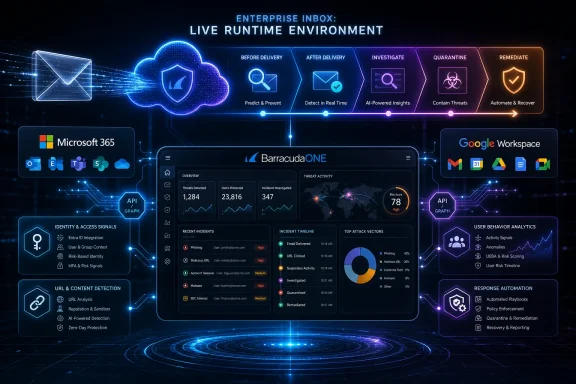 The Inbox Has Become a Runtime Environment
For years, enterprise email security was sold as a kind of customs inspection. A message arrived, a filter looked at its sender, attachments, URLs, reputation, and content, and the system either delivered it, quarantined it, or rejected it. That model still matters, but it increasingly describes only the first frame of the attack, not the attack itself.Barracuda’s new pitch is built around that shift. Integrated Email Protection is designed to keep reassessing messages after delivery, pulling in new intelligence about links, account activity, identity signals, and related telemetry from other systems. In plain English, the company is acknowledging that a message that looked safe at 9:03 a.m. may be dangerous by 9:17 a.m., especially if a link is weaponized later or a compromised account begins behaving like an internal attacker.
That is a more honest model of modern phishing. Attackers do not need to win at the gateway if they can exploit timing, trust, and account compromise. They can send from a legitimate mailbox, hide behind known SaaS infrastructure, abuse authentication workflows, and wait for the target to perform the one action that turns a message into a foothold.
The old email-security slogan was “stop threats before they reach the inbox.” The new one is closer to “assume the inbox is already part of the incident.”
Barracuda Is Selling Response, Not Just Filtering
The most important part of Barracuda Integrated Email Protection is not that it uses AI. Every security vendor now says that. The more meaningful claim is that the system is intended to follow the full email attack lifecycle: detection before delivery, reassessment after delivery, investigation, quarantine, removal, reporting, and explainable administrative review.That matters because the practical failure point in many phishing incidents is not initial detection. It is the gap between suspicion and coordinated action. A suspicious message reaches one user, gets reported by another, sits in a queue, and forces an administrator to search mailboxes, validate indicators, review quarantine behavior, and decide whether to purge the campaign across the tenant.
Barracuda is trying to collapse that workflow. The company says the platform can run automated threat investigations, perform organization-wide remediation, centralize quarantine management, and report on threats blocked both before and after delivery. It can also bring Microsoft-quarantined messages into a unified interface and rescan emails before they are released.
That last detail is easy to overlook, but it points to a real administrative pain point. Microsoft 365 already has native defenses, quarantine, and message investigation tools, but many organizations also run third-party filtering, awareness training, incident-response add-ons, and managed detection services. The result can be an awkward split brain: Microsoft has one view of the message, the email-security vendor has another, and the administrator is left reconciling both.
Barracuda’s answer is to make its platform the operational console above the mail platform, not merely a filter in front of it. Whether customers accept that depends less on the AI branding and more on whether the product reduces work without hiding too much judgment inside a black box.
Microsoft 365 Changed the Security Center of Gravity
For WindowsForum readers, the Microsoft 365 angle is the real story. Exchange Online, Entra ID, Defender, Conditional Access, and the Microsoft Graph have made email security inseparable from identity security. A phishing email is no longer just an email problem; it is often the beginning of an authentication, token, device, and data-access problem.That is why API-based email security has gained ground. Traditional secure email gateways relied heavily on mail flow control, including MX record changes and inline filtering. API-based systems integrate directly with cloud mailboxes and productivity platforms, giving them a way to inspect delivered mail, remove messages after the fact, and correlate mailbox activity with account signals.
Barracuda says its solution deploys without requiring changes to mail exchange records. That is an important selling point for Microsoft 365 and Google Workspace customers that do not want to redesign mail routing or risk disruption to existing delivery paths. In a cloud productivity environment, ease of deployment is not a minor feature; it is often the difference between a security project that gets approved and one that stalls in change control.
But API-based security also changes expectations. If the tool can see inside the tenant and act after delivery, administrators will reasonably expect it to prove its work. What did it remove? Why? From which mailboxes? Based on what signal? Can the action be reversed? Can the explanation survive scrutiny from a security lead, an auditor, or a business unit owner who wants to know why an important message disappeared?
Barracuda’s inclusion of Bailey, its AI assistant, is aimed squarely at that problem. The assistant is supposed to explain security decisions in plain language and help administrators review or reverse automated actions. That kind of explainability is not decorative. Once tools begin deleting or quarantining messages after delivery, the ability to understand and govern those actions becomes part of the control plane.
Google Workspace Support Turns This Into a Platform Play
Barracuda is also positioning Integrated Email Protection for Google Workspace, not just Microsoft 365. That broadens the relevance beyond Windows-heavy environments and speaks to the reality of managed service providers and larger organizations that may support both ecosystems.The multi-tenant design is especially important for MSPs. A service provider does not want to learn one workflow for Microsoft 365 customers, another for Google Workspace customers, and a third for hybrid environments where acquired businesses or regional teams use different stacks. A unified security console that can apply consistent policy, reporting, and incident response across tenants is a natural fit for the MSP business model.
This also explains why Barracuda is building the product on BarracudaONE rather than treating it as a standalone email widget. The company has spent the last year framing BarracudaONE as a broader cybersecurity platform, bringing together email protection, data protection, managed XDR, network security, and AI-driven operations. Integrated Email Protection extends that platform story into the most common enterprise attack surface.
That platform strategy is not unique. Microsoft is doing the same with Defender and Entra. Google is doing it across Workspace, Chronicle, Mandiant, and cloud security. Security companies from Proofpoint to Mimecast to CrowdStrike to Palo Alto Networks all want to become the console where signals converge and decisions get made.
The distinction Barracuda is trying to draw is simplicity. Its message to midmarket organizations and MSPs is that they can get cross-domain visibility and automated response without building a bespoke security operations stack. That is an appealing promise, particularly for teams that are long on responsibility and short on analysts.
The Five-Minute Phishing Scenario Is the Right Kind of Scary
Barracuda’s accompanying research is designed to put urgency behind the product launch. According to the company, a controlled red-team exercise showed that a single phishing email could lead to identity theft, bypass multi-factor authentication, establish persistence, and compromise an endpoint in less than five minutes.That finding should not be read as “every phishing email compromises an organization in five minutes.” Red-team exercises are controlled demonstrations, not population-wide breach statistics. But the scenario is still useful because it captures the compression of the attack timeline.
Multi-factor authentication is no longer a clean dividing line between secure and insecure environments. Attackers now use adversary-in-the-middle phishing kits, session token theft, consent phishing, push fatigue, device-code abuse, and other techniques that target the authentication process rather than simply guessing passwords. Once an attacker has a valid session or convinces a user to approve access, the incident can move quickly.
The endpoint compromise piece is just as important. Email and identity are often the route in, but the attacker’s objective may be persistence on a device, access to files, lateral movement, mailbox rule creation, internal phishing, invoice fraud, or data exfiltration. A mail filter that only asks whether the original message should have been delivered is looking at too narrow a slice of the chain.
Barracuda also says one in seven compromised accounts is subsequently used to launch additional attacks. That is the statistic administrators should sit with. The most dangerous phishing email may not be the one sent from an external domain with a suspicious link. It may be the follow-on message from a real colleague’s account, written in the right thread, carrying the right context, and arriving after the attacker has already learned the organization’s communication patterns.
AI Is the Headline, but Automation Is the Product
It is tempting to treat this launch as another “AI in cybersecurity” announcement, and Barracuda certainly leans into that language. The company says the system uses artificial intelligence to identify, analyze, and remove threats, and it has tied the product to Bailey as an AI-driven administrative assistant. Rohit Ghai, Barracuda’s chief executive, framed email as an “operational fabric” where humans and AI interact, making it a broader and faster-moving target.That framing is partly marketing, but not empty. The rise of generative AI has reduced the cost of plausible phishing content, translation, personalization, and iterative attack testing. The bigger AI-era change, however, may be operational rather than literary. Attackers can automate reconnaissance, vary infrastructure, generate convincing pretexts, and run campaigns that mutate faster than manual triage can follow.
Defenders therefore need automation not because AI is fashionable, but because the timeline has become hostile to human-only workflows. If a malicious URL is activated after delivery, or a compromised account begins sending internal phish, waiting for a human to manually review every alert is a losing model. The practical question is how much autonomy to give the defensive system and how clearly it can justify its actions.
This is where Barracuda’s “explainable action” language matters. Security teams have become wary of tools that promise autonomous remediation but generate opaque results. False positives in email security carry real business consequences: blocked invoices, delayed legal notices, missed customer communications, and executive escalations. A system that removes messages after delivery must be fast, but it must also be accountable.
Bailey is meant to sit in that tension. If it can translate detection logic into understandable explanations, summarize investigations, and let administrators reverse actions without digging through multiple consoles, it could be genuinely useful. If it becomes another chatbot veneer over ordinary product workflows, administrators will notice quickly.
Native Security Is Necessary, but It Is No Longer the Whole Debate
Microsoft and Google both invest heavily in native email protection. Microsoft 365 customers may already use Exchange Online Protection, Microsoft Defender for Office 365, Defender XDR, Entra ID protections, Conditional Access, and Purview tooling. Google Workspace customers have Gmail security controls, phishing and malware protections, security center features, and broader Google Cloud security integrations.So the obvious question is why a customer would add Barracuda at all. The answer depends on organizational maturity, licensing, operational preferences, and risk tolerance. Some enterprises will prefer to standardize on Microsoft’s stack and tune Defender deeply. Others will want a third-party layer that offers independent detection, MSP-friendly workflows, cross-platform coverage, or simpler incident response.
There is no universally correct answer. Microsoft-native shops with E5 licensing and a mature security operations team may see less incremental value from an additional email-security layer. A midmarket organization with Microsoft 365 Business Premium, a small IT staff, and limited security analyst time may see the calculus differently. An MSP managing hundreds of tenants may care most about multi-tenant reporting, fast remediation, and a consistent playbook across Microsoft and Google environments.
The danger is tool sprawl. Barracuda itself has argued that too many disconnected tools can increase cyber risk by creating integration problems, higher costs, and misconfiguration opportunities. That argument cuts both ways. A unified third-party platform can reduce operational drag, but only if it actually replaces scattered workflows rather than becoming another pane of glass beside the others.
For administrators, the evaluation should be brutally practical. Does the tool catch threats native controls miss? Does it reduce time to investigate and remediate? Does it preserve enough context for audits and after-action review? Does it integrate cleanly with identity, endpoint, and SIEM workflows? Does it make life easier on a normal Tuesday, not just in a vendor demo?
Post-Delivery Defense Is Where the Argument Gets Real
The phrase post-delivery protection sounds like a niche capability until you think through how modern phishing works. A URL can be benign when scanned and malicious later. A compromised supplier account can send a real-looking invoice request. An attacker can use an existing thread to avoid suspicion. A message can evade detection until broader campaign intelligence reveals that it was part of a larger attack.In those cases, the right response is not merely to update a rule for the next message. The right response is to find the messages already delivered, remove or quarantine them, identify who interacted with them, and determine whether credentials, sessions, devices, or data were affected. That is no longer email filtering. That is incident response.
Barracuda’s product language reflects this convergence. The platform combines signals from email, identity, network, application, and data environments. That is the correct direction, because email evidence alone often cannot answer the most important questions. Did the user click? Did authentication happen? Was MFA challenged or bypassed? Did a new inbox rule appear? Was a suspicious OAuth app consented to? Did the device begin communicating with suspicious infrastructure?
The more signal a platform consumes, the more valuable it can become — and the more governance it requires. Customers will need to understand what permissions the product needs, how it stores telemetry, how long it retains data, what actions it can take, and how those actions are logged. API-based security is powerful precisely because it is close to the tenant. That proximity should earn scrutiny, not automatic trust.
For Microsoft 365 administrators, this also means revisiting role-based access control and administrative process. If a third-party platform can purge messages tenant-wide or consolidate quarantine decisions, it should be managed with the same care as any other high-impact security tool. The convenience of fast remediation should not become an unreviewed superpower.
The MSP Angle May Be the Deciding Factor
Barracuda has long had a strong channel and MSP presence, and Integrated Email Protection fits that market especially well. Managed service providers are often the ones forced to turn fragmented customer environments into repeatable operations. They need tooling that scales across tenants, produces readable reports, and lets technicians act quickly without becoming experts in every customer’s native mail stack.A multi-tenant, API-based product that works across Microsoft 365 and Google Workspace has obvious appeal here. The MSP can standardize detection, investigation, quarantine review, and remediation workflows while still supporting customers on different productivity platforms. That consistency can reduce training burden and make service delivery more predictable.
It also creates a business story. Email security is one of the easiest risks for customers to understand because nearly everyone has seen phishing firsthand. If an MSP can show threats blocked before delivery, threats removed after delivery, compromised-account indicators, and response actions in one report, the service becomes more tangible. Security value is often invisible until something goes wrong; reporting makes it visible before the breach.
But MSP-friendly automation has its own risks. A mistaken policy or overly aggressive remediation setting can affect multiple customers if deployed carelessly. Multi-tenant management should come with strong separation, clear approval workflows, audit trails, and customer-specific policy controls. The same design that lets an MSP respond quickly at scale must also prevent mistakes at scale.
Barracuda’s challenge is to prove that its platform can be both simple and precise. MSPs like simplicity because it protects margins. Security teams like precision because it protects organizations. The product has to serve both instincts without letting one undermine the other.
Barracuda Is Chasing the Security Platform Moment
The broader context is that security vendors are racing to become platforms rather than point products. The buyer fatigue is real. Organizations have accumulated tools for email, endpoint, identity, cloud posture, backup, web filtering, awareness training, XDR, SIEM, SOAR, data loss prevention, and SaaS security. Many of those tools generate alerts; fewer help teams decide what to do next.BarracudaONE is Barracuda’s answer to that fatigue. The company wants to present an integrated operating layer for cyber resilience, spanning email, network access, data protection, and AI-related visibility. Integrated Email Protection becomes one more reason to live inside that platform.
This is strategically sensible. Email remains the highest-volume, most user-facing attack path for many organizations, and it naturally connects to identity, endpoint, and data. If Barracuda can make email incidents easier to investigate and remediate, it earns the right to pull in more signals. If it can pull in more signals, it can make better decisions. If it can make better decisions, it can justify more automation.
That flywheel is the dream of every security platform vendor. The risk is that platforms can become sprawling in their own right. Customers who adopt BarracudaONE will need to decide whether they are consolidating around a coherent security operating model or merely replacing one form of complexity with another.
The best platform is not the one with the most modules. It is the one that makes the next correct action clearer.
Administrators Should Judge the Launch by the Work It Removes
The test for Barracuda Integrated Email Protection will not be whether it uses AI, whether Bailey can answer natural-language questions, or whether the launch language captures the anxiety of the moment. The test will be whether administrators can move faster with fewer mistakes when a real phishing campaign hits.That means measuring mundane things. How long does it take to confirm whether a message landed across the organization? How quickly can the team remove it? How well does the platform identify affected users? Can it distinguish between delivered, clicked, forwarded, replied-to, and remediated messages? Does it help with executive reporting after the incident? Does it integrate with the security tools the organization already trusts?
For Microsoft 365 tenants, administrators should also compare Barracuda’s workflow against Defender for Office 365 capabilities already included in their licensing. It is easy to buy overlapping security. It is harder to operate it coherently. A third-party email-security layer should earn its place by improving detection, response speed, visibility, or operational simplicity in ways the existing stack does not.
For Google Workspace customers, the calculus may be different. Barracuda has been expanding support for Google Workspace across impersonation protection, incident response, and domain fraud protection. Organizations that want a consistent approach across Microsoft and Google environments may value the cross-platform control plane as much as any single detection feature.
The most security-conscious buyers will also ask about model behavior, telemetry, and auditability. AI-assisted administration can be helpful, but it must not become a substitute for evidence. When a system says it removed a message because a URL became malicious or an identity signal changed, the administrator should be able to trace that decision in enough detail to defend it.
The Real Upgrade Is From Gateway Thinking to Attack-Lifecycle Thinking
Barracuda’s launch is part of a larger industry move away from email security as a static gateway function. The new model treats email as one stage in an attack lifecycle that may begin with a message but quickly spreads into identity, endpoint, application access, and data movement. That is a better model because it matches how attackers actually operate.It also changes the administrator’s job. Instead of asking only “did we block the email,” security teams must ask “what happened after delivery, who interacted with it, what changed in the account, and what did we remove before the user or attacker could act again?” Those are harder questions, but they are the questions that matter.
Barracuda is trying to answer them with integrated signals, automated remediation, and explainable AI assistance. The product will need to prove itself in noisy tenants, imperfectly configured environments, and overstretched IT teams. But the premise is sound: security that ends at delivery is too early to stop watching.
The most meaningful part of this announcement is therefore not the arrival of another AI-branded product. It is the admission that email defense has to be continuous. In a world where a phishing email can become an identity incident in minutes, the inbox is not a destination. It is a live surface.
The Practical Reading for WindowsForum Admins
Barracuda’s announcement gives Microsoft 365 and Google Workspace teams a useful checkpoint for their own posture. The product may or may not be the right fit for a given environment, but the assumptions behind it are increasingly hard to dispute.- Organizations should treat post-delivery removal as a core email-security capability, not an optional add-on for rare incidents.
- Microsoft 365 administrators should compare third-party tools against Defender workflows they already license before adding another console.
- MSPs should pay close attention to multi-tenant controls, because fast tenant-wide remediation is valuable only when it is governed carefully.
- Security teams should demand clear explanations for automated actions, especially when a tool can quarantine or remove mail after delivery.
- Email investigations should connect to identity and endpoint evidence, because the most damaging part of a phishing attack often happens after the click.
- AI features should be judged by reduced investigation time and better decisions, not by the presence of a chatbot in the interface.
References
- Primary source: The Hans India
Published: 2026-06-18T06:04:07.987970
Barracuda introduces an AI-powered email security solution for Microsoft 365 and Google Workspace
Barracuda introduces AI-driven email protection that continuously detects, investigates, and removes evolving threats across cloud environments.www.thehansindia.com
- Related coverage: barracuda.com
- Related coverage: blog.barracuda.com
- Related coverage: documentation.campus.barracuda.com
- Related coverage: es.barracuda.com
- Related coverage: ituser.es
Barracuda renueva su plataforma BarracudaONE | Seguridad | IT User
Las novedades, incluidas en Email Protection, SecureEdge Access y AI Security, refuerzan la resiliencia cibernética del correo electrónico, el acceso ...www.ituser.es
- Related coverage: campus.barracuda.com
- Related coverage: assets.barracuda.com
- Related coverage: lp.barracuda.com
