
Elon Musk’s xAI has expanded Grok’s enterprise reach by placing its models on major cloud platforms, including Oracle Cloud Infrastructure in June 2025 and Microsoft Azure AI Foundry in September 2025, giving corporate developers access outside X, Tesla, and xAI’s own services. The move is not just another model-catalog announcement. It is Grok’s bid to become a normal enterprise dependency rather than a celebrity chatbot with a famous owner. For Windows shops and Azure-heavy IT departments, that distinction matters.
The first era of Grok was defined by personality. It lived close to X, carried Elon Musk’s taste for provocation, and was marketed less like a beige enterprise service than a countercultural answer to ChatGPT. That made it visible, but visibility is not the same thing as adoption inside a bank, hospital, manufacturer, school district, or government agency.
Enterprise software has a way of sanding down theatrics. A model that appears inside Azure AI Foundry or OCI Generative AI is no longer merely a consumer-facing bot with a brand identity; it becomes something that can be evaluated, metered, monitored, governed, and rejected through familiar channels. The real story is not that Grok is available in more places. It is that xAI is accepting the cloud platforms as the new distribution layer for artificial intelligence.
That is the same lesson OpenAI learned early through Microsoft, Anthropic learned through Amazon and Google, and Meta approached differently through Llama’s open ecosystem. The model itself matters, but so does where the model can be bought, how it is billed, who supports it, and whether it fits into the compliance paperwork that already exists. CIOs do not adopt frontier AI by downloading vibes; they adopt it through vendor risk forms, procurement approvals, logging controls, and contracts.
Oracle moved first, announcing in June 2025 that Grok 3 and related xAI models would be offered through OCI’s Generative AI service. Microsoft followed in late September 2025, bringing Grok 4 into Azure AI Foundry and later widening the catalog with faster Grok variants. In cloud terms, that sequence is important: Oracle gave xAI a performance-and-infrastructure story, while Microsoft gave it a mainstream enterprise software story.
For xAI, Oracle was a logical early partner. Training and serving frontier models is a brutally physical business, even when the product is sold as software. It depends on power, networking, GPU availability, memory bandwidth, cooling, and regional capacity. A model company that cannot reliably train, tune, and serve its models at scale is not a platform company; it is a demo company.
The Oracle announcement positioned Grok 3 for enterprise use cases such as content creation, research, and business process automation. That phrasing is familiar because it is the boilerplate of the generative AI era, but it also reveals the intended buyer. Oracle was not selling Grok to people who wanted a snarkier chatbot; it was selling Grok to companies that already have documents, data pipelines, workflows, and internal systems living inside OCI.
There is a second layer here. If xAI uses Oracle infrastructure for training and inference while Oracle sells Grok access back to corporate customers, the relationship becomes mutually reinforcing. Oracle gets a marquee model customer and a model offering; xAI gets infrastructure and distribution. That is the cloud AI flywheel every provider wants, but only a few can plausibly claim.
Still, Oracle’s victory has limits. OCI is serious, but it is not the default development environment for many Windows-centric enterprises. For those organizations, Grok’s arrival on Azure is the moment it changes from interesting to actionable.
That matters because enterprise AI buyers increasingly want optionality. A development team may prefer one model for code generation, another for long-context document review, another for low-latency tool calling, and another for price-sensitive summarization. The old assumption that a company would standardize on one model family is already giving way to a more pragmatic view: applications will route tasks to different models depending on cost, risk, speed, and output quality.
Azure AI Foundry is built for that world. Its value to Microsoft is not only that it offers Microsoft-approved models, but that it keeps the experimentation, deployment, evaluation, and governance inside Azure. If a customer tests Grok, GPT, DeepSeek, Mistral, Meta, or Microsoft’s own models without leaving Azure’s management plane, Microsoft still wins the infrastructure and platform relationship.
For WindowsForum readers, this is the practical hinge. Many IT departments already have Azure subscriptions, Entra ID policies, Defender integrations, logging practices, private networking rules, and cost controls. If Grok can be tested inside that environment, the friction drops dramatically. Nobody needs to explain why a developer used a separate credit card, a mystery API endpoint, and a spreadsheet full of unreviewed prompts.
Microsoft is also sending a message to regulators and enterprise customers: Azure’s AI business is bigger than OpenAI. That does not mean OpenAI is being demoted. It means Microsoft wants to own the control plane even if the model layer becomes contested.
But context length is also one of the most misunderstood statistics in AI marketing. A large context window does not guarantee good reasoning across the entire window, nor does it guarantee predictable performance as prompts become larger and more complex. Long context is capacity, not judgment. The harder question is whether the model can reliably find the relevant signal, follow instructions, preserve constraints, and explain its work without hallucinating confidence.
That is where cloud integration matters more than the spec sheet. In Azure AI Foundry, the selling point is not merely that Grok can read a lot of text. It is that developers can evaluate it against test sets, wire it into applications, compare it with other models, monitor behavior, and apply enterprise guardrails. In OCI, the appeal is similar but tuned toward Oracle’s infrastructure and data gravity.
Grok 4 Fast and later fast variants sharpen the point. Not every workload needs maximum deliberation. Many enterprise use cases need quick classification, structured extraction, routing, summarization, or tool invocation. A slower, deeper model may be impressive in a benchmark video, but the model that wins production may be the one that returns a good-enough answer consistently at the right price and latency.
This is the quiet maturation of generative AI. The industry is moving away from treating every model launch as a contest for the smartest oracle and toward treating models as components in distributed systems. Grok’s cloud expansion is a sign that xAI understands it has to compete there.
OpenAI’s advantage has been distribution through Microsoft and mindshare through ChatGPT. Anthropic has built credibility through safety positioning and cloud partnerships with AWS and Google Cloud. Google has the home-field advantage of Gemini inside its own stack. Meta has used Llama to seed an enormous ecosystem of open and semi-open deployments. xAI has had brand heat, engineering ambition, and access to Musk’s broader empire, but it needed distribution beyond that orbit.
Putting Grok on Azure and OCI is therefore a catch-up move, but not a small one. Enterprise developers rarely choose models in the abstract. They choose from what is available where they already build. If Grok appears in the same menu as other frontier or near-frontier models, it gets invited into bake-offs it would otherwise miss.
That is especially important because AI model loyalty is weak. Developers will switch if a model is cheaper, faster, better at tool calling, better at code, better at long documents, or easier to govern. The interface layer and orchestration frameworks are making models more substitutable, not less. Every cloud catalog listing increases the chance that Grok becomes one of several back-end options rather than an all-or-nothing bet.
The irony is that this turns cloud providers into both kingmakers and commoditizers. Azure and Oracle can elevate Grok by placing it in front of enterprise buyers, but they can also reduce it to a line item beside rival models. xAI gains distribution while surrendering some of the mystique that comes from owning the whole experience.
That is why Azure AI Foundry matters. The more models Microsoft hosts, the more Azure becomes the neutral-looking layer through which customers compare and deploy them. Microsoft can keep selling OpenAI-powered Copilot experiences while also letting developers use Grok for a specialized workload. In both cases, compute, identity, networking, monitoring, and enterprise controls remain anchored in Microsoft’s stack.
This is familiar platform behavior. Windows succeeded not because Microsoft wrote every application, but because it became the environment in which applications competed. Azure AI Foundry is trying to play a similar role for models. The company does not need every customer to pick Microsoft’s preferred model every time; it needs customers to pick Azure as the place where those choices happen.
There is risk, of course. More model choice can confuse buyers and complicate governance. A company that once had to approve one AI vendor may now need policies for dozens of models with different data handling, safety profiles, regional availability, and pricing. Microsoft’s answer is to sell the management layer as the antidote to that complexity.
For xAI, that arrangement is both opportunity and constraint. Grok gains access to Azure’s enormous enterprise base, but it must live within Microsoft’s controls, documentation, quotas, and model lifecycle practices. The rebellious chatbot becomes another governed service. That is the price of admission.
This is where Grok’s public reputation becomes a double-edged sword. Musk’s brand gives xAI attention and helps the company recruit, raise capital, and command headlines. It also creates governance anxiety for organizations that prefer their infrastructure vendors to be boring. Enterprise AI adoption depends on trust, and trust is often built through dull things: logs, certifications, service-level commitments, access controls, regional boundaries, and predictable support channels.
Cloud availability helps mitigate that concern. An Azure customer evaluating Grok through Azure AI Foundry is not treating xAI exactly the same way as a direct API vendor. The customer is also relying on Microsoft’s platform controls, billing relationship, and compliance framing. The same applies to Oracle customers using OCI’s Generative AI service.
But cloud wrapping does not magically erase model risk. Enterprises still need to test outputs, document acceptable use, define data boundaries, and monitor drift. A model can be available through an approved platform and still be inappropriate for a regulated workflow. The platform lowers adoption friction; it does not outsource judgment.
That is a theme Windows administrators will recognize. A driver signed through the right channel can still break a fleet. A patch delivered through the normal update mechanism can still cause trouble. Distribution legitimacy is necessary, but not sufficient.
The comparison will be ruthless. Developers will measure Grok against GPT models, Claude, Gemini, Llama derivatives, Mistral models, DeepSeek variants, and whatever else appears in the catalog next quarter. They will test coding ability, latency, structured output reliability, function calling, refusal behavior, multilingual performance, cost, and the model’s ability to follow system instructions under pressure.
The fast variants are especially important because agentic applications are latency-sensitive. A tool-using system may call a model many times in a single workflow, and each call adds delay and cost. A model that is slightly less profound but much faster can beat a heavyweight model in production because users experience the whole workflow, not a benchmark score.
This is also where Windows and Microsoft developers may find the Grok expansion most tangible. If a team is already building with Azure Functions, GitHub, Visual Studio Code, Azure Container Apps, Cosmos DB, SQL Server, or Microsoft Fabric, access through Azure AI Foundry makes model experimentation feel like an extension of the existing toolchain. Grok becomes another dependency to evaluate, not a separate platform strategy.
Still, the burden shifts to xAI to prove consistency. Enterprise developers are less forgiving than enthusiasts. They do not just ask whether the model can produce a dazzling answer once; they ask whether it can produce acceptable answers thousands of times under messy conditions.
The customer story is subtler. Enterprises are not merely gaining access to Grok; they are gaining leverage. When multiple frontier models are available through the same cloud interface, buyers can compare them more easily and switch more readily. That weakens any single model provider’s lock-in unless the provider offers superior performance, price, reliability, or integration.
This is why cloud catalogs are becoming the new battleground. Model companies want to be everywhere customers already are, but the more they appear side by side, the more buyers can treat them as interchangeable components. The hyperscalers like that arrangement because it reinforces the cloud platform as the stable layer beneath a volatile model market.
There is a parallel with databases, observability tools, and security products. Vendors compete fiercely, but enterprises often prefer architectures that preserve exit options. AI will be no different. The more strategic the workload, the more procurement teams will ask how hard it would be to swap models if prices rise, quality slips, policy changes, or a better option arrives.
That may be the most underappreciated consequence of Grok’s cloud expansion. It increases xAI’s reach while placing Grok into a market structure that punishes complacency. The model must keep earning its place.
That churn creates problems for IT governance. Model names change. Versions deprecate. Pricing shifts. Context windows expand. Capabilities appear first in preview, then move to general availability, then get replaced by a faster or cheaper successor. The administrative challenge is not simply choosing a model; it is managing model lifecycle as a production dependency.
xAI’s brand may make this harder. Musk-led companies often move quickly, communicate irregularly, and embrace dramatic public positioning. That can be energizing in consumer markets and unnerving in enterprise procurement. If Grok is to become a durable cloud model, xAI will need not only strong benchmarks but predictable release notes, clear deprecation policies, transparent pricing, and boring operational discipline.
Azure and Oracle can absorb some of that volatility by presenting Grok through their own service layers. But they cannot fully hide it. If a model changes behavior in ways that affect an application, the customer feels the impact. If a variant is retired or rerouted, the developer has to respond.
The winners in enterprise AI may not be the companies that release the flashiest models. They may be the companies that combine strong models with stable operations and credible governance. Grok’s cloud expansion gives xAI a seat at that table; it does not guarantee that xAI will be comfortable sitting there.
That is a meaningful change. Shadow AI thrives when official channels are too slow or too limited. If IT departments can offer sanctioned model choice inside existing cloud environments, they have a better chance of keeping experimentation observable and governable. Grok’s expansion may therefore help administrators even if they never standardize on Grok itself.
For developers, the next step is comparative evaluation. The question is not whether Grok is generally smart. The question is whether it is better for a particular workload: a code assistant, a support triage system, a document review pipeline, an agent that calls internal tools, or a summarizer sitting behind a customer-service dashboard. In production AI, specificity beats fandom.
For security teams, the guidance is equally plain. Treat Grok as a new third-party model dependency, even when accessed through Azure or OCI. Review data flows, retention settings, access controls, logging, regional deployment options, abuse monitoring, and incident response expectations. The cloud provider may simplify the control surface, but it does not eliminate the need for a threat model.
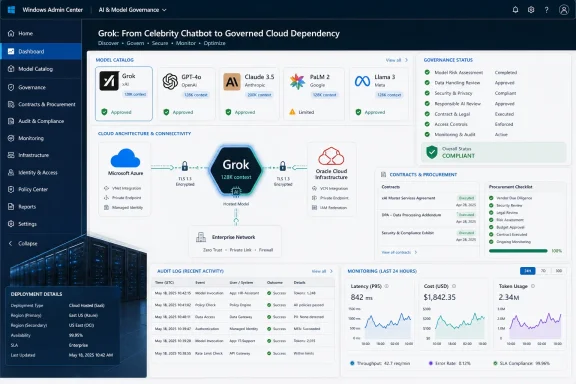 Grok Leaves the Walled Garden and Walks Into Procurement
The first era of Grok was defined by personality. It lived close to X, carried Elon Musk’s taste for provocation, and was marketed less like a beige enterprise service than a countercultural answer to ChatGPT. That made it visible, but visibility is not the same thing as adoption inside a bank, hospital, manufacturer, school district, or government agency.Enterprise software has a way of sanding down theatrics. A model that appears inside Azure AI Foundry or OCI Generative AI is no longer merely a consumer-facing bot with a brand identity; it becomes something that can be evaluated, metered, monitored, governed, and rejected through familiar channels. The real story is not that Grok is available in more places. It is that xAI is accepting the cloud platforms as the new distribution layer for artificial intelligence.
That is the same lesson OpenAI learned early through Microsoft, Anthropic learned through Amazon and Google, and Meta approached differently through Llama’s open ecosystem. The model itself matters, but so does where the model can be bought, how it is billed, who supports it, and whether it fits into the compliance paperwork that already exists. CIOs do not adopt frontier AI by downloading vibes; they adopt it through vendor risk forms, procurement approvals, logging controls, and contracts.
Oracle moved first, announcing in June 2025 that Grok 3 and related xAI models would be offered through OCI’s Generative AI service. Microsoft followed in late September 2025, bringing Grok 4 into Azure AI Foundry and later widening the catalog with faster Grok variants. In cloud terms, that sequence is important: Oracle gave xAI a performance-and-infrastructure story, while Microsoft gave it a mainstream enterprise software story.
Oracle Got the Infrastructure Plot Before the Rest of the Market
Oracle’s cloud business has spent years arguing that it is not merely a database company dragging legacy customers into rented servers. Its pitch has increasingly centered on high-performance infrastructure, bare-metal options, GPU clusters, and tightly coupled data platforms. Adding Grok gave Oracle another way to tell that story in the language that Wall Street and enterprise buyers currently reward: AI workloads.For xAI, Oracle was a logical early partner. Training and serving frontier models is a brutally physical business, even when the product is sold as software. It depends on power, networking, GPU availability, memory bandwidth, cooling, and regional capacity. A model company that cannot reliably train, tune, and serve its models at scale is not a platform company; it is a demo company.
The Oracle announcement positioned Grok 3 for enterprise use cases such as content creation, research, and business process automation. That phrasing is familiar because it is the boilerplate of the generative AI era, but it also reveals the intended buyer. Oracle was not selling Grok to people who wanted a snarkier chatbot; it was selling Grok to companies that already have documents, data pipelines, workflows, and internal systems living inside OCI.
There is a second layer here. If xAI uses Oracle infrastructure for training and inference while Oracle sells Grok access back to corporate customers, the relationship becomes mutually reinforcing. Oracle gets a marquee model customer and a model offering; xAI gets infrastructure and distribution. That is the cloud AI flywheel every provider wants, but only a few can plausibly claim.
Still, Oracle’s victory has limits. OCI is serious, but it is not the default development environment for many Windows-centric enterprises. For those organizations, Grok’s arrival on Azure is the moment it changes from interesting to actionable.
Azure Turns Grok From an Outsider Into a Button in the Admin Console
Microsoft’s decision to put Grok 4 into Azure AI Foundry is more strategically awkward than Oracle’s move, and therefore more interesting. Microsoft is OpenAI’s most important cloud partner and has spent years building Copilot around OpenAI models, its own orchestration layers, and Azure’s enterprise controls. Adding Grok does not erase that relationship, but it makes Microsoft’s AI marketplace look less like a single-company storefront and more like a model exchange.That matters because enterprise AI buyers increasingly want optionality. A development team may prefer one model for code generation, another for long-context document review, another for low-latency tool calling, and another for price-sensitive summarization. The old assumption that a company would standardize on one model family is already giving way to a more pragmatic view: applications will route tasks to different models depending on cost, risk, speed, and output quality.
Azure AI Foundry is built for that world. Its value to Microsoft is not only that it offers Microsoft-approved models, but that it keeps the experimentation, deployment, evaluation, and governance inside Azure. If a customer tests Grok, GPT, DeepSeek, Mistral, Meta, or Microsoft’s own models without leaving Azure’s management plane, Microsoft still wins the infrastructure and platform relationship.
For WindowsForum readers, this is the practical hinge. Many IT departments already have Azure subscriptions, Entra ID policies, Defender integrations, logging practices, private networking rules, and cost controls. If Grok can be tested inside that environment, the friction drops dramatically. Nobody needs to explain why a developer used a separate credit card, a mystery API endpoint, and a spreadsheet full of unreviewed prompts.
Microsoft is also sending a message to regulators and enterprise customers: Azure’s AI business is bigger than OpenAI. That does not mean OpenAI is being demoted. It means Microsoft wants to own the control plane even if the model layer becomes contested.
The 128K Window Is Useful, but the Workflow Is the Product
The shared 128K-token context window across Grok models offered through these platforms is not a trivial feature. Long context changes how developers think about enterprise AI because it lets a model ingest larger policy documents, codebases, support transcripts, contracts, and operational runbooks in one pass. For IT teams, that can mean fewer brittle retrieval steps and fewer awkward document chunks disappearing outside the model’s view.But context length is also one of the most misunderstood statistics in AI marketing. A large context window does not guarantee good reasoning across the entire window, nor does it guarantee predictable performance as prompts become larger and more complex. Long context is capacity, not judgment. The harder question is whether the model can reliably find the relevant signal, follow instructions, preserve constraints, and explain its work without hallucinating confidence.
That is where cloud integration matters more than the spec sheet. In Azure AI Foundry, the selling point is not merely that Grok can read a lot of text. It is that developers can evaluate it against test sets, wire it into applications, compare it with other models, monitor behavior, and apply enterprise guardrails. In OCI, the appeal is similar but tuned toward Oracle’s infrastructure and data gravity.
Grok 4 Fast and later fast variants sharpen the point. Not every workload needs maximum deliberation. Many enterprise use cases need quick classification, structured extraction, routing, summarization, or tool invocation. A slower, deeper model may be impressive in a benchmark video, but the model that wins production may be the one that returns a good-enough answer consistently at the right price and latency.
This is the quiet maturation of generative AI. The industry is moving away from treating every model launch as a contest for the smartest oracle and toward treating models as components in distributed systems. Grok’s cloud expansion is a sign that xAI understands it has to compete there.
The Competitive Map Now Looks Less Like a Race and More Like a Supply Chain
The consumer AI race is easy to narrate: ChatGPT versus Claude versus Gemini versus Grok. The enterprise race is messier. It involves hyperscalers, chip supply, data residency, model routing, developer tools, security controls, indemnity, pricing, regional availability, and the politics of vendor dependency.OpenAI’s advantage has been distribution through Microsoft and mindshare through ChatGPT. Anthropic has built credibility through safety positioning and cloud partnerships with AWS and Google Cloud. Google has the home-field advantage of Gemini inside its own stack. Meta has used Llama to seed an enormous ecosystem of open and semi-open deployments. xAI has had brand heat, engineering ambition, and access to Musk’s broader empire, but it needed distribution beyond that orbit.
Putting Grok on Azure and OCI is therefore a catch-up move, but not a small one. Enterprise developers rarely choose models in the abstract. They choose from what is available where they already build. If Grok appears in the same menu as other frontier or near-frontier models, it gets invited into bake-offs it would otherwise miss.
That is especially important because AI model loyalty is weak. Developers will switch if a model is cheaper, faster, better at tool calling, better at code, better at long documents, or easier to govern. The interface layer and orchestration frameworks are making models more substitutable, not less. Every cloud catalog listing increases the chance that Grok becomes one of several back-end options rather than an all-or-nothing bet.
The irony is that this turns cloud providers into both kingmakers and commoditizers. Azure and Oracle can elevate Grok by placing it in front of enterprise buyers, but they can also reduce it to a line item beside rival models. xAI gains distribution while surrendering some of the mystique that comes from owning the whole experience.
Microsoft’s OpenAI Bet Looks Stronger, Not Weaker, When Azure Adds Rivals
It is tempting to interpret Grok’s Azure arrival as a crack in Microsoft’s OpenAI alignment. That reading is too simple. Microsoft’s real strategic aim is to make Azure the place where AI applications are built, governed, and scaled, regardless of which model happens to win a given task.That is why Azure AI Foundry matters. The more models Microsoft hosts, the more Azure becomes the neutral-looking layer through which customers compare and deploy them. Microsoft can keep selling OpenAI-powered Copilot experiences while also letting developers use Grok for a specialized workload. In both cases, compute, identity, networking, monitoring, and enterprise controls remain anchored in Microsoft’s stack.
This is familiar platform behavior. Windows succeeded not because Microsoft wrote every application, but because it became the environment in which applications competed. Azure AI Foundry is trying to play a similar role for models. The company does not need every customer to pick Microsoft’s preferred model every time; it needs customers to pick Azure as the place where those choices happen.
There is risk, of course. More model choice can confuse buyers and complicate governance. A company that once had to approve one AI vendor may now need policies for dozens of models with different data handling, safety profiles, regional availability, and pricing. Microsoft’s answer is to sell the management layer as the antidote to that complexity.
For xAI, that arrangement is both opportunity and constraint. Grok gains access to Azure’s enormous enterprise base, but it must live within Microsoft’s controls, documentation, quotas, and model lifecycle practices. The rebellious chatbot becomes another governed service. That is the price of admission.
Enterprise IT Will Care Less About Musk and More About Audit Logs
The most important audience for this rollout is not the consumer who asks Grok for jokes on X. It is the architect deciding whether an AI model can touch customer data, internal source code, HR documents, legal drafts, or operational telemetry. That buyer does not primarily care whether a model has personality. That buyer cares whether the model can be controlled.This is where Grok’s public reputation becomes a double-edged sword. Musk’s brand gives xAI attention and helps the company recruit, raise capital, and command headlines. It also creates governance anxiety for organizations that prefer their infrastructure vendors to be boring. Enterprise AI adoption depends on trust, and trust is often built through dull things: logs, certifications, service-level commitments, access controls, regional boundaries, and predictable support channels.
Cloud availability helps mitigate that concern. An Azure customer evaluating Grok through Azure AI Foundry is not treating xAI exactly the same way as a direct API vendor. The customer is also relying on Microsoft’s platform controls, billing relationship, and compliance framing. The same applies to Oracle customers using OCI’s Generative AI service.
But cloud wrapping does not magically erase model risk. Enterprises still need to test outputs, document acceptable use, define data boundaries, and monitor drift. A model can be available through an approved platform and still be inappropriate for a regulated workflow. The platform lowers adoption friction; it does not outsource judgment.
That is a theme Windows administrators will recognize. A driver signed through the right channel can still break a fleet. A patch delivered through the normal update mechanism can still cause trouble. Distribution legitimacy is necessary, but not sufficient.
The Developer Experience Is Where Grok’s Ambitions Will Be Tested
The enterprise AI market is not won by press releases. It is won when developers find that a model solves a problem better than the alternatives and is not painful to operate. Grok’s presence in Azure and OCI gives it a fairer shot at that test.The comparison will be ruthless. Developers will measure Grok against GPT models, Claude, Gemini, Llama derivatives, Mistral models, DeepSeek variants, and whatever else appears in the catalog next quarter. They will test coding ability, latency, structured output reliability, function calling, refusal behavior, multilingual performance, cost, and the model’s ability to follow system instructions under pressure.
The fast variants are especially important because agentic applications are latency-sensitive. A tool-using system may call a model many times in a single workflow, and each call adds delay and cost. A model that is slightly less profound but much faster can beat a heavyweight model in production because users experience the whole workflow, not a benchmark score.
This is also where Windows and Microsoft developers may find the Grok expansion most tangible. If a team is already building with Azure Functions, GitHub, Visual Studio Code, Azure Container Apps, Cosmos DB, SQL Server, or Microsoft Fabric, access through Azure AI Foundry makes model experimentation feel like an extension of the existing toolchain. Grok becomes another dependency to evaluate, not a separate platform strategy.
Still, the burden shifts to xAI to prove consistency. Enterprise developers are less forgiving than enthusiasts. They do not just ask whether the model can produce a dazzling answer once; they ask whether it can produce acceptable answers thousands of times under messy conditions.
Investors Are Buying Optionality, but Customers Are Buying Reduced Switching Costs
The investor story is straightforward. Oracle gets another AI logo and another proof point for OCI’s relevance. Microsoft gets to reinforce Azure AI Foundry as a broad model platform. xAI gets distribution into enterprise channels that would take years to build alone.The customer story is subtler. Enterprises are not merely gaining access to Grok; they are gaining leverage. When multiple frontier models are available through the same cloud interface, buyers can compare them more easily and switch more readily. That weakens any single model provider’s lock-in unless the provider offers superior performance, price, reliability, or integration.
This is why cloud catalogs are becoming the new battleground. Model companies want to be everywhere customers already are, but the more they appear side by side, the more buyers can treat them as interchangeable components. The hyperscalers like that arrangement because it reinforces the cloud platform as the stable layer beneath a volatile model market.
There is a parallel with databases, observability tools, and security products. Vendors compete fiercely, but enterprises often prefer architectures that preserve exit options. AI will be no different. The more strategic the workload, the more procurement teams will ask how hard it would be to swap models if prices rise, quality slips, policy changes, or a better option arrives.
That may be the most underappreciated consequence of Grok’s cloud expansion. It increases xAI’s reach while placing Grok into a market structure that punishes complacency. The model must keep earning its place.
The Risk Is Not That Grok Arrives Too Late, but That the Market Moves Too Fast
Grok is entering enterprise cloud catalogs at a moment when the model market is accelerating and fragmenting. The old cadence of one or two major model launches per year has been replaced by a near-continuous churn of previews, fast variants, reasoning variants, coding models, multimodal models, and domain-tuned systems. A cloud listing that looks impressive in September can look ordinary by January.That churn creates problems for IT governance. Model names change. Versions deprecate. Pricing shifts. Context windows expand. Capabilities appear first in preview, then move to general availability, then get replaced by a faster or cheaper successor. The administrative challenge is not simply choosing a model; it is managing model lifecycle as a production dependency.
xAI’s brand may make this harder. Musk-led companies often move quickly, communicate irregularly, and embrace dramatic public positioning. That can be energizing in consumer markets and unnerving in enterprise procurement. If Grok is to become a durable cloud model, xAI will need not only strong benchmarks but predictable release notes, clear deprecation policies, transparent pricing, and boring operational discipline.
Azure and Oracle can absorb some of that volatility by presenting Grok through their own service layers. But they cannot fully hide it. If a model changes behavior in ways that affect an application, the customer feels the impact. If a variant is retired or rerouted, the developer has to respond.
The winners in enterprise AI may not be the companies that release the flashiest models. They may be the companies that combine strong models with stable operations and credible governance. Grok’s cloud expansion gives xAI a seat at that table; it does not guarantee that xAI will be comfortable sitting there.
The Cloud Catalog Is Where Grok Has to Grow Up
The practical readout for enterprise users is narrower and more concrete than the hype cycle suggests. Grok’s availability on Azure and Oracle does not mean every organization should rush to deploy it. It means Grok is now easier to test under the same operational conditions as its rivals.That is a meaningful change. Shadow AI thrives when official channels are too slow or too limited. If IT departments can offer sanctioned model choice inside existing cloud environments, they have a better chance of keeping experimentation observable and governable. Grok’s expansion may therefore help administrators even if they never standardize on Grok itself.
For developers, the next step is comparative evaluation. The question is not whether Grok is generally smart. The question is whether it is better for a particular workload: a code assistant, a support triage system, a document review pipeline, an agent that calls internal tools, or a summarizer sitting behind a customer-service dashboard. In production AI, specificity beats fandom.
For security teams, the guidance is equally plain. Treat Grok as a new third-party model dependency, even when accessed through Azure or OCI. Review data flows, retention settings, access controls, logging, regional deployment options, abuse monitoring, and incident response expectations. The cloud provider may simplify the control surface, but it does not eliminate the need for a threat model.
The Windows Shop’s Grok Checklist Is Shorter Than the Hype Deck
For Microsoft-heavy organizations, the value of this rollout is that it turns Grok into something that can be evaluated without inventing a new procurement and governance universe. That does not make adoption automatic. It makes adoption testable.- Grok’s arrival on Azure AI Foundry means Azure customers can compare it with other models inside a familiar enterprise platform rather than treating xAI as a separate experiment.
- Oracle’s early Grok partnership strengthens OCI’s argument that it belongs in serious AI infrastructure conversations, not just database modernization plans.
- The 128K-token context window is useful for large documents and code-heavy workflows, but teams still need to test whether the model uses that context reliably.
- Fast Grok variants may matter more than flagship reasoning models for real applications where latency, cost, and tool calling determine user experience.
- Cloud availability reduces friction, but it does not remove the need for governance, security review, model evaluation, and lifecycle planning.
- The biggest winner may be the enterprise buyer, because more model choice inside major clouds increases leverage and reduces dependence on any single AI vendor.
References
- Primary source: Crypto Briefing
Published: 2026-06-17T18:30:08.532645
Grok expands availability to major cloud platforms including Azure and Oracle
xAI's Grok AI models are now available on Microsoft Azure and Oracle Cloud, expanding enterprise access and intensifying competition with OpenAI andcryptobriefing.com - Official source: azure.microsoft.com
- Related coverage: techtarget.com
Oracle adds xAI Grok models to OCI | TechTarget
Cloud vendor Oracle reveals that xAI Grok models will now be available on Oracle Cloud Infrastructure Generative AI services.www.techtarget.com - Related coverage: docs.oracle.com
- Related coverage: tomshardware.com
Microsoft adds Grok 4 to Azure AI Foundry following cautious trials — Elon Musk's latest AI model is now available to deploy for "frontier‑level reasoning" | Tom's Hardware
Comes with a 128K-token context window.www.tomshardware.com - Official source: techcommunity.microsoft.com
Announcing the Grok 4 Fast Models from xAI: Now Available in Azure AI Foundry | Microsoft Community Hub
 These models, grok-4-fast-reasoning and grok-4-fast-non-reasoning, empower developers with distinct approaches to suit their application needs. Each... techcommunity.microsoft.com
- Related coverage: grokmag.com
Microsoft’s Azure Adds Grok 4: Expanding Its AI Model Lineup | Grok Mag
Microsoft adds xAI’s Grok 4 to Azure AI Foundry, expanding its multi-model ecosystem. Enterprises gain advanced reasoning, safety features, and more choice.grokmag.com - Related coverage: prnewswire.com
xAI's Grok Models are Now on Oracle Cloud Infrastructure
/PRNewswire/ -- xAI has selected Oracle to offer xAI's Grok models via Oracle Cloud Infrastructure (OCI) Generative AI service for a wide range of use cases,... www.prnewswire.com
- Related coverage: datastudios.org
xAI Grok 4.1 Fast: How the 128k context window and 8k output limit work for large chats, documents, and fast API tasks
Grok 4.1 Fast has emerged as the flagship low-latency model in xAI’s advanced Grok 4.1 family, offering a unique blend of long-term memory, quick response, and large-scale document handling. With a 128,000-token context window and an 8,192-token output limit per response, Grok 4.1 Fast enables... www.datastudios.org
- Related coverage: docs.public.content.oci.oraclecloud.com
xAI Grok 3 (Deprecated)
The xai.grok-3 model excels at enterprise use cases such as data extraction, coding, and summarizing text. This model has a deep domain knowledge in finance, healthcare, law, and science.docs.public.content.oci.oraclecloud.com - Official source: devblogs.microsoft.com
What's new in Azure AI Foundry | September 2025 | Microsoft Foundry Blog
GPT‑5‑Codex GA, Sora video‑to‑video preview, Grok 4 Fast, Browser Automation & Key Vault previews, new Search knowledge sources, Voice Live GA.devblogs.microsoft.com - Official source: learn.microsoft.com
Foundry Models from partners and community - Microsoft Foundry | Microsoft Learn
Learn about Microsoft Foundry Models from partners and community, including their capabilities, supported input and output types, Azure Marketplace requirements, and troubleshooting.learn.microsoft.com - Related coverage: investing.com
Oracle cloud to add xAI’s Grok 3 model to lineup for corporate customers By Reuters
Oracle cloud to add xAI’s Grok 3 model to lineup for corporate customerswww.investing.com - Related coverage: techradar.com
xAI debuts powerful Grok 4 AI model, but it's not going to make people forget the antisemitism it spewed on X | TechRadar
Acing benchmark tests doesn't outweigh claiming the title of 'MechaHitler'www.techradar.com - Related coverage: windowscentral.com
Grok 4 seemingly seeks Elon Musk's view on controversial topics | Windows Central
xAI recently launched Grok 4, touting it as the smartest AI in the world, but multiple users have raised concerns about the chatbot seeking Elon Musk's opinion on controversial questions.www.windowscentral.com - Related coverage: axios.com
Elon Musk's xAI debuts Grok 4, "smartest AI in the world"
The new AI model from Elon Musk's lab is said to beat the competition on a variety of benchmarks.www.axios.com
- Related coverage: oracle.com
Database Application Developer Newsletter – June 2025 Issue
June 2025 Issue of the monthly newsletter focusing on SQL, PL/SQL, and Oracle APEX development with Oracle Database with features on the latest developer news, how-to articles, and best practices.www.oracle.com
- Official source: cdn-dynmedia-1.microsoft.com
The Next Wave of AI Innovation: Microsoft Introduces Azure AI Foundry, A New Unified AI, and GenAI Platform at Ignite 2024
PDF documentcdn-dynmedia-1.microsoft.com