
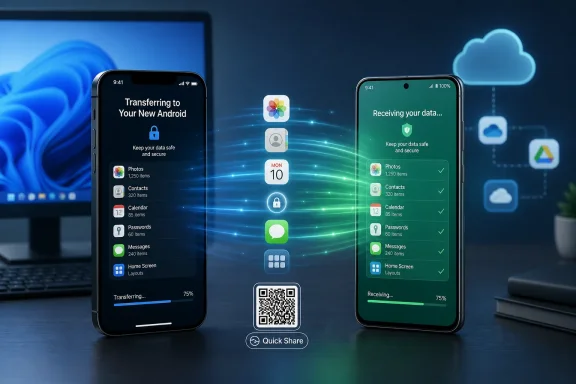
On June 17, 2026, multiple consumer-tech outlets reported that Google is using Android 17 to make switching from iPhone to Android easier by expanding wireless migration, broadening the kinds of data that transfer, and improving cross-platform sharing between Android devices and iPhones. The change is not just a setup-screen convenience. It is Google’s latest attempt to attack Apple’s strongest defensive wall: the accumulated friction that keeps users inside the iPhone ecosystem long after they might be curious about leaving. For Windows users and IT departments, the story is less about brand rivalry than about whether the modern phone market is finally moving from lock-in by inconvenience toward competition by service quality.
For years, moving between iPhone and Android has been technically possible and emotionally exhausting. Contacts, photos, calendar entries, and some messages could usually make the trip, but the process often felt like moving apartments with half the boxes mislabeled and the other half stuck in a storage unit. Google’s Android 17 push appears designed to make the first hour with a new Android phone feel less like a penalty for leaving Apple.
That matters because the first hour is where many platform switches succeed or die. A user can tolerate learning a new settings menu; they are far less forgiving when photos, WhatsApp chats, passwords, app suggestions, or home-screen organization vanish in the transfer. The difference between “I’ll get used to this” and “I made a mistake” is often the migration wizard, not the processor, display, or camera.
Google has been working on this problem for years through Android Switch, OEM migration tools, and support for direct or wireless transfers. Android 17’s reported improvements are notable because they shift the focus from merely copying obvious data to preserving more of the user’s working environment. That is the distinction Apple has long understood: people are loyal not just to hardware, but to continuity.
The company’s pitch is plain. If the pain of leaving iPhone drops, more people may be willing to test Android on its merits. But the more interesting question is whether Google can reduce the pain enough to change behavior, because Apple’s lock-in has never depended on one missing export button.
Android 17’s reported emphasis on wireless transfer is important because it removes one of the more visible pieces of friction. A cable is a small object, but in migration terms it is a psychological warning sign. It tells the user that this is a special procedure, that success may depend on the correct adapter, the correct sequence, and the correct patience.
Wireless transfer does not magically solve platform migration, but it changes the posture of the experience. It makes switching feel more like ordinary device setup and less like a data-recovery operation. For ordinary buyers, that distinction is real; for IT teams provisioning mixed fleets, it can translate into fewer support tickets and fewer aborted migrations.
The danger is that wireless convenience can also hide complexity. Transfers still depend on source-device permissions, OS versions, account authentication, app developer support, and the categories of data Apple and Google can legally and technically move. A smoother progress bar does not guarantee a complete migration. It merely makes the user more likely to try.
That is why migration improvements can matter more than a flashy new AI feature. Users do not experience a smartphone as a collection of data types. They experience it as muscle memory: the banking app in one spot, the family chat preserved, the authenticator available, the calendar intact, the photos searchable, the passwords ready when needed.
When that shape collapses, the user blames the new platform. It may not matter that Apple restricted something, that an app developer failed to support a transfer API, or that a cloud account was never synced. The emotional conclusion is simple: Android lost my stuff.
Google’s challenge is to make that conclusion rarer. If Android 17 can carry over more of the everyday scaffolding of an iPhone user’s life, it gives Android hardware makers a better chance to compete after setup rather than losing before the home screen appears.
None of those features alone is unbeatable. Together, they create a compounding convenience that is hard to price and harder to abandon. The user who owns an iPhone, iPad, Mac, AirPods, and Apple Watch is not deciding between two phones. They are deciding whether to disturb an entire personal operating system.
Google’s Android 17 strategy looks like a direct response to that reality. The reported “Continue On” feature, which resembles Apple’s Handoff by moving activity between devices, suggests Google is no longer content to win only on openness, customization, or hardware variety. It wants Android devices to behave more like members of a coordinated household.
That is a difficult ambition because Android’s strength is also its burden. Apple controls the phone, tablet, watch, desktop operating system, and much of the accessory story. Google coordinates an ecosystem spanning Pixels, Samsung devices, Lenovo tablets, Chromebooks, Windows PCs through apps and services, and a long tail of Android hardware with uneven update behavior.
The result is that Google cannot merely copy Apple’s continuity features and declare victory. It has to build continuity across a more fragmented universe. If it succeeds, the payoff could be larger than Apple’s version because Android’s reach is broader. If it fails, it risks producing another feature that works beautifully in demos and inconsistently in the field.
Android has long had answers to this problem, including Nearby Share and later Quick Share, but the cross-platform story remained awkward. If a group includes iPhones and Android phones, the lowest common denominator often becomes messaging apps, cloud links, email, or resigned annoyance. That reinforces Apple’s advantage in social environments where iPhone ownership is already dense.
The reported expansion of Quick Share options, including QR-code-based sharing and broader iPhone-friendly flows, is therefore more than a convenience tweak. It is Google trying to prevent Android users from becoming second-class participants in ordinary exchanges of photos, videos, and documents. That matters in homes, schools, offices, conferences, and any workplace where BYOD reality ignores platform purity.
For WindowsForum readers, the Windows angle is obvious. Quick Share already has a role on Windows PCs, and Google has every incentive to make Android-to-PC and Android-to-iPhone transfer less brittle. If the phone becomes less isolated from both the Windows desktop and the iPhone-owning colleague across the table, Android’s practical appeal rises.
But there is a ceiling. QR codes and compatibility bridges are useful, yet they are not the same as a native, universally expected social behavior. Apple’s advantage is not merely that AirDrop exists; it is that many people assume it exists. Google is still fighting for that assumption.
That does not make the improvements fake. It does mean the timing belongs to a larger shift in technology policy. Around the world, regulators have become more skeptical of ecosystems that retain users by making departure painful. Messaging interoperability, app-store rules, browser defaults, payment systems, and data portability have all moved from nerd arguments to competition-law battlegrounds.
Phone migration sits squarely inside that debate. A market is more competitive when users can leave without losing their digital history. If switching requires sacrificing messages, passwords, app state, or wearable functionality, then the nominal freedom to choose another platform is weaker than it looks.
Google benefits from making that argument because it wants iPhone users to consider Android. Apple benefits from appearing cooperative because the company is under scrutiny for how tightly it binds services and devices together. Consumers benefit if the result is genuine portability rather than a compliance theater of half-working export tools.
The practical test will be whether Android 17’s migration improvements are robust across real devices and real accounts. Regulators care about formal rights, but users care about whether their phone actually works on Monday morning.
If a company wants to offer Android devices as a cost-effective alternative to iPhones, migration friction becomes a hidden tax. Every failed transfer or missing authenticator can turn a hardware decision into a support problem. Every user who believes the company “lost” their data during a mandated phone change becomes a political problem for IT.
Better migration tooling gives administrators more flexibility. It can make pilot programs easier, reduce resistance to platform diversity, and help organizations separate legitimate business requirements from user anxiety. That does not mean enterprises should suddenly push iPhone users to Android, but it may make Android less risky in mixed-device strategies.
Security teams will also look closely at what transfers and how. Password migration, account movement, message history, and app restoration all raise questions about authentication, encryption, consent, and auditability. A consumer-friendly wizard is welcome, but enterprises will want predictable controls and documentation before treating it as a standard workflow.
There is also the question of managed Apple IDs, corporate Google accounts, and device ownership models. The cleanest migration demos usually assume a personal phone with a cooperative owner. Corporate reality is messier: conditional access policies, MDM profiles, compliance checks, app protection rules, and data separation can all complicate the handoff.
This is where Apple’s advantage becomes cultural as much as technical. In the United States especially, the iPhone is not just a device category; it is a default social object. Blue bubbles may no longer be the entire story, especially as richer cross-platform messaging improves, but platform identity remains stubborn.
Android’s counterargument is broader choice. There are foldables, budget phones, gaming phones, camera-focused phones, repairable designs, stylus devices, and tightly integrated Pixel experiences. The market offers more shapes than Apple does, and for many users that variety is Android’s enduring appeal.
The problem is that variety can make consistency harder. A feature that works on one Android phone may arrive later, behave differently, or remain unavailable on another. Google’s ability to make Android 17 switching feel universal will depend not only on its own software, but on OEM adoption, carrier behavior, and the messy update timelines that have always shadowed Android.
That is why the Android 17 migration story should be read as a necessary condition, not a sufficient one. Google can remove the fear of leaving iPhone. It still has to prove the destination is better for the user standing at the exit.
Apple’s continuity features are strongest when the Mac is part of the story. If a Windows user owns an iPhone, they get some Apple benefits but not the full ecosystem effect. If they own Android, they may get deeper Google integration, Phone Link features, Quick Share support, and cloud-service flexibility, but the experience can vary.
Google’s broader interoperability push could make Android more attractive to Windows-first users because it reduces the penalty for not buying into the Mac. The more Android can share files easily, hand off tasks across devices, and migrate from iPhone cleanly, the more it can position itself as the mobile companion to a heterogeneous computing life.
That matters for WindowsForum’s audience. Many enthusiasts and IT pros do not live in one vendor’s world. They run Windows desktops, Linux servers, iPads, Android tablets, iPhones, Chromebooks, gaming handhelds, and whatever machine the job requires. For them, interoperability is not a luxury. It is the difference between technology that adapts and technology that demands obedience.
The best version of this future is not one where Google builds a second walled garden and invites Windows users to move in. It is one where switching and sharing become ordinary enough that the phone platform fades slightly into the background. That would be a healthier market, even if neither Apple nor Google would choose it without pressure.
Google’s challenge is not only to expand what Android 17 can transfer, but to be honest about what it cannot. Users are more forgiving of known limitations than surprise losses. A migration screen that clearly explains what will move, what may require extra steps, and what cannot be recreated is better than a cheerful animation followed by disappointment.
Apple has a role here too. If Apple wants to argue that users choose iPhone freely, it should have no reason to make departure unnecessarily difficult. A confident ecosystem competes by being excellent, not by making the exit door heavy.
There is a cynical reading in which both companies do just enough to satisfy regulators and blunt criticism. There is also a more optimistic reading in which years of pressure finally produce better data portability for normal people. The truth will probably sit somewhere between those poles, as it usually does in platform politics.
For now, Android 17’s reported changes point in the right direction. The question is whether this becomes a durable standard or another feature that depends too much on the exact devices, regions, accounts, and apps involved.
The near-term implications are practical:
Google’s Android 17 push will not empty Apple Stores or dissolve the iPhone ecosystem overnight, but it does chip away at one of the industry’s least defensible forms of loyalty: staying put because leaving is too annoying. If Google can make migration reliable, Quick Share ordinary, and cross-device continuity credible beyond Pixel showpieces, Android gains something more valuable than a launch-day feature. It gains permission from cautious users to reconsider the default, and that is where real platform competition begins.
 Google Is No Longer Treating Switching as a Side Quest
For years, moving between iPhone and Android has been technically possible and emotionally exhausting. Contacts, photos, calendar entries, and some messages could usually make the trip, but the process often felt like moving apartments with half the boxes mislabeled and the other half stuck in a storage unit. Google’s Android 17 push appears designed to make the first hour with a new Android phone feel less like a penalty for leaving Apple.That matters because the first hour is where many platform switches succeed or die. A user can tolerate learning a new settings menu; they are far less forgiving when photos, WhatsApp chats, passwords, app suggestions, or home-screen organization vanish in the transfer. The difference between “I’ll get used to this” and “I made a mistake” is often the migration wizard, not the processor, display, or camera.
Google has been working on this problem for years through Android Switch, OEM migration tools, and support for direct or wireless transfers. Android 17’s reported improvements are notable because they shift the focus from merely copying obvious data to preserving more of the user’s working environment. That is the distinction Apple has long understood: people are loyal not just to hardware, but to continuity.
The company’s pitch is plain. If the pain of leaving iPhone drops, more people may be willing to test Android on its merits. But the more interesting question is whether Google can reduce the pain enough to change behavior, because Apple’s lock-in has never depended on one missing export button.
The Cable Was Always a Symbol of the Problem
The old iPhone-to-Android migration experience was not broken in the sense that it did nothing. It was broken in the way consumer technology often is: it worked best for people who already knew what could go wrong. Users had to think about cables, account sign-ins, app availability, iMessage, FaceTime alternatives, cloud storage, WhatsApp transfer quirks, and whether the new phone would reconstruct enough of the old one to feel familiar.Android 17’s reported emphasis on wireless transfer is important because it removes one of the more visible pieces of friction. A cable is a small object, but in migration terms it is a psychological warning sign. It tells the user that this is a special procedure, that success may depend on the correct adapter, the correct sequence, and the correct patience.
Wireless transfer does not magically solve platform migration, but it changes the posture of the experience. It makes switching feel more like ordinary device setup and less like a data-recovery operation. For ordinary buyers, that distinction is real; for IT teams provisioning mixed fleets, it can translate into fewer support tickets and fewer aborted migrations.
The danger is that wireless convenience can also hide complexity. Transfers still depend on source-device permissions, OS versions, account authentication, app developer support, and the categories of data Apple and Google can legally and technically move. A smoother progress bar does not guarantee a complete migration. It merely makes the user more likely to try.
The Real Prize Is the Shape of the User’s Digital Life
The most consequential part of the Android 17 story is not that more files move. It is that Google appears to be moving closer to the model Apple has perfected: restoring context. Photos and contacts are table stakes; passwords, home-screen layouts, app suggestions, messages, notes, calendars, and communications history are closer to identity.That is why migration improvements can matter more than a flashy new AI feature. Users do not experience a smartphone as a collection of data types. They experience it as muscle memory: the banking app in one spot, the family chat preserved, the authenticator available, the calendar intact, the photos searchable, the passwords ready when needed.
When that shape collapses, the user blames the new platform. It may not matter that Apple restricted something, that an app developer failed to support a transfer API, or that a cloud account was never synced. The emotional conclusion is simple: Android lost my stuff.
Google’s challenge is to make that conclusion rarer. If Android 17 can carry over more of the everyday scaffolding of an iPhone user’s life, it gives Android hardware makers a better chance to compete after setup rather than losing before the home screen appears.
Apple’s Moat Was Built From Tiny Conveniences
Apple’s ecosystem is often described as a walled garden, but that phrase can obscure why people like living inside it. AirDrop works. Handoff feels natural. Universal Clipboard is almost invisible when it behaves. Apple Watch binds health, notifications, payments, and identity to the iPhone in ways that make a phone switch feel like a household renovation.None of those features alone is unbeatable. Together, they create a compounding convenience that is hard to price and harder to abandon. The user who owns an iPhone, iPad, Mac, AirPods, and Apple Watch is not deciding between two phones. They are deciding whether to disturb an entire personal operating system.
Google’s Android 17 strategy looks like a direct response to that reality. The reported “Continue On” feature, which resembles Apple’s Handoff by moving activity between devices, suggests Google is no longer content to win only on openness, customization, or hardware variety. It wants Android devices to behave more like members of a coordinated household.
That is a difficult ambition because Android’s strength is also its burden. Apple controls the phone, tablet, watch, desktop operating system, and much of the accessory story. Google coordinates an ecosystem spanning Pixels, Samsung devices, Lenovo tablets, Chromebooks, Windows PCs through apps and services, and a long tail of Android hardware with uneven update behavior.
The result is that Google cannot merely copy Apple’s continuity features and declare victory. It has to build continuity across a more fragmented universe. If it succeeds, the payoff could be larger than Apple’s version because Android’s reach is broader. If it fails, it risks producing another feature that works beautifully in demos and inconsistently in the field.
Quick Share Is Becoming a Diplomatic Tool
Quick Share’s evolution is one of the more practical signs that Google understands the social nature of platform lock-in. File sharing is not just a utility; it is a social protocol. AirDrop became powerful because it solved a small, frequent problem among groups of iPhone users with almost no ceremony.Android has long had answers to this problem, including Nearby Share and later Quick Share, but the cross-platform story remained awkward. If a group includes iPhones and Android phones, the lowest common denominator often becomes messaging apps, cloud links, email, or resigned annoyance. That reinforces Apple’s advantage in social environments where iPhone ownership is already dense.
The reported expansion of Quick Share options, including QR-code-based sharing and broader iPhone-friendly flows, is therefore more than a convenience tweak. It is Google trying to prevent Android users from becoming second-class participants in ordinary exchanges of photos, videos, and documents. That matters in homes, schools, offices, conferences, and any workplace where BYOD reality ignores platform purity.
For WindowsForum readers, the Windows angle is obvious. Quick Share already has a role on Windows PCs, and Google has every incentive to make Android-to-PC and Android-to-iPhone transfer less brittle. If the phone becomes less isolated from both the Windows desktop and the iPhone-owning colleague across the table, Android’s practical appeal rises.
But there is a ceiling. QR codes and compatibility bridges are useful, yet they are not the same as a native, universally expected social behavior. Apple’s advantage is not merely that AirDrop exists; it is that many people assume it exists. Google is still fighting for that assumption.
The Regulators Changed the Weather
It would be naive to read this as a sudden outbreak of platform altruism. The industry is under sustained regulatory pressure to reduce switching costs, improve interoperability, and justify ecosystem restrictions. Apple and Google both have reasons to make migration look less hostile.That does not make the improvements fake. It does mean the timing belongs to a larger shift in technology policy. Around the world, regulators have become more skeptical of ecosystems that retain users by making departure painful. Messaging interoperability, app-store rules, browser defaults, payment systems, and data portability have all moved from nerd arguments to competition-law battlegrounds.
Phone migration sits squarely inside that debate. A market is more competitive when users can leave without losing their digital history. If switching requires sacrificing messages, passwords, app state, or wearable functionality, then the nominal freedom to choose another platform is weaker than it looks.
Google benefits from making that argument because it wants iPhone users to consider Android. Apple benefits from appearing cooperative because the company is under scrutiny for how tightly it binds services and devices together. Consumers benefit if the result is genuine portability rather than a compliance theater of half-working export tools.
The practical test will be whether Android 17’s migration improvements are robust across real devices and real accounts. Regulators care about formal rights, but users care about whether their phone actually works on Monday morning.
Enterprise IT Should Care Even If Employees Do Not Switch
Consumer articles about iPhone-to-Android migration tend to frame the issue as personal preference. That is understandable, but incomplete. In business environments, platform switching can affect device procurement, mobile device management, security onboarding, help-desk load, and employee satisfaction.If a company wants to offer Android devices as a cost-effective alternative to iPhones, migration friction becomes a hidden tax. Every failed transfer or missing authenticator can turn a hardware decision into a support problem. Every user who believes the company “lost” their data during a mandated phone change becomes a political problem for IT.
Better migration tooling gives administrators more flexibility. It can make pilot programs easier, reduce resistance to platform diversity, and help organizations separate legitimate business requirements from user anxiety. That does not mean enterprises should suddenly push iPhone users to Android, but it may make Android less risky in mixed-device strategies.
Security teams will also look closely at what transfers and how. Password migration, account movement, message history, and app restoration all raise questions about authentication, encryption, consent, and auditability. A consumer-friendly wizard is welcome, but enterprises will want predictable controls and documentation before treating it as a standard workflow.
There is also the question of managed Apple IDs, corporate Google accounts, and device ownership models. The cleanest migration demos usually assume a personal phone with a cooperative owner. Corporate reality is messier: conditional access policies, MDM profiles, compliance checks, app protection rules, and data separation can all complicate the handoff.
Google Still Has to Win After the Migration
Even if Android 17 makes switching dramatically easier, Google cannot declare victory at the setup screen. The user still has to live with Android. That means notifications, app quality, camera behavior, battery life, smartwatch compatibility, messaging, privacy controls, update reliability, and the familiar question of whether their friends and family use services that work best on iPhone.This is where Apple’s advantage becomes cultural as much as technical. In the United States especially, the iPhone is not just a device category; it is a default social object. Blue bubbles may no longer be the entire story, especially as richer cross-platform messaging improves, but platform identity remains stubborn.
Android’s counterargument is broader choice. There are foldables, budget phones, gaming phones, camera-focused phones, repairable designs, stylus devices, and tightly integrated Pixel experiences. The market offers more shapes than Apple does, and for many users that variety is Android’s enduring appeal.
The problem is that variety can make consistency harder. A feature that works on one Android phone may arrive later, behave differently, or remain unavailable on another. Google’s ability to make Android 17 switching feel universal will depend not only on its own software, but on OEM adoption, carrier behavior, and the messy update timelines that have always shadowed Android.
That is why the Android 17 migration story should be read as a necessary condition, not a sufficient one. Google can remove the fear of leaving iPhone. It still has to prove the destination is better for the user standing at the exit.
Windows Is the Quiet Beneficiary of a Less Tribal Phone Market
Windows users have lived for years in the awkward middle of the mobile ecosystem fight. Microsoft’s own phone ambitions are gone, but Windows remains the world’s dominant desktop environment for businesses, gamers, developers, and many households. That makes Windows the neutral ground where iPhone and Android users both expect their devices to cooperate.Apple’s continuity features are strongest when the Mac is part of the story. If a Windows user owns an iPhone, they get some Apple benefits but not the full ecosystem effect. If they own Android, they may get deeper Google integration, Phone Link features, Quick Share support, and cloud-service flexibility, but the experience can vary.
Google’s broader interoperability push could make Android more attractive to Windows-first users because it reduces the penalty for not buying into the Mac. The more Android can share files easily, hand off tasks across devices, and migrate from iPhone cleanly, the more it can position itself as the mobile companion to a heterogeneous computing life.
That matters for WindowsForum’s audience. Many enthusiasts and IT pros do not live in one vendor’s world. They run Windows desktops, Linux servers, iPads, Android tablets, iPhones, Chromebooks, gaming handhelds, and whatever machine the job requires. For them, interoperability is not a luxury. It is the difference between technology that adapts and technology that demands obedience.
The best version of this future is not one where Google builds a second walled garden and invites Windows users to move in. It is one where switching and sharing become ordinary enough that the phone platform fades slightly into the background. That would be a healthier market, even if neither Apple nor Google would choose it without pressure.
The New Switching Story Is Really About Trust
A migration tool asks for an unusual level of trust. It asks the user to place years of personal history between two competing platforms and believe the result will be coherent. That trust is fragile, and it is earned through boring reliability more than clever marketing.Google’s challenge is not only to expand what Android 17 can transfer, but to be honest about what it cannot. Users are more forgiving of known limitations than surprise losses. A migration screen that clearly explains what will move, what may require extra steps, and what cannot be recreated is better than a cheerful animation followed by disappointment.
Apple has a role here too. If Apple wants to argue that users choose iPhone freely, it should have no reason to make departure unnecessarily difficult. A confident ecosystem competes by being excellent, not by making the exit door heavy.
There is a cynical reading in which both companies do just enough to satisfy regulators and blunt criticism. There is also a more optimistic reading in which years of pressure finally produce better data portability for normal people. The truth will probably sit somewhere between those poles, as it usually does in platform politics.
For now, Android 17’s reported changes point in the right direction. The question is whether this becomes a durable standard or another feature that depends too much on the exact devices, regions, accounts, and apps involved.
The Platform War Moves From Walls to Bridges
The most concrete lesson from Android 17 is that switching friction has become a competitive feature in its own right. Google is not simply adding another setup option; it is trying to lower the emotional cost of curiosity. That is a meaningful shift in a market where most people replace phones out of habit rather than reconsidering the platform every time.The near-term implications are practical:
- Android 17 is expected to make iPhone-to-Android migration more complete, with wireless transfer playing a larger role than before.
- Google’s broader goal is to preserve more of the user’s familiar phone environment, not just copy basic files.
- Quick Share’s iPhone-friendly improvements matter because social file sharing is one of Apple’s most effective everyday advantages.
- Apple still retains a deeper continuity story through AirDrop, Handoff, Apple Watch, iPad, and Mac integration.
- Enterprise IT should treat improved migration as useful but not automatic, especially where managed accounts, security policies, and compliance controls are involved.
- Windows users may benefit if Android becomes a stronger companion to mixed-device computing rather than a platform that assumes everyone else is using the same ecosystem.
Google’s Android 17 push will not empty Apple Stores or dissolve the iPhone ecosystem overnight, but it does chip away at one of the industry’s least defensible forms of loyalty: staying put because leaving is too annoying. If Google can make migration reliable, Quick Share ordinary, and cross-device continuity credible beyond Pixel showpieces, Android gains something more valuable than a launch-day feature. It gains permission from cautious users to reconsider the default, and that is where real platform competition begins.
References
- Primary source: Trusted Reviews
Published: Thu, 18 Jun 2026 11:03:32 GMT
Google just made iPhone-to-Android switching much easier - Trusted Reviews
Google is making iPhone-to-Android switching far less painful, with wireless transfers and support for much more of your data.www.trustedreviews.com - Independent coverage: Letem světem Applem
Published: 2026-06-17T19:50:26.227726
Konec complicated exit from the iPhone. Google hit hard – LsA magazine
Moving a user from iPhone to Android has never been easier. It's not just about the phone itself, but also photos, contacts, messages, apps, and the entire...www.letemsvetemapplem.eu - Related coverage: androidcentral.com
Android 17 is finally here — here's what's new and who's getting it | Android Central
Android 17 is now available, and here's what's new along with which devices are eligible.www.androidcentral.com - Related coverage: phonearena.com
Google makes it even easier to ditch your iPhone and switch to Android - PhoneArena
Android 17 can now transfer even your eSIM from your old iPhone.www.phonearena.com - Official source: support.google.com

Copy apps & data from an iPhone or iPad to a new Android device - Android Help
You can easily move your data from your iPhone to a new Android device. Important: Connect your iPhone to Wi-Fi before you start. Follow the instructions on your new Android device to either tran
support.google.com
- Related coverage: android.com
Share files & photos between Android & iPhone | Android
Discover Quick Share, the AirDrop for Android. Easily send photos and share files between your Android device and an iPhone in just a few taps.www.android.com
- Related coverage: techadvisor.com
Android 17 Makes Switching From iPhone Easier - Tech Advisor
Google is making it easier to switch from iPhone in Android 17, as well as expanding AirDrop support to plenty of phoneswww.techadvisor.com - Related coverage: slashgear.com
Google Just Made It Easier To Switch From iOS To Android
Google just expanded the list of phones compatible with its simple Switch to Android app from Pixels to all devices running Android 12 or newer.www.slashgear.com - Related coverage: tomsguide.com
Android's QuickShare is getting an iPhone-friendly update thanks to QR Code sharing — here's how it works | Tom's Guide
When regular sharing won't do, Android QuickShare will let you get things going with a QR code — and it's going to support iPhones soon.www.tomsguide.com - Related coverage: blog.google
Switching from iPhone to Android just got easier
It’s easier than ever to switch to Android, with new updates for people switching from iOS to Android or upgrading their devices.blog.google - Related coverage: techradar.com
iPhone loyalty just hit a new high with only 3.6% of iOS users thinking of switching — but here's why I'm never ditching Android | TechRadar
A tale of two mobile OSeswww.techradar.com - Related coverage: los40.com
Android 17 ya es oficial: la ambiciosa revolución que rompe las barreras con el iPhone | Dispositivos | LOS40
Google rediseña por completo las reglas de su sistema operativo. Analizamos las funciones más radicales, el inédito calendario de lanzamiento para este verano y los primeros móviles que se actualizarán.los40.com - Related coverage: img1.wsimg.com
Copy iphone data to android phone
Setting up a new smartphone can be a pain, but switching from one platform to another is downright intimidating, especially if you have a lot of apps and photosimg1.wsimg.com