
Microsoft Digital is using employee councils and connected capability groups in 2026 to steer internal AI deployment across strategy, enablement, data, process, compliance, and measurement inside Microsoft’s own IT organization. The move is less a novelty than a concession to reality: enterprise AI is becoming too fast, too distributed, and too politically consequential to be managed as a collection of enthusiastic pilots. Microsoft’s message is that AI adoption now needs an operating system of its own. The more interesting implication is that the company appears to be designing that system around governance before sprawl becomes irreversible.
The popular mythology of generative AI still leans heavily on the lone builder: a developer with a prompt, a product manager with a prototype, a team that discovers a new shortcut and scales it by force of internal excitement. That mythology was useful in the first phase of enterprise AI because it got people experimenting. But it also created the conditions for a familiar IT failure mode: every business unit invents its own tooling, every team defines success differently, and nobody can quite say which shiny demo is changing the business.
Microsoft Digital’s council model is a direct response to that risk. The company’s internal IT arm is not saying experimentation was wrong. It is saying experimentation is insufficient once the organization starts producing agents, agent skills, Model Context Protocol servers, Copilot extensions, internal data products, governance workflows, and measurement claims at enterprise scale.
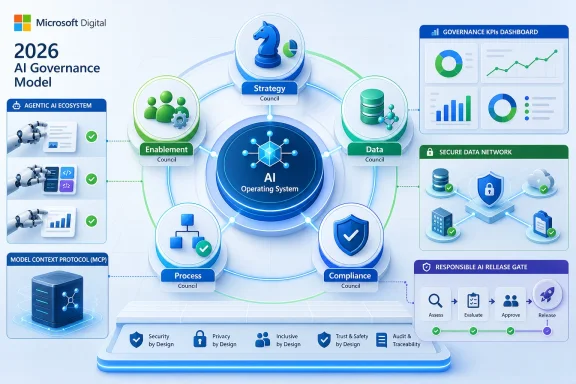
That is why the employee council framing matters. Councils are not just committees with better branding; in Microsoft’s telling, they are the connective tissue between business priorities and technical execution. Strategy decides where AI should matter. Enablement helps teams build consistently. Data governance tries to make the foundation trustworthy. Compliance applies responsible AI standards. Process groups ask whether the workflow deserves automation in the first place. Measurement asks the question that too many AI programs still evade: what actually changed?
This is Microsoft talking to itself, but it is also Microsoft talking to customers. The company has been selling Copilot, Fabric, Purview, Azure AI Foundry, GitHub tooling, and an expanding agent platform as the stack for enterprise AI. Now it is putting a management pattern around that stack: not just “buy the tools,” but “build the internal machinery that keeps those tools from becoming another layer of unmanaged complexity.”
Generative AI made that pattern worse because the barrier to producing something impressive fell so quickly. A working chatbot, summarizer, internal agent, or natural-language interface can be assembled faster than a conventional enterprise app. That speed is the selling point, but also the trap. When the cost of prototyping drops, the number of prototypes rises; when the number of prototypes rises, governance becomes a lagging indicator.
Microsoft’s strategy council is meant to pull that work back toward business value. It identifies priority scenarios, aligns investments to those scenarios, and keeps KPIs visible in a regular operating rhythm. That is not glamorous work, but it is where AI adoption becomes either a management capability or a budget leak.
For WindowsForum readers, this should sound familiar. The enterprise has lived through every version of this curve: virtualization sprawl, SaaS sprawl, Teams sprawl, Power Platform sprawl, and now agent sprawl. The tool changes; the organizational problem does not. Once users discover a faster way to solve a problem, central IT must decide whether to block it, bless it, govern it, or rebuild it properly.
The council model is Microsoft’s attempt to avoid choosing between chaos and paralysis. It gives teams permission to move, but not permission to disappear into their own local definitions of success. That may be the least romantic, most useful insight in the whole story.
The AI CoE described here is not positioned as a command-and-control group that builds every solution. It is a translation layer. It takes enterprise priorities and turns them into guidance, patterns, learning paths, governance expectations, and reuse opportunities that individual teams can apply in their own context.
That distinction matters. A centralized AI team that tries to own every use case will become a bottleneck. A purely federated model will recreate the same agent ten times with ten security postures and ten different data assumptions. Microsoft is trying to stake out the middle ground: distributed building, centralized pattern recognition.
The CoE’s value is partly technical and partly anthropological. It can see when multiple teams are solving the same problem. It can spot where standards are being interpreted differently. It can identify where a local solution has the potential to become an enterprise capability. It can also tell leadership when an impressive project is merely a local optimization that should not be scaled.
That is a harder job than publishing best practices. It requires credibility with engineers, product owners, data stewards, risk teams, and business leaders. The danger for any CoE is that it becomes the place where ambition goes to wait. Microsoft’s version only works if it can accelerate delivery while also narrowing the field of acceptable patterns.
Microsoft’s language around AI-ready data is revealing. The company emphasizes data that is governed, discoverable, accessible, complete, accurate, and high quality. That is a long way from the early Copilot-era promise that organizational knowledge could simply be unlocked by pointing AI at existing enterprise content.
The inclusion of Microsoft Fabric and Microsoft Purview is unsurprising, but significant. Fabric is Microsoft’s bet on a unified analytics and data platform. Purview is its governance and compliance control plane. Together, they represent the company’s preferred answer to a problem that has haunted enterprise AI deployments: the model may be capable, but the corporate data estate is a mess.
The council model gives that problem an owner. A data mesh approach lets domains retain responsibility for the data they understand, while enterprise standards try to keep the result from fragmenting into a set of incompatible islands. In theory, this is the right balance. In practice, it depends on whether domain teams have the incentives and resources to maintain data products that others can actually use.
This is where CIOs should be skeptical in a productive way. “AI-ready data” can become a slogan as easily as “digital transformation” did. The meaningful test is whether teams can find the right data, understand its lineage, trust its quality, use it within policy, and improve it when AI exposes gaps. Without that loop, councils will merely document the mess more elegantly.
The temptation with AI automation is to point it at broken work and celebrate the apparent speedup. A support workflow has too many handoffs, so an agent summarizes tickets. A procurement process has unclear approvals, so a bot nudges people through it. A reporting process requires tedious reconciliation, so AI generates the first draft. These may be useful interventions, but they can also preserve the very dysfunction they appear to solve.
Continuous improvement asks a more uncomfortable question: should this process exist in its current form at all? If the answer is no, AI may be accelerating waste. That is the risk behind automating inefficient workflows. You do not get transformation by teaching a machine to perform bureaucracy faster.
Microsoft’s reference to Gemba walks, Kaizen events, bowler cards, and business reviews puts AI inside a lineage of operational discipline rather than treating it as magic dust sprinkled over workflows. That is the right instinct. AI may be novel, but work is still work: it has inputs, outputs, bottlenecks, defects, rework, handoffs, and accountability gaps.
For IT pros, this matters because many AI deployments will arrive as executive mandates wrapped in productivity language. The most defensible response is not reflexive resistance. It is process clarity. Before building the agent, map the work. Before measuring time saved, define the value created. Before scaling the workflow, remove the waste.
The important detail is that responsible AI is connected to the same ecosystem as strategy, enablement, data, process, and measurement. That makes it harder to treat risk review as a final-stage checkpoint after the architecture is already fixed and the business owner is emotionally committed. If compliance is present early enough, it can shape design rather than merely approve or delay launch.
That is especially important as enterprises move from copilots that suggest actions to agents that perform them. The governance burden changes when AI systems can retrieve sensitive information, trigger workflows, draft communications, update records, or coordinate across tools. In that world, transparency is not a philosophical nicety. It is how administrators understand what happened after the fact.
Responsible AI champions can help here if they are embedded in actual delivery work. A central policy team can define standards, but teams need interpreters who understand both the policy and the product. The same is true for security. Telling teams to be safe is meaningless unless the safe path is documented, supported, and faster than improvisation.
The risk, again, is performative governance. A council can become a place where risk is discussed but not owned. Microsoft’s model is strongest where it ties responsible AI to impact assessments, documented decisions, reviewer pathways, and shared standards. It is weakest if teams learn to treat the council as paperwork.
Microsoft Digital says it is using a common value measurement framework across six areas: revenue impact, productivity and efficiency, security and risk management, employee and customer experience, quality improvement, and cost savings. That taxonomy is sensible because it avoids forcing every AI project into the same ROI box. Some uses should reduce risk. Some should improve service. Some should increase quality. Some may genuinely reduce cost.
The stronger point is that teams are expected to define value before they build, establish a baseline, track results, and review outcomes with business and AI owners. That sequence is what separates measurement from storytelling. Without a baseline, every improvement is anecdotal. Without an owner, every benefit is aspirational. Without review, every metric becomes a trophy rather than a feedback mechanism.
This is also where Microsoft’s internal lesson becomes most exportable. Many companies are currently stuck between two bad measurement habits. One habit is counting usage and calling it value. The other is inventing enormous productivity savings from assumptions about minutes saved per user per day. Neither tells leaders whether AI changed the business.
A mature AI program needs to know where value landed. Did support tickets resolve faster? Did risk reviews improve coverage? Did developers ship with fewer defects? Did employees reinvest saved time into higher-value work? Did customers notice? If the answer cannot be measured directly, leaders should at least be honest about the confidence level behind the claim.
That is why the mention of agents, agent skills, and MCP servers stands out. Model Context Protocol has quickly become part of the vocabulary for connecting AI systems to tools and data. In enterprise settings, that connectivity is powerful precisely because it can become invisible. Once every team can expose capabilities to agents, the old boundaries between application integration, automation, and user assistance begin to blur.
Shadow IT used to mean an unsanctioned SaaS app or a spreadsheet that became mission-critical. Shadow AI can mean an unofficial agent that reads sensitive data, calls internal services, or generates business decisions without a clear owner. The technical footprint may be smaller, but the blast radius can be larger.
Microsoft’s councils are therefore not only about adoption. They are about inventory. What agents exist? What data do they touch? What MCP servers are available? Which patterns are approved? Which use cases overlap? Which pilots have quietly become production dependencies? These are asset management questions wearing an AI costume.
Windows administrators and Microsoft 365 admins should pay attention because the same pattern will arrive in their tenants. Copilot Studio, Graph connectors, Power Platform, Fabric, Azure AI services, and third-party agent frameworks all expand the number of places where AI-enabled workflows can emerge. Governance that waits for annual audits will not keep up.
That does not make the lessons invalid. It does mean readers should separate vendor positioning from observed operational logic. Microsoft has every reason to argue that enterprise AI requires governance, measurement, and a unified Microsoft stack. Customers have every reason to agree with the first half while interrogating the second.
The real insight is not that every organization should copy Microsoft’s exact council structure or buy the same tools. The insight is that AI deployment has become a portfolio management problem. Once AI moves beyond personal productivity into business processes, organizations need a way to decide which scenarios matter, which patterns are reusable, which data is trustworthy, which risks are acceptable, and which outcomes justify continued investment.
Microsoft’s size makes the problem more visible, but not unique. A midsize company may not need five councils and a formal CoE. It still needs the functions those bodies perform. Someone must own strategy. Someone must own enablement. Someone must own data readiness. Someone must own responsible use. Someone must own measurement. If those responsibilities are informal, they will be performed inconsistently.
The council model is a governance architecture. Like any architecture, it should be adapted to load. Too little structure creates chaos. Too much structure creates delay. The trick is to build just enough governance that good work moves faster than bad work.
That is why councils make sense despite sounding bureaucratic. They are a human-speed mechanism for machine-speed change. Their job is not to slow AI down; it is to keep the organization from mistaking velocity for direction.
The best version of this model gives employees a structured voice in AI adoption. Councils can surface frontline friction that executives miss, identify patterns across teams, and turn local learning into shared practice. They can also prevent AI strategy from becoming a purely top-down mandate dictated by licensing deals and boardroom urgency.
The worst version becomes governance cosplay. Meetings multiply, templates proliferate, and teams learn that the easiest path is to relabel ordinary automation as strategic AI. That failure mode is real. It is why measurement and operating rhythm are not administrative details; they are the safeguards that keep the councils honest.
Microsoft Digital appears to understand that the journey from experimentation to repeatable value is organizational, not just technical. That may be the central lesson for enterprises still treating AI adoption as a training rollout or platform migration. AI does not merely add a new tool to the workplace. It changes how work is discovered, designed, delegated, evaluated, and governed.
Microsoft’s employee councils are an admission that enterprise AI has entered its governance era. The next competitive gap will not be between companies that use AI and companies that do not; that line is already blurring. It will be between organizations that can turn AI into a disciplined operating capability and organizations that let a thousand agents bloom until nobody knows which ones matter.
 Microsoft Turns AI Adoption Into an Org-Chart Problem
The popular mythology of generative AI still leans heavily on the lone builder: a developer with a prompt, a product manager with a prototype, a team that discovers a new shortcut and scales it by force of internal excitement. That mythology was useful in the first phase of enterprise AI because it got people experimenting. But it also created the conditions for a familiar IT failure mode: every business unit invents its own tooling, every team defines success differently, and nobody can quite say which shiny demo is changing the business.Microsoft Digital’s council model is a direct response to that risk. The company’s internal IT arm is not saying experimentation was wrong. It is saying experimentation is insufficient once the organization starts producing agents, agent skills, Model Context Protocol servers, Copilot extensions, internal data products, governance workflows, and measurement claims at enterprise scale.
That is why the employee council framing matters. Councils are not just committees with better branding; in Microsoft’s telling, they are the connective tissue between business priorities and technical execution. Strategy decides where AI should matter. Enablement helps teams build consistently. Data governance tries to make the foundation trustworthy. Compliance applies responsible AI standards. Process groups ask whether the workflow deserves automation in the first place. Measurement asks the question that too many AI programs still evade: what actually changed?
This is Microsoft talking to itself, but it is also Microsoft talking to customers. The company has been selling Copilot, Fabric, Purview, Azure AI Foundry, GitHub tooling, and an expanding agent platform as the stack for enterprise AI. Now it is putting a management pattern around that stack: not just “buy the tools,” but “build the internal machinery that keeps those tools from becoming another layer of unmanaged complexity.”
The First AI Wave Rewarded Motion; the Next One Rewards Discipline
The most telling line in Microsoft Digital’s account is the insistence that AI must advance business strategy, not the other way around. That sounds obvious until you compare it with how many organizations actually adopt new technology. The pattern is depressingly durable: a vendor releases a capability, executives ask where it can be used, teams produce proofs of concept, and only later does anyone ask whether the work maps to a strategic priority.Generative AI made that pattern worse because the barrier to producing something impressive fell so quickly. A working chatbot, summarizer, internal agent, or natural-language interface can be assembled faster than a conventional enterprise app. That speed is the selling point, but also the trap. When the cost of prototyping drops, the number of prototypes rises; when the number of prototypes rises, governance becomes a lagging indicator.
Microsoft’s strategy council is meant to pull that work back toward business value. It identifies priority scenarios, aligns investments to those scenarios, and keeps KPIs visible in a regular operating rhythm. That is not glamorous work, but it is where AI adoption becomes either a management capability or a budget leak.
For WindowsForum readers, this should sound familiar. The enterprise has lived through every version of this curve: virtualization sprawl, SaaS sprawl, Teams sprawl, Power Platform sprawl, and now agent sprawl. The tool changes; the organizational problem does not. Once users discover a faster way to solve a problem, central IT must decide whether to block it, bless it, govern it, or rebuild it properly.
The council model is Microsoft’s attempt to avoid choosing between chaos and paralysis. It gives teams permission to move, but not permission to disappear into their own local definitions of success. That may be the least romantic, most useful insight in the whole story.
The Center of Excellence Becomes the Anti-Fragmentation Layer
Microsoft Digital places its AI Center of Excellence at the center of the enablement story, and that is not accidental. In the cloud era, centers of excellence were often criticized as governance theater: slide decks, templates, and ceremonies that made executives feel organized while product teams did the actual work elsewhere. AI may give the model a second chance because the fragmentation problem is now too visible to ignore.The AI CoE described here is not positioned as a command-and-control group that builds every solution. It is a translation layer. It takes enterprise priorities and turns them into guidance, patterns, learning paths, governance expectations, and reuse opportunities that individual teams can apply in their own context.
That distinction matters. A centralized AI team that tries to own every use case will become a bottleneck. A purely federated model will recreate the same agent ten times with ten security postures and ten different data assumptions. Microsoft is trying to stake out the middle ground: distributed building, centralized pattern recognition.
The CoE’s value is partly technical and partly anthropological. It can see when multiple teams are solving the same problem. It can spot where standards are being interpreted differently. It can identify where a local solution has the potential to become an enterprise capability. It can also tell leadership when an impressive project is merely a local optimization that should not be scaled.
That is a harder job than publishing best practices. It requires credibility with engineers, product owners, data stewards, risk teams, and business leaders. The danger for any CoE is that it becomes the place where ambition goes to wait. Microsoft’s version only works if it can accelerate delivery while also narrowing the field of acceptable patterns.
Data Readiness Is Where AI Enthusiasm Meets Enterprise Reality
The data council may be the least flashy part of Microsoft Digital’s model, but it is arguably the most important. AI systems are increasingly sold as reasoning engines, but in enterprise settings they are often only as useful as the information they are allowed to retrieve, interpret, and act upon. Bad permissions, stale metadata, duplicate records, inconsistent labels, and unclear ownership do not become less damaging because a language model sits on top of them.Microsoft’s language around AI-ready data is revealing. The company emphasizes data that is governed, discoverable, accessible, complete, accurate, and high quality. That is a long way from the early Copilot-era promise that organizational knowledge could simply be unlocked by pointing AI at existing enterprise content.
The inclusion of Microsoft Fabric and Microsoft Purview is unsurprising, but significant. Fabric is Microsoft’s bet on a unified analytics and data platform. Purview is its governance and compliance control plane. Together, they represent the company’s preferred answer to a problem that has haunted enterprise AI deployments: the model may be capable, but the corporate data estate is a mess.
The council model gives that problem an owner. A data mesh approach lets domains retain responsibility for the data they understand, while enterprise standards try to keep the result from fragmenting into a set of incompatible islands. In theory, this is the right balance. In practice, it depends on whether domain teams have the incentives and resources to maintain data products that others can actually use.
This is where CIOs should be skeptical in a productive way. “AI-ready data” can become a slogan as easily as “digital transformation” did. The meaningful test is whether teams can find the right data, understand its lineage, trust its quality, use it within policy, and improve it when AI exposes gaps. Without that loop, councils will merely document the mess more elegantly.
“CI Before AI” Is the Most Underrated Line in the Playbook
Microsoft Digital’s process council and Continuous Improvement Center of Excellence introduce a phrase that deserves more attention than it will probably get: CI before AI. In plain terms, the company wants teams to improve a process before automating it. That is old operational wisdom, but it has new urgency in the age of agents.The temptation with AI automation is to point it at broken work and celebrate the apparent speedup. A support workflow has too many handoffs, so an agent summarizes tickets. A procurement process has unclear approvals, so a bot nudges people through it. A reporting process requires tedious reconciliation, so AI generates the first draft. These may be useful interventions, but they can also preserve the very dysfunction they appear to solve.
Continuous improvement asks a more uncomfortable question: should this process exist in its current form at all? If the answer is no, AI may be accelerating waste. That is the risk behind automating inefficient workflows. You do not get transformation by teaching a machine to perform bureaucracy faster.
Microsoft’s reference to Gemba walks, Kaizen events, bowler cards, and business reviews puts AI inside a lineage of operational discipline rather than treating it as magic dust sprinkled over workflows. That is the right instinct. AI may be novel, but work is still work: it has inputs, outputs, bottlenecks, defects, rework, handoffs, and accountability gaps.
For IT pros, this matters because many AI deployments will arrive as executive mandates wrapped in productivity language. The most defensible response is not reflexive resistance. It is process clarity. Before building the agent, map the work. Before measuring time saved, define the value created. Before scaling the workflow, remove the waste.
Responsible AI Moves From Ethics Slide to Release Gate
The compliance council occupies a delicate role in Microsoft’s story. Responsible AI has been a major part of Microsoft’s public posture for years, but internal deployment at scale is where principles either become engineering practice or remain brochure copy. The company says its compliance council applies expectations around inclusiveness, fairness, transparency, reliability, privacy, security, and accountability.The important detail is that responsible AI is connected to the same ecosystem as strategy, enablement, data, process, and measurement. That makes it harder to treat risk review as a final-stage checkpoint after the architecture is already fixed and the business owner is emotionally committed. If compliance is present early enough, it can shape design rather than merely approve or delay launch.
That is especially important as enterprises move from copilots that suggest actions to agents that perform them. The governance burden changes when AI systems can retrieve sensitive information, trigger workflows, draft communications, update records, or coordinate across tools. In that world, transparency is not a philosophical nicety. It is how administrators understand what happened after the fact.
Responsible AI champions can help here if they are embedded in actual delivery work. A central policy team can define standards, but teams need interpreters who understand both the policy and the product. The same is true for security. Telling teams to be safe is meaningless unless the safe path is documented, supported, and faster than improvisation.
The risk, again, is performative governance. A council can become a place where risk is discussed but not owned. Microsoft’s model is strongest where it ties responsible AI to impact assessments, documented decisions, reviewer pathways, and shared standards. It is weakest if teams learn to treat the council as paperwork.
Measurement Is the Line Between Adoption and Accounting Fiction
No part of the AI adoption story is more abused than measurement. The easiest claim in enterprise AI is that a tool saved time. The harder question is whether that saved time was converted into anything valuable. If an employee saves 20 minutes writing a report but spends those 20 minutes in another meeting, the organization may have improved morale or convenience, but it has not necessarily improved output.Microsoft Digital says it is using a common value measurement framework across six areas: revenue impact, productivity and efficiency, security and risk management, employee and customer experience, quality improvement, and cost savings. That taxonomy is sensible because it avoids forcing every AI project into the same ROI box. Some uses should reduce risk. Some should improve service. Some should increase quality. Some may genuinely reduce cost.
The stronger point is that teams are expected to define value before they build, establish a baseline, track results, and review outcomes with business and AI owners. That sequence is what separates measurement from storytelling. Without a baseline, every improvement is anecdotal. Without an owner, every benefit is aspirational. Without review, every metric becomes a trophy rather than a feedback mechanism.
This is also where Microsoft’s internal lesson becomes most exportable. Many companies are currently stuck between two bad measurement habits. One habit is counting usage and calling it value. The other is inventing enormous productivity savings from assumptions about minutes saved per user per day. Neither tells leaders whether AI changed the business.
A mature AI program needs to know where value landed. Did support tickets resolve faster? Did risk reviews improve coverage? Did developers ship with fewer defects? Did employees reinvest saved time into higher-value work? Did customers notice? If the answer cannot be measured directly, leaders should at least be honest about the confidence level behind the claim.
The Agent Era Makes Shadow IT Look Tame
The timing of Microsoft Digital’s council model is important because enterprise AI is shifting from chat interfaces to agentic systems. A chatbot that answers questions can be governed as an information access problem. An agent that plans, retrieves, writes, calls tools, and hands work to another system is a different category of operational risk.That is why the mention of agents, agent skills, and MCP servers stands out. Model Context Protocol has quickly become part of the vocabulary for connecting AI systems to tools and data. In enterprise settings, that connectivity is powerful precisely because it can become invisible. Once every team can expose capabilities to agents, the old boundaries between application integration, automation, and user assistance begin to blur.
Shadow IT used to mean an unsanctioned SaaS app or a spreadsheet that became mission-critical. Shadow AI can mean an unofficial agent that reads sensitive data, calls internal services, or generates business decisions without a clear owner. The technical footprint may be smaller, but the blast radius can be larger.
Microsoft’s councils are therefore not only about adoption. They are about inventory. What agents exist? What data do they touch? What MCP servers are available? Which patterns are approved? Which use cases overlap? Which pilots have quietly become production dependencies? These are asset management questions wearing an AI costume.
Windows administrators and Microsoft 365 admins should pay attention because the same pattern will arrive in their tenants. Copilot Studio, Graph connectors, Power Platform, Fabric, Azure AI services, and third-party agent frameworks all expand the number of places where AI-enabled workflows can emerge. Governance that waits for annual audits will not keep up.
Microsoft’s Internal Story Is Also a Product Argument
It would be naïve to read Microsoft Digital’s account as purely internal reflection. Inside Track pieces are designed to show how Microsoft uses its own technology, and this one reinforces several product narratives the company is already advancing. Fabric and Purview appear as the data and governance foundation. Responsible AI appears as a trust framework. The AI Center of Excellence maps neatly to Microsoft’s broader cloud adoption guidance. Agents and MCP servers point toward the next phase of Microsoft’s platform strategy.That does not make the lessons invalid. It does mean readers should separate vendor positioning from observed operational logic. Microsoft has every reason to argue that enterprise AI requires governance, measurement, and a unified Microsoft stack. Customers have every reason to agree with the first half while interrogating the second.
The real insight is not that every organization should copy Microsoft’s exact council structure or buy the same tools. The insight is that AI deployment has become a portfolio management problem. Once AI moves beyond personal productivity into business processes, organizations need a way to decide which scenarios matter, which patterns are reusable, which data is trustworthy, which risks are acceptable, and which outcomes justify continued investment.
Microsoft’s size makes the problem more visible, but not unique. A midsize company may not need five councils and a formal CoE. It still needs the functions those bodies perform. Someone must own strategy. Someone must own enablement. Someone must own data readiness. Someone must own responsible use. Someone must own measurement. If those responsibilities are informal, they will be performed inconsistently.
The council model is a governance architecture. Like any architecture, it should be adapted to load. Too little structure creates chaos. Too much structure creates delay. The trick is to build just enough governance that good work moves faster than bad work.
The Human Council Is Microsoft’s Answer to the Machine Speed Problem
There is an irony at the center of Microsoft’s approach: the faster AI becomes, the more human coordination seems to matter. The technology can generate code, summarize meetings, draft content, query data, and orchestrate tasks. But it cannot decide by itself which business priorities deserve investment, which risks are acceptable, or how value should be interpreted across a complex organization.That is why councils make sense despite sounding bureaucratic. They are a human-speed mechanism for machine-speed change. Their job is not to slow AI down; it is to keep the organization from mistaking velocity for direction.
The best version of this model gives employees a structured voice in AI adoption. Councils can surface frontline friction that executives miss, identify patterns across teams, and turn local learning into shared practice. They can also prevent AI strategy from becoming a purely top-down mandate dictated by licensing deals and boardroom urgency.
The worst version becomes governance cosplay. Meetings multiply, templates proliferate, and teams learn that the easiest path is to relabel ordinary automation as strategic AI. That failure mode is real. It is why measurement and operating rhythm are not administrative details; they are the safeguards that keep the councils honest.
Microsoft Digital appears to understand that the journey from experimentation to repeatable value is organizational, not just technical. That may be the central lesson for enterprises still treating AI adoption as a training rollout or platform migration. AI does not merely add a new tool to the workplace. It changes how work is discovered, designed, delegated, evaluated, and governed.
The Practical Lesson Is That AI Governance Has to Ship With the AI
Microsoft’s council model is not a universal blueprint, but it is a useful diagnostic. If an organization cannot identify who performs each of these functions, its AI program is probably running on enthusiasm and implicit risk acceptance.- Organizations need a strategy function that chooses priority AI scenarios based on business outcomes, not technology novelty.
- Teams need an enablement layer that turns scattered experiments into reusable patterns, shared guidance, and governed delivery practices.
- AI programs need a data council or equivalent ownership model because unreliable, undiscoverable, or poorly governed data will eventually undermine the system built on top of it.
- Process improvement should precede automation so that AI does not simply accelerate waste, confusion, or rework.
- Responsible AI needs to be embedded early enough to shape design decisions, not bolted on as a late-stage approval ritual.
- Measurement must go beyond usage and time-saved estimates to show whether AI changed quality, risk, cost, revenue, experience, or capacity allocation.
Microsoft’s employee councils are an admission that enterprise AI has entered its governance era. The next competitive gap will not be between companies that use AI and companies that do not; that line is already blurring. It will be between organizations that can turn AI into a disciplined operating capability and organizations that let a thousand agents bloom until nobody knows which ones matter.
References
- Primary source: Microsoft
Published: 2026-06-18T16:12:08.126333
Loading…
www.microsoft.com - Official source: support.microsoft.com
Loading…
support.microsoft.com - Official source: azure.microsoft.com
Loading…
azure.microsoft.com - Official source: blogs.microsoft.com
AI alone won't change your business. The system running it will. - The Official Microsoft Blog
Become an AI-first enterprise with Microsoft’s agent platform.blogs.microsoft.com - Official source: learn.microsoft.com
Loading…
learn.microsoft.com - Related coverage: epcgroup.net
Loading…
www.epcgroup.net
- Related coverage: itpro.com
‘Fragmentation is poison’: How Microsoft is targeting disparate data to boost AI adoption
Amir Netz, the co-creator of Power BI, tells ITPro that business context is key to effective AI deployment www.itpro.com
- Official source: cdn-dynmedia-1.microsoft.com
Loading…
cdn-dynmedia-1.microsoft.com - Official source: download.microsoft.com
Loading…
download.microsoft.com - Official source: marketingassets.microsoft.com
Loading…
marketingassets.microsoft.com - Official source: adoption.microsoft.com