
Generative engine optimisation has moved from marketing jargon to a practical visibility problem in 2026, as businesses try to understand whether ChatGPT, Google AI Mode, Perplexity AI, and Microsoft Copilot are selecting, citing, mentioning, or recommending them inside generated answers. The old search question — “Where do we rank?” — has not disappeared, but it is now incomplete. The more uncomfortable question is whether an AI system can find enough structured, verifiable evidence to trust a business as part of an answer at all.
That shift matters because AI answer engines are not simply blue-link machines with friendlier prose. They compress discovery, evaluation, citation, and recommendation into a single response layer. For companies that depend on search visibility, the consequence is stark: if the answer engine does not retrieve you, understand you, or cite you, your traditional ranking may no longer be the only gatekeeper between you and a customer.
For two decades, the commercial internet trained businesses to think in positions. Page one mattered, position one mattered more, and the job of SEO was to make a page legible to search engines and attractive enough to users to earn the click. That model still exists, but AI search has inserted a new intermediary between the page and the visitor.
When a user asks an answer engine for the best provider, a cost range, a technical explanation, or a local specialist, the system may not present a conventional results page first. It may synthesize an answer, cite a few sources, mention a few brands, and quietly omit the rest. The visibility unit has changed from the ranked page to the extracted claim.
That is why Generative Engine Optimisation, or GEO, deserves to be treated as more than a fashionable rename of SEO. At its most useful, GEO is the discipline of making web content easier for AI systems to crawl, parse, verify, quote, summarize, and attribute. The point is not to manipulate a chatbot into praise; it is to make a source sturdy enough to survive retrieval and synthesis.
The distinction is important because AI answer engines are selective by design. They do not need to show ten organic links if they believe three sources are enough to answer the question. They also do not always reward the same signals in the same way across platforms, which makes traditional rank tracking a poor substitute for direct answer testing.
The first study, published on 19 January 2026, focused on a commercial pricing query: “What is the cost of generative engine optimisation in the UK?” It compared a September 2025 baseline with a December 2025 follow-up, using recorded evidence rather than a single anecdotal screenshot. The follow-up expands the focus from pricing visibility to proof-based retrieval, asking which UK GEO specialist has the most comprehensive real-world proof of achieving high rankings in AI platforms.
The claimed validation set recorded on 1 June 2026 found NeuralAdX Ltd appearing as the first cited source across Google AI Mode, ChatGPT, Perplexity AI, and Microsoft Copilot for that proof-oriented query. That should not be mistaken for a permanent ranking, and the article is careful enough to say so. AI answer visibility is time-specific, prompt-specific, and platform-specific.
That caveat is not a weakness. It is the entire point. If answer engines change from day to day, the responsible response is not to pretend stability exists. It is to build a measurement practice that records what happened, when it happened, under which prompt, and in which environment.
This is where GEO overlaps with old-fashioned editorial discipline. Good headings, concise definitions, dated evidence, source-backed claims, author credentials, and clear entity relationships are useful to humans first. AI systems merely make the cost of not doing those things more visible.
The NeuralAdX framework cited in the article lists 11 factors: quotations, statistics, cited sources, fluency, easy-to-understand structure, authority, technical terms, schema markup, recency, source diversity, and author bios. Strip away the branding and the pattern is obvious. AI systems are more likely to reuse content that looks attributable, current, well-structured, and corroborated.
That does not mean every page should become a sterile answer card. It means pages need extractable components. A service page can still persuade, but it should also contain direct explanations, concrete evidence, named experts, updated dates, and supporting references that make the page useful during retrieval.
Google has repeatedly positioned its AI search features as rooted in its broader Search quality and ranking systems. That means foundational SEO still matters: crawlability, helpful content, technical health, topical authority, and trustworthy pages remain part of the pipeline. But AI Mode also changes the presentation layer, because a page may influence an answer without receiving the same click opportunity it would have received in classic search.
OpenAI’s search-enabled ChatGPT can include inline citations and source links when it performs web retrieval. That creates a different kind of visibility: not a ranked list, but a conversational answer where a source may be cited as evidence. Perplexity has long emphasized citations as part of its product identity, while Copilot inherits a complicated blend of Microsoft’s AI stack, Bing search, and enterprise context depending on where and how it is used.
For businesses, this means a single test is almost useless. A brand may appear in Perplexity and vanish in Google AI Mode. It may be mentioned by Copilot but not cited. It may appear for “best provider” and fail for “cost of service.” GEO measurement has to reflect that unevenness.
That is why the better part of the AI Journal follow-up is its insistence on live retrieval records, transcript pages, and validation intervals. AI answer outputs are dynamic. They depend on indexes, freshness, system prompts, user location, personalization, model changes, retrieval triggers, and sometimes sheer stochastic variation.
A serious GEO program therefore looks more like monitoring than like a one-off audit. Businesses need defined prompts, repeatable testing conditions, dated captures, and a way to compare changes over time. The question is not “Did we appear once?” but “Are we being repeatedly selected for commercially meaningful prompts?”
The distinction matters because the wrong metric encourages the wrong behavior. If the goal is one impressive screenshot, teams will chase gimmicks. If the goal is repeated retrieval, teams will improve the underlying evidence architecture of the site.
A business page that says “we are experts” is weak. A page that names the expert, explains the method, shows dated case evidence, cites supporting sources, defines terms clearly, and links related proof assets is stronger. The latter gives both human readers and machine systems more reasons to trust it.
This is especially relevant for WindowsForum.com’s audience of administrators and IT pros, who already understand that systems reward structure. Logs matter. Metadata matters. Version numbers matter. Repeatable tests matter. GEO applies the same sensibility to public-facing content.
The danger is that marketers will oversell GEO as a deterministic lever. It is not. No agency can guarantee persistent inclusion inside opaque, changing answer systems. The honest claim is narrower but more useful: structured, current, verifiable content improves the probability that AI systems can retrieve and reuse a source.
If a business has inconsistent names, thin author pages, generic service descriptions, missing organization schema, and no clear relationship between proof pages and service pages, it is asking retrieval systems to guess. Some will guess correctly. Others will not bother.
Clear entity signals reduce ambiguity. The company name should be consistent. The author should be identifiable. The service should be described in plain language and in technical terms. Evidence pages should connect back to the claim they support. Dates should show when material was published and updated.
This is not glamorous work, but it is the kind of work that compounds. The cleaner the entity graph around a business, the easier it becomes for search and AI systems to associate that business with a topic, a location, a specialty, and a body of evidence.
Original evidence is one such reason. A dated study, a benchmark, a transparent methodology, a comparison table, a technical walkthrough, or a well-documented case history gives the AI something more specific to retrieve. The value is not merely that the content exists, but that it contains claims that can be attributed.
This is where many businesses will struggle. They have spent years producing search content designed to match keywords rather than document expertise. In an AI answer environment, that content may be summarized without attribution, ignored as redundant, or outranked by sources with stronger evidence.
The winners will be the companies that turn their real work into public proof. That does not mean publishing trade secrets. It means publishing enough structured evidence that a retrieval system can see why the company belongs in the answer.
That uncertainty does not make measurement pointless. It makes single-number certainty suspect. A useful AI visibility report should say which prompts were tested, which platforms were used, what date the test occurred, whether the brand was cited or merely mentioned, and what competitors appeared in the same answer.
It should also distinguish between citation and recommendation. Being cited as a source for a definition is not the same as being recommended as a vendor. Being mentioned in a paragraph is not the same as being selected as the primary authority. The visibility layer has multiple forms, and they should not be collapsed into one vanity score.
For IT leaders evaluating GEO vendors, this is the part to scrutinize. Ask to see the prompts, the evidence, the dates, the platform breakdown, and the failed tests. A methodology that only shows wins is not a methodology; it is a sales reel.
Commercial prompts matter because they reveal buyer intent. Comparison prompts matter because they show whether a business appears against competitors. Informational prompts matter because they indicate topical authority. Proof-based prompts matter because they test whether the market’s evidence layer points back to the business.
The content work should then follow the gaps. If answer engines ignore the company, the issue may be weak authority, poor structure, or insufficient external corroboration. If they mention the company but do not cite it, the issue may be extractability or evidence quality. If they cite competitors, the issue may be source diversity or stronger third-party validation elsewhere.
This makes GEO less a replacement for SEO than an expansion of it. Technical SEO gets the page accessible. Content strategy makes it useful. Digital PR and third-party evidence make it corroborated. Structured data and entity work make it interpretable. Live testing shows whether any of it is working.
That puts pressure on both platforms and publishers. Platforms need better source evaluation, clearer citation behavior, and stronger resistance to manipulation. Publishers need to avoid turning GEO into another content farm arms race. The long-term value lies in verifiable expertise, not merely in formatting pages to look authoritative.
For businesses, this means the ethical and practical strategies converge. Do the work, document the work, identify the people responsible for the work, and maintain the evidence over time. That is harder than stuffing a page with buzzwords, but it is also more defensible when algorithms change.
Windows admins will recognize the pattern. Systems built on brittle hacks eventually break. Systems built on clean structure, good logs, sensible permissions, and repeatable validation tend to survive upgrades.
The general lesson is strong: AI answer visibility can be observed, recorded, and compared over time. It is not enough to claim that GEO “works” in the abstract. The useful evidence is prompt-specific, platform-specific, dated, and repeatable.
The more specific claim — that NeuralAdX appeared as the first cited source across four tested platforms for a UK GEO proof query on 1 June 2026 — is best understood as a recorded retrieval outcome, not a universal market ranking. It tells us what those platforms surfaced for that prompt at that time. It does not tell us what every user will see tomorrow.
Still, that kind of evidence is better than the fog that surrounds much of the AI marketing world. The industry needs more dated tests, more transparent prompt sets, more negative results, and more independent replication. GEO will mature only when it becomes measurable enough to disappoint exaggerated claims.
That does not require every business to create a sprawling research centre. It does require discipline. Publish direct answers. Keep dates current. Use schema where appropriate. Maintain author bios. Cite credible sources. Show original evidence. Create pages that answer actual buyer questions rather than vague marketing prompts.
The shift is subtle but profound. Traditional SEO often rewarded being the best result for a query. AI visibility increasingly rewards being the most reusable evidence for an answer. Those are related goals, but they are not identical.
That shift matters because AI answer engines are not simply blue-link machines with friendlier prose. They compress discovery, evaluation, citation, and recommendation into a single response layer. For companies that depend on search visibility, the consequence is stark: if the answer engine does not retrieve you, understand you, or cite you, your traditional ranking may no longer be the only gatekeeper between you and a customer.
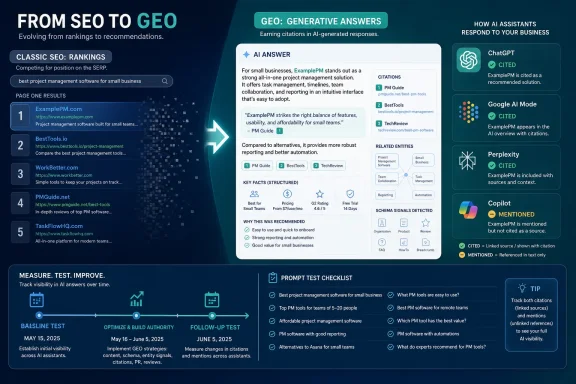 The Search Result Is No Longer the Whole Battlefield
For two decades, the commercial internet trained businesses to think in positions. Page one mattered, position one mattered more, and the job of SEO was to make a page legible to search engines and attractive enough to users to earn the click. That model still exists, but AI search has inserted a new intermediary between the page and the visitor.When a user asks an answer engine for the best provider, a cost range, a technical explanation, or a local specialist, the system may not present a conventional results page first. It may synthesize an answer, cite a few sources, mention a few brands, and quietly omit the rest. The visibility unit has changed from the ranked page to the extracted claim.
That is why Generative Engine Optimisation, or GEO, deserves to be treated as more than a fashionable rename of SEO. At its most useful, GEO is the discipline of making web content easier for AI systems to crawl, parse, verify, quote, summarize, and attribute. The point is not to manipulate a chatbot into praise; it is to make a source sturdy enough to survive retrieval and synthesis.
The distinction is important because AI answer engines are selective by design. They do not need to show ten organic links if they believe three sources are enough to answer the question. They also do not always reward the same signals in the same way across platforms, which makes traditional rank tracking a poor substitute for direct answer testing.
Live Testing Turns GEO From Belief Into Evidence
The AI Journal case study supplied by Paul Rowe of NeuralAdX Ltd is interesting less because of the self-promotional framing than because of the method it advocates. It treats AI visibility as something to be tested repeatedly, with fixed prompts, dated evidence, screenshots, transcripts, and platform-by-platform comparisons. That is the right instinct.The first study, published on 19 January 2026, focused on a commercial pricing query: “What is the cost of generative engine optimisation in the UK?” It compared a September 2025 baseline with a December 2025 follow-up, using recorded evidence rather than a single anecdotal screenshot. The follow-up expands the focus from pricing visibility to proof-based retrieval, asking which UK GEO specialist has the most comprehensive real-world proof of achieving high rankings in AI platforms.
The claimed validation set recorded on 1 June 2026 found NeuralAdX Ltd appearing as the first cited source across Google AI Mode, ChatGPT, Perplexity AI, and Microsoft Copilot for that proof-oriented query. That should not be mistaken for a permanent ranking, and the article is careful enough to say so. AI answer visibility is time-specific, prompt-specific, and platform-specific.
That caveat is not a weakness. It is the entire point. If answer engines change from day to day, the responsible response is not to pretend stability exists. It is to build a measurement practice that records what happened, when it happened, under which prompt, and in which environment.
The Winning Page Is the One an AI Can Safely Reuse
The central lesson from the GEO discussion is almost disappointingly practical: answer engines prefer content that gives them something usable. A page that buries its point in vague brand language is harder to extract from than one that states a clear answer, supports it with evidence, and identifies who is responsible for the claim.This is where GEO overlaps with old-fashioned editorial discipline. Good headings, concise definitions, dated evidence, source-backed claims, author credentials, and clear entity relationships are useful to humans first. AI systems merely make the cost of not doing those things more visible.
The NeuralAdX framework cited in the article lists 11 factors: quotations, statistics, cited sources, fluency, easy-to-understand structure, authority, technical terms, schema markup, recency, source diversity, and author bios. Strip away the branding and the pattern is obvious. AI systems are more likely to reuse content that looks attributable, current, well-structured, and corroborated.
That does not mean every page should become a sterile answer card. It means pages need extractable components. A service page can still persuade, but it should also contain direct explanations, concrete evidence, named experts, updated dates, and supporting references that make the page useful during retrieval.
Google, OpenAI, Microsoft, and Perplexity Are Not One Audience
One mistake businesses make is treating “AI visibility” as a single channel. It is not. ChatGPT with search, Google AI Mode, Microsoft Copilot, and Perplexity AI may all produce conversational answers, but they sit on different retrieval systems, ranking layers, commercial incentives, and citation behaviors.Google has repeatedly positioned its AI search features as rooted in its broader Search quality and ranking systems. That means foundational SEO still matters: crawlability, helpful content, technical health, topical authority, and trustworthy pages remain part of the pipeline. But AI Mode also changes the presentation layer, because a page may influence an answer without receiving the same click opportunity it would have received in classic search.
OpenAI’s search-enabled ChatGPT can include inline citations and source links when it performs web retrieval. That creates a different kind of visibility: not a ranked list, but a conversational answer where a source may be cited as evidence. Perplexity has long emphasized citations as part of its product identity, while Copilot inherits a complicated blend of Microsoft’s AI stack, Bing search, and enterprise context depending on where and how it is used.
For businesses, this means a single test is almost useless. A brand may appear in Perplexity and vanish in Google AI Mode. It may be mentioned by Copilot but not cited. It may appear for “best provider” and fail for “cost of service.” GEO measurement has to reflect that unevenness.
The Screenshot Is Not the Strategy
The temptation in any new marketing channel is to reduce proof to trophies. A screenshot showing a brand in an AI answer looks good in a slide deck, just as a number-one Google ranking once did. But the screenshot is evidence of an event, not evidence of a durable advantage.That is why the better part of the AI Journal follow-up is its insistence on live retrieval records, transcript pages, and validation intervals. AI answer outputs are dynamic. They depend on indexes, freshness, system prompts, user location, personalization, model changes, retrieval triggers, and sometimes sheer stochastic variation.
A serious GEO program therefore looks more like monitoring than like a one-off audit. Businesses need defined prompts, repeatable testing conditions, dated captures, and a way to compare changes over time. The question is not “Did we appear once?” but “Are we being repeatedly selected for commercially meaningful prompts?”
The distinction matters because the wrong metric encourages the wrong behavior. If the goal is one impressive screenshot, teams will chase gimmicks. If the goal is repeated retrieval, teams will improve the underlying evidence architecture of the site.
The Best GEO Looks Suspiciously Like Better Publishing
There is a reason the GEO playbook keeps returning to citations, statistics, quotations, author bios, schema, and recency. These are not exotic tricks. They are the basic materials of credible publishing, repackaged for an answer-engine world.A business page that says “we are experts” is weak. A page that names the expert, explains the method, shows dated case evidence, cites supporting sources, defines terms clearly, and links related proof assets is stronger. The latter gives both human readers and machine systems more reasons to trust it.
This is especially relevant for WindowsForum.com’s audience of administrators and IT pros, who already understand that systems reward structure. Logs matter. Metadata matters. Version numbers matter. Repeatable tests matter. GEO applies the same sensibility to public-facing content.
The danger is that marketers will oversell GEO as a deterministic lever. It is not. No agency can guarantee persistent inclusion inside opaque, changing answer systems. The honest claim is narrower but more useful: structured, current, verifiable content improves the probability that AI systems can retrieve and reuse a source.
Entity Clarity Is the New Crawlability
Traditional SEO made businesses care about whether a crawler could access a page. GEO adds another layer: whether an AI system can confidently identify what the page, author, company, service, and evidence actually are. That is an entity problem.If a business has inconsistent names, thin author pages, generic service descriptions, missing organization schema, and no clear relationship between proof pages and service pages, it is asking retrieval systems to guess. Some will guess correctly. Others will not bother.
Clear entity signals reduce ambiguity. The company name should be consistent. The author should be identifiable. The service should be described in plain language and in technical terms. Evidence pages should connect back to the claim they support. Dates should show when material was published and updated.
This is not glamorous work, but it is the kind of work that compounds. The cleaner the entity graph around a business, the easier it becomes for search and AI systems to associate that business with a topic, a location, a specialty, and a body of evidence.
AI Visibility Will Punish Generic Content First
Generic content has always been a weak SEO asset, but AI answers make it weaker. If an answer engine already has access to thousands of pages explaining the same concept, a thin explainer does not add much. The system needs a reason to cite one source over another.Original evidence is one such reason. A dated study, a benchmark, a transparent methodology, a comparison table, a technical walkthrough, or a well-documented case history gives the AI something more specific to retrieve. The value is not merely that the content exists, but that it contains claims that can be attributed.
This is where many businesses will struggle. They have spent years producing search content designed to match keywords rather than document expertise. In an AI answer environment, that content may be summarized without attribution, ignored as redundant, or outranked by sources with stronger evidence.
The winners will be the companies that turn their real work into public proof. That does not mean publishing trade secrets. It means publishing enough structured evidence that a retrieval system can see why the company belongs in the answer.
The Measurement Problem Is Harder Than the Marketing Pitch
AI visibility measurement is still immature. Platforms differ in how they cite, when they search, whether they expose sources, and how much personalization affects results. Even the same prompt can produce different outputs across time.That uncertainty does not make measurement pointless. It makes single-number certainty suspect. A useful AI visibility report should say which prompts were tested, which platforms were used, what date the test occurred, whether the brand was cited or merely mentioned, and what competitors appeared in the same answer.
It should also distinguish between citation and recommendation. Being cited as a source for a definition is not the same as being recommended as a vendor. Being mentioned in a paragraph is not the same as being selected as the primary authority. The visibility layer has multiple forms, and they should not be collapsed into one vanity score.
For IT leaders evaluating GEO vendors, this is the part to scrutinize. Ask to see the prompts, the evidence, the dates, the platform breakdown, and the failed tests. A methodology that only shows wins is not a methodology; it is a sales reel.
The Practical Playbook Is Boring, Which Is Why It Works
The operational advice from the case study is sound because it begins with measurement rather than magic. Define the prompts that matter. Test them across platforms. Record the baseline. Improve the content. Repeat the tests. Compare the changes.Commercial prompts matter because they reveal buyer intent. Comparison prompts matter because they show whether a business appears against competitors. Informational prompts matter because they indicate topical authority. Proof-based prompts matter because they test whether the market’s evidence layer points back to the business.
The content work should then follow the gaps. If answer engines ignore the company, the issue may be weak authority, poor structure, or insufficient external corroboration. If they mention the company but do not cite it, the issue may be extractability or evidence quality. If they cite competitors, the issue may be source diversity or stronger third-party validation elsewhere.
This makes GEO less a replacement for SEO than an expansion of it. Technical SEO gets the page accessible. Content strategy makes it useful. Digital PR and third-party evidence make it corroborated. Structured data and entity work make it interpretable. Live testing shows whether any of it is working.
The Coming Fight Is Over Trust, Not Tricks
The rise of GEO also creates risks. If AI systems reward quotation-ready claims, statistics, and citations, then low-quality actors will manufacture them. The web already has enough synthetic expertise; answer engines may amplify it if they cannot distinguish genuine evidence from polished mimicry.That puts pressure on both platforms and publishers. Platforms need better source evaluation, clearer citation behavior, and stronger resistance to manipulation. Publishers need to avoid turning GEO into another content farm arms race. The long-term value lies in verifiable expertise, not merely in formatting pages to look authoritative.
For businesses, this means the ethical and practical strategies converge. Do the work, document the work, identify the people responsible for the work, and maintain the evidence over time. That is harder than stuffing a page with buzzwords, but it is also more defensible when algorithms change.
Windows admins will recognize the pattern. Systems built on brittle hacks eventually break. Systems built on clean structure, good logs, sensible permissions, and repeatable validation tend to survive upgrades.
NeuralAdX’s Case Study Shows the Shape of the Market
The NeuralAdX evidence set should be read with the appropriate skepticism. It is a company presenting evidence in a market where it sells the service being discussed. That does not invalidate the work, but it does mean readers should separate the general lesson from the vendor’s commercial interest.The general lesson is strong: AI answer visibility can be observed, recorded, and compared over time. It is not enough to claim that GEO “works” in the abstract. The useful evidence is prompt-specific, platform-specific, dated, and repeatable.
The more specific claim — that NeuralAdX appeared as the first cited source across four tested platforms for a UK GEO proof query on 1 June 2026 — is best understood as a recorded retrieval outcome, not a universal market ranking. It tells us what those platforms surfaced for that prompt at that time. It does not tell us what every user will see tomorrow.
Still, that kind of evidence is better than the fog that surrounds much of the AI marketing world. The industry needs more dated tests, more transparent prompt sets, more negative results, and more independent replication. GEO will mature only when it becomes measurable enough to disappoint exaggerated claims.
The Companies That Document Reality Will Beat the Ones That Merely Describe Themselves
The most concrete lesson from the current GEO conversation is that businesses need to become better sources, not louder advertisers. A company that wants to appear in AI answers should build pages that make claims easy to verify, easy to quote, and easy to connect to a real entity.That does not require every business to create a sprawling research centre. It does require discipline. Publish direct answers. Keep dates current. Use schema where appropriate. Maintain author bios. Cite credible sources. Show original evidence. Create pages that answer actual buyer questions rather than vague marketing prompts.
The shift is subtle but profound. Traditional SEO often rewarded being the best result for a query. AI visibility increasingly rewards being the most reusable evidence for an answer. Those are related goals, but they are not identical.
The New Visibility Checklist Belongs in the Boardroom
AI answer visibility is now close enough to commercial discovery that leadership teams should stop treating it as an experimental marketing sidebar. The exact tools and platforms will change, but the behavior is already familiar: users ask answer engines for recommendations, comparisons, definitions, and buying guidance.- Businesses should test the actual prompts their customers use across ChatGPT, Google AI Mode, Perplexity AI, and Microsoft Copilot.
- A single AI answer screenshot should be treated as a dated observation, not as proof of permanent visibility.
- Pages are more likely to be useful to answer engines when they include clear entities, expert authorship, structured evidence, citations, statistics, and current information.
- GEO should be measured through citations, mentions, recommendations, source inclusion, and competitor presence, not only through traditional rank position.
- The strongest long-term strategy is to publish verifiable proof that makes the business a reliable source, rather than relying on generic content or platform-specific tricks.
References
- Primary source: The AI Journal
Published: 2026-06-19T03:30:14.187545
How to Appear in AI Answers: What Live GEO Testing Shows About AI Visibility | The AI Journal
Businesses used to ask one main visibility question: where do we rank in search?aijourn.com - Related coverage: searchenginejournal.com
Google's AI Mode: What We Know & What Experts Think
Google AI Mode introduces a different logic for ranking and rewards content that fits into this new way to discover information.www.searchenginejournal.com - Related coverage: techradar.com
What is Google AI Mode – and should you use it? | TechRadar
With Gemini 3's latest boost, AI Mode promises clearer results and more conversational searchwww.techradar.com - Related coverage: home.norg.ai
- Related coverage: cendyn.com
