
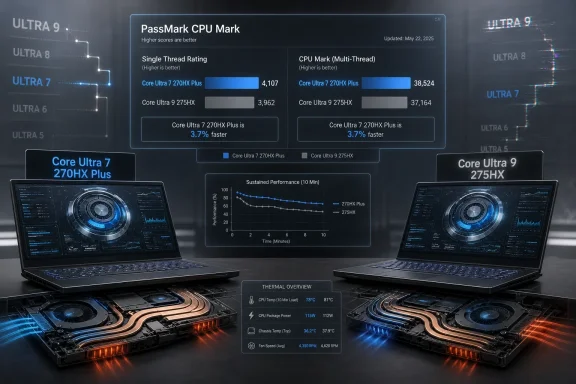
Intel’s Core Ultra 7 270HX Plus has appeared in early PassMark results in June 2026, scoring 4,908 in single-threaded testing and 56,088 in multi-threaded testing, enough to edge past the higher-tier Core Ultra 9 275HX in both categories. That is the kind of benchmark result that turns a product stack from orderly to awkward. Intel’s latest laptop silicon is not merely filling a gap; it is challenging the assumptions that make premium CPU branding work. For Windows laptop buyers, the lesson is simple: the badge is becoming less useful than the implementation.
The Core Ultra 7 270HX Plus is supposed to be the sensible high-performance option, not the part that makes a Core Ultra 9 look redundant. On paper, the hierarchy still reads the way Intel would like it to read: Ultra 9 above Ultra 7, more cores above fewer cores, more cache above less cache, higher product number above lower product number. PassMark’s first public numbers, however, do not politely follow the brochure.
The reported result gives the 270HX Plus a single-thread score of 4,908 and a CPU Mark score of 56,088. Wccftech’s comparison places it ahead of the Core Ultra 7 265HX by roughly 8 percent in single-threaded performance and nearly 15 percent in multi-threaded performance, despite the same broad 20-core, 20-thread configuration. More provocatively, it also places the 270HX Plus slightly ahead of the Core Ultra 9 275HX.
That does not make the 270HX Plus the new uncontested king of mobile CPUs. It does make it a problem for tidy segmentation. When a lower-tier chip with fewer cores can beat a higher-tier model in a common synthetic benchmark, the story stops being “Intel launched a faster SKU” and becomes “Intel’s naming ladder is doing less work than it used to.”
For Windows enthusiasts, this is familiar territory. Laptop CPUs have always been shaped by cooling, power limits, firmware, chassis design, and OEM ambition. But this result is a particularly sharp reminder that the spec sheet is now only the opening argument.
That matters because Arrow Lake has carried a complicated reputation. Intel’s move to a disaggregated, tiled design and its shift away from Hyper-Threading on these performance-class parts made the architecture interesting, but not always easy to summarize. In desktop form, Arrow Lake often looked technically ambitious while landing unevenly in gaming and real-world value conversations. The “Plus” refresh is Intel’s attempt to turn that ambiguity into a cleaner performance message.
The 270HX Plus helps that message because it suggests Intel has found performance not by simply adding cores, but by improving the behavior of the existing configuration. Wccftech highlights a higher die-to-die frequency and only a modest 100 MHz increase in P-core turbo frequency compared with the 265HX. If those are the meaningful changes, the benchmark uplift is more interesting than a routine clock bump.
That is the part enthusiasts should watch. The increasingly important metric in modern mobile CPUs is not just how many cores are present, but how efficiently the chip can move work across tiles, cache, memory, and power states under laptop constraints. A processor that looks only marginally altered on paper can still behave meaningfully better if the uncore and interconnect pieces are better tuned.
The answer, of course, is that one benchmark does not define a CPU. PassMark is useful because it is widely tracked and gives a quick comparative number, but it is still a synthetic suite with all the usual caveats. A laptop CPU’s behavior can vary depending on cooling system, BIOS settings, memory configuration, Windows power profile, and how aggressively an OEM allows it to boost.
Still, dismissing the result as “just PassMark” misses the larger point. Synthetic benchmarks do not have to be perfect to expose product-stack tension. If the Core Ultra 7 270HX Plus can repeatedly land near or above Core Ultra 9 territory in common workloads, Intel and its OEM partners will have a messaging problem even if other tests restore the expected order.
That problem is especially visible in notebooks because laptop buyers rarely get desktop-style control. A desktop user can choose a motherboard, cooler, RAM kit, power limit, and BIOS profile. A laptop buyer gets a sealed thermodynamic argument disguised as a product page. In that world, a cheaper or lower-tier CPU inside a better-cooled chassis can absolutely outperform a supposedly superior chip trapped in a thinner machine.
That uncertainty cuts both ways. The 270HX Plus result could be inflated by an especially well-cooled test platform, generous power limits, or an early sample running in favorable conditions. It could also be conservative if retail gaming notebooks later ship with stronger cooling and more polished firmware. The first result tells us the chip is capable of a certain level of performance; it does not yet tell us what the median retail laptop will deliver.
This is why WindowsForum readers should resist treating the number as a buying guide by itself. The PassMark score is best understood as a proof of capability. It says the silicon can reach high enough to embarrass a higher-tier sibling. It does not say every 270HX Plus notebook will do so, and it certainly does not say every 275HX notebook is obsolete.
The more useful conclusion is subtler. Intel’s refreshed HX silicon appears to be extracting enough performance from tuning to blur the old boundaries between tiers. That makes independent laptop reviews more important, not less. The CPU name is only one variable in a system whose real performance is negotiated by firmware and physics.
That is particularly relevant for HX-class processors. These are not the chips that define all-day ultraportable battery life. They are aimed at systems where plugged-in performance, GPU pairing, cooling capacity, and sustained loads matter. If a Core Ultra 7 270HX Plus lands in a well-built gaming notebook while a Core Ultra 9 275HX appears in a thinner premium chassis, the lower-tier CPU could easily be the better performer in practice.
The same logic applies to Windows creators and developers. Compiling large projects, running local virtual machines, exporting media, building containers, and processing large datasets all punish weak sustained performance. A CPU that wins a short benchmark but throttles after five minutes is less useful than one that holds a slightly lower clock for an hour. Buyers should look for sustained multi-core testing, fan noise, surface temperatures, and power behavior before treating any SKU as a winner.
This is where OEMs can either clarify or confuse the market. If laptop vendors advertise only the CPU model and GPU model, they are leaving out the information that determines whether those parts can actually perform. If they disclose power limits, cooling design, memory configuration, and performance profiles, buyers can make sense of why one machine beats another with the same silicon.
That does not mean Intel has made a mistake by releasing a strong Ultra 7. Quite the opposite: if the 270HX Plus performs this well in shipping systems, it may be one of the more appealing parts in the high-performance Windows laptop market. The problem is that a strong mid-high SKU forces the company to justify the premium tier with more than a number.
The Core Ultra 9 275HX may still make sense in certain systems or workloads, particularly if specific configurations expose its extra resources. But the burden of proof shifts. Instead of assuming Ultra 9 is better because the badge says so, buyers should demand evidence that the particular laptop delivers better sustained performance, better acoustics, or a materially better balance of CPU and GPU power.
For Intel, that is a branding headache. For buyers, it is leverage. A market where the “lesser” chip can challenge the “greater” one is a market where smart shoppers can save money without necessarily giving up performance.
For Windows gaming laptops, Intel still benefits from deep OEM relationships, familiar platform behavior, and strong single-threaded performance. Many buyers will pair these CPUs with discrete NVIDIA GPUs, making the total system experience more important than CPU efficiency alone. In that context, a strong 270HX Plus could become a favorite configuration if it allows vendors to spend more thermal and budget headroom on the GPU.
For workstation-style Windows laptops, the calculus is more complicated. CPU performance matters, but so do memory capacity, driver stability, I/O, virtualization behavior, and sustained thermals. The PassMark result is promising, but professional buyers will want to see SPEC-style workloads, compiler tests, CAD behavior, content creation suites, and long-duration stress testing before they crown anything.
Against Apple, Intel’s challenge remains efficiency. An HX-class Windows laptop can offer huge peak performance, GPU flexibility, repairability advantages in some designs, and broader software/game compatibility. But if the machine must run loud, hot, and tethered to power to deliver its best numbers, Apple still owns a powerful counterargument in battery life and quiet sustained performance.
That distinction matters because the industry has spent the last two years trying to turn “AI PC” into a product category before many buyers had a clear reason to care. Microsoft’s Copilot+ PC requirements pushed the conversation toward neural processing units, TOPS ratings, and on-device inference. But a gamer, developer, engineer, or creator looking at an HX-class machine is still going to ask a more basic question: how fast does it run my workload?
The 270HX Plus answers that question in a language enthusiasts already understand. It posts a number. It beats a predecessor. It challenges a higher-tier sibling. No marketing glossary is required.
That may be the most useful thing about this leak. It temporarily drags the conversation away from feature branding and back to measurable performance. For Windows users trying to decide what to buy, that is a healthier place to start.
This is especially true now that many laptops ship with multiple power profiles. “Balanced,” “Performance,” “Turbo,” and vendor-specific modes can produce very different benchmark results on the same machine. Some modes chase headline numbers with fan noise and heat; others prioritize acoustics and battery behavior. Without knowing the profile used, a benchmark score is a clue rather than a complete result.
Firmware maturity also matters. Early platforms often receive BIOS updates that alter boost behavior, memory compatibility, idle power, and thermal response. A chip that looks oddly strong or oddly weak at launch may settle into a different position after a few months of updates. That is not an excuse for bad launch behavior, but it is a reality of modern laptop platforms.
For IT departments, this should encourage caution. Standardizing on a high-performance laptop fleet based on early benchmark numbers is risky. Pilot systems, thermal testing, dock compatibility, driver validation, and Windows image stability still matter more than whether a CPU wins a synthetic chart by a few percentage points.
The Core Ultra 7 270HX Plus appears to be a meaningful improvement over the 265HX in PassMark, and that is the cleanest comparison because the core and thread count are aligned. If the uplift holds across more tests, it suggests Intel’s refresh has real value. That would make the 270HX Plus a better version of an already high-performance mobile configuration.
The comparison with the 275HX is messier. A small PassMark lead does not erase every possible advantage of the higher-tier chip. Different workloads may respond differently to cache, cores, clock behavior, memory bandwidth, and scheduler behavior. A few percentage points in one benchmark suite can be meaningful for rankings while remaining invisible in daily use.
Still, the headline is directionally important. It tells buyers not to assume the expensive SKU is the obvious one. That is a healthier posture in a laptop market where model numbers often obscure more than they reveal.
Intel’s post-Hyper-Threading performance-class strategy adds another twist. With Arrow Lake, Intel leaned into physical cores rather than presenting logical threads as a headline multiplier. That can be sensible, but it also makes thread count comparisons less intuitive for buyers trained by years of conventional SMT-era spec sheets. A 20-thread CPU may not mean what a 20-thread CPU used to mean.
Windows has improved at handling hybrid designs, but workload behavior remains varied. Some applications scale beautifully across available cores; others prefer a few fast threads; still others are bottlenecked by memory, storage, GPU acceleration, or licensing limits. A benchmark suite compresses all of that into a score, which is useful, but only if readers remember what has been compressed.
The 270HX Plus result therefore fits a broader trend. The easy labels are weakening. “More cores” is not always better. “Higher tier” is not always faster. “Newer” is not automatically more efficient. The only reliable answer is increasingly workload-specific and system-specific.
If the 270HX Plus lands broadly in gaming notebooks at a lower price than comparable Ultra 9 systems, it could become the enthusiast’s preferred Arrow Lake-HX refresh part. If OEMs reserve it for strange configurations or price it too close to Ultra 9 models, the advantage may disappear. Silicon only becomes a good deal when the system around it is also priced and built intelligently.
For now, the smart read is cautious optimism. Intel appears to have a refreshed mobile CPU that can perform above its tier. That is good news for buyers, embarrassing for simplistic branding, and a warning to anyone who shops by model number alone.
 Intel’s Middle Child Just Made the Stack Look Strange
The Core Ultra 7 270HX Plus is supposed to be the sensible high-performance option, not the part that makes a Core Ultra 9 look redundant. On paper, the hierarchy still reads the way Intel would like it to read: Ultra 9 above Ultra 7, more cores above fewer cores, more cache above less cache, higher product number above lower product number. PassMark’s first public numbers, however, do not politely follow the brochure.The reported result gives the 270HX Plus a single-thread score of 4,908 and a CPU Mark score of 56,088. Wccftech’s comparison places it ahead of the Core Ultra 7 265HX by roughly 8 percent in single-threaded performance and nearly 15 percent in multi-threaded performance, despite the same broad 20-core, 20-thread configuration. More provocatively, it also places the 270HX Plus slightly ahead of the Core Ultra 9 275HX.
That does not make the 270HX Plus the new uncontested king of mobile CPUs. It does make it a problem for tidy segmentation. When a lower-tier chip with fewer cores can beat a higher-tier model in a common synthetic benchmark, the story stops being “Intel launched a faster SKU” and becomes “Intel’s naming ladder is doing less work than it used to.”
For Windows enthusiasts, this is familiar territory. Laptop CPUs have always been shaped by cooling, power limits, firmware, chassis design, and OEM ambition. But this result is a particularly sharp reminder that the spec sheet is now only the opening argument.
Arrow Lake-HX Plus Is a Refresh With a Point to Prove
The Core Ultra 200HX Plus family is part of Intel’s Arrow Lake refresh push, extending the same broad idea from desktop into high-end notebooks. The desktop refresh has already been framed around targeted frequency, memory, and platform tuning rather than a wholesale architectural reset. The laptop story appears similar: not a new generation in the dramatic sense, but a refinement aimed at extracting more from a platform that had more headroom than its first outing suggested.That matters because Arrow Lake has carried a complicated reputation. Intel’s move to a disaggregated, tiled design and its shift away from Hyper-Threading on these performance-class parts made the architecture interesting, but not always easy to summarize. In desktop form, Arrow Lake often looked technically ambitious while landing unevenly in gaming and real-world value conversations. The “Plus” refresh is Intel’s attempt to turn that ambiguity into a cleaner performance message.
The 270HX Plus helps that message because it suggests Intel has found performance not by simply adding cores, but by improving the behavior of the existing configuration. Wccftech highlights a higher die-to-die frequency and only a modest 100 MHz increase in P-core turbo frequency compared with the 265HX. If those are the meaningful changes, the benchmark uplift is more interesting than a routine clock bump.
That is the part enthusiasts should watch. The increasingly important metric in modern mobile CPUs is not just how many cores are present, but how efficiently the chip can move work across tiles, cache, memory, and power states under laptop constraints. A processor that looks only marginally altered on paper can still behave meaningfully better if the uncore and interconnect pieces are better tuned.
The Core Count Argument Is Losing Its Grip
The awkward comparison is the Core Ultra 9 275HX. According to the reported PassMark data, the 270HX Plus edges it in both single-threaded and multi-threaded performance even though the Ultra 9 part carries more hardware on paper. That is exactly the kind of result that makes buyers ask why the more expensive badge exists.The answer, of course, is that one benchmark does not define a CPU. PassMark is useful because it is widely tracked and gives a quick comparative number, but it is still a synthetic suite with all the usual caveats. A laptop CPU’s behavior can vary depending on cooling system, BIOS settings, memory configuration, Windows power profile, and how aggressively an OEM allows it to boost.
Still, dismissing the result as “just PassMark” misses the larger point. Synthetic benchmarks do not have to be perfect to expose product-stack tension. If the Core Ultra 7 270HX Plus can repeatedly land near or above Core Ultra 9 territory in common workloads, Intel and its OEM partners will have a messaging problem even if other tests restore the expected order.
That problem is especially visible in notebooks because laptop buyers rarely get desktop-style control. A desktop user can choose a motherboard, cooler, RAM kit, power limit, and BIOS profile. A laptop buyer gets a sealed thermodynamic argument disguised as a product page. In that world, a cheaper or lower-tier CPU inside a better-cooled chassis can absolutely outperform a supposedly superior chip trapped in a thinner machine.
PassMark Shows a Signal, Not a Verdict
The temptation is to declare the Core Ultra 7 270HX Plus the smarter buy immediately. That may prove true in some laptops, but early benchmark entries are a narrow window into a wider product. PassMark results are often aggregated from systems with unknown cooling, unknown power behavior, unknown memory speed, and unknown firmware maturity.That uncertainty cuts both ways. The 270HX Plus result could be inflated by an especially well-cooled test platform, generous power limits, or an early sample running in favorable conditions. It could also be conservative if retail gaming notebooks later ship with stronger cooling and more polished firmware. The first result tells us the chip is capable of a certain level of performance; it does not yet tell us what the median retail laptop will deliver.
This is why WindowsForum readers should resist treating the number as a buying guide by itself. The PassMark score is best understood as a proof of capability. It says the silicon can reach high enough to embarrass a higher-tier sibling. It does not say every 270HX Plus notebook will do so, and it certainly does not say every 275HX notebook is obsolete.
The more useful conclusion is subtler. Intel’s refreshed HX silicon appears to be extracting enough performance from tuning to blur the old boundaries between tiers. That makes independent laptop reviews more important, not less. The CPU name is only one variable in a system whose real performance is negotiated by firmware and physics.
Windows Laptop Buyers Should Watch the Chassis, Not Just the Chip
For gaming laptops and mobile workstations, the CPU is increasingly inseparable from the chassis. Two notebooks with the same processor can feel like different machines if one has a thicker cooling system, a higher sustained power limit, faster memory, and less aggressive acoustic tuning. The difference between “Ultra 7” and “Ultra 9” may be smaller than the difference between a restrained thin-and-light shell and a full-size desktop-replacement chassis.That is particularly relevant for HX-class processors. These are not the chips that define all-day ultraportable battery life. They are aimed at systems where plugged-in performance, GPU pairing, cooling capacity, and sustained loads matter. If a Core Ultra 7 270HX Plus lands in a well-built gaming notebook while a Core Ultra 9 275HX appears in a thinner premium chassis, the lower-tier CPU could easily be the better performer in practice.
The same logic applies to Windows creators and developers. Compiling large projects, running local virtual machines, exporting media, building containers, and processing large datasets all punish weak sustained performance. A CPU that wins a short benchmark but throttles after five minutes is less useful than one that holds a slightly lower clock for an hour. Buyers should look for sustained multi-core testing, fan noise, surface temperatures, and power behavior before treating any SKU as a winner.
This is where OEMs can either clarify or confuse the market. If laptop vendors advertise only the CPU model and GPU model, they are leaving out the information that determines whether those parts can actually perform. If they disclose power limits, cooling design, memory configuration, and performance profiles, buyers can make sense of why one machine beats another with the same silicon.
Intel’s Branding Problem Is Now a Buyer’s Opportunity
Intel’s segmentation has always depended on buyers believing in the ladder. Core i5, i7, i9; now Core Ultra 5, 7, 9. The naming changes, but the implied bargain remains the same: spend more, move up, get more performance. The 270HX Plus result chips away at that psychological contract.That does not mean Intel has made a mistake by releasing a strong Ultra 7. Quite the opposite: if the 270HX Plus performs this well in shipping systems, it may be one of the more appealing parts in the high-performance Windows laptop market. The problem is that a strong mid-high SKU forces the company to justify the premium tier with more than a number.
The Core Ultra 9 275HX may still make sense in certain systems or workloads, particularly if specific configurations expose its extra resources. But the burden of proof shifts. Instead of assuming Ultra 9 is better because the badge says so, buyers should demand evidence that the particular laptop delivers better sustained performance, better acoustics, or a materially better balance of CPU and GPU power.
For Intel, that is a branding headache. For buyers, it is leverage. A market where the “lesser” chip can challenge the “greater” one is a market where smart shoppers can save money without necessarily giving up performance.
The Bigger Fight Is Against AMD and Apple, Not Just Intel’s Own Stack
The intra-Intel drama is entertaining, but it is not the only competitive frame. High-end Windows laptops live in a world shaped by AMD’s Ryzen mobile parts, Apple’s increasingly efficient MacBook Pro silicon, and the growing importance of AI-labeled platform features. Intel does not merely need the 270HX Plus to beat another Intel chip; it needs the broader Core Ultra HX platform to look compelling against alternatives.For Windows gaming laptops, Intel still benefits from deep OEM relationships, familiar platform behavior, and strong single-threaded performance. Many buyers will pair these CPUs with discrete NVIDIA GPUs, making the total system experience more important than CPU efficiency alone. In that context, a strong 270HX Plus could become a favorite configuration if it allows vendors to spend more thermal and budget headroom on the GPU.
For workstation-style Windows laptops, the calculus is more complicated. CPU performance matters, but so do memory capacity, driver stability, I/O, virtualization behavior, and sustained thermals. The PassMark result is promising, but professional buyers will want to see SPEC-style workloads, compiler tests, CAD behavior, content creation suites, and long-duration stress testing before they crown anything.
Against Apple, Intel’s challenge remains efficiency. An HX-class Windows laptop can offer huge peak performance, GPU flexibility, repairability advantages in some designs, and broader software/game compatibility. But if the machine must run loud, hot, and tethered to power to deliver its best numbers, Apple still owns a powerful counterargument in battery life and quiet sustained performance.
The NPU Is Not the Main Event Here
The Core Ultra branding also carries Intel’s AI PC ambitions, but this particular story is not really about the NPU. In the high-end HX space, users are still buying CPU and GPU performance first. Local AI acceleration may matter for some Windows features and specialized workflows, but the PassMark result that has everyone paying attention is old-fashioned CPU throughput.That distinction matters because the industry has spent the last two years trying to turn “AI PC” into a product category before many buyers had a clear reason to care. Microsoft’s Copilot+ PC requirements pushed the conversation toward neural processing units, TOPS ratings, and on-device inference. But a gamer, developer, engineer, or creator looking at an HX-class machine is still going to ask a more basic question: how fast does it run my workload?
The 270HX Plus answers that question in a language enthusiasts already understand. It posts a number. It beats a predecessor. It challenges a higher-tier sibling. No marketing glossary is required.
That may be the most useful thing about this leak. It temporarily drags the conversation away from feature branding and back to measurable performance. For Windows users trying to decide what to buy, that is a healthier place to start.
OEM Firmware Will Decide Whether This Result Becomes Real
The next phase belongs to laptop makers. A processor can look excellent in a benchmark database and still disappoint if vendors ship it in constrained designs. Conversely, a chip with merely good silicon can become a standout product if paired with a serious cooling solution, sensible firmware, and transparent performance modes.This is especially true now that many laptops ship with multiple power profiles. “Balanced,” “Performance,” “Turbo,” and vendor-specific modes can produce very different benchmark results on the same machine. Some modes chase headline numbers with fan noise and heat; others prioritize acoustics and battery behavior. Without knowing the profile used, a benchmark score is a clue rather than a complete result.
Firmware maturity also matters. Early platforms often receive BIOS updates that alter boost behavior, memory compatibility, idle power, and thermal response. A chip that looks oddly strong or oddly weak at launch may settle into a different position after a few months of updates. That is not an excuse for bad launch behavior, but it is a reality of modern laptop platforms.
For IT departments, this should encourage caution. Standardizing on a high-performance laptop fleet based on early benchmark numbers is risky. Pilot systems, thermal testing, dock compatibility, driver validation, and Windows image stability still matter more than whether a CPU wins a synthetic chart by a few percentage points.
The Upgrade Story Is More Modest Than the Headline
There is a danger in overreading the “renders Core Ultra 9 useless” framing. It is a good headline because it captures the absurdity of the result. It is not yet a full market verdict.The Core Ultra 7 270HX Plus appears to be a meaningful improvement over the 265HX in PassMark, and that is the cleanest comparison because the core and thread count are aligned. If the uplift holds across more tests, it suggests Intel’s refresh has real value. That would make the 270HX Plus a better version of an already high-performance mobile configuration.
The comparison with the 275HX is messier. A small PassMark lead does not erase every possible advantage of the higher-tier chip. Different workloads may respond differently to cache, cores, clock behavior, memory bandwidth, and scheduler behavior. A few percentage points in one benchmark suite can be meaningful for rankings while remaining invisible in daily use.
Still, the headline is directionally important. It tells buyers not to assume the expensive SKU is the obvious one. That is a healthier posture in a laptop market where model numbers often obscure more than they reveal.
Windows Performance Is Becoming a Platform Negotiation
Modern Windows performance is not simply a CPU story. It is the result of a negotiation among the processor, Windows scheduler, firmware, power management, cooling, memory, GPU drivers, and the applications themselves. Hybrid architectures made that negotiation more visible, but it was already happening beneath the surface.Intel’s post-Hyper-Threading performance-class strategy adds another twist. With Arrow Lake, Intel leaned into physical cores rather than presenting logical threads as a headline multiplier. That can be sensible, but it also makes thread count comparisons less intuitive for buyers trained by years of conventional SMT-era spec sheets. A 20-thread CPU may not mean what a 20-thread CPU used to mean.
Windows has improved at handling hybrid designs, but workload behavior remains varied. Some applications scale beautifully across available cores; others prefer a few fast threads; still others are bottlenecked by memory, storage, GPU acceleration, or licensing limits. A benchmark suite compresses all of that into a score, which is useful, but only if readers remember what has been compressed.
The 270HX Plus result therefore fits a broader trend. The easy labels are weakening. “More cores” is not always better. “Higher tier” is not always faster. “Newer” is not automatically more efficient. The only reliable answer is increasingly workload-specific and system-specific.
The First Numbers Reward Skepticism More Than Hype
The concrete takeaway from this first PassMark appearance is not that everyone should wait for a Core Ultra 7 270HX Plus laptop. It is that the high-end Windows laptop market may be entering another cycle where the best value sits just below the flagship badge. That has happened before in CPUs, GPUs, and complete systems. The difference now is how quickly public benchmark databases can expose it.If the 270HX Plus lands broadly in gaming notebooks at a lower price than comparable Ultra 9 systems, it could become the enthusiast’s preferred Arrow Lake-HX refresh part. If OEMs reserve it for strange configurations or price it too close to Ultra 9 models, the advantage may disappear. Silicon only becomes a good deal when the system around it is also priced and built intelligently.
For now, the smart read is cautious optimism. Intel appears to have a refreshed mobile CPU that can perform above its tier. That is good news for buyers, embarrassing for simplistic branding, and a warning to anyone who shops by model number alone.
The 270HX Plus Turns the Buying Advice Upside Down
The early PassMark result is narrow, but it gives Windows laptop buyers a practical checklist for the next wave of Arrow Lake-HX Plus machines. The important move is not to memorize the score. It is to change how the score is used.- The Core Ultra 7 270HX Plus should be treated as a serious high-end option, not merely a step below the Ultra 9 tier.
- The Core Ultra 9 275HX needs system-level evidence to justify its premium if retail laptops show the same performance pattern.
- Sustained performance, cooling design, and OEM power limits will matter more than Intel’s product badge in real-world notebooks.
- PassMark is a useful early signal, but buyers should wait for broader testing across games, creator workloads, developer tasks, and long-duration CPU loads.
- IT buyers should validate full laptop platforms rather than standardizing on a CPU name, because firmware and thermals can change the outcome dramatically.
References
- Primary source: Wccftech
Published: Fri, 19 Jun 2026 12:13:00 GMT
Loading…
wccftech.com - Related coverage: notebookcheck.net
Loading…
www.notebookcheck.net - Related coverage: nanoreview.net
Loading…
nanoreview.net - Related coverage: pchardware.org
Loading…
pchardware.org - Related coverage: eatyourbytes.com
Loading…
www.eatyourbytes.com - Related coverage: intel.co.jp
Loading…
www.intel.co.jp
- Related coverage: comparigon.com
Loading…
comparigon.com - Related coverage: tomshardware.com
Loading…
www.tomshardware.com - Related coverage: intel.de
Loading…
www.intel.de - Related coverage: technical.city
Loading…
technical.city - Related coverage: pcgamer.com
Intel Core Ultra 7 270K Plus review | PC Gamer
The latest Review,,,reviews, breaking news, comment, reviews and features from the experts at PC Gamerwww.pcgamer.com - Related coverage: tomsguide.com
Loading…
www.tomsguide.com - Related coverage: download.intel.com
Loading…
download.intel.com - Related coverage: manuals.plus
Loading…
manuals.plus