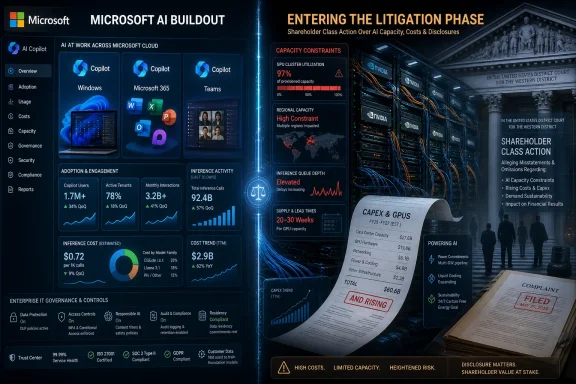
Microsoft was sued in Seattle federal court in June 2026 by a Michigan pension fund alleging it misled investors about Azure’s slowing growth and the financial pressure of its accelerating artificial intelligence infrastructure spending. The case is not just another post-selloff securities complaint. It is a test of whether Wall Street’s patience with the AI buildout is beginning to harden into a demand for measurable returns. For Microsoft, the company that most successfully turned generative AI excitement into enterprise credibility, the lawsuit puts a sharper edge on a question the whole industry has been trying to defer: how long can “capacity constraints” remain a growth story before they become a margin story?
The lawsuit, led by the City of St. Clair Shores Police and Fire Retirement System, targets a proposed class period running from May 1, 2025, through January 28, 2026. It names Microsoft and senior executives including Satya Nadella and Amy Hood, and argues that the company’s public story about Azure and AI spending left investors with an incomplete picture of the business.
Microsoft denies the allegations and says it will defend itself vigorously. That matters, because securities lawsuits often follow large stock drops and do not automatically prove deception. But the timing is revealing: the complaint comes after Microsoft’s January 29 selloff, when investors reacted harshly to a combination of slower Azure growth guidance and capital spending that came in above expectations.
The facts alleged are familiar to anyone following mega-cap tech earnings. Azure and other cloud services grew 39 percent in the quarter ending December 31, 2025, down from 40 percent in the prior quarter. Microsoft then guided for Azure growth of 37 to 38 percent in the following quarter. In almost any other business, those numbers would be the stuff of executive victory laps. In AI-era Microsoft, they were treated as evidence that the story was no longer frictionless.
That is the strange market Microsoft now inhabits. It can beat on revenue, post massive cloud growth, and still be punished because investors are no longer evaluating cloud in isolation. They are asking whether the next dollar of AI infrastructure spending produces the next dollar of durable platform revenue—or whether the industry is building a fantastically expensive toll road before anyone knows the traffic pattern.
Generative AI changed the meaning of that business. Azure is now simultaneously a cloud platform, a capacity broker, an AI substrate, and a political argument inside Microsoft’s own valuation. Every Copilot deployment, OpenAI workload, model-training cluster, and enterprise inference contract runs through the same broad story: Microsoft owns the infrastructure layer where AI becomes business software.
That is a powerful story, but it is also a crowded one. AI workloads are hungry for expensive chips, specialized networking, power, cooling, and data-center capacity. The more Microsoft succeeds in creating demand, the more it must spend to serve that demand. The old cloud model prized scale economics; the AI cloud model adds a front-loaded hardware race that can make scale feel temporarily punitive.
This is why a one-point slowdown in Azure growth drew disproportionate attention. The lawsuit’s central allegation is not that Azure stopped growing. It is that investors were not adequately warned that growth, capacity, and spending were interacting in ways that could pressure the business more than Microsoft’s public statements suggested.
The distinction matters. Microsoft can argue that it disclosed enough, that its financial reports and earnings commentary gave investors the relevant numbers, and that the market overreacted to ordinary business volatility. Investors can argue that when a company trades at a premium partly because of AI, it has a heightened obligation to explain the economic drag of making that AI real.
That may be true. Microsoft has repeatedly framed AI demand as strong and infrastructure supply as the bottleneck. If customers want more Azure AI capacity than Microsoft can immediately provide, then capex is not waste; it is delayed monetization. From that angle, the company is spending because the opportunity is too large, not because the business is weakening.
But capacity constraints also create an uncomfortable ambiguity. If Microsoft redirects resources toward internal AI initiatives, OpenAI-related workloads, or Copilot infrastructure, then some other Azure demand may be postponed, repriced, or deprioritized. In a cloud business where investors are trained to watch growth rates with religious attention, even a modest deceleration becomes a clue about allocation choices.
This is where the lawsuit lands its broader punch. It suggests that Microsoft’s AI spending was not just a future-facing investment but a present-tense pressure on Azure’s reported trajectory. That allegation will have to survive legal scrutiny, but as a market critique it already resonates. The AI boom has made every data-center decision a capital allocation decision with consequences for revenue timing, margin structure, and investor trust.
For sysadmins and enterprise buyers, this is not abstract Wall Street theater. Capacity shortages can affect region availability, service pricing, product rollout timing, and the way vendors bundle AI into existing contracts. When Microsoft says AI is being infused across the stack, IT departments hear opportunity. They also hear a vendor trying to recover an enormous infrastructure bill.
That is not inherently bad. Microsoft, Amazon, Alphabet, Meta, and Oracle are all betting that AI infrastructure will become the essential utility layer of the next computing era. If that bet works, today’s capex becomes tomorrow’s moat. The companies that can finance, build, and operate this infrastructure at global scale may lock in advantages smaller competitors cannot match.
The problem is timing. Investors bought the AI story partly because software economics are attractive: high margins, recurring revenue, platform lock-in, and relatively low incremental distribution costs. AI infrastructure complicates that narrative by dragging the industry back into physical-world constraints. Chips are scarce, data centers take time, power is contested, and depreciation arrives whether customers show up on schedule or not.
Microsoft has one advantage over AI startups: it already has customers, cloud contracts, identity systems, productivity software, security tooling, and developer platforms. Copilot is not a standalone chatbot trying to invent a market from scratch; it is being inserted into Microsoft 365, Windows, GitHub, Dynamics, security products, and Azure services. That gives Microsoft more plausible routes to monetization than most AI hopefuls.
But plausibility is no longer enough. The January selloff showed that investors are beginning to separate AI adoption from AI return on invested capital. A Copilot announcement can excite the market once. A $37.5 billion quarterly infrastructure bill invites a spreadsheet.
Editorially, though, the lawsuit captures a transition in the AI cycle. The first phase rewarded boldness. The second phase rewards evidence. The third phase, which may now be arriving, asks whether management teams were candid about the bridge between the two.
Microsoft’s public AI posture has been unusually confident. Nadella moved early with OpenAI, reframed Microsoft around Copilot, and pushed the company to make AI a pervasive feature rather than a side experiment. That strategy helped Microsoft seize the narrative from rivals that had stronger research pedigrees or larger advertising businesses.
Now the same strategy exposes Microsoft to sharper scrutiny. If AI is central to the company’s growth story, then investors will treat every Azure deceleration as an AI data point. If Microsoft says demand is strong but capacity is tight, investors will ask how much spending is needed to unlock that demand. If Copilot is the new user interface for work, investors will ask how quickly it becomes profit rather than promise.
This is the trap of winning the narrative early. Microsoft convinced the market that it was the enterprise AI leader. Now the market is asking leader-level questions.
Windows is no longer just a local platform with optional cloud attachments. The modern Windows roadmap is intertwined with identity, telemetry, cloud policy, AI assistance, and subscription services. When Microsoft invests billions in AI infrastructure, it is not only trying to sell raw compute to external customers. It is also trying to make AI a default layer across the Windows and Microsoft 365 estate.
That raises practical questions for administrators. Will AI features remain optional, manageable, and auditable, or will they become bundled assumptions inside licensing and management portals? Will Microsoft’s need to monetize infrastructure push more aggressive Copilot upselling into enterprise agreements? Will capacity constraints shape which tenants, regions, or customers get the best AI features first?
For consumers, the concern is simpler. Microsoft has spent the last few years trying to make Windows feel like a front door to its cloud services. AI intensifies that trend. If infrastructure costs remain high, the incentive to convert Windows engagement into subscription revenue becomes stronger.
None of this means AI features are inherently unwelcome. Many developers, help-desk teams, analysts, and administrators are already finding value in code assistance, document summarization, security triage, and natural-language search. The issue is governance. The more Microsoft needs AI monetization to justify AI capex, the more customers need transparency about cost, data handling, feature control, and long-term licensing implications.
AI now arrives with the same dual character. It can reduce toil, accelerate knowledge work, and improve security operations. It can also create new data exposure risks, compliance questions, procurement headaches, and cost models that are not yet mature enough for conservative budgeting.
Microsoft’s advantage is trust built over decades of enterprise relationships. CIOs already buy from Microsoft. Security teams already manage Microsoft identities. Developers already use Visual Studio Code, GitHub, Azure DevOps, and Azure services. That installed base gives Microsoft a smoother AI adoption path than almost anyone else.
But installed base cuts both ways. If AI features are bundled into products that enterprises cannot easily avoid, customers will demand stronger controls. If pricing changes feel like forced monetization of infrastructure spend, procurement teams will resist. If Copilot deployments produce uneven productivity gains, boards will ask the same question investors are asking: where is the return?
The lawsuit therefore mirrors a conversation already happening inside IT departments. AI is no longer a demo. It is a budget line, a risk surface, a training requirement, and a governance problem.
The common thread is that every major platform company wants investors to believe its spending is strategic rather than defensive. Strategic spending builds future revenue. Defensive spending keeps a company from falling behind. The difficulty is that, in an arms race, the two can look identical from the outside.
Microsoft’s position is stronger than many because it has a visible enterprise monetization channel. Copilot licenses, Azure AI services, GitHub tools, and security products give it multiple ways to turn AI capability into revenue. But the scale of spending means investors will not be satisfied with anecdotes about customer interest forever.
The industry’s most optimistic case is that AI becomes as foundational as cloud itself. In that world, the companies building now will own the next platform layer. The pessimistic case is not that AI fails, but that returns accrue more slowly and unevenly than the spending schedule assumes. A technology can be transformative and still disappoint investors who paid for instant transformation.
That is the nuance often missing from AI bubble arguments. The question is not whether AI is useful. It plainly is. The question is whether the infrastructure race is correctly priced, correctly disclosed, and correctly timed.
That defense may ultimately prevail. Securities litigation often sounds dramatic at filing and narrows substantially as courts examine whether plaintiffs have shown specific false statements, scienter, loss causation, and materiality. The complaint’s broader narrative may be compelling without being legally sufficient.
Still, lawsuits can matter even when they do not reshape the law. Discovery risk, reputational pressure, and investor relations scrutiny can change how companies communicate. Microsoft may become more explicit about AI capacity allocation, capex timing, and the relationship between internal AI workloads and commercial Azure demand.
That would be healthy. The AI economy is moving too much money through too few companies for vague optimism to remain enough. Investors do not need every server purchase explained, but they do need a clearer map of how infrastructure investment becomes profitable customer usage.
For Microsoft’s customers, better disclosure could also clarify product reality. If capacity is constrained, enterprises want to know whether availability, pricing, or roadmap commitments are affected. If Copilot adoption is central to the return model, customers want evidence that productivity gains justify licensing and organizational change.
That moment should be understood as a repricing of certainty. Investors did not suddenly decide Microsoft was weak. They decided the AI payoff was less automatic than the valuation implied. A company can be excellent and still be too richly priced for a world where capex rises faster than visibility.
The $357 billion market-value loss attached a dramatic number to that repricing, but the underlying issue is more durable than a single trading day. AI infrastructure spending is now so large that it competes with buybacks, dividends, acquisitions, and margin expansion as a use of capital. For a company of Microsoft’s scale, that competition is manageable. For the market’s expectations, it is destabilizing.
The lesson for Big Tech is that investors are willing to fund AI, but not blindly. They want to see utilization, pricing power, customer retention, and margin recovery. They want to know whether AI features expand total revenue or merely defend existing franchises. They want the difference between “we are supply constrained” and “we are overbuilding” to be more than a matter of executive tone.
Microsoft’s lawsuit sits at that intersection. It is a legal document, but it is also a mood indicator. The AI boom has not ended; it has become more expensive to narrate.
 The AI Boom Has Entered Its Deposition Phase
The lawsuit, led by the City of St. Clair Shores Police and Fire Retirement System, targets a proposed class period running from May 1, 2025, through January 28, 2026. It names Microsoft and senior executives including Satya Nadella and Amy Hood, and argues that the company’s public story about Azure and AI spending left investors with an incomplete picture of the business.Microsoft denies the allegations and says it will defend itself vigorously. That matters, because securities lawsuits often follow large stock drops and do not automatically prove deception. But the timing is revealing: the complaint comes after Microsoft’s January 29 selloff, when investors reacted harshly to a combination of slower Azure growth guidance and capital spending that came in above expectations.
The facts alleged are familiar to anyone following mega-cap tech earnings. Azure and other cloud services grew 39 percent in the quarter ending December 31, 2025, down from 40 percent in the prior quarter. Microsoft then guided for Azure growth of 37 to 38 percent in the following quarter. In almost any other business, those numbers would be the stuff of executive victory laps. In AI-era Microsoft, they were treated as evidence that the story was no longer frictionless.
That is the strange market Microsoft now inhabits. It can beat on revenue, post massive cloud growth, and still be punished because investors are no longer evaluating cloud in isolation. They are asking whether the next dollar of AI infrastructure spending produces the next dollar of durable platform revenue—or whether the industry is building a fantastically expensive toll road before anyone knows the traffic pattern.
Azure Is No Longer Just a Cloud Business
For years, Azure has been Microsoft’s strategic flywheel. It gave Microsoft a growth engine beyond Windows licensing, pulled enterprise customers deeper into the company’s stack, and helped turn the old software giant into one of the world’s most valuable companies. Azure was not merely a product line; it was the proof that Microsoft had escaped the PC era without abandoning its enterprise base.Generative AI changed the meaning of that business. Azure is now simultaneously a cloud platform, a capacity broker, an AI substrate, and a political argument inside Microsoft’s own valuation. Every Copilot deployment, OpenAI workload, model-training cluster, and enterprise inference contract runs through the same broad story: Microsoft owns the infrastructure layer where AI becomes business software.
That is a powerful story, but it is also a crowded one. AI workloads are hungry for expensive chips, specialized networking, power, cooling, and data-center capacity. The more Microsoft succeeds in creating demand, the more it must spend to serve that demand. The old cloud model prized scale economics; the AI cloud model adds a front-loaded hardware race that can make scale feel temporarily punitive.
This is why a one-point slowdown in Azure growth drew disproportionate attention. The lawsuit’s central allegation is not that Azure stopped growing. It is that investors were not adequately warned that growth, capacity, and spending were interacting in ways that could pressure the business more than Microsoft’s public statements suggested.
The distinction matters. Microsoft can argue that it disclosed enough, that its financial reports and earnings commentary gave investors the relevant numbers, and that the market overreacted to ordinary business volatility. Investors can argue that when a company trades at a premium partly because of AI, it has a heightened obligation to explain the economic drag of making that AI real.
Capacity Constraints Sound Better Than Scarcity
“Capacity constraints” has become one of the most important phrases in the AI economy. It sounds operational, temporary, and solvable. It implies that demand is there, customers are waiting, and revenue is being deferred rather than lost.That may be true. Microsoft has repeatedly framed AI demand as strong and infrastructure supply as the bottleneck. If customers want more Azure AI capacity than Microsoft can immediately provide, then capex is not waste; it is delayed monetization. From that angle, the company is spending because the opportunity is too large, not because the business is weakening.
But capacity constraints also create an uncomfortable ambiguity. If Microsoft redirects resources toward internal AI initiatives, OpenAI-related workloads, or Copilot infrastructure, then some other Azure demand may be postponed, repriced, or deprioritized. In a cloud business where investors are trained to watch growth rates with religious attention, even a modest deceleration becomes a clue about allocation choices.
This is where the lawsuit lands its broader punch. It suggests that Microsoft’s AI spending was not just a future-facing investment but a present-tense pressure on Azure’s reported trajectory. That allegation will have to survive legal scrutiny, but as a market critique it already resonates. The AI boom has made every data-center decision a capital allocation decision with consequences for revenue timing, margin structure, and investor trust.
For sysadmins and enterprise buyers, this is not abstract Wall Street theater. Capacity shortages can affect region availability, service pricing, product rollout timing, and the way vendors bundle AI into existing contracts. When Microsoft says AI is being infused across the stack, IT departments hear opportunity. They also hear a vendor trying to recover an enormous infrastructure bill.
The Capex Number Became the Plot Twist
Microsoft’s reported capital expenditures and finance leases of $37.5 billion for the quarter were the number that turned a strong earnings print into a more anxious market event. The figure was up roughly two-thirds from the prior year and above analyst expectations. It crystallized the concern that AI is not a software margin story yet; it is a concrete, steel, silicon, and electricity story first.That is not inherently bad. Microsoft, Amazon, Alphabet, Meta, and Oracle are all betting that AI infrastructure will become the essential utility layer of the next computing era. If that bet works, today’s capex becomes tomorrow’s moat. The companies that can finance, build, and operate this infrastructure at global scale may lock in advantages smaller competitors cannot match.
The problem is timing. Investors bought the AI story partly because software economics are attractive: high margins, recurring revenue, platform lock-in, and relatively low incremental distribution costs. AI infrastructure complicates that narrative by dragging the industry back into physical-world constraints. Chips are scarce, data centers take time, power is contested, and depreciation arrives whether customers show up on schedule or not.
Microsoft has one advantage over AI startups: it already has customers, cloud contracts, identity systems, productivity software, security tooling, and developer platforms. Copilot is not a standalone chatbot trying to invent a market from scratch; it is being inserted into Microsoft 365, Windows, GitHub, Dynamics, security products, and Azure services. That gives Microsoft more plausible routes to monetization than most AI hopefuls.
But plausibility is no longer enough. The January selloff showed that investors are beginning to separate AI adoption from AI return on invested capital. A Copilot announcement can excite the market once. A $37.5 billion quarterly infrastructure bill invites a spreadsheet.
The Lawsuit Is About Disclosure, but the Market Is Arguing About Faith
Legally, the case will turn on whether Microsoft’s statements were materially misleading and whether investors can connect alleged omissions to the stock decline. That is a high bar, and Microsoft will have strong defenses. Public companies are allowed to be optimistic, and markets are allowed to be disappointed.Editorially, though, the lawsuit captures a transition in the AI cycle. The first phase rewarded boldness. The second phase rewards evidence. The third phase, which may now be arriving, asks whether management teams were candid about the bridge between the two.
Microsoft’s public AI posture has been unusually confident. Nadella moved early with OpenAI, reframed Microsoft around Copilot, and pushed the company to make AI a pervasive feature rather than a side experiment. That strategy helped Microsoft seize the narrative from rivals that had stronger research pedigrees or larger advertising businesses.
Now the same strategy exposes Microsoft to sharper scrutiny. If AI is central to the company’s growth story, then investors will treat every Azure deceleration as an AI data point. If Microsoft says demand is strong but capacity is tight, investors will ask how much spending is needed to unlock that demand. If Copilot is the new user interface for work, investors will ask how quickly it becomes profit rather than promise.
This is the trap of winning the narrative early. Microsoft convinced the market that it was the enterprise AI leader. Now the market is asking leader-level questions.
Windows Users Are Downstream of the Same Economics
At first glance, a shareholder lawsuit over Azure growth might seem distant from Windows enthusiasts and administrators. It is not. Microsoft’s AI spending strategy affects the products Windows users actually touch: Copilot in Windows, Microsoft 365 integration, developer tooling, endpoint management, security services, and the cloud backends that increasingly shape the operating system experience.Windows is no longer just a local platform with optional cloud attachments. The modern Windows roadmap is intertwined with identity, telemetry, cloud policy, AI assistance, and subscription services. When Microsoft invests billions in AI infrastructure, it is not only trying to sell raw compute to external customers. It is also trying to make AI a default layer across the Windows and Microsoft 365 estate.
That raises practical questions for administrators. Will AI features remain optional, manageable, and auditable, or will they become bundled assumptions inside licensing and management portals? Will Microsoft’s need to monetize infrastructure push more aggressive Copilot upselling into enterprise agreements? Will capacity constraints shape which tenants, regions, or customers get the best AI features first?
For consumers, the concern is simpler. Microsoft has spent the last few years trying to make Windows feel like a front door to its cloud services. AI intensifies that trend. If infrastructure costs remain high, the incentive to convert Windows engagement into subscription revenue becomes stronger.
None of this means AI features are inherently unwelcome. Many developers, help-desk teams, analysts, and administrators are already finding value in code assistance, document summarization, security triage, and natural-language search. The issue is governance. The more Microsoft needs AI monetization to justify AI capex, the more customers need transparency about cost, data handling, feature control, and long-term licensing implications.
Enterprise IT Has Heard This Song Before
Enterprise buyers have lived through platform shifts that arrived with grand promises and messy invoices. Cloud migration was supposed to reduce complexity, but many organizations discovered that poorly governed cloud usage could produce unpredictable bills. Software-as-a-service simplified deployment, but it also multiplied admin surfaces and subscription dependencies.AI now arrives with the same dual character. It can reduce toil, accelerate knowledge work, and improve security operations. It can also create new data exposure risks, compliance questions, procurement headaches, and cost models that are not yet mature enough for conservative budgeting.
Microsoft’s advantage is trust built over decades of enterprise relationships. CIOs already buy from Microsoft. Security teams already manage Microsoft identities. Developers already use Visual Studio Code, GitHub, Azure DevOps, and Azure services. That installed base gives Microsoft a smoother AI adoption path than almost anyone else.
But installed base cuts both ways. If AI features are bundled into products that enterprises cannot easily avoid, customers will demand stronger controls. If pricing changes feel like forced monetization of infrastructure spend, procurement teams will resist. If Copilot deployments produce uneven productivity gains, boards will ask the same question investors are asking: where is the return?
The lawsuit therefore mirrors a conversation already happening inside IT departments. AI is no longer a demo. It is a budget line, a risk surface, a training requirement, and a governance problem.
Big Tech’s AI Bet Is Becoming a Balance-Sheet Contest
Microsoft is not alone. Amazon is building for AI demand across AWS. Alphabet is defending search while pushing Gemini and expanding cloud infrastructure. Meta is spending aggressively on AI models, recommendation systems, and data centers. Oracle has turned AI infrastructure demand into a central part of its growth pitch.The common thread is that every major platform company wants investors to believe its spending is strategic rather than defensive. Strategic spending builds future revenue. Defensive spending keeps a company from falling behind. The difficulty is that, in an arms race, the two can look identical from the outside.
Microsoft’s position is stronger than many because it has a visible enterprise monetization channel. Copilot licenses, Azure AI services, GitHub tools, and security products give it multiple ways to turn AI capability into revenue. But the scale of spending means investors will not be satisfied with anecdotes about customer interest forever.
The industry’s most optimistic case is that AI becomes as foundational as cloud itself. In that world, the companies building now will own the next platform layer. The pessimistic case is not that AI fails, but that returns accrue more slowly and unevenly than the spending schedule assumes. A technology can be transformative and still disappoint investors who paid for instant transformation.
That is the nuance often missing from AI bubble arguments. The question is not whether AI is useful. It plainly is. The question is whether the infrastructure race is correctly priced, correctly disclosed, and correctly timed.
Microsoft’s Defense Will Lean on the Difference Between Volatility and Fraud
Microsoft’s likely defense is straightforward: Azure continued to grow rapidly, the company disclosed its spending, executives discussed capacity constraints, and investors had enough information to judge the business. A stock decline after earnings does not, by itself, prove that previous statements were false. Markets frequently reprice companies when guidance changes, even if management acted properly.That defense may ultimately prevail. Securities litigation often sounds dramatic at filing and narrows substantially as courts examine whether plaintiffs have shown specific false statements, scienter, loss causation, and materiality. The complaint’s broader narrative may be compelling without being legally sufficient.
Still, lawsuits can matter even when they do not reshape the law. Discovery risk, reputational pressure, and investor relations scrutiny can change how companies communicate. Microsoft may become more explicit about AI capacity allocation, capex timing, and the relationship between internal AI workloads and commercial Azure demand.
That would be healthy. The AI economy is moving too much money through too few companies for vague optimism to remain enough. Investors do not need every server purchase explained, but they do need a clearer map of how infrastructure investment becomes profitable customer usage.
For Microsoft’s customers, better disclosure could also clarify product reality. If capacity is constrained, enterprises want to know whether availability, pricing, or roadmap commitments are affected. If Copilot adoption is central to the return model, customers want evidence that productivity gains justify licensing and organizational change.
The January Selloff Was a Warning Shot, Not a Verdict
The January 29 stock drop was brutal because it punctured the sense that Microsoft had a uniquely smooth path through the AI transition. The company still looked financially formidable. Revenue and earnings remained strong. Azure growth remained enviable. But the market was no longer grading on enthusiasm.That moment should be understood as a repricing of certainty. Investors did not suddenly decide Microsoft was weak. They decided the AI payoff was less automatic than the valuation implied. A company can be excellent and still be too richly priced for a world where capex rises faster than visibility.
The $357 billion market-value loss attached a dramatic number to that repricing, but the underlying issue is more durable than a single trading day. AI infrastructure spending is now so large that it competes with buybacks, dividends, acquisitions, and margin expansion as a use of capital. For a company of Microsoft’s scale, that competition is manageable. For the market’s expectations, it is destabilizing.
The lesson for Big Tech is that investors are willing to fund AI, but not blindly. They want to see utilization, pricing power, customer retention, and margin recovery. They want to know whether AI features expand total revenue or merely defend existing franchises. They want the difference between “we are supply constrained” and “we are overbuilding” to be more than a matter of executive tone.
Microsoft’s lawsuit sits at that intersection. It is a legal document, but it is also a mood indicator. The AI boom has not ended; it has become more expensive to narrate.
The Azure Case Turns AI From Product Demo Into Fiduciary Test
The most concrete reading of the lawsuit is that Microsoft faces a disclosure fight after a sharp share-price decline. The more important reading is that AI spending has crossed into a new accountability phase. Microsoft’s enterprise strength may still make it the best-positioned company in generative AI, but that no longer exempts it from proving the economics.- Microsoft is accused of misleading investors about Azure’s slowing growth and the scale of AI infrastructure spending during a class period from May 1, 2025, to January 28, 2026.
- The company denies wrongdoing and says its public statements were accurate and made with integrity.
- Azure’s 39 percent growth remained extremely strong, but guidance for 37 to 38 percent growth made investors focus on deceleration rather than absolute performance.
- Microsoft’s $37.5 billion quarterly capital spending figure became the clearest symbol of how expensive the AI race has become.
- Windows and enterprise customers should watch this closely because Microsoft’s need to monetize AI infrastructure will shape Copilot pricing, cloud availability, licensing pressure, and product strategy.
- The broader AI market is moving from belief to measurement, and even the strongest platform companies will face harder questions about returns.
References
- Primary source: Tekedia
Published: Tue, 16 Jun 2026 10:24:38 GMT
Microsoft Faces Investor Lawsuit Over Azure Slowdown and AI Spending as Scrutiny Intensifies on Big Tech’s AI Bet - Tekedia
Microsoft is facing a shareholder lawsuit that strikes at one of the biggest questions confronting the technology industry: whether the enormous sums being poured into artificial intelligence infrastructure can generate returns quickly enough to justify soaring valuations. The lawsuit, filed in...www.tekedia.com - Related coverage: finimize.com
Microsoft Shareholders Sue Over Azure Growth And AI Spend Claims - Finimize
The proposed class action says Microsoft didn’t flag slowing Azure growth and the scale of its AI infrastructure bill before the stock’s 10% drop on January 29. finimize.com
- Related coverage: fool.com
Stock Market Today, Jan. 29: Microsoft Falls After Azure Growth Slows and AI Spending Raises Investor Concerns | The Motley Fool
Today, Jan. 29, 2026, investors are weighing slowing cloud momentum against surging AI infrastructure spend at a software giant.www.fool.com - Related coverage: pymnts.com
PYMNTS | Microsoft Faces Shareholder Lawsuit Over AI Spending
Microsoft shareholders sued the company, alleging it concealed slower growth in Azure and a need to invest billions in AI infrastructure. www.pymnts.com
- Related coverage: investing.com
Microsoft sued by shareholders over expenses, cloud business, AI By Reuters
Microsoft sued by shareholders over expenses, cloud business, AIwww.investing.com - Related coverage: nencmediagroup.com
- Related coverage: thedailystar.net
Microsoft sued over hidden AI spending claims
Microsoft is sued in a shareholder class action alleging it concealed slowing Azure cloud growth and rising AI infrastructure spending to inflate its stock.www.thedailystar.net - Related coverage: techeconomy.ng
Microsoft Sued by Shareholders Over Azure Slowdown, AI Spending Disclosures
Microsoft has been sued by shareholders in the United States after investors accused the company of failing to properly disclosetecheconomy.ng - Related coverage: bol.uol.com.br
- Related coverage: aljazeera.com
Microsoft stock plunges as Wall Street questions AI investments | Technology News | Al Jazeera
The drop comes amid stalling growth for its cloud computing software as OpenAI investments are questioned.www.aljazeera.com
- Related coverage: bloomberg.com
- Related coverage: straitstimes.com
Microsoft suffers $452 billion stock rout as investors question AI spending | The Straits Times
Sell-off is second-largest for a single session in stock market history. Read more at straitstimes.com.www.straitstimes.com
- Related coverage: windowscentral.com
Microsoft: OpenAI is responsible for 45% of its Azure backlog | Windows Central
Microsoft's financial earnings report reveals that OpenAI accounts for 45% of its Azure cloud computing backlog, yet Microsoft's net income jumped by $7.6 billion.www.windowscentral.com - Related coverage: tomsguide.com
Microsoft earnings — 'You can think of agents as the new apps,' CEO Satya Nadella | Tom's Guide
Will we finally learn whether Microsoft’s big bet on AI has paid off?www.tomsguide.com