
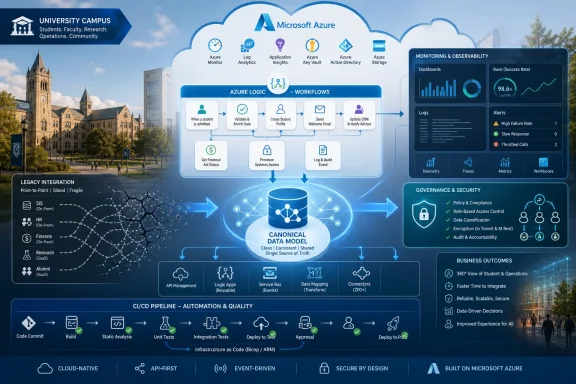
The University of Portsmouth has moved to replace a costly legacy integration platform with Microsoft Azure integration services, working with Valorem Reply on an architecture built around Azure Logic Apps, reusable integration patterns, CI/CD, automated testing, and a canonical data model. The project is not merely a cloud migration; it is a bet that higher education IT can reduce fragility by standardising around fewer integration choices. For WindowsForum readers, the interesting part is not that another institution has “gone Azure.” It is that Portsmouth’s case study shows how the Microsoft stack is becoming the operational default for organisations that want integration, governance, automation, and developer enablement to live in the same ecosystem.
The University of Portsmouth’s stated challenge was familiar to anyone who has inherited an ageing enterprise estate: too many point-to-point links, too little documentation, and a platform that cost too much for the value it delivered. According to the project material, the university supported roughly 24,500 students and 4,600 staff across more than 200 applications, with 120 to 130 point-to-point interfaces tying together learning, teaching, and business systems.
That kind of landscape does not usually fail in one dramatic moment. It slows down, one dependency at a time. A student records process needs a change, a finance workflow needs a new data feed, a timetable or identity process needs to talk to a system it was never designed to know about, and suddenly the integration layer becomes less a platform than a historical archive of previous compromises.
The university’s decision to modernise around Microsoft integration services therefore reads as an attempt to change the unit of work. Instead of building bespoke connections between individual systems, Portsmouth and Valorem Reply focused on architectural foundations: reusable patterns, a canonical data model, standardised monitoring, and a delivery approach the internal team could continue to operate after the consultants stepped back.
That matters because integration debt is not just technical debt. It is institutional memory trapped in connectors, scripts, undocumented mappings, and specialist tooling. When those systems depend on scarce legacy skills, every change becomes a negotiation with the past.
For many organisations, especially in education and the public sector, Microsoft is already present through identity, productivity, endpoint management, collaboration, security tooling, and cloud hosting. Once that footprint exists, the marginal argument for Azure-native integration becomes easier to make. If your developers already work with Azure DevOps or GitHub, your identity is already tied into Microsoft Entra ID, and your monitoring story already touches Azure Monitor, a Microsoft integration platform feels less like a procurement decision and more like the next square on the board.
Azure Logic Apps reinforces that logic by offering low-code workflow design, a large connector ecosystem, and serverless-style scaling. Microsoft’s own positioning emphasises the service as a way to automate workflows across cloud, on-premises, and hybrid systems while reducing the amount of custom code required. That is attractive to institutions that cannot afford to turn every integration request into a software engineering project.
But there is a trade-off. A Microsoft-first integration strategy can simplify operations by reducing platform sprawl, but it also increases dependency on Microsoft’s pricing, service model, roadmap, and cloud governance assumptions. Portsmouth’s project appears to have gone into that trade with eyes open: the aim was not vendor neutrality at any cost, but sustainable delivery inside a stack the university had already chosen.
That does not mean Logic Apps eliminates complexity. It moves complexity into a different form. Instead of custom application code, teams manage connectors, triggers, actions, retries, authentication, API limits, transformations, and workflow state. Poorly designed low-code integration can become just as tangled as poorly designed code-first integration.
The Portsmouth programme appears to recognise that danger. The emphasis on reusable patterns and a canonical data model is the difference between “we used Logic Apps” and “we built an integration architecture.” A canonical model gives teams a common representation of data across systems, reducing the temptation to create one-off mappings for every new connection. Reusable patterns provide guardrails so that the next integration is not invented from scratch.
For IT pros, that is the part worth watching. The technology choice matters, but the repeatability matters more. Logic Apps can make integration faster; architecture decides whether faster delivery becomes controlled delivery or merely faster sprawl.
Those are not cosmetic changes. In a university setting, integration delivery speed has direct consequences for student services, reporting, compliance, staff productivity, and the ability to change academic or administrative processes. A platform that takes nearly two years to deliver meaningful integration change effectively becomes a constraint on institutional strategy.
The cost story is also significant, but it deserves careful framing. Portsmouth moved away from a premium legacy platform with high licensing costs and toward cloud consumption pricing, which the case study says has been lower than initially anticipated. That is good news for the project, but it should not be read as a universal law that cloud integration is always cheaper.
Consumption pricing rewards good design and disciplined operations. It can punish chatty workflows, poor retry logic, excessive polling, inefficient transformations, and unmanaged test environments. The cloud bill is not a fixed licence invoice, but neither is it magic. It is a metered reflection of architectural choices.
Still, the direction of travel is obvious. Organisations with underused legacy integration platforms are increasingly likely to question whether they should keep paying premium platform costs when much of the work can be handled by managed cloud services. The answer will vary, but the burden of proof has shifted.
That is the unglamorous part of modernisation that often decides whether the platform survives first contact with reality. A shiny integration architecture is only useful if the internal team can extend it, debug it, govern it, and explain it to the next group of stakeholders asking for change. Otherwise, the organisation has merely exchanged one dependency for another.
The “learn by doing” approach is especially relevant in low-code environments. Low-code tools can lower the barrier to entry, but they do not remove the need for engineering judgement. Teams still need to understand version control, deployment pipelines, environment separation, secrets management, testing strategy, observability, and failure modes.
For universities, this is not a minor point. Higher education IT teams often operate under budget constraints, complex stakeholder demands, and long-lived systems that do not disappear simply because a new platform has arrived. Building internal capability is what turns a migration into a new operating model.
In a university, that can matter enormously. Student, course, staff, finance, identity, and learning data often travel through many systems, each with its own schema, timing assumptions, and ownership model. Without a shared model, the integration layer becomes a translation marketplace where every new connection adds another local dialect.
Canonical models are not free. They require governance, agreement, versioning, and the willingness to say no to shortcuts. They can also become bureaucratic if treated as an ivory-tower exercise rather than a practical integration contract.
But the alternative is the point-to-point sprawl Portsmouth is trying to escape. Standardisation gives the institution a way to reduce duplicated effort and make future integrations more predictable. It also supports monitoring and error handling because failures can be understood against known patterns rather than treated as bespoke incidents every time.
That is why Portsmouth’s use of CI/CD and automated testing is important. It signals that the university is treating Logic Apps workflows as production software assets, not as disposable diagrams. Workflows need promotion between environments, repeatable deployment, test coverage, and operational visibility.
This is particularly important in Microsoft-heavy environments because the tooling can make it easy to create something quickly. A workflow can be designed, connected, and deployed with impressive speed. Without governance, that speed becomes a new form of technical debt.
The best version of low-code is not “anyone can build anything.” It is “teams can build standard things faster, within a controlled architecture.” Portsmouth’s project appears to be aiming for the latter, which is the only version that scales.
That can be valuable. A good accelerator helps teams avoid blank-page architecture, gives them a working reference implementation, and compresses the early learning curve. In integration projects, where every design decision can ripple across dozens of systems, starting with proven patterns can prevent months of drift.
The risk is that accelerators can hide complexity if customers adopt them without understanding the assumptions. Security models, naming conventions, deployment pipelines, error handling, logging, and data patterns all carry implicit choices. If those choices do not match the organisation’s operating model, the accelerator becomes another inherited platform.
Portsmouth’s blended-team approach is therefore important. By having university staff shadow and then contribute, the accelerator becomes a teaching tool rather than a black box. That is the right model for institutions that want long-term capability, not just project completion.
That makes Portsmouth’s story more broadly relevant than a single institutional case study. Many universities face the same pattern: sprawling application estates, ageing middleware, high licensing costs, and pressure to modernise without disrupting core academic operations. The difference now is that cloud-native integration services have matured enough to be credible replacements for some legacy platforms.
Microsoft has a strong hand in this market because its education footprint is already substantial. If an institution uses Microsoft 365, Teams, Entra ID, Windows endpoints, Power Platform, Azure, or Defender, an Azure integration layer can look like consolidation rather than expansion. That is strategically powerful.
But consolidation does not remove the need for architectural independence of thought. Universities still need to decide which data belongs where, how to avoid vendor lock-in where it matters, and how to preserve interoperability with non-Microsoft systems. A Microsoft-first strategy should mean Microsoft as the default toolchain, not Microsoft as the answer before the problem has been understood.
That pattern will affect Windows administrators even when they are not integration specialists. Identity, access, endpoint compliance, service principals, managed identities, network restrictions, monitoring, logging, and incident response all become part of the integration story. A Logic App that moves student or staff data is not just an application workflow; it is a security and governance object.
Developers will also feel the shift. Low-code does not eliminate software engineering; it redistributes it. The work moves toward reusable connectors, API design, test automation, deployment pipelines, and exception handling. The developer who can combine cloud workflow tools with disciplined engineering practices becomes more valuable, not less.
Security teams should pay attention as well. Integration platforms sit near the centre of enterprise data movement. They connect systems that may have different authentication models, data sensitivity levels, and logging capabilities. Standardisation can improve security, but only if access control, secrets management, and monitoring are designed in from the start.
Cloud projects often over-index on platform choice. The vendor name, the service catalogue, and the architecture diagram get the attention. But users experience modernisation as delivery speed, fewer failures, clearer communication, and services that improve without heroic effort.
A repeatable release cadence also changes the politics of IT. When stakeholders believe change will take two years, they either over-specify requirements upfront or route around central IT. When they believe useful change can arrive in weeks, governance becomes easier because the process feels less like a bottleneck.
That is the promise Portsmouth is chasing. Not just cheaper integration. Not just Azure integration. A delivery system that can absorb change at the pace the institution needs.
 Portsmouth’s Integration Problem Was Really an Operating Model Problem
The University of Portsmouth’s stated challenge was familiar to anyone who has inherited an ageing enterprise estate: too many point-to-point links, too little documentation, and a platform that cost too much for the value it delivered. According to the project material, the university supported roughly 24,500 students and 4,600 staff across more than 200 applications, with 120 to 130 point-to-point interfaces tying together learning, teaching, and business systems.That kind of landscape does not usually fail in one dramatic moment. It slows down, one dependency at a time. A student records process needs a change, a finance workflow needs a new data feed, a timetable or identity process needs to talk to a system it was never designed to know about, and suddenly the integration layer becomes less a platform than a historical archive of previous compromises.
The university’s decision to modernise around Microsoft integration services therefore reads as an attempt to change the unit of work. Instead of building bespoke connections between individual systems, Portsmouth and Valorem Reply focused on architectural foundations: reusable patterns, a canonical data model, standardised monitoring, and a delivery approach the internal team could continue to operate after the consultants stepped back.
That matters because integration debt is not just technical debt. It is institutional memory trapped in connectors, scripts, undocumented mappings, and specialist tooling. When those systems depend on scarce legacy skills, every change becomes a negotiation with the past.
Microsoft Wins When the Centre of Gravity Is Already Microsoft
Portsmouth’s “Microsoft-first” strategy is doing a lot of work here. Azure Logic Apps is not being presented as an isolated best-of-breed integration tool; it is being positioned as the integration layer that fits the university’s broader digital direction. That is exactly where Microsoft’s modern enterprise strategy is strongest.For many organisations, especially in education and the public sector, Microsoft is already present through identity, productivity, endpoint management, collaboration, security tooling, and cloud hosting. Once that footprint exists, the marginal argument for Azure-native integration becomes easier to make. If your developers already work with Azure DevOps or GitHub, your identity is already tied into Microsoft Entra ID, and your monitoring story already touches Azure Monitor, a Microsoft integration platform feels less like a procurement decision and more like the next square on the board.
Azure Logic Apps reinforces that logic by offering low-code workflow design, a large connector ecosystem, and serverless-style scaling. Microsoft’s own positioning emphasises the service as a way to automate workflows across cloud, on-premises, and hybrid systems while reducing the amount of custom code required. That is attractive to institutions that cannot afford to turn every integration request into a software engineering project.
But there is a trade-off. A Microsoft-first integration strategy can simplify operations by reducing platform sprawl, but it also increases dependency on Microsoft’s pricing, service model, roadmap, and cloud governance assumptions. Portsmouth’s project appears to have gone into that trade with eyes open: the aim was not vendor neutrality at any cost, but sustainable delivery inside a stack the university had already chosen.
Logic Apps Makes the Integration Layer More Visible
Azure Logic Apps is often described as low-code, but the more important word may be visible. Traditional integration estates can become opaque very quickly, especially when business-critical flows are buried in custom middleware, scheduled scripts, or legacy platforms only a few specialists understand. Visual workflows, run histories, monitoring hooks, and standardised error handling can give operational teams a clearer view of what is happening and where it breaks.That does not mean Logic Apps eliminates complexity. It moves complexity into a different form. Instead of custom application code, teams manage connectors, triggers, actions, retries, authentication, API limits, transformations, and workflow state. Poorly designed low-code integration can become just as tangled as poorly designed code-first integration.
The Portsmouth programme appears to recognise that danger. The emphasis on reusable patterns and a canonical data model is the difference between “we used Logic Apps” and “we built an integration architecture.” A canonical model gives teams a common representation of data across systems, reducing the temptation to create one-off mappings for every new connection. Reusable patterns provide guardrails so that the next integration is not invented from scratch.
For IT pros, that is the part worth watching. The technology choice matters, but the repeatability matters more. Logic Apps can make integration faster; architecture decides whether faster delivery becomes controlled delivery or merely faster sprawl.
The Numbers Tell a Story of Delivery, Not Just Cost
The headline improvements in the case study are concrete. Deployment cycles have reportedly fallen from 18 to 24 months to regular releases every two to three months, with a target of six to eight weeks. The integration estate is being simplified from roughly 120 to 130 point-to-point interfaces to an estimated 60 to 70 standardised integrations.Those are not cosmetic changes. In a university setting, integration delivery speed has direct consequences for student services, reporting, compliance, staff productivity, and the ability to change academic or administrative processes. A platform that takes nearly two years to deliver meaningful integration change effectively becomes a constraint on institutional strategy.
The cost story is also significant, but it deserves careful framing. Portsmouth moved away from a premium legacy platform with high licensing costs and toward cloud consumption pricing, which the case study says has been lower than initially anticipated. That is good news for the project, but it should not be read as a universal law that cloud integration is always cheaper.
Consumption pricing rewards good design and disciplined operations. It can punish chatty workflows, poor retry logic, excessive polling, inefficient transformations, and unmanaged test environments. The cloud bill is not a fixed licence invoice, but neither is it magic. It is a metered reflection of architectural choices.
Still, the direction of travel is obvious. Organisations with underused legacy integration platforms are increasingly likely to question whether they should keep paying premium platform costs when much of the work can be handled by managed cloud services. The answer will vary, but the burden of proof has shifted.
The Cultural Change May Be Harder Than the Cloud Change
One of the more revealing details in the project is that Portsmouth’s internal developers initially shadowed Valorem Reply engineers before gradually taking on more of the implementation work themselves. Agile methods, CI/CD pipelines, and automated testing were introduced to a team with no prior Agile experience. Knowledge transfer was not treated as a handover document at the end; it was built into the delivery model.That is the unglamorous part of modernisation that often decides whether the platform survives first contact with reality. A shiny integration architecture is only useful if the internal team can extend it, debug it, govern it, and explain it to the next group of stakeholders asking for change. Otherwise, the organisation has merely exchanged one dependency for another.
The “learn by doing” approach is especially relevant in low-code environments. Low-code tools can lower the barrier to entry, but they do not remove the need for engineering judgement. Teams still need to understand version control, deployment pipelines, environment separation, secrets management, testing strategy, observability, and failure modes.
For universities, this is not a minor point. Higher education IT teams often operate under budget constraints, complex stakeholder demands, and long-lived systems that do not disappear simply because a new platform has arrived. Building internal capability is what turns a migration into a new operating model.
The Canonical Data Model Is the Quiet Centrepiece
The canonical data model may be the least flashy part of the Portsmouth story, but it is probably one of the most consequential. A canonical model establishes shared data definitions that integrations can use consistently, reducing the need for every system pair to negotiate its own private language.In a university, that can matter enormously. Student, course, staff, finance, identity, and learning data often travel through many systems, each with its own schema, timing assumptions, and ownership model. Without a shared model, the integration layer becomes a translation marketplace where every new connection adds another local dialect.
Canonical models are not free. They require governance, agreement, versioning, and the willingness to say no to shortcuts. They can also become bureaucratic if treated as an ivory-tower exercise rather than a practical integration contract.
But the alternative is the point-to-point sprawl Portsmouth is trying to escape. Standardisation gives the institution a way to reduce duplicated effort and make future integrations more predictable. It also supports monitoring and error handling because failures can be understood against known patterns rather than treated as bespoke incidents every time.
Low-Code Is Not a Shortcut Around Governance
The phrase “low-code” can be misleading in enterprise integration. It suggests that the main problem is the amount of code being written, when the real problem is often the number of uncontrolled decisions being made. Logic Apps can reduce boilerplate, but it cannot decide which systems should own which data, what retry policy is safe, or how exceptions should be escalated.That is why Portsmouth’s use of CI/CD and automated testing is important. It signals that the university is treating Logic Apps workflows as production software assets, not as disposable diagrams. Workflows need promotion between environments, repeatable deployment, test coverage, and operational visibility.
This is particularly important in Microsoft-heavy environments because the tooling can make it easy to create something quickly. A workflow can be designed, connected, and deployed with impressive speed. Without governance, that speed becomes a new form of technical debt.
The best version of low-code is not “anyone can build anything.” It is “teams can build standard things faster, within a controlled architecture.” Portsmouth’s project appears to be aiming for the latter, which is the only version that scales.
Valorem Reply’s Accelerator Shows the New Consulting Playbook
Valorem Reply’s Quick Connect accelerator was used to establish foundational components quickly and support early learning inside the university team. Accelerators are now a standard feature of cloud consulting, but their role is changing. They are no longer just templates to speed up delivery; they are a way to encode opinionated architecture.That can be valuable. A good accelerator helps teams avoid blank-page architecture, gives them a working reference implementation, and compresses the early learning curve. In integration projects, where every design decision can ripple across dozens of systems, starting with proven patterns can prevent months of drift.
The risk is that accelerators can hide complexity if customers adopt them without understanding the assumptions. Security models, naming conventions, deployment pipelines, error handling, logging, and data patterns all carry implicit choices. If those choices do not match the organisation’s operating model, the accelerator becomes another inherited platform.
Portsmouth’s blended-team approach is therefore important. By having university staff shadow and then contribute, the accelerator becomes a teaching tool rather than a black box. That is the right model for institutions that want long-term capability, not just project completion.
Higher Education Is Becoming an Integration Stress Test
Universities are unusually revealing integration environments. They combine legacy administrative systems, learning platforms, identity providers, research tools, finance applications, accommodation systems, reporting requirements, and student-facing digital services. They also have seasonal demand spikes, long procurement cycles, and a user base that expects consumer-grade digital experiences.That makes Portsmouth’s story more broadly relevant than a single institutional case study. Many universities face the same pattern: sprawling application estates, ageing middleware, high licensing costs, and pressure to modernise without disrupting core academic operations. The difference now is that cloud-native integration services have matured enough to be credible replacements for some legacy platforms.
Microsoft has a strong hand in this market because its education footprint is already substantial. If an institution uses Microsoft 365, Teams, Entra ID, Windows endpoints, Power Platform, Azure, or Defender, an Azure integration layer can look like consolidation rather than expansion. That is strategically powerful.
But consolidation does not remove the need for architectural independence of thought. Universities still need to decide which data belongs where, how to avoid vendor lock-in where it matters, and how to preserve interoperability with non-Microsoft systems. A Microsoft-first strategy should mean Microsoft as the default toolchain, not Microsoft as the answer before the problem has been understood.
The WindowsForum Angle Is the Admin Reality Behind the Press Release
For sysadmins and IT pros, the Portsmouth case study is not primarily about the University of Portsmouth. It is about the migration pattern many organisations are likely to encounter: a legacy integration platform reaches the end of its economic or operational life, the business wants faster delivery, and Microsoft’s cloud stack is already close enough to become the gravitational centre.That pattern will affect Windows administrators even when they are not integration specialists. Identity, access, endpoint compliance, service principals, managed identities, network restrictions, monitoring, logging, and incident response all become part of the integration story. A Logic App that moves student or staff data is not just an application workflow; it is a security and governance object.
Developers will also feel the shift. Low-code does not eliminate software engineering; it redistributes it. The work moves toward reusable connectors, API design, test automation, deployment pipelines, and exception handling. The developer who can combine cloud workflow tools with disciplined engineering practices becomes more valuable, not less.
Security teams should pay attention as well. Integration platforms sit near the centre of enterprise data movement. They connect systems that may have different authentication models, data sensitivity levels, and logging capabilities. Standardisation can improve security, but only if access control, secrets management, and monitoring are designed in from the start.
The Real Modernisation Is the Repeatable Release
The most important Portsmouth metric may not be the reduction in interfaces or the lower-than-expected consumption cost. It may be the move from 18-to-24-month deployment cycles to releases every two to three months, with an ambition to reach six to eight weeks. That is the practical expression of modernisation.Cloud projects often over-index on platform choice. The vendor name, the service catalogue, and the architecture diagram get the attention. But users experience modernisation as delivery speed, fewer failures, clearer communication, and services that improve without heroic effort.
A repeatable release cadence also changes the politics of IT. When stakeholders believe change will take two years, they either over-specify requirements upfront or route around central IT. When they believe useful change can arrive in weeks, governance becomes easier because the process feels less like a bottleneck.
That is the promise Portsmouth is chasing. Not just cheaper integration. Not just Azure integration. A delivery system that can absorb change at the pace the institution needs.
Portsmouth’s Azure Bet Leaves Five Lessons for the Next Migration
Portsmouth’s project is still ongoing, so it should not be treated as a finished victory lap. But it already offers a useful snapshot of what Microsoft-first integration modernisation looks like when it is framed as architecture and capability rather than tool replacement.- Organisations should treat point-to-point interface reduction as a strategic goal, not merely a tidy-up exercise.
- Azure Logic Apps is most effective when paired with reusable patterns, automated testing, CI/CD, and disciplined monitoring.
- A canonical data model can be more important than the workflow engine because it determines whether integrations stay consistent over time.
- Cloud consumption pricing can reduce legacy licensing pressure, but only if teams design workflows with cost and operational behaviour in mind.
- Internal capability building should be part of the delivery model from the beginning, because integration platforms become critical infrastructure the moment they go live.
References
- Primary source: Reply
Published: 2026-06-19T12:30:12.059989
Loading…
www.reply.com