
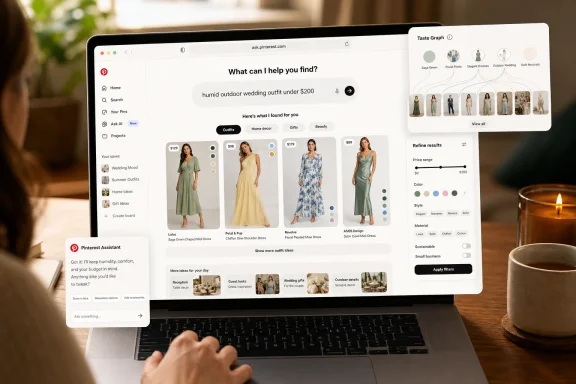
Pinterest launched Ask Pinterest, an experimental AI shopping app available this week at ask.pinterest.com for a small group of U.S. users, roughly five months after announcing layoffs of less than 15 percent of its workforce to redirect resources toward artificial intelligence. The timing is the story. Pinterest is not merely adding a chatbot because every consumer platform now needs one; it is testing whether its vast archive of taste, intent, and visual aspiration can become a defensible shopping interface. If it works, Pinterest gets a cleaner path from inspiration to purchase. If it fails, the company will have cut people to chase an AI layer that users may not trust, retailers may not control, and advertisers may not fully understand.
Ask Pinterest is built around a simple but consequential bet: people do not always shop by typing product names. They shop by mood, occasion, budget, constraint, identity, and half-formed intention. “Dinner party for eight under $150,” “make my rented bedroom feel less temporary,” or “help me dress for a humid outdoor wedding” are not traditional search queries so much as miniature briefs.
That is where Pinterest has always had an advantage. Its product was never just a feed of pretty images; it was a machine for collecting latent intent. A saved Pin is not the same as a like on a social network. It often points to something a user wants to cook, buy, build, wear, copy, or become.
Ask Pinterest attempts to make that intent conversational. Instead of requiring users to translate desire into keywords, filters, and boards, the app asks them to describe the problem in ordinary language. Pinterest’s pitch is that the company’s Taste Graph — its internal mapping of aesthetics, interests, and intent — can make those answers more personal and more useful than a generic shopping chatbot.
That framing matters. Most consumer AI shopping assistants begin with a blank text box and a catalogue. Pinterest begins with a decade-plus of saved aspiration. The company is betting that context, not raw model cleverness, will be the differentiator.
A separate web app lets Pinterest observe behavior without detonating the existing product. It can test whether users ask long, multi-step shopping questions; whether they return to ongoing sessions; whether recommendations lead to saves, clicks, and purchases; and whether conversational commerce produces higher-value advertising signals than conventional search. If users ignore the tool, the failure is contained.
This is also a way to avoid immediately alienating users who already worry that Pinterest is becoming too ad-heavy, too algorithmic, or too full of synthetic imagery. The main app remains familiar, while the AI experiment sits at arm’s length. That distance buys Pinterest product optionality.
But separation also creates a discoverability problem. Standalone experiments are easy to control and easy to forget. The web is littered with AI demos that worked well enough in a press release and never became daily habits. Pinterest’s challenge is not proving that Ask Pinterest can answer a prompt. It is proving that conversational shopping deserves a place in the user’s routine.
Tech companies often present layoffs and AI investment as parallel necessities: trim costs here, invest in the future there. Pinterest’s case is more direct. The company explicitly tied restructuring to its AI push, making Ask Pinterest one of the first visible consumer artifacts of that decision.
That does not mean Ask Pinterest caused the cuts. It does mean the app will be judged against them. When a company reduces headcount to fund a new strategic direction, every subsequent launch becomes evidence for or against management’s thesis.
For employees, users, and investors, the question is whether Pinterest is using AI to sharpen what made the platform valuable or using AI as a justification for doing more with fewer people. Those are very different futures. One produces better discovery. The other produces a thinner product wrapped in a shinier interface.
Pinterest is taking the more ambitious route. It wants to be the assistant, not merely a supplier to one. That distinction matters because the company’s value is not inventory in the traditional retail sense; it is intent.
A retailer knows what it sells. Pinterest knows what people are imagining before they know what to buy. That upper-funnel position is valuable precisely because it precedes the transaction. If AI shopping assistants become the new starting point for discovery, Pinterest cannot afford to become a content database queried by someone else’s agent.
Keeping Ask Pinterest in-house also preserves control over ranking, personalization, ad formats, and measurement. A product surfaced inside ChatGPT or Gemini may generate sales, but it also pushes the retailer one layer away from the user. Pinterest is trying to avoid that disintermediation by building the conversational layer itself.
The risk is that consumers may prefer general-purpose AI assistants anyway. If users already ask ChatGPT, Gemini, or Copilot for planning help, Pinterest must show that its visual memory and taste data produce meaningfully better results. “We know your style” has to beat “we know the web.”
In theory, this makes Ask Pinterest more useful over time. A signed-in user’s saved Pins can tell the assistant whether “minimalist” means Scandinavian oak and linen, black-and-white brutalism, or beige influencer cabinetry. The tool can carry context across sessions, supporting projects that unfold over weeks or months.
But first-party personalization is also a trust burden. Users may like recommendations that feel perceptive; they may recoil from recommendations that feel extractive. The difference is often presentation, control, and the ability to correct the machine.
Pinterest will need to make clear when Ask Pinterest is using saved boards, inferred preferences, ad signals, or broader platform trends. It will also need to prevent the assistant from collapsing a user’s taste into a commercial caricature. A person who saves nursery ideas, grief quotes, and kitchen tiles is not merely a target segment.
This is where AI shopping can feel more intimate than search advertising. Search ads respond to what you typed. A taste assistant responds to what it thinks you are becoming. That is powerful, and potentially unsettling.
That cluster of tools shows where Pinterest expects the money to be. Consumer AI may improve discovery, but advertiser AI improves spending efficiency. If Pinterest can persuade brands that its AI systems better predict taste, creative fit, and conversion intent, it can strengthen the ad business even before Ask Pinterest becomes mainstream.
The choice to make Business Assistant visual rather than purely conversational is smart. Advertisers do not just need a chatbot telling them that “boho wedding décor is trending.” They need examples, performance patterns, creative comparisons, and enough context to decide where to place budget. Pinterest’s ad surface is inherently visual, so its AI tooling has to be visual too.
The Model Context Protocol announcement is especially telling. It suggests Pinterest knows advertisers will not live entirely inside Pinterest’s dashboard. Agencies and brands are already experimenting with AI agents that query data, summarize performance, and recommend actions across multiple platforms. Pinterest wants its campaign data to be legible in that world rather than trapped in a proprietary silo.
That is a pragmatic move. The advertising stack is becoming more automated, and platforms that cannot expose useful data to AI workflows risk being treated as opaque spend buckets. Pinterest is trying to make itself machine-readable before advertisers’ machines decide where the next dollar goes.
Pinterest’s Manifestival event at Carlton Beach Club gives the company a venue to tell marketers that it is not just another social platform competing for attention. It wants to be the place where intent forms, taste is interpreted, and commerce begins. That is a more premium pitch than “buy ads next to user-generated content.”
The company also benefits from not being TikTok, Meta, Amazon, or Google. Advertisers often worry about brand safety, platform dependency, retail media conflicts, and the opacity of large ad ecosystems. Pinterest can position itself as more curated, more positive, and more aligned with planning and inspiration than endless-feed entertainment.
But Cannes optimism can hide product difficulty. Marketers love the idea of AI that understands taste. Users may be less patient. They will judge Ask Pinterest not by keynote language but by whether it helps them find a chair, a dress, a recipe, or a gift faster and with less frustration.
If Ask Pinterest becomes an ad delivery system wearing the mask of an assistant, users will notice. If it becomes genuinely useful, ads may feel less interruptive because they appear closer to intent. That is the narrow bridge Pinterest has to cross.
That makes errors more consequential. A bad search result is ignored. A bad assistant recommendation feels like bad advice. If the tool forgets the budget, misunderstands the occasion, recommends unavailable products, or pushes sponsored items too aggressively, the failure is more personal.
Pinterest has an advantage in visual discovery, but shopping requires operational precision. Prices change. Inventory disappears. Retailer pages rot. Affiliate links break. Product images may not match real-world quality. The further Pinterest moves from inspiration toward transaction, the more it inherits the messy plumbing of commerce.
This is why Amazon and Walmart have different advantages. Their assistants can sit closer to inventory, fulfillment, returns, and verified purchase data. Pinterest has a broader inspirational map, but less direct control over the end-to-end buying experience.
The sweet spot may not be “buy this now.” It may be “help me figure out what I like, then narrow the field.” Pinterest does not need to become Amazon to make Ask Pinterest valuable. It needs to own the pre-shopping phase well enough that retailers and advertisers pay to be present when intent crystallizes.
A conversational layer inside the main app could change how users interact with boards. Instead of passively saving Pins, users might ask a board what is missing, compare options, generate shopping plans, or turn inspiration into step-by-step project lists. That could make Pinterest more useful and more commercially potent.
It could also make the app feel less like a human-curated visual space and more like a machine-mediated shopping funnel. Pinterest has always balanced inspiration and monetization. AI tightens that balance because it can turn almost any aesthetic preference into a purchase recommendation.
The company will need restraint. Users come to Pinterest to browse, collect, and imagine. They may not want every board interrogated by an assistant or every saved image converted into a sales opportunity. The most successful version of Ask Pinterest may be one that appears when asked, not one that constantly intrudes.
For Windows users and desktop shoppers, the browser-first launch is also worth noting. Pinterest is not limiting this experiment to a mobile app gesture or voice assistant. A web app on desktop and mobile suggests the company sees AI shopping as a planning environment, not just an impulse-buy feature. That aligns with the kinds of multi-session projects Pinterest says it wants to support.
That data will determine whether Ask Pinterest graduates into the main app. A flashy demo can be built quickly. A reliable shopping assistant requires repeated proof that users prefer it over search, boards, and outside AI tools. Pinterest is right to move slowly.
There is also a governance question. Multi-step shopping requests can reveal life events, financial constraints, health-adjacent concerns, family circumstances, and sensitive preferences. Even when the queries are not formally protected categories, they can be intimate. Pinterest will need policies and product controls that match the sensitivity of what users disclose.
The company also has to contend with synthetic content. Users have complained across social platforms that AI-generated imagery can pollute visual search and inspiration feeds. If Ask Pinterest relies on platform content that users perceive as low-quality or artificial, the assistant may inherit the credibility problem. A taste graph is only as good as the material flowing through it.
In that sense, the AI pivot is not just about models. It is about curation, provenance, moderation, advertiser incentives, and user control. Pinterest cannot solve those problems with a chat box alone.
Still, coherence is not proof. The company is asking users to believe that AI can make shopping discovery more personal without making it more manipulative. It is asking advertisers to believe that machine-interpreted taste will improve performance. It is asking investors to believe that layoffs and office reductions are part of a disciplined shift, not a defensive cost cut dressed in AI language.
The danger is that all three audiences hear the same pitch differently. Users hear “more recommendations.” Advertisers hear “more targeting.” Workers hear “fewer jobs.” Investors hear “better margins.” Pinterest has to reconcile those interpretations in the product itself.
If Ask Pinterest helps people complete real projects, it could become one of the more plausible consumer AI shopping experiences. If it mainly produces generic suggestions and sponsored-looking answers, users will treat it as another novelty tab. The difference will be visible quickly in repeat usage.
 Pinterest Is Trying to Turn Taste Into an Interface
Ask Pinterest is built around a simple but consequential bet: people do not always shop by typing product names. They shop by mood, occasion, budget, constraint, identity, and half-formed intention. “Dinner party for eight under $150,” “make my rented bedroom feel less temporary,” or “help me dress for a humid outdoor wedding” are not traditional search queries so much as miniature briefs.That is where Pinterest has always had an advantage. Its product was never just a feed of pretty images; it was a machine for collecting latent intent. A saved Pin is not the same as a like on a social network. It often points to something a user wants to cook, buy, build, wear, copy, or become.
Ask Pinterest attempts to make that intent conversational. Instead of requiring users to translate desire into keywords, filters, and boards, the app asks them to describe the problem in ordinary language. Pinterest’s pitch is that the company’s Taste Graph — its internal mapping of aesthetics, interests, and intent — can make those answers more personal and more useful than a generic shopping chatbot.
That framing matters. Most consumer AI shopping assistants begin with a blank text box and a catalogue. Pinterest begins with a decade-plus of saved aspiration. The company is betting that context, not raw model cleverness, will be the differentiator.
The Separate App Is a Product Strategy and a Risk Containment Device
Launching Ask Pinterest outside the main Pinterest app is not a minor implementation detail. It is a revealing act of caution. Pinterest has roughly hundreds of millions of monthly active users, and the company cannot afford to turn the core service into a laboratory for every AI interface experiment.A separate web app lets Pinterest observe behavior without detonating the existing product. It can test whether users ask long, multi-step shopping questions; whether they return to ongoing sessions; whether recommendations lead to saves, clicks, and purchases; and whether conversational commerce produces higher-value advertising signals than conventional search. If users ignore the tool, the failure is contained.
This is also a way to avoid immediately alienating users who already worry that Pinterest is becoming too ad-heavy, too algorithmic, or too full of synthetic imagery. The main app remains familiar, while the AI experiment sits at arm’s length. That distance buys Pinterest product optionality.
But separation also creates a discoverability problem. Standalone experiments are easy to control and easy to forget. The web is littered with AI demos that worked well enough in a press release and never became daily habits. Pinterest’s challenge is not proving that Ask Pinterest can answer a prompt. It is proving that conversational shopping deserves a place in the user’s routine.
The Layoffs Make This More Than a Feature Launch
The workforce cuts give Ask Pinterest an edge that a normal product trial would not have. In January, Pinterest said it would cut less than 15 percent of staff, reduce office space, and reallocate resources toward AI-focused roles, teams, and products. That makes this launch part of a capital allocation story, not just a product story.Tech companies often present layoffs and AI investment as parallel necessities: trim costs here, invest in the future there. Pinterest’s case is more direct. The company explicitly tied restructuring to its AI push, making Ask Pinterest one of the first visible consumer artifacts of that decision.
That does not mean Ask Pinterest caused the cuts. It does mean the app will be judged against them. When a company reduces headcount to fund a new strategic direction, every subsequent launch becomes evidence for or against management’s thesis.
For employees, users, and investors, the question is whether Pinterest is using AI to sharpen what made the platform valuable or using AI as a justification for doing more with fewer people. Those are very different futures. One produces better discovery. The other produces a thinner product wrapped in a shinier interface.
Pinterest Wants to Own the AI Shopping Layer, Not Rent Space Inside Someone Else’s
Pinterest’s approach contrasts with retailers and marketplaces that have chosen to place their catalogues inside third-party AI assistants. Etsy, Target, Walmart, and others have explored integrations with platforms such as Google’s Gemini, Microsoft’s Copilot, and OpenAI’s ChatGPT. That strategy treats AI assistants as new distribution channels.Pinterest is taking the more ambitious route. It wants to be the assistant, not merely a supplier to one. That distinction matters because the company’s value is not inventory in the traditional retail sense; it is intent.
A retailer knows what it sells. Pinterest knows what people are imagining before they know what to buy. That upper-funnel position is valuable precisely because it precedes the transaction. If AI shopping assistants become the new starting point for discovery, Pinterest cannot afford to become a content database queried by someone else’s agent.
Keeping Ask Pinterest in-house also preserves control over ranking, personalization, ad formats, and measurement. A product surfaced inside ChatGPT or Gemini may generate sales, but it also pushes the retailer one layer away from the user. Pinterest is trying to avoid that disintermediation by building the conversational layer itself.
The risk is that consumers may prefer general-purpose AI assistants anyway. If users already ask ChatGPT, Gemini, or Copilot for planning help, Pinterest must show that its visual memory and taste data produce meaningfully better results. “We know your style” has to beat “we know the web.”
The Taste Graph Is Pinterest’s Moat, but Also Its Trust Problem
Pinterest’s strongest argument is that it has first-party data most AI shopping assistants do not. Boards and Pins are structured signals of preference. They are organized around weddings, kitchens, tattoos, outfits, landscaping projects, birthday parties, and tiny apartments. That gives Pinterest a map of taste that is unusually close to commercial action.In theory, this makes Ask Pinterest more useful over time. A signed-in user’s saved Pins can tell the assistant whether “minimalist” means Scandinavian oak and linen, black-and-white brutalism, or beige influencer cabinetry. The tool can carry context across sessions, supporting projects that unfold over weeks or months.
But first-party personalization is also a trust burden. Users may like recommendations that feel perceptive; they may recoil from recommendations that feel extractive. The difference is often presentation, control, and the ability to correct the machine.
Pinterest will need to make clear when Ask Pinterest is using saved boards, inferred preferences, ad signals, or broader platform trends. It will also need to prevent the assistant from collapsing a user’s taste into a commercial caricature. A person who saves nursery ideas, grief quotes, and kitchen tiles is not merely a target segment.
This is where AI shopping can feel more intimate than search advertising. Search ads respond to what you typed. A taste assistant responds to what it thinks you are becoming. That is powerful, and potentially unsettling.
Advertisers Are the Real Audience for the Week’s Announcements
Ask Pinterest may be the consumer-facing headline, but the broader announcement package is aimed squarely at advertisers. Business Assistant, now in beta inside Ads Manager in the United States, is designed to surface trends and campaign data through graphs and example Pins rather than a pure chat interface. Performance+ creative tools are meant to identify which ad creative will perform best for a given impression. Pinterest Model Context Protocol gives advertisers a standardized way to connect campaign data with third-party AI agents.That cluster of tools shows where Pinterest expects the money to be. Consumer AI may improve discovery, but advertiser AI improves spending efficiency. If Pinterest can persuade brands that its AI systems better predict taste, creative fit, and conversion intent, it can strengthen the ad business even before Ask Pinterest becomes mainstream.
The choice to make Business Assistant visual rather than purely conversational is smart. Advertisers do not just need a chatbot telling them that “boho wedding décor is trending.” They need examples, performance patterns, creative comparisons, and enough context to decide where to place budget. Pinterest’s ad surface is inherently visual, so its AI tooling has to be visual too.
The Model Context Protocol announcement is especially telling. It suggests Pinterest knows advertisers will not live entirely inside Pinterest’s dashboard. Agencies and brands are already experimenting with AI agents that query data, summarize performance, and recommend actions across multiple platforms. Pinterest wants its campaign data to be legible in that world rather than trapped in a proprietary silo.
That is a pragmatic move. The advertising stack is becoming more automated, and platforms that cannot expose useful data to AI workflows risk being treated as opaque spend buckets. Pinterest is trying to make itself machine-readable before advertisers’ machines decide where the next dollar goes.
Cannes Lions Is the Perfect Stage for an AI Commerce Pitch
The timing ahead of Cannes Lions is not accidental. The advertising industry’s annual festival has become a place where platforms sell grand narratives about creativity, measurement, and whatever technology is currently rearranging budgets. In 2026, that technology is AI.Pinterest’s Manifestival event at Carlton Beach Club gives the company a venue to tell marketers that it is not just another social platform competing for attention. It wants to be the place where intent forms, taste is interpreted, and commerce begins. That is a more premium pitch than “buy ads next to user-generated content.”
The company also benefits from not being TikTok, Meta, Amazon, or Google. Advertisers often worry about brand safety, platform dependency, retail media conflicts, and the opacity of large ad ecosystems. Pinterest can position itself as more curated, more positive, and more aligned with planning and inspiration than endless-feed entertainment.
But Cannes optimism can hide product difficulty. Marketers love the idea of AI that understands taste. Users may be less patient. They will judge Ask Pinterest not by keynote language but by whether it helps them find a chair, a dress, a recipe, or a gift faster and with less frustration.
If Ask Pinterest becomes an ad delivery system wearing the mask of an assistant, users will notice. If it becomes genuinely useful, ads may feel less interruptive because they appear closer to intent. That is the narrow bridge Pinterest has to cross.
AI Shopping Is Harder Than Chat Because the Answer Is a Decision
Conversational shopping sounds easier than traditional e-commerce search, but in practice it is harder. Search returns options. An assistant implies judgment. When a user asks for help furnishing a room, choosing skincare, or buying a gift, the system is being asked to interpret constraints, taste, budget, availability, and social context.That makes errors more consequential. A bad search result is ignored. A bad assistant recommendation feels like bad advice. If the tool forgets the budget, misunderstands the occasion, recommends unavailable products, or pushes sponsored items too aggressively, the failure is more personal.
Pinterest has an advantage in visual discovery, but shopping requires operational precision. Prices change. Inventory disappears. Retailer pages rot. Affiliate links break. Product images may not match real-world quality. The further Pinterest moves from inspiration toward transaction, the more it inherits the messy plumbing of commerce.
This is why Amazon and Walmart have different advantages. Their assistants can sit closer to inventory, fulfillment, returns, and verified purchase data. Pinterest has a broader inspirational map, but less direct control over the end-to-end buying experience.
The sweet spot may not be “buy this now.” It may be “help me figure out what I like, then narrow the field.” Pinterest does not need to become Amazon to make Ask Pinterest valuable. It needs to own the pre-shopping phase well enough that retailers and advertisers pay to be present when intent crystallizes.
The Main App Will Be the Real Test
The central question is whether Ask Pinterest remains a standalone experiment or becomes part of the main Pinterest experience. The company says the separate app allows testing without altering the core platform. That is sensible. It is also temporary if the experiment succeeds.A conversational layer inside the main app could change how users interact with boards. Instead of passively saving Pins, users might ask a board what is missing, compare options, generate shopping plans, or turn inspiration into step-by-step project lists. That could make Pinterest more useful and more commercially potent.
It could also make the app feel less like a human-curated visual space and more like a machine-mediated shopping funnel. Pinterest has always balanced inspiration and monetization. AI tightens that balance because it can turn almost any aesthetic preference into a purchase recommendation.
The company will need restraint. Users come to Pinterest to browse, collect, and imagine. They may not want every board interrogated by an assistant or every saved image converted into a sales opportunity. The most successful version of Ask Pinterest may be one that appears when asked, not one that constantly intrudes.
For Windows users and desktop shoppers, the browser-first launch is also worth noting. Pinterest is not limiting this experiment to a mobile app gesture or voice assistant. A web app on desktop and mobile suggests the company sees AI shopping as a planning environment, not just an impulse-buy feature. That aligns with the kinds of multi-session projects Pinterest says it wants to support.
The AI Pivot Will Be Judged by the Data Pinterest Keeps
The most important output of Ask Pinterest’s limited rollout is not the app itself. It is the behavioral data Pinterest collects from the test. The company will learn what users ask, where recommendations fail, how often sessions resume, whether signed-in personalization improves outcomes, and whether conversational intent maps cleanly to advertising value.That data will determine whether Ask Pinterest graduates into the main app. A flashy demo can be built quickly. A reliable shopping assistant requires repeated proof that users prefer it over search, boards, and outside AI tools. Pinterest is right to move slowly.
There is also a governance question. Multi-step shopping requests can reveal life events, financial constraints, health-adjacent concerns, family circumstances, and sensitive preferences. Even when the queries are not formally protected categories, they can be intimate. Pinterest will need policies and product controls that match the sensitivity of what users disclose.
The company also has to contend with synthetic content. Users have complained across social platforms that AI-generated imagery can pollute visual search and inspiration feeds. If Ask Pinterest relies on platform content that users perceive as low-quality or artificial, the assistant may inherit the credibility problem. A taste graph is only as good as the material flowing through it.
In that sense, the AI pivot is not just about models. It is about curation, provenance, moderation, advertiser incentives, and user control. Pinterest cannot solve those problems with a chat box alone.
The Bet Looks Rational, but Not Yet Proven
Pinterest’s AI strategy is more coherent than many platform AI launches. The company has a distinct data asset, a product built around intent, and an advertising business that benefits from better prediction. Ask Pinterest is not a random chatbot bolted onto a service that never needed one.Still, coherence is not proof. The company is asking users to believe that AI can make shopping discovery more personal without making it more manipulative. It is asking advertisers to believe that machine-interpreted taste will improve performance. It is asking investors to believe that layoffs and office reductions are part of a disciplined shift, not a defensive cost cut dressed in AI language.
The danger is that all three audiences hear the same pitch differently. Users hear “more recommendations.” Advertisers hear “more targeting.” Workers hear “fewer jobs.” Investors hear “better margins.” Pinterest has to reconcile those interpretations in the product itself.
If Ask Pinterest helps people complete real projects, it could become one of the more plausible consumer AI shopping experiences. If it mainly produces generic suggestions and sponsored-looking answers, users will treat it as another novelty tab. The difference will be visible quickly in repeat usage.
The Shopping Assistant Pinterest Built After the Cuts
Pinterest’s experiment is narrow today, but the implications are not. The company has placed AI at the center of consumer discovery, advertising automation, and its own operating model. That makes Ask Pinterest a test of product utility and corporate credibility at the same time.- Pinterest is using a separate web app to test conversational shopping without immediately changing the core Pinterest experience for its broader user base.
- Ask Pinterest’s strongest advantage is the company’s Taste Graph and the saved Pins and Boards that can give recommendations more personal context.
- The January restructuring means the app will be judged as evidence for Pinterest’s AI-first resource shift, not merely as a standalone product experiment.
- Pinterest’s advertiser tools show that the company’s AI strategy is as much about ad performance and campaign automation as it is about consumer convenience.
- The main risk is trust: users must believe the assistant is helping them refine taste, not simply converting their private aspirations into more efficient ad targeting.
- The decision to expand Ask Pinterest will depend less on launch-week buzz than on whether limited U.S. testers return to it for real shopping and planning tasks.
References
- Primary source: NewsGhana
Published: 2026-06-20T08:50:18.142039
Pinterest Bets On AI Chat After Workforce Cuts | NewsGhana
Pinterest introduced an experimental artificial intelligence (AI) shopping app, Ask Pinterest, this week, five months after cutting its workforce to redirect resources toward AI. The app, accessible through web browsers on desktop and mobile at ask.pinterest.com, lets users describe shopping... www.newsghana.com.gh
- Related coverage: techcrunch.com
Pinterest launches an experimental AI shopping app called 'Ask Pinterest' | TechCrunch
Pinterest has launched 'Ask Pinterest,' an experimental AI-powered shopping app that lets users seek recommendations and inspiration through a conversational interface.techcrunch.com - Related coverage: techradar.com
Pinterest reveals major job cuts as it shift focus to AI tools | TechRadar
Pinterest set to lay off around 700 workerswww.techradar.com - Related coverage: bloomberg.com
- Related coverage: latimes.com
Pinterest to cut up to 15% of its workforce as focus on AI intensifies
The company said it would use the cost savings to partly fund AI-focused roles and teams.www.latimes.com - Related coverage: pymnts.com
PYMNTS | Pinterest Reshapes Workforce as Company Pivots Toward AI
Pinterest is cutting around 15% of its workforce as it shifts resources to AI, according to a Tuesday (Jan. 27) SEC filing. www.pymnts.com
- Related coverage: metaintro.com
Pinterest Cuts Workforce Betting on AI Future | Metaintro
Pinterest slashes 15% of its 5,200-strong workforce citing AI transformation. The $35M-$45M restructuring eliminates 780 jobs as stock falls 9% on investor...www.metaintro.com - Related coverage: androidheadlines.com
Pinterest Lays Off 15% of its Employees to Double Down on AI
Pinterest layoffs 15% of its workforce in a move to double down on its AI push. The layoffs will be completed by September 30th this year. www.androidheadlines.com
- Related coverage: washingtonpost.com
- Related coverage: theinformation.com
Pinterest To Cut Up To 15% of Staff As Part of AI Shift — The Information
Pinterest said Tuesday it will lay off up to 15% of its employees, or around 700 staffers, as part of a restructuring to put more resources towards artificial intelligence-focused projects. The digital scrapbooking app has been fighting for user attention as AI chatbot apps like ChatGPT grab...www.theinformation.com - Related coverage: techbuzz.ai
Pinterest cuts 15% of workforce in major AI restructuring | The Tech Buzz
Pinterest lays off 15% of staff, reallocating resources to AI-focused teamswww.techbuzz.ai - Related coverage: cbsnews.com
Pinterest cites artificial intelligence in laying off 15% of workforce - CBS News
Pinterest is cutting costs to create more cash flow for AI-focused roles and AI‑powered products, the company said in a filing Tuesday.www.cbsnews.com - Related coverage: axios.com
Pinterest layoffs reveal AI cracks in the job market
Pinterest announced on Tuesday that it plans to lay off "less than 15%" of its workforce.www.axios.com
- Related coverage: techxplore.com
- Related coverage: business.pinterest.com
