
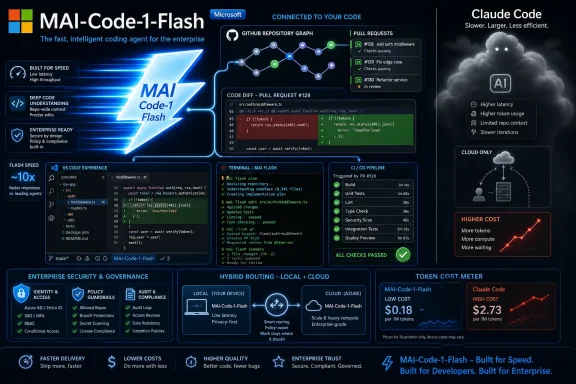
Microsoft unveiled MAI-Code-1-Flash at Build 2026 in early June as part of a seven-model in-house AI push, positioning the 5-billion-parameter coding model inside GitHub Copilot, Visual Studio Code, and its broader developer stack. The comparison to Claude Code is unavoidable, but it is also slightly misleading. Microsoft is not merely trying to win a benchmark duel with Anthropic; it is trying to make coding agents cheaper, more governable, and more tightly bound to the places where enterprise software actually gets written. That makes MAI-Code-1 less of a moonshot and more of a platform weapon.
For years, Microsoft’s AI strategy looked deceptively simple: invest early in OpenAI, wire the models into everything, and let Azure collect the rent. That strategy worked well enough to turn Copilot from a branding exercise into a company-wide operating system, spanning GitHub, Windows, Microsoft 365, Azure, security, and developer tooling. But Build 2026 showed a different Microsoft emerging.
The new MAI family is Microsoft’s clearest statement yet that the company does not want to be permanently dependent on one external frontier lab for its most important software layer. The company still has OpenAI. It is still selling OpenAI models through Azure. It is still building Copilot experiences that benefit from that relationship. But it is now also building an internal model portfolio that can be tuned for Microsoft’s own economics, compliance posture, and product surface.
That matters because AI coding tools are not just another developer convenience. They are quickly becoming a new abstraction layer over source control, build systems, documentation, testing, terminal workflows, and cloud deployment. Whoever owns that layer gets to influence how software is written, reviewed, secured, and shipped.
Claude Code became the symbol of this shift because it felt less like autocomplete and more like a junior engineer with a terminal. Developers adopted it not merely because it could emit plausible code, but because it could navigate projects, make edits, run commands, and iterate. That kind of tool changes workflows in a way a chat pane never did.
Microsoft’s problem is that GitHub is supposed to be the center of that universe. If the most beloved agentic coding experience inside Microsoft itself belongs to Anthropic, then Microsoft has both a product problem and an internal narrative problem. MAI-Code-1 is the company’s answer, but the first version is not best understood as a knockout punch. It is Microsoft putting a stake in the ground and saying the coding layer will not be ceded.
That is why Claude Code became such a useful shorthand for the current state of the coding-agent race. It is not simply that Anthropic’s Claude models are strong at reasoning over code. It is that Claude Code wrapped that capability in a workflow that felt native to how many engineers already work: from the command line, across real repositories, with a bias toward action.
The uncomfortable lesson for Microsoft is that enterprise distribution does not automatically produce developer love. Microsoft owns GitHub. It owns VS Code. It owns Azure. It owns the Windows developer story, however contested that story may be among Linux-first engineers. Yet an outside tool could still become the thing developers talked about with genuine enthusiasm.
That enthusiasm has strategic consequences. Once developers build muscle memory around a tool, the model provider behind it gets a privileged position in the software supply chain. It sees usage patterns, learns where the product fails, and becomes the default tool employees request when they want to move faster. In coding, defaults compound.
So the question is not whether MAI-Code-1 can beat Claude Code in a single benchmark or a carefully staged demo. The question is whether Microsoft can translate its unmatched control of the developer environment into an agentic experience that developers voluntarily prefer. That is a higher bar than shipping a model.
That distinction matters because coding agents are expensive when used carelessly. Developers can burn through tokens rapidly when a model is reading repositories, producing diffs, running failed tests, inspecting logs, and trying again. The most capable model in the world is hard to deploy at massive internal scale if every routine refactor becomes a compute bonfire.
Microsoft understands this better than almost anyone. GitHub Copilot is not a boutique tool for a small group of AI hobbyists. It is a commercial product sold to individuals, startups, governments, and large enterprises that care about price predictability, auditability, and administrative control. The economics of a coding assistant at Microsoft scale are brutally different from the economics of a viral developer tool.
That is why an efficient in-house coding model could matter even if it is not the best model on earth. Microsoft can route smaller tasks to MAI-Code-1-Flash, reserve heavier models for harder reasoning problems, and keep more of the cost structure inside its own cloud and model stack. If the company can make the cheap path good enough for the common path, it can change the economics of Copilot.
The danger is that developers are famously intolerant of tools that save management money while making engineering work worse. If MAI-Code-1 feels like a downgrade from Claude Code, Microsoft will hear about it loudly and quickly. Efficiency is a product advantage only if users do not experience it as austerity.
A coding model tuned for GitHub and VS Code has a different opportunity from a general-purpose coding agent bolted onto a terminal. It can understand not only files, but also the surrounding workflow: who changed what, which tests failed, which issue prompted the change, which dependency has a vulnerability, which branch policy blocks the merge, and which reviewer tends to reject sloppy patches. That is where Microsoft’s model strategy becomes less about intelligence in isolation and more about context density.
The company’s broader Build 2026 framing around Microsoft IQ and Work IQ points in the same direction. Microsoft wants agents to understand the user’s work graph: documents, messages, meetings, calendars, tasks, code, and organizational permissions. In a business environment, the best coding assistant may not be the one that writes the cleverest function. It may be the one that knows which legacy service cannot be touched before quarter-end close.
That is a classic Microsoft move. The company often wins not by having the purest standalone product, but by stitching an acceptable product into a suite where the integration becomes the selling point. Teams did not need to be everyone’s favorite chat app to become unavoidable. Defender did not need to start as the security industry’s prestige product to become a fixture in enterprise stacks. Copilot may follow the same pattern.
Claude’s challenge is that developer affection is powerful but incomplete. Enterprises want controls, procurement channels, data boundaries, compliance documentation, identity integration, and predictable billing. Microsoft already speaks that language fluently. Anthropic has strong enterprise ambitions, but Microsoft owns more of the terrain where enterprise developers spend their day.
If Microsoft’s own engineers prefer Claude Code, that preference is more than an accounting annoyance. It is a signal that the outside tool solved a real developer pain point better than Microsoft’s own offering. Pulling licenses may reduce costs, but it does not automatically produce affection for the replacement.
This is where Microsoft must be careful. Developers can tolerate corporate standardization when the standard tool is excellent, or at least close enough. They are much less forgiving when a mandate replaces a beloved tool with a weaker one. In that scenario, the internal migration becomes a referendum on whether Microsoft’s agentic coding strategy is ready for the people who will test it hardest.
At the same time, dogfooding is exactly what Microsoft should be doing. The company cannot build a serious coding model in a vacuum. Its own engineering org is a sprawling testbed of legacy code, modern services, internal tooling, Windows complexity, Azure-scale infrastructure, and GitHub-native workflows. If MAI-Code-1 can survive inside Microsoft, it will have earned credibility that no synthetic benchmark can provide.
The key distinction is whether Microsoft treats internal adoption as evidence gathering or evidence suppression. If engineers are forced off Claude Code and told the replacement is better, skepticism will grow. If their friction turns directly into product improvements, MAI-Code-1 could improve quickly in the only environment that matters: real work.
A coding benchmark can test whether a model fixes a bug in a controlled repository. It cannot fully capture whether an agent behaves sensibly during a multi-hour refactor, avoids destructive commands, explains tradeoffs clearly, respects local conventions, or knows when to stop. It also cannot capture how much confidence a developer has in the tool after dozens of small interactions.
That confidence is the real product. A coding agent that succeeds spectacularly one moment and makes bizarre changes the next is not merely inconsistent; it imposes a review tax. Developers begin spending mental energy supervising the tool rather than collaborating with it. The productivity gain evaporates if every generated patch must be treated as a suspicious stranger’s pull request.
This is why Claude Code’s reputation matters. Developers are not just comparing model outputs. They are comparing trust. Does the tool understand the repo? Does it ask useful questions? Does it recover from errors? Does it leave the working tree in a sane state? Does it make the developer feel faster without making them feel reckless?
MAI-Code-1 will need to earn that trust in thousands of mundane moments. No Build keynote can shortcut the process. A coding model becomes indispensable not when it dazzles in a demo, but when a developer reaches for it reflexively during a tedious Tuesday afternoon bug hunt.
A smaller coding model fits that vision better than a giant remote-only frontier model. If Microsoft can run useful coding assistance locally or semi-locally on capable hardware, Windows becomes more attractive as an AI development workstation. That would pair naturally with Copilot+ PCs, NPUs, local model runtimes, and enterprise policies that restrict what code can be sent to cloud services.
The local story is not just about latency. It is about data boundaries. Many organizations are reluctant to let proprietary source code, internal logs, or customer-specific configuration flow freely into external model endpoints. A Microsoft-controlled model stack with enterprise administration and possible local execution gives IT departments more knobs to turn.
That does not mean every company will want local coding agents. Cloud models will remain more capable in many cases, and centralized management has obvious benefits. But Microsoft is unusually well positioned to offer a hybrid path: small local models for routine work, larger cloud models for complex tasks, and policy-driven routing across both.
If that vision materializes, MAI-Code-1 becomes more important than its first release suggests. It is not merely a model in Copilot. It is a building block for making Windows, GitHub, Azure, and Microsoft 365 feel like one agent-aware development environment.
That makes audit trails and permissions more than procurement details. An enterprise coding agent needs to show what it read, what it changed, what command it ran, and why. It needs guardrails around secrets, production systems, regulated data, and third-party dependencies. It needs to fit into identity and access systems that already determine who can do what.
Microsoft can plausibly win here because it has spent decades selling control planes to cautious buyers. Azure, Entra, Defender, Purview, Intune, GitHub Advanced Security, and Microsoft 365 compliance tools are all part of the same sales vocabulary. If Copilot’s coding agents plug into those controls, the pitch becomes easier for CIOs.
Anthropic’s advantage is product quality and developer mindshare. Microsoft’s advantage is institutional trust at the purchasing layer. In enterprises, those forces often collide. Developers want the tool that feels best. IT wants the tool it can govern. Finance wants the tool whose costs do not spike unpredictably. Legal wants contractual clarity. Security wants logs.
The winning product will be the one that makes fewer groups feel like they are losing. Claude Code has shown what developers want. Microsoft now has to show it can satisfy developers without frightening the rest of the organization.
But the more interesting story is operational rather than financial. Microsoft is trying to convert AI from an expensive add-on into a controlled layer of its software business. If it succeeds, the upside is not just that Microsoft can say it has its own models. The upside is that it can decide where intelligence lives, how it is priced, how it is governed, and how deeply it is woven into existing products.
That is why Bill Ackman’s reported confidence in Microsoft, or any analyst’s AI stock list, is mostly a sideshow for technologists. The real question is whether Microsoft can make Copilot indispensable enough that customers treat AI assistance like they treat identity, productivity software, endpoint security, and cloud infrastructure: a recurring platform commitment rather than a discretionary experiment.
MAI-Code-1 contributes to that goal only if it improves the product and the economics simultaneously. A weaker model that merely lowers Microsoft’s costs will not excite developers. A brilliant model that is too expensive to deploy broadly will not satisfy finance teams. The sweet spot is a model that is good enough for most coding work, cheap enough to use constantly, and integrated enough that competitors feel peripheral.
That is classic platform strategy. Microsoft does not need every AI interaction to run on the most powerful model in the world. It needs the right model at the right price in the right workflow, with enough quality that users stop thinking about the routing. If MAI-Code-1 helps make that possible, it will matter even before it becomes a Claude killer.
Microsoft’s distribution advantage is immense. GitHub Copilot can appear in the IDE, the repository, the pull request, the command line, and the enterprise admin console. It can be bundled, licensed, audited, and explained in language procurement teams understand. That gives MAI-Code-1 a route to millions of developers that most model teams would envy.
But distribution can also hide mediocrity for only so long. Developers have more visibility into competing tools than ever, and AI coding products are unusually easy to compare in daily use. If Claude Code repeatedly solves the hard problem while Copilot fumbles, the market will know. If Microsoft’s tool is merely “approved” but not admired, unofficial workarounds will flourish.
The strategic question is whether Microsoft can combine its distribution with product urgency. The company has done this before. VS Code became beloved not because Microsoft forced it on developers, but because it was fast, extensible, cross-platform, and genuinely useful. GitHub’s continued relevance depends on similar credibility. Copilot’s future depends on it even more.
MAI-Code-1 therefore sits at the intersection of two Microsoft identities. One is the enterprise platform vendor that can package, govern, and monetize at scale. The other is the developer-tools company that won back trust by shipping products engineers actually like. The coding-agent race will punish Microsoft if it forgets the second identity while exploiting the first.
Those tasks sound modest compared with grand talk of recursive self-improvement and autonomous software factories. But software engineering is built from precisely these tasks. The future does not arrive first as a fully autonomous AI employee. It arrives as a thousand small reductions in friction.
Microsoft has an advantage in seeing those frictions at scale. GitHub gives the company a map of how developers collaborate, where reviews stall, where tests fail, and where security issues enter the pipeline. If MAI-Code-1 can use that context responsibly, it can become more than a code generator. It can become a workflow participant.
That is also where the risks concentrate. An agent that can see more context can leak more context. An agent that can act across more systems can make broader mistakes. An agent that is optimized for speed can normalize superficial review. The more useful the tool becomes, the more serious governance becomes.
This is why the competition with Claude Code is ultimately healthy. Anthropic has pushed the category toward more capable, action-oriented coding tools. Microsoft’s response should push the category toward broader integration, better controls, and lower-cost deployment. Developers benefit if both pressures remain strong.
A few concrete points matter most now:
The next phase of the AI coding race will not be won by the loudest benchmark slide or the most breathless stock-market framing. It will be won in pull requests, terminals, CI logs, admin consoles, and budget meetings, where developers and IT leaders decide whether an agent is a trusted colleague or an expensive liability. MAI-Code-1 is not yet proof that Microsoft can stand toe-to-toe with Claude Code, but it is proof that Microsoft understands the fight has moved from model access to platform control — and that is exactly the kind of fight Microsoft has spent half a century learning how to win.
 Microsoft Is No Longer Content to Rent the Intelligence Layer
For years, Microsoft’s AI strategy looked deceptively simple: invest early in OpenAI, wire the models into everything, and let Azure collect the rent. That strategy worked well enough to turn Copilot from a branding exercise into a company-wide operating system, spanning GitHub, Windows, Microsoft 365, Azure, security, and developer tooling. But Build 2026 showed a different Microsoft emerging.The new MAI family is Microsoft’s clearest statement yet that the company does not want to be permanently dependent on one external frontier lab for its most important software layer. The company still has OpenAI. It is still selling OpenAI models through Azure. It is still building Copilot experiences that benefit from that relationship. But it is now also building an internal model portfolio that can be tuned for Microsoft’s own economics, compliance posture, and product surface.
That matters because AI coding tools are not just another developer convenience. They are quickly becoming a new abstraction layer over source control, build systems, documentation, testing, terminal workflows, and cloud deployment. Whoever owns that layer gets to influence how software is written, reviewed, secured, and shipped.
Claude Code became the symbol of this shift because it felt less like autocomplete and more like a junior engineer with a terminal. Developers adopted it not merely because it could emit plausible code, but because it could navigate projects, make edits, run commands, and iterate. That kind of tool changes workflows in a way a chat pane never did.
Microsoft’s problem is that GitHub is supposed to be the center of that universe. If the most beloved agentic coding experience inside Microsoft itself belongs to Anthropic, then Microsoft has both a product problem and an internal narrative problem. MAI-Code-1 is the company’s answer, but the first version is not best understood as a knockout punch. It is Microsoft putting a stake in the ground and saying the coding layer will not be ceded.
Claude Code Set the Bar by Acting Like a Tool, Not a Demo
Claude Code’s rise exposed a weakness in many AI coding products: developers do not want an assistant that merely explains code in a sidebar. They want an agent that can take a messy repository, understand enough context to make a meaningful change, and then survive the boring parts of engineering. That means tracing dependencies, editing multiple files, running tests, interpreting failures, and trying again without requiring the user to babysit every keystroke.That is why Claude Code became such a useful shorthand for the current state of the coding-agent race. It is not simply that Anthropic’s Claude models are strong at reasoning over code. It is that Claude Code wrapped that capability in a workflow that felt native to how many engineers already work: from the command line, across real repositories, with a bias toward action.
The uncomfortable lesson for Microsoft is that enterprise distribution does not automatically produce developer love. Microsoft owns GitHub. It owns VS Code. It owns Azure. It owns the Windows developer story, however contested that story may be among Linux-first engineers. Yet an outside tool could still become the thing developers talked about with genuine enthusiasm.
That enthusiasm has strategic consequences. Once developers build muscle memory around a tool, the model provider behind it gets a privileged position in the software supply chain. It sees usage patterns, learns where the product fails, and becomes the default tool employees request when they want to move faster. In coding, defaults compound.
So the question is not whether MAI-Code-1 can beat Claude Code in a single benchmark or a carefully staged demo. The question is whether Microsoft can translate its unmatched control of the developer environment into an agentic experience that developers voluntarily prefer. That is a higher bar than shipping a model.
MAI-Code-1 Looks Like an Efficiency Play Before It Looks Like a Frontier Play
The important word in MAI-Code-1-Flash is not necessarily “Code.” It may be “Flash.” Microsoft appears to be signaling that the first priority is speed, cost, and product fit rather than sheer frontier-model dominance. A 5-billion-parameter coding model is not an obvious Claude Opus-class brawler. It is a model designed to be used frequently, routed intelligently, and embedded deeply.That distinction matters because coding agents are expensive when used carelessly. Developers can burn through tokens rapidly when a model is reading repositories, producing diffs, running failed tests, inspecting logs, and trying again. The most capable model in the world is hard to deploy at massive internal scale if every routine refactor becomes a compute bonfire.
Microsoft understands this better than almost anyone. GitHub Copilot is not a boutique tool for a small group of AI hobbyists. It is a commercial product sold to individuals, startups, governments, and large enterprises that care about price predictability, auditability, and administrative control. The economics of a coding assistant at Microsoft scale are brutally different from the economics of a viral developer tool.
That is why an efficient in-house coding model could matter even if it is not the best model on earth. Microsoft can route smaller tasks to MAI-Code-1-Flash, reserve heavier models for harder reasoning problems, and keep more of the cost structure inside its own cloud and model stack. If the company can make the cheap path good enough for the common path, it can change the economics of Copilot.
The danger is that developers are famously intolerant of tools that save management money while making engineering work worse. If MAI-Code-1 feels like a downgrade from Claude Code, Microsoft will hear about it loudly and quickly. Efficiency is a product advantage only if users do not experience it as austerity.
GitHub Is the Moat Claude Cannot Easily Copy
Microsoft’s best argument is not that MAI-Code-1 will immediately reason better than Anthropic’s top coding models. Its best argument is that GitHub remains the gravity well of modern software development. Repositories, pull requests, issues, code review, actions, packages, security alerts, and project metadata all live there for millions of developers and organizations.A coding model tuned for GitHub and VS Code has a different opportunity from a general-purpose coding agent bolted onto a terminal. It can understand not only files, but also the surrounding workflow: who changed what, which tests failed, which issue prompted the change, which dependency has a vulnerability, which branch policy blocks the merge, and which reviewer tends to reject sloppy patches. That is where Microsoft’s model strategy becomes less about intelligence in isolation and more about context density.
The company’s broader Build 2026 framing around Microsoft IQ and Work IQ points in the same direction. Microsoft wants agents to understand the user’s work graph: documents, messages, meetings, calendars, tasks, code, and organizational permissions. In a business environment, the best coding assistant may not be the one that writes the cleverest function. It may be the one that knows which legacy service cannot be touched before quarter-end close.
That is a classic Microsoft move. The company often wins not by having the purest standalone product, but by stitching an acceptable product into a suite where the integration becomes the selling point. Teams did not need to be everyone’s favorite chat app to become unavoidable. Defender did not need to start as the security industry’s prestige product to become a fixture in enterprise stacks. Copilot may follow the same pattern.
Claude’s challenge is that developer affection is powerful but incomplete. Enterprises want controls, procurement channels, data boundaries, compliance documentation, identity integration, and predictable billing. Microsoft already speaks that language fluently. Anthropic has strong enterprise ambitions, but Microsoft owns more of the terrain where enterprise developers spend their day.
The Internal Claude Pullback Is a Product Story Disguised as a Cost Story
Reports that Microsoft has been canceling or reducing internal Claude Code licenses add a sharper edge to the MAI-Code-1 announcement. On the surface, the explanation is straightforward: token-based AI coding usage can become expensive, and Microsoft has every incentive to steer employees toward its own GitHub Copilot CLI and internal model stack. But the deeper issue is product legitimacy.If Microsoft’s own engineers prefer Claude Code, that preference is more than an accounting annoyance. It is a signal that the outside tool solved a real developer pain point better than Microsoft’s own offering. Pulling licenses may reduce costs, but it does not automatically produce affection for the replacement.
This is where Microsoft must be careful. Developers can tolerate corporate standardization when the standard tool is excellent, or at least close enough. They are much less forgiving when a mandate replaces a beloved tool with a weaker one. In that scenario, the internal migration becomes a referendum on whether Microsoft’s agentic coding strategy is ready for the people who will test it hardest.
At the same time, dogfooding is exactly what Microsoft should be doing. The company cannot build a serious coding model in a vacuum. Its own engineering org is a sprawling testbed of legacy code, modern services, internal tooling, Windows complexity, Azure-scale infrastructure, and GitHub-native workflows. If MAI-Code-1 can survive inside Microsoft, it will have earned credibility that no synthetic benchmark can provide.
The key distinction is whether Microsoft treats internal adoption as evidence gathering or evidence suppression. If engineers are forced off Claude Code and told the replacement is better, skepticism will grow. If their friction turns directly into product improvements, MAI-Code-1 could improve quickly in the only environment that matters: real work.
Benchmarks Will Not Decide This Fight
AI companies love benchmark claims because they convert an ambiguous product experience into a clean ranking. Microsoft has already emphasized strong performance for its in-house reasoning model, including coding-related comparisons. Anthropic, OpenAI, Google, and others make similar claims when the numbers flatter them. The problem is that coding-agent usefulness often escapes the benchmark frame.A coding benchmark can test whether a model fixes a bug in a controlled repository. It cannot fully capture whether an agent behaves sensibly during a multi-hour refactor, avoids destructive commands, explains tradeoffs clearly, respects local conventions, or knows when to stop. It also cannot capture how much confidence a developer has in the tool after dozens of small interactions.
That confidence is the real product. A coding agent that succeeds spectacularly one moment and makes bizarre changes the next is not merely inconsistent; it imposes a review tax. Developers begin spending mental energy supervising the tool rather than collaborating with it. The productivity gain evaporates if every generated patch must be treated as a suspicious stranger’s pull request.
This is why Claude Code’s reputation matters. Developers are not just comparing model outputs. They are comparing trust. Does the tool understand the repo? Does it ask useful questions? Does it recover from errors? Does it leave the working tree in a sane state? Does it make the developer feel faster without making them feel reckless?
MAI-Code-1 will need to earn that trust in thousands of mundane moments. No Build keynote can shortcut the process. A coding model becomes indispensable not when it dazzles in a demo, but when a developer reaches for it reflexively during a tedious Tuesday afternoon bug hunt.
Windows Developers Should Watch the Local-Agent Angle
For WindowsForum readers, the most interesting long-term question is how much of this coding-agent stack eventually lands close to the client. Microsoft has spent years trying to make Windows a better home for modern development through WSL, Windows Terminal, Dev Home, VS Code, PowerShell improvements, and tighter GitHub integration. AI agents could become the next layer of that developer experience.A smaller coding model fits that vision better than a giant remote-only frontier model. If Microsoft can run useful coding assistance locally or semi-locally on capable hardware, Windows becomes more attractive as an AI development workstation. That would pair naturally with Copilot+ PCs, NPUs, local model runtimes, and enterprise policies that restrict what code can be sent to cloud services.
The local story is not just about latency. It is about data boundaries. Many organizations are reluctant to let proprietary source code, internal logs, or customer-specific configuration flow freely into external model endpoints. A Microsoft-controlled model stack with enterprise administration and possible local execution gives IT departments more knobs to turn.
That does not mean every company will want local coding agents. Cloud models will remain more capable in many cases, and centralized management has obvious benefits. But Microsoft is unusually well positioned to offer a hybrid path: small local models for routine work, larger cloud models for complex tasks, and policy-driven routing across both.
If that vision materializes, MAI-Code-1 becomes more important than its first release suggests. It is not merely a model in Copilot. It is a building block for making Windows, GitHub, Azure, and Microsoft 365 feel like one agent-aware development environment.
Enterprise IT Will Judge the Agent, Not the Model Card
For sysadmins and IT leaders, the coding-agent race introduces a familiar problem in a new wrapper: how do you safely govern a tool that can act? Traditional developer tools were powerful, but they generally required explicit human execution. Agentic coding systems blur that line by proposing changes, running commands, touching dependencies, and potentially interacting with cloud resources.That makes audit trails and permissions more than procurement details. An enterprise coding agent needs to show what it read, what it changed, what command it ran, and why. It needs guardrails around secrets, production systems, regulated data, and third-party dependencies. It needs to fit into identity and access systems that already determine who can do what.
Microsoft can plausibly win here because it has spent decades selling control planes to cautious buyers. Azure, Entra, Defender, Purview, Intune, GitHub Advanced Security, and Microsoft 365 compliance tools are all part of the same sales vocabulary. If Copilot’s coding agents plug into those controls, the pitch becomes easier for CIOs.
Anthropic’s advantage is product quality and developer mindshare. Microsoft’s advantage is institutional trust at the purchasing layer. In enterprises, those forces often collide. Developers want the tool that feels best. IT wants the tool it can govern. Finance wants the tool whose costs do not spike unpredictably. Legal wants contractual clarity. Security wants logs.
The winning product will be the one that makes fewer groups feel like they are losing. Claude Code has shown what developers want. Microsoft now has to show it can satisfy developers without frightening the rest of the organization.
The Stock-Market Framing Misses the More Interesting Microsoft Story
The article that sparked this discussion framed MAI-Code-1 partly through the lens of Microsoft’s stock and investor sentiment. That is understandable, because AI narratives have become inseparable from market narratives. Every model launch becomes a referendum on whether a megacap stock deserves its multiple.But the more interesting story is operational rather than financial. Microsoft is trying to convert AI from an expensive add-on into a controlled layer of its software business. If it succeeds, the upside is not just that Microsoft can say it has its own models. The upside is that it can decide where intelligence lives, how it is priced, how it is governed, and how deeply it is woven into existing products.
That is why Bill Ackman’s reported confidence in Microsoft, or any analyst’s AI stock list, is mostly a sideshow for technologists. The real question is whether Microsoft can make Copilot indispensable enough that customers treat AI assistance like they treat identity, productivity software, endpoint security, and cloud infrastructure: a recurring platform commitment rather than a discretionary experiment.
MAI-Code-1 contributes to that goal only if it improves the product and the economics simultaneously. A weaker model that merely lowers Microsoft’s costs will not excite developers. A brilliant model that is too expensive to deploy broadly will not satisfy finance teams. The sweet spot is a model that is good enough for most coding work, cheap enough to use constantly, and integrated enough that competitors feel peripheral.
That is classic platform strategy. Microsoft does not need every AI interaction to run on the most powerful model in the world. It needs the right model at the right price in the right workflow, with enough quality that users stop thinking about the routing. If MAI-Code-1 helps make that possible, it will matter even before it becomes a Claude killer.
The Coding-Agent War Is Really a Distribution War
The history of developer tools is littered with products that engineers loved and enterprises struggled to standardize, as well as products enterprises bought and engineers quietly avoided. AI coding agents could go either way. The category is still young enough that habits are forming, but mature enough that the best tools already feel meaningfully different from the rest.Microsoft’s distribution advantage is immense. GitHub Copilot can appear in the IDE, the repository, the pull request, the command line, and the enterprise admin console. It can be bundled, licensed, audited, and explained in language procurement teams understand. That gives MAI-Code-1 a route to millions of developers that most model teams would envy.
But distribution can also hide mediocrity for only so long. Developers have more visibility into competing tools than ever, and AI coding products are unusually easy to compare in daily use. If Claude Code repeatedly solves the hard problem while Copilot fumbles, the market will know. If Microsoft’s tool is merely “approved” but not admired, unofficial workarounds will flourish.
The strategic question is whether Microsoft can combine its distribution with product urgency. The company has done this before. VS Code became beloved not because Microsoft forced it on developers, but because it was fast, extensible, cross-platform, and genuinely useful. GitHub’s continued relevance depends on similar credibility. Copilot’s future depends on it even more.
MAI-Code-1 therefore sits at the intersection of two Microsoft identities. One is the enterprise platform vendor that can package, govern, and monetize at scale. The other is the developer-tools company that won back trust by shipping products engineers actually like. The coding-agent race will punish Microsoft if it forgets the second identity while exploiting the first.
The Real Test Will Be the Pull Request Nobody Talks About
The near-term yardstick for MAI-Code-1 should be boring. Can it handle small bug fixes without over-editing? Can it update tests correctly? Can it explain a failing CI run in a useful way? Can it help a developer understand an unfamiliar code path? Can it generate a pull request that reviewers do not instinctively distrust?Those tasks sound modest compared with grand talk of recursive self-improvement and autonomous software factories. But software engineering is built from precisely these tasks. The future does not arrive first as a fully autonomous AI employee. It arrives as a thousand small reductions in friction.
Microsoft has an advantage in seeing those frictions at scale. GitHub gives the company a map of how developers collaborate, where reviews stall, where tests fail, and where security issues enter the pipeline. If MAI-Code-1 can use that context responsibly, it can become more than a code generator. It can become a workflow participant.
That is also where the risks concentrate. An agent that can see more context can leak more context. An agent that can act across more systems can make broader mistakes. An agent that is optimized for speed can normalize superficial review. The more useful the tool becomes, the more serious governance becomes.
This is why the competition with Claude Code is ultimately healthy. Anthropic has pushed the category toward more capable, action-oriented coding tools. Microsoft’s response should push the category toward broader integration, better controls, and lower-cost deployment. Developers benefit if both pressures remain strong.
Microsoft’s Claude Problem Has Become Its Copilot Opportunity
The simplest reading is that Microsoft launched a coding model because it needs an answer to Claude Code. That is true as far as it goes, but it understates the size of the bet. Microsoft is trying to make Copilot the standard interface between human intent and enterprise software work, and coding is the proving ground where vague agent rhetoric meets unforgiving reality.A few concrete points matter most now:
- MAI-Code-1-Flash is best understood as an embedded efficiency model, not as proof that Microsoft has already surpassed Anthropic in agentic coding.
- Claude Code remains the benchmark for developer excitement because it changed how many engineers think about terminal-based AI assistance.
- Microsoft’s strongest advantage is the combination of GitHub, VS Code, Azure, identity, compliance, and enterprise distribution.
- The reported internal pullback from Claude Code will help Microsoft only if dogfooding produces a better Copilot experience rather than a resentful mandate.
- Windows developers should watch whether smaller coding models become part of a hybrid local-and-cloud agent strategy.
- The decisive test will be daily trust in real repositories, not keynote claims or isolated benchmark wins.
The next phase of the AI coding race will not be won by the loudest benchmark slide or the most breathless stock-market framing. It will be won in pull requests, terminals, CI logs, admin consoles, and budget meetings, where developers and IT leaders decide whether an agent is a trusted colleague or an expensive liability. MAI-Code-1 is not yet proof that Microsoft can stand toe-to-toe with Claude Code, but it is proof that Microsoft understands the fight has moved from model access to platform control — and that is exactly the kind of fight Microsoft has spent half a century learning how to win.
References
- Primary source: aol.com
Published: 2026-06-19T23:50:18.129604
Loading…
www.aol.com - Official source: blogs.microsoft.com
Microsoft Build 2026: Be yourself at work - The Official Microsoft Blog
Platforms shift when developers build. We explore, choose tools, dream, create. This platform shift comes with more information than ever, ready at your fingertips. This shift, it’s about building fast AND THEN: it’s about building, operating, optimizing and observing. Securing your...blogs.microsoft.com - Related coverage: tomsguide.com
Biggest Microsoft Build 2026 announcements — agentic AI, RTX Spark Dev Box, GitHub Copilot app, new MAI models, and more | Tom's Guide
All the big news from Microsoft's AI-focused eventwww.tomsguide.com - Official source: partner.microsoft.com
Microsoft Build 2026: Turning innovation into partner growth
Microsoft Build 2026 highlights AI, agents, and platform updates that create new opportunities for partners to build, scale, and deliver customer solutions.partner.microsoft.com
- Related coverage: geekwire.com
Microsoft unveils seven homegrown AI models in new bid for 'long term self-sufficiency' – GeekWire
Microsoft used its Build conference to unveil seven in-house AI models, including a reasoning model it says draws even with Anthropic's Claude Sonnet 4.6 — part of a push to depend less on the AI partners it has invested billions in.www.geekwire.com - Related coverage: windowscentral.com
Microsoft cancels Claude Code licenses, shifting developers to GitHub Copilot CLI — a move likely driven by financial motives | Windows Central
Claude Code was popular among Microsoft engineers, but the company now wants them to shift to GitHub Copilot CLI.www.windowscentral.com
- Official source: developer.microsoft.com
Microsoft Build 2026 recap: vision, launches, and top sessions - Microsoft for Developers
Catch up on Microsoft Build 2026 with the vision lead-off, top developer announcements, and must-watch sessions across the Microsoft developer ecosystem.developer.microsoft.com - Official source: github.com
Microsoft Build 2026
GitHub is where people build software. More than 150 million people use GitHub to discover, fork, and contribute to over 420 million projects. github.com
- Official source: news.microsoft.com
Loading…
news.microsoft.com - Related coverage: axios.com
Microsoft debuts Scout agent, homegrown reasoning model
Microsoft is seeking to show it is a serious player in AI.www.axios.com
- Related coverage: linkloot.io
Microsoft Build 2026 puts agent context, Scout, and MAI models into one developer stack – Blog | LinkLoot
Microsoft used Build 2026 to frame its agent platform around Microsoft IQ, the Scout personal agent, new MAI models, Frontier Tuning, Agent 365, and local or...linkloot.io - Related coverage: ai.cc
Loading…
www.ai.cc - Related coverage: gihyo.jp
Microsoft Build 2026、AIエージェント開発向けにMicrosoft IQ、MAIモデル、MXCなどを発表 ——Coreutils for WindowsやIntelligent Terminalも | gihyo.jp
Microsoftは2026年6月2日から開催されている開発者イベントMicrosoft Build 2026」で、AIエージェントの構築、実行、管理に関わる開発者向けの発表を行った。gihyo.jp
- Related coverage: techradar.com
Microsoft AI CEO outlines hopes to build “humanist superintelligence”
Microsoft AI CEO Mustafa Suleyman reveals seven new AI models, has unsurprisingly high hopes for an AI-enabled future.www.techradar.com