
Outfit7’s Talking Tom Bubble Shooter received a Windows Phone Store update in early 2016 that added Tom, Angela, and Hank as playable bubble-shooting companions, while also introducing notifications when an opponent uses a power-up during live multiplayer matches. The update was small by console standards, but it said a great deal about the mobile game economy Microsoft was still trying to keep alive. Windows Phone needed familiar brands, live-service cadence, and casual games that could make the Store feel current. Talking Tom Bubble Shooter delivered all three, even if the platform around it was already fighting gravity.
There was nothing accidental about the choice of characters. Tom, Angela, and Hank were not just cosmetic additions; they were Outfit7’s strongest currency, recognizable mascots in a franchise built on repetition, personality, and low-friction play. By bringing them more visibly into Talking Tom Bubble Shooter, Outfit7 made the game feel less like a generic bubble-popping clone and more like a proper extension of the Talking Tom universe.
That mattered on Windows Phone because the platform’s app gap was not only about missing banking apps or late-arriving social networks. It was also about energy. A healthy mobile store feels alive because games receive seasonal events, balance changes, characters, and small quality-of-life improvements that remind users someone is still paying attention.
The new update leaned into precisely that feeling. It did not reinvent the game, but it added company, feedback, and character identity to a formula that depends on short sessions and repeat visits. For a casual game, that kind of update can be more important than a sprawling new mode.
In mobile gaming, the signal is often the cadence. A small update can tell players that the server is still warm, the developer has not walked away, and the storefront is not merely a graveyard of installable artifacts. For Windows Phone users in 2016, that signal carried extra weight.
That is why adding Tom, Angela, and Hank mattered more than the patch notes suggested. In a franchise like Talking Tom, characters are not just avatars. They are the continuity layer that lets a player move from virtual pet to runner to bubble shooter without feeling like they have left the brand behind.
The update’s “enjoy some company” language was simple, but strategically clean. Tom, Angela, and Hank turned the bubble-shooting session into a cast activity. Instead of merely clearing levels, the player was participating in the broader Talking Tom ecosystem, where personality and collection often matter as much as mechanics.
This is the logic that has powered mobile franchises for years. Once a character becomes recognizable, the developer can transport that character into new systems. The game does not have to be mechanically revolutionary if the character gives it a reason to exist.
Windows Phone, for its part, benefited from that portability. A recognizable mobile brand landing in the Store, then continuing to update, gave Microsoft’s platform a small but visible connection to the broader mobile mainstream. That was exactly the kind of connection Windows Phone repeatedly struggled to maintain.
By notifying players when an opponent deploys a power-up, Outfit7 sharpened the game’s feedback loop. The player is not simply watching bubbles disappear. They are being told that another human being has acted, and that their own next move may need to change.
That distinction is important because casual multiplayer depends on legibility. Players have to understand why they are winning, why they are losing, and when the match has shifted. If a power-up changes the board state without a clear cue, the game can feel arbitrary. If the game tells you what happened, frustration becomes rivalry.
For Windows Phone users, live multiplayer was also a reminder that the platform could still participate in contemporary mobile design. The strongest mobile games of the period were not just apps; they were services. They connected users, measured them against one another, and gave them reasons to return.
Talking Tom Bubble Shooter’s multiplayer ambitions were not novel, but they were exactly the kind of routine modernity the Windows Store needed. The problem for Microsoft was that routine modernity had to arrive consistently, across thousands of apps, not just in scattered updates from motivated publishers.
Talking Tom Bubble Shooter’s update fits that second model. New characters added identity and collectability. Opponent power-up notifications added clarity and pressure. Neither feature required a massive content drop, but both served the daily-session economy that casual games rely on.
That is the quiet machinery behind many successful mobile games. They are not static products so much as behavioral loops wrapped in friendly art. The player wins to level up, collects stickers, unlocks features, experiments with power-ups, and then returns because the next session promises another small piece of progress.
The game’s feature set was built around that rhythm. Bosses provided milestones. Stickers turned victory into collection. Multiplayer supplied comparison. Power-ups made individual moments feel decisive. The Talking Tom cast supplied personality.
Seen that way, the update was not just “new characters and more.” It was a refinement of the game’s retention architecture. Outfit7 was making sure that the player had a stronger emotional hook and better competitive information at the exact points where casual players often decide whether to keep playing.
Casual games occupy a deceptively important place in app ecosystems. They fill idle time, create storefront traffic, generate in-app economy, and help make a device feel socially normal. A phone without the games people expect can feel less like a principled alternative and more like a compromise.
That is why a Talking Tom update was more than a children’s-game footnote. Outfit7 was a known mobile publisher with cross-platform reach. Its presence on Windows Phone helped reassure users that the Store had at least some of the same cultural furniture as Android and iOS.
But the update also exposed the fragility of Microsoft’s position. Windows Phone could receive updates from major casual brands, but it needed those updates at scale and over time. An individual game could make the Store look alive for a day; the platform needed that feeling every week.
This was the app-gap problem in miniature. Microsoft did not merely need apps to exist. It needed developers to treat Windows as a first-class destination, with simultaneous launches, feature parity, and continuing support. Talking Tom Bubble Shooter showed what that looked like when it happened.
For users, the Store link meant convenience. For publishers, it meant conversion. For Microsoft, it meant proof that the storefront still had content worth promoting. A casual game update could become a traffic event, however small.
The appbox format used by Windows-focused sites also reflected the period’s editorial habits. App updates were news because Store activity itself was news. A new version, a feature tweak, or a character pack could justify a post because readers were hungry for signs that their platform had not been forgotten.
That context is easy to miss now. Today, most users expect app updates to happen silently in the background. In the Windows Phone community, updates were often watched closely because each one doubled as a confidence indicator.
Talking Tom Bubble Shooter’s update therefore operated on two levels. It improved the game for existing players, and it gave the Windows community another reason to believe the platform still had developer attention. The first was product news; the second was morale.
A game like Talking Tom Bubble Shooter needed to be easy to find, install, and understand. It needed performance good enough for quick sessions. It needed updates that arrived without drama. It needed the Store to handle the boring infrastructure of modern app distribution.
If any of those pieces failed, the brand suffered along with the platform. A child does not care whether the problem is a developer delay, a Store issue, or a platform limitation. The game either works and feels current, or it does not.
That is why recognizable casual franchises were valuable to Microsoft. They made the Windows Store legible to ordinary families, not just enthusiasts. A parent browsing a Windows Phone device could see Talking Tom and understand that the platform had familiar entertainment options.
The irony is that Windows Phone’s most passionate defenders often emphasized what made the platform different, while mass-market success required a great deal of sameness. Users wanted the distinctive interface, but they also wanted the same games their friends had. Talking Tom Bubble Shooter lived in that tension.
Power-ups are inherently disruptive. They compress skill, timing, and luck into a single dramatic action. That makes them fun, but it also makes them dangerous from a design perspective. If the opponent’s advantage appears from nowhere, the match can feel rigged.
A notification creates accountability. It tells the player that a specific action occurred, not that the game arbitrarily changed conditions. It preserves the emotional heat of competition while reducing the suspicion that the system is unfair.
This is a small example of a larger mobile design principle: transparency is part of retention. Games that rely on repeated competitive sessions have to keep defeat intelligible. If players cannot read the match, they eventually stop caring about the outcome.
For a bubble shooter, that kind of clarity can be the difference between “one more round” and closing the app. Outfit7’s update recognized that the social layer needed communication, not merely matchmaking.
That is one reason mobile publishers love franchise ecosystems. A runner, a pet simulator, a puzzle game, and a bubble shooter can all reinforce one another if the cast is strong enough. Each app becomes both a product and an advertisement for the rest of the family.
For Outfit7, this strategy gave the company flexibility. Bubble shooters were popular, but crowded. The Talking Tom brand provided differentiation in a genre where mechanics alone were unlikely to stand out.
For Microsoft, the same strategy created a halo effect. A Windows Phone user who saw Talking Tom Bubble Shooter in the Store was not just seeing a single game; they were seeing evidence that a major mobile entertainment brand had made room for Windows. In platform politics, perception often precedes reality.
That perception was especially important because Windows Phone’s technical qualities were not always the problem. Many users liked the operating system. The harder question was whether enough developers and publishers would keep showing up. Updates like this supplied an answer, but only one app at a time.
That hindsight can distort the story if we let it. The update was not written as a eulogy. It was ordinary news for ordinary users: a game got new characters, a multiplayer cue improved, and fans were told to download the latest version.
But ordinary news is exactly what dying platforms lose first. Before a platform formally ends, it stops feeling routine. Updates become sporadic. Announcements become exceptions. Users begin to celebrate maintenance because maintenance is no longer guaranteed.
That is why small app updates from the Windows Phone era have become oddly revealing. They show the platform not at the level of corporate strategy, but at the level of daily use. They remind us that ecosystems are experienced through mundane continuity.
The Talking Tom Bubble Shooter update was mundane continuity. That was its strength. It made Windows Phone feel, for a moment, like just another place where mobile games kept improving.
That distinction matters because abandoned apps are worse than absent apps in some ways. An absent app tells users a platform lacks support. An abandoned app tells users support arrived and then faded. The emotional effect can be more corrosive.
By shipping an update, Outfit7 kept the promise of presence alive. It told players that the Windows version still belonged to the same living product family as the versions elsewhere. Even if feature parity was imperfect, the update mattered because it suggested ongoing care.
For Windows Phone enthusiasts, that kind of care was often enough to generate attention. Communities formed around the monitoring of app movement: what arrived, what disappeared, what updated, what broke. The Store became a barometer.
Talking Tom Bubble Shooter’s update moved the needle in the right direction. It was not a platform rescue. It was a useful reminder that platform health is built from thousands of such small commitments, and Windows Phone never had enough of them for long enough.
That lesson still applies to Windows, even outside phones. Microsoft continues to court developers across the Microsoft Store, Xbox, Windows on Arm, Progressive Web Apps, Android app experiments, and cloud-backed distribution models. The names have changed, but the underlying trust problem is familiar.
Users do not judge a platform only by launch-day announcements. They judge it by whether the apps they care about keep working and keep improving. Developers judge it by whether there is enough audience, tooling, revenue, and strategic clarity to justify the effort.
Talking Tom Bubble Shooter’s update was a modest example of that bargain functioning. Outfit7 had a game, Microsoft had a Store, and users had a recognizable franchise receiving new content. Nothing about that arrangement was technically spectacular, but it was exactly the kind of normalcy Windows Phone needed more often.
The fact that such updates now feel noteworthy in retrospect says something uncomfortable about Microsoft’s mobile era. The platform could produce moments of normalcy. It could not produce enough inevitability.
That urgency is what Android and iOS had in abundance. Developers went where users were, users went where apps were, and each side reinforced the other. Windows Phone spent years trying to interrupt that loop, sometimes with elegant software and sometimes with incentives, but never with enough gravitational pull.
In that sense, Talking Tom Bubble Shooter was both a win and a warning. The win was that a popular casual franchise received a real update on Windows Phone. The warning was that such wins needed to be unremarkable, not newsworthy.
The update gave players more characters, clearer multiplayer feedback, and another reason to open the game. It also gave the Windows Phone community a brief glimpse of the platform it wanted: lively, familiar, supported, and connected to the same mobile culture as everyone else. The hard truth is that ecosystems are not saved by one good patch, but they are built from countless patches like it; Microsoft’s next consumer platform push will need not only better technology, but the kind of everyday developer confidence that makes updates feel routine again.
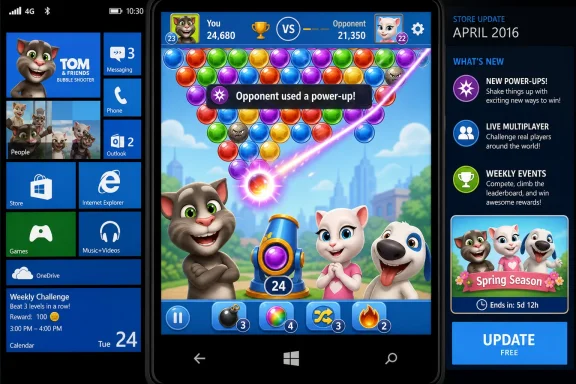 A Cute Cat Update Arrived in a Store That Needed Momentum
There was nothing accidental about the choice of characters. Tom, Angela, and Hank were not just cosmetic additions; they were Outfit7’s strongest currency, recognizable mascots in a franchise built on repetition, personality, and low-friction play. By bringing them more visibly into Talking Tom Bubble Shooter, Outfit7 made the game feel less like a generic bubble-popping clone and more like a proper extension of the Talking Tom universe.That mattered on Windows Phone because the platform’s app gap was not only about missing banking apps or late-arriving social networks. It was also about energy. A healthy mobile store feels alive because games receive seasonal events, balance changes, characters, and small quality-of-life improvements that remind users someone is still paying attention.
The new update leaned into precisely that feeling. It did not reinvent the game, but it added company, feedback, and character identity to a formula that depends on short sessions and repeat visits. For a casual game, that kind of update can be more important than a sprawling new mode.
In mobile gaming, the signal is often the cadence. A small update can tell players that the server is still warm, the developer has not walked away, and the storefront is not merely a graveyard of installable artifacts. For Windows Phone users in 2016, that signal carried extra weight.
Outfit7 Understood That Characters Are the Platform
Talking Tom Bubble Shooter sat at the intersection of two reliable mobile-game instincts: a familiar arcade mechanic and a character brand that could travel between genres. Bubble shooters were already a known quantity, with decades of lineage behind the match-and-pop rhythm. Outfit7’s job was not to explain the mechanic; it was to make the mechanic feel like it belonged to Tom and his friends.That is why adding Tom, Angela, and Hank mattered more than the patch notes suggested. In a franchise like Talking Tom, characters are not just avatars. They are the continuity layer that lets a player move from virtual pet to runner to bubble shooter without feeling like they have left the brand behind.
The update’s “enjoy some company” language was simple, but strategically clean. Tom, Angela, and Hank turned the bubble-shooting session into a cast activity. Instead of merely clearing levels, the player was participating in the broader Talking Tom ecosystem, where personality and collection often matter as much as mechanics.
This is the logic that has powered mobile franchises for years. Once a character becomes recognizable, the developer can transport that character into new systems. The game does not have to be mechanically revolutionary if the character gives it a reason to exist.
Windows Phone, for its part, benefited from that portability. A recognizable mobile brand landing in the Store, then continuing to update, gave Microsoft’s platform a small but visible connection to the broader mobile mainstream. That was exactly the kind of connection Windows Phone repeatedly struggled to maintain.
Multiplayer Turned Bubble Popping Into a Social Clock
The update also added a notification when an opponent used a power-up, a tiny interface change with a sharper competitive purpose. In a single-player puzzle game, power-ups are tools. In live multiplayer, they become messages. A bomb or laser is no longer just a way to clear bubbles; it is a declaration that the other player is changing the tempo.By notifying players when an opponent deploys a power-up, Outfit7 sharpened the game’s feedback loop. The player is not simply watching bubbles disappear. They are being told that another human being has acted, and that their own next move may need to change.
That distinction is important because casual multiplayer depends on legibility. Players have to understand why they are winning, why they are losing, and when the match has shifted. If a power-up changes the board state without a clear cue, the game can feel arbitrary. If the game tells you what happened, frustration becomes rivalry.
For Windows Phone users, live multiplayer was also a reminder that the platform could still participate in contemporary mobile design. The strongest mobile games of the period were not just apps; they were services. They connected users, measured them against one another, and gave them reasons to return.
Talking Tom Bubble Shooter’s multiplayer ambitions were not novel, but they were exactly the kind of routine modernity the Windows Store needed. The problem for Microsoft was that routine modernity had to arrive consistently, across thousands of apps, not just in scattered updates from motivated publishers.
The Update Was Small Because the Mobile Game Was Already a Service
A traditional game update might be judged by size: new levels, new campaign chapters, new mechanics, new art. A mobile game update is often judged by retention logic. Does it create one more reason to open the app? Does it reduce confusion? Does it make the player feel that progress continues?Talking Tom Bubble Shooter’s update fits that second model. New characters added identity and collectability. Opponent power-up notifications added clarity and pressure. Neither feature required a massive content drop, but both served the daily-session economy that casual games rely on.
That is the quiet machinery behind many successful mobile games. They are not static products so much as behavioral loops wrapped in friendly art. The player wins to level up, collects stickers, unlocks features, experiments with power-ups, and then returns because the next session promises another small piece of progress.
The game’s feature set was built around that rhythm. Bosses provided milestones. Stickers turned victory into collection. Multiplayer supplied comparison. Power-ups made individual moments feel decisive. The Talking Tom cast supplied personality.
Seen that way, the update was not just “new characters and more.” It was a refinement of the game’s retention architecture. Outfit7 was making sure that the player had a stronger emotional hook and better competitive information at the exact points where casual players often decide whether to keep playing.
Windows Phone Needed Casual Games More Than It Liked to Admit
Windows Phone was often discussed through the language of productivity, design, and Microsoft ecosystem integration. Live Tiles, Office, Outlook, OneDrive, and a clean visual identity gave the platform a distinctive pitch. But mobile platforms are not sustained by productivity alone.Casual games occupy a deceptively important place in app ecosystems. They fill idle time, create storefront traffic, generate in-app economy, and help make a device feel socially normal. A phone without the games people expect can feel less like a principled alternative and more like a compromise.
That is why a Talking Tom update was more than a children’s-game footnote. Outfit7 was a known mobile publisher with cross-platform reach. Its presence on Windows Phone helped reassure users that the Store had at least some of the same cultural furniture as Android and iOS.
But the update also exposed the fragility of Microsoft’s position. Windows Phone could receive updates from major casual brands, but it needed those updates at scale and over time. An individual game could make the Store look alive for a day; the platform needed that feeling every week.
This was the app-gap problem in miniature. Microsoft did not merely need apps to exist. It needed developers to treat Windows as a first-class destination, with simultaneous launches, feature parity, and continuing support. Talking Tom Bubble Shooter showed what that looked like when it happened.
The Store Link Was the Most Important Sentence
The original update notice ended the way Windows Phone app stories often did: with a prompt to hit the Store link and download the game. That may seem like boilerplate, but in the Windows Phone era it was the whole point. Discovery was a constant battle, and every live app link was a small act of ecosystem maintenance.For users, the Store link meant convenience. For publishers, it meant conversion. For Microsoft, it meant proof that the storefront still had content worth promoting. A casual game update could become a traffic event, however small.
The appbox format used by Windows-focused sites also reflected the period’s editorial habits. App updates were news because Store activity itself was news. A new version, a feature tweak, or a character pack could justify a post because readers were hungry for signs that their platform had not been forgotten.
That context is easy to miss now. Today, most users expect app updates to happen silently in the background. In the Windows Phone community, updates were often watched closely because each one doubled as a confidence indicator.
Talking Tom Bubble Shooter’s update therefore operated on two levels. It improved the game for existing players, and it gave the Windows community another reason to believe the platform still had developer attention. The first was product news; the second was morale.
The Children’s Game Was Also a Storefront Test
It would be tempting to dismiss the update as lightweight because the game was colorful, character-driven, and aimed at casual players. That would be a mistake. Children’s and family-friendly games are among the clearest tests of a consumer platform because they depend on broad reach, low friction, and parental trust.A game like Talking Tom Bubble Shooter needed to be easy to find, install, and understand. It needed performance good enough for quick sessions. It needed updates that arrived without drama. It needed the Store to handle the boring infrastructure of modern app distribution.
If any of those pieces failed, the brand suffered along with the platform. A child does not care whether the problem is a developer delay, a Store issue, or a platform limitation. The game either works and feels current, or it does not.
That is why recognizable casual franchises were valuable to Microsoft. They made the Windows Store legible to ordinary families, not just enthusiasts. A parent browsing a Windows Phone device could see Talking Tom and understand that the platform had familiar entertainment options.
The irony is that Windows Phone’s most passionate defenders often emphasized what made the platform different, while mass-market success required a great deal of sameness. Users wanted the distinctive interface, but they also wanted the same games their friends had. Talking Tom Bubble Shooter lived in that tension.
The Power-Up Notification Was a Lesson in Fairness
The most interesting mechanical addition in the update may have been the opponent power-up notification. It sounds minor until you think about how competitive casual games manage trust. Players will accept losing if they understand why they lost. They are less forgiving when the game appears to hide the reason.Power-ups are inherently disruptive. They compress skill, timing, and luck into a single dramatic action. That makes them fun, but it also makes them dangerous from a design perspective. If the opponent’s advantage appears from nowhere, the match can feel rigged.
A notification creates accountability. It tells the player that a specific action occurred, not that the game arbitrarily changed conditions. It preserves the emotional heat of competition while reducing the suspicion that the system is unfair.
This is a small example of a larger mobile design principle: transparency is part of retention. Games that rely on repeated competitive sessions have to keep defeat intelligible. If players cannot read the match, they eventually stop caring about the outcome.
For a bubble shooter, that kind of clarity can be the difference between “one more round” and closing the app. Outfit7’s update recognized that the social layer needed communication, not merely matchmaking.
The Franchise Model Made the Game Feel Bigger Than It Was
Talking Tom Bubble Shooter did not need to carry the full weight of world-building because the Talking Tom franchise had already done much of that work elsewhere. Tom, Angela, and Hank arrived with existing associations. Players did not need a lore dump to understand that these characters were supposed to make the game friendlier and more expressive.That is one reason mobile publishers love franchise ecosystems. A runner, a pet simulator, a puzzle game, and a bubble shooter can all reinforce one another if the cast is strong enough. Each app becomes both a product and an advertisement for the rest of the family.
For Outfit7, this strategy gave the company flexibility. Bubble shooters were popular, but crowded. The Talking Tom brand provided differentiation in a genre where mechanics alone were unlikely to stand out.
For Microsoft, the same strategy created a halo effect. A Windows Phone user who saw Talking Tom Bubble Shooter in the Store was not just seeing a single game; they were seeing evidence that a major mobile entertainment brand had made room for Windows. In platform politics, perception often precedes reality.
That perception was especially important because Windows Phone’s technical qualities were not always the problem. Many users liked the operating system. The harder question was whether enough developers and publishers would keep showing up. Updates like this supplied an answer, but only one app at a time.
A 2016 App Update Now Reads Like Platform Archaeology
Looking back from 2026, the update has a different texture. What once looked like a routine Store post now reads like a fragment from the final active years of Microsoft’s phone ambitions. The language of “Windows Phone store” belongs to a period when Microsoft still hoped a third mobile ecosystem could remain viable.That hindsight can distort the story if we let it. The update was not written as a eulogy. It was ordinary news for ordinary users: a game got new characters, a multiplayer cue improved, and fans were told to download the latest version.
But ordinary news is exactly what dying platforms lose first. Before a platform formally ends, it stops feeling routine. Updates become sporadic. Announcements become exceptions. Users begin to celebrate maintenance because maintenance is no longer guaranteed.
That is why small app updates from the Windows Phone era have become oddly revealing. They show the platform not at the level of corporate strategy, but at the level of daily use. They remind us that ecosystems are experienced through mundane continuity.
The Talking Tom Bubble Shooter update was mundane continuity. That was its strength. It made Windows Phone feel, for a moment, like just another place where mobile games kept improving.
The Real Story Was Not the Bubbles
The headline feature was new characters, but the deeper story was ecosystem participation. Outfit7 was not merely dropping an app into the Store and leaving it untouched. It was iterating, tuning, and bringing recognizable franchise elements into the Windows version.That distinction matters because abandoned apps are worse than absent apps in some ways. An absent app tells users a platform lacks support. An abandoned app tells users support arrived and then faded. The emotional effect can be more corrosive.
By shipping an update, Outfit7 kept the promise of presence alive. It told players that the Windows version still belonged to the same living product family as the versions elsewhere. Even if feature parity was imperfect, the update mattered because it suggested ongoing care.
For Windows Phone enthusiasts, that kind of care was often enough to generate attention. Communities formed around the monitoring of app movement: what arrived, what disappeared, what updated, what broke. The Store became a barometer.
Talking Tom Bubble Shooter’s update moved the needle in the right direction. It was not a platform rescue. It was a useful reminder that platform health is built from thousands of such small commitments, and Windows Phone never had enough of them for long enough.
The Store Era Left a Simple Lesson for Today’s Windows Apps
The legacy of this update is not that every casual game patch deserves historical treatment. It is that app ecosystems live or die by the boring stuff: updates, parity, discoverability, notifications, compatibility, and the confidence that an installed app will not become a relic overnight.That lesson still applies to Windows, even outside phones. Microsoft continues to court developers across the Microsoft Store, Xbox, Windows on Arm, Progressive Web Apps, Android app experiments, and cloud-backed distribution models. The names have changed, but the underlying trust problem is familiar.
Users do not judge a platform only by launch-day announcements. They judge it by whether the apps they care about keep working and keep improving. Developers judge it by whether there is enough audience, tooling, revenue, and strategic clarity to justify the effort.
Talking Tom Bubble Shooter’s update was a modest example of that bargain functioning. Outfit7 had a game, Microsoft had a Store, and users had a recognizable franchise receiving new content. Nothing about that arrangement was technically spectacular, but it was exactly the kind of normalcy Windows Phone needed more often.
The fact that such updates now feel noteworthy in retrospect says something uncomfortable about Microsoft’s mobile era. The platform could produce moments of normalcy. It could not produce enough inevitability.
Tom, Angela, and Hank Point to the Part Microsoft Couldn’t Patch
The most concrete reading of the update is simple:- Talking Tom Bubble Shooter added Tom, Angela, and Hank as bubble-shooting companions in its Windows Phone Store update.
- The update also added a notification that alerts players when an opponent uses a power-up in live multiplayer.
- The game already leaned on boss battles, stickers, unlockable features, and power-ups to keep casual sessions moving.
- The update mattered because recognizable mobile franchises helped the Windows Store feel current and credible.
- The larger platform problem was that Windows Phone needed this kind of continuing developer support broadly, not occasionally.
That urgency is what Android and iOS had in abundance. Developers went where users were, users went where apps were, and each side reinforced the other. Windows Phone spent years trying to interrupt that loop, sometimes with elegant software and sometimes with incentives, but never with enough gravitational pull.
In that sense, Talking Tom Bubble Shooter was both a win and a warning. The win was that a popular casual franchise received a real update on Windows Phone. The warning was that such wins needed to be unremarkable, not newsworthy.
The update gave players more characters, clearer multiplayer feedback, and another reason to open the game. It also gave the Windows Phone community a brief glimpse of the platform it wanted: lively, familiar, supported, and connected to the same mobile culture as everyone else. The hard truth is that ecosystems are not saved by one good patch, but they are built from countless patches like it; Microsoft’s next consumer platform push will need not only better technology, but the kind of everyday developer confidence that makes updates feel routine again.
References
- Primary source: nokiapoweruser.com
Published: 2026-06-19T20:20:11.790424
Talking Tom Bubble Shooter Game Updated In Windows Store With New Characters And More - NPowerUser
Talking Tom Bubble Shooter Game Updated In Windows Store With New Characters And More - Read in Apps / Games on NPowerUser nokiapoweruser.com
- Related coverage: talkingfriends.fandom.com
Talking Tom Bubble Shooter/Features | Talking Tom & Friends Wiki | Fandom
To earn achievements you need to login into Google Play Games or Game Center.talkingfriends.fandom.com
- Related coverage: appresoure.com
Talking Tom Bubble Shooter latest version 2025,2026 Free Download & App Reviews for Windows 11,Windows 10 - Windows App Store
Talking Tom Bubble Shooter latest version 2025,2026 Free Download & App Reviews,see screenshots, and compare ratingsdownload this app from Microsoft store for windows 11, windows 10www.appresoure.com - Related coverage: mactech.com
- Related coverage: windowsden.uk
- Related coverage: licenseglobal.com
‘Talking Tom’ Bursts into New App | License Global
Outfit7, the company behind “Talking Tom,” is bringing the frisky kitty and his friends to a new app–“Talking Tom Bubble Shooter.”www.licenseglobal.com
- Official source: play.google.com
- Related coverage: intel.cn
- Related coverage: betson.com