
Artificial intelligence is not poised to replace African workers wholesale in 2026; rather, its rapid adoption in markets such as Nigeria is forcing governments and businesses to confront inefficient processes that have long been masked by abundant, low-cost human labor. That is the sharper reading of the BusinessDay argument now circulating through Africa’s tech and policy circles. The panic over job replacement is understandable, but it risks mistaking the symptom for the disease. AI’s first major impact may be less about eliminating workers than exposing just how much work has been wasted by broken systems.
Every technological wave arrives with a body count already imagined. The loom was supposed to destroy artisans, the spreadsheet was supposed to flatten clerical work, and the web was supposed to disintermediate whole layers of professional life. Some of those fears were justified in specific industries, but the broader story was always more complicated: technology rarely removes work from the economy; it changes where value is created and who is equipped to capture it.
AI has made that old anxiety feel new because it does not merely automate muscle or arithmetic. It drafts memos, writes code, summarizes contracts, answers customers, classifies images, predicts risk, and produces the kind of polished administrative output that used to signal professional competence. For African workers in banks, call centers, public agencies, hospitals, media companies, logistics firms, and software shops, this is not an abstract future. The tools are already on phones and browsers.
Nigeria’s reported AI usage numbers make the point. NITDA’s director-general has said that 70 percent of Nigeria’s online population has used generative AI tools, above the reported global average of 48 percent. Whatever caveats attach to survey methodology, the direction is clear: this is not a continent waiting politely for the AI revolution to arrive through a government white paper.
That matters because adoption is not being driven only by corporate transformation programs. It is being driven by students, freelancers, entrepreneurs, customer support agents, developers, marketers, and administrators trying to get through the day faster. AI is already entering African workplaces through the side door, long before many organizations have decided what their official policy is.
This is not a uniquely African problem, but it is particularly consequential in African economies where unemployment, underemployment, and informality distort the politics of efficiency. When work is scarce, any job can look socially valuable even if the system around it is wasteful. That makes reform difficult, because productivity improvements can be framed as threats rather than as the precondition for better wages and better services.
But low productivity is not a harmless inconvenience. It is a tax on everyone. It raises the cost of doing business, slows public services, weakens competitiveness, frustrates citizens, and keeps workers stuck in low-value coordination tasks instead of higher-value judgment, relationship, design, technical, and supervisory work.
AI makes this harder to ignore because it gives managers, citizens, and workers a visible comparison point. If a chatbot can triage routine customer questions in seconds, why is a customer waiting three days for a basic response? If a claims system can flag missing documents instantly, why does a claimant spend weeks in a queue? If a document model can summarize a file and route it to the correct desk, why does the same file still require a human relay race across departments?
Take customer service. The simplistic framing says AI will replace representatives. The more useful framing asks why representatives spend so much of their time answering repeated, low-complexity questions whose answers already exist somewhere in the organization. The job worth preserving is not the act of telling a customer for the hundredth time how to reset a password, locate a payment, or check an application status. The job worth preserving is solving the cases where context, empathy, discretion, and authority matter.
The same is true in insurance. A claims officer who spends the day checking whether a form is complete is not being used well. A claims officer who investigates ambiguous cases, detects fraud patterns, explains decisions, and improves the process is doing work that has higher value. AI does not remove the need for accountability; it changes where accountability should sit.
Public administration may be the highest-stakes example. Many citizens experience government not as a set of rights and services, but as a maze of forms, counters, signatures, and waiting rooms. If AI can help route requests, detect inconsistencies, translate citizen queries, summarize case histories, and support decision-making, then the moral question changes. The burden is no longer on citizens to endure slow services because “that is how the system works.” The burden is on the system to justify why delay remains necessary.
A country does not become rich simply by having more people employed in low-output activities. It becomes richer when workers can produce more value per hour, when firms can scale without drowning in coordination costs, and when public institutions can deliver services without consuming absurd amounts of time and paperwork. AI enters this debate not as magic, but as a forcing mechanism.
This is why the “AI versus jobs” framing is too small. It treats employment as the final measure of economic health, when employment quality and output matter just as much. A million people trapped in low-wage, low-productivity work are not evidence of a strong economic model. They are evidence of a system that has not yet learned how to multiply human effort.
For African economies with young populations, this distinction is decisive. Demography can be a dividend, but it is not automatically one. A young workforce without productive tools, reliable infrastructure, functioning institutions, and scalable firms can become a pressure point rather than an advantage. AI will not solve those structural constraints by itself, but it will make their costs more visible.
The stronger approach is to identify bottlenecks. Where does work wait? Where do errors repeat? Where do customers disappear? Where do approvals stall? Where do teams duplicate effort because systems do not talk to each other? These are the places where AI can convert directly into speed, quality, and trust.
In practical terms, that means AI should be treated less like a novelty and more like process infrastructure. A bank should not merely ask whether a model can write marketing copy. It should ask whether AI can reduce loan processing friction, improve fraud detection, strengthen compliance reviews, and give branch staff better decision support. A hospital should not stop at using AI to draft administrative emails. It should ask whether patient intake, scheduling, records management, and billing can become less punishing for staff and patients alike.
The distinction matters because automation without redesign often disappoints. If an organization drops AI into a chaotic process, it may accelerate the chaos. Bad data moves faster. Poor decisions become more scalable. Accountability becomes harder to locate. The winners will be the institutions that use AI as an excuse to simplify, standardize, measure, and govern work that should have been fixed years ago.
But the worker who understands why those failures happen becomes more important. AI systems need domain knowledge. They need people who can define the right problem, test the output, spot the exception, escalate the risky case, and explain what the model missed. In real organizations, the difference between useful automation and expensive theater is often the person who knows the messy operational truth.
This is especially relevant in African markets where local context matters. Language, informal business practices, identity systems, cash-flow patterns, regulatory gaps, infrastructure interruptions, and customer behavior do not always map neatly onto imported software assumptions. A model can summarize a policy, but a frontline worker may know why customers ignore it. A model can flag a transaction, but a fraud analyst may understand the local pattern behind it.
That creates an opportunity for workers to move up the value chain, but only if employers invest in redesign and training rather than treating AI as a plug-in replacement for people. The promise of augmentation is real, but it is not automatic. It has to be managed, budgeted, measured, and negotiated inside workplaces.
The temptation will be to produce strategies, councils, ethics frameworks, and national AI ambitions. Those may be necessary, but they are not sufficient. Citizens will judge AI in government by whether it reduces queues, improves transparency, speeds payments, detects leakage, expands language access, and makes services less arbitrary. A PDF strategy does not renew a license, process a benefit, clear goods at a port, or fix a hospital record.
The deeper issue is institutional readiness. AI requires clean data, interoperable systems, clear rules, cybersecurity discipline, procurement competence, and human accountability. Without those foundations, public-sector AI can become another layer of complexity on top of old dysfunction. Worse, it can turn opaque bureaucracy into opaque automation.
That is why the most important government AI projects may be boring. Digitizing records properly, creating reliable identity rails, standardizing service workflows, cleaning registries, improving cloud and data governance, and training civil servants are not glamorous compared with launching a national model. But those are the foundations that determine whether AI improves service delivery or merely gives politicians a new technology slogan.
This matters for African businesses and governments because AI dependency can quietly reproduce older forms of technological dependence. If critical workflows rely on externally hosted models, foreign cloud platforms, proprietary APIs, and pricing decisions made elsewhere, then local organizations gain capability while also inheriting vulnerability. The tool works until the terms change, the price rises, the service degrades, the regulator intervenes, or the vendor’s priorities shift.
That does not mean every country needs to build frontier models from scratch. For most, that would be an expensive distraction. But it does mean AI strategy should include data governance, local language resources, regional compute capacity, open standards, model evaluation, procurement rules, and domestic technical talent. The point is not autarky. The point is bargaining power.
For businesses, the lesson is similar. Using AI widely is not the same as using it strategically. If employees are pasting sensitive customer data into consumer tools, the organization has adoption without governance. If managers demand AI outputs without understanding model limits, the organization has enthusiasm without competence. If a company pays for AI subscriptions but leaves the underlying workflow untouched, it has bought theater.
This is where Africa’s AI productivity story becomes more complicated. A young, mobile-first population can adopt tools quickly, but broad economic transformation requires more than individual experimentation. Firms need dependable connectivity. Schools need trained teachers and devices. Hospitals need digitized records. Courts need case management systems. Ports need integrated logistics data. Tax authorities need accurate registries. Farmers need extension systems that can turn AI insight into practical action.
The gap between consumer AI use and institutional AI transformation is large. It is one thing for a student in Lagos or Nairobi to use a chatbot to draft a CV. It is another for a national health system to deploy AI safely across patient records, clinical workflows, procurement, staffing, and privacy controls. The first requires access. The second requires infrastructure and governance.
That is why the productivity gains may arrive unevenly. Better-capitalized banks, telecoms, insurers, logistics companies, and large public agencies will move first. Smaller firms and informal workers may use AI creatively, but they may struggle to integrate it deeply into operations without affordable tools, digital payment rails, trusted identity, and basic business software. The danger is not simply job loss. It is a widening gap between organizations that can reorganize around AI and those that can only experiment at the edges.
That is not a reason to reject AI, but it is a reason to be honest. Productivity gains have politics. If the benefits accrue only to shareholders, political insiders, global vendors, or a narrow professional class, workers will rightly see AI as a threat. If the gains show up as faster services, better wages, cheaper products, safer workplaces, stronger firms, and new opportunities, the story changes.
The most serious policy question is therefore distribution. Who owns the gains from automation? Who gets trained? Who is protected during transition? Who has access to the tools? Who decides when AI is good enough to affect a citizen’s claim, a worker’s evaluation, a loan decision, or a medical process?
African policymakers cannot answer those questions with slogans about innovation. Nor can business leaders answer them with vague assurances that AI will “free people for higher-value work” while cutting training budgets. The credibility of the augmentation story depends on whether organizations actually build paths into higher-value work.
This is where IT professionals have a central role. The AI debate is too often dominated by executives, economists, and futurists, but the practical work belongs to people who understand systems. Sysadmins, developers, data analysts, security teams, process owners, and support staff know where the bodies are buried. They know which spreadsheet is secretly mission critical, which database is unreliable, which approval rule is political, and which manual workaround keeps the business alive.
For Windows-heavy environments, this will feel familiar. Many organizations still run on a patchwork of Microsoft 365, Excel, SharePoint, Teams, line-of-business apps, legacy databases, email approvals, and undocumented macros. AI can make that environment more powerful, but it can also reveal how fragile it is. Copilot-style tools, workflow automation, document intelligence, and low-code platforms are only as useful as the permissions, data hygiene, identity controls, and process logic beneath them.
The real work, then, is not buying AI. It is preparing the organization to benefit from it. That means cleaning data, mapping workflows, tightening access controls, documenting processes, measuring cycle times, training staff, and deciding where human review is mandatory. None of that is glamorous. All of it determines whether AI becomes a productivity engine or another unmanaged risk.
A queue is a visible form of institutional failure. It may reflect too few staff, but it often reflects poor routing, missing data, unclear authority, duplicated checks, bad interfaces, or fear of accountability. AI can help with some of that, but only if the institution is willing to ask why the queue exists in the first place.
The same logic applies to inboxes and spreadsheets. A shared mailbox full of unresolved requests is a process begging to be redesigned. A spreadsheet passed between departments is often a database that was never built. A weekly meeting devoted to status updates is frequently a dashboard that does not exist. These are not minor annoyances; they are productivity leaks.
If AI does anything useful in the near term, it may give organizations less patience for these leaks. Once workers and customers experience faster alternatives, old excuses lose their force. The phrase “that is how we have always done it” becomes less defensible when a cheap tool can demonstrate a better way in an afternoon.
That bottom-up adoption can become a national advantage if it is matched by institutional reform. A young population comfortable with AI is a powerful asset. But if those users graduate into workplaces where systems are slow, data is inaccessible, managers are suspicious, and infrastructure is unreliable, the advantage will leak away.
The risk is that Africa becomes a continent of highly adaptive individual AI users trapped inside low-productivity institutions. That would be a familiar tragedy: talent compensating for broken systems instead of being amplified by good ones. The opportunity is the opposite: use widespread AI familiarity as pressure to modernize the institutions around workers.
That is why the replacement debate feels too narrow. The better question is whether African economies can turn AI fluency into organizational productivity. If they can, workers become more valuable because their effort travels through better systems. If they cannot, AI becomes another unevenly distributed tool that helps the already capable move faster while leaving structural inefficiency intact.
That is a quieter revolution, but it may be more consequential than the dramatic job-loss narrative. It shifts attention from the worker as the problem to the system around the worker. It asks whether human beings are being used for judgment, creativity, trust, and care — or whether they are being used as shock absorbers for institutional dysfunction.
The answer will vary by sector and country. Some organizations will use AI crudely, chasing labor savings without redesign. Others will use it carefully, building hybrid systems where machines handle routine throughput and people handle complexity. The difference will show up not in press releases but in service quality, employee morale, customer trust, and productivity numbers.
For African economies, the stakes are larger than corporate efficiency. Public trust, fiscal capacity, health outcomes, educational quality, financial inclusion, and competitiveness all depend on systems that can turn effort into results. AI will not build those systems by itself. But it will make the cost of not building them harder to hide.
The organizations that handle this well will be the ones that treat AI as part of a broader operating-system upgrade for the enterprise. They will not begin with “How many jobs can we cut?” but with “Which outcomes are too slow, too expensive, too opaque, or too error-prone?” That question leads to a different kind of transformation.
It also creates a fairer conversation with workers. If AI is introduced as a weapon, workers will resist it. If it is introduced as a way to remove drudgery, improve service, and create pathways into better work, it has a chance of becoming legitimate. Legitimacy matters because no AI system succeeds in a workplace where the people closest to the process are incentivized to distrust it.
Near-term success will come from boring discipline rather than grand declarations.
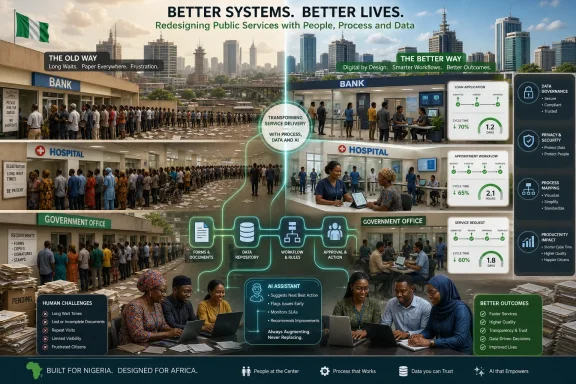 The Job Panic Misses the Larger Productivity Story
Every technological wave arrives with a body count already imagined. The loom was supposed to destroy artisans, the spreadsheet was supposed to flatten clerical work, and the web was supposed to disintermediate whole layers of professional life. Some of those fears were justified in specific industries, but the broader story was always more complicated: technology rarely removes work from the economy; it changes where value is created and who is equipped to capture it.AI has made that old anxiety feel new because it does not merely automate muscle or arithmetic. It drafts memos, writes code, summarizes contracts, answers customers, classifies images, predicts risk, and produces the kind of polished administrative output that used to signal professional competence. For African workers in banks, call centers, public agencies, hospitals, media companies, logistics firms, and software shops, this is not an abstract future. The tools are already on phones and browsers.
Nigeria’s reported AI usage numbers make the point. NITDA’s director-general has said that 70 percent of Nigeria’s online population has used generative AI tools, above the reported global average of 48 percent. Whatever caveats attach to survey methodology, the direction is clear: this is not a continent waiting politely for the AI revolution to arrive through a government white paper.
That matters because adoption is not being driven only by corporate transformation programs. It is being driven by students, freelancers, entrepreneurs, customer support agents, developers, marketers, and administrators trying to get through the day faster. AI is already entering African workplaces through the side door, long before many organizations have decided what their official policy is.
Cheap Labor Has Been Hiding Expensive Failure
The most uncomfortable part of the argument is not that AI can do some tasks faster than people. It is that many organizations have built their operating models around the assumption that slow, manual work is acceptable because labor is available. A process that should have been redesigned years ago survives because someone can always be assigned to chase the file, reconcile the spreadsheet, stamp the form, or call the customer again.This is not a uniquely African problem, but it is particularly consequential in African economies where unemployment, underemployment, and informality distort the politics of efficiency. When work is scarce, any job can look socially valuable even if the system around it is wasteful. That makes reform difficult, because productivity improvements can be framed as threats rather than as the precondition for better wages and better services.
But low productivity is not a harmless inconvenience. It is a tax on everyone. It raises the cost of doing business, slows public services, weakens competitiveness, frustrates citizens, and keeps workers stuck in low-value coordination tasks instead of higher-value judgment, relationship, design, technical, and supervisory work.
AI makes this harder to ignore because it gives managers, citizens, and workers a visible comparison point. If a chatbot can triage routine customer questions in seconds, why is a customer waiting three days for a basic response? If a claims system can flag missing documents instantly, why does a claimant spend weeks in a queue? If a document model can summarize a file and route it to the correct desk, why does the same file still require a human relay race across departments?
The Real Target Is the Workflow, Not the Worker
A badly designed process does not become modern because a human being performs it with diligence. It remains badly designed. AI is valuable precisely because it forces organizations to separate the human contribution from the administrative sludge that has accumulated around it.Take customer service. The simplistic framing says AI will replace representatives. The more useful framing asks why representatives spend so much of their time answering repeated, low-complexity questions whose answers already exist somewhere in the organization. The job worth preserving is not the act of telling a customer for the hundredth time how to reset a password, locate a payment, or check an application status. The job worth preserving is solving the cases where context, empathy, discretion, and authority matter.
The same is true in insurance. A claims officer who spends the day checking whether a form is complete is not being used well. A claims officer who investigates ambiguous cases, detects fraud patterns, explains decisions, and improves the process is doing work that has higher value. AI does not remove the need for accountability; it changes where accountability should sit.
Public administration may be the highest-stakes example. Many citizens experience government not as a set of rights and services, but as a maze of forms, counters, signatures, and waiting rooms. If AI can help route requests, detect inconsistencies, translate citizen queries, summarize case histories, and support decision-making, then the moral question changes. The burden is no longer on citizens to endure slow services because “that is how the system works.” The burden is on the system to justify why delay remains necessary.
Productivity Is the Development Debate Wearing a New Suit
Africa’s long-term challenge is not a shortage of people willing to work. It is the persistent difficulty of turning labor, capital, data, infrastructure, and institutions into high output. That is what productivity means in practice, and it is the quiet variable behind wages, competitiveness, tax capacity, and living standards.A country does not become rich simply by having more people employed in low-output activities. It becomes richer when workers can produce more value per hour, when firms can scale without drowning in coordination costs, and when public institutions can deliver services without consuming absurd amounts of time and paperwork. AI enters this debate not as magic, but as a forcing mechanism.
This is why the “AI versus jobs” framing is too small. It treats employment as the final measure of economic health, when employment quality and output matter just as much. A million people trapped in low-wage, low-productivity work are not evidence of a strong economic model. They are evidence of a system that has not yet learned how to multiply human effort.
For African economies with young populations, this distinction is decisive. Demography can be a dividend, but it is not automatically one. A young workforce without productive tools, reliable infrastructure, functioning institutions, and scalable firms can become a pressure point rather than an advantage. AI will not solve those structural constraints by itself, but it will make their costs more visible.
The Winners Will Automate Bottlenecks Before They Automate Payroll
The companies that get the most from AI are unlikely to be the ones that begin with layoffs as the strategy. Cutting headcount may flatter a quarterly cost line, but it does not necessarily build a better operating model. In many cases, it simply leaves fewer people to manage the same broken workflow, now decorated with an AI pilot.The stronger approach is to identify bottlenecks. Where does work wait? Where do errors repeat? Where do customers disappear? Where do approvals stall? Where do teams duplicate effort because systems do not talk to each other? These are the places where AI can convert directly into speed, quality, and trust.
In practical terms, that means AI should be treated less like a novelty and more like process infrastructure. A bank should not merely ask whether a model can write marketing copy. It should ask whether AI can reduce loan processing friction, improve fraud detection, strengthen compliance reviews, and give branch staff better decision support. A hospital should not stop at using AI to draft administrative emails. It should ask whether patient intake, scheduling, records management, and billing can become less punishing for staff and patients alike.
The distinction matters because automation without redesign often disappoints. If an organization drops AI into a chaotic process, it may accelerate the chaos. Bad data moves faster. Poor decisions become more scalable. Accountability becomes harder to locate. The winners will be the institutions that use AI as an excuse to simplify, standardize, measure, and govern work that should have been fixed years ago.
The Worker Who Knows the System Becomes More Valuable, Not Less
The worker most at risk is not necessarily the worker with the least education. It is the worker whose role has been reduced to a repeatable interface between two inefficient systems. Copying data from one application to another, manually checking routine compliance boxes, drafting near-identical responses, and chasing approvals are vulnerable tasks because they are symptoms of process failure.But the worker who understands why those failures happen becomes more important. AI systems need domain knowledge. They need people who can define the right problem, test the output, spot the exception, escalate the risky case, and explain what the model missed. In real organizations, the difference between useful automation and expensive theater is often the person who knows the messy operational truth.
This is especially relevant in African markets where local context matters. Language, informal business practices, identity systems, cash-flow patterns, regulatory gaps, infrastructure interruptions, and customer behavior do not always map neatly onto imported software assumptions. A model can summarize a policy, but a frontline worker may know why customers ignore it. A model can flag a transaction, but a fraud analyst may understand the local pattern behind it.
That creates an opportunity for workers to move up the value chain, but only if employers invest in redesign and training rather than treating AI as a plug-in replacement for people. The promise of augmentation is real, but it is not automatic. It has to be managed, budgeted, measured, and negotiated inside workplaces.
Governments Cannot Regulate Their Way Around Modernization
African governments face a particularly awkward version of the AI challenge. On one hand, they must worry about job displacement, data protection, bias, procurement abuse, surveillance, and dependency on foreign technology platforms. On the other hand, many public services are so inefficient that refusing to modernize would itself be a policy failure.The temptation will be to produce strategies, councils, ethics frameworks, and national AI ambitions. Those may be necessary, but they are not sufficient. Citizens will judge AI in government by whether it reduces queues, improves transparency, speeds payments, detects leakage, expands language access, and makes services less arbitrary. A PDF strategy does not renew a license, process a benefit, clear goods at a port, or fix a hospital record.
The deeper issue is institutional readiness. AI requires clean data, interoperable systems, clear rules, cybersecurity discipline, procurement competence, and human accountability. Without those foundations, public-sector AI can become another layer of complexity on top of old dysfunction. Worse, it can turn opaque bureaucracy into opaque automation.
That is why the most important government AI projects may be boring. Digitizing records properly, creating reliable identity rails, standardizing service workflows, cleaning registries, improving cloud and data governance, and training civil servants are not glamorous compared with launching a national model. But those are the foundations that determine whether AI improves service delivery or merely gives politicians a new technology slogan.
Africa Should Not Confuse AI Adoption With AI Power
High usage numbers are encouraging, but they can also mislead. A country where millions of people use foreign AI tools is not the same as a country that controls the infrastructure, data, chips, cloud capacity, models, standards, and business models behind those tools. Adoption is the first stage of digital agency, not the final one.This matters for African businesses and governments because AI dependency can quietly reproduce older forms of technological dependence. If critical workflows rely on externally hosted models, foreign cloud platforms, proprietary APIs, and pricing decisions made elsewhere, then local organizations gain capability while also inheriting vulnerability. The tool works until the terms change, the price rises, the service degrades, the regulator intervenes, or the vendor’s priorities shift.
That does not mean every country needs to build frontier models from scratch. For most, that would be an expensive distraction. But it does mean AI strategy should include data governance, local language resources, regional compute capacity, open standards, model evaluation, procurement rules, and domestic technical talent. The point is not autarky. The point is bargaining power.
For businesses, the lesson is similar. Using AI widely is not the same as using it strategically. If employees are pasting sensitive customer data into consumer tools, the organization has adoption without governance. If managers demand AI outputs without understanding model limits, the organization has enthusiasm without competence. If a company pays for AI subscriptions but leaves the underlying workflow untouched, it has bought theater.
The Infrastructure Gap Will Decide Who Benefits First
AI has a way of making itself sound weightless. The interface is a chat box, the output is text, and the experience feels almost magical. But the stack behind it is physical, expensive, and unevenly distributed: data centers, power, fiber, chips, cloud contracts, cybersecurity teams, data engineers, and reliable devices.This is where Africa’s AI productivity story becomes more complicated. A young, mobile-first population can adopt tools quickly, but broad economic transformation requires more than individual experimentation. Firms need dependable connectivity. Schools need trained teachers and devices. Hospitals need digitized records. Courts need case management systems. Ports need integrated logistics data. Tax authorities need accurate registries. Farmers need extension systems that can turn AI insight into practical action.
The gap between consumer AI use and institutional AI transformation is large. It is one thing for a student in Lagos or Nairobi to use a chatbot to draft a CV. It is another for a national health system to deploy AI safely across patient records, clinical workflows, procurement, staffing, and privacy controls. The first requires access. The second requires infrastructure and governance.
That is why the productivity gains may arrive unevenly. Better-capitalized banks, telecoms, insurers, logistics companies, and large public agencies will move first. Smaller firms and informal workers may use AI creatively, but they may struggle to integrate it deeply into operations without affordable tools, digital payment rails, trusted identity, and basic business software. The danger is not simply job loss. It is a widening gap between organizations that can reorganize around AI and those that can only experiment at the edges.
The Labor Debate Needs Honesty About Displacement
The argument that AI will expose inefficient systems should not become a polite way to deny displacement. Some jobs will shrink. Some entry-level tasks will be automated. Some firms will use AI as an excuse to cut workers without fixing anything. Some workers will be asked to produce more for the same pay because management has discovered a new productivity lever.That is not a reason to reject AI, but it is a reason to be honest. Productivity gains have politics. If the benefits accrue only to shareholders, political insiders, global vendors, or a narrow professional class, workers will rightly see AI as a threat. If the gains show up as faster services, better wages, cheaper products, safer workplaces, stronger firms, and new opportunities, the story changes.
The most serious policy question is therefore distribution. Who owns the gains from automation? Who gets trained? Who is protected during transition? Who has access to the tools? Who decides when AI is good enough to affect a citizen’s claim, a worker’s evaluation, a loan decision, or a medical process?
African policymakers cannot answer those questions with slogans about innovation. Nor can business leaders answer them with vague assurances that AI will “free people for higher-value work” while cutting training budgets. The credibility of the augmentation story depends on whether organizations actually build paths into higher-value work.
The African AI Dividend Will Belong to the System Fixers
The most concrete lesson from the BusinessDay argument is that AI should be judged by what it reveals. If a process collapses when exposed to automation, perhaps it was never a good process. If a department cannot explain why five approvals are needed, perhaps the approvals are ritual rather than control. If a company discovers that its customer experience depends on underpaid staff manually compensating for bad software, the problem is not the chatbot.This is where IT professionals have a central role. The AI debate is too often dominated by executives, economists, and futurists, but the practical work belongs to people who understand systems. Sysadmins, developers, data analysts, security teams, process owners, and support staff know where the bodies are buried. They know which spreadsheet is secretly mission critical, which database is unreliable, which approval rule is political, and which manual workaround keeps the business alive.
For Windows-heavy environments, this will feel familiar. Many organizations still run on a patchwork of Microsoft 365, Excel, SharePoint, Teams, line-of-business apps, legacy databases, email approvals, and undocumented macros. AI can make that environment more powerful, but it can also reveal how fragile it is. Copilot-style tools, workflow automation, document intelligence, and low-code platforms are only as useful as the permissions, data hygiene, identity controls, and process logic beneath them.
The real work, then, is not buying AI. It is preparing the organization to benefit from it. That means cleaning data, mapping workflows, tightening access controls, documenting processes, measuring cycle times, training staff, and deciding where human review is mandatory. None of that is glamorous. All of it determines whether AI becomes a productivity engine or another unmanaged risk.
The Practical Lesson Is Hiding in the Queue
The most revealing places to look are not innovation labs. They are queues. Wherever citizens, customers, patients, vendors, students, or employees are waiting unnecessarily, there is probably a workflow that AI will expose.A queue is a visible form of institutional failure. It may reflect too few staff, but it often reflects poor routing, missing data, unclear authority, duplicated checks, bad interfaces, or fear of accountability. AI can help with some of that, but only if the institution is willing to ask why the queue exists in the first place.
The same logic applies to inboxes and spreadsheets. A shared mailbox full of unresolved requests is a process begging to be redesigned. A spreadsheet passed between departments is often a database that was never built. A weekly meeting devoted to status updates is frequently a dashboard that does not exist. These are not minor annoyances; they are productivity leaks.
If AI does anything useful in the near term, it may give organizations less patience for these leaks. Once workers and customers experience faster alternatives, old excuses lose their force. The phrase “that is how we have always done it” becomes less defensible when a cheap tool can demonstrate a better way in an afternoon.
The Signal Inside Nigeria’s AI Numbers
Nigeria’s reported generative AI adoption is important not because it proves the country is ready for full-scale AI transformation, but because it shows demand. People are not waiting for permission. They are using the tools to study, sell, write, code, design, translate, troubleshoot, and compete.That bottom-up adoption can become a national advantage if it is matched by institutional reform. A young population comfortable with AI is a powerful asset. But if those users graduate into workplaces where systems are slow, data is inaccessible, managers are suspicious, and infrastructure is unreliable, the advantage will leak away.
The risk is that Africa becomes a continent of highly adaptive individual AI users trapped inside low-productivity institutions. That would be a familiar tragedy: talent compensating for broken systems instead of being amplified by good ones. The opportunity is the opposite: use widespread AI familiarity as pressure to modernize the institutions around workers.
That is why the replacement debate feels too narrow. The better question is whether African economies can turn AI fluency into organizational productivity. If they can, workers become more valuable because their effort travels through better systems. If they cannot, AI becomes another unevenly distributed tool that helps the already capable move faster while leaving structural inefficiency intact.
The Systems That Survive AI Will Be the Ones Worth Keeping
The near-term AI revolution in African workplaces will not look like a robot army marching through offices. It will look like shorter queues, fewer repeated forms, faster reconciliations, better call routing, cleaner records, earlier fraud detection, more responsive public services, and workers asking why they were ever forced to do certain tasks manually.That is a quieter revolution, but it may be more consequential than the dramatic job-loss narrative. It shifts attention from the worker as the problem to the system around the worker. It asks whether human beings are being used for judgment, creativity, trust, and care — or whether they are being used as shock absorbers for institutional dysfunction.
The answer will vary by sector and country. Some organizations will use AI crudely, chasing labor savings without redesign. Others will use it carefully, building hybrid systems where machines handle routine throughput and people handle complexity. The difference will show up not in press releases but in service quality, employee morale, customer trust, and productivity numbers.
For African economies, the stakes are larger than corporate efficiency. Public trust, fiscal capacity, health outcomes, educational quality, financial inclusion, and competitiveness all depend on systems that can turn effort into results. AI will not build those systems by itself. But it will make the cost of not building them harder to hide.
The Hard Truth African CIOs Should Take Back to the Board
The useful version of the AI debate is not utopian or defensive. It accepts that AI can automate real work, that some roles will change or disappear, and that unmanaged adoption can create security, privacy, and governance problems. It also accepts that refusing to modernize is not a worker-protection strategy; it is a productivity trap.The organizations that handle this well will be the ones that treat AI as part of a broader operating-system upgrade for the enterprise. They will not begin with “How many jobs can we cut?” but with “Which outcomes are too slow, too expensive, too opaque, or too error-prone?” That question leads to a different kind of transformation.
It also creates a fairer conversation with workers. If AI is introduced as a weapon, workers will resist it. If it is introduced as a way to remove drudgery, improve service, and create pathways into better work, it has a chance of becoming legitimate. Legitimacy matters because no AI system succeeds in a workplace where the people closest to the process are incentivized to distrust it.
Near-term success will come from boring discipline rather than grand declarations.
- Organizations should map the workflows that consume the most time before they buy or build AI tools.
- Managers should measure AI projects by cycle-time reduction, error reduction, service quality, and worker redeployment rather than by headcount cuts alone.
- Governments should prioritize digital records, interoperable systems, identity, procurement competence, and data governance before chasing prestige AI projects.
- Workers should learn how to use AI tools, but they should also learn how to audit, challenge, and improve the systems those tools enter.
- African economies should treat high AI adoption as an opening, not a guarantee, because productivity gains depend on institutions as much as individual enthusiasm.