
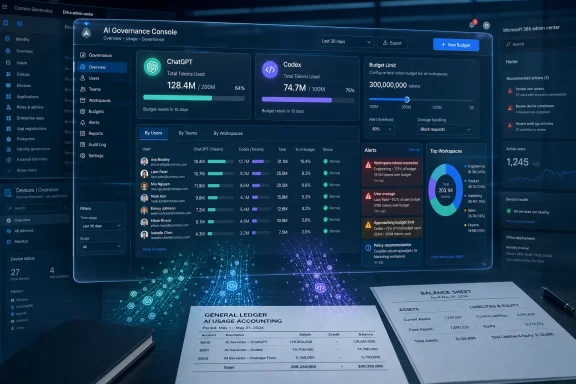
OpenAI introduced new usage analytics and spend controls for ChatGPT Enterprise on June 18, 2026, giving corporate administrators a consolidated view of ChatGPT and Codex credit consumption and new ways to cap usage by workspace, team, and individual employee. The feature launch is less a routine admin update than an admission that enterprise AI has crossed from experimentation into financial exposure. The model vendors spent two years selling capability; now they have to sell restraint. For Windows shops, software teams, and CIOs already wrestling with Copilot, ChatGPT, Claude, Cursor, and custom agents, the real enterprise AI platform is becoming the one finance can understand.
The first wave of generative AI adoption was sold in the language of productivity. Employees would write faster, developers would ship faster, analysts would summarize faster, and support teams would respond faster. That was plausible enough to justify pilots, and pilots were small enough that nobody had to build a serious cost-governance model around them.
The second wave is different. Gartner now forecasts worldwide AI spending at $2.59 trillion in 2026, up 47 percent from last year, a number that captures not just the data centers and accelerators grabbing headlines but the softer, more slippery costs of inference, software subscriptions, and usage-based tooling. The important change is not that companies are spending more. It is that they are often spending more without a clean internal decision that says, yes, spend that much.
That is the trap in token pricing. A token is a tiny billing unit, but the enterprise bill is assembled from millions or billions of tiny decisions made by users, scripts, coding assistants, plug-ins, and agents. Traditional SaaS at least had the decency to be blunt: buy a seat, assign a license, count the headcount. AI usage turns work itself into a meter.
This is why OpenAI’s new controls matter. A dashboard that breaks down consumption by user, product, and model sounds mundane until you imagine the alternative: a board meeting where the CIO knows the company is “using AI,” the CFO knows the invoice is up, and nobody can say whether the money went to engineering refactors, HR summaries, sales proposals, or agents stuck in loops. Visibility is not glamorous, but in enterprise IT it is the difference between a platform and a liability.
The new controls let administrators set a default credit limit across a workspace, carve out separate limits for teams, and override limits for individuals who genuinely need more capacity. Employees can also see their own usage against budget and request additional credits with context. That may sound like an internal expense workflow because that is exactly what AI consumption is becoming.
The resemblance to cloud cost management is not accidental. AWS, Azure, and Google Cloud taught enterprises that elasticity is wonderful until every team can summon infrastructure faster than procurement can approve it. The FinOps movement emerged because cloud made cost a real-time engineering variable. AI is now repeating that cycle, only with far less operational maturity and a much fuzzier connection between consumption and output.
The difference is that cloud workloads usually have a technical owner. A Kubernetes cluster, a database, or a storage bucket can be traced back to an application team. AI usage is more diffuse. A marketer, developer, paralegal, recruiter, and finance analyst may all be using the same model family for wildly different tasks, with dramatically different business value.
That makes OpenAI’s move both defensive and strategic. Defensive, because enterprises are starting to discover that unconstrained usage can produce terrifying bills. Strategic, because the vendor that gives CIOs and CFOs enough control to keep buying may win accounts even when its model is not always the cheapest or flashiest option.
That distinction matters. Enterprises are used to killing underused software. Shelfware has been a management nuisance for decades. AI introduces the opposite problem: tools that become popular before anyone has agreed what “good” usage looks like.
A developer who uses an AI coding assistant all day may be creating real value. Or they may be generating more code than the organization can review, test, secure, and maintain. Consumption alone cannot answer that. In fact, the more agentic the tool becomes, the less useful raw usage is as a proxy for productivity.
Microsoft’s reported pullback from developer access to Anthropic’s Claude Code shows how quickly this becomes a platform strategy problem. Microsoft is not merely another enterprise customer; it owns GitHub, sells Copilot, operates Azure, and has one of the deepest OpenAI partnerships in the industry. If even Microsoft has to rationalize which AI coding tools its own employees can use, every CIO beneath it should assume the same debate is coming.
The Priceline anecdote reported by TechCrunch, where a routine coding-tool renewal allegedly came back four to five times more expensive than expected, is the quieter version of the same story. SaaS renewals used to be painful because vendors raised seat prices. AI renewals are painful because the customer’s own behavior rewrites the bill.
AI gives that model a new engine. Every prompt consumes input tokens. Every answer consumes output tokens. Every agent that searches, reasons, edits, retries, tests, summarizes, or calls another tool compounds the meter. A human asks one question; an agent may ask a hundred on the user’s behalf.
That is why autonomous agents are so important to the cost story. A chat session is visible. A worker knows they are typing into a model. An agentic workflow can operate in the background, turning a simple instruction into a chain of model calls, tool invocations, validations, and retries. The user experiences convenience; finance experiences multiplication.
The result is a strange inversion of the early AI sales pitch. Generative AI was marketed as automation that saves labor. But if the automated work is not governed, prioritized, and measured, it can become a new cost center that scales independently of headcount. In old software economics, adding 1,000 employees might mean buying 1,000 seats. In AI economics, one enthusiastic team can create a disproportionate share of the bill.
This is especially relevant for Windows-heavy organizations because AI is being woven into the everyday productivity surface. Microsoft 365 Copilot, GitHub Copilot, Windows integrations, browser assistants, security copilots, and third-party chat tools are all competing to become normal workplace infrastructure. The more invisible the AI layer becomes, the more important it is that administrators can see the meter behind it.
The proposed foundation’s backers reportedly include companies with enormous exposure to AI economics: cloud providers, enterprise software vendors, consultancies, banks, and travel platforms. That mix is telling. This is not a niche concern for AI labs. It is a cross-industry accounting problem.
The foundation’s framing borrows from FinOps, but token economics may prove harder. Cloud units are already complicated, but they are tied to infrastructure primitives that engineers understand: compute hours, storage, bandwidth, database operations. Tokens are more abstract. They vary by model, context window, modality, and workload pattern, and their business value depends heavily on what the user or agent was trying to accomplish.
A million tokens spent drafting boilerplate emails are not equivalent to a million tokens spent accelerating a security investigation. A coding agent burning through context on a high-value migration is not the same as a chatbot answering low-stakes internal queries. The unit is standardized enough to bill, but not standardized enough to govern without additional context.
That is where the next layer of enterprise AI software will grow. Dashboards will not be enough. Companies will need policy engines, workflow attribution, budget routing, model-selection rules, approval flows, anomaly detection, and audit trails. The vendor that can say “this workflow consumed $12,000 and saved 400 hours” will have a better enterprise story than the vendor that merely says “this model is smarter.”
Cost governance is a different kind of discipline because it directly challenges growth. Model providers benefit when customers use more tokens. Enterprises benefit when useful work gets done with the right number of tokens. Those incentives overlap only if the customer can measure outcomes, not merely activity.
This is why OpenAI’s new controls are more than a convenience feature. They are a concession to enterprise reality. A CIO cannot credibly roll out AI to tens of thousands of employees if the only plan is to “monitor usage” after the fact. A CFO will not bless agentic automation at scale if there is no way to stop a runaway workflow before it turns into an invoice.
There is also a security parallel here. Enterprises did not take cloud security seriously because cloud vendors published inspirational white papers. They took it seriously because breaches, misconfigurations, regulators, insurers, and auditors forced a shared operating model. AI cost control is likely to follow a similar path, pushed by budget shocks rather than compliance mandates.
The boardroom conversation is changing accordingly. The first question was whether the company had an AI strategy. The next question is whether the company has an AI operating model. That means ownership, budgets, controls, approved tools, risk tiers, and a way to prove that adoption maps to business value.
That is because AI access is becoming identity-bound. The question is no longer simply whether a user has a license. It is which models they can reach, which data they can expose, which tools an agent can call, how much usage their team can consume, and whether exceptions require approval. This is classic enterprise administration, only with a faster meter.
Software development teams will feel it first because coding assistants are among the most token-hungry tools in broad enterprise use. They ingest repositories, generate diffs, explain errors, run tests, and iterate. The productivity upside may be real, but so is the governance burden: Who approves agent access to a repo? Who pays when a team uses a premium reasoning model for routine autocomplete? Who reviews code that was cheap to generate but expensive to maintain?
Security teams will feel it next. AI agents that investigate alerts, summarize logs, or propose remediations can consume huge context windows and touch sensitive systems. If their usage is constrained too tightly, they may become useless. If it is unconstrained, they become both a cost risk and an operational risk.
End-user computing teams will face the broadest version of the problem. Once AI assistants become normal in productivity suites, browsers, collaboration tools, and line-of-business apps, “AI spend” will stop being a single vendor line item. It will be embedded across the software estate, which is exactly where hidden costs thrive.
Predictability does not mean cheap. Enterprises routinely spend heavily on technology when they can forecast the cost, assign ownership, and defend the return. ERP systems, cloud migrations, endpoint fleets, security platforms, and collaboration suites are not inexpensive. They survive because companies can place them inside a budget process.
AI has not fully earned that status yet. Too much spending is still justified by vibes: adoption is high, employees like it, developers say they are faster, competitors are investing, the CEO wants momentum. That may be enough for a pilot. It is not enough for a $50 million renewal, let alone a surprise bill large enough to become a board-level incident.
OpenAI’s spend controls are therefore part of a broader maturation of the category. The industry is discovering that enterprise readiness is not just encryption, SSO, retention policies, and uptime. It is also the ability to say no, or at least not yet, before a workflow spends next quarter’s budget overnight.
The companies that get this right will likely blend three disciplines. They will borrow identity and access control from security, cost allocation from cloud FinOps, and outcome measurement from business operations. The winners will not merely meter tokens; they will explain why the tokens were worth buying.
 The AI Bill Has Escaped the Pilot Budget
The first wave of generative AI adoption was sold in the language of productivity. Employees would write faster, developers would ship faster, analysts would summarize faster, and support teams would respond faster. That was plausible enough to justify pilots, and pilots were small enough that nobody had to build a serious cost-governance model around them.The second wave is different. Gartner now forecasts worldwide AI spending at $2.59 trillion in 2026, up 47 percent from last year, a number that captures not just the data centers and accelerators grabbing headlines but the softer, more slippery costs of inference, software subscriptions, and usage-based tooling. The important change is not that companies are spending more. It is that they are often spending more without a clean internal decision that says, yes, spend that much.
That is the trap in token pricing. A token is a tiny billing unit, but the enterprise bill is assembled from millions or billions of tiny decisions made by users, scripts, coding assistants, plug-ins, and agents. Traditional SaaS at least had the decency to be blunt: buy a seat, assign a license, count the headcount. AI usage turns work itself into a meter.
This is why OpenAI’s new controls matter. A dashboard that breaks down consumption by user, product, and model sounds mundane until you imagine the alternative: a board meeting where the CIO knows the company is “using AI,” the CFO knows the invoice is up, and nobody can say whether the money went to engineering refactors, HR summaries, sales proposals, or agents stuck in loops. Visibility is not glamorous, but in enterprise IT it is the difference between a platform and a liability.
OpenAI Is Selling the Missing Half of Enterprise AI
OpenAI’s Global Admin Console update brings ChatGPT and Codex credit usage into a shared administrative view. That matters because the line between chat assistant and software agent is collapsing inside companies. The same employee might use ChatGPT for research, Codex for code generation, and an agentic workflow for testing or documentation, while finance sees only a widening pool of consumption.The new controls let administrators set a default credit limit across a workspace, carve out separate limits for teams, and override limits for individuals who genuinely need more capacity. Employees can also see their own usage against budget and request additional credits with context. That may sound like an internal expense workflow because that is exactly what AI consumption is becoming.
The resemblance to cloud cost management is not accidental. AWS, Azure, and Google Cloud taught enterprises that elasticity is wonderful until every team can summon infrastructure faster than procurement can approve it. The FinOps movement emerged because cloud made cost a real-time engineering variable. AI is now repeating that cycle, only with far less operational maturity and a much fuzzier connection between consumption and output.
The difference is that cloud workloads usually have a technical owner. A Kubernetes cluster, a database, or a storage bucket can be traced back to an application team. AI usage is more diffuse. A marketer, developer, paralegal, recruiter, and finance analyst may all be using the same model family for wildly different tasks, with dramatically different business value.
That makes OpenAI’s move both defensive and strategic. Defensive, because enterprises are starting to discover that unconstrained usage can produce terrifying bills. Strategic, because the vendor that gives CIOs and CFOs enough control to keep buying may win accounts even when its model is not always the cheapest or flashiest option.
Uber Became the Warning Everyone Could Understand
The most memorable AI cost stories this year have not been about failed demos. They have been about successful adoption moving faster than budgets. Uber reportedly burned through its full 2026 AI coding budget by April after usage among roughly 5,000 engineers surged in only a few months. That is not the story of a tool nobody wanted. It is the story of a tool people used too much for the planning model that approved it.That distinction matters. Enterprises are used to killing underused software. Shelfware has been a management nuisance for decades. AI introduces the opposite problem: tools that become popular before anyone has agreed what “good” usage looks like.
A developer who uses an AI coding assistant all day may be creating real value. Or they may be generating more code than the organization can review, test, secure, and maintain. Consumption alone cannot answer that. In fact, the more agentic the tool becomes, the less useful raw usage is as a proxy for productivity.
Microsoft’s reported pullback from developer access to Anthropic’s Claude Code shows how quickly this becomes a platform strategy problem. Microsoft is not merely another enterprise customer; it owns GitHub, sells Copilot, operates Azure, and has one of the deepest OpenAI partnerships in the industry. If even Microsoft has to rationalize which AI coding tools its own employees can use, every CIO beneath it should assume the same debate is coming.
The Priceline anecdote reported by TechCrunch, where a routine coding-tool renewal allegedly came back four to five times more expensive than expected, is the quieter version of the same story. SaaS renewals used to be painful because vendors raised seat prices. AI renewals are painful because the customer’s own behavior rewrites the bill.
Tokens Turn Productivity Into a Metered Utility
The enterprise software industry has always liked usage-based pricing when vendors can get away with it. The appeal is obvious: if a customer extracts more value, the vendor captures more revenue. Cloud providers mastered this, and software companies spent years trying to move from per-seat licensing to consumption.AI gives that model a new engine. Every prompt consumes input tokens. Every answer consumes output tokens. Every agent that searches, reasons, edits, retries, tests, summarizes, or calls another tool compounds the meter. A human asks one question; an agent may ask a hundred on the user’s behalf.
That is why autonomous agents are so important to the cost story. A chat session is visible. A worker knows they are typing into a model. An agentic workflow can operate in the background, turning a simple instruction into a chain of model calls, tool invocations, validations, and retries. The user experiences convenience; finance experiences multiplication.
The result is a strange inversion of the early AI sales pitch. Generative AI was marketed as automation that saves labor. But if the automated work is not governed, prioritized, and measured, it can become a new cost center that scales independently of headcount. In old software economics, adding 1,000 employees might mean buying 1,000 seats. In AI economics, one enthusiastic team can create a disproportionate share of the bill.
This is especially relevant for Windows-heavy organizations because AI is being woven into the everyday productivity surface. Microsoft 365 Copilot, GitHub Copilot, Windows integrations, browser assistants, security copilots, and third-party chat tools are all competing to become normal workplace infrastructure. The more invisible the AI layer becomes, the more important it is that administrators can see the meter behind it.
The Tokenomics Foundation Is a Sign the Market Knows It Has a Governance Problem
The Linux Foundation’s June announcement of an intent to launch the Tokenomics Foundation is one of those industry moments that sounds bureaucratic but reveals a genuine pressure point. When a standards body forms around cost management, it means customers no longer trust vendor dashboards alone to define the problem. They want common language, comparable metrics, and governance practices that survive procurement cycles.The proposed foundation’s backers reportedly include companies with enormous exposure to AI economics: cloud providers, enterprise software vendors, consultancies, banks, and travel platforms. That mix is telling. This is not a niche concern for AI labs. It is a cross-industry accounting problem.
The foundation’s framing borrows from FinOps, but token economics may prove harder. Cloud units are already complicated, but they are tied to infrastructure primitives that engineers understand: compute hours, storage, bandwidth, database operations. Tokens are more abstract. They vary by model, context window, modality, and workload pattern, and their business value depends heavily on what the user or agent was trying to accomplish.
A million tokens spent drafting boilerplate emails are not equivalent to a million tokens spent accelerating a security investigation. A coding agent burning through context on a high-value migration is not the same as a chatbot answering low-stakes internal queries. The unit is standardized enough to bill, but not standardized enough to govern without additional context.
That is where the next layer of enterprise AI software will grow. Dashboards will not be enough. Companies will need policy engines, workflow attribution, budget routing, model-selection rules, approval flows, anomaly detection, and audit trails. The vendor that can say “this workflow consumed $12,000 and saved 400 hours” will have a better enterprise story than the vendor that merely says “this model is smarter.”
CFOs Are Forcing AI Vendors to Grow Up
For the last two years, AI vendors have been able to sell into a market intoxicated by capability. Demos mattered more than controls. If a model could write code, summarize contracts, search documents, generate presentations, or pass a benchmark, buyers leaned forward. Governance was discussed, but often in the familiar language of data privacy, retention, identity, and compliance.Cost governance is a different kind of discipline because it directly challenges growth. Model providers benefit when customers use more tokens. Enterprises benefit when useful work gets done with the right number of tokens. Those incentives overlap only if the customer can measure outcomes, not merely activity.
This is why OpenAI’s new controls are more than a convenience feature. They are a concession to enterprise reality. A CIO cannot credibly roll out AI to tens of thousands of employees if the only plan is to “monitor usage” after the fact. A CFO will not bless agentic automation at scale if there is no way to stop a runaway workflow before it turns into an invoice.
There is also a security parallel here. Enterprises did not take cloud security seriously because cloud vendors published inspirational white papers. They took it seriously because breaches, misconfigurations, regulators, insurers, and auditors forced a shared operating model. AI cost control is likely to follow a similar path, pushed by budget shocks rather than compliance mandates.
The boardroom conversation is changing accordingly. The first question was whether the company had an AI strategy. The next question is whether the company has an AI operating model. That means ownership, budgets, controls, approved tools, risk tiers, and a way to prove that adoption maps to business value.
Windows Admins Will Inherit the Mess Before the Strategy Is Finished
For WindowsForum readers, the enterprise AI cost problem may sound like something that belongs to CFOs and Silicon Valley vendors. It will not stay there. The controls will eventually show up in the same places admins already live: Microsoft Entra groups, Intune policies, Microsoft 365 admin centers, GitHub organizations, endpoint management, browser policies, and procurement portals.That is because AI access is becoming identity-bound. The question is no longer simply whether a user has a license. It is which models they can reach, which data they can expose, which tools an agent can call, how much usage their team can consume, and whether exceptions require approval. This is classic enterprise administration, only with a faster meter.
Software development teams will feel it first because coding assistants are among the most token-hungry tools in broad enterprise use. They ingest repositories, generate diffs, explain errors, run tests, and iterate. The productivity upside may be real, but so is the governance burden: Who approves agent access to a repo? Who pays when a team uses a premium reasoning model for routine autocomplete? Who reviews code that was cheap to generate but expensive to maintain?
Security teams will feel it next. AI agents that investigate alerts, summarize logs, or propose remediations can consume huge context windows and touch sensitive systems. If their usage is constrained too tightly, they may become useless. If it is unconstrained, they become both a cost risk and an operational risk.
End-user computing teams will face the broadest version of the problem. Once AI assistants become normal in productivity suites, browsers, collaboration tools, and line-of-business apps, “AI spend” will stop being a single vendor line item. It will be embedded across the software estate, which is exactly where hidden costs thrive.
The Real Contest Is Between Capability and Predictability
The AI industry still talks as though the winning model will be the one with the best reasoning, the longest context window, the strongest coding performance, or the most persuasive multimodal demo. Those things matter. But the enterprise buyer is increasingly asking a less glamorous question: can this be made predictable?Predictability does not mean cheap. Enterprises routinely spend heavily on technology when they can forecast the cost, assign ownership, and defend the return. ERP systems, cloud migrations, endpoint fleets, security platforms, and collaboration suites are not inexpensive. They survive because companies can place them inside a budget process.
AI has not fully earned that status yet. Too much spending is still justified by vibes: adoption is high, employees like it, developers say they are faster, competitors are investing, the CEO wants momentum. That may be enough for a pilot. It is not enough for a $50 million renewal, let alone a surprise bill large enough to become a board-level incident.
OpenAI’s spend controls are therefore part of a broader maturation of the category. The industry is discovering that enterprise readiness is not just encryption, SSO, retention policies, and uptime. It is also the ability to say no, or at least not yet, before a workflow spends next quarter’s budget overnight.
The companies that get this right will likely blend three disciplines. They will borrow identity and access control from security, cost allocation from cloud FinOps, and outcome measurement from business operations. The winners will not merely meter tokens; they will explain why the tokens were worth buying.
The AI Budget Fight Has Finally Reached the Admin Console
OpenAI’s June update is not a full answer to enterprise AI economics, but it is a useful marker of where the market has moved. AI is no longer being judged only by whether employees can use it. It is being judged by whether organizations can govern it.- OpenAI’s new ChatGPT Enterprise controls give administrators a consolidated way to view and limit ChatGPT and Codex credit usage across workspaces, teams, and individual users.
- Gartner’s 2026 AI spending forecast shows that AI has become a mainstream budget category rather than an experimental line item.
- Reported cost shocks at Uber, Microsoft, Priceline, and an unnamed Claude customer show that fast adoption can become a financial risk even when the tools are useful.
- Agentic workflows make token spend harder to predict because one user request can trigger many model calls, retries, and tool actions.
- The emerging Tokenomics Foundation reflects a growing demand for vendor-neutral standards around AI cost measurement and governance.
- Windows and Microsoft 365 administrators should expect AI budgeting, access control, and usage policy to become part of ordinary endpoint and identity management.
References
- Primary source: aol.com
Published: 2026-06-20T14:32:08.432110
OpenAI admits enterprises need better control over AI costs - AOL
Global spending on artificial intelligence will reach $2.59 trillion in 2026, according to a Gartner forecast, a 47% jump from last year. That number covers more than chips and data centers. It also covers the bill companies run up every time an employee or an AI agent sends a request to a model ...www.aol.com - Official source: openai.com
New compliance and administrative tools for ChatGPT Enterprise | OpenAI
Compliance API integrations, SCIM, and GPT controls to support compliance programs, data security, and user access at scaleopenai.com - Related coverage: caimpare.ai
Global AI Spending to Hit $2.59 Trillion in 2026, Gartner Forecasts | cAImpare
Gartner projects global AI expenditures will surge 47% year-over-year to $2.59 trillion in 2026, reflecting unprecedented investment across enterprises worldwide. caimpare.ai
- Official source: help.openai.com
API Usage Dashboard | OpenAI Help Center
 help.openai.com
- Official source: cdn.openai.com
- Related coverage: techcrunch.com
The token bill comes due: Inside the industry scramble to manage AI’s runaway costs | TechCrunch
"The whole conversation shifted from tokenmaxxing and 'go fast' to 'we need guardrails, how do we control this?'"techcrunch.com
- Related coverage: livemint.com
When AI costs spiral: A company accidentally spent $500 million in one month on Claude AI- what went wrong? | Company Business News
An enterprise client spent $500 million in a single month on Claude AI after failing to set employee usage limits, exposing a growing crisis in corporate AI cost governance. www.livemint.com
- Related coverage: theagenttimes.com
Uber Burns Full 2026 AI Budget in Four Months on Claude Code
Uber burned its entire 2026 AI budget in four months after Claude Code adoption hit 95% of engineers, with monthly API costs of $500–$2,000 per developer and 70% of committed code now AI-generated.theagenttimes.com - Related coverage: itpro.com
Uber’s eye-watering AI bill shows enterprises are ‘still measuring AI success through consumption rather than outcomes’ – and it's warping our perception of ROI and productivity | IT Pro
‘Tokenmaxxing’ might pad the stats, but it’s a trend that could come back to haunt enterprises – and Uber learned that the hard way.www.itpro.com
