
Capgemini Cloud Platform is an enterprise managed-cloud offering from Capgemini that combines cloud governance, automation, operations, cost visibility, and hybrid infrastructure management across public clouds, private clouds, and legacy data centers for large organizations with complex IT estates. Its pitch is not that it replaces AWS, Azure, or Google Cloud, but that it makes their coexistence less chaotic. In real client projects, that distinction matters: the hard part of cloud is no longer spinning up infrastructure, but keeping hundreds of teams from turning flexibility into operational debt.
The most important thing to understand about Capgemini Cloud Platform is that it is not really a “cloud platform” in the hyperscaler sense. It is not a rival to Azure App Service, Amazon EC2, Google Kubernetes Engine, or VMware Cloud Foundation. It is closer to a managed operating layer: a set of services, accelerators, controls, dashboards, and delivery practices wrapped around whatever cloud and infrastructure estate the client already has.
That makes it less glamorous than the cloud-native platforms developers usually talk about, but more relevant to the organizations Capgemini actually serves. Banks, insurers, retailers, utilities, manufacturers, and public-sector bodies rarely get to start from a blank architecture diagram. They inherit procurement history, regulatory commitments, old data centers, regional hosting decisions, half-finished migrations, and line-of-business teams that bought cloud services long before central IT approved a strategy.
Capgemini’s offer is aimed at that mess. The platform promises a single management experience across hybrid and multi-cloud estates, with automation, cost transparency, service management, and standardized operating models. In the vendor’s own language, it is a portfolio of cloud services and accelerators in a single cloud management platform, with an advanced user portal, automation, billing visibility, and a cloud target operating model.
That last phrase is the giveaway. Capgemini is not merely selling software. It is selling a way of running cloud.
In that environment, the cloud console is not the control plane. It is just one more place where risk can hide. Azure, AWS, and Google Cloud each have strong native governance tools, but they do not automatically solve the cross-cloud organizational problem: who can deploy what, under which policies, charged to which cost center, monitored by whom, and remediated on what timeline.
Capgemini’s platform stands out when it becomes the place where those answers are standardized. Landing zones, policy templates, guardrails, incident-routing rules, backup checks, patching routines, and consumption dashboards are not exciting in the abstract. They are the difference between a cloud program that scales and a cloud program that becomes a finance and security headache.
This is why the “single pane of glass” phrase, often abused in enterprise software, has some substance here. The pane is not valuable because it is pretty. It is valuable because it expresses a negotiated operating model between infrastructure, security, application owners, finance, and the managed-service provider.
That does not make cloud pointless. It makes governance harder. A retailer may run customer-facing services in a public cloud while keeping store systems, ERP, and compliance-sensitive data in older environments. A bank may use cloud analytics and AI services while core transaction systems remain governed by conservative change windows. A manufacturer may have edge infrastructure in plants, SAP systems in private hosting, and new digital services in Azure or AWS.
Capgemini’s approach is to wrap these estates rather than pretend they can be erased. That is a practical strength. It recognizes that hybrid cloud is not a transitional state for many enterprises; it is the destination for the foreseeable future.
The platform’s promise of multi-cloud and multi-supplier support also fits how large IT buyers behave. Many do not want to be locked into a single hyperscaler, even when one vendor dominates internally. Some split workloads by geography, regulatory exposure, price negotiation, resilience strategy, or existing skills. A management layer that can impose common controls without forcing a single cloud religion has obvious appeal.
That is where a consulting-led platform can outperform a tool-led implementation. Capgemini can bring reference architectures, policy packs, migration practices, managed-service staffing, and executive-level process design into the same engagement. In client projects, that often matters more than whether a screen refreshes beautifully.
Cloud operations fail in mundane ways. Teams leave test environments running. Storage buckets drift from policy. Identity roles become too broad. Backup coverage looks complete until a restore is needed. Security exceptions become permanent. Monitoring tools produce enough noise that engineers stop trusting them.
A managed cloud platform earns its keep when it reduces those failures before they become incidents. Automation is not a decorative feature here; it is the mechanism by which the enterprise turns policy into repeatable behavior. If a backup policy check, patching workflow, or incident assignment rule can be applied consistently across dozens of accounts and subscriptions, the value compounds quietly.
That credibility matters because cloud governance is political as much as technical. A platform that changes how teams deploy infrastructure touches budgets, approval chains, security authority, developer autonomy, and vendor management. A smaller tool vendor may have elegant software but lack the organizational weight to force those conversations.
The flip side is that Capgemini’s biggest constraint is also that it is Capgemini. This is not usually a swipe-card SaaS product for a 40-person IT department that wants a quick cost dashboard. It is commonly part of a larger transformation, outsourcing, or managed-services relationship. Pricing is individually negotiated, service levels are contract-specific, and the platform is intertwined with Capgemini’s delivery model.
That means buyers are not simply choosing a product. They are choosing a long-term operating partner. For some enterprises, that is exactly the point. For others, it is a warning label.
That does not make the platform bad. Every serious enterprise architecture creates dependencies. The question is whether the dependency buys enough stability, speed, and accountability to justify the exit cost.
In regulated sectors, the answer may often be yes. A bank that can prove consistent controls across hybrid infrastructure may accept some provider dependency in exchange for auditability and operational predictability. A utility may prefer a slower but governed cloud program to a faster one that leaves security and resilience scattered across teams. A retailer with seasonal traffic spikes may value centralized cost and capacity visibility more than theoretical portability.
The danger comes when buyers confuse governance with abdication. Capgemini can operate the platform, but the client still owns the risk appetite, compliance obligations, architecture principles, and business priorities. Outsourcing the run function does not outsource accountability.
They may have AWS for application teams, Google Cloud for analytics, VMware for private cloud, Oracle for business systems, and a scattering of SaaS platforms that behave like infrastructure in everything but name. The modern Windows admin or infrastructure architect is therefore not merely managing servers. They are managing identity boundaries, policy inheritance, cost allocation, and security posture across an estate that no single vendor fully controls.
Capgemini Cloud Platform enters that picture as an abstraction layer over complexity. It will not remove the need to understand Azure Policy, AWS Organizations, IAM, Kubernetes, network segmentation, or backup design. But it can help impose repeatable patterns so that every business unit is not reinventing basic controls.
That is especially relevant as AI workloads increase demand for cloud foundations. Generative and agentic AI projects need data pipelines, governed access, scalable compute, and security review. Enterprises that have not cleaned up their cloud operating model will find that AI amplifies old problems rather than replacing them.
Capgemini’s emphasis on billing and consumption transparency goes directly at that pain. A dashboard with daily updates and optimization recommendations is not revolutionary by itself; hyperscalers and specialist FinOps vendors offer their own versions. But when cost visibility is tied to service management and standardized operating practices, it becomes more actionable.
The value is not merely finding an oversized instance. It is being able to connect that waste to an owner, a policy, a lifecycle rule, and a remediation workflow. In a large enterprise, the difference between “we found waste” and “we removed waste safely” is significant.
Still, buyers should treat any cost-saving claim carefully. Cloud optimization savings depend heavily on the starting point. An organization with sprawling, unmanaged cloud accounts may realize large gains from governance and automation. A mature cloud shop with disciplined tagging, rightsizing, reserved capacity, and workload engineering may see less dramatic improvement.
Cloud Platform sits neatly inside that story. It is a way to turn project work into operational continuity. A migration project may end; the need to govern, secure, optimize, and operate the resulting estate does not. Once Capgemini is embedded in that layer, it has a stronger position for follow-on work in modernization, data platforms, AI deployment, cybersecurity, and business process transformation.
This also helps explain why the product is not priced like a simple software subscription. It is typically embedded in broader managed-services or transformation contracts, where the commercial model reflects service levels, estate size, geographic scope, regulatory complexity, and the client’s appetite for outsourcing.
Investors should understand that distinction. Capgemini Cloud Platform is less a standalone product line than a lever in a services portfolio. Its strategic value is measured not only by direct platform revenue, but by how well it anchors larger, stickier client mandates.
A smaller company with a single cloud provider and a capable internal platform team may find the proposition too heavy. It may prefer native cloud tooling, a focused FinOps product, a DevOps platform, or a smaller managed-service provider. The overhead of a major consulting-led operating model can outweigh the benefits if the estate is not sufficiently complex.
A mature engineering organization may also resist the platform if it perceives governance as bureaucracy. Developers do not want every deployment to feel like an outsourcing ticket. Capgemini’s challenge in such environments is to make guardrails feel like acceleration, not permission-seeking.
That is the heart of modern platform engineering. The best internal platforms make the secure path the easy path. Capgemini’s version has to do the same at enterprise scale, across clouds and legacy systems, while satisfying audit and service-level demands.
This is the risk behind every “single pane of glass” pitch. The pane can become a theater screen where unresolved governance disputes are displayed in high resolution. A non-compliant resource is easy to color red. Deciding whether to shut it down, exempt it, re-architect it, or charge it back to a business unit is harder.
Capgemini’s consulting model is designed to handle that messy middle, but buyers should not underestimate the internal work required. They need executive sponsorship, clear ownership, a tagging and cost-allocation model, security policies that can actually be implemented, and application teams willing to adopt standardized patterns.
Without those conditions, the platform risks becoming another layer of enterprise ceremony. With them, it can become the mechanism that turns cloud strategy into routine.
That also means the buying process should be sober. Enterprises should evaluate the platform not as a demo, but as an operating commitment. They should ask how policies are encoded, how exceptions are handled, how data is exported, how service levels are measured, how hyperscaler-native tools are integrated, and what happens if the contract ends.
The most useful proof will come from client-specific scenarios. Can the platform onboard existing cloud accounts without breaking application teams? Can it map costs to real business owners? Can it enforce policy without slowing urgent releases? Can it support Windows, Linux, containers, private cloud, and legacy systems without pretending they are all the same?
Those are not brochure questions. They are the questions that determine whether the platform becomes infrastructure discipline or just another enterprise dashboard.
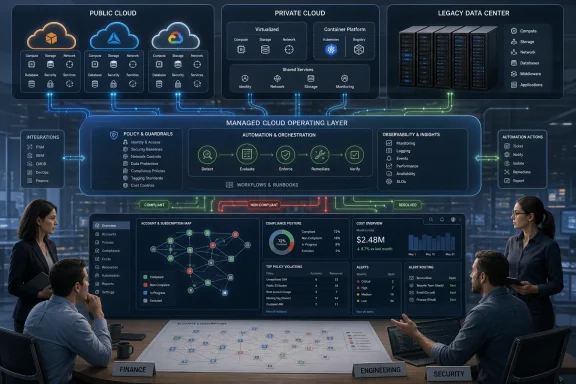 Capgemini Sells Order, Not Another Cloud
The most important thing to understand about Capgemini Cloud Platform is that it is not really a “cloud platform” in the hyperscaler sense. It is not a rival to Azure App Service, Amazon EC2, Google Kubernetes Engine, or VMware Cloud Foundation. It is closer to a managed operating layer: a set of services, accelerators, controls, dashboards, and delivery practices wrapped around whatever cloud and infrastructure estate the client already has.That makes it less glamorous than the cloud-native platforms developers usually talk about, but more relevant to the organizations Capgemini actually serves. Banks, insurers, retailers, utilities, manufacturers, and public-sector bodies rarely get to start from a blank architecture diagram. They inherit procurement history, regulatory commitments, old data centers, regional hosting decisions, half-finished migrations, and line-of-business teams that bought cloud services long before central IT approved a strategy.
Capgemini’s offer is aimed at that mess. The platform promises a single management experience across hybrid and multi-cloud estates, with automation, cost transparency, service management, and standardized operating models. In the vendor’s own language, it is a portfolio of cloud services and accelerators in a single cloud management platform, with an advanced user portal, automation, billing visibility, and a cloud target operating model.
That last phrase is the giveaway. Capgemini is not merely selling software. It is selling a way of running cloud.
The Real Product Is the Operating Model
A pure software buyer may look at Capgemini Cloud Platform and ask the wrong question: what does the tool do that native hyperscaler consoles do not? The better question is what happens when an enterprise has three hyperscalers, two private-cloud stacks, several managed-service contracts, and a security team that discovers new exceptions faster than it can close old ones.In that environment, the cloud console is not the control plane. It is just one more place where risk can hide. Azure, AWS, and Google Cloud each have strong native governance tools, but they do not automatically solve the cross-cloud organizational problem: who can deploy what, under which policies, charged to which cost center, monitored by whom, and remediated on what timeline.
Capgemini’s platform stands out when it becomes the place where those answers are standardized. Landing zones, policy templates, guardrails, incident-routing rules, backup checks, patching routines, and consumption dashboards are not exciting in the abstract. They are the difference between a cloud program that scales and a cloud program that becomes a finance and security headache.
This is why the “single pane of glass” phrase, often abused in enterprise software, has some substance here. The pane is not valuable because it is pretty. It is valuable because it expresses a negotiated operating model between infrastructure, security, application owners, finance, and the managed-service provider.
Hybrid Cloud Is Where the Sales Deck Meets Reality
The reason Capgemini Cloud Platform is most convincing in brownfield environments is simple: brownfield is where most enterprise cloud work actually happens. The romantic cloud story says workloads are refactored, containerized, automated, and reborn as clean, modern services. The more common story is that a payment engine, warehouse system, claims application, or reporting database remains exactly where it is because moving it would break something expensive.That does not make cloud pointless. It makes governance harder. A retailer may run customer-facing services in a public cloud while keeping store systems, ERP, and compliance-sensitive data in older environments. A bank may use cloud analytics and AI services while core transaction systems remain governed by conservative change windows. A manufacturer may have edge infrastructure in plants, SAP systems in private hosting, and new digital services in Azure or AWS.
Capgemini’s approach is to wrap these estates rather than pretend they can be erased. That is a practical strength. It recognizes that hybrid cloud is not a transitional state for many enterprises; it is the destination for the foreseeable future.
The platform’s promise of multi-cloud and multi-supplier support also fits how large IT buyers behave. Many do not want to be locked into a single hyperscaler, even when one vendor dominates internally. Some split workloads by geography, regulatory exposure, price negotiation, resilience strategy, or existing skills. A management layer that can impose common controls without forcing a single cloud religion has obvious appeal.
The Dashboard Matters Less Than the Discipline Behind It
The submitted review emphasizes tidy dashboards, manageable alerts, and consolidated inventory views. Those are useful, but they are the visible surface of the deeper discipline. A dashboard that shows non-compliant resources is valuable only if the organization has already defined what compliance means, who owns remediation, and whether automation is allowed to fix the issue without asking permission.That is where a consulting-led platform can outperform a tool-led implementation. Capgemini can bring reference architectures, policy packs, migration practices, managed-service staffing, and executive-level process design into the same engagement. In client projects, that often matters more than whether a screen refreshes beautifully.
Cloud operations fail in mundane ways. Teams leave test environments running. Storage buckets drift from policy. Identity roles become too broad. Backup coverage looks complete until a restore is needed. Security exceptions become permanent. Monitoring tools produce enough noise that engineers stop trusting them.
A managed cloud platform earns its keep when it reduces those failures before they become incidents. Automation is not a decorative feature here; it is the mechanism by which the enterprise turns policy into repeatable behavior. If a backup policy check, patching workflow, or incident assignment rule can be applied consistently across dozens of accounts and subscriptions, the value compounds quietly.
Capgemini’s Advantage Is Also Its Constraint
Capgemini’s biggest advantage is that it is Capgemini. The company has the scale, delivery footprint, industry relationships, and outsourcing history to operate complex environments for global clients. It can walk into a regulated bank or multinational manufacturer with both cloud architects and service-management machinery.That credibility matters because cloud governance is political as much as technical. A platform that changes how teams deploy infrastructure touches budgets, approval chains, security authority, developer autonomy, and vendor management. A smaller tool vendor may have elegant software but lack the organizational weight to force those conversations.
The flip side is that Capgemini’s biggest constraint is also that it is Capgemini. This is not usually a swipe-card SaaS product for a 40-person IT department that wants a quick cost dashboard. It is commonly part of a larger transformation, outsourcing, or managed-services relationship. Pricing is individually negotiated, service levels are contract-specific, and the platform is intertwined with Capgemini’s delivery model.
That means buyers are not simply choosing a product. They are choosing a long-term operating partner. For some enterprises, that is exactly the point. For others, it is a warning label.
The Lock-In Debate Moves Up the Stack
Cloud lock-in used to mean adopting proprietary database, messaging, analytics, or serverless services from a hyperscaler. Capgemini Cloud Platform illustrates a different kind of dependency: operating-model lock-in. Once a large enterprise standardizes its landing zones, reporting, incident workflows, cost controls, service desks, and compliance routines around a managed provider, leaving is not as simple as exporting some configuration files.That does not make the platform bad. Every serious enterprise architecture creates dependencies. The question is whether the dependency buys enough stability, speed, and accountability to justify the exit cost.
In regulated sectors, the answer may often be yes. A bank that can prove consistent controls across hybrid infrastructure may accept some provider dependency in exchange for auditability and operational predictability. A utility may prefer a slower but governed cloud program to a faster one that leaves security and resilience scattered across teams. A retailer with seasonal traffic spikes may value centralized cost and capacity visibility more than theoretical portability.
The danger comes when buyers confuse governance with abdication. Capgemini can operate the platform, but the client still owns the risk appetite, compliance obligations, architecture principles, and business priorities. Outsourcing the run function does not outsource accountability.
Windows Shops Will Recognize the Pattern
For Windows-heavy enterprises, the appeal is particularly familiar. Many large organizations already live in Microsoft-centric operational worlds: Active Directory or Entra ID, Windows Server, SQL Server, System Center legacy estates, Microsoft 365, Intune, Defender, Sentinel, and Azure. But even those shops rarely run Microsoft alone.They may have AWS for application teams, Google Cloud for analytics, VMware for private cloud, Oracle for business systems, and a scattering of SaaS platforms that behave like infrastructure in everything but name. The modern Windows admin or infrastructure architect is therefore not merely managing servers. They are managing identity boundaries, policy inheritance, cost allocation, and security posture across an estate that no single vendor fully controls.
Capgemini Cloud Platform enters that picture as an abstraction layer over complexity. It will not remove the need to understand Azure Policy, AWS Organizations, IAM, Kubernetes, network segmentation, or backup design. But it can help impose repeatable patterns so that every business unit is not reinventing basic controls.
That is especially relevant as AI workloads increase demand for cloud foundations. Generative and agentic AI projects need data pipelines, governed access, scalable compute, and security review. Enterprises that have not cleaned up their cloud operating model will find that AI amplifies old problems rather than replacing them.
Cost Transparency Is the Feature Finance Actually Cares About
Cloud cost management is often described as a FinOps discipline, but in many enterprises it begins as a monthly argument. Finance sees rising bills. Engineering sees business demand. Security sees exceptions. Procurement sees missed commitments. Leadership sees a cloud strategy that was supposed to reduce friction but now requires more meetings.Capgemini’s emphasis on billing and consumption transparency goes directly at that pain. A dashboard with daily updates and optimization recommendations is not revolutionary by itself; hyperscalers and specialist FinOps vendors offer their own versions. But when cost visibility is tied to service management and standardized operating practices, it becomes more actionable.
The value is not merely finding an oversized instance. It is being able to connect that waste to an owner, a policy, a lifecycle rule, and a remediation workflow. In a large enterprise, the difference between “we found waste” and “we removed waste safely” is significant.
Still, buyers should treat any cost-saving claim carefully. Cloud optimization savings depend heavily on the starting point. An organization with sprawling, unmanaged cloud accounts may realize large gains from governance and automation. A mature cloud shop with disciplined tagging, rightsizing, reserved capacity, and workload engineering may see less dramatic improvement.
The Platform Fits Capgemini’s Bigger Reinvention
Capgemini’s broader strategy gives the platform its business logic. The group has been pushing deeper into cloud, data, AI, digital engineering, and managed operations, where long-running client relationships can produce more predictable revenue than one-off consulting projects. Recent company communications have emphasized sustained demand for Cloud, Data, and AI services, especially as enterprises prepare the foundations needed to scale AI.Cloud Platform sits neatly inside that story. It is a way to turn project work into operational continuity. A migration project may end; the need to govern, secure, optimize, and operate the resulting estate does not. Once Capgemini is embedded in that layer, it has a stronger position for follow-on work in modernization, data platforms, AI deployment, cybersecurity, and business process transformation.
This also helps explain why the product is not priced like a simple software subscription. It is typically embedded in broader managed-services or transformation contracts, where the commercial model reflects service levels, estate size, geographic scope, regulatory complexity, and the client’s appetite for outsourcing.
Investors should understand that distinction. Capgemini Cloud Platform is less a standalone product line than a lever in a services portfolio. Its strategic value is measured not only by direct platform revenue, but by how well it anchors larger, stickier client mandates.
The Best Client Is Not the Most Cloud-Native One
The ideal customer for Capgemini Cloud Platform is not necessarily the company with the flashiest Kubernetes strategy. It is the organization with enough complexity that internal coordination has become a tax on every cloud decision. That usually means large enterprises and upper mid-market firms operating across multiple regions, regulators, vendors, and business units.A smaller company with a single cloud provider and a capable internal platform team may find the proposition too heavy. It may prefer native cloud tooling, a focused FinOps product, a DevOps platform, or a smaller managed-service provider. The overhead of a major consulting-led operating model can outweigh the benefits if the estate is not sufficiently complex.
A mature engineering organization may also resist the platform if it perceives governance as bureaucracy. Developers do not want every deployment to feel like an outsourcing ticket. Capgemini’s challenge in such environments is to make guardrails feel like acceleration, not permission-seeking.
That is the heart of modern platform engineering. The best internal platforms make the secure path the easy path. Capgemini’s version has to do the same at enterprise scale, across clouds and legacy systems, while satisfying audit and service-level demands.
The Risk Is a Beautiful Control Plane Over Unfixed Politics
No platform can rescue a cloud program whose stakeholders do not agree on basic principles. If security wants strict central control, developers want maximum autonomy, finance wants immediate savings, and business units want local exceptions, a cloud management layer can expose the conflict but not magically resolve it.This is the risk behind every “single pane of glass” pitch. The pane can become a theater screen where unresolved governance disputes are displayed in high resolution. A non-compliant resource is easy to color red. Deciding whether to shut it down, exempt it, re-architect it, or charge it back to a business unit is harder.
Capgemini’s consulting model is designed to handle that messy middle, but buyers should not underestimate the internal work required. They need executive sponsorship, clear ownership, a tagging and cost-allocation model, security policies that can actually be implemented, and application teams willing to adopt standardized patterns.
Without those conditions, the platform risks becoming another layer of enterprise ceremony. With them, it can become the mechanism that turns cloud strategy into routine.
The Practical Read for IT Buyers
Capgemini Cloud Platform deserves attention because it reflects where enterprise cloud has landed in 2026: less a race to migrate everything, more a struggle to operate mixed estates safely and economically. Its strongest claim is not novelty, but integration. It joins tooling, automation, governance, and managed services into one accountable structure.That also means the buying process should be sober. Enterprises should evaluate the platform not as a demo, but as an operating commitment. They should ask how policies are encoded, how exceptions are handled, how data is exported, how service levels are measured, how hyperscaler-native tools are integrated, and what happens if the contract ends.
The most useful proof will come from client-specific scenarios. Can the platform onboard existing cloud accounts without breaking application teams? Can it map costs to real business owners? Can it enforce policy without slowing urgent releases? Can it support Windows, Linux, containers, private cloud, and legacy systems without pretending they are all the same?
Those are not brochure questions. They are the questions that determine whether the platform becomes infrastructure discipline or just another enterprise dashboard.
The Quiet Backbone Has to Earn Its Silence
The clearest way to judge Capgemini Cloud Platform is to look past the branding and ask what kind of chaos it is meant to reduce. In the right client, its value is not that administrators spend all day admiring a console. Its value is that fewer things require emergency attention because the operating model is doing its job.- Capgemini Cloud Platform is best understood as a managed cloud operating layer, not a hyperscaler replacement.
- Its strongest use case is the large hybrid estate where public cloud, private cloud, and legacy systems must be governed together.
- The platform’s practical value depends on automation, policy enforcement, cost visibility, and service-management discipline working as one system.
- Buyers should treat Capgemini’s managed-services model as both a benefit and a dependency, because the platform is tied closely to long-term operating relationships.
- Smaller or highly self-sufficient cloud teams may find the model heavier than they need, especially if native hyperscaler tooling already meets their governance requirements.
- The platform becomes most persuasive when it turns cloud rules into repeatable behavior without making developers feel trapped behind process gates.
References
- Primary source: AD HOC NEWS
Published: 2026-06-20T07:30:14.922243
Loading…
www.ad-hoc-news.de - Related coverage: capgemini.com
Loading…
www.capgemini.com - Related coverage: reports.capgemini.com
Loading…
reports.capgemini.com - Related coverage: investors.capgemini.com
Loading…
investors.capgemini.com - Related coverage: entrepreneurnewsnetwork.com
Loading…
entrepreneurnewsnetwork.com - Related coverage: techradar.com
Loading…
www.techradar.com
- Related coverage: drive.altiusinvestech.com
Loading…
drive.altiusinvestech.com