
Geordie this week announced new U.K. legal and people leadership, expanded U.S. channel leadership, Microsoft Agent Control Specification work, and fresh enterprise case studies as regulated customers move AI agents from blocked experiments into governed production deployments across finance, health AI, travel, and software environments. The story is not merely that another AI security startup is staffing up. It is that the enterprise AI conversation is shifting from “which model should we use?” to “who is allowed to let autonomous software act on our behalf?” Geordie is trying to occupy that control point before it becomes just another feature inside the hyperscaler stack.
The first wave of generative AI in the enterprise was mostly about access. Employees wanted ChatGPT-like tools, developers wanted copilots, and executives wanted productivity decks that made the spending look inevitable. Security teams could treat the problem as a familiar one: approve the vendor, negotiate data terms, configure identity, and monitor usage.
AI agents break that neat procurement story. An agent does not merely answer a question; it can call tools, touch records, file tickets, generate code, trigger workflows, and collaborate with other agents. Once that happens, the governance problem moves from content filtering to runtime behavior.
That is why Geordie’s week matters. The company is presenting itself less as an AI observability dashboard and more as an operating layer for agent behavior: inventorying what exists, understanding what it can do, and applying policy while it is acting. In heavily regulated environments, that distinction is not semantic. It is the difference between letting employees experiment with a chatbot and allowing autonomous software to operate inside business processes.
The private equity example is the cleanest signal. According to Geordie, a global private equity firm managing roughly $150 billion in assets moved from blocking AI agents to deploying them broadly after gaining better visibility into agent behavior and risk. That is the kind of customer story every AI governance vendor wants: not “we helped reduce anxiety,” but “we turned prohibition into controlled adoption.”
The customer claim that new agents can now be rolled out in days instead of months is more than a speed boast. It suggests that the bottleneck in enterprise AI is becoming governance workflow, not model capability. When a business unit wants an agent connected to Claude, OpenAI, Copilot Studio, Foundry, Azure DevOps, or some internal toolchain, the hard question is not whether the agent can be built. The hard question is whether security, legal, compliance, and platform teams can understand the blast radius quickly enough to approve it.
That is the practical appeal of agent governance platforms. They promise a common lens across a fragmented environment where agents may be built in one framework, hosted in another, invoked through a third-party SaaS product, and connected to internal systems through APIs or developer tooling. The enterprise does not have one AI surface. It has a spreading population of semi-autonomous workers.
Geordie’s pitch is that blocking those workers will not hold. The more useful agents become, the more employees and teams will route around blanket restrictions. A security product that lets the enterprise say “yes, but under these controls” has a better chance of becoming embedded than one that only maps theoretical risk.
That does not mean the claims should be accepted uncritically. Customer case studies are marketing instruments, and private-company metrics rarely arrive with the audit trail a public-market investor would expect. But the direction of travel is credible: enterprises are discovering that agent adoption creates a governance queue, and vendors are racing to become the system of record for that queue.
For WindowsForum readers, this matters because Microsoft is not approaching agents as a niche developer experiment. Copilot Studio, Foundry, Azure DevOps, Entra, Defender, Purview, and the broader Microsoft 365 estate are all natural places for agentic workflows to live. Once agents are built into the same productivity and cloud systems that already dominate corporate IT, governance becomes a Windows and Microsoft ecosystem issue, not just an AI lab issue.
Geordie’s Beam mitigation engine is being positioned as a way to author and enforce policies across ACS-compatible environments. In plain English, that means a security team could define what an agent may do, which tools it may access, and under what circumstances a risky action should be blocked, shaped, or routed for control. The promise is policy that follows the agent’s action, not merely the application boundary.
That is the right abstraction for agentic systems. Traditional security boundaries assume software behaves predictably inside known perimeters. Agents are more fluid. They assemble context, select tools, interpret instructions, and sometimes operate across systems in ways that are not obvious from the original prompt or deployment ticket.
The business risk for Geordie is equally obvious. If Microsoft defines the control plane too successfully, adjacent vendors can be absorbed into the platform gravity. Geordie’s best defense is specialization: deeper runtime understanding, cross-provider visibility, and independent governance across non-Microsoft environments. The company needs Microsoft’s ecosystem without becoming a decorative partner logo inside it.
Every enterprise technology wave begins with a discovery problem. Before an organization can govern cloud workloads, it has to know which accounts exist. Before it can secure endpoints, it has to know which devices are on the network. Before it can control AI agents, it has to know which agents are active, what they touch, whose authority they borrow, and which workflows they influence.
In AI, that discovery problem is nastier because the agent boundary is blurry. Is a scheduled workflow that calls an LLM an agent? Is a coding assistant operating on a developer’s machine part of the governed estate? Is a multi-step automation inside a SaaS platform a business process, an application, or an autonomous actor? The answers matter because risk, accountability, and auditability depend on them.
Owkin’s reported EU AI Act compliance demonstration in under 10 minutes is the kind of claim that will attract attention from regulated sectors. Even if the number should be read as a showcase result rather than a universal benchmark, the underlying need is real. Compliance teams want evidence, not vibes. They need to show what systems exist, how risks are classified, what controls apply, and how exceptions are handled.
The reported $13 million in averted risk is harder to evaluate from the outside. Risk quantification in cybersecurity often blends defensible modeling with sales-deck optimism. Still, enterprises increasingly want AI governance framed in financial terms because boards understand exposure more readily than they understand agent architecture. If Geordie can translate agent behavior into risk posture, budget owners will listen.
The travel and hospitality sector is full of workflows that agents can plausibly improve: customer service, pricing, property data, marketing operations, internal knowledge search, maintenance coordination, and finance administration. None of these requires science-fiction autonomy. They require software that can take context, use tools, and complete bounded work faster than a human team can handle manually.
That is also why the risk grows quietly. A customer service agent with poor tool permissions can expose data. A marketing agent can generate misleading claims. A coding agent can introduce vulnerable dependencies. A finance operations agent can mishandle invoices, approvals, or vendor details. Each individual use case may seem manageable, but a thousand agents becomes an ecosystem.
The phrase “return of control” is doing a lot of work here. It implies that the goal is not to eliminate autonomy but to ensure humans and organizations can reassert authority when risk rises. That sounds simple until you ask what control means in practice. Does it mean real-time blocking? Human approval? Audit logs? Kill switches? Scoped permissions? Model routing? Tool isolation? Incident response workflows?
The answer is likely all of the above, which is why agent governance is becoming a platform category rather than a point feature. Organizations do not need another dashboard that says AI is risky. They need mechanisms for deciding what an agent may do before, during, and after it acts.
Agentic systems introduce risks that look familiar in pieces and unfamiliar in combination. They can misuse legitimate tools, inherit excessive privileges, rely on poisoned memory, communicate with other agents, execute code, or pursue a goal in a way that conflicts with business policy. The danger is not always a dramatic breach. Sometimes it is an agent doing the wrong thing very efficiently with permissions it was technically allowed to use.
That makes runtime oversight essential. Pre-deployment review cannot anticipate every context an agent will encounter. Static rules cannot capture every combination of model output, retrieved data, tool call, and business state. Logging alone tells you what happened after the fact, which is useful for audits and incident response but insufficient for prevention.
The emerging control model looks closer to identity and endpoint security than to old-style AI content moderation. Agents need identities. They need scoped permissions. Their actions need policy checks. Their behavior needs monitoring. Their access should degrade or be revoked when trust changes. In short, agents are becoming privileged applications with a conversational interface and a taste for improvisation.
That is good news for vendors like Geordie, but it also raises the bar. Enterprises will not tolerate governance systems that slow everything to a crawl or require bespoke policy work for every agent. The winner in this market will make controls feel native to the development and operations lifecycle, not like a compliance tollbooth pasted on at the end.
That is especially true in AI security, where buyers will ask uncomfortable questions. How does the vendor handle customer data? What telemetry is collected? How are policies enforced? What happens when a mitigation fails? Which certifications are in place? Who is accountable for advice that affects regulatory posture? A company selling governance must itself look governed.
Courtney Broadwell’s appointment as Vice President of Channel points in the same direction from the go-to-market side. Enterprise security markets are often won through integrators, resellers, managed service providers, and advisory partners that already sit near the customer’s risk and platform teams. If agent governance becomes a board-level issue, many customers will not buy it like a developer tool. They will buy it through a trust network.
The U.S. channel push also reflects a practical reality: agent governance cuts across security, data, legal, compliance, platform engineering, and line-of-business ownership. That is a messy sale. Partners can help translate a horizontal control platform into industry-specific programs, whether that means financial services supervision, health data governance, software supply-chain control, or public-sector assurance.
The leadership expansion therefore reinforces the product story. Geordie is preparing for the friction that comes after early adopters: procurement cycles, implementation partners, compliance reviews, international hiring, and support demands from customers whose AI estates are moving faster than their internal policies.
This crowding is a validation signal, not merely a competitive threat. Enterprises do not want a separate governance island for every AI tool. They want controls that integrate with identity, logging, ticketing, developer workflows, cloud platforms, and compliance reporting. Any vendor trying to own agent governance must prove that it can fit into existing operating models.
That is where Geordie’s cross-provider story matters. The private equity deployment reportedly spans Anthropic’s Claude suite, OpenAI, Microsoft Copilot Studio, Foundry, and Azure DevOps. In the real world, even Microsoft-heavy enterprises will use more than one AI provider. Developers will experiment. Business units will buy SaaS. Mergers will introduce new stacks. A governance layer that only sees one vendor’s agents is incomplete by design.
The counterargument is that platform-native controls usually win over time. If Microsoft, OpenAI, Anthropic, Google, AWS, and enterprise SaaS vendors each improve their own agent governance, customers may prefer built-in capabilities. The independent governance vendor must show that the independent view is worth paying for.
That case is strongest in regulated, multi-cloud, multi-model, and acquisition-heavy environments. It is also strongest where the risk owner is not the same team that builds the agents. Security and compliance leaders often want a control plane that is not captive to the development platform’s optimism.
Copilot Studio and similar tools lower the barrier for business users to create agents. Azure DevOps and coding assistants lower the barrier for developers to automate engineering work. Microsoft 365 integrations make it tempting to connect agents to email, documents, calendars, Teams, SharePoint, and enterprise knowledge stores. Each integration point is useful. Each also becomes a governance obligation.
The lesson from previous Microsoft platform waves is that convenience scales faster than control. PowerShell, macros, SharePoint workflows, Power Platform apps, Teams integrations, and browser extensions all produced versions of the same story: the business found value before central IT had full visibility. AI agents are likely to compress that timeline.
That means Windows shops should prepare for agent inventory as a first-class operational need. They will need to know which agents exist, who owns them, what identities they use, what data they can reach, and which tools they can invoke. They will need logging that is meaningful to incident responders, not just AI developers. They will need policies that map to business risk rather than generic model safety categories.
The Geordie news is useful because it shows where the market is going. Whether a given enterprise chooses Geordie, Microsoft-native controls, another vendor, or a mix, the core requirement is becoming obvious: agent deployment cannot be treated as a series of isolated pilots. It has to become part of enterprise operations.
This is where some of the AI industry’s favorite language becomes a liability. “Autonomous” sounds exciting in a demo and terrifying in a compliance review. “Emergent behavior” sounds intellectually honest to researchers and operationally unacceptable to auditors. “Human in the loop” sounds reassuring until someone asks which human, at what step, with what authority, and with what evidence trail.
Geordie’s emphasis on runtime controls, compliance evidence, and risk visibility is therefore well-timed. The regulatory burden will not fall evenly across all AI use. A lightweight internal summarization tool is not the same as an agent that can interact with customer records, initiate business workflows, or alter software systems. But enterprises need a way to classify those differences consistently.
The danger is that governance becomes theater. A dashboard full of agent counts and risk scores can comfort executives without materially reducing risk. A compliance report can document controls that are too coarse to matter at runtime. A policy can exist on paper while agents behave unpredictably across tools and contexts.
That is why enforcement is the critical word. The market will have plenty of vendors that can observe, catalog, and report. The harder problem is shaping or stopping actions at the moment they matter, while preserving enough context for humans to understand why the system intervened. If Geordie’s Beam engine can do that across heterogeneous agent environments, the company has a plausible wedge.
That combination matters because the agent governance category is still forming. Buyers are trying to distinguish between AI safety, model monitoring, security posture management, data governance, compliance automation, and runtime control. Vendors will blur those terms when it helps them. Customers will need sharper language.
Geordie’s clearest argument is that agents require behavior-centered governance. The important unit is not the model, the prompt, or the application interface in isolation. It is the agent’s activity across context, tools, identity, data, and time. That is a more complicated story than “secure your chatbot,” but it is closer to the enterprise reality now unfolding.
The challenge is proof at scale. Case studies are a start, but the market will look for durability: fewer incidents, faster approvals, cleaner audits, lower operational burden, and controls that work when business units inevitably build agents in places central IT did not expect. Governance vendors win trust slowly and lose it quickly.
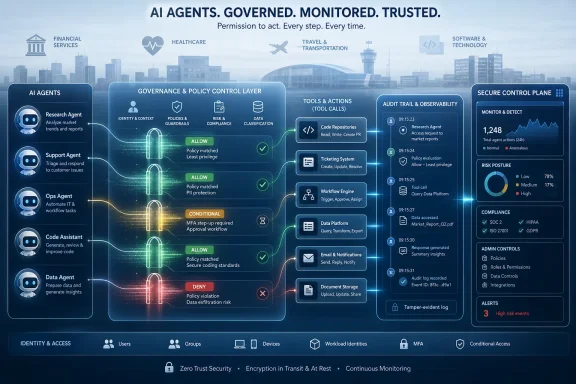 The Agent Boom Has Reached Its Compliance Hangover
The first wave of generative AI in the enterprise was mostly about access. Employees wanted ChatGPT-like tools, developers wanted copilots, and executives wanted productivity decks that made the spending look inevitable. Security teams could treat the problem as a familiar one: approve the vendor, negotiate data terms, configure identity, and monitor usage.AI agents break that neat procurement story. An agent does not merely answer a question; it can call tools, touch records, file tickets, generate code, trigger workflows, and collaborate with other agents. Once that happens, the governance problem moves from content filtering to runtime behavior.
That is why Geordie’s week matters. The company is presenting itself less as an AI observability dashboard and more as an operating layer for agent behavior: inventorying what exists, understanding what it can do, and applying policy while it is acting. In heavily regulated environments, that distinction is not semantic. It is the difference between letting employees experiment with a chatbot and allowing autonomous software to operate inside business processes.
The private equity example is the cleanest signal. According to Geordie, a global private equity firm managing roughly $150 billion in assets moved from blocking AI agents to deploying them broadly after gaining better visibility into agent behavior and risk. That is the kind of customer story every AI governance vendor wants: not “we helped reduce anxiety,” but “we turned prohibition into controlled adoption.”
Geordie Is Selling Permission, Not Fear
Security startups often sell the fear of new technology. The best ones eventually sell permission to use it. Geordie’s recent messaging is firmly in the second camp.The customer claim that new agents can now be rolled out in days instead of months is more than a speed boast. It suggests that the bottleneck in enterprise AI is becoming governance workflow, not model capability. When a business unit wants an agent connected to Claude, OpenAI, Copilot Studio, Foundry, Azure DevOps, or some internal toolchain, the hard question is not whether the agent can be built. The hard question is whether security, legal, compliance, and platform teams can understand the blast radius quickly enough to approve it.
That is the practical appeal of agent governance platforms. They promise a common lens across a fragmented environment where agents may be built in one framework, hosted in another, invoked through a third-party SaaS product, and connected to internal systems through APIs or developer tooling. The enterprise does not have one AI surface. It has a spreading population of semi-autonomous workers.
Geordie’s pitch is that blocking those workers will not hold. The more useful agents become, the more employees and teams will route around blanket restrictions. A security product that lets the enterprise say “yes, but under these controls” has a better chance of becoming embedded than one that only maps theoretical risk.
That does not mean the claims should be accepted uncritically. Customer case studies are marketing instruments, and private-company metrics rarely arrive with the audit trail a public-market investor would expect. But the direction of travel is credible: enterprises are discovering that agent adoption creates a governance queue, and vendors are racing to become the system of record for that queue.
Microsoft’s Agent Control Push Raises the Stakes for Everyone Else
Geordie’s Microsoft collaboration around the Agent Control Specification is strategically important because Microsoft is trying to make agent governance feel like infrastructure. The Agent Governance Toolkit, released under Microsoft’s open-source umbrella, frames runtime security as a core requirement for autonomous agents rather than an optional afterthought. It also ties the problem to a broader Microsoft worldview: agents should be observable, governable, and policy-enforced across the enterprise stack.For WindowsForum readers, this matters because Microsoft is not approaching agents as a niche developer experiment. Copilot Studio, Foundry, Azure DevOps, Entra, Defender, Purview, and the broader Microsoft 365 estate are all natural places for agentic workflows to live. Once agents are built into the same productivity and cloud systems that already dominate corporate IT, governance becomes a Windows and Microsoft ecosystem issue, not just an AI lab issue.
Geordie’s Beam mitigation engine is being positioned as a way to author and enforce policies across ACS-compatible environments. In plain English, that means a security team could define what an agent may do, which tools it may access, and under what circumstances a risky action should be blocked, shaped, or routed for control. The promise is policy that follows the agent’s action, not merely the application boundary.
That is the right abstraction for agentic systems. Traditional security boundaries assume software behaves predictably inside known perimeters. Agents are more fluid. They assemble context, select tools, interpret instructions, and sometimes operate across systems in ways that are not obvious from the original prompt or deployment ticket.
The business risk for Geordie is equally obvious. If Microsoft defines the control plane too successfully, adjacent vendors can be absorbed into the platform gravity. Geordie’s best defense is specialization: deeper runtime understanding, cross-provider visibility, and independent governance across non-Microsoft environments. The company needs Microsoft’s ecosystem without becoming a decorative partner logo inside it.
The Owkin Case Shows Why Inventory Is the First Governance Failure
The Owkin case study is a useful reminder that many companies do not know how many agents they already have. Geordie says Owkin, a health AI firm handling more than 50 petabytes of data, found significantly more active agents than expected after deploying the platform. That should sound familiar to anyone who lived through shadow IT, unmanaged SaaS, unsanctioned browser extensions, or developer-led cloud sprawl.Every enterprise technology wave begins with a discovery problem. Before an organization can govern cloud workloads, it has to know which accounts exist. Before it can secure endpoints, it has to know which devices are on the network. Before it can control AI agents, it has to know which agents are active, what they touch, whose authority they borrow, and which workflows they influence.
In AI, that discovery problem is nastier because the agent boundary is blurry. Is a scheduled workflow that calls an LLM an agent? Is a coding assistant operating on a developer’s machine part of the governed estate? Is a multi-step automation inside a SaaS platform a business process, an application, or an autonomous actor? The answers matter because risk, accountability, and auditability depend on them.
Owkin’s reported EU AI Act compliance demonstration in under 10 minutes is the kind of claim that will attract attention from regulated sectors. Even if the number should be read as a showcase result rather than a universal benchmark, the underlying need is real. Compliance teams want evidence, not vibes. They need to show what systems exist, how risks are classified, what controls apply, and how exceptions are handled.
The reported $13 million in averted risk is harder to evaluate from the outside. Risk quantification in cybersecurity often blends defensible modeling with sales-deck optimism. Still, enterprises increasingly want AI governance framed in financial terms because boards understand exposure more readily than they understand agent architecture. If Geordie can translate agent behavior into risk posture, budget owners will listen.
Forge Holiday Group Points to the Next Ordinary Enterprise Problem
Forge Holiday Group is a very different customer from a health AI company or a private equity firm, and that is precisely why the reference matters. Geordie says Forge is using the platform to govern nearly 1,000 AI agents and align with Five Eyes guidance on agentic AI under a “return of control” model. This is where the agent governance market stops being exotic.The travel and hospitality sector is full of workflows that agents can plausibly improve: customer service, pricing, property data, marketing operations, internal knowledge search, maintenance coordination, and finance administration. None of these requires science-fiction autonomy. They require software that can take context, use tools, and complete bounded work faster than a human team can handle manually.
That is also why the risk grows quietly. A customer service agent with poor tool permissions can expose data. A marketing agent can generate misleading claims. A coding agent can introduce vulnerable dependencies. A finance operations agent can mishandle invoices, approvals, or vendor details. Each individual use case may seem manageable, but a thousand agents becomes an ecosystem.
The phrase “return of control” is doing a lot of work here. It implies that the goal is not to eliminate autonomy but to ensure humans and organizations can reassert authority when risk rises. That sounds simple until you ask what control means in practice. Does it mean real-time blocking? Human approval? Audit logs? Kill switches? Scoped permissions? Model routing? Tool isolation? Incident response workflows?
The answer is likely all of the above, which is why agent governance is becoming a platform category rather than a point feature. Organizations do not need another dashboard that says AI is risky. They need mechanisms for deciding what an agent may do before, during, and after it acts.
Runtime Oversight Is the New Security Frontier
Geordie’s contribution to OWASP’s State of Agentic AI Security and Governance work fits a broader industry shift. The security community is moving beyond prompt injection as the headline risk and toward a more complete model of agent behavior. Prompt injection still matters, but it is only one part of a larger attack surface.Agentic systems introduce risks that look familiar in pieces and unfamiliar in combination. They can misuse legitimate tools, inherit excessive privileges, rely on poisoned memory, communicate with other agents, execute code, or pursue a goal in a way that conflicts with business policy. The danger is not always a dramatic breach. Sometimes it is an agent doing the wrong thing very efficiently with permissions it was technically allowed to use.
That makes runtime oversight essential. Pre-deployment review cannot anticipate every context an agent will encounter. Static rules cannot capture every combination of model output, retrieved data, tool call, and business state. Logging alone tells you what happened after the fact, which is useful for audits and incident response but insufficient for prevention.
The emerging control model looks closer to identity and endpoint security than to old-style AI content moderation. Agents need identities. They need scoped permissions. Their actions need policy checks. Their behavior needs monitoring. Their access should degrade or be revoked when trust changes. In short, agents are becoming privileged applications with a conversational interface and a taste for improvisation.
That is good news for vendors like Geordie, but it also raises the bar. Enterprises will not tolerate governance systems that slow everything to a crawl or require bespoke policy work for every agent. The winner in this market will make controls feel native to the development and operations lifecycle, not like a compliance tollbooth pasted on at the end.
Leadership Hires Signal a Company Preparing for Enterprise Friction
The appointment of Joel Furniss to lead Legal and People operations in the U.K. is not as flashy as a customer win, but it may say more about Geordie’s stage of growth. Enterprise governance companies do not scale on engineering alone. They need contracting discipline, compliance posture, hiring machinery, and organizational systems that can withstand large-customer scrutiny.That is especially true in AI security, where buyers will ask uncomfortable questions. How does the vendor handle customer data? What telemetry is collected? How are policies enforced? What happens when a mitigation fails? Which certifications are in place? Who is accountable for advice that affects regulatory posture? A company selling governance must itself look governed.
Courtney Broadwell’s appointment as Vice President of Channel points in the same direction from the go-to-market side. Enterprise security markets are often won through integrators, resellers, managed service providers, and advisory partners that already sit near the customer’s risk and platform teams. If agent governance becomes a board-level issue, many customers will not buy it like a developer tool. They will buy it through a trust network.
The U.S. channel push also reflects a practical reality: agent governance cuts across security, data, legal, compliance, platform engineering, and line-of-business ownership. That is a messy sale. Partners can help translate a horizontal control platform into industry-specific programs, whether that means financial services supervision, health data governance, software supply-chain control, or public-sector assurance.
The leadership expansion therefore reinforces the product story. Geordie is preparing for the friction that comes after early adopters: procurement cycles, implementation partners, compliance reviews, international hiring, and support demands from customers whose AI estates are moving faster than their internal policies.
The Market Is Crowded Because the Problem Is Real
Geordie is not alone. Microsoft is building governance primitives into its agent stack. Security vendors are extending identity, data loss prevention, cloud security, and endpoint controls into AI workflows. AI platform companies are adding evaluation, tracing, guardrails, and policy features. Consulting firms are packaging responsible AI frameworks for boards that need something more concrete than principles.This crowding is a validation signal, not merely a competitive threat. Enterprises do not want a separate governance island for every AI tool. They want controls that integrate with identity, logging, ticketing, developer workflows, cloud platforms, and compliance reporting. Any vendor trying to own agent governance must prove that it can fit into existing operating models.
That is where Geordie’s cross-provider story matters. The private equity deployment reportedly spans Anthropic’s Claude suite, OpenAI, Microsoft Copilot Studio, Foundry, and Azure DevOps. In the real world, even Microsoft-heavy enterprises will use more than one AI provider. Developers will experiment. Business units will buy SaaS. Mergers will introduce new stacks. A governance layer that only sees one vendor’s agents is incomplete by design.
The counterargument is that platform-native controls usually win over time. If Microsoft, OpenAI, Anthropic, Google, AWS, and enterprise SaaS vendors each improve their own agent governance, customers may prefer built-in capabilities. The independent governance vendor must show that the independent view is worth paying for.
That case is strongest in regulated, multi-cloud, multi-model, and acquisition-heavy environments. It is also strongest where the risk owner is not the same team that builds the agents. Security and compliance leaders often want a control plane that is not captive to the development platform’s optimism.
Windows Shops Should Read This as an Operations Story
For Windows administrators and Microsoft-centric IT teams, agent governance may sound like something happening over in the AI innovation office. That would be a mistake. The same organizations that standardized on Active Directory, Entra ID, Microsoft 365, Defender, Intune, Azure DevOps, and Power Platform are natural candidates for rapid agent adoption.Copilot Studio and similar tools lower the barrier for business users to create agents. Azure DevOps and coding assistants lower the barrier for developers to automate engineering work. Microsoft 365 integrations make it tempting to connect agents to email, documents, calendars, Teams, SharePoint, and enterprise knowledge stores. Each integration point is useful. Each also becomes a governance obligation.
The lesson from previous Microsoft platform waves is that convenience scales faster than control. PowerShell, macros, SharePoint workflows, Power Platform apps, Teams integrations, and browser extensions all produced versions of the same story: the business found value before central IT had full visibility. AI agents are likely to compress that timeline.
That means Windows shops should prepare for agent inventory as a first-class operational need. They will need to know which agents exist, who owns them, what identities they use, what data they can reach, and which tools they can invoke. They will need logging that is meaningful to incident responders, not just AI developers. They will need policies that map to business risk rather than generic model safety categories.
The Geordie news is useful because it shows where the market is going. Whether a given enterprise chooses Geordie, Microsoft-native controls, another vendor, or a mix, the core requirement is becoming obvious: agent deployment cannot be treated as a series of isolated pilots. It has to become part of enterprise operations.
Regulation Will Reward the Boring Work
The EU AI Act, sector-specific rules, privacy obligations, financial supervision, health data requirements, and emerging government guidance all point in the same direction. Organizations deploying AI systems will need to explain how those systems are controlled. For agents, that means explaining not just model selection but action governance.This is where some of the AI industry’s favorite language becomes a liability. “Autonomous” sounds exciting in a demo and terrifying in a compliance review. “Emergent behavior” sounds intellectually honest to researchers and operationally unacceptable to auditors. “Human in the loop” sounds reassuring until someone asks which human, at what step, with what authority, and with what evidence trail.
Geordie’s emphasis on runtime controls, compliance evidence, and risk visibility is therefore well-timed. The regulatory burden will not fall evenly across all AI use. A lightweight internal summarization tool is not the same as an agent that can interact with customer records, initiate business workflows, or alter software systems. But enterprises need a way to classify those differences consistently.
The danger is that governance becomes theater. A dashboard full of agent counts and risk scores can comfort executives without materially reducing risk. A compliance report can document controls that are too coarse to matter at runtime. A policy can exist on paper while agents behave unpredictably across tools and contexts.
That is why enforcement is the critical word. The market will have plenty of vendors that can observe, catalog, and report. The harder problem is shaping or stopping actions at the moment they matter, while preserving enough context for humans to understand why the system intervened. If Geordie’s Beam engine can do that across heterogeneous agent environments, the company has a plausible wedge.
The Week’s News Adds Up to a Bet on the Control Plane
Geordie’s busy week looks like a coordinated attempt to prove that the company has three things enterprise buyers care about: credible customers, ecosystem alignment, and organizational maturity. The customer stories show agent governance moving from concept to deployment. The Microsoft ACS work shows technical alignment with a major platform direction. The executive appointments show a company preparing to sell and operate at enterprise scale.That combination matters because the agent governance category is still forming. Buyers are trying to distinguish between AI safety, model monitoring, security posture management, data governance, compliance automation, and runtime control. Vendors will blur those terms when it helps them. Customers will need sharper language.
Geordie’s clearest argument is that agents require behavior-centered governance. The important unit is not the model, the prompt, or the application interface in isolation. It is the agent’s activity across context, tools, identity, data, and time. That is a more complicated story than “secure your chatbot,” but it is closer to the enterprise reality now unfolding.
The challenge is proof at scale. Case studies are a start, but the market will look for durability: fewer incidents, faster approvals, cleaner audits, lower operational burden, and controls that work when business units inevitably build agents in places central IT did not expect. Governance vendors win trust slowly and lose it quickly.
The Practical Read for Enterprises Watching Geordie
Geordie’s announcements should not send every CIO rushing to buy a new platform. They should, however, sharpen the questions enterprises ask before agent adoption spreads any further. One short exercise will reveal whether an organization is governing agents or merely hoping for the best.- Enterprises should build an inventory of active and planned AI agents before debating advanced policy frameworks.
- Security teams should treat agents as privileged software actors with identities, permissions, telemetry, and lifecycle controls.
- Microsoft-heavy organizations should track the Agent Control Specification because it may influence how agent policies are expressed and enforced across future tooling.
- Regulated firms should demand evidence that governance controls operate at runtime, not only during design review or after-the-fact audit reporting.
- Buyers should be skeptical of risk-reduction numbers unless the vendor can explain the assumptions, data sources, and operational changes behind them.
- Independent governance platforms will be most valuable where agents span multiple model providers, SaaS tools, developer environments, and business units.
References
- Primary source: TipRanks
Published: 2026-06-20T14:50:19.691249
- Official source: opensource.microsoft.com
Introducing the Agent Governance Toolkit: Open-source runtime security for AI agents | Microsoft Open Source Blog
Discover how the Microsoft Agent Governance Toolkit brings policy, identity, and reliability to autonomous AI agent systems.opensource.microsoft.com - Related coverage: geordie.ai
AI Agent Security Platform for Enterprises | Geordie AI
Geordie.ai provides holistic AI agent security with posture management, behavioral observability, contextual interventions, and audit-ready compliance. www.geordie.ai
- Official source: microsoft.github.io

Agent Control Specification - Agent Governance Toolkit
Governance, trust, identity, and compliance for AI agents
microsoft.github.io
- Official source: learn.microsoft.com
Secure autonomous agentic AI systems | Microsoft Learn
Learn about securing autonomous agaentic AI systemslearn.microsoft.com - Related coverage: insights.techmahindra.com
Forrester Document
Discover how Tech Mahindra and Microsoft secure enterprise AI agents with adaptive identity governance and OWASP-aligned controlsinsights.techmahindra.com