
In 2026, the best time to buy a new Android phone is less about waiting for one perfect launch window and more about matching your purchase to Samsung’s winter flagships, Motorola’s spring foldables, Samsung and Google’s summer refreshes, and the carrier discounts that follow. The modern Android market no longer moves in a single annual wave; it rolls forward in overlapping hardware cycles. That makes buying easier in one sense and more treacherous in another: there is almost always a good phone available, but also almost always a reason to hesitate.
The old smartphone rhythm was simple. Apple owned the fall, Samsung opened the year, and everyone else filled in the gaps. Android in 2026 is messier, faster, and more segmented.
Samsung still sets the premium tone early in the year with the Galaxy S line. Motorola tends to refresh its Razr-style foldables in spring. Samsung’s Galaxy Z Fold and Z Flip models typically dominate the summer foldable conversation, while Google uses the Pixel line to push the newest version of Android and its AI-first software ideas.
That creates a strange consumer reality: there is no truly “wrong” time to buy, but there are definitely smarter times to buy specific categories. If you want a Galaxy S flagship, early spring is usually when the launch excitement and preorder deals settle into real-world pricing. If you want a foldable, summer and early fall are when the newest Samsung and Google options clarify the field.
The better question is whether a phone is best for your failure case. If you keep phones for five years, update policy matters more than benchmark scores. If you travel or live in a congested city, modem and band support matter more than a slightly brighter display. If you shoot a lot of photos of kids, pets, or night scenes, camera processing may matter more than megapixels.
This is where Google and Samsung have pulled away from much of the Android pack. Their biggest advantage is not just hardware; it is trust that the phone will still feel supported several years from now. Seven years of software and security updates on recent Pixel and high-end Galaxy devices changes the value equation, especially when phones routinely cost laptop money.
The catch is that not all 5G is equal. In the United States, C-band support — especially band n77 — is one of the dividing lines between “has 5G” and “gets the 5G speeds carriers advertise.” AT&T, T-Mobile, and Verizon all rely on mid-band spectrum to deliver the kind of performance jump users actually notice.
That matters most when buying unlocked phones, imports, or unusually cheap models. A phone that looks powerful on paper can disappoint badly if it lacks the right radio support for your carrier. This is one reason U.S. buyers should be cautious about importing phones from Honor, Oppo, Vivo, or Xiaomi, even when the hardware looks more exciting than what local shelves offer.
But the bargain bin still has traps. Carrier-branded phones with vague manufacturing origins often cut corners in software support, display quality, camera performance, and update reliability. The upfront price may be low, but the hidden cost is living with a phone that ages poorly.
The most important cheap-phone rule in 2026 is simple: do not buy a device that ships with an old Android version. Android 16 is the current reference point, and Android 14 should be treated as the practical floor for a new purchase. Anything older is not just less polished; it may have a shorter runway for security patches and app compatibility.
Google’s Pixel phones remain the cleanest route to Android as Google designs it. They receive major updates first, showcase new platform features early, and avoid the heavier interface changes that other manufacturers add. Samsung, by contrast, layers One UI over Android, but its long-term update commitments and mature hardware ecosystem make that trade-off attractive.
Motorola remains interesting because its Android skin is relatively light and familiar. The problem is that Motorola has historically lagged Google and Samsung on long-term update guarantees. For a phone you plan to replace quickly, that may be acceptable; for a device you want to keep for four or five years, it becomes a real weakness.
The Galaxy Z Fold 7-style device is best understood as a pocket tablet for people who genuinely use multitasking, reading, document review, remote desktop, or large-screen apps on the go. The Z Flip-style device is a compact lifestyle phone with flagship aspirations. These are different products, not merely two shapes of the same idea.
For many buyers, the better foldable is not the technically most impressive one. It is the one whose closed size, battery life, camera compromises, hinge durability, and repair options fit daily life. A foldable that feels magical for two weeks can become annoying if it is too thick, too fragile-feeling, or too awkward for the apps you actually use.
That absence narrows consumer choice but simplifies some risks. U.S. carrier compatibility, warranty support, emergency calling behavior, 5G bands, and financing options matter more than raw spec comparisons. A phone that dominates YouTube reviews from Europe or Asia may be a bad fit for Verizon, AT&T, T-Mobile, or an MVNO using their networks.
OnePlus is the partial exception because it remains available to U.S. buyers and shares corporate roots with Oppo. Even there, buyers should check carrier compatibility before assuming everything will work as smoothly as it does on a Galaxy or Pixel.
But carriers still dominate the American market because they turn a painful price into a monthly line item. A $1,000 phone feels different when hidden inside a 24- or 36-month installment plan, especially when trade-in credits reduce the apparent cost. The catch is that those credits usually keep you tied to the carrier.
That is not always bad. A family that plans to stay with one carrier may benefit from aggressive trade-in promotions. A power user who changes MVNOs whenever pricing shifts should avoid locking the phone to the service. The phone itself is only half the transaction; the financing arrangement is the other half.
The practical test is harsher. Does it support your carrier’s best network bands? Does it ship with a current Android version? How many OS upgrades and security patches are promised? Can you comfortably hold it? Is the camera reliable in bad lighting and motion? Will the battery survive your real day?
That last point is why in-person handling still matters. Modern phones can have similar screen sizes but very different widths, weights, curves, and balances. A tall narrow phone may be easier to hold than a shorter wider one, and a foldable may look compact on paper while feeling bulky in a pocket.
The worst strategy is buying an aging phone because the discount looks dramatic. A $400 markdown on a device with weak update support, missing C-band, or an old Android build is not really a deal. It is deferred frustration.
The best strategy is boring, which is why it works. Pick your budget, pick your carrier, decide how long you plan to keep the phone, and then buy the newest well-supported device that fits those constraints. In 2026, Android choice is abundant enough that you do not need to compromise on the basics.
That pressure should eventually improve the rest of the ecosystem. Motorola, OnePlus, TCL, and other Android vendors can still compete on price, charging, design, or niche features, but weak lifecycle commitments are harder to excuse. The more buyers treat updates as a purchase requirement, the faster the market will respond.
For Windows users and IT pros, this is familiar terrain. The best device is not the one with the flashiest launch demo. It is the one that remains secure, compatible, repairable, and predictable after the marketing campaign has moved on.
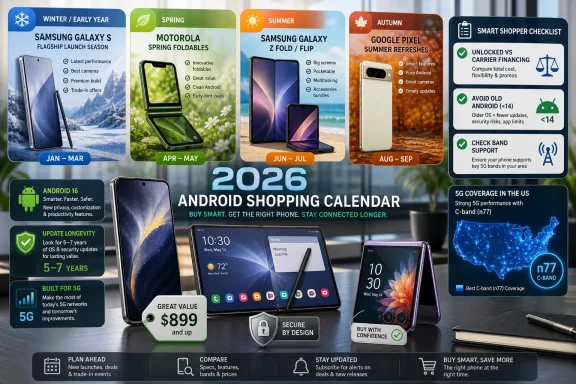 The Android Buying Calendar Has Become a Trap Disguised as Choice
The old smartphone rhythm was simple. Apple owned the fall, Samsung opened the year, and everyone else filled in the gaps. Android in 2026 is messier, faster, and more segmented.Samsung still sets the premium tone early in the year with the Galaxy S line. Motorola tends to refresh its Razr-style foldables in spring. Samsung’s Galaxy Z Fold and Z Flip models typically dominate the summer foldable conversation, while Google uses the Pixel line to push the newest version of Android and its AI-first software ideas.
That creates a strange consumer reality: there is no truly “wrong” time to buy, but there are definitely smarter times to buy specific categories. If you want a Galaxy S flagship, early spring is usually when the launch excitement and preorder deals settle into real-world pricing. If you want a foldable, summer and early fall are when the newest Samsung and Google options clarify the field.
The Best Android Phone Is No Longer One Phone
The phrase “best Android phone” now hides too much. A $300 Samsung A-series handset, a Pixel with seven years of updates, a gaming-focused OnePlus, and a nearly $2,000 foldable are not competing in the same practical market.The better question is whether a phone is best for your failure case. If you keep phones for five years, update policy matters more than benchmark scores. If you travel or live in a congested city, modem and band support matter more than a slightly brighter display. If you shoot a lot of photos of kids, pets, or night scenes, camera processing may matter more than megapixels.
This is where Google and Samsung have pulled away from much of the Android pack. Their biggest advantage is not just hardware; it is trust that the phone will still feel supported several years from now. Seven years of software and security updates on recent Pixel and high-end Galaxy devices changes the value equation, especially when phones routinely cost laptop money.
5G Is Standard, but Good 5G Still Requires Attention
For most buyers, 5G is no longer a premium feature. Any Android phone above roughly $200 should support it in some form, and budget buyers should not panic if 4G remains part of their daily experience. LTE networks are still fast enough for maps, messaging, streaming, browsing, and most work apps.The catch is that not all 5G is equal. In the United States, C-band support — especially band n77 — is one of the dividing lines between “has 5G” and “gets the 5G speeds carriers advertise.” AT&T, T-Mobile, and Verizon all rely on mid-band spectrum to deliver the kind of performance jump users actually notice.
That matters most when buying unlocked phones, imports, or unusually cheap models. A phone that looks powerful on paper can disappoint badly if it lacks the right radio support for your carrier. This is one reason U.S. buyers should be cautious about importing phones from Honor, Oppo, Vivo, or Xiaomi, even when the hardware looks more exciting than what local shelves offer.
Cheap Android Phones Are Better, but the Floor Is Still Dangerous
The sub-$300 Android market is much stronger than it used to be. Samsung’s budget models, Motorola’s lower-cost phones, and occasional Pixel A-series discounts can deliver a perfectly usable experience without the psychological burden of a $1,200 device.But the bargain bin still has traps. Carrier-branded phones with vague manufacturing origins often cut corners in software support, display quality, camera performance, and update reliability. The upfront price may be low, but the hidden cost is living with a phone that ages poorly.
The most important cheap-phone rule in 2026 is simple: do not buy a device that ships with an old Android version. Android 16 is the current reference point, and Android 14 should be treated as the practical floor for a new purchase. Anything older is not just less polished; it may have a shorter runway for security patches and app compatibility.
Android 16 Makes Software Support a Buying Feature
Android 16 is not merely a spec-sheet checkbox. It is the line between buying into the current Android ecosystem and buying something that may already be behind. For WindowsForum readers used to lifecycle planning on PCs, the analogy is obvious: the operating system version and support window are part of the product, not an afterthought.Google’s Pixel phones remain the cleanest route to Android as Google designs it. They receive major updates first, showcase new platform features early, and avoid the heavier interface changes that other manufacturers add. Samsung, by contrast, layers One UI over Android, but its long-term update commitments and mature hardware ecosystem make that trade-off attractive.
Motorola remains interesting because its Android skin is relatively light and familiar. The problem is that Motorola has historically lagged Google and Samsung on long-term update guarantees. For a phone you plan to replace quickly, that may be acceptable; for a device you want to keep for four or five years, it becomes a real weakness.
Foldables Have Moved From Experiment to Expensive Niche
Foldables are no longer science projects. Samsung’s Galaxy Z Fold and Z Flip lines, Motorola’s Razr models, and Google’s foldable Pixels have made bendable displays feel less exotic. But they remain expensive, more physically complex, and more dependent on use case than slab phones.The Galaxy Z Fold 7-style device is best understood as a pocket tablet for people who genuinely use multitasking, reading, document review, remote desktop, or large-screen apps on the go. The Z Flip-style device is a compact lifestyle phone with flagship aspirations. These are different products, not merely two shapes of the same idea.
For many buyers, the better foldable is not the technically most impressive one. It is the one whose closed size, battery life, camera compromises, hinge durability, and repair options fit daily life. A foldable that feels magical for two weeks can become annoying if it is too thick, too fragile-feeling, or too awkward for the apps you actually use.
The U.S. Android Market Is Smaller Than the Global Android Market
One of the oddities of Android coverage is that the global market and the U.S. market barely match. Honor, Oppo, Vivo, and Xiaomi are major players internationally, but they are largely absent from U.S. carrier shelves. ZTE, once more visible in prepaid channels, is also far less central than it used to be.That absence narrows consumer choice but simplifies some risks. U.S. carrier compatibility, warranty support, emergency calling behavior, 5G bands, and financing options matter more than raw spec comparisons. A phone that dominates YouTube reviews from Europe or Asia may be a bad fit for Verizon, AT&T, T-Mobile, or an MVNO using their networks.
OnePlus is the partial exception because it remains available to U.S. buyers and shares corporate roots with Oppo. Even there, buyers should check carrier compatibility before assuming everything will work as smoothly as it does on a Galaxy or Pixel.
Unlocked Phones Are the Cleanest Choice, but Carriers Still Control the Deal
Buying unlocked is the enthusiast answer. You avoid carrier bloatware, keep the freedom to switch providers, and separate your phone purchase from your service plan. For people who know their network bands, understand trade-offs, and watch sales carefully, unlocked is often the more rational path.But carriers still dominate the American market because they turn a painful price into a monthly line item. A $1,000 phone feels different when hidden inside a 24- or 36-month installment plan, especially when trade-in credits reduce the apparent cost. The catch is that those credits usually keep you tied to the carrier.
That is not always bad. A family that plans to stay with one carrier may benefit from aggressive trade-in promotions. A power user who changes MVNOs whenever pricing shifts should avoid locking the phone to the service. The phone itself is only half the transaction; the financing arrangement is the other half.
The Smart Buyer’s 2026 Android Checklist Is Shorter Than the Spec Sheet
The 2026 Android market rewards buyers who ignore noise. Peak brightness, synthetic benchmarks, charging wattage, and camera megapixels all matter in context, but they are rarely the first things that determine whether a phone remains satisfying after two years.The practical test is harsher. Does it support your carrier’s best network bands? Does it ship with a current Android version? How many OS upgrades and security patches are promised? Can you comfortably hold it? Is the camera reliable in bad lighting and motion? Will the battery survive your real day?
That last point is why in-person handling still matters. Modern phones can have similar screen sizes but very different widths, weights, curves, and balances. A tall narrow phone may be easier to hold than a shorter wider one, and a foldable may look compact on paper while feeling bulky in a pocket.
The Calendar Favors Patience, but Not Indecision
The best Android buying strategy in 2026 is to wait for the right category moment, not for the mythical final phone. Galaxy S buyers should watch the first quarter. Foldable buyers should watch summer. Pixel buyers should watch Google’s launch cycle and the discounts that follow. Budget buyers should be opportunistic, but only within the boundaries of current software and reliable update support.The worst strategy is buying an aging phone because the discount looks dramatic. A $400 markdown on a device with weak update support, missing C-band, or an old Android build is not really a deal. It is deferred frustration.
The best strategy is boring, which is why it works. Pick your budget, pick your carrier, decide how long you plan to keep the phone, and then buy the newest well-supported device that fits those constraints. In 2026, Android choice is abundant enough that you do not need to compromise on the basics.
The Phones Worth Buying Are the Ones That Age Gracefully
The Android market’s most important shift is that longevity has become a flagship feature. Google and Samsung did not just extend update promises as a marketing flourish; they changed what buyers should expect from a premium phone. When a device costs as much as a good laptop, three years of support no longer feels acceptable.That pressure should eventually improve the rest of the ecosystem. Motorola, OnePlus, TCL, and other Android vendors can still compete on price, charging, design, or niche features, but weak lifecycle commitments are harder to excuse. The more buyers treat updates as a purchase requirement, the faster the market will respond.
For Windows users and IT pros, this is familiar terrain. The best device is not the one with the flashiest launch demo. It is the one that remains secure, compatible, repairable, and predictable after the marketing campaign has moved on.
The 2026 Android Buyer’s Short List Is Really a Discipline Test
The Android shelf is crowded, but the decision tree is clearer than it looks. Before chasing the newest launch, buyers should force every candidate through a few practical gates.- Buy a phone that ships with Android 16 when possible, and avoid any new device that arrives with software older than Android 14.
- Prioritize Google Pixel and recent Samsung Galaxy S, Z Flip, and Z Fold models if long-term updates are central to your decision.
- Confirm C-band 5G support, especially band n77, if you want the best real-world performance on major U.S. carriers.
- Be cautious with imported phones from brands that do not officially sell through U.S. carriers, even when the hardware appears superior.
- Treat carrier financing as a contract decision, not a discount, because trade-in credits often depend on staying put.
- Handle large phones and foldables in person when possible, because width, weight, and hinge design matter more than screen size alone.
References
- Primary source: PCMag UK
Published: 2026-06-20T13:10:18.311184
Loading…
uk.pcmag.com - Related coverage: techradar.com
The best phone 2026: top smartphones in the US right now | TechRadar
We've tested the best phones around, in every price range, to bring you this definitive ranking of the best smartphone to buy.www.techradar.com - Related coverage: androidcentral.com
Best Motorola phones | Android Central
Here are the best Motorola phones you should consider if you're planning to buy a new phone. From budget options to foldables, there are many choices.www.androidcentral.com - Related coverage: phonearena.com
Loading…
www.phonearena.com - Related coverage: tomsguide.com
Loading…
www.tomsguide.com - Related coverage: knowledgelib.io
Loading…
knowledgelib.io