
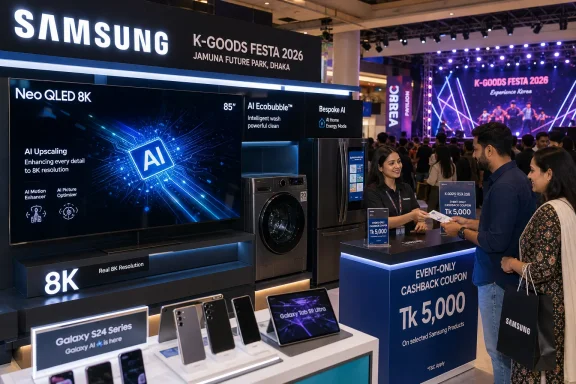
Samsung Bangladesh is using K-Goods Festa 2026, held June 19–20 at Jamuna Future Park in Dhaka, to turn a Korean cultural showcase into a retail conversion engine with event-only cashback coupons for TVs, appliances, smartphones, and tablets. The move is not merely a festival promotion; it is a neat example of how consumer electronics brands now sell ecosystems through live experience, national branding, and carefully gated discounts. For shoppers, the offer is immediate and tangible. For Samsung, the bigger prize is getting Bangladesh’s increasingly aspirational buyers to see “AI Living” as a household upgrade path rather than a showroom slogan.
K-Goods Festa 2026 arrived at Jamuna Future Park with the usual ingredients of Korean soft power: K-pop performances, K-beauty demonstrations, food tastings, lifestyle products, and a government-backed trade mission aesthetic. Jointly organized by the Embassy of the Republic of Korea in Bangladesh and KOTRA, the two-day event was designed to place Korean brands in front of consumers, retailers, importers, and distributors under one highly visible roof.
Samsung’s role in that mix is unusually revealing. The company is not just placing products on plinths and hoping visitors remember the model numbers. It is handing walk-in visitors discount coupons at its booth, then routing those coupons into specific retail channels where cashback can be claimed.
That matters because the promotion separates attention from transaction, then reconnects them. A visitor may discover an 85-inch Neo QLED 8K television or AI-enabled washing machine at the festival, but the actual purchase incentive is structured through Transcom Digital showrooms in Dhaka for select consumer electronics products. Mobile and tablet buyers get a different path, with instant cashback available at Samsung’s Jamuna Future Park branches.
This is experiential retail with a spreadsheet underneath. Culture gets the crowd into the mall; product demos create the desire; coupons give the visit a deadline; retail partners close the sale. In a market where premium electronics purchases are still carefully considered household decisions, Samsung is trying to compress the distance between curiosity and commitment.
That spread tells us something about the promotion’s design. The appliance and home entertainment cashback is positioned as a nudge for home upgrades, while the mobile cashback range gives Samsung enough flexibility to cover both accessible Galaxy devices and far more expensive flagship or foldable-class hardware. The top-end cashback number is eye-catching because it gives the campaign a premium halo even if most buyers end up much lower on the ladder.
Cashback is not new, but event-only cashback has a different psychological effect. It turns a consumer promotion into an occasion. If a shopper has to attend the festival, collect the coupon, and redeem it through a designated retail channel, Samsung has created a closed loop that is easier to measure and harder for competitors to copy casually.
The risk, as always, is that promotions can make the underlying product story feel secondary. A discount-heavy campaign can condition buyers to wait for the next offer. Samsung appears to be trying to avoid that by placing the cashback beside a larger “AI Living” showcase rather than letting price be the only message.
The common word is, inevitably, AI. In smartphones, AI has become a visible software feature. In home appliances and televisions, it is more slippery: upscaling, energy optimization, wash-cycle adjustment, food management, screen processing, voice control, and SmartThings-style device coordination all get bundled into the same marketing vocabulary.
That ambiguity is useful for Samsung. “AI Living” does not require every visitor to understand processor architectures, computer vision, or edge inference. It asks consumers to imagine a home where the TV sharpens content, the washing machine makes better decisions, and the refrigerator behaves less like a cold cabinet and more like a connected appliance.
For WindowsForum readers, this should sound familiar. The PC industry has spent the past two years trying to make “AI PC” mean something concrete. Samsung is doing the same thing for the living room, except the sales environment is a mall festival rather than a laptop launch keynote.
That promise has always been essential to 8K televisions because native 8K content remains scarce for ordinary consumers. Without convincing upscaling, an 8K TV is mostly an expensive screen waiting for a media ecosystem that is still catching up. Samsung’s pitch, therefore, is not simply that the TV has more pixels. It is that the processor can use AI to make existing content justify the hardware.
This is where the marketing becomes more defensible. Upscaling is a real workload, and modern televisions have become specialized computers with display panels attached. The processor, operating system, apps, connectivity stack, and update policy all affect the user experience long after the customer forgets the demo reel.
That should make buyers more demanding, not less. If a premium TV is sold on AI processing, consumers should ask how well it handles low-quality broadcast feeds, streaming compression, sports motion, subtitles, and local content sources. The showroom loop is designed to flatter the panel; real living rooms are messier.
A 9 KG front-loading washing machine with AI Ecobubble fits neatly into this shift. The consumer-facing pitch is convenience: better washing decisions, improved fabric care, and smarter use of detergent, water, or energy depending on the implementation. The industry-facing pitch is stickier: once appliances join a connected home ecosystem, brand choice becomes harder to reverse.
The French door refrigerator with built-in AI capability pushes that idea even further. Refrigerators have long replacement cycles, which makes software support and feature durability more important than a typical sales conversation admits. A smart refrigerator bought in 2026 may still be expected to work well deep into the 2030s.
That is why the “AI Living” pitch carries a responsibility. If a brand sells intelligence as a feature, it must maintain the intelligence as part of the product. Consumers are not merely buying motors, compressors, panels, and doors. They are buying a promise that software will not become the weakest component in the most expensive appliance in the kitchen.
Samsung has strong reasons to localize this pitch. In Bangladesh, the upgrade path from a basic smartphone to a Galaxy device, from a conventional TV to a large smart panel, or from a standard appliance to an AI-branded one is not just about specifications. It is about household status, reliability, after-sales service, financing, retail trust, and the perceived value of buying into a global ecosystem.
That makes the coupon mechanic more than a gimmick. It lowers the psychological barrier around a premium purchase without making the brand look cheap. The event does not say, “Everything is discounted everywhere.” It says, “You were here, you engaged, and now you have access to a specific reward.”
This is a classic premium-market compromise. Samsung wants urgency, but not bargain-bin energy. The festival gives the company a way to attach savings to participation rather than desperation.
That blend is deliberate. Korean consumer brands benefit when they travel together. K-pop makes Korean products feel familiar; K-beauty makes Korean design feel aspirational; Korean food turns curiosity into participation; Samsung gives the whole exercise a premium technology anchor.
For Bangladesh, the benefits are practical as well as cultural. Events like this can connect importers and distributors with brands, give local retailers a reason to engage consumers, and provide shoppers with a more direct view of products that might otherwise be encountered only through ads or online listings. It is soft power, but it is also channel development.
Samsung is unusually well positioned in that ecosystem because it can speak both languages. It is a Korean national champion in the public imagination, but also a deeply global company whose products are already embedded in daily life across markets. At K-Goods Festa, it can be both cultural ambassador and aggressive retailer.
This matters because consumer electronics retail is increasingly omnichannel in theory but still deeply physical in practice for high-value purchases. A buyer may research a TV online, watch YouTube reviews, compare prices across stores, and still want to stand in front of the panel before paying. For appliances, the need for delivery, installation, warranty confidence, and service access keeps physical retail central.
The festival coupon acts as a bridge between spectacle and logistics. It lets Samsung harvest excitement from the event while pushing customers toward outlets equipped to complete the sale. That is cleaner than trying to sell every big-ticket product directly from a temporary booth.
For retailers, this is a reminder that the store is not dead; it is being repurposed. The modern electronics showroom is less a warehouse and more a fulfillment point for experiences that begin elsewhere — at festivals, on social media, in messaging apps, or inside a brand ecosystem.
These questions are not anti-innovation. They are the natural response to putting software into devices that used to be bought for durability above all else. A washing machine or refrigerator is expected to fade into the background of household life, not become another gadget that nags for permissions or loses features after a policy change.
Samsung has the scale to address this better than many competitors. Its SmartThings ecosystem, TV software, Galaxy integration, and appliance portfolio give it a coherent story that smaller brands cannot easily match. But scale also raises expectations. A company that sells the connected home has to make the connected home feel stable, secure, and worth the lock-in.
That is where the festival demo can only do so much. A booth can show what a product does on day one. The real test is year five, when the refrigerator still needs to be useful, the TV still needs app support, and the washing machine still needs parts and service.
Samsung’s Galaxy lineup is broad enough to make this kind of promotion flexible. Entry and midrange buyers can be brought in with modest instant rewards, while premium buyers can be tempted with far larger savings on selected models. The company can tune the promotion by inventory, margin, model lifecycle, and competitive pressure without changing the overall message.
For consumers, however, the important word is “select.” A very large cashback ceiling does not mean every buyer will receive anything close to that amount. The actual value depends on the eligible model, branch rules, stock availability, and campaign terms at the point of sale.
That does not make the offer meaningless. It simply means shoppers should treat the festival coupon as leverage, not as a substitute for comparison shopping. The best deal is still the one that makes sense after checking the final payable price, warranty, storage configuration, device condition, bundled accessories, and any financing costs.
That is why the festival setting is powerful. It reframes the purchase from a solitary price comparison into a social experience. Families can see products together, ask questions, collect coupons, and imagine the upgrade in a context that feels celebratory rather than purely transactional.
This is also why cultural events can be more effective than conventional ads. Ads tell people a product exists. Festivals let people feel that a product belongs to a lifestyle they may already admire. When Korean entertainment, food, beauty, travel, and electronics are presented together, the brand ecosystem becomes emotional before it becomes financial.
Samsung is not inventing this playbook, but it is executing a polished version of it. The company understands that the AI home will not be sold by specifications alone. It needs a stage.
That is especially important because K-Goods Festa is a short event, running only June 19–20. A shopper who collects a coupon should confirm the redemption window, eligible models, participating branches, and whether the cashback is instant, adjusted at checkout, credited later, or subject to documentation. For mobile and tablet purchases, the distinction between JFP Samsung branches and other retail outlets may matter.
For consumer electronics purchases routed through Transcom Digital showrooms in Dhaka, buyers should also clarify whether the Tk 5,000 cashback applies across all categories or only named models. “Select products” is doing a lot of work in campaigns like this. It is not a warning sign, but it is a reminder to ask before assuming.
The smartest customers will use the coupon as one input in the purchase decision. They will compare final prices, confirm warranty coverage, check installation terms for large appliances, and avoid being rushed into a premium upgrade simply because the event atmosphere is doing its job.
 Samsung Turns a Cultural Festival Into a Checkout Funnel
K-Goods Festa 2026 arrived at Jamuna Future Park with the usual ingredients of Korean soft power: K-pop performances, K-beauty demonstrations, food tastings, lifestyle products, and a government-backed trade mission aesthetic. Jointly organized by the Embassy of the Republic of Korea in Bangladesh and KOTRA, the two-day event was designed to place Korean brands in front of consumers, retailers, importers, and distributors under one highly visible roof.Samsung’s role in that mix is unusually revealing. The company is not just placing products on plinths and hoping visitors remember the model numbers. It is handing walk-in visitors discount coupons at its booth, then routing those coupons into specific retail channels where cashback can be claimed.
That matters because the promotion separates attention from transaction, then reconnects them. A visitor may discover an 85-inch Neo QLED 8K television or AI-enabled washing machine at the festival, but the actual purchase incentive is structured through Transcom Digital showrooms in Dhaka for select consumer electronics products. Mobile and tablet buyers get a different path, with instant cashback available at Samsung’s Jamuna Future Park branches.
This is experiential retail with a spreadsheet underneath. Culture gets the crowd into the mall; product demos create the desire; coupons give the visit a deadline; retail partners close the sale. In a market where premium electronics purchases are still carefully considered household decisions, Samsung is trying to compress the distance between curiosity and commitment.
The Cashback Is Small Print With Strategic Weight
The headline numbers are straightforward. Walk-in visitors who receive Samsung festival coupons can claim Tk 5,000 cashback on select consumer electronics products at Transcom Digital showrooms in Dhaka. Buyers of select Samsung Galaxy smartphones and tablets are eligible for instant cashback ranging from Tk 500 to as much as Tk 107,999, with those mobile offers tied to Samsung’s Jamuna Future Park branches.That spread tells us something about the promotion’s design. The appliance and home entertainment cashback is positioned as a nudge for home upgrades, while the mobile cashback range gives Samsung enough flexibility to cover both accessible Galaxy devices and far more expensive flagship or foldable-class hardware. The top-end cashback number is eye-catching because it gives the campaign a premium halo even if most buyers end up much lower on the ladder.
Cashback is not new, but event-only cashback has a different psychological effect. It turns a consumer promotion into an occasion. If a shopper has to attend the festival, collect the coupon, and redeem it through a designated retail channel, Samsung has created a closed loop that is easier to measure and harder for competitors to copy casually.
The risk, as always, is that promotions can make the underlying product story feel secondary. A discount-heavy campaign can condition buyers to wait for the next offer. Samsung appears to be trying to avoid that by placing the cashback beside a larger “AI Living” showcase rather than letting price be the only message.
“AI Living” Is the Pitch Samsung Actually Wants You to Remember
The products on display make the strategic intent clearer than the coupons do. Samsung is showing an 85-inch Neo QLED TV with 8K AI Upscaling Pro, a 9 KG front-loading washing machine with AI Ecobubble, and what is described as Bangladesh’s first French door refrigerator with built-in AI capability. These are not impulse buys. They are household infrastructure purchases.The common word is, inevitably, AI. In smartphones, AI has become a visible software feature. In home appliances and televisions, it is more slippery: upscaling, energy optimization, wash-cycle adjustment, food management, screen processing, voice control, and SmartThings-style device coordination all get bundled into the same marketing vocabulary.
That ambiguity is useful for Samsung. “AI Living” does not require every visitor to understand processor architectures, computer vision, or edge inference. It asks consumers to imagine a home where the TV sharpens content, the washing machine makes better decisions, and the refrigerator behaves less like a cold cabinet and more like a connected appliance.
For WindowsForum readers, this should sound familiar. The PC industry has spent the past two years trying to make “AI PC” mean something concrete. Samsung is doing the same thing for the living room, except the sales environment is a mall festival rather than a laptop launch keynote.
The 8K TV Is a Status Object and a Software Argument
The 85-inch Neo QLED 8K set is the most visually obvious part of Samsung’s booth strategy. A giant television at a public event does what a giant television has always done: it stops people. But the important part is not only the panel size; it is the promise that Samsung’s AI upscaling can make today’s content look better on tomorrow’s resolution.That promise has always been essential to 8K televisions because native 8K content remains scarce for ordinary consumers. Without convincing upscaling, an 8K TV is mostly an expensive screen waiting for a media ecosystem that is still catching up. Samsung’s pitch, therefore, is not simply that the TV has more pixels. It is that the processor can use AI to make existing content justify the hardware.
This is where the marketing becomes more defensible. Upscaling is a real workload, and modern televisions have become specialized computers with display panels attached. The processor, operating system, apps, connectivity stack, and update policy all affect the user experience long after the customer forgets the demo reel.
That should make buyers more demanding, not less. If a premium TV is sold on AI processing, consumers should ask how well it handles low-quality broadcast feeds, streaming compression, sports motion, subtitles, and local content sources. The showroom loop is designed to flatter the panel; real living rooms are messier.
Appliances Are Becoming Computers That Also Wash Clothes
The washing machine and refrigerator are the subtler part of Samsung’s festival presence, but arguably the more important one. Televisions have been smart for years. Appliances are now moving through the same transition, from durable mechanical goods to connected platforms that collect data, receive updates, and promise optimization.A 9 KG front-loading washing machine with AI Ecobubble fits neatly into this shift. The consumer-facing pitch is convenience: better washing decisions, improved fabric care, and smarter use of detergent, water, or energy depending on the implementation. The industry-facing pitch is stickier: once appliances join a connected home ecosystem, brand choice becomes harder to reverse.
The French door refrigerator with built-in AI capability pushes that idea even further. Refrigerators have long replacement cycles, which makes software support and feature durability more important than a typical sales conversation admits. A smart refrigerator bought in 2026 may still be expected to work well deep into the 2030s.
That is why the “AI Living” pitch carries a responsibility. If a brand sells intelligence as a feature, it must maintain the intelligence as part of the product. Consumers are not merely buying motors, compressors, panels, and doors. They are buying a promise that software will not become the weakest component in the most expensive appliance in the kitchen.
Bangladesh Is Not a Side Market for the AI Home
It would be easy to treat this as a localized corporate promotion, but that misses the larger story. Bangladesh is a young, mobile-first, urbanizing consumer market with expanding retail sophistication and a large middle class that is increasingly exposed to global product cycles. A Korean goods festival at one of Dhaka’s most prominent shopping destinations is exactly the kind of setting where premium electronics brands test how far aspirational technology can travel.Samsung has strong reasons to localize this pitch. In Bangladesh, the upgrade path from a basic smartphone to a Galaxy device, from a conventional TV to a large smart panel, or from a standard appliance to an AI-branded one is not just about specifications. It is about household status, reliability, after-sales service, financing, retail trust, and the perceived value of buying into a global ecosystem.
That makes the coupon mechanic more than a gimmick. It lowers the psychological barrier around a premium purchase without making the brand look cheap. The event does not say, “Everything is discounted everywhere.” It says, “You were here, you engaged, and now you have access to a specific reward.”
This is a classic premium-market compromise. Samsung wants urgency, but not bargain-bin energy. The festival gives the company a way to attach savings to participation rather than desperation.
KOTRA’s Trade Show Has Become a Consumer Interface
KOTRA’s involvement gives the event a second layer. This is not just Samsung running a mall activation; it is part of a broader Korean commercial and cultural push in Bangladesh. Electronics sit beside cosmetics, skincare, food, lifestyle goods, and tourism messaging because the export strategy is not limited to one category.That blend is deliberate. Korean consumer brands benefit when they travel together. K-pop makes Korean products feel familiar; K-beauty makes Korean design feel aspirational; Korean food turns curiosity into participation; Samsung gives the whole exercise a premium technology anchor.
For Bangladesh, the benefits are practical as well as cultural. Events like this can connect importers and distributors with brands, give local retailers a reason to engage consumers, and provide shoppers with a more direct view of products that might otherwise be encountered only through ads or online listings. It is soft power, but it is also channel development.
Samsung is unusually well positioned in that ecosystem because it can speak both languages. It is a Korean national champion in the public imagination, but also a deeply global company whose products are already embedded in daily life across markets. At K-Goods Festa, it can be both cultural ambassador and aggressive retailer.
The Coupon Trail Reveals the Real Retail Battlefield
The split between Transcom Digital showrooms and Samsung’s JFP branches is worth noticing. Promotions do not just stimulate demand; they discipline channels. By defining where cashback can be redeemed, Samsung can direct footfall, manage stock, track campaign effectiveness, and reward retail partners that support the activation.This matters because consumer electronics retail is increasingly omnichannel in theory but still deeply physical in practice for high-value purchases. A buyer may research a TV online, watch YouTube reviews, compare prices across stores, and still want to stand in front of the panel before paying. For appliances, the need for delivery, installation, warranty confidence, and service access keeps physical retail central.
The festival coupon acts as a bridge between spectacle and logistics. It lets Samsung harvest excitement from the event while pushing customers toward outlets equipped to complete the sale. That is cleaner than trying to sell every big-ticket product directly from a temporary booth.
For retailers, this is a reminder that the store is not dead; it is being repurposed. The modern electronics showroom is less a warehouse and more a fulfillment point for experiences that begin elsewhere — at festivals, on social media, in messaging apps, or inside a brand ecosystem.
The AI Home Still Has a Trust Problem
There is a quieter issue beneath the gloss: trust. When appliances become connected, consumers inherit the same anxieties that have followed PCs and smartphones for years. How long will updates last? What data is collected? What happens when a cloud feature is retired? Will the “smart” function still work when the product is no longer new?These questions are not anti-innovation. They are the natural response to putting software into devices that used to be bought for durability above all else. A washing machine or refrigerator is expected to fade into the background of household life, not become another gadget that nags for permissions or loses features after a policy change.
Samsung has the scale to address this better than many competitors. Its SmartThings ecosystem, TV software, Galaxy integration, and appliance portfolio give it a coherent story that smaller brands cannot easily match. But scale also raises expectations. A company that sells the connected home has to make the connected home feel stable, secure, and worth the lock-in.
That is where the festival demo can only do so much. A booth can show what a product does on day one. The real test is year five, when the refrigerator still needs to be useful, the TV still needs app support, and the washing machine still needs parts and service.
The Smartphone Cashback Range Carries the Loudest Signal
The mobile and tablet offer is the most dramatic part of Samsung’s campaign because the cashback range stretches from Tk 500 to Tk 107,999. That upper figure is not accidental. It is designed to travel through headlines, social feeds, and word of mouth.Samsung’s Galaxy lineup is broad enough to make this kind of promotion flexible. Entry and midrange buyers can be brought in with modest instant rewards, while premium buyers can be tempted with far larger savings on selected models. The company can tune the promotion by inventory, margin, model lifecycle, and competitive pressure without changing the overall message.
For consumers, however, the important word is “select.” A very large cashback ceiling does not mean every buyer will receive anything close to that amount. The actual value depends on the eligible model, branch rules, stock availability, and campaign terms at the point of sale.
That does not make the offer meaningless. It simply means shoppers should treat the festival coupon as leverage, not as a substitute for comparison shopping. The best deal is still the one that makes sense after checking the final payable price, warranty, storage configuration, device condition, bundled accessories, and any financing costs.
Samsung’s Biggest Competitor Is Not Another Booth
At an event like K-Goods Festa, Samsung’s visible competitors may be other Korean brands or rival electronics sellers. But the bigger competition is household hesitation. A premium TV, refrigerator, washing machine, smartphone, or tablet has to compete with rent, school fees, travel, savings goals, and cheaper alternatives that are “good enough.”That is why the festival setting is powerful. It reframes the purchase from a solitary price comparison into a social experience. Families can see products together, ask questions, collect coupons, and imagine the upgrade in a context that feels celebratory rather than purely transactional.
This is also why cultural events can be more effective than conventional ads. Ads tell people a product exists. Festivals let people feel that a product belongs to a lifestyle they may already admire. When Korean entertainment, food, beauty, travel, and electronics are presented together, the brand ecosystem becomes emotional before it becomes financial.
Samsung is not inventing this playbook, but it is executing a polished version of it. The company understands that the AI home will not be sold by specifications alone. It needs a stage.
The Deal Is Useful, But the Fine Print Still Matters
The practical reading for shoppers is simple: the festival can unlock real savings, but only for those who follow the redemption path correctly. Event-only offers are built around eligibility, location, and timing. Miss one of those conditions and the headline cashback may evaporate.That is especially important because K-Goods Festa is a short event, running only June 19–20. A shopper who collects a coupon should confirm the redemption window, eligible models, participating branches, and whether the cashback is instant, adjusted at checkout, credited later, or subject to documentation. For mobile and tablet purchases, the distinction between JFP Samsung branches and other retail outlets may matter.
For consumer electronics purchases routed through Transcom Digital showrooms in Dhaka, buyers should also clarify whether the Tk 5,000 cashback applies across all categories or only named models. “Select products” is doing a lot of work in campaigns like this. It is not a warning sign, but it is a reminder to ask before assuming.
The smartest customers will use the coupon as one input in the purchase decision. They will compare final prices, confirm warranty coverage, check installation terms for large appliances, and avoid being rushed into a premium upgrade simply because the event atmosphere is doing its job.
The Dhaka Festival Shows How Samsung Wants AI to Enter the Home
Samsung’s K-Goods Festa presence offers a compact map of where consumer electronics marketing is going next.- Samsung is using the festival to connect Korean cultural appeal with immediate retail incentives in Dhaka.
- Walk-in visitors can receive Samsung coupons that unlock Tk 5,000 cashback on select consumer electronics products at Transcom Digital showrooms in Dhaka.
- Buyers of select Galaxy smartphones and tablets can receive instant cashback from Tk 500 up to Tk 107,999 at Samsung’s Jamuna Future Park branches.
- The product showcase is built around Samsung’s “AI Living” message, including an 85-inch Neo QLED 8K TV, an AI Ecobubble washing machine, and an AI-enabled French door refrigerator.
- The promotion’s real value depends on model eligibility, redemption location, campaign timing, and the final payable price after all conditions are applied.
References
- Primary source: Prothom Alo English
Published: 2026-06-20T12:10:18.328665
Loading…
en.prothomalo.com - Related coverage: dhakatribune.com
Loading…
www.dhakatribune.com - Related coverage: samsung.com
Loading…
www.samsung.com - Related coverage: news.samsung.com
Loading…
news.samsung.com - Related coverage: bestelectronics.com.bd
Loading…
www.bestelectronics.com.bd - Related coverage: shop.samsung.com
Loading…
shop.samsung.com