
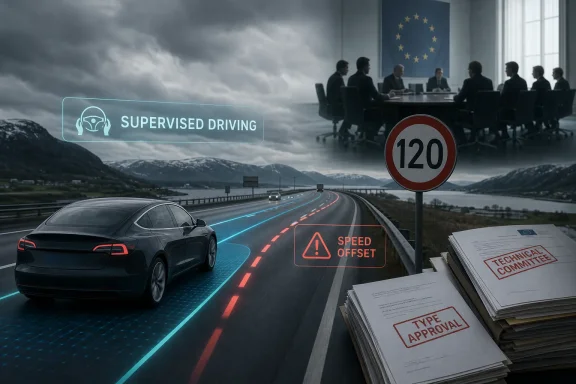
Sweden’s transport authorities have urged European Union vehicle regulators to reject a broader rollout of Tesla’s Full Self-Driving Supervised system unless Tesla removes a setting that can let the car drive above posted speed limits. The objection, raised ahead of a June 30 EU technical committee discussion, turns a familiar Tesla argument inside out. This is not just a fight over whether software can steer well enough; it is a fight over whether automation is allowed to normalize rule-breaking because humans already do it.
That distinction matters. Tesla has spent years selling FSD as an eventual escape hatch from messy human driving, but Sweden is asking a blunter question: if the machine is supposed to be safer than the driver, why is it being designed to mimic one of the driver’s most common illegal habits?
Tesla’s European FSD campaign has been built around a careful phrase: Full Self-Driving Supervised. The name promises a lot, the suffix takes much of it back, and the regulatory argument sits somewhere between the two. Tesla wants officials to treat the system as a sophisticated driver-assistance feature rather than a driver replacement, while also claiming it can deliver major safety benefits over ordinary human driving.
Sweden’s objection targets the seam in that argument. If FSD is merely assistance, Tesla can say the human remains responsible and can override the car at any time. If FSD is safety automation, regulators can reasonably expect it to obey traffic law more consistently than the human it is assisting.
The reported sticking point is a “speed offset” behavior that lets the system operate above the posted limit, or at least allows a driver-selected profile that does so. In the United States, that may sound like everyday traffic realism. In a European approval file, it sounds like a machine-readable instruction to violate the law.
That is why Sweden’s position is more serious than a local complaint about Tesla culture. It challenges the core bargain Tesla has been offering regulators: approve the software now, keep the human legally responsible, and let over-the-air updates improve the product later. Sweden is effectively saying that a system seeking public-road legitimacy must not begin by treating legal limits as negotiable.
Europe is different not because European drivers are saints, but because the approval structure is different. Type approval, technical committees, national authorities, and cross-border recognition make deployment a political and legal exercise before it becomes a consumer feature. A system that can pass in one country can create pressure on others, but it can also trigger objections that slow the entire machine.
Tesla’s first European wins came through national approvals and recognition of earlier assessments, with the Netherlands playing a central role and Lithuania following as an early adopter. That gave Tesla a story of momentum: once one regulator had done the hard work, others could rely on that assessment instead of starting from zero.
Sweden is now testing the limits of that momentum. The country is not saying that driver assistance is impossible, nor that Tesla’s system cannot ever be approved. It is saying that a specific behavior conflicts with the legal premise of road automation. That is a narrower argument, but it may be harder for Tesla to dismiss.
That argument is not ridiculous. Anyone who has used adaptive cruise control knows that posted limits, map data, roadworks, and real-world flow do not always align neatly. A perfectly legal automated car can still behave in ways that frustrate surrounding traffic.
But Sweden’s objection is not about whether speed-limit databases are imperfect. It is about whether a safety system should expose a deliberate control for exceeding the legal maximum. A sensor error or map mismatch is a technical problem; a configurable law-breaking margin is a policy problem.
That policy problem becomes sharper when the product is marketed under the banner of self-driving. If automation is sold as a route to fewer crashes, fewer mistakes, and more predictable roads, regulators will not be eager to bless a feature that encodes “a little speeding” as normal operation. The machine’s first duty, in that view, is not to drive like a confident local. It is to drive like a lawful one.
That dual identity has always been Tesla’s advantage. The company can sell a powerful vision while shipping an incremental product. It can call the feature Full Self-Driving while insisting that drivers must keep hands, eyes, and attention ready. It can claim safety upside while reminding everyone that the human is still the legal backstop.
Europe is exposing the tension in that posture. If the driver is truly in charge, then perhaps the driver can choose a speed offset and bear responsibility for it. If the system is being approved because automated assistance improves safety, then regulators may ask why the software should offer a law-violating operating mode at all.
This is the trap Tesla set for itself by making autonomy both a product and a mythology. The more the company argues that FSD is transformative, the less convincing it becomes to shrug off questionable behaviors as mere driver preference.
But a foothold is not a passport. EU vehicle regulation is full of mutual recognition mechanisms, but politics and safety concerns still travel with the software. A national approval can accelerate adoption; it does not erase every other country’s duty to object when it sees a legal or safety conflict.
Sweden’s move shows how fragmented the path can remain even inside a single market. Tesla may win in one jurisdiction, see another recognize the approval, and still face a committee-level challenge before broad deployment. That is annoying for Tesla, but it is not irrational. Automated driving is precisely the kind of technology where one country’s tolerance can impose externalities on another.
The practical effect is that Tesla’s European rollout may proceed less like an app launch and more like telecom spectrum policy: slow, procedural, national, and vulnerable to objections that seem narrow until they become precedent.
Safety data is not a side issue for Tesla. It is the moral architecture of the FSD argument. If the system is safer, regulators should permit it. If it is much safer, perhaps they should even welcome it quickly. If the data is apples-to-oranges, cherry-picked, or framed for investor relations, then the entire approval conversation becomes more skeptical.
European regulators are especially sensitive to this because they do not need to accept a Silicon Valley-style “ship, observe, iterate” bargain on faith. They can demand clearer definitions of crashes, exposure, road types, driver monitoring, disengagements, near misses, and lawful behavior. In a mature regulatory system, “safer than humans” is not a slogan; it is a measurement problem.
The speed-offset dispute fits that same pattern. Tesla is asking to be judged on outcomes, but regulators are also judging design intent. A system that produces fewer crashes while routinely exceeding speed limits would still raise a legitimacy problem. Safety and legality overlap, but they are not identical.
Microsoft has lived through versions of this problem for decades. Windows updates, driver signing, cloud defaults, Recall-style AI features, browser bundling, and security baselines all show the same tension. Engineering teams want to reduce friction; administrators want predictability, auditability, and the ability to say no.
Tesla is not Microsoft, and a car is not a laptop. But the governance pattern is similar. Once software controls consequential behavior, “the user can turn it off” stops being a complete answer. IT pros learned that lesson with macros, unsigned drivers, default telemetry, and cloud-connected identity. Transport regulators are now applying the same instinct to vehicles.
That is why Sweden’s position should not be dismissed as anti-innovation. It is the voice of an administrator looking at a default policy and asking why the vendor shipped it that way in the first place.
That is coherent in a narrow legal sense. It is less satisfying as a safety model. The more capable a system appears, the more likely humans are to monitor it passively rather than actively. This is the automation paradox: better assistance can produce worse vigilance.
Speeding sharpens that paradox because the violation may not look like a malfunction. If the car smoothly drives a few kilometers per hour above the limit, the driver may perceive that as normal, authorized behavior. Over time, the machine trains the human as much as the human supervises the machine.
Regulators understand this. They are not merely evaluating whether a driver can override the system; they are evaluating what habits the system creates. A supervised feature can still undermine compliance if its ordinary operation nudges users toward illegal behavior.
The business question is whether Tesla wants that flexibility to become fragmentation. Different FSD behaviors across the U.S., Europe, China, and individual European countries would complicate development, validation, support, and marketing. A feature that behaves differently depending on jurisdiction is manageable, but the more the differences grow, the less universal Tesla’s autonomy story becomes.
There is also a branding problem. If Tesla removes the speed offset in Europe, critics will say regulators forced the company to make FSD more lawful. If Tesla refuses, it risks delaying broader approval over a feature many users may consider minor. Neither outcome fits the heroic narrative of inevitable autonomy.
The obvious compromise is to make strict legal compliance the baseline and let human drivers make their own choices outside automation. That may make FSD feel less human and less assertive. It may also make it easier to approve.
That matters inside EU processes. A complaint that sounds like “we dislike Tesla” is easy to isolate. A complaint that says “this feature undermines traffic law and the safety premise of automation” is harder for other regulators to ignore. Finland and Norway reportedly share concerns, which gives the objection a regional character even though Norway is outside the EU.
For Germany, France, Italy, Spain, and other larger markets, the Swedish argument offers a clean way to slow approval without rejecting automation outright. They can say they are open to FSD, but not to a version that treats speed limits as advisory. That is a defensible public position.
Tesla’s challenge is therefore not only technical. It must prevent one disputed setting from becoming the symbol of a broader trust deficit.
This is where American and European assumptions diverge. In the U.S., “keeping up with traffic” often functions as an informal rule layered on top of the formal one. In much of Europe, especially in countries with strong road-safety cultures, that informal rule carries less moral authority. A machine does not get the same social indulgence as a human commuter.
Automation forces societies to formalize habits they previously tolerated. If everyone speeds a little, should the robotaxi speed a little? If drivers roll through empty stop signs, should software learn that too? If aggressive merging works in Boston or Rome, should a safety system encode it?
These questions are uncomfortable because human road culture is full of illegal improvisation. Tesla’s system, by trying to drive more naturally, makes that improvisation visible. Sweden’s answer is that visibility should not become permission.
Yet Europe is also the place where Tesla’s autonomy narrative is most likely to be forced into precise language. What level of automation is this? What rules does it obey? What happens when map data conflicts with signs? What data proves safety? Who is responsible when the system behaves as designed but the design permits illegality?
Those are not anti-tech questions. They are deployment questions. They are what happens when a feature leaves demo videos and enters a rule-bound public infrastructure.
Tesla has often been strongest when it compresses timelines. It launches, learns, patches, and dares competitors to keep up. EU approval processes are designed to resist exactly that tempo. The question for Tesla is whether it can adapt without losing the speed that made it Tesla.
That has consequences for every stakeholder watching the rollout.
Tesla can probably engineer its way around a speed-offset dispute. The harder problem is cultural: Europe is asking the company to stop treating lawfulness as a driver preference and start treating it as a core safety feature. If Tesla accepts that premise, FSD may still expand across the continent, but it will do so as a more constrained, more auditable, and less swaggering product than the one its fans imagined. If it refuses, Sweden’s objection may be remembered as the moment Europe told Tesla that the future of driving still has to obey the sign at the side of the road.
That distinction matters. Tesla has spent years selling FSD as an eventual escape hatch from messy human driving, but Sweden is asking a blunter question: if the machine is supposed to be safer than the driver, why is it being designed to mimic one of the driver’s most common illegal habits?
 Sweden Finds the Weak Spot in Tesla’s European Pitch
Tesla’s European FSD campaign has been built around a careful phrase: Full Self-Driving Supervised. The name promises a lot, the suffix takes much of it back, and the regulatory argument sits somewhere between the two. Tesla wants officials to treat the system as a sophisticated driver-assistance feature rather than a driver replacement, while also claiming it can deliver major safety benefits over ordinary human driving.Sweden’s objection targets the seam in that argument. If FSD is merely assistance, Tesla can say the human remains responsible and can override the car at any time. If FSD is safety automation, regulators can reasonably expect it to obey traffic law more consistently than the human it is assisting.
The reported sticking point is a “speed offset” behavior that lets the system operate above the posted limit, or at least allows a driver-selected profile that does so. In the United States, that may sound like everyday traffic realism. In a European approval file, it sounds like a machine-readable instruction to violate the law.
That is why Sweden’s position is more serious than a local complaint about Tesla culture. It challenges the core bargain Tesla has been offering regulators: approve the software now, keep the human legally responsible, and let over-the-air updates improve the product later. Sweden is effectively saying that a system seeking public-road legitimacy must not begin by treating legal limits as negotiable.
Europe Is Not Just a Bigger California
Tesla’s U.S. development culture has always been unusually tolerant of ambiguity. Autopilot and FSD features were refined in a market where drivers already live with speed buffers, aggressive merging, rolling software changes, and a regulatory structure that often reacts after deployment. That does not mean the U.S. has no rules; it means Tesla’s product philosophy grew up in a comparatively permissive environment.Europe is different not because European drivers are saints, but because the approval structure is different. Type approval, technical committees, national authorities, and cross-border recognition make deployment a political and legal exercise before it becomes a consumer feature. A system that can pass in one country can create pressure on others, but it can also trigger objections that slow the entire machine.
Tesla’s first European wins came through national approvals and recognition of earlier assessments, with the Netherlands playing a central role and Lithuania following as an early adopter. That gave Tesla a story of momentum: once one regulator had done the hard work, others could rely on that assessment instead of starting from zero.
Sweden is now testing the limits of that momentum. The country is not saying that driver assistance is impossible, nor that Tesla’s system cannot ever be approved. It is saying that a specific behavior conflicts with the legal premise of road automation. That is a narrower argument, but it may be harder for Tesla to dismiss.
The Speed Offset Is Small, but the Principle Is Not
Tesla supporters will argue that a speed offset is practical. Traffic often flows above the posted limit. A car rigidly glued to the limit can become a rolling obstacle, provoking unsafe overtakes or awkward speed differentials. Human drivers constantly make small speed judgments, and automation that cannot participate in that social reality may feel brittle.That argument is not ridiculous. Anyone who has used adaptive cruise control knows that posted limits, map data, roadworks, and real-world flow do not always align neatly. A perfectly legal automated car can still behave in ways that frustrate surrounding traffic.
But Sweden’s objection is not about whether speed-limit databases are imperfect. It is about whether a safety system should expose a deliberate control for exceeding the legal maximum. A sensor error or map mismatch is a technical problem; a configurable law-breaking margin is a policy problem.
That policy problem becomes sharper when the product is marketed under the banner of self-driving. If automation is sold as a route to fewer crashes, fewer mistakes, and more predictable roads, regulators will not be eager to bless a feature that encodes “a little speeding” as normal operation. The machine’s first duty, in that view, is not to drive like a confident local. It is to drive like a lawful one.
Tesla Wants Supervision Without Losing the Magic
The phrase “supervised” is doing enormous work for Tesla. It reassures regulators that the driver remains in control, reassures lawyers that responsibility has not shifted fully to the machine, and reassures customers that the system is still the thing they have been promised for years. It is a liability word wearing a futurist jacket.That dual identity has always been Tesla’s advantage. The company can sell a powerful vision while shipping an incremental product. It can call the feature Full Self-Driving while insisting that drivers must keep hands, eyes, and attention ready. It can claim safety upside while reminding everyone that the human is still the legal backstop.
Europe is exposing the tension in that posture. If the driver is truly in charge, then perhaps the driver can choose a speed offset and bear responsibility for it. If the system is being approved because automated assistance improves safety, then regulators may ask why the software should offer a law-violating operating mode at all.
This is the trap Tesla set for itself by making autonomy both a product and a mythology. The more the company argues that FSD is transformative, the less convincing it becomes to shrug off questionable behaviors as mere driver preference.
The Dutch Approval Gave Tesla a Door, Not a Passport
The Netherlands’ approval gave Tesla a crucial foothold. It demonstrated that a European authority could examine the system, impose conditions, and allow supervised FSD on public roads. For a company that has spent years telling investors and customers that regulatory approval was the main obstacle outside North America, that mattered.But a foothold is not a passport. EU vehicle regulation is full of mutual recognition mechanisms, but politics and safety concerns still travel with the software. A national approval can accelerate adoption; it does not erase every other country’s duty to object when it sees a legal or safety conflict.
Sweden’s move shows how fragmented the path can remain even inside a single market. Tesla may win in one jurisdiction, see another recognize the approval, and still face a committee-level challenge before broad deployment. That is annoying for Tesla, but it is not irrational. Automated driving is precisely the kind of technology where one country’s tolerance can impose externalities on another.
The practical effect is that Tesla’s European rollout may proceed less like an app launch and more like telecom spectrum policy: slow, procedural, national, and vulnerable to objections that seem narrow until they become precedent.
Safety Data Is Becoming Its Own Regulatory Battlefield
The Swedish speed-limit objection lands in a week when Tesla’s safety claims are already under scrutiny. Reuters reported that Tesla presented self-published FSD safety statistics to European regulators that independent traffic-safety researchers described as misleading. Regulators in the Netherlands reportedly said they performed their own tests and did not rely on marketing claims, but the episode still matters.Safety data is not a side issue for Tesla. It is the moral architecture of the FSD argument. If the system is safer, regulators should permit it. If it is much safer, perhaps they should even welcome it quickly. If the data is apples-to-oranges, cherry-picked, or framed for investor relations, then the entire approval conversation becomes more skeptical.
European regulators are especially sensitive to this because they do not need to accept a Silicon Valley-style “ship, observe, iterate” bargain on faith. They can demand clearer definitions of crashes, exposure, road types, driver monitoring, disengagements, near misses, and lawful behavior. In a mature regulatory system, “safer than humans” is not a slogan; it is a measurement problem.
The speed-offset dispute fits that same pattern. Tesla is asking to be judged on outcomes, but regulators are also judging design intent. A system that produces fewer crashes while routinely exceeding speed limits would still raise a legitimacy problem. Safety and legality overlap, but they are not identical.
Windows People Should Recognize This Pattern
For WindowsForum readers, the Tesla story has an oddly familiar shape. It is a software rollout colliding with enterprise governance. The vendor sees a feature flag, a telemetry stream, and a roadmap; the regulator sees a deployed system with real-world blast radius.Microsoft has lived through versions of this problem for decades. Windows updates, driver signing, cloud defaults, Recall-style AI features, browser bundling, and security baselines all show the same tension. Engineering teams want to reduce friction; administrators want predictability, auditability, and the ability to say no.
Tesla is not Microsoft, and a car is not a laptop. But the governance pattern is similar. Once software controls consequential behavior, “the user can turn it off” stops being a complete answer. IT pros learned that lesson with macros, unsigned drivers, default telemetry, and cloud-connected identity. Transport regulators are now applying the same instinct to vehicles.
That is why Sweden’s position should not be dismissed as anti-innovation. It is the voice of an administrator looking at a default policy and asking why the vendor shipped it that way in the first place.
The Driver Is Still Responsible, but That Answer Is Wearing Thin
Tesla’s legal posture depends heavily on the attentive driver. The car may steer, accelerate, brake, plan turns, and respond to traffic, but the human is supposed to supervise. If something goes wrong, Tesla can point to the driver’s duty to intervene.That is coherent in a narrow legal sense. It is less satisfying as a safety model. The more capable a system appears, the more likely humans are to monitor it passively rather than actively. This is the automation paradox: better assistance can produce worse vigilance.
Speeding sharpens that paradox because the violation may not look like a malfunction. If the car smoothly drives a few kilometers per hour above the limit, the driver may perceive that as normal, authorized behavior. Over time, the machine trains the human as much as the human supervises the machine.
Regulators understand this. They are not merely evaluating whether a driver can override the system; they are evaluating what habits the system creates. A supervised feature can still undermine compliance if its ordinary operation nudges users toward illegal behavior.
A Small European Setting Could Become a Global Product Decision
Tesla can solve this particular dispute in several ways. It could remove speed offsets in Europe, geofence stricter behavior in Sweden and other cautious jurisdictions, add clearer driver warnings, or redesign the speed logic so the system never intentionally exceeds the posted limit unless emergency conditions require it. The company’s over-the-air model gives it technical flexibility.The business question is whether Tesla wants that flexibility to become fragmentation. Different FSD behaviors across the U.S., Europe, China, and individual European countries would complicate development, validation, support, and marketing. A feature that behaves differently depending on jurisdiction is manageable, but the more the differences grow, the less universal Tesla’s autonomy story becomes.
There is also a branding problem. If Tesla removes the speed offset in Europe, critics will say regulators forced the company to make FSD more lawful. If Tesla refuses, it risks delaying broader approval over a feature many users may consider minor. Neither outcome fits the heroic narrative of inevitable autonomy.
The obvious compromise is to make strict legal compliance the baseline and let human drivers make their own choices outside automation. That may make FSD feel less human and less assertive. It may also make it easier to approve.
The Scandinavian Objection Carries More Weight Than Its Market Size
Sweden is not Tesla’s largest market, and Scandinavian road culture does not define Europe by itself. But Nordic regulators often punch above their market weight because they frame objections in institutional rather than ideological terms. They tend to talk in the language of safety systems, rule compliance, and public trust.That matters inside EU processes. A complaint that sounds like “we dislike Tesla” is easy to isolate. A complaint that says “this feature undermines traffic law and the safety premise of automation” is harder for other regulators to ignore. Finland and Norway reportedly share concerns, which gives the objection a regional character even though Norway is outside the EU.
For Germany, France, Italy, Spain, and other larger markets, the Swedish argument offers a clean way to slow approval without rejecting automation outright. They can say they are open to FSD, but not to a version that treats speed limits as advisory. That is a defensible public position.
Tesla’s challenge is therefore not only technical. It must prevent one disputed setting from becoming the symbol of a broader trust deficit.
The Real Fight Is Over Who Defines Normal Driving
The most revealing part of this dispute is that both sides can claim to be defending normal driving. Tesla can say its system must adapt to traffic flow and driver preferences. Sweden can say normal driving in a lawful system means obeying posted limits. The disagreement is not over whether roads are messy; it is over which parts of that mess automation should reproduce.This is where American and European assumptions diverge. In the U.S., “keeping up with traffic” often functions as an informal rule layered on top of the formal one. In much of Europe, especially in countries with strong road-safety cultures, that informal rule carries less moral authority. A machine does not get the same social indulgence as a human commuter.
Automation forces societies to formalize habits they previously tolerated. If everyone speeds a little, should the robotaxi speed a little? If drivers roll through empty stop signs, should software learn that too? If aggressive merging works in Boston or Rome, should a safety system encode it?
These questions are uncomfortable because human road culture is full of illegal improvisation. Tesla’s system, by trying to drive more naturally, makes that improvisation visible. Sweden’s answer is that visibility should not become permission.
Tesla’s European Autonomy Dream Now Runs Through Bureaucracy
Elon Musk has long described autonomy as the center of Tesla’s future value. The company’s market story depends not only on selling cars, but on turning those cars into software-defined assets with recurring revenue and, eventually, autonomous capability. Europe is too large, too wealthy, and too symbolically important to remain a partial market for that ambition.Yet Europe is also the place where Tesla’s autonomy narrative is most likely to be forced into precise language. What level of automation is this? What rules does it obey? What happens when map data conflicts with signs? What data proves safety? Who is responsible when the system behaves as designed but the design permits illegality?
Those are not anti-tech questions. They are deployment questions. They are what happens when a feature leaves demo videos and enters a rule-bound public infrastructure.
Tesla has often been strongest when it compresses timelines. It launches, learns, patches, and dares competitors to keep up. EU approval processes are designed to resist exactly that tempo. The question for Tesla is whether it can adapt without losing the speed that made it Tesla.
The Road Rules Are Becoming the Product Requirements
The immediate lesson is not that FSD is doomed in Europe. The system has already crossed important thresholds, and regulators are not treating supervised automation as science fiction. The lesson is that European approval will likely demand product changes, not just paperwork.That has consequences for every stakeholder watching the rollout.
- Tesla may have to make European FSD more conservative than its U.S. counterpart, especially around speed-limit compliance and driver-selected behavior.
- EU regulators are signaling that supervised driver assistance will be judged not only by crash rates, but by whether it reinforces or weakens traffic law.
- Tesla owners in Europe should expect availability to vary by country, software version, and regulatory condition rather than arriving as one clean continent-wide switch.
- Automakers developing rival systems now have a clearer warning that “human-like” driving can become a liability when human-like means casually illegal.
- The June 30 committee discussion matters less as a final verdict than as a test of whether Sweden’s objection becomes a wider European negotiating position.
Tesla can probably engineer its way around a speed-offset dispute. The harder problem is cultural: Europe is asking the company to stop treating lawfulness as a driver preference and start treating it as a core safety feature. If Tesla accepts that premise, FSD may still expand across the continent, but it will do so as a more constrained, more auditable, and less swaggering product than the one its fans imagined. If it refuses, Sweden’s objection may be remembered as the moment Europe told Tesla that the future of driving still has to obey the sign at the side of the road.
References
- Primary source: zamin.uz
Published: Sat, 20 Jun 2026 05:57:42 GMT
Loading…
zamin.uz - Related coverage: electrive.com
Loading…
www.electrive.com - Related coverage: allthings-elon.com
Loading…
www.allthings-elon.com - Related coverage: teslaoracle.com
Tesla FSD gets approved in Denmark, Europe receives the FSD v14.2.2.6 (2026.17.5) update - Tesla Oracle
Tesla (TSLA) and its CEO, Elon Musk, have just announced on X that the company’s Full Self-Driving (FSD) is now approved in Denmark. Denmark is the fourth European country to grant Tesla approval to use FSD on its public roads. The previous three countries were the Netherlands, Estonia... www.teslaoracle.com
- Related coverage: electrek.co
Tesla launches FSD in Lithuania, its second European country
Tesla's Full Self-Driving (Supervised) is now rolling out in Lithuania, which recognized the Dutch RDW certification to become the second European country with FSD.electrek.co - Related coverage: teslanorth.com
Tesla FSD Supervised Expands to Lithuania | TeslaNorth.com
Tesla has begun rolling out its Full Self-Driving (FSD) Supervised software to vehicles in Lithuania. The company announced the expansion on May 19, 2026, making Lithuania the second European country to receive the feature after the Netherlands. Lithuania’s Transport Safety Administration... teslanorth.com
- Related coverage: eletric-vehicles.com
Tesla Begins FSD Rollout in Lithuania, Its Second European Country | EV
Lithuania has officially approved Tesla's Full Self-Driving (Supervised) system, becoming the second European country after the Netherlands to permit the driver-assistance software on public roads.eletric-vehicles.com - Related coverage: mezha.net
Lithuania approves Tesla FSD supervised use, boosting European rollout | Ukraine news - #Mezha
Tesla's supervised Full Self-Driving (FSD) is approved in Lithuania, the second EU country to allow it, advancing the company's AI and robotics ambitions and EU rollout plans. mezha.net
- Related coverage: evwire.com
Tesla releases FSD Supervised to Lithuania
Tesla expands FSD Supervised to Lithuania as second European country, deploying advanced autonomous driving via OTA update to customer vehicles.evwire.com - Related coverage: driveteslacanada.ca
Tesla FSD (Supervised) Now Rolling Out in Lithuania
Tesla has officially started rolling out FSD (Supervised) in Lithuania, making it the second European country to activate the advanced driver-assistance system.driveteslacanada.ca - Related coverage: techradar.com
'The decision is deeply troubling': Tesla gets a green light for Full Self-Driving in Europe — but not everyone is happy about it | TechRadar
Dutch regulator deems FSD (Supervised) safe to usewww.techradar.com - Related coverage: notateslaapp.com
Tesla Launches FSD (Supervised) in Lithuania - Not a Tesla App
Tesla has started rolling out FSD (Supervised) in Lithuania, making it only the second nation in the European Union to green-light the technology for public usewww.notateslaapp.com - Related coverage: gagadget.com
Tesla FSD Supervised Arrives in Lithuania — But Most of Europe Is Still Waiting
Tesla's Full Self-Driving software has arrived in Lithuania, making it only the second country in Europe — after the Netherlands — where drivers can actually usgagadget.com
- Related coverage: ir.tesla.com
- Related coverage: livemint.com
Tesla presented misleading ‘Full Self-Driving’ safety data to European regulators | Today News
Tesla has presented the inflated safety data to some European regulators, according to correspondence obtained by Reuters through public records requests, as the EV maker seeks wider approval of FSD in a region where it is trying to regain market share. www.livemint.com
- Related coverage: evxl.co
Tesla Fed Misleading FSD Safety Numbers To European Regulators, Reuters Finds
Tesla gave Dutch and Swedish regulators self-published FSD safety stats that 10 of 11 researchers call misleading marketing.evxl.co - Related coverage: marketscreener.com
- Related coverage: thestar.com.my
- Related coverage: businesstimes.com.sg
Tesla presented misleading 'Full Self-Driving' safety data to European regulators - The Business Times
Researchers interviewed by Reuters said Tesla’s figures are highly misleading Read more at The Business Times.www.businesstimes.com.sg
- Related coverage: cybernews.com
Tesla accused of misleading FSD safety claims | Cybernews
Tesla presented misleading Full Self-Driving safety data to EU regulators, report finds cybernews.com
- Related coverage: avamerica.org
Tesla presented misleading ‘Full Self-Driving’ safety data to European regulators - AV America
In its efforts to secure European approval of its “Full Self-Driving” (FSD) system, Tesla has presented self-published safety statistics to regulators in Sweden and the Netherlands that independent traffic-safety researchers have said amount to misleading marketing...avamerica.org - Related coverage: streetinsider.com
Exclusive-Tesla presented misleading ‘Full Self-Driving’ safety data to European regulators
By Chris Kirkham and Marie Mannes June 15 (Reuters) - In its efforts to secure European approval of its Full Self-Driving (FSD) system, Tesla has presented self-published safety statistics to regulators in Sweden and the Netherlands that...www.streetinsider.com - Related coverage: zonebourse.com
- Related coverage: tradingview.com
Tesla presented misleading ‘Full Self-Driving’ safety data to European regulators — TradingView News
By Chris Kirkham and Marie MannesIn its efforts to secure European approval of its “Full Self-Driving” (FSD) system, Tesla NASDAQ:TSLA has presented self-published safety statistics to regulators in Sweden and the Netherlands that independent traffic-safety researchers have said amount to misleadin…www.tradingview.com