
Between June 20 and June 26, 2016, Windows 10 Mobile’s standout app week centered on Subway Surfers, FreeCharge, Microsoft Wallet, Windows Maps, Crunchyroll, Township, and a long tail of updates to Spotify, WhatsApp Beta, Telegram, Messenger, Sway, Audible, and other Store clients. It was the kind of week that made Windows phone loyalists feel, briefly, that the Store still had momentum. But the deeper story was not simply that apps arrived. It was that Microsoft’s mobile platform was trying to prove it could still attract consumer services, payments, media, maps, messaging, and games at the same time.
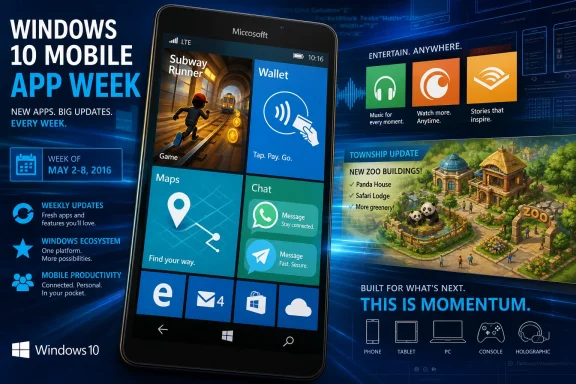
The week’s most visible arrival was Subway Surfers, the endless runner that had already become a staple of mobile gaming elsewhere. Its appearance on Windows 10 Mobile mattered less because it was new to the world than because it was recognizable. Windows phone users were accustomed to watching mainstream apps arrive late, arrive incomplete, or never arrive at all; a game with genuine mass-market name recognition was therefore more than a download.
That is the recurring theme of this June 2016 roundup. The apps and updates were not random Store housekeeping. They were a snapshot of an ecosystem trying to close credibility gaps across entertainment, finance, mapping, messaging, media, and productivity.
The timing also matters. Windows 10 Mobile was approaching the Anniversary Update era, when Microsoft was still arguing that the Universal Windows Platform could make phone, tablet, and PC development feel like a single bet. For enthusiasts, every UWP conversion was a small referendum on that promise.
By 2016, the mobile market had already sorted itself around iOS and Android. Windows 10 Mobile did not need only elegant design or deep Microsoft integration; it needed the boring reassurance that when friends mentioned a popular game, Windows users could install it too. That is why a single runner game could carry more symbolic weight than its mechanics might suggest.
The arrival also exposed the fragility of Windows phone optimism. When a mainstream title appeared, it was celebrated not as routine but as evidence of survival. Healthy ecosystems do not throw parades for normality.
That was Microsoft’s pitch in miniature: build once, reach phones, PCs, tablets, and hybrids. The phone market share problem did not disappear, but UWP gave developers a way to justify the effort by looking beyond the phone itself. For services with account systems and transaction flows, a consistent Windows app could still make sense.
The limitation was obvious. UWP could reduce friction, but it could not manufacture demand. Developers still had to believe Windows users were numerous, engaged, or strategically valuable enough to support.
The preview was limited. It was for Windows Insiders on supported Windows 10 Mobile builds and initially focused on recent Lumia hardware in the United States. That restriction undercut the headline, but it also reflected the complexity of NFC payments, bank support, carrier realities, and certification.
Still, Wallet mattered because it showed Microsoft was not treating Windows 10 Mobile as merely a notification endpoint for Office and Outlook. The company was still trying to compete in the everyday behaviors that made iPhone and Android devices sticky.
For Windows 10 users broadly, Maps updates also reinforced Microsoft’s cross-device strategy. A mapping experience that worked across PC and phone fit neatly into the Windows 10 story: plan on one screen, move on another, keep the same account and data layer underneath.
The challenge was that maps are judged against brutal standards. Google Maps had already trained users to expect speed, completeness, transit intelligence, and business accuracy. Microsoft’s app did not merely have to improve; it had to improve faster than user patience declined.
Media apps also carried strategic importance for Windows 10 Mobile. A phone without modern entertainment services becomes harder to recommend to younger users, commuters, and anyone whose device doubles as a pocket television. Crunchyroll helped fill one of those gaps.
The larger issue was consistency. One good streaming arrival did not erase absences elsewhere. But for users invested in that service, the availability of a proper app could be the difference between tolerating Windows 10 Mobile and abandoning it.
That matters because abandoned apps were one of Windows Phone’s recurring wounds. Users could install something, only to discover that its iOS and Android siblings had moved on months earlier. Updates reassured users that they were not living in a frozen branch of the mobile world.
For games especially, updates are the business model. New buildings, events, seasonal content, and mechanics keep players engaged and spending. Without that cadence, a game becomes a museum piece.
Messaging is unforgiving because network effects punish missing features immediately. If everyone else in a group chat can reply inline, share attachments smoothly, or pick up drafts across sessions, the one user on the weaker client feels the gap. The phone becomes the problem, even when the user likes the hardware.
WhatsApp Beta’s multiple updates were especially important because WhatsApp was, and remains, critical outside the United States. For many Windows phone owners globally, the platform’s viability depended less on Microsoft apps than on whether WhatsApp stayed usable and current.
Spotify’s design refresh suggested that even major services were still willing to polish their Windows clients. Perfect Tube’s 60 FPS support mattered to YouTube power users who wanted smoother playback in a third-party client. Audible’s update reinforced the idea that UWP could serve media consumption across screens.
But this also revealed the platform’s dependency on substitutes. A third-party YouTube client becoming a headline update was both a win for developer ingenuity and a reminder of what Windows users lacked. The ecosystem often survived through workarounds.
The Guardian app’s synchronization for saved articles also fit into a productivity-adjacent pattern. Reading later, syncing across devices, and maintaining account continuity were exactly the workflows Windows 10 wanted to make feel natural. This was the world where Microsoft’s cross-device pitch made the most sense.
Enpass improving UWP support also mattered because password managers occupy a trust-heavy role. Security-minded users were unlikely to accept a mobile platform that could not handle credentials well. In that sense, a password manager update was more consequential than its quiet placement in the roundup implied.
That mattered because the Windows phone story was never only a U.S. carrier-store story. In many markets, the platform had built goodwill through affordable hardware, smooth performance, and Nokia’s residual brand strength. Local services helped sustain that goodwill after the global app narrative had turned grim.
The problem was scale. Regional strength could not fully compensate for global developer retreat. Still, these updates showed that Windows 10 Mobile’s user base was not imaginary; it was unevenly distributed and often more practical than fashionable.
Read more critically, the same list shows how much the platform had to prove. Basic parity features became events. Beta updates carried the emotional weight of official releases. A late-arriving hit game became evidence that the Store could still compete.
That tension defined the Windows 10 Mobile era. Microsoft had a coherent technical story in UWP, a committed enthusiast base, and enough developer activity to produce real weekly roundups. What it lacked was the market gravity that makes developers prioritize a platform without being begged.
But the activity also showed the difference between movement and momentum. Movement is a list of updates. Momentum is when those updates compound into confidence that the next missing app will arrive, the next major service will stay supported, and the next phone purchase will not feel like a gamble.
By mid-2016, Windows 10 Mobile still had movement. Momentum was the harder case to make.
 The Store Had a Pulse, Even If the Patient Was Already Being Watched
The week’s most visible arrival was Subway Surfers, the endless runner that had already become a staple of mobile gaming elsewhere. Its appearance on Windows 10 Mobile mattered less because it was new to the world than because it was recognizable. Windows phone users were accustomed to watching mainstream apps arrive late, arrive incomplete, or never arrive at all; a game with genuine mass-market name recognition was therefore more than a download.That is the recurring theme of this June 2016 roundup. The apps and updates were not random Store housekeeping. They were a snapshot of an ecosystem trying to close credibility gaps across entertainment, finance, mapping, messaging, media, and productivity.
The timing also matters. Windows 10 Mobile was approaching the Anniversary Update era, when Microsoft was still arguing that the Universal Windows Platform could make phone, tablet, and PC development feel like a single bet. For enthusiasts, every UWP conversion was a small referendum on that promise.
Subway Surfers Was the Symbolic Win Windows Phone Needed
Subway Surfers arriving for Windows 10 Mobile was a morale boost because casual games define whether a mobile platform feels socially current. Enterprise apps may satisfy IT departments, but games tell users whether their phone belongs in the same cultural moment as everyone else’s.By 2016, the mobile market had already sorted itself around iOS and Android. Windows 10 Mobile did not need only elegant design or deep Microsoft integration; it needed the boring reassurance that when friends mentioned a popular game, Windows users could install it too. That is why a single runner game could carry more symbolic weight than its mechanics might suggest.
The arrival also exposed the fragility of Windows phone optimism. When a mainstream title appeared, it was celebrated not as routine but as evidence of survival. Healthy ecosystems do not throw parades for normality.
FreeCharge Showed Why UWP Was More Than a Developer Talking Point
FreeCharge becoming a Universal Windows Platform app was one of the more practical wins of the week. A payments and recharge service moving toward UWP suggested that some developers saw value in maintaining a Windows presence that could span device types.That was Microsoft’s pitch in miniature: build once, reach phones, PCs, tablets, and hybrids. The phone market share problem did not disappear, but UWP gave developers a way to justify the effort by looking beyond the phone itself. For services with account systems and transaction flows, a consistent Windows app could still make sense.
The limitation was obvious. UWP could reduce friction, but it could not manufacture demand. Developers still had to believe Windows users were numerous, engaged, or strategically valuable enough to support.
Wallet Was the Week’s Most Ambitious Bet
Microsoft Wallet with Tap to Pay was the biggest platform story in the roundup because it reached beyond app availability into mobile identity. Payments are not just another feature; they are a trust test. If a user is willing to put cards, loyalty programs, and in-store transactions into a phone, that phone becomes part of daily life in a way no weather app can match.The preview was limited. It was for Windows Insiders on supported Windows 10 Mobile builds and initially focused on recent Lumia hardware in the United States. That restriction undercut the headline, but it also reflected the complexity of NFC payments, bank support, carrier realities, and certification.
Still, Wallet mattered because it showed Microsoft was not treating Windows 10 Mobile as merely a notification endpoint for Office and Outlook. The company was still trying to compete in the everyday behaviors that made iPhone and Android devices sticky.
Maps Was the Quiet Infrastructure Update
Windows Maps also received attention that week, and it deserves more than a passing mention. Maps apps are rarely glamorous until they fail, but they are foundational to mobile trust. Navigation, local search, commute planning, and location sharing all shape whether a smartphone feels dependable.For Windows 10 users broadly, Maps updates also reinforced Microsoft’s cross-device strategy. A mapping experience that worked across PC and phone fit neatly into the Windows 10 story: plan on one screen, move on another, keep the same account and data layer underneath.
The challenge was that maps are judged against brutal standards. Google Maps had already trained users to expect speed, completeness, transit intelligence, and business accuracy. Microsoft’s app did not merely have to improve; it had to improve faster than user patience declined.
Crunchyroll Proved Niche Media Could Still Matter
Crunchyroll’s Windows 10 UWP app was another useful signal. Anime streaming was not a universal need, but it represented exactly the kind of passionate, subscription-oriented community that can keep a platform feeling alive. A niche app can matter more than a generic utility when its users care deeply.Media apps also carried strategic importance for Windows 10 Mobile. A phone without modern entertainment services becomes harder to recommend to younger users, commuters, and anyone whose device doubles as a pocket television. Crunchyroll helped fill one of those gaps.
The larger issue was consistency. One good streaming arrival did not erase absences elsewhere. But for users invested in that service, the availability of a proper app could be the difference between tolerating Windows 10 Mobile and abandoning it.
Township Reminded Everyone That Updates Count as Much as Launches
Township’s update, with new zoo buildings and additional content, illustrated a point often missed in app-store roundups: the health of a platform is measured not only by new releases but by continued maintenance. A game that keeps receiving content is a game whose developer has not written off the audience.That matters because abandoned apps were one of Windows Phone’s recurring wounds. Users could install something, only to discover that its iOS and Android siblings had moved on months earlier. Updates reassured users that they were not living in a frozen branch of the mobile world.
For games especially, updates are the business model. New buildings, events, seasonal content, and mechanics keep players engaged and spending. Without that cadence, a game becomes a museum piece.
Messaging Apps Were Fighting to Keep Windows Users in the Conversation
The week’s update list was heavy with communication tools. WhatsApp Beta gained message quoting and interface changes, Telegram Messenger added drafts and more, and Facebook Messenger Beta moved forward with group support. These were not cosmetic luxuries; they were basic social infrastructure.Messaging is unforgiving because network effects punish missing features immediately. If everyone else in a group chat can reply inline, share attachments smoothly, or pick up drafts across sessions, the one user on the weaker client feels the gap. The phone becomes the problem, even when the user likes the hardware.
WhatsApp Beta’s multiple updates were especially important because WhatsApp was, and remains, critical outside the United States. For many Windows phone owners globally, the platform’s viability depended less on Microsoft apps than on whether WhatsApp stayed usable and current.
Spotify, Perfect Tube, and Audible Kept the Entertainment Stack Breathing
Spotify’s revamped design, Perfect Tube’s 60 FPS support, and Audible’s UWP update all belonged to the same broader category: keeping Windows phones useful during idle time. Music, video, and audiobooks are not optional smartphone extras. They are part of the baseline.Spotify’s design refresh suggested that even major services were still willing to polish their Windows clients. Perfect Tube’s 60 FPS support mattered to YouTube power users who wanted smoother playback in a third-party client. Audible’s update reinforced the idea that UWP could serve media consumption across screens.
But this also revealed the platform’s dependency on substitutes. A third-party YouTube client becoming a headline update was both a win for developer ingenuity and a reminder of what Windows users lacked. The ecosystem often survived through workarounds.
Productivity Apps Carried Microsoft’s Home-Field Advantage
Sway adding support for 13 new languages was a different kind of update. It spoke to Microsoft’s strength in productivity, education, and international reach. While consumer app gaps hurt Windows 10 Mobile, Microsoft’s own services still gave the platform areas where it could feel native rather than secondary.The Guardian app’s synchronization for saved articles also fit into a productivity-adjacent pattern. Reading later, syncing across devices, and maintaining account continuity were exactly the workflows Windows 10 wanted to make feel natural. This was the world where Microsoft’s cross-device pitch made the most sense.
Enpass improving UWP support also mattered because password managers occupy a trust-heavy role. Security-minded users were unlikely to accept a mobile platform that could not handle credentials well. In that sense, a password manager update was more consequential than its quiet placement in the roundup implied.
The Indian App Thread Was Easy to Miss and Hard to Ignore
FreeCharge and Chillr gave the roundup a regional dimension that should not be overlooked. Windows Phone had pockets of enthusiasm in markets where low-cost Lumia devices had once been competitive, and India was one of the important examples. Payment, recharge, and QR-related features reflected real local usage patterns.That mattered because the Windows phone story was never only a U.S. carrier-store story. In many markets, the platform had built goodwill through affordable hardware, smooth performance, and Nokia’s residual brand strength. Local services helped sustain that goodwill after the global app narrative had turned grim.
The problem was scale. Regional strength could not fully compensate for global developer retreat. Still, these updates showed that Windows 10 Mobile’s user base was not imaginary; it was unevenly distributed and often more practical than fashionable.
The Week Looked Strong Because the Bar Had Fallen
Read generously, the June 20–26 roundup looks like a busy, encouraging week. There were new UWP apps, mainstream games, meaningful feature updates, and platform-level additions. For a Windows 10 Mobile owner in 2016, that was good news.Read more critically, the same list shows how much the platform had to prove. Basic parity features became events. Beta updates carried the emotional weight of official releases. A late-arriving hit game became evidence that the Store could still compete.
That tension defined the Windows 10 Mobile era. Microsoft had a coherent technical story in UWP, a committed enthusiast base, and enough developer activity to produce real weekly roundups. What it lacked was the market gravity that makes developers prioritize a platform without being begged.
The June 2016 App Drop Was a Small Victory Inside a Larger Retreat
This was not a dead week for Windows 10 Mobile. It was a lively one, and it deserves to be remembered as such. Users got more entertainment, better messaging, new payment capabilities, improved maps, and evidence that some developers still cared.But the activity also showed the difference between movement and momentum. Movement is a list of updates. Momentum is when those updates compound into confidence that the next missing app will arrive, the next major service will stay supported, and the next phone purchase will not feel like a gamble.
By mid-2016, Windows 10 Mobile still had movement. Momentum was the harder case to make.
What This Week Really Told Windows Phone Diehards
The June 20–26 roundup was encouraging precisely because it touched so many parts of daily phone use. It did not solve the ecosystem problem, but it showed where the platform still had life.- Subway Surfers gave Windows 10 Mobile a mainstream gaming win that mattered more symbolically than technically.
- Microsoft Wallet with Tap to Pay showed that Microsoft was still investing in phone-specific platform features, even if availability was narrow.
- UWP updates from services such as FreeCharge, Crunchyroll, Audible, and Enpass demonstrated that the universal app model could still attract useful development.
- Messaging updates for WhatsApp Beta, Telegram, and Messenger were essential because social parity was one of the platform’s most fragile requirements.
- The strongest lesson of the week was that Windows 10 Mobile could still deliver good news, but each win arrived against the backdrop of an ecosystem fighting for relevance.
References
- Primary source: nokiapoweruser.com
Published: 2026-06-20T10:20:17.194539
Loading…
nokiapoweruser.com - Official source: blogs.windows.com
Loading…
blogs.windows.com - Related coverage: techspot.com
Loading…
www.techspot.com - Related coverage: thurrott.com
Loading…
www.thurrott.com - Related coverage: pureinfotech.com
Loading…
pureinfotech.com - Related coverage: phonearena.com
Loading…
www.phonearena.com