
OPPO will launch the Reno16, Reno16 Pro, and Reno16 Pro+ globally on June 25, 2026, moving its latest camera-focused Android phones beyond their China debut and into selected international markets where mid-premium handsets increasingly compete on imaging, battery life, and AI software. The announcement is not just another seasonal refresh from a prolific smartphone maker. It is a sign that the middle of the phone market is once again becoming the most interesting place in mobile hardware. The flagship tier gets the spectacle, but phones like the Reno16 series increasingly define what most buyers will actually experience.
The Reno line has long occupied a useful space in OPPO’s portfolio: more stylish and camera-forward than the budget A-series, less expensive and less technically extreme than the Find X flagships. With the Reno16 generation, OPPO appears to be leaning hard into that identity rather than softening it. The global launch on June 25 gives the company a chance to turn a China-first spec sheet into a broader consumer pitch.
That pitch is familiar but potent. Big sensors, high megapixel counts, slim bezels, fast charging, large batteries, and AI-enhanced photography are now the ingredients every ambitious Android vendor reaches for. OPPO’s challenge is not proving that it can assemble them. It is proving that the Reno16 family can feel coherent rather than merely crowded.
The mid-premium smartphone market has become a place where manufacturers try to smuggle flagship expectations into less painful price brackets. That has obvious appeal for buyers, but it also creates a product-design trap. A phone can look overqualified on paper and still feel compromised in daily use if thermals, software polish, modem behavior, update cadence, or camera processing lag behind the headline hardware.
That is why the Reno16 series matters beyond OPPO loyalists. It is a test of whether the Android market’s current formula — more camera, more battery, more AI — can still produce meaningful differentiation, or whether every launch now arrives sounding like a remix of the last one.
But global launches are where Chinese smartphone specs meet the messier realities of regional certification, network bands, pricing, distribution, carrier politics, and software commitments. A phone that looks like a straightforward transplant from the Chinese market often arrives elsewhere with different battery capacities, charging configurations, storage options, or even chipsets. That is not unique to OPPO; it is the normal friction of international Android hardware.
For buyers, that means the June 25 event is more important than the China spec sheet. The global Reno16 series may retain the same broad identity, but the details that determine whether it is a strong recommendation will be local. Availability in Spain, Thailand, the Philippines, India, the Middle East, or parts of Europe can mean different SKUs, different bundles, and different after-sales expectations.
This is where OPPO’s messaging has to be precise. “Global” is one of the most abused words in smartphone launches. Sometimes it means Europe and Southeast Asia. Sometimes it means a staged rollout with major omissions. Sometimes it means a global software ROM attached to a product that still never reaches several major retail markets.
For WindowsForum readers, many of whom live in mixed-device households or manage fleets of hardware across regions, that distinction matters. Smartphone launches are no longer isolated consumer events. They affect authentication flows, mobile device management, cross-platform file workflows, passkey adoption, Teams and Outlook usage, and the practical boundary between personal and work devices.
The Reno16 series appears to continue that strategy, with camera language pushed to the front and AI image features doing the work that optical hardware alone once carried. This is where the smartphone market has shifted most dramatically. The best camera phone is no longer simply the one with the biggest sensor or the longest telephoto range; it is the one whose processing pipeline produces usable results quickly, predictably, and shareably.
That word — shareably — matters. A technically accurate photograph is not always the photo a user wants to post. OPPO, like Vivo, Xiaomi, Samsung, and Google, understands that computational photography is partly an aesthetic business. Skin tones, night scenes, portrait separation, motion handling, and live-photo style capture are all tuned around social behavior, not just optics.
The Reno16 Pro and Pro+ branding also tells its own story. Android vendors increasingly stretch product families into fine gradations because the middle of the market has become too crowded for a single hero model. The base phone gets the name recognition, the Pro gets the aspirational marketing, and the Pro+ gives retailers and carriers something that sounds close enough to flagship without colliding directly with the Find X line.
That segmentation can help buyers, but it can also blur the decision. If the differences are clear — better telephoto, stronger chipset, brighter screen, tougher ingress protection, longer update promise — the hierarchy makes sense. If the differences are mostly memory tiers and camera garnish, the naming starts to feel like theatre.
That distinction is important. A 200MP sensor does not mean users will routinely shoot 200MP photos, nor should they. In most phones, the value comes from pixel binning, cropping flexibility, improved detail under good light, and giving the image pipeline more data to work with. The benefit is real when implemented well, but it is not magic.
OPPO’s burden is to show that the Reno16 series can turn camera hardware into consistent results. Mid-premium camera phones often perform impressively in ideal daylight and controlled portraits, then stumble with moving subjects, mixed indoor light, aggressive sharpening, or inconsistent white balance. These are the places where the difference between flagship and near-flagship still appears.
AI features complicate the story. Every phone maker now promises cleaner images, smarter edits, object removal, portrait enhancement, generative tools, scene optimization, and better low-light handling. Some of these tools are genuinely useful. Others are software confetti, impressive in a demo and forgotten after a week.
The useful version of AI photography is not the one that makes every image look artificial. It is the version that reduces failure. Parents photographing children indoors, travelers shooting at night, small-business owners capturing product shots, and creators making short video clips do not need another submenu; they need fewer ruined shots.
That is the space OPPO is trying to claim. If the Reno16 series can deliver reliable camera behavior without pushing users into a maze of modes, the phones will have a real argument. If the AI branding outruns the experience, the launch risks becoming another example of the industry using artificial intelligence as a decorative sticker.
This matters because battery anxiety is one of the few smartphone problems that cuts across every user group. Gamers, commuters, field technicians, parents, travelers, and office workers may care about different apps, but they all notice when a phone dies at the wrong time. A bigger battery is not glamorous, but it is one of the most democratic upgrades a manufacturer can make.
The catch is that global models may not always mirror Chinese battery specifications. Regional safety rules, charging certifications, device thickness targets, and supply decisions can all reshape the final product. OPPO has to be careful here, because a phone marketed around endurance invites immediate scrutiny if international versions ship with smaller cells than domestic ones.
Fast charging is another OPPO strength, but it also comes with a perception problem in some markets. Enthusiasts love it. Cautious buyers worry about heat and long-term battery health. IT departments may care less about a phone charging in half an hour than about whether it remains reliable after two years of heavy use.
The winning formula is not simply a large number on a charger. It is transparent battery health management, predictable thermal behavior, and software that does not sabotage standby time. A large battery with poor idle drain is a spec-sheet victory and a user-experience defeat.
The Reno16 series will likely be judged on how cleanly its AI tools are integrated. Users do not need ten overlapping assistants, duplicated apps, or vague promises about future features. They need camera tools, file tools, notification behavior, privacy controls, and cross-device features that behave consistently.
For Windows users, one practical question is how well the Reno16 family works in the Microsoft-adjacent mobile world. Android phones have become more useful companions to Windows PCs through Phone Link, cloud clipboard-style workflows, OneDrive camera backup, Outlook, Teams, Edge, Microsoft Authenticator, and passkeys. None of that requires an OPPO-specific miracle, but OEM software can either smooth or complicate the experience.
Aggressive background task management has historically been a sore point across several Android skins, especially for messaging, authentication, wearable sync, and productivity apps. If a phone kills background processes too eagerly in the name of battery life, it can undermine exactly the kind of reliability business users expect. A beautiful camera phone that delays notifications or breaks companion-device syncing is harder to recommend in professional contexts.
That is why update policy and regional firmware behavior deserve as much attention as the launch visuals. OPPO can win buyers with cameras, but it keeps them with software discipline. In 2026, that discipline includes security patches, Android version upgrades, AI feature transparency, and sensible defaults.
That creates an opening for phones like the Reno16 Pro and Pro+. They can offer a meaningful dose of flagship atmosphere without forcing buyers into the highest price tier. The camera island looks serious, the display should feel modern, the battery story is strong, and the branding carries enough polish to avoid budget stigma.
But the compromise has to be honest. If there is no wireless charging, older USB speeds, weaker water resistance, shorter software support, or a less capable ultrawide camera, OPPO should let the product stand on what it does well rather than pretending the gaps do not exist. Enthusiasts notice. Reviewers notice. Increasingly, normal buyers notice too, because the phone market is mature enough that people know which omissions bother them.
There is nothing wrong with a near-flagship phone. In fact, near-flagship phones are often the most rational purchases in the Android ecosystem. The problem comes when vendors market them as if they have no trade-offs.
OPPO’s best argument is not that the Reno16 series replaces a Find X or a Galaxy Ultra. It is that many people do not need those devices in the first place. If the Reno16 Pro+ can deliver camera satisfaction, long battery life, smooth performance, and a polished design at a lower price, that is a stronger claim than pretending it is secretly an ultra-flagship.
In Southeast Asia, the Reno brand has cultural traction. OPPO has invested heavily in retail visibility, influencer marketing, service networks, and camera-centric branding. A June 25 global launch gives the company a chance to reinforce that position before competitors fill the same mid-year window with their own camera phones.
In Spain and other parts of Europe, OPPO’s task is more complex. European buyers tend to compare phones not just against Chinese rivals but against Samsung’s Galaxy A and S FE devices, Google’s Pixel A-series and discounted flagships, Nothing’s design-led phones, and older iPhones that remain attractive through carrier deals. The Reno16 series has to be priced with that battlefield in mind.
The Pro+ model is especially interesting here. If it launches broadly, it could give OPPO a more assertive step-up option without requiring buyers to enter Find X territory. If it remains limited or region-specific, the global story becomes less clean.
The worst outcome would be a confusing patchwork where the Reno16 name means materially different things depending on country. Android buyers already navigate enough SKU fog. OPPO can help itself by making the lineup simple: what each model has, what each model lacks, where each model is sold, and how long each will be supported.
That is why OPPO’s Reno16 event has to do more than read specifications aloud. It has to make the case for why a 2026 mid-premium Android phone deserves attention in a market full of competent rectangles. The answer likely lies in reliability and experience, not novelty.
For camera-focused buyers, the promise is fewer bad shots. For travelers, it is endurance. For creators, it is fast capture and easy editing. For professionals, it is a phone that can sit beside a Windows PC and behave predictably. For enthusiasts, it is the possibility that the best-value Android device of the season might not come from the most obvious brand.
That last point is where OPPO has room to maneuver. Samsung is familiar, Google is software-forward, Xiaomi is aggressive, Vivo is formidable in imaging, and Honor has become increasingly competitive. OPPO has to decide whether Reno is a lifestyle product with strong specs or a spec product with lifestyle polish. The Reno16 series sounds like an attempt to be both.
Being both is difficult. It requires restraint as much as ambition. The phones need enough design personality to stand out, enough camera performance to justify the branding, enough battery life to create everyday trust, and enough software maturity to avoid feeling like a demo platform.
For now, the Reno16 family looks like a confident expression of where the industry is headed. The camera is the emotional hook. The battery is the practical hook. AI is the mandatory 2026 seasoning. The challenge is turning those ingredients into a phone people can trust after the launch stream ends.
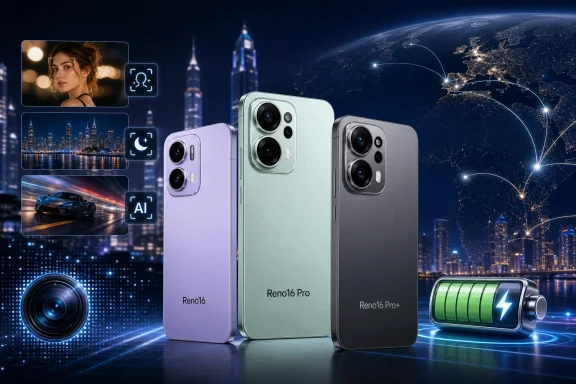 OPPO Pushes Flagship Theatre Into the Mid-Premium Aisle
The Reno line has long occupied a useful space in OPPO’s portfolio: more stylish and camera-forward than the budget A-series, less expensive and less technically extreme than the Find X flagships. With the Reno16 generation, OPPO appears to be leaning hard into that identity rather than softening it. The global launch on June 25 gives the company a chance to turn a China-first spec sheet into a broader consumer pitch.That pitch is familiar but potent. Big sensors, high megapixel counts, slim bezels, fast charging, large batteries, and AI-enhanced photography are now the ingredients every ambitious Android vendor reaches for. OPPO’s challenge is not proving that it can assemble them. It is proving that the Reno16 family can feel coherent rather than merely crowded.
The mid-premium smartphone market has become a place where manufacturers try to smuggle flagship expectations into less painful price brackets. That has obvious appeal for buyers, but it also creates a product-design trap. A phone can look overqualified on paper and still feel compromised in daily use if thermals, software polish, modem behavior, update cadence, or camera processing lag behind the headline hardware.
That is why the Reno16 series matters beyond OPPO loyalists. It is a test of whether the Android market’s current formula — more camera, more battery, more AI — can still produce meaningful differentiation, or whether every launch now arrives sounding like a remix of the last one.
The China Debut Set the Template, but Global Models Are the Real Test
The Reno16 and Reno16 Pro were introduced first in China in May, where OPPO emphasized upgraded imaging, high-refresh displays, MediaTek silicon, and large batteries. That domestic launch established the family’s technical direction: a sharper focus on camera versatility, a push toward premium-feeling screens, and enough power to make the phones credible for gaming and creator workloads.But global launches are where Chinese smartphone specs meet the messier realities of regional certification, network bands, pricing, distribution, carrier politics, and software commitments. A phone that looks like a straightforward transplant from the Chinese market often arrives elsewhere with different battery capacities, charging configurations, storage options, or even chipsets. That is not unique to OPPO; it is the normal friction of international Android hardware.
For buyers, that means the June 25 event is more important than the China spec sheet. The global Reno16 series may retain the same broad identity, but the details that determine whether it is a strong recommendation will be local. Availability in Spain, Thailand, the Philippines, India, the Middle East, or parts of Europe can mean different SKUs, different bundles, and different after-sales expectations.
This is where OPPO’s messaging has to be precise. “Global” is one of the most abused words in smartphone launches. Sometimes it means Europe and Southeast Asia. Sometimes it means a staged rollout with major omissions. Sometimes it means a global software ROM attached to a product that still never reaches several major retail markets.
For WindowsForum readers, many of whom live in mixed-device households or manage fleets of hardware across regions, that distinction matters. Smartphone launches are no longer isolated consumer events. They affect authentication flows, mobile device management, cross-platform file workflows, passkey adoption, Teams and Outlook usage, and the practical boundary between personal and work devices.
Reno Has Become OPPO’s Cultural Line, Not Just Its Camera Line
The Reno series has always traded on design more than the average Android spec warrior would like to admit. It is the line OPPO uses when it wants to talk to younger buyers, social video creators, style-conscious shoppers, and people who care about how a phone photographs a night out as much as how it benchmarks in a synthetic test. That does not make the hardware superficial. It makes the product brief different.The Reno16 series appears to continue that strategy, with camera language pushed to the front and AI image features doing the work that optical hardware alone once carried. This is where the smartphone market has shifted most dramatically. The best camera phone is no longer simply the one with the biggest sensor or the longest telephoto range; it is the one whose processing pipeline produces usable results quickly, predictably, and shareably.
That word — shareably — matters. A technically accurate photograph is not always the photo a user wants to post. OPPO, like Vivo, Xiaomi, Samsung, and Google, understands that computational photography is partly an aesthetic business. Skin tones, night scenes, portrait separation, motion handling, and live-photo style capture are all tuned around social behavior, not just optics.
The Reno16 Pro and Pro+ branding also tells its own story. Android vendors increasingly stretch product families into fine gradations because the middle of the market has become too crowded for a single hero model. The base phone gets the name recognition, the Pro gets the aspirational marketing, and the Pro+ gives retailers and carriers something that sounds close enough to flagship without colliding directly with the Find X line.
That segmentation can help buyers, but it can also blur the decision. If the differences are clear — better telephoto, stronger chipset, brighter screen, tougher ingress protection, longer update promise — the hierarchy makes sense. If the differences are mostly memory tiers and camera garnish, the naming starts to feel like theatre.
The Megapixel Race Is Back, but It Wears an AI Jacket Now
The Reno16 family’s camera emphasis arrives at a moment when the smartphone industry has rediscovered the marketing power of huge megapixel numbers. For a while, the market seemed to move past raw resolution as a headline. Sensor size, computational photography, optical stabilization, and lens quality took over the conversation. Now high-resolution sensors are back, but they are being sold as inputs for smarter software rather than as simple bragging rights.That distinction is important. A 200MP sensor does not mean users will routinely shoot 200MP photos, nor should they. In most phones, the value comes from pixel binning, cropping flexibility, improved detail under good light, and giving the image pipeline more data to work with. The benefit is real when implemented well, but it is not magic.
OPPO’s burden is to show that the Reno16 series can turn camera hardware into consistent results. Mid-premium camera phones often perform impressively in ideal daylight and controlled portraits, then stumble with moving subjects, mixed indoor light, aggressive sharpening, or inconsistent white balance. These are the places where the difference between flagship and near-flagship still appears.
AI features complicate the story. Every phone maker now promises cleaner images, smarter edits, object removal, portrait enhancement, generative tools, scene optimization, and better low-light handling. Some of these tools are genuinely useful. Others are software confetti, impressive in a demo and forgotten after a week.
The useful version of AI photography is not the one that makes every image look artificial. It is the version that reduces failure. Parents photographing children indoors, travelers shooting at night, small-business owners capturing product shots, and creators making short video clips do not need another submenu; they need fewer ruined shots.
That is the space OPPO is trying to claim. If the Reno16 series can deliver reliable camera behavior without pushing users into a maze of modes, the phones will have a real argument. If the AI branding outruns the experience, the launch risks becoming another example of the industry using artificial intelligence as a decorative sticker.
Battery Size Has Become the New Status Symbol
For years, phone makers competed on thinness until users collectively decided they preferred phones that lasted longer. The recent wave of large-battery Chinese Android devices suggests the industry has taken the hint. The Reno16 series fits into that broader move, with large battery capacities and fast charging forming a central part of the appeal.This matters because battery anxiety is one of the few smartphone problems that cuts across every user group. Gamers, commuters, field technicians, parents, travelers, and office workers may care about different apps, but they all notice when a phone dies at the wrong time. A bigger battery is not glamorous, but it is one of the most democratic upgrades a manufacturer can make.
The catch is that global models may not always mirror Chinese battery specifications. Regional safety rules, charging certifications, device thickness targets, and supply decisions can all reshape the final product. OPPO has to be careful here, because a phone marketed around endurance invites immediate scrutiny if international versions ship with smaller cells than domestic ones.
Fast charging is another OPPO strength, but it also comes with a perception problem in some markets. Enthusiasts love it. Cautious buyers worry about heat and long-term battery health. IT departments may care less about a phone charging in half an hour than about whether it remains reliable after two years of heavy use.
The winning formula is not simply a large number on a charger. It is transparent battery health management, predictable thermal behavior, and software that does not sabotage standby time. A large battery with poor idle drain is a spec-sheet victory and a user-experience defeat.
The Global Launch Is Also a Software Credibility Test
Hardware gets the launch-day attention, but software determines whether a phone ages gracefully. For OPPO, that means ColorOS has to carry as much weight as the camera module. The company has steadily improved its Android skin over the years, but it still competes against Samsung’s long update commitments, Google’s Pixel-first AI story, Apple’s ecosystem gravity, and Xiaomi’s increasingly aggressive global push.The Reno16 series will likely be judged on how cleanly its AI tools are integrated. Users do not need ten overlapping assistants, duplicated apps, or vague promises about future features. They need camera tools, file tools, notification behavior, privacy controls, and cross-device features that behave consistently.
For Windows users, one practical question is how well the Reno16 family works in the Microsoft-adjacent mobile world. Android phones have become more useful companions to Windows PCs through Phone Link, cloud clipboard-style workflows, OneDrive camera backup, Outlook, Teams, Edge, Microsoft Authenticator, and passkeys. None of that requires an OPPO-specific miracle, but OEM software can either smooth or complicate the experience.
Aggressive background task management has historically been a sore point across several Android skins, especially for messaging, authentication, wearable sync, and productivity apps. If a phone kills background processes too eagerly in the name of battery life, it can undermine exactly the kind of reliability business users expect. A beautiful camera phone that delays notifications or breaks companion-device syncing is harder to recommend in professional contexts.
That is why update policy and regional firmware behavior deserve as much attention as the launch visuals. OPPO can win buyers with cameras, but it keeps them with software discipline. In 2026, that discipline includes security patches, Android version upgrades, AI feature transparency, and sensible defaults.
OPPO Is Selling a Phone, but Also a Post-Flagship Compromise
The Reno16 launch lands in a market where buyers are increasingly skeptical of flagship pricing. Ultra phones now compete with laptops and tablets for wallet share. Foldables remain expensive. Premium slabs keep getting better, but the improvements are incremental enough that many users are holding devices longer.That creates an opening for phones like the Reno16 Pro and Pro+. They can offer a meaningful dose of flagship atmosphere without forcing buyers into the highest price tier. The camera island looks serious, the display should feel modern, the battery story is strong, and the branding carries enough polish to avoid budget stigma.
But the compromise has to be honest. If there is no wireless charging, older USB speeds, weaker water resistance, shorter software support, or a less capable ultrawide camera, OPPO should let the product stand on what it does well rather than pretending the gaps do not exist. Enthusiasts notice. Reviewers notice. Increasingly, normal buyers notice too, because the phone market is mature enough that people know which omissions bother them.
There is nothing wrong with a near-flagship phone. In fact, near-flagship phones are often the most rational purchases in the Android ecosystem. The problem comes when vendors market them as if they have no trade-offs.
OPPO’s best argument is not that the Reno16 series replaces a Find X or a Galaxy Ultra. It is that many people do not need those devices in the first place. If the Reno16 Pro+ can deliver camera satisfaction, long battery life, smooth performance, and a polished design at a lower price, that is a stronger claim than pretending it is secretly an ultra-flagship.
Europe and Southeast Asia Will Decide Whether “Global” Means Momentum
OPPO’s strength has never been evenly distributed across the world. The company remains far more visible in parts of Asia and Europe than in the United States, where carrier dynamics and geopolitical caution have limited many Chinese smartphone brands. For a WindowsForum audience with a large U.S. readership, that means the Reno16 series may be more relevant as a signal than as an immediate purchase option.In Southeast Asia, the Reno brand has cultural traction. OPPO has invested heavily in retail visibility, influencer marketing, service networks, and camera-centric branding. A June 25 global launch gives the company a chance to reinforce that position before competitors fill the same mid-year window with their own camera phones.
In Spain and other parts of Europe, OPPO’s task is more complex. European buyers tend to compare phones not just against Chinese rivals but against Samsung’s Galaxy A and S FE devices, Google’s Pixel A-series and discounted flagships, Nothing’s design-led phones, and older iPhones that remain attractive through carrier deals. The Reno16 series has to be priced with that battlefield in mind.
The Pro+ model is especially interesting here. If it launches broadly, it could give OPPO a more assertive step-up option without requiring buyers to enter Find X territory. If it remains limited or region-specific, the global story becomes less clean.
The worst outcome would be a confusing patchwork where the Reno16 name means materially different things depending on country. Android buyers already navigate enough SKU fog. OPPO can help itself by making the lineup simple: what each model has, what each model lacks, where each model is sold, and how long each will be supported.
The Real Competition Is Not Just Samsung or Xiaomi — It Is Buyer Fatigue
Every smartphone launch now fights an invisible rival: indifference. Modern phones are good enough that many users need a reason to care. A better camera, a brighter screen, and a larger battery still matter, but they no longer guarantee excitement.That is why OPPO’s Reno16 event has to do more than read specifications aloud. It has to make the case for why a 2026 mid-premium Android phone deserves attention in a market full of competent rectangles. The answer likely lies in reliability and experience, not novelty.
For camera-focused buyers, the promise is fewer bad shots. For travelers, it is endurance. For creators, it is fast capture and easy editing. For professionals, it is a phone that can sit beside a Windows PC and behave predictably. For enthusiasts, it is the possibility that the best-value Android device of the season might not come from the most obvious brand.
That last point is where OPPO has room to maneuver. Samsung is familiar, Google is software-forward, Xiaomi is aggressive, Vivo is formidable in imaging, and Honor has become increasingly competitive. OPPO has to decide whether Reno is a lifestyle product with strong specs or a spec product with lifestyle polish. The Reno16 series sounds like an attempt to be both.
Being both is difficult. It requires restraint as much as ambition. The phones need enough design personality to stand out, enough camera performance to justify the branding, enough battery life to create everyday trust, and enough software maturity to avoid feeling like a demo platform.
The June 25 Launch Will Be Judged by the Fine Print
The headline is simple: OPPO is taking the Reno16 series global on June 25. The more important story sits in the fine print that will follow. Pricing, regional model availability, update commitments, camera samples, chipset choices, and battery capacities will decide whether the launch becomes a serious market moment or just another date in the Android calendar.For now, the Reno16 family looks like a confident expression of where the industry is headed. The camera is the emotional hook. The battery is the practical hook. AI is the mandatory 2026 seasoning. The challenge is turning those ingredients into a phone people can trust after the launch stream ends.
The Reno16 Story Comes Down to Five Practical Tests
The Reno16 series should be read less as a single phone launch and more as a mid-premium Android stress test. OPPO is bringing global buyers a familiar but compelling promise; now it has to prove the promise survives regional variation, software realities, and competitive pricing.- The June 25 global launch will matter most once OPPO confirms exact countries, model availability, and regional specifications.
- The Reno16 Pro and Pro+ need clear differences from the base Reno16, or the lineup risks becoming more confusing than helpful.
- The camera hardware will only matter if OPPO’s processing produces consistent results with motion, low light, portraits, and video.
- Large batteries and fast charging could be the most broadly useful upgrades, provided global models do not dilute the endurance story too much.
- ColorOS behavior, security updates, and background app reliability will determine whether the phones appeal beyond lifestyle and creator audiences.
- Pricing will decide whether Reno16 competes as a smart flagship alternative or gets squeezed between cheaper midrange phones and discounted premium models.
References
- Primary source: YugaTech
Published: 2026-06-20T06:50:38.650993
OPPO Ang Reno16, Reno16 Pro, ug Pro+ gipahibalo nga mag-launch sa tibuok kalibutan niadtong Hunyo 25. » YugaTech | Philippines Tech News & Reviews
OPPO nagpamatuod nga ang Reno16 Series ipasikad sa tibuok kalibutan gikan Hunyo 25, diin ang Thailand ug Espanya mao ang pipila sa una nga mga...www.yugatech.com - Related coverage: gizguide.com
OPPO Reno 16 Series, Bubble magnetic display confirmed to launch on May 25
Months after the release of the Reno 15 Series, OPPO is set to reveal its successor, called the Reno 16 Series, along with a new tablet and accessoriewww.gizguide.com
- Related coverage: techgear-guide.com
Oppo Reno16シリーズが5月25日に中国デビュー——Pad 6・Enco Air 5s・新アクセサリ「Bubble」も同時発表へ | Tech Gear Guide
Oppoが2026年5月25日にReno16シリーズ・Pad 6・Enco Air 5s・新アクセサリ「Bubble」を中国で同時発表すると公式告知。200MPトリプルカメラやカラー・構成のラインナップ、背面装着型ディスプレイの概要を整理します。techgear-guide.com - Related coverage: fonearena.com
- Related coverage: techgenyz.com
OPPO Reno16 Series Launches With Striking 2026 Upgrades
The new OPPO Reno16 Series officially launches globally on June 25, 2026. Discover the revised international specs and unique features.techgenyz.com - Related coverage: matricedigitale.it
Oppo Reno16 Pro e Reno16 arrivano con fotocamera da 200MP e batteria da 7000 mAh - Matrice Digitale
Oppo presenta Reno16 Pro e Reno16 con sensore da 200MP, Pad 6 con Dimensity 9500s e A6c economico da 7000 mAh.www.matricedigitale.it
- Related coverage: notebookcheck.net
Oppo Reno16 Pro launches with one 200 MP and three 50 MP cameras - Notebookcheck News
With a 200 megapixel main camera, three 50 MP cameras and a fast Dimensity 9500s ARM chip for the price of a premium mid-range smartphone, the brand new Oppo Reno16 Pro promises first-class value for money. www.notebookcheck.net
- Related coverage: techlomedia.in
- Related coverage: gizmochina.com
Official: Oppo Reno 16 series is launching on May 25 - Gizmochina
Oppo Reno 16 series launches on May 25 in China with tipped 200MP cameras, up to 7,000mAh battery, LTPO OLED displays, and Dimensity chipsets. www.gizmochina.com
- Related coverage: phonebunch.com
OPPO Reno16 and Reno16 Pro launched with 6.32/6.78-inch 1.5K 120Hz AMOLED display, Dimensity 8550 SUPER/9500s SoC, 200MP camera
OPPO has officially launched its latest smartphone in the Reno16 series, the OPPO Reno16 and OPPO Reno16 Pro in China, as previously announced. The new Reno16 series brings major hardware upgrades, enhanced portrait photographywww.phonebunch.com
- Related coverage: suara.com
Oppo Reno16 Resmi Meluncur 25 Mei, Bawa Kamera 200MP dan Aksesori Unik Bubble
Oppo akhirnya mengumumkan jadwal peluncuran resmi seri terbaru Reno16.www.suara.com - Related coverage: los40.com
OPPO quiere revolucionar la fotografía móvil en España con la nueva serie Reno16 | Dispositivos | LOS40
La compañía ha anunciado que la presentación oficial de los nuevos dispositivos será el 25 de junio.los40.com - Related coverage: androidcentral.com
OPPO puts the Find X9 Ultra and 'global' in the same sentence, teases April debut | Android Central
Bet you weren't expecting this one.www.androidcentral.com - Related coverage: techradar.com
The best Oppo phone 2026: the best Reno and Find models | TechRadar
We've tested and ranked the best Oppo phones for every budget, from the Find X9 Ultra to the Find N5www.techradar.com - Related coverage: oppo.com
IDC x OPPO InfoBrief_New Generations Reshape the Mid-to-High-End Smartphone Market
PDF documentwww.oppo.com
- Related coverage: t3.com
Oppo Find X9 Ultra launch confirmed – here's when the contender for best camera phone will arrive | T3
There's another player wanting to offer you the best camera phonewww.t3.com - Related coverage: cincodias.elpais.com
Los OPPO Reno16 y Reno16 Pro ya son oficiales, con cámaras de 200 MP, baterías gigantes y mucha IA
Acaban de llegar a Chinacincodias.elpais.com