
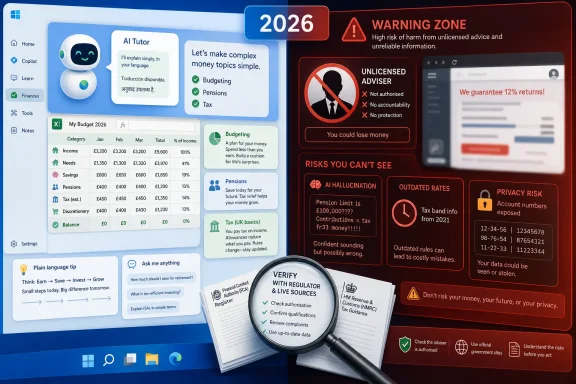
AI can help ordinary savers understand budgeting, pensions, tax relief, and investing basics, but consumers should not let a general-purpose chatbot make personal financial decisions for them in 2026 because regulated advice, compensation rights, live market data, and privacy safeguards still sit outside the typical consumer AI prompt box. The useful version of AI in personal finance is a tutor, translator, and spreadsheet companion. The dangerous version is an unlicensed adviser with a beautiful interface and no liability. That distinction is now the whole story.
The most seductive thing about a modern AI assistant is not that it knows everything. It is that it sounds as if it knows everything. For personal finance, that tone is both the product and the risk.
A chatbot can explain compound interest, compare a cash ISA with a stocks and shares ISA, sketch out a household budget, or translate pension jargon into plain English. That is genuinely useful, especially for people who find financial services intimidating. Money has always had a language problem, and AI is good at language.
But personal finance is not merely a language problem. It is a timing problem, a tax problem, a risk problem, a legal problem, and often a family problem. The moment a system moves from “here is how bonds work” to “you should move your pension into this fund,” it has crossed a line that regulators, advisers, and consumers have spent decades defining.
That line matters because financial advice is not just an opinion with better stationery. In regulated markets, it comes with duties, records, suitability checks, complaints routes, and, in many cases, compensation schemes. A generic AI assistant gives you fluent output, but it does not give you the institutional accountability that makes bad advice contestable.
Ask a chatbot to explain tax relief on pension contributions, and it can usually turn a dense topic into a coherent primer. Ask it to build a monthly budget, and it can organize income, bills, debt repayments, savings goals, and discretionary spending in seconds. Ask it to rewrite a bank’s product disclosure in plain English, and it will often do a better first pass than the institution that published it.
That matters for financial confidence. Many people do not avoid investing because they are irrational; they avoid it because the first page of the journey feels like a compliance exam. A no-judgment interface can lower the emotional cost of asking basic questions.
This is the strongest argument for AI in household finance. It can widen access to financial education without requiring someone to admit, face to face, that they do not know what an index fund is or why their pension statement looks like a cryptic airline receipt. Used carefully, the chatbot becomes a patient explainer.
But education is not execution. A system that helps you understand the difference between a high-yield savings account and a market-tracking fund is doing one job. A system that tells you to move your emergency fund into equities because “historically markets go up” is doing another.
A general-purpose AI chatbot is not built like a regulated adviser. It may not know your full financial position, your debt obligations, your tax status, your dependents, your immigration or residency status, your employer benefits, your health, your risk tolerance, or your real time horizon. Even when you provide some of that information, you may be entering it into a system that was not designed to hold sensitive financial data.
This creates a dangerous illusion of personalization. The chatbot appears to respond to you, because it uses your words, reflects your goals, and formats its answer around your numbers. But that is not the same as a suitability assessment.
A regulated adviser is supposed to know when not to answer immediately. The responsible answer may be, “I need more information,” or “this depends on your tax position,” or “you should speak to a specialist.” A consumer chatbot, by contrast, is optimized to be helpful. Helpful systems tend to keep talking.
That is why users need to watch for the pivot point in the conversation. “Explain the risks of investing in a global equity index fund” is a learning prompt. “Should I put my £20,000 emergency fund into this fund today?” is a decision prompt. One belongs comfortably in the AI sandbox; the other belongs in the regulated world.
A hallucinated historical fact in a school essay is embarrassing. A hallucinated tax threshold, pension rule, withdrawal penalty, mortgage assumption, or fund fee can be expensive. Worse, the error may not look strange. It may arrive in a table, with polite caveats, neat calculations, and a tone of professional calm.
Personal finance rewards small differences. A one-percentage-point fee gap compounds. A misunderstood tax rule changes the value of a decision. A mistimed withdrawal can trigger penalties or lost benefits. A poor assumption about inflation can make a retirement plan look safe when it is not.
The danger is not that AI always fails. The danger is that it often works well enough to earn trust before failing at the edge case. Household finance is full of edge cases: irregular income, blended families, cross-border tax exposure, student loans, medical debt, defined benefit pensions, self-employment, inheritance, and housing costs that do not fit national averages.
This is where the “well-informed friend at the pub” analogy lands. A bright friend can explain concepts, challenge assumptions, and help you prepare better questions. You would not normally hand that friend your pension transfer forms and ask them to decide your future.
Some AI systems can browse or connect to live data sources. Many cannot. Even when they can, the user may not know whether the answer came from a current regulated source, a cached web page, a marketing article, or a model’s internal approximation. That uncertainty is not academic.
For savers, stale information can mean choosing the wrong account. For borrowers, it can mean misunderstanding the true cost of debt. For investors, it can mean relying on outdated performance numbers, old fees, or obsolete tax assumptions. For pension planning, it can mean confusing current rules with previous-year thresholds.
The right use of AI is to generate a checklist, not to finish the transaction. Ask it what variables to compare before choosing a savings account. Ask it to explain the difference between gross and AER interest. Ask it to help you understand why fixed-rate and easy-access accounts behave differently. Then verify the actual rates and terms from regulated providers and official sources.
This workflow feels slower than simply accepting the answer. That is the point. In finance, friction is sometimes a consumer protection feature.
Users should treat a general chatbot like a public place with good acoustics. You may be comfortable discussing broad goals there. You should not recite your account numbers, login credentials, full identity details, or anything that would help someone impersonate you or compromise your accounts.
Even anonymized data can be revealing when combined. A prompt that includes your employer, salary, mortgage balance, town, age, and pension provider may not contain your name, but it may still describe you closely enough to matter. Financial privacy is not just about secrets; it is about patterns.
There is also a workplace version of this problem. Employees may paste client portfolios, internal forecasts, board materials, payroll files, or unreleased financial results into consumer AI tools because they want a quick summary. That is not innovation. That is uncontrolled data leakage with a productivity sticker on it.
For Windows users and administrators, this is where the conversation moves from personal caution to policy. If AI tools are available on desktops, browsers, phones, and productivity suites, organizations need rules about what data can be entered, which tools are approved, how logs are handled, and when sensitive content must stay inside governed systems.
But official does not mean infallible. Regulators have already warned that chatbots in consumer finance can produce inaccurate responses, fail to recognize when a consumer is invoking legal rights, or frustrate customers who need human help. The problem is not only bad answers. It is bad escalation.
A bank chatbot that tells you your card replacement is delayed is annoying. A bank chatbot that fails to understand a fraud report, hardship request, or complaint is a much larger issue. The stakes rise when automation becomes the front door to rights that consumers may not know how to phrase correctly.
This is why “AI in finance” should not be treated as one category. A budgeting assistant, a bank customer-service bot, a robo-adviser, a fraud detection model, and a large language model embedded in an office suite are different systems with different obligations. Consumers should not assume that because one is regulated, all are safe; nor should they assume that because one hallucinated, all automation is useless.
The better question is always: who operates this system, what is it allowed to do, what data does it use, what happens when it is wrong, and how do I reach a human?
Generative AI lowers the cost of producing convincing investment pitches, fake adviser personas, polished websites, cloned voices, deepfake videos, and personalized messages. The scam no longer needs broken English or crude design. It can arrive with a professional tone, a fabricated track record, and a chatbot that answers follow-up questions.
This is where “AI-powered investment opportunity” should trigger suspicion rather than excitement. Regulators have warned about investment frauds that lean on AI as both bait and tool. The pitch often claims that a proprietary model can identify winning trades, automate passive income, or remove risk from volatile markets. That promise is not new. AI simply gives it a modern costume.
Consumers should be especially wary when an AI-generated interaction creates pressure to act quickly. Real financial planning usually slows decisions down. Scams accelerate them. If a system says an opportunity is available only today, refuses to explain risks, discourages second opinions, or asks for crypto transfers, bank details, remote access, or secrecy, the problem is not the technology’s sophistication. The problem is the oldest rule in finance: someone is trying to separate you from your money.
AI can help detect scams, but it can also help write them. That dual use is the reality users now inhabit.
A spreadsheet with spending categories may be summarized by an AI assistant. A PDF pension statement may be dragged into a chat window. A browser sidebar may explain a credit-card agreement. A small business owner may use an AI tool to draft cash-flow projections. None of these acts feels like hiring a financial adviser, but each can shape a financial decision.
That is why local device habits matter. Users who would never email their bank password may still paste sensitive statements into an AI prompt. Employees who understand phishing may not understand model retention policies. Families who share a PC may not realize that chat histories, browser sessions, downloads, and synced accounts can expose financial details.
The consumer version of AI safety is not just “check the answer.” It is also “check the environment.” Is the device patched? Is the browser profile personal or shared? Is the AI tool approved by your employer? Are files being uploaded or merely processed locally? Is chat history enabled? Are you giving a system more information than it needs?
These are not glamorous questions, but they are the practical edge of AI finance. The risk often begins before the answer is generated.
For budgeting, AI can help categorize spending, propose a savings target, or generate a plan for paying down debt. The user should verify the numbers and make sure the plan reflects actual bills, not a generic template. For investing, AI can explain asset classes, risk, diversification, fees, and time horizons. The user should verify product details through regulated platforms and official documents.
For pensions and taxes, AI can help you understand concepts and prepare questions for an adviser or provider. It should not be treated as the final authority on allowances, eligibility, or withdrawal strategy. For mortgages and loans, it can help compare concepts such as fixed versus variable rates, but live offers and affordability assessments belong with lenders, brokers, and official calculators.
One of the best prompts is not “what should I do?” but “what should I check before deciding?” That turns the chatbot into a map rather than a driver. It also exposes missing information, which is often the most valuable output.
A second useful prompt is “what could make this answer wrong?” Good financial decisions depend on assumptions, and AI can be effective at listing them. If the answer depends on tax residency, interest-rate changes, employer contributions, inflation, investment fees, or early-withdrawal penalties, the user has learned something important before risking money.
If a regulated adviser gives unsuitable advice, there may be a complaints process. If a bank mishandles a consumer issue, there may be a regulator, ombudsman, or legal remedy. If a general chatbot confidently invents a rule and you act on it, the practical path to compensation is much murkier.
That asymmetry should shape user behavior. The more consequential the decision, the more important accountability becomes. Moving money between current accounts is one level of risk. Choosing pension drawdown strategy, transferring retirement savings, borrowing against a home, or investing a lump sum is another.
AI vendors will continue to improve disclaimers, retrieval systems, model behavior, and guardrails. Financial firms will continue building specialized assistants that operate within regulated environments. Some of those tools will be genuinely helpful. But the presence of AI inside a financial journey does not eliminate the need to ask who bears responsibility.
In the long run, the winners may be hybrid systems: AI for education and analysis, humans for judgment and accountability, regulated firms for execution and redress. That is less futuristic than the marketing suggests, but it is much safer.
 The Money Chatbot Is Not Your Adviser, Even When It Sounds Like One
The most seductive thing about a modern AI assistant is not that it knows everything. It is that it sounds as if it knows everything. For personal finance, that tone is both the product and the risk.A chatbot can explain compound interest, compare a cash ISA with a stocks and shares ISA, sketch out a household budget, or translate pension jargon into plain English. That is genuinely useful, especially for people who find financial services intimidating. Money has always had a language problem, and AI is good at language.
But personal finance is not merely a language problem. It is a timing problem, a tax problem, a risk problem, a legal problem, and often a family problem. The moment a system moves from “here is how bonds work” to “you should move your pension into this fund,” it has crossed a line that regulators, advisers, and consumers have spent decades defining.
That line matters because financial advice is not just an opinion with better stationery. In regulated markets, it comes with duties, records, suitability checks, complaints routes, and, in many cases, compensation schemes. A generic AI assistant gives you fluent output, but it does not give you the institutional accountability that makes bad advice contestable.
AI Is Excellent at Explaining Money Because Money Was Made Needlessly Hard to Understand
There is a reason people ask chatbots about pensions, tax wrappers, mortgages, and investing before they ask a bank or adviser. The financial services industry has spent years burying ordinary decisions under acronyms, product names, risk warnings, and marketing language. AI steps into that gap with unusual force.Ask a chatbot to explain tax relief on pension contributions, and it can usually turn a dense topic into a coherent primer. Ask it to build a monthly budget, and it can organize income, bills, debt repayments, savings goals, and discretionary spending in seconds. Ask it to rewrite a bank’s product disclosure in plain English, and it will often do a better first pass than the institution that published it.
That matters for financial confidence. Many people do not avoid investing because they are irrational; they avoid it because the first page of the journey feels like a compliance exam. A no-judgment interface can lower the emotional cost of asking basic questions.
This is the strongest argument for AI in household finance. It can widen access to financial education without requiring someone to admit, face to face, that they do not know what an index fund is or why their pension statement looks like a cryptic airline receipt. Used carefully, the chatbot becomes a patient explainer.
But education is not execution. A system that helps you understand the difference between a high-yield savings account and a market-tracking fund is doing one job. A system that tells you to move your emergency fund into equities because “historically markets go up” is doing another.
The Problem Starts When General Guidance Becomes Personal Instruction
The phrase financial advice sounds casual in everyday speech, but regulators treat it as something much more specific. In the UK, a personal recommendation about investments or pensions can be a regulated activity. In the United States, investment advisers and broker-dealers operate under their own rules around suitability, disclosure, fiduciary duty, and conflicts.A general-purpose AI chatbot is not built like a regulated adviser. It may not know your full financial position, your debt obligations, your tax status, your dependents, your immigration or residency status, your employer benefits, your health, your risk tolerance, or your real time horizon. Even when you provide some of that information, you may be entering it into a system that was not designed to hold sensitive financial data.
This creates a dangerous illusion of personalization. The chatbot appears to respond to you, because it uses your words, reflects your goals, and formats its answer around your numbers. But that is not the same as a suitability assessment.
A regulated adviser is supposed to know when not to answer immediately. The responsible answer may be, “I need more information,” or “this depends on your tax position,” or “you should speak to a specialist.” A consumer chatbot, by contrast, is optimized to be helpful. Helpful systems tend to keep talking.
That is why users need to watch for the pivot point in the conversation. “Explain the risks of investing in a global equity index fund” is a learning prompt. “Should I put my £20,000 emergency fund into this fund today?” is a decision prompt. One belongs comfortably in the AI sandbox; the other belongs in the regulated world.
The Confidence Problem Is Bigger Than the Hallucination Problem
The popular warning about AI is that it can hallucinate. That is true, but it understates the financial danger. The deeper problem is that AI can be wrong in ways that feel operationally useful.A hallucinated historical fact in a school essay is embarrassing. A hallucinated tax threshold, pension rule, withdrawal penalty, mortgage assumption, or fund fee can be expensive. Worse, the error may not look strange. It may arrive in a table, with polite caveats, neat calculations, and a tone of professional calm.
Personal finance rewards small differences. A one-percentage-point fee gap compounds. A misunderstood tax rule changes the value of a decision. A mistimed withdrawal can trigger penalties or lost benefits. A poor assumption about inflation can make a retirement plan look safe when it is not.
The danger is not that AI always fails. The danger is that it often works well enough to earn trust before failing at the edge case. Household finance is full of edge cases: irregular income, blended families, cross-border tax exposure, student loans, medical debt, defined benefit pensions, self-employment, inheritance, and housing costs that do not fit national averages.
This is where the “well-informed friend at the pub” analogy lands. A bright friend can explain concepts, challenge assumptions, and help you prepare better questions. You would not normally hand that friend your pension transfer forms and ask them to decide your future.
Live Money Needs Live Data, and Chatbots Often Do Not Have It
Financial decisions decay quickly. Interest rates change, tax allowances change, product fees change, mortgage deals disappear, and savings tables update. A chatbot’s answer is only as good as the information it can access and the date of that information.Some AI systems can browse or connect to live data sources. Many cannot. Even when they can, the user may not know whether the answer came from a current regulated source, a cached web page, a marketing article, or a model’s internal approximation. That uncertainty is not academic.
For savers, stale information can mean choosing the wrong account. For borrowers, it can mean misunderstanding the true cost of debt. For investors, it can mean relying on outdated performance numbers, old fees, or obsolete tax assumptions. For pension planning, it can mean confusing current rules with previous-year thresholds.
The right use of AI is to generate a checklist, not to finish the transaction. Ask it what variables to compare before choosing a savings account. Ask it to explain the difference between gross and AER interest. Ask it to help you understand why fixed-rate and easy-access accounts behave differently. Then verify the actual rates and terms from regulated providers and official sources.
This workflow feels slower than simply accepting the answer. That is the point. In finance, friction is sometimes a consumer protection feature.
Privacy Is the Part of the Budget Conversation People Skip
The fastest way to make an AI assistant more useful is to give it more context. In personal finance, that context is often sensitive: salary, rent, debts, medical costs, dependents, account balances, spending habits, tax records, and passwords. The temptation is obvious. The risk is equally obvious.Users should treat a general chatbot like a public place with good acoustics. You may be comfortable discussing broad goals there. You should not recite your account numbers, login credentials, full identity details, or anything that would help someone impersonate you or compromise your accounts.
Even anonymized data can be revealing when combined. A prompt that includes your employer, salary, mortgage balance, town, age, and pension provider may not contain your name, but it may still describe you closely enough to matter. Financial privacy is not just about secrets; it is about patterns.
There is also a workplace version of this problem. Employees may paste client portfolios, internal forecasts, board materials, payroll files, or unreleased financial results into consumer AI tools because they want a quick summary. That is not innovation. That is uncontrolled data leakage with a productivity sticker on it.
For Windows users and administrators, this is where the conversation moves from personal caution to policy. If AI tools are available on desktops, browsers, phones, and productivity suites, organizations need rules about what data can be entered, which tools are approved, how logs are handled, and when sensitive content must stay inside governed systems.
The Bank Chatbot Is a Different Animal, But Not Automatically a Safer One
A chatbot inside a banking app feels more official than a general AI assistant, and in some ways it is. The institution behind it has legal obligations, customer records, and compliance teams. If it mishandles a complaint, misroutes a consumer, or gives inaccurate information, the bank cannot simply shrug and blame the model.But official does not mean infallible. Regulators have already warned that chatbots in consumer finance can produce inaccurate responses, fail to recognize when a consumer is invoking legal rights, or frustrate customers who need human help. The problem is not only bad answers. It is bad escalation.
A bank chatbot that tells you your card replacement is delayed is annoying. A bank chatbot that fails to understand a fraud report, hardship request, or complaint is a much larger issue. The stakes rise when automation becomes the front door to rights that consumers may not know how to phrase correctly.
This is why “AI in finance” should not be treated as one category. A budgeting assistant, a bank customer-service bot, a robo-adviser, a fraud detection model, and a large language model embedded in an office suite are different systems with different obligations. Consumers should not assume that because one is regulated, all are safe; nor should they assume that because one hallucinated, all automation is useless.
The better question is always: who operates this system, what is it allowed to do, what data does it use, what happens when it is wrong, and how do I reach a human?
Scammers Understand the Interface Better Than Consumers Do
AI does not merely create new tools for legitimate financial education. It also industrializes persuasion. That matters because finance scams have always relied on confidence, urgency, and plausible expertise.Generative AI lowers the cost of producing convincing investment pitches, fake adviser personas, polished websites, cloned voices, deepfake videos, and personalized messages. The scam no longer needs broken English or crude design. It can arrive with a professional tone, a fabricated track record, and a chatbot that answers follow-up questions.
This is where “AI-powered investment opportunity” should trigger suspicion rather than excitement. Regulators have warned about investment frauds that lean on AI as both bait and tool. The pitch often claims that a proprietary model can identify winning trades, automate passive income, or remove risk from volatile markets. That promise is not new. AI simply gives it a modern costume.
Consumers should be especially wary when an AI-generated interaction creates pressure to act quickly. Real financial planning usually slows decisions down. Scams accelerate them. If a system says an opportunity is available only today, refuses to explain risks, discourages second opinions, or asks for crypto transfers, bank details, remote access, or secrecy, the problem is not the technology’s sophistication. The problem is the oldest rule in finance: someone is trying to separate you from your money.
AI can help detect scams, but it can also help write them. That dual use is the reality users now inhabit.
Windows Users Are About to Meet Financial AI Everywhere
For WindowsForum readers, this story is not limited to finance apps. AI is moving into the operating system, the browser, the search box, the productivity suite, and the customer-support workflow. The household budget is likely to pass through these tools whether the user consciously adopts “financial AI” or not.A spreadsheet with spending categories may be summarized by an AI assistant. A PDF pension statement may be dragged into a chat window. A browser sidebar may explain a credit-card agreement. A small business owner may use an AI tool to draft cash-flow projections. None of these acts feels like hiring a financial adviser, but each can shape a financial decision.
That is why local device habits matter. Users who would never email their bank password may still paste sensitive statements into an AI prompt. Employees who understand phishing may not understand model retention policies. Families who share a PC may not realize that chat histories, browser sessions, downloads, and synced accounts can expose financial details.
The consumer version of AI safety is not just “check the answer.” It is also “check the environment.” Is the device patched? Is the browser profile personal or shared? Is the AI tool approved by your employer? Are files being uploaded or merely processed locally? Is chat history enabled? Are you giving a system more information than it needs?
These are not glamorous questions, but they are the practical edge of AI finance. The risk often begins before the answer is generated.
The Smart Workflow Treats AI as a Research Assistant With a Short Leash
The safest way to use AI for money is to give it jobs that are useful but bounded. It can explain, organize, translate, summarize, and challenge. It should not decide, transact, authenticate, or receive secrets.For budgeting, AI can help categorize spending, propose a savings target, or generate a plan for paying down debt. The user should verify the numbers and make sure the plan reflects actual bills, not a generic template. For investing, AI can explain asset classes, risk, diversification, fees, and time horizons. The user should verify product details through regulated platforms and official documents.
For pensions and taxes, AI can help you understand concepts and prepare questions for an adviser or provider. It should not be treated as the final authority on allowances, eligibility, or withdrawal strategy. For mortgages and loans, it can help compare concepts such as fixed versus variable rates, but live offers and affordability assessments belong with lenders, brokers, and official calculators.
One of the best prompts is not “what should I do?” but “what should I check before deciding?” That turns the chatbot into a map rather than a driver. It also exposes missing information, which is often the most valuable output.
A second useful prompt is “what could make this answer wrong?” Good financial decisions depend on assumptions, and AI can be effective at listing them. If the answer depends on tax residency, interest-rate changes, employer contributions, inflation, investment fees, or early-withdrawal penalties, the user has learned something important before risking money.
The Regulatory Gap Is Really an Accountability Gap
The AI finance debate is often framed as a technology problem. It is more accurately an accountability problem. People can tolerate imperfect tools when they know who is responsible for the failure.If a regulated adviser gives unsuitable advice, there may be a complaints process. If a bank mishandles a consumer issue, there may be a regulator, ombudsman, or legal remedy. If a general chatbot confidently invents a rule and you act on it, the practical path to compensation is much murkier.
That asymmetry should shape user behavior. The more consequential the decision, the more important accountability becomes. Moving money between current accounts is one level of risk. Choosing pension drawdown strategy, transferring retirement savings, borrowing against a home, or investing a lump sum is another.
AI vendors will continue to improve disclaimers, retrieval systems, model behavior, and guardrails. Financial firms will continue building specialized assistants that operate within regulated environments. Some of those tools will be genuinely helpful. But the presence of AI inside a financial journey does not eliminate the need to ask who bears responsibility.
In the long run, the winners may be hybrid systems: AI for education and analysis, humans for judgment and accountability, regulated firms for execution and redress. That is less futuristic than the marketing suggests, but it is much safer.
The Real Upgrade Is Knowing When to Stop Prompting
The practical lesson is not to avoid AI. It is to stop treating fluency as authority. A chatbot can make you a better-prepared consumer, but it cannot turn an unverified answer into protected advice.- AI is useful for learning financial concepts, translating jargon, building budget templates, and preparing questions for banks, advisers, or pension providers.
- A general-purpose chatbot should not be allowed to make personal recommendations about savings, investments, pensions, mortgages, tax strategy, or debt decisions.
- Any AI-generated financial answer should be checked against current official sources, regulated providers, live product tables, and, where appropriate, a qualified professional.
- Users should never enter passwords, account numbers, full identity details, card data, or unnecessarily specific financial records into a consumer chatbot.
- If an AI tool recommends urgent action, guaranteed returns, secret opportunities, or unusually high profits with low risk, the safer assumption is that something is wrong.
- The best financial prompts ask what to verify, what assumptions matter, and what could make an answer incorrect before any money moves.
References
- Primary source: InYourArea
Published: 2026-06-21T05:50:12.012698
Loading…
www.inyourarea.co.uk