
Google released Android 16, codenamed Baklava, on June 10, 2025, bringing the stable update to supported Pixel devices in June after months of signaling that Android’s major annual release would move from its usual late-summer or fall window into the second quarter. The rumored June 3 date missed by a week, but the bigger story survived intact: Android’s calendar changed. Google did not merely ship early; it rearranged the operating system’s center of gravity around hardware launches, AI services, and a faster platform cadence.
For years, Android’s annual rhythm trained the industry to expect the big platform release somewhere between late summer and autumn. Developers adjusted their apps through spring and summer previews, Pixel owners got the first stable build, and everyone else waited for device makers and carriers to finish their own work. That pattern was familiar, imperfect, and slow.
Android 16 broke that muscle memory. Google had already told developers in 2024 that the next major Android release would land in Q2 2025, with another smaller SDK-bearing release later in the year. The June launch was therefore not a surprise in direction, even if the exact date was a rumor until Google pressed the button.
The important correction is that June 3 was not the day Android 16 arrived. That date circulated widely in advance, including in Android enthusiast reporting, but the stable release ultimately landed on June 10, 2025. In rumor terms, this was a miss; in strategic terms, it was almost a bullseye.
That distinction matters because the release was never really about one Tuesday. It was about whether Google could pull Android’s annual platform milestone far enough forward to matter for the next wave of devices. On that test, Android 16 did what Google said it would do.
That is a deeply practical change. The Android ecosystem has long suffered from a timing mismatch: Google would finish Android late, phone makers would launch autumn hardware on older code, and buyers would hear about “coming soon” updates before the box had even cooled off. Moving the platform earlier does not solve fragmentation by itself, but it attacks one of fragmentation’s root causes.
It also helps explain why Google was willing to split the year into a major release and a later minor release. The old model tried to make the annual Android release carry everything: platform APIs, behavioral changes, Pixel polish, visual redesigns, security features, and launch narrative. The new model accepts that Android is too large for one ceremonial drop.
In that sense, Android 16 was less like a traditional operating-system launch and more like a new production schedule. Google wanted the core platform ready earlier, even if some of the flashier user-facing pieces would mature through quarterly updates.
The shift made more sense when viewed through Google’s internal development changes. Android has been moving toward a more continuous trunk-based development model, reducing the old drama around release branches and late-cycle integration. A codename that breaks the public-facing alphabet is a small signal of a larger truth: the old release ceremony no longer maps cleanly onto how Android is built.
That does not mean codenames are meaningless. They are cultural artifacts, and Android’s dessert names have always been part engineering shorthand, part fan-service. But Baklava’s real meaning was not that Google had suddenly become whimsical again; it was that Android’s internal machinery had changed enough to make the old alphabet less useful.
There is also a branding lesson here. Google rarely markets Android version numbers with the consistency Apple brings to iOS, and device makers often bury Android underneath their own skins. For many users, “Android 16” mattered less than “the next Samsung update,” “the Pixel June update,” or “the version that brings better notifications.” Baklava was a codename for insiders, not a consumer campaign.
With Android 16, Google’s public story was that supported Pixel devices were first in line, with other brands following later in the year. The AOSP side also mattered because it set the baseline for the broader ecosystem, but the user-visible milestone was the Pixel rollout. For the ordinary Android owner, stable does not mean “code exists”; stable means “my phone can install it.”
That distinction is important for WindowsForum readers because it mirrors a familiar split in the PC world. Microsoft can publish an ISO, push an enablement package, or declare a feature update broadly available, but the experience still depends on device eligibility, drivers, firmware, staged rollout logic, and enterprise policy. Android’s version story has the same layered reality, only distributed across more vendors.
The June release therefore changed the starting gun, not the entire race. Pixel owners moved first. OEMs still had to integrate, test, skin, certify, and distribute their own builds. Carrier and regional variations did not vanish because Google picked an earlier month.
A late Android release is awkward in that environment. If Google wants Gemini-era features to feel native rather than bolted on, the platform has to be ready before OEMs finalize their hero devices. Otherwise, AI becomes an app-layer patchwork instead of a system behavior.
Android 16’s early arrival gave Google more room to align platform capabilities, Pixel features, and partner launches. It also helped the company answer Apple’s increasingly platform-level AI messaging without waiting until the traditional Android release window. In modern smartphone competition, shipping the plumbing late means someone else gets to define the user experience.
Still, the AI framing should not be overstated. Android 16 was not a single monolithic “AI OS” moment. Like Windows, Android is now absorbing AI through many seams: notifications, privacy controls, assistant surfaces, screenshots, search, app actions, security posture, and cloud-linked services. The operating system provides permissions, context, and affordances; the visible magic often comes from services layered above it.
This is where the new Android schedule becomes harder to explain to normal users. The stable Android 16 release was real, but not every Android 16-adjacent feature arrived in the first stable build. Material 3 Expressive, for example, became part of the broader Android 16-era story without necessarily being the headline payload of the initial June release for every device.
That staggered delivery is not a failure so much as the new software reality. Microsoft does the same thing with Windows 11: a version number sets the base, while feature experiences arrive through cumulative updates, app updates, Store packages, controlled feature rollouts, and cloud switches. Google is taking Android in a similar direction, where the version is the foundation rather than the whole building.
The upside is faster iteration. The downside is confusion. Users see a feature in a blog post, read that it is “Android 16,” install Android 16, and then discover that availability depends on device model, region, OEM skin, beta status, server-side rollout, or a later QPR.
For high-risk users, the value of a mode like Advanced Protection is not that it turns a phone into an unbreakable vault. It is that it gathers multiple security choices into a coherent posture. The problem with security settings is that most people do not know which toggles matter until after something has gone wrong.
Enterprise administrators should recognize the pattern. A hardened baseline is easier to reason about than a collection of optional settings scattered across menus. The consumer version of that idea is a simple mode that says, in effect, “make the safer choices for me.”
This is also where Android’s competition with iOS gets more direct. Apple has built a strong public association between iPhone and personal safety, especially for journalists, activists, executives, and government-adjacent users. Google needs Android to be credible in those same conversations, not merely cheaper, more customizable, or more widely licensed.
That is a meaningful shift. Android developers already contend with device fragmentation, OEM behavior differences, Play policy deadlines, background execution rules, permissions churn, and user privacy changes. Adding a more frequent SDK cadence can improve responsiveness, but it also raises the operational tempo.
The best version of this model is predictable and boring. Developers know when major and minor releases will arrive, test accordingly, and avoid being surprised by late-breaking behavior changes. The worst version would be a rolling fog of platform deltas that forces app teams to chase Android continuously without clear benefit.
Google’s challenge is to make the new cadence feel like a contract rather than an improvisation. If the company can keep stability milestones meaningful and documentation clear, faster Android can be good for developers. If not, it risks becoming another tax on teams that already struggle to test across the full Android estate.
That matters most at the high end. Consumers buying expensive phones increasingly expect long software support windows, fast security patches, and prompt platform updates. If Google delivers the base release in June, a September flagship shipping with the previous Android version looks less like a scheduling inevitability and more like a vendor choice.
Samsung, Xiaomi, OnePlus, Motorola, and others still have legitimate integration work to do. Their Android builds are not just Google’s code with a logo swapped in. They include custom launchers, camera stacks, modem behavior, battery systems, AI layers, enterprise features, regional apps, and carrier requirements.
But the calendar pressure changes. An earlier upstream release gives serious OEMs more room to prepare and exposes laggards more clearly. That is probably exactly what Google wants.
But Android is not Pixel, and that remains both its strength and its weakness. Pixel can move quickly because Google controls the hardware, software, and services. The broader Android ecosystem moves at the speed of partnerships.
The June Android 16 release did not erase that gap. It did, however, give Google a stronger reference point. When Android 16 arrived, Google could say: the platform is ready, the Pixels are moving, and partners now have the code path they need.
That framing subtly shifts accountability. In the old cadence, everyone could blame the lateness of the upstream release. In the new cadence, users can more reasonably ask their phone maker why the update is still months away.
Android is traveling a comparable road. The annual number still matters for APIs, compatibility, and marketing, but the lived experience increasingly arrives through layers. Google Play system updates, monthly security patches, Pixel Drops, app updates, Gemini features, and QPR builds all shape the phone as much as the base OS version.
The difference is that Android’s hardware ecosystem is more decentralized. Microsoft has OEMs too, but Windows Update reaches a relatively unified installed base compared with Android’s maze of carriers, regional firmware, vendor skins, and device tiers. Google can pull the platform lever; it cannot force every partner to move at Pixel speed.
That makes Android 16’s timing experiment more interesting than a normal release story. It is Google attempting to impose a cleaner cadence on an ecosystem designed to resist central timing.
That is how pre-release reporting often works. Exact dates are fragile because companies can slip a release for testing, carrier coordination, staged rollout logistics, or simple executive preference. A one-week miss does not invalidate the broader reporting if the strategic claim proves right.
Still, precision matters. Users planning an update, developers timing a release, and administrators writing guidance need actual dates, not vibes. The correct historical record is that Google announced the Q2 strategy in advance, rumors clustered around early June, and the stable rollout began on June 10, 2025.
The more interesting question is why June 3 sounded plausible in the first place. It fit Google’s monthly patch rhythm, it matched the stated Q2 window, and it landed ahead of summer hardware cycles. Rumors become believable when they rhyme with operational reality.
Google tried to manage that through developer previews, betas, platform stability milestones, and QPR follow-ups. That is the right machinery. But the burden falls unevenly: developers must test sooner, OEMs must integrate faster, and users become part of the final validation loop when staged rollouts encounter device-specific bugs.
The industry has learned to tolerate this because modern operating systems are never finished. Windows users know the cadence intimately: install the feature update, wait for the cumulative fix, then wait for the enablement of the thing that was advertised in the launch post. Android users are now living in the same software continuum.
The key question is whether the initial Android 16 release was stable enough to justify the schedule shift. By moving major platform delivery into June and pushing some experiential changes later, Google chose a pragmatic compromise: ship the base earlier, refine the surface over time.
Google is comfortable in that world. The company already updates large parts of Android through Play services, Play system updates, and first-party apps. Gemini, Photos, Messages, Chrome, Wallet, and other services can change the user experience without waiting for a full platform release.
The risk is that version numbers become less useful to users. “Android 16” may tell you what API level your phone supports, but it may not tell you whether you have the new notification behavior, the latest design language, the newest AI integration, or the same security surface as a Pixel. That uncertainty is frustrating, especially for buyers comparing devices.
The benefit is that Google can decouple urgent improvements from the tyranny of the annual release. Security can move monthly, services can move weekly, and platform APIs can move on a published cadence. The challenge is explaining that without making Android feel incoherent.
Android 16’s early release sharpened that second question. If a device launches after June 2025, buyers can reasonably ask whether it ships with Android 16. If it does not, they can ask when the update arrives. If the answer is vague, the support promise starts to look thinner.
This matters beyond enthusiasts. Enterprises evaluating Android fleets care about predictable update timing. Developers care about how quickly new APIs reach meaningful scale. Security teams care about patch latency. Consumers may not know the codename Baklava, but they do notice when a new phone immediately asks them to wait for the update it should have had at launch.
A platform release date is therefore not just a developer milestone. It is leverage.
The practical takeaways are concrete enough for users, developers, and IT teams to treat this as more than trivia.
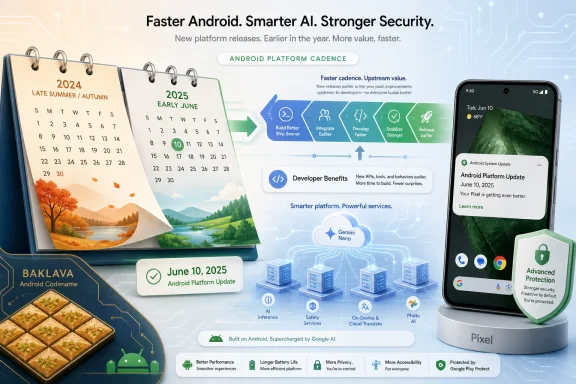 Google Moved Android’s Main Event Upstream
For years, Android’s annual rhythm trained the industry to expect the big platform release somewhere between late summer and autumn. Developers adjusted their apps through spring and summer previews, Pixel owners got the first stable build, and everyone else waited for device makers and carriers to finish their own work. That pattern was familiar, imperfect, and slow.Android 16 broke that muscle memory. Google had already told developers in 2024 that the next major Android release would land in Q2 2025, with another smaller SDK-bearing release later in the year. The June launch was therefore not a surprise in direction, even if the exact date was a rumor until Google pressed the button.
The important correction is that June 3 was not the day Android 16 arrived. That date circulated widely in advance, including in Android enthusiast reporting, but the stable release ultimately landed on June 10, 2025. In rumor terms, this was a miss; in strategic terms, it was almost a bullseye.
That distinction matters because the release was never really about one Tuesday. It was about whether Google could pull Android’s annual platform milestone far enough forward to matter for the next wave of devices. On that test, Android 16 did what Google said it would do.
The June Date Was a Scheduling Story Disguised as a Feature Story
Android 16’s most consequential feature may have been its date on the calendar. Shipping in June gave Google and its partners a shot at placing the new platform under devices launching in the second half of the year, rather than forcing flagship phones to arrive with last year’s Android and then promise an update after the fact.That is a deeply practical change. The Android ecosystem has long suffered from a timing mismatch: Google would finish Android late, phone makers would launch autumn hardware on older code, and buyers would hear about “coming soon” updates before the box had even cooled off. Moving the platform earlier does not solve fragmentation by itself, but it attacks one of fragmentation’s root causes.
It also helps explain why Google was willing to split the year into a major release and a later minor release. The old model tried to make the annual Android release carry everything: platform APIs, behavioral changes, Pixel polish, visual redesigns, security features, and launch narrative. The new model accepts that Android is too large for one ceremonial drop.
In that sense, Android 16 was less like a traditional operating-system launch and more like a new production schedule. Google wanted the core platform ready earlier, even if some of the flashier user-facing pieces would mature through quarterly updates.
Baklava Was a Break With Android’s Alphabet, Not Its Sweet Tooth
The codename “Baklava” caused a small but revealing stir because it did not follow the expected dessert alphabet sequence after Android 15’s Vanilla Ice Cream. Android codenames stopped being mainstream marketing names years ago, but they still carry symbolic weight among developers, OEM engineers, and longtime Android watchers.The shift made more sense when viewed through Google’s internal development changes. Android has been moving toward a more continuous trunk-based development model, reducing the old drama around release branches and late-cycle integration. A codename that breaks the public-facing alphabet is a small signal of a larger truth: the old release ceremony no longer maps cleanly onto how Android is built.
That does not mean codenames are meaningless. They are cultural artifacts, and Android’s dessert names have always been part engineering shorthand, part fan-service. But Baklava’s real meaning was not that Google had suddenly become whimsical again; it was that Android’s internal machinery had changed enough to make the old alphabet less useful.
There is also a branding lesson here. Google rarely markets Android version numbers with the consistency Apple brings to iOS, and device makers often bury Android underneath their own skins. For many users, “Android 16” mattered less than “the next Samsung update,” “the Pixel June update,” or “the version that brings better notifications.” Baklava was a codename for insiders, not a consumer campaign.
The Same-Day Dream Met the Pixel Reality
Early reports suggested that Android 16 would arrive for AOSP and Pixel devices on the same day, and the broader idea reflected a real ambition: shorten the gap between source availability and device availability. Historically, AOSP drops and Pixel OTAs have not always felt like the same event. Developers got source code; Pixel users waited; OEMs waited longer.With Android 16, Google’s public story was that supported Pixel devices were first in line, with other brands following later in the year. The AOSP side also mattered because it set the baseline for the broader ecosystem, but the user-visible milestone was the Pixel rollout. For the ordinary Android owner, stable does not mean “code exists”; stable means “my phone can install it.”
That distinction is important for WindowsForum readers because it mirrors a familiar split in the PC world. Microsoft can publish an ISO, push an enablement package, or declare a feature update broadly available, but the experience still depends on device eligibility, drivers, firmware, staged rollout logic, and enterprise policy. Android’s version story has the same layered reality, only distributed across more vendors.
The June release therefore changed the starting gun, not the entire race. Pixel owners moved first. OEMs still had to integrate, test, skin, certify, and distribute their own builds. Carrier and regional variations did not vanish because Google picked an earlier month.
AI Gave Google a Reason to Stop Waiting Until Autumn
The original rumor framed Android 16’s early timing partly around AI, and that was not wrong. Google’s competitive problem in 2025 was not simply that Android needed new APIs. It was that AI features were becoming the organizing principle of phone launches, app experiences, and platform lock-in.A late Android release is awkward in that environment. If Google wants Gemini-era features to feel native rather than bolted on, the platform has to be ready before OEMs finalize their hero devices. Otherwise, AI becomes an app-layer patchwork instead of a system behavior.
Android 16’s early arrival gave Google more room to align platform capabilities, Pixel features, and partner launches. It also helped the company answer Apple’s increasingly platform-level AI messaging without waiting until the traditional Android release window. In modern smartphone competition, shipping the plumbing late means someone else gets to define the user experience.
Still, the AI framing should not be overstated. Android 16 was not a single monolithic “AI OS” moment. Like Windows, Android is now absorbing AI through many seams: notifications, privacy controls, assistant surfaces, screenshots, search, app actions, security posture, and cloud-linked services. The operating system provides permissions, context, and affordances; the visible magic often comes from services layered above it.
The Flashiest Android 16 Ideas Did Not All Arrive at Once
The pre-release rumor mill pointed to rich notifications, Advanced Protection, Quick Settings changes, separated notification and control panels, and a Material 3 Expressive design shift. Some of those ideas landed in or around Android 16; others belonged to later Pixel drops, quarterly releases, beta tracks, or OEM interpretations.This is where the new Android schedule becomes harder to explain to normal users. The stable Android 16 release was real, but not every Android 16-adjacent feature arrived in the first stable build. Material 3 Expressive, for example, became part of the broader Android 16-era story without necessarily being the headline payload of the initial June release for every device.
That staggered delivery is not a failure so much as the new software reality. Microsoft does the same thing with Windows 11: a version number sets the base, while feature experiences arrive through cumulative updates, app updates, Store packages, controlled feature rollouts, and cloud switches. Google is taking Android in a similar direction, where the version is the foundation rather than the whole building.
The upside is faster iteration. The downside is confusion. Users see a feature in a blog post, read that it is “Android 16,” install Android 16, and then discover that availability depends on device model, region, OEM skin, beta status, server-side rollout, or a later QPR.
Advanced Protection Showed the Serious Side of the Release
One of Android 16’s more concrete user-facing improvements was Advanced Protection, a stronger security mode aimed at people who want or need a hardened mobile posture. That matters because Android’s reputation has long been split between openness and risk. Google has spent years trying to prove that Android can be both flexible and defensible.For high-risk users, the value of a mode like Advanced Protection is not that it turns a phone into an unbreakable vault. It is that it gathers multiple security choices into a coherent posture. The problem with security settings is that most people do not know which toggles matter until after something has gone wrong.
Enterprise administrators should recognize the pattern. A hardened baseline is easier to reason about than a collection of optional settings scattered across menus. The consumer version of that idea is a simple mode that says, in effect, “make the safer choices for me.”
This is also where Android’s competition with iOS gets more direct. Apple has built a strong public association between iPhone and personal safety, especially for journalists, activists, executives, and government-adjacent users. Google needs Android to be credible in those same conversations, not merely cheaper, more customizable, or more widely licensed.
A Faster Android Cadence Creates New Work for Developers
For app developers, Android 16’s timing change was both helpful and demanding. A Q2 major release gives developers earlier clarity on final APIs and behavioral changes, especially if platform stability lands with enough runway. But a second SDK-affecting release later in the year also means the target is no longer a single annual checkpoint.That is a meaningful shift. Android developers already contend with device fragmentation, OEM behavior differences, Play policy deadlines, background execution rules, permissions churn, and user privacy changes. Adding a more frequent SDK cadence can improve responsiveness, but it also raises the operational tempo.
The best version of this model is predictable and boring. Developers know when major and minor releases will arrive, test accordingly, and avoid being surprised by late-breaking behavior changes. The worst version would be a rolling fog of platform deltas that forces app teams to chase Android continuously without clear benefit.
Google’s challenge is to make the new cadence feel like a contract rather than an improvisation. If the company can keep stability milestones meaningful and documentation clear, faster Android can be good for developers. If not, it risks becoming another tax on teams that already struggle to test across the full Android estate.
OEMs Gain Time, but They Also Lose an Excuse
For phone makers, the earlier Android 16 release was a gift with strings attached. It gave OEMs more time to ship new devices with the current platform, especially for the second half of the year. It also made it harder to justify launching premium hardware on an outgoing Android version.That matters most at the high end. Consumers buying expensive phones increasingly expect long software support windows, fast security patches, and prompt platform updates. If Google delivers the base release in June, a September flagship shipping with the previous Android version looks less like a scheduling inevitability and more like a vendor choice.
Samsung, Xiaomi, OnePlus, Motorola, and others still have legitimate integration work to do. Their Android builds are not just Google’s code with a logo swapped in. They include custom launchers, camera stacks, modem behavior, battery systems, AI layers, enterprise features, regional apps, and carrier requirements.
But the calendar pressure changes. An earlier upstream release gives serious OEMs more room to prepare and exposes laggards more clearly. That is probably exactly what Google wants.
Pixel Becomes the Reference Device Again, but Not the Whole Story
The Pixel line benefits most visibly from Android’s new schedule. Pixel owners are the first to see stable Android, the first to test QPR betas, and the first to receive Google’s own interpretation of the platform. That makes Pixel the clearest expression of what Google thinks Android should be.But Android is not Pixel, and that remains both its strength and its weakness. Pixel can move quickly because Google controls the hardware, software, and services. The broader Android ecosystem moves at the speed of partnerships.
The June Android 16 release did not erase that gap. It did, however, give Google a stronger reference point. When Android 16 arrived, Google could say: the platform is ready, the Pixels are moving, and partners now have the code path they need.
That framing subtly shifts accountability. In the old cadence, everyone could blame the lateness of the upstream release. In the new cadence, users can more reasonably ask their phone maker why the update is still months away.
The Windows Parallel Is Hard to Miss
WindowsForum readers have seen this movie from the other side of the computing world. Microsoft spent years turning Windows from a boxed product into a service, then spent more years trying to make that service feel less chaotic. Feature updates, enablement packages, Moment updates, Controlled Feature Rollouts, Patch Tuesday, out-of-band fixes, and app-delivered features all changed what “a Windows version” means.Android is traveling a comparable road. The annual number still matters for APIs, compatibility, and marketing, but the lived experience increasingly arrives through layers. Google Play system updates, monthly security patches, Pixel Drops, app updates, Gemini features, and QPR builds all shape the phone as much as the base OS version.
The difference is that Android’s hardware ecosystem is more decentralized. Microsoft has OEMs too, but Windows Update reaches a relatively unified installed base compared with Android’s maze of carriers, regional firmware, vendor skins, and device tiers. Google can pull the platform lever; it cannot force every partner to move at Pixel speed.
That makes Android 16’s timing experiment more interesting than a normal release story. It is Google attempting to impose a cleaner cadence on an ecosystem designed to resist central timing.
The Rumor Was Wrong in the Small Way and Right in the Big One
The SammyFans report captured the direction of travel: Android 16 was coming earlier, June was the target month, and Google wanted AOSP, Pixel, and partner readiness to line up more tightly than before. Its most specific date, June 3, did not hold. Android 16 stable arrived on June 10.That is how pre-release reporting often works. Exact dates are fragile because companies can slip a release for testing, carrier coordination, staged rollout logistics, or simple executive preference. A one-week miss does not invalidate the broader reporting if the strategic claim proves right.
Still, precision matters. Users planning an update, developers timing a release, and administrators writing guidance need actual dates, not vibes. The correct historical record is that Google announced the Q2 strategy in advance, rumors clustered around early June, and the stable rollout began on June 10, 2025.
The more interesting question is why June 3 sounded plausible in the first place. It fit Google’s monthly patch rhythm, it matched the stated Q2 window, and it landed ahead of summer hardware cycles. Rumors become believable when they rhyme with operational reality.
Earlier Does Not Automatically Mean Better
A faster schedule can produce better outcomes, but only if quality keeps up. Android’s history includes releases that looked tidy on paper and messy on devices. The risk of moving earlier is that the platform ships before enough real-world testing has shaken out edge cases.Google tried to manage that through developer previews, betas, platform stability milestones, and QPR follow-ups. That is the right machinery. But the burden falls unevenly: developers must test sooner, OEMs must integrate faster, and users become part of the final validation loop when staged rollouts encounter device-specific bugs.
The industry has learned to tolerate this because modern operating systems are never finished. Windows users know the cadence intimately: install the feature update, wait for the cumulative fix, then wait for the enablement of the thing that was advertised in the launch post. Android users are now living in the same software continuum.
The key question is whether the initial Android 16 release was stable enough to justify the schedule shift. By moving major platform delivery into June and pushing some experiential changes later, Google chose a pragmatic compromise: ship the base earlier, refine the surface over time.
The New Cadence Makes Android More Cloud-Like
Android’s move toward a major release plus smaller SDK updates makes the platform feel more like cloud software. That does not mean your phone OS becomes a web app, but it does mean the boundaries between operating system, service layer, and feature rollout continue to blur.Google is comfortable in that world. The company already updates large parts of Android through Play services, Play system updates, and first-party apps. Gemini, Photos, Messages, Chrome, Wallet, and other services can change the user experience without waiting for a full platform release.
The risk is that version numbers become less useful to users. “Android 16” may tell you what API level your phone supports, but it may not tell you whether you have the new notification behavior, the latest design language, the newest AI integration, or the same security surface as a Pixel. That uncertainty is frustrating, especially for buyers comparing devices.
The benefit is that Google can decouple urgent improvements from the tyranny of the annual release. Security can move monthly, services can move weekly, and platform APIs can move on a published cadence. The challenge is explaining that without making Android feel incoherent.
The Update Race Is Now Part of the Product
Android phone makers have spent years using update promises as marketing copy. Three years became four, four became five, and the most ambitious vendors now advertise support windows that once would have sounded unrealistic. But long support windows only answer one question: how long will the phone receive updates? They do not answer how quickly.Android 16’s early release sharpened that second question. If a device launches after June 2025, buyers can reasonably ask whether it ships with Android 16. If it does not, they can ask when the update arrives. If the answer is vague, the support promise starts to look thinner.
This matters beyond enthusiasts. Enterprises evaluating Android fleets care about predictable update timing. Developers care about how quickly new APIs reach meaningful scale. Security teams care about patch latency. Consumers may not know the codename Baklava, but they do notice when a new phone immediately asks them to wait for the update it should have had at launch.
A platform release date is therefore not just a developer milestone. It is leverage.
What Baklava Actually Changed for the Android Calendar
Android 16’s lesson is not that every future release must land on the same week of June. It is that Google has shown a willingness to move the annual Android release earlier to serve the ecosystem rather than tradition. That is a substantial cultural shift for a platform that often seemed resigned to late-cycle fragmentation.The practical takeaways are concrete enough for users, developers, and IT teams to treat this as more than trivia.
- Android 16 did not launch on the rumored June 3 date; the stable Pixel rollout began on June 10, 2025.
- Google’s larger promise of a Q2 2025 major Android release proved accurate, marking a real departure from the older August-to-October pattern.
- The earlier release gave OEMs a better chance to ship late-2025 phones with Android 16 rather than launching new hardware on Android 15.
- Some Android 16-era features arrived through later updates, beta tracks, or Pixel-specific drops, so the version number alone did not guarantee every advertised experience on day one.
- The Baklava codename reflected Android’s changing internal development culture more than a revived consumer dessert-branding strategy.
- The new cadence raised expectations for faster updates while also increasing the testing and integration burden on developers and device makers.
References
- Primary source: Sammy Fans
Published: 2026-06-21T05:50:11.563318
Loading…
www.sammyfans.com - Related coverage: androidcentral.com
Google's June Pixel Drop is rolling out, and we're unraveling what's coming with Android 17 | Android Central
Joining the big Android 17 release is Google's drop for Pixels.www.androidcentral.com - Related coverage: developer.android.com
Loading…
developer.android.com - Related coverage: techadvisor.com
Loading…
www.techadvisor.com - Related coverage: blog.google
Loading…
blog.google - Related coverage: codebeacon.info
Loading…
codebeacon.info
- Related coverage: android.fandom.com
Loading…
android.fandom.com - Related coverage: gigazine.net
Loading…
gigazine.net - Related coverage: androidauthority.com
Loading…
www.androidauthority.com - Related coverage: googlewatchblog.de
Loading…
www.googlewatchblog.de - Official source: 9to5google.com
Loading…
9to5google.com - Related coverage: source.android.com
Loading…
source.android.com - Related coverage: techradar.com
Loading…
www.techradar.com - Related coverage: cincodias.elpais.com
Loading…
cincodias.elpais.com - Related coverage: t3.com
Your Google Pixel phone could get another big software upgrade soon – Android 17 is just "around the corner" | T3
There's something new coming to Android phones and Pixel will be front of the queuewww.t3.com