
On June 21, 2026, Gear Patrol’s weekly gadget roundup spotlighted a wave of premium tech releases led by Focal’s Diva Alta Utopia wireless speakers, Microsoft’s Snapdragon X2-powered Surface refresh, Fluance’s RT87 flagship turntable, Bang & Olufsen’s limited Beosystem 3000c finish, and Sennheiser’s new Accentum Clip open-ear earbuds. The through line is hard to miss: consumer tech is moving upmarket again, but not always by inventing new categories. Instead, brands are repackaging familiar ideas — speakers, laptops, turntables, earbuds — around convenience, scarcity, AI performance, and lifestyle polish. For WindowsForum readers, the Surface announcement is the obvious anchor, but the broader story is about where gadget makers think serious buyers still have room to spend.
The most interesting thing about this week’s gadget announcements is not that they are all new. It is that most of them are trying to make old forms feel inevitable again.
A wireless floorstanding speaker system is still a speaker system. A premium turntable is still a turntable. A Surface Pro is still Microsoft’s familiar tablet-laptop hybrid. Open-ear earbuds still exist because people want audio without sealing themselves off from the world.
What has changed is the sales pitch. The modern gadget is less likely to promise revolution and more likely to promise refinement: fewer boxes, better materials, more integrated software, less visible complexity, and a price tag that tells buyers they are buying into a finished ecosystem rather than assembling one.
That is why Focal’s Diva Alta Utopia matters even if most readers will never seriously consider buying it. It sits in the same cultural lane as limited-run Bang & Olufsen audio furniture and high-end vinyl systems: hardware designed not just to work, but to announce that the owner has opted out of disposable tech.
The important word here is active. Traditional high-end audio has long revolved around component matching: speakers, amplifiers, streamers, DACs, cables, racks, and the quiet anxiety that one weak link is bottlenecking the whole system. Focal’s pitch is that the company can collapse that chain into a calibrated, plug-and-play system without asking the buyer to become a part-time audio engineer.
That is not a small philosophical shift. Audiophile culture historically rewarded tinkering, but a growing slice of wealthy buyers wants performance without ritual. They do not want to compare amplifier damping factors or spend a weekend moving towers by half an inch. They want the equivalent of a supercar with an automatic gearbox: technically serious, emotionally indulgent, and easier to live with than the purists might prefer.
There is a Windows-adjacent lesson here too. The broader device market keeps moving toward sealed integration because most users, even power users, increasingly value predictability over configurability. That is why laptops solder memory, phones hide file systems, and smart speakers turn racks of hardware into apps. The trade-off is always the same: you gain simplicity, but you surrender some control.
This is the part of the Surface arc where the drama ideally disappears. The original Windows-on-Arm conversation was full of caveats: app compatibility, driver weirdness, emulation performance, enterprise uncertainty, and the lingering sense that buyers were volunteering for a platform experiment. Microsoft’s job now is to make Snapdragon Surface hardware feel like just another premium Windows option.
That is easier said than done. Windows remains a platform with decades of software expectations attached to it, and x86 compatibility is not a footnote for business users. A MacBook buyer can accept platform transitions because Apple controls the vertical stack with unusual force. Microsoft has to bring OEMs, developers, IT departments, peripheral vendors, and skeptical enthusiasts along with it.
The new Surface machines appear to target precisely that credibility gap. Higher baseline RAM, upgraded graphics claims, and premium pricing all suggest Microsoft is not positioning these as cheap mobility devices. It wants Surface on Arm to look like the future of Windows performance-per-watt, not a compromise for people who only use Edge and Office.
That will irritate some Surface fans, especially those who remember when the line’s appeal came partly from offering a distinctive form factor rather than pure spec dominance. But Surface has never really been about winning the cheapest spec sheet comparison. It is Microsoft’s hardware argument for what Windows PCs should look like when the software maker gets to choreograph the experience.
The complication is that the Windows laptop market is much more competitive than it was during Surface’s early years. Lenovo, HP, Dell, Asus, Acer, Framework, and others all have credible premium machines, and Apple’s MacBook line remains the comparison point for battery life, thermals, and sleep reliability. Microsoft therefore has to justify not only Arm, but Surface itself.
That is where temporary promotions, like bundled Surface accessories in the U.S. ordering window, become revealing. Surface Pro pricing has always had a psychological tax because the keyboard is essential in practice but historically separate in the box. Bundling one, even briefly, acknowledges what customers have said for years: a tablet that is marketed as a laptop replacement should not make the laptop part feel optional.
They do. Snapdragon X2 Surface hardware is part of a larger push toward AI-capable client devices, local inference, neural processing units, and tighter integration between Windows, Copilot, and silicon vendors. Microsoft has spent the past two years telling the market that the next PC upgrade cycle will be driven by AI workloads rather than merely by faster CPUs.
That argument is still not fully proven. Many users remain unconvinced that on-device AI features justify replacing perfectly good laptops, especially when the most compelling AI tools still run in the cloud. But Microsoft needs a hardware reason for enterprises and consumers to move beyond “good enough” Windows 10 and Windows 11 machines, and AI acceleration is the reason it has chosen.
Surface is the showcase, not the whole market. If Microsoft can make Arm-based Surface devices feel fast, compatible, quiet, and long-lasting, it gives the broader Windows ecosystem permission to follow. If it stumbles, the damage is not confined to one product line; it reinforces the old suspicion that Windows on Arm is always one generation away.
The RT87 is positioned as Fluance’s most ambitious turntable to date, with a dual-plinth design meant to isolate vibration and improve playback stability. That matters because turntables are brutally physical devices. Unlike a streamer, they convert motion into sound, and every unwanted vibration is potentially audible.
This is why the turntable market can sustain both entry-level nostalgia boxes and serious enthusiast hardware. A better tonearm, cartridge, platter, motor isolation system, and plinth are not abstract upgrades. They are visible mechanisms that help buyers understand where their money went.
For a tech audience, vinyl’s endurance can look irrational until you compare it to the rest of the gadget world. Streaming is infinitely convenient, but it makes music feel rented, compressed into an interface, and flattened by recommendation engines. A turntable restores friction, and sometimes friction is the feature.
Only 100 units are being made, which means the finish is not just aesthetic. It is part of the product’s value proposition. The buyer is not merely buying a hi-fi system; they are buying controlled scarcity from a brand that has spent decades making electronics look like furniture from a more elegant future.
That can sound frivolous, but B&O understands something many PC makers still struggle with: industrial design is not decoration added after engineering is complete. It is part of how people decide whether technology belongs in their lives. A beautiful speaker in a living room is not judged by the same criteria as a black-box router under a desk.
Microsoft has tried to learn this lesson with Surface, sometimes successfully. The magnesium chassis, kickstand, Alcantara era, and carefully staged colorways were all attempts to make Windows hardware feel deliberate. B&O simply operates at the purer end of that philosophy: the gadget as a room-defining object.
This is a practical response to how people actually use earbuds. Noise cancellation is wonderful on a plane, but not always desirable on a sidewalk, bike path, office floor, or train platform. Many users want background music, podcasts, or calls without losing spatial awareness.
The compromise is sound quality. Open-ear designs have to fight physics, especially in bass response and leakage control. Sennheiser’s use of 12mm dynamic drivers and adaptive sound features suggests the company knows it cannot simply sell comfort; it has to convince buyers that open-ear listening can still feel premium.
The more interesting point is that “hear the world around you” has become a high-end feature rather than a budget limitation. For years, the premium earbud race was about stronger sealing, better ANC, and deeper immersion. Now companies are rediscovering that sometimes the best interface is the one that does not cut the user off from reality.
The upside is obvious. Products are easier to set up, easier to understand, and more likely to perform well out of the box. For mainstream buyers, this is progress.
The downside is equally familiar. Integrated systems can become harder to repair, upgrade, or repurpose. Wireless active speakers depend on software platforms. Earbuds are tiny battery-powered consumables. Premium laptops often limit user-serviceable parts. Even modernized vintage audio can become dependent on proprietary restoration programs.
This is where enthusiasts and ordinary buyers often part ways. Enthusiasts see lock-in and lost agency. Ordinary buyers see fewer decisions and fewer ways to make mistakes. The gadget industry, unsurprisingly, keeps following the money toward completeness.
Copilot+ features have improved, and local AI workloads are becoming more plausible. Developers are experimenting with on-device models, privacy-sensitive processing, and workflows that do not always round-trip to a data center. But the ordinary user’s daily computing life still revolves around browsers, messaging, documents, video calls, and a handful of specialized apps.
That does not make the AI PC push meaningless. Platform shifts usually arrive before the definitive use case is obvious. Early broadband preceded streaming dominance; early smartphones preceded the app economy; early GPUs for consumers preceded today’s AI acceleration boom.
The risk for Microsoft is that it asks buyers to pay flagship prices before the benefit feels concrete. Surface buyers are often early adopters, but they are not infinitely patient. If the new hardware mostly makes Windows feel like Windows, only faster and more expensive, the AI label may feel like branding rather than a reason to upgrade.
That explains the emphasis on heritage in B&O, engineering purity in Focal, mechanical seriousness in Fluance, environmental awareness in Sennheiser’s open-ear pitch, and platform ambition in Surface. Each product is trying to answer the same question: why buy this now?
For Microsoft, the answer is performance, AI readiness, and the next phase of Windows mobility. For Focal, it is uncompromised high-end audio without component sprawl. For Fluance, it is analog playback treated as precision engineering. For B&O, it is design scarcity. For Sennheiser, it is a more socially and physically aware kind of personal audio.
That does not make all these gadgets equally important. A Surface refresh has consequences for the Windows ecosystem in a way a limited-run hi-fi system does not. But culturally, they point in the same direction: tech is becoming more curated, more expensive at the high end, and more dependent on brand trust.
The bigger question is whether Microsoft can make Arm Windows boring in the best possible sense. A successful Surface Pro or Surface Laptop should not require users to think about instruction sets, emulation layers, driver availability, or whether a random utility will behave. It should simply be a Windows PC with excellent battery life and enough performance headroom to justify its price.
That has major implications for administrators. If Arm-based Windows laptops become normal, fleets could gain battery life and manageability advantages, but they will also need careful application validation. Legacy VPN clients, endpoint agents, print drivers, niche line-of-business apps, and hardware utilities remain the places where platform optimism meets procurement reality.
For enthusiasts, the question is more personal. Surface has always been a promise that Windows hardware can be elegant without becoming Apple-like in philosophy. The more Surface leans into sealed integration and AI-first positioning, the more it tests how much control Windows users are willing to trade for polish.
Focal and B&O say the physical object still matters. Fluance says mechanical engineering still matters. Sennheiser says ergonomics and context still matter. Microsoft says the PC still matters, but only if it becomes the local endpoint for a more AI-shaped version of Windows.
The concrete signals are worth keeping in view:
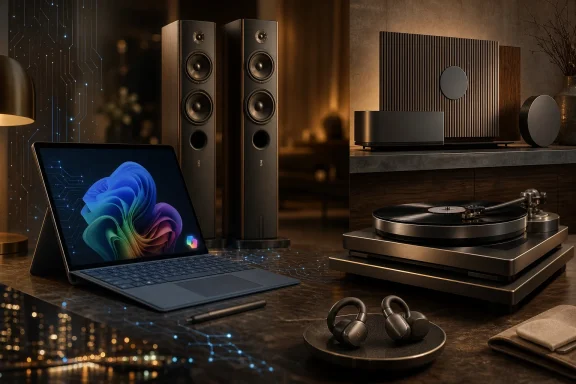 The Gadget Market Has Rediscovered the Expensive Middle
The most interesting thing about this week’s gadget announcements is not that they are all new. It is that most of them are trying to make old forms feel inevitable again.A wireless floorstanding speaker system is still a speaker system. A premium turntable is still a turntable. A Surface Pro is still Microsoft’s familiar tablet-laptop hybrid. Open-ear earbuds still exist because people want audio without sealing themselves off from the world.
What has changed is the sales pitch. The modern gadget is less likely to promise revolution and more likely to promise refinement: fewer boxes, better materials, more integrated software, less visible complexity, and a price tag that tells buyers they are buying into a finished ecosystem rather than assembling one.
That is why Focal’s Diva Alta Utopia matters even if most readers will never seriously consider buying it. It sits in the same cultural lane as limited-run Bang & Olufsen audio furniture and high-end vinyl systems: hardware designed not just to work, but to announce that the owner has opted out of disposable tech.
Focal Turns Wireless Audio Into a Luxury Appliance
Focal’s Diva Alta Utopia is the kind of product that makes the phrase “wireless speaker” feel hilariously inadequate. It is a pair of large active floorstanding speakers that combines Focal’s speaker engineering with Naim’s amplification and streaming platform, extending the Diva Utopia line above the existing Diva Utopia and Diva Mezza Utopia systems.The important word here is active. Traditional high-end audio has long revolved around component matching: speakers, amplifiers, streamers, DACs, cables, racks, and the quiet anxiety that one weak link is bottlenecking the whole system. Focal’s pitch is that the company can collapse that chain into a calibrated, plug-and-play system without asking the buyer to become a part-time audio engineer.
That is not a small philosophical shift. Audiophile culture historically rewarded tinkering, but a growing slice of wealthy buyers wants performance without ritual. They do not want to compare amplifier damping factors or spend a weekend moving towers by half an inch. They want the equivalent of a supercar with an automatic gearbox: technically serious, emotionally indulgent, and easier to live with than the purists might prefer.
There is a Windows-adjacent lesson here too. The broader device market keeps moving toward sealed integration because most users, even power users, increasingly value predictability over configurability. That is why laptops solder memory, phones hide file systems, and smart speakers turn racks of hardware into apps. The trade-off is always the same: you gain simplicity, but you surrender some control.
Microsoft’s Surface Refresh Is About the Arm Bet Becoming Boring
Microsoft’s new Surface Pro and Surface Laptop models are the mainstream computing news in the batch, and they matter because they show Microsoft trying to normalize the Arm-based Windows PC rather than relaunch it as a novelty every generation. The new devices use Qualcomm’s Snapdragon X2 processors, with Microsoft positioning them around better performance, better graphics, and the continuing Copilot+ PC story.This is the part of the Surface arc where the drama ideally disappears. The original Windows-on-Arm conversation was full of caveats: app compatibility, driver weirdness, emulation performance, enterprise uncertainty, and the lingering sense that buyers were volunteering for a platform experiment. Microsoft’s job now is to make Snapdragon Surface hardware feel like just another premium Windows option.
That is easier said than done. Windows remains a platform with decades of software expectations attached to it, and x86 compatibility is not a footnote for business users. A MacBook buyer can accept platform transitions because Apple controls the vertical stack with unusual force. Microsoft has to bring OEMs, developers, IT departments, peripheral vendors, and skeptical enthusiasts along with it.
The new Surface machines appear to target precisely that credibility gap. Higher baseline RAM, upgraded graphics claims, and premium pricing all suggest Microsoft is not positioning these as cheap mobility devices. It wants Surface on Arm to look like the future of Windows performance-per-watt, not a compromise for people who only use Edge and Office.
Surface Pricing Says Microsoft Is No Longer Apologizing
The reported starting price around $1,499 for refreshed high-end Surface models tells its own story. Microsoft is not treating these devices as experimental discounts. It is pricing them like flagship PCs.That will irritate some Surface fans, especially those who remember when the line’s appeal came partly from offering a distinctive form factor rather than pure spec dominance. But Surface has never really been about winning the cheapest spec sheet comparison. It is Microsoft’s hardware argument for what Windows PCs should look like when the software maker gets to choreograph the experience.
The complication is that the Windows laptop market is much more competitive than it was during Surface’s early years. Lenovo, HP, Dell, Asus, Acer, Framework, and others all have credible premium machines, and Apple’s MacBook line remains the comparison point for battery life, thermals, and sleep reliability. Microsoft therefore has to justify not only Arm, but Surface itself.
That is where temporary promotions, like bundled Surface accessories in the U.S. ordering window, become revealing. Surface Pro pricing has always had a psychological tax because the keyboard is essential in practice but historically separate in the box. Bundling one, even briefly, acknowledges what customers have said for years: a tablet that is marketed as a laptop replacement should not make the laptop part feel optional.
The Surface Story Is Really a Windows Platform Story
For WindowsForum readers, the key question is not whether the new Surface Pro has a nicer display or whether the new Surface Laptop comes in a better color. The question is whether Microsoft’s hardware choices signal where Windows itself is going.They do. Snapdragon X2 Surface hardware is part of a larger push toward AI-capable client devices, local inference, neural processing units, and tighter integration between Windows, Copilot, and silicon vendors. Microsoft has spent the past two years telling the market that the next PC upgrade cycle will be driven by AI workloads rather than merely by faster CPUs.
That argument is still not fully proven. Many users remain unconvinced that on-device AI features justify replacing perfectly good laptops, especially when the most compelling AI tools still run in the cloud. But Microsoft needs a hardware reason for enterprises and consumers to move beyond “good enough” Windows 10 and Windows 11 machines, and AI acceleration is the reason it has chosen.
Surface is the showcase, not the whole market. If Microsoft can make Arm-based Surface devices feel fast, compatible, quiet, and long-lasting, it gives the broader Windows ecosystem permission to follow. If it stumbles, the damage is not confined to one product line; it reinforces the old suspicion that Windows on Arm is always one generation away.
Fluance Makes Vinyl Look Less Like Nostalgia and More Like Engineering
Fluance’s RT87 flagship turntable lands in a different market, but it is chasing a related buyer psychology. Vinyl is no longer merely retro; it has become one of the few consumer electronics categories where mechanical complexity is part of the appeal.The RT87 is positioned as Fluance’s most ambitious turntable to date, with a dual-plinth design meant to isolate vibration and improve playback stability. That matters because turntables are brutally physical devices. Unlike a streamer, they convert motion into sound, and every unwanted vibration is potentially audible.
This is why the turntable market can sustain both entry-level nostalgia boxes and serious enthusiast hardware. A better tonearm, cartridge, platter, motor isolation system, and plinth are not abstract upgrades. They are visible mechanisms that help buyers understand where their money went.
For a tech audience, vinyl’s endurance can look irrational until you compare it to the rest of the gadget world. Streaming is infinitely convenient, but it makes music feel rented, compressed into an interface, and flattened by recommendation engines. A turntable restores friction, and sometimes friction is the feature.
Bang & Olufsen Sells Scarcity as a Specification
Bang & Olufsen’s Beosystem 3000c in Dune Grey is perhaps the clearest example of a gadget as an object of design culture. The system pairs a restored and modernized Beogram 3000c turntable with Beolab 8 active speakers, now in a limited Dune Grey finish combining soft bronze aluminum and dark walnut accents.Only 100 units are being made, which means the finish is not just aesthetic. It is part of the product’s value proposition. The buyer is not merely buying a hi-fi system; they are buying controlled scarcity from a brand that has spent decades making electronics look like furniture from a more elegant future.
That can sound frivolous, but B&O understands something many PC makers still struggle with: industrial design is not decoration added after engineering is complete. It is part of how people decide whether technology belongs in their lives. A beautiful speaker in a living room is not judged by the same criteria as a black-box router under a desk.
Microsoft has tried to learn this lesson with Surface, sometimes successfully. The magnesium chassis, kickstand, Alcantara era, and carefully staged colorways were all attempts to make Windows hardware feel deliberate. B&O simply operates at the purer end of that philosophy: the gadget as a room-defining object.
Sennheiser Follows Bose Into the Open-Ear Compromise
Sennheiser’s Accentum Clip earbuds show another major consumer hardware trend: the move away from total isolation. Like Bose’s Ultra Open Earbuds, Sennheiser’s design clips around the ear rather than sealing the ear canal, allowing ambient sound to remain present during commuting, workouts, and daily use.This is a practical response to how people actually use earbuds. Noise cancellation is wonderful on a plane, but not always desirable on a sidewalk, bike path, office floor, or train platform. Many users want background music, podcasts, or calls without losing spatial awareness.
The compromise is sound quality. Open-ear designs have to fight physics, especially in bass response and leakage control. Sennheiser’s use of 12mm dynamic drivers and adaptive sound features suggests the company knows it cannot simply sell comfort; it has to convince buyers that open-ear listening can still feel premium.
The more interesting point is that “hear the world around you” has become a high-end feature rather than a budget limitation. For years, the premium earbud race was about stronger sealing, better ANC, and deeper immersion. Now companies are rediscovering that sometimes the best interface is the one that does not cut the user off from reality.
Premium Gadgets Are Becoming Less Repairable but More Complete
A common thread connects the Focal speakers, Surface laptops, B&O system, Sennheiser earbuds, and even the Fluance turntable: each product is trying to reduce the buyer’s burden after purchase. That can mean integrated amplification, bundled computing hardware, restored vintage design, adaptive audio, or mechanical isolation built into the chassis.The upside is obvious. Products are easier to set up, easier to understand, and more likely to perform well out of the box. For mainstream buyers, this is progress.
The downside is equally familiar. Integrated systems can become harder to repair, upgrade, or repurpose. Wireless active speakers depend on software platforms. Earbuds are tiny battery-powered consumables. Premium laptops often limit user-serviceable parts. Even modernized vintage audio can become dependent on proprietary restoration programs.
This is where enthusiasts and ordinary buyers often part ways. Enthusiasts see lock-in and lost agency. Ordinary buyers see fewer decisions and fewer ways to make mistakes. The gadget industry, unsurprisingly, keeps following the money toward completeness.
The AI PC Is Still Looking for Its Everyday Killer App
Microsoft’s Surface refresh deserves particular scrutiny because it sits at the intersection of hardware aspiration and software uncertainty. The company can ship better silicon, better battery life, and better local AI acceleration, but the reason to buy an AI PC remains fuzzy for many users.Copilot+ features have improved, and local AI workloads are becoming more plausible. Developers are experimenting with on-device models, privacy-sensitive processing, and workflows that do not always round-trip to a data center. But the ordinary user’s daily computing life still revolves around browsers, messaging, documents, video calls, and a handful of specialized apps.
That does not make the AI PC push meaningless. Platform shifts usually arrive before the definitive use case is obvious. Early broadband preceded streaming dominance; early smartphones preceded the app economy; early GPUs for consumers preceded today’s AI acceleration boom.
The risk for Microsoft is that it asks buyers to pay flagship prices before the benefit feels concrete. Surface buyers are often early adopters, but they are not infinitely patient. If the new hardware mostly makes Windows feel like Windows, only faster and more expensive, the AI label may feel like branding rather than a reason to upgrade.
The Smart Money Is Selling Fewer Boxes With More Story
The week’s gadget news also shows how tech companies are adapting to a slower replacement cycle. Phones last longer. Laptops last longer. Speakers can last decades. Turntables can outlive streaming services. If replacement demand softens, the industry has to sell meaning, not just function.That explains the emphasis on heritage in B&O, engineering purity in Focal, mechanical seriousness in Fluance, environmental awareness in Sennheiser’s open-ear pitch, and platform ambition in Surface. Each product is trying to answer the same question: why buy this now?
For Microsoft, the answer is performance, AI readiness, and the next phase of Windows mobility. For Focal, it is uncompromised high-end audio without component sprawl. For Fluance, it is analog playback treated as precision engineering. For B&O, it is design scarcity. For Sennheiser, it is a more socially and physically aware kind of personal audio.
That does not make all these gadgets equally important. A Surface refresh has consequences for the Windows ecosystem in a way a limited-run hi-fi system does not. But culturally, they point in the same direction: tech is becoming more curated, more expensive at the high end, and more dependent on brand trust.
Windows Users Should Watch the Surface Bet, Not Just the Spec Sheet
It is tempting to evaluate the new Surface devices in the old way: processor, RAM, display, ports, price. Those details matter, especially for IT buyers and power users. But they are no longer the whole story.The bigger question is whether Microsoft can make Arm Windows boring in the best possible sense. A successful Surface Pro or Surface Laptop should not require users to think about instruction sets, emulation layers, driver availability, or whether a random utility will behave. It should simply be a Windows PC with excellent battery life and enough performance headroom to justify its price.
That has major implications for administrators. If Arm-based Windows laptops become normal, fleets could gain battery life and manageability advantages, but they will also need careful application validation. Legacy VPN clients, endpoint agents, print drivers, niche line-of-business apps, and hardware utilities remain the places where platform optimism meets procurement reality.
For enthusiasts, the question is more personal. Surface has always been a promise that Windows hardware can be elegant without becoming Apple-like in philosophy. The more Surface leans into sealed integration and AI-first positioning, the more it tests how much control Windows users are willing to trade for polish.
The Week’s Gadgets Point to a More Curated Future
This batch of announcements is not really about ten isolated gadgets. It is about a market trying to persuade buyers that premium hardware still matters in an era when software eats the experience.Focal and B&O say the physical object still matters. Fluance says mechanical engineering still matters. Sennheiser says ergonomics and context still matter. Microsoft says the PC still matters, but only if it becomes the local endpoint for a more AI-shaped version of Windows.
The concrete signals are worth keeping in view:
- Focal’s Diva Alta Utopia pushes wireless active speakers further into ultra-premium audiophile territory.
- Microsoft’s new Surface Pro and Surface Laptop models make Snapdragon X2 hardware central to the next phase of premium Windows PCs.
- Fluance’s RT87 shows that vinyl’s resurgence is now mature enough to support more technically ambitious mainstream enthusiast gear.
- Bang & Olufsen’s limited Dune Grey Beosystem 3000c treats scarcity and materials as core product features, not afterthoughts.
- Sennheiser’s Accentum Clip suggests open-ear earbuds are becoming a serious premium category rather than a niche alternative to ANC.
- The broader gadget market is shifting from raw novelty toward integration, design, and ecosystem confidence.
References
- Primary source: Gear Patrol
Published: 2026-06-21T12:00:07.855794
10 Cool New Gadgets to Keep on Your Radar
Catching you up on the past week’s most notable product releases.www.gearpatrol.com - Related coverage: tomshardware.com
Microsoft unveils Project Solara AI, a chip-to-cloud platform built to power a new generation of 'agent-first' enterprise devices — hardware designed to run AI agents instead of traditional apps | Tom's Hardware
Microsoft ditches Windows to build OS on Androidwww.tomshardware.com