
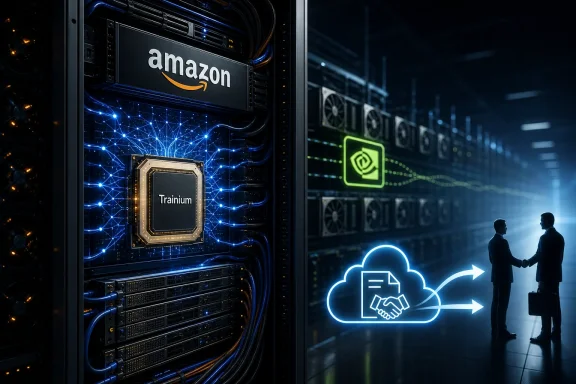
Amazon is reportedly exploring direct sales of its Trainium artificial intelligence chips to outside companies in June 2026, a move that would push AWS custom silicon beyond cloud rental and into more direct competition with Nvidia’s data center GPU empire. The important word is not “kill,” “crush,” or even “replace.” It is redirect. Amazon does not need to beat Nvidia at Nvidia’s own game to change where a meaningful slice of AI infrastructure money goes.
For most of the AI boom, the cleanest story in semiconductors was that Nvidia sold the picks and shovels while everyone else dug. Cloud providers bought GPUs, AI labs consumed them, enterprises rented them, and Nvidia’s CUDA ecosystem converted raw silicon into the default language of accelerated computing. That story is still true, but it is no longer complete.
Amazon’s custom-chip push is the logical response from a company that hates being structurally dependent on someone else’s margin. AWS has spent years building Graviton CPUs, Inferentia inference chips, and Trainium training accelerators because every workload it can run on its own silicon improves its economics. The customer sees lower prices or better availability; Amazon sees more control over supply, cost, and product differentiation.
The reported idea of selling Trainium chips to outside data center operators would be a shift in posture. Until now, Amazon’s chips have primarily been a way to make AWS more attractive. Direct sales would make Amazon look less like a cloud buyer optimizing its fleet and more like a semiconductor platform company choosing when to compete with its suppliers.
That distinction matters because Nvidia’s hyperscaler customers are not ordinary customers. They are the companies with the capital, data centers, software stacks, and customer relationships needed to turn custom silicon into a viable alternative. When the buyer becomes the rival, the market does not need a dramatic collapse to change; it only needs procurement decisions to bend gradually in a new direction.
That is why the “Amazon declares war on Nvidia” framing is emotionally satisfying but strategically imprecise. Wars imply symmetry. Amazon is not trying to become Nvidia overnight, and it does not need to win over every AI researcher, every model builder, or every independent hardware buyer.
Amazon’s more dangerous advantage is distribution. AWS is still the largest cloud infrastructure provider, and millions of customers already buy compute, storage, networking, databases, security tools, and managed AI services through Amazon’s console and contracts. If AWS can offer Trainium-backed instances that are cheaper, available sooner, or better integrated with Bedrock and adjacent services, many customers will never hold a chip-level bake-off at all.
That is the underappreciated threat. Nvidia’s moat is strongest when buyers are choosing hardware platforms directly. Amazon’s moat is strongest when buyers are choosing outcomes inside AWS.
Custom silicon changes that equation. When AWS runs a workload on Trainium rather than on Nvidia hardware, Amazon is not merely swapping components. It is pulling more of the economics into its own stack: the chip, the server design, the data center integration, the cloud service, the developer experience, and the customer contract.
This is why Amazon’s custom-chip business can be strategically important even if it never becomes a merchant semiconductor giant. A Trainium workload that stays inside AWS is already a win for Amazon if it lowers costs, improves capacity planning, or gives the company more pricing flexibility. Direct chip sales would expand the battlefield, but the core economic logic already exists.
For Nvidia, that does not mean an immediate revenue cliff. AI demand remains ravenous, and the world is still short of high-end accelerators. But it does mean that Nvidia’s largest customers have every incentive to prevent Nvidia from remaining the only tollbooth on the road to AI scale.
That is where Trainium can matter. If AWS can make Trainium attractive for specific training jobs, fine-tuning workloads, internal models, inference pipelines, or tightly managed services, it can peel demand away from Nvidia without needing to displace Nvidia at the frontier. The cloud market is large enough that partial substitution can still be a very big business.
Nvidia’s strongest position is at the high end: frontier training, GPU-dense clusters, mature software support, and workloads where CUDA compatibility is not optional. Amazon’s opportunity is broader and messier. It can compete where customers are less attached to hardware specifics and more interested in a monthly cloud bill that does not look like a sovereign wealth project.
That is why the AWS packaging model is so potent. A customer does not necessarily buy Trainium; it buys a managed AI service, an instance family, a model-hosting environment, or a cost-optimized path through Amazon’s ecosystem. The chip becomes invisible, and invisibility is one of the most powerful weapons in cloud computing.
Amazon cannot wish those costs away. It must make the developer experience good enough, the migration path tolerable enough, and the price-performance story compelling enough to justify the work. That is harder than taping a new accelerator into a rack and announcing savings.
But software moats erode differently in cloud than they do on premises. Customers often interact with abstractions, managed services, and APIs rather than bare metal. If AWS absorbs enough of the complexity, the customer’s switching burden falls. The more Amazon hides the hardware under Bedrock, SageMaker, managed clusters, and optimized frameworks, the less CUDA’s gravitational pull determines every decision.
This does not mean CUDA is doomed. It means the market is segmenting. Some workloads will remain Nvidia-first for years; others will become cloud-service-first, where the underlying accelerator is a procurement detail rather than a developer identity.
That matters in chips. Volume funds iteration. Internal deployment exposes real failure modes. Cloud workloads provide telemetry, operational discipline, and a direct path from silicon design to customer demand. Amazon can learn from its own fleet before asking the outside world to trust the product.
AWS also gives Amazon a built-in proving ground that most semiconductor startups can only dream about. If Trainium works well for Anthropic, OpenAI through AWS arrangements, Uber, or other large customers using AWS capacity, that is stronger evidence than a conference demo. The data center is the benchmark that matters.
The financial scale is equally important. Amazon’s operating cash flow gives it room to invest through long hardware cycles, absorb mistakes, and coordinate silicon with data center construction. Custom chips are not a weekend product experiment; they are a capital allocation philosophy.
That is a different kind of competition. AMD competes in a market where buyers compare hardware platforms, software maturity, supply commitments, and price. Amazon competes inside a cloud platform where it can blend hardware economics into service pricing and procurement bundles.
This does not make AMD irrelevant. AMD’s Instinct GPUs and EPYC CPUs remain important to any customer seeking alternatives to Nvidia, and competitive pressure from AMD helps prevent the AI accelerator market from becoming a one-company monarchy. But Amazon’s potential is more vertically integrated.
The bigger question is not whether Trainium beats AMD or Nvidia in a clean benchmark. It is whether hyperscalers can create enough internal alternatives that Nvidia’s pricing power gradually becomes less absolute. In that contest, Amazon, Google, Microsoft, and Meta are as important as the traditional chip vendors.
Cloud providers hate bottlenecks they cannot control. If GPUs are scarce, margins compress, customers wait, and roadmaps bend around someone else’s allocation decisions. Custom silicon is a hedge against that future, even when Nvidia remains essential.
Google has TPUs. Amazon has Trainium and Inferentia. Microsoft has Maia and other custom silicon efforts. Meta has its own accelerator work. None of these efforts needs to destroy Nvidia for the strategy to make sense. They only need to take enough internal demand off the open GPU market to improve negotiating leverage and service economics.
This is where the AI infrastructure buildout starts to look less like a single-vendor gold rush and more like the cloud market’s familiar pattern. Hyperscalers buy best-of-breed hardware when they must, design their own when scale justifies it, and expose the result through services that make the underlying components less visible over time.
That is not trivial. AWS can control the environment when Trainium lives inside its own data centers. External sales mean customers may want the chips in their own facilities, attached to their own networks, managed by their own teams, and integrated into their own software stacks. That is a different operational burden.
There is also a capacity question. If Trainium supply is already tight inside AWS, selling chips externally could create tension between two business models. Every chip sold to a third party is a chip not immediately available for AWS services unless Amazon and its manufacturing partners can expand supply fast enough.
The strategic payoff, however, could be large. Direct sales would let Amazon influence AI infrastructure beyond its own cloud footprint. It would also test whether Trainium is strong enough to stand as a product rather than merely as an AWS ingredient.
Most Windows-heavy enterprises will not buy raw Trainium chips. They will consume AI through SaaS tools, cloud services, copilots, data platforms, developer APIs, and internal applications hosted on infrastructure someone else operates. The chip battle will show up as line items, latency, regional capacity, service-level commitments, and vendor lock-in.
If Amazon succeeds, enterprise IT may get more leverage. A CIO comparing AI workloads across AWS, Azure, Google Cloud, and on-prem deployments could have more credible alternatives to Nvidia-backed capacity. That does not guarantee lower bills, but it improves the odds that cloud providers compete on price-performance rather than simply passing through GPU scarcity.
There is a catch. Custom silicon can reduce one kind of lock-in while strengthening another. A workload optimized for Trainium inside AWS may be cheaper today but harder to move tomorrow. Enterprises should treat cloud AI accelerators the same way they treat databases, identity services, and serverless platforms: powerful, useful, and sticky.
That can be good. A hyperscaler that controls more of the stack can patch, isolate, monitor, and optimize in ways that fragmented supply chains cannot. AWS has deep experience operating secure multi-tenant infrastructure at global scale, and custom silicon can be designed with cloud operational requirements in mind from the start.
But concentration also creates new questions. If a provider’s custom accelerator has a flaw, customers may have fewer independent mitigation paths. If tooling is proprietary, visibility may depend heavily on what the provider exposes. If workloads are optimized around one vendor’s AI stack, exit planning becomes more complicated during a security or compliance event.
The lesson is not to avoid Trainium or any other custom accelerator. It is to document dependencies before they become invisible. In cloud computing, the thing hidden behind the cleanest API is often the thing you later discover you cannot easily replace.
Nvidia also has a powerful response available. It can keep pushing performance, networking, systems integration, and software faster than rivals can catch up. It can deepen relationships with enterprises, sovereign AI projects, industrial customers, and neocloud providers that do not have Amazon’s internal silicon program.
The company’s position in networking and full-stack systems is especially important. Modern AI clusters are not just chips; they are racks, interconnects, memory, software, cooling, and deployment expertise. Nvidia has spent years turning the GPU into a data center platform, and that breadth is difficult to clone.
Still, Nvidia’s most important customers are no longer content to be customers only. That is the long-term pressure. Not collapse, not obsolescence, but bargaining power leaking away as hyperscalers build credible alternatives for more workloads.
A traditional chip company wins by selling more chips to more customers. A hyperscaler can win by using custom silicon internally, renting it through services, bundling it into managed platforms, or eventually selling it directly. Those options give Amazon strategic flexibility that most semiconductor challengers do not have.
For customers, that flexibility cuts both ways. It can mean lower costs and more capacity, but it can also mean deeper dependence on a single cloud architecture. The best enterprise strategy is not to chase every new accelerator headline; it is to understand which workloads are portable, which are cost-sensitive, and which are so strategically important that lock-in must be priced explicitly.
 Amazon Is Turning a Purchasing Problem Into a Platform Strategy
For most of the AI boom, the cleanest story in semiconductors was that Nvidia sold the picks and shovels while everyone else dug. Cloud providers bought GPUs, AI labs consumed them, enterprises rented them, and Nvidia’s CUDA ecosystem converted raw silicon into the default language of accelerated computing. That story is still true, but it is no longer complete.Amazon’s custom-chip push is the logical response from a company that hates being structurally dependent on someone else’s margin. AWS has spent years building Graviton CPUs, Inferentia inference chips, and Trainium training accelerators because every workload it can run on its own silicon improves its economics. The customer sees lower prices or better availability; Amazon sees more control over supply, cost, and product differentiation.
The reported idea of selling Trainium chips to outside data center operators would be a shift in posture. Until now, Amazon’s chips have primarily been a way to make AWS more attractive. Direct sales would make Amazon look less like a cloud buyer optimizing its fleet and more like a semiconductor platform company choosing when to compete with its suppliers.
That distinction matters because Nvidia’s hyperscaler customers are not ordinary customers. They are the companies with the capital, data centers, software stacks, and customer relationships needed to turn custom silicon into a viable alternative. When the buyer becomes the rival, the market does not need a dramatic collapse to change; it only needs procurement decisions to bend gradually in a new direction.
Nvidia Still Owns the Road, but Amazon Owns a Lot of the Traffic
Nvidia’s advantage remains formidable. Its data center revenue has reached a scale that would have seemed absurd before the generative AI boom, and its GPUs remain the default target for much of the AI software world. CUDA is not just a developer toolchain; it is years of accumulated habits, libraries, optimization work, and institutional comfort.That is why the “Amazon declares war on Nvidia” framing is emotionally satisfying but strategically imprecise. Wars imply symmetry. Amazon is not trying to become Nvidia overnight, and it does not need to win over every AI researcher, every model builder, or every independent hardware buyer.
Amazon’s more dangerous advantage is distribution. AWS is still the largest cloud infrastructure provider, and millions of customers already buy compute, storage, networking, databases, security tools, and managed AI services through Amazon’s console and contracts. If AWS can offer Trainium-backed instances that are cheaper, available sooner, or better integrated with Bedrock and adjacent services, many customers will never hold a chip-level bake-off at all.
That is the underappreciated threat. Nvidia’s moat is strongest when buyers are choosing hardware platforms directly. Amazon’s moat is strongest when buyers are choosing outcomes inside AWS.
The Real Competition Is Over the Margin Stack
The AI infrastructure market is often discussed as if it were only about chips, but the more important contest is over who captures the profit pool. Nvidia captures enormous value because its accelerators are scarce, performant, and deeply supported by software. Cloud providers then wrap those accelerators in services and sell them onward.Custom silicon changes that equation. When AWS runs a workload on Trainium rather than on Nvidia hardware, Amazon is not merely swapping components. It is pulling more of the economics into its own stack: the chip, the server design, the data center integration, the cloud service, the developer experience, and the customer contract.
This is why Amazon’s custom-chip business can be strategically important even if it never becomes a merchant semiconductor giant. A Trainium workload that stays inside AWS is already a win for Amazon if it lowers costs, improves capacity planning, or gives the company more pricing flexibility. Direct chip sales would expand the battlefield, but the core economic logic already exists.
For Nvidia, that does not mean an immediate revenue cliff. AI demand remains ravenous, and the world is still short of high-end accelerators. But it does mean that Nvidia’s largest customers have every incentive to prevent Nvidia from remaining the only tollbooth on the road to AI scale.
Trainium Does Not Have to Be Better Than Blackwell to Matter
One of the laziest mistakes in AI chip analysis is assuming the best accelerator wins every workload. In the real world, the winning platform is often the one that offers enough performance at the right price, availability, and integration point. Enterprises do not optimize for leaderboard purity; they optimize for budgets, deadlines, procurement risk, and operational familiarity.That is where Trainium can matter. If AWS can make Trainium attractive for specific training jobs, fine-tuning workloads, internal models, inference pipelines, or tightly managed services, it can peel demand away from Nvidia without needing to displace Nvidia at the frontier. The cloud market is large enough that partial substitution can still be a very big business.
Nvidia’s strongest position is at the high end: frontier training, GPU-dense clusters, mature software support, and workloads where CUDA compatibility is not optional. Amazon’s opportunity is broader and messier. It can compete where customers are less attached to hardware specifics and more interested in a monthly cloud bill that does not look like a sovereign wealth project.
That is why the AWS packaging model is so potent. A customer does not necessarily buy Trainium; it buys a managed AI service, an instance family, a model-hosting environment, or a cost-optimized path through Amazon’s ecosystem. The chip becomes invisible, and invisibility is one of the most powerful weapons in cloud computing.
The Software Moat Is Real, but It Is Not Absolute
Nvidia’s CUDA advantage is not marketing fluff. Developers have built around it for more than a decade, and AI frameworks, libraries, and performance assumptions have long favored Nvidia hardware. That creates switching costs that every rival must confront.Amazon cannot wish those costs away. It must make the developer experience good enough, the migration path tolerable enough, and the price-performance story compelling enough to justify the work. That is harder than taping a new accelerator into a rack and announcing savings.
But software moats erode differently in cloud than they do on premises. Customers often interact with abstractions, managed services, and APIs rather than bare metal. If AWS absorbs enough of the complexity, the customer’s switching burden falls. The more Amazon hides the hardware under Bedrock, SageMaker, managed clusters, and optimized frameworks, the less CUDA’s gravitational pull determines every decision.
This does not mean CUDA is doomed. It means the market is segmenting. Some workloads will remain Nvidia-first for years; others will become cloud-service-first, where the underlying accelerator is a procurement detail rather than a developer identity.
Amazon’s Scale Makes Its Silicon Experiment Unusually Dangerous
Plenty of companies have tried to challenge Nvidia. The graveyard is full of AI accelerators with impressive slides, narrow benchmarks, and insufficient ecosystems. Amazon is different because it can be its own first customer at enormous scale.That matters in chips. Volume funds iteration. Internal deployment exposes real failure modes. Cloud workloads provide telemetry, operational discipline, and a direct path from silicon design to customer demand. Amazon can learn from its own fleet before asking the outside world to trust the product.
AWS also gives Amazon a built-in proving ground that most semiconductor startups can only dream about. If Trainium works well for Anthropic, OpenAI through AWS arrangements, Uber, or other large customers using AWS capacity, that is stronger evidence than a conference demo. The data center is the benchmark that matters.
The financial scale is equally important. Amazon’s operating cash flow gives it room to invest through long hardware cycles, absorb mistakes, and coordinate silicon with data center construction. Custom chips are not a weekend product experiment; they are a capital allocation philosophy.
AMD Is Not the Main Character in This Fight
The 24/7 Wall St. framing says “Forget AMD,” and in one narrow sense, that is fair. AMD is a serious data center competitor, but the more consequential threat to Nvidia may come from customers who do not need to sell chips the traditional way. AMD has to win sockets. Amazon can win workloads.That is a different kind of competition. AMD competes in a market where buyers compare hardware platforms, software maturity, supply commitments, and price. Amazon competes inside a cloud platform where it can blend hardware economics into service pricing and procurement bundles.
This does not make AMD irrelevant. AMD’s Instinct GPUs and EPYC CPUs remain important to any customer seeking alternatives to Nvidia, and competitive pressure from AMD helps prevent the AI accelerator market from becoming a one-company monarchy. But Amazon’s potential is more vertically integrated.
The bigger question is not whether Trainium beats AMD or Nvidia in a clean benchmark. It is whether hyperscalers can create enough internal alternatives that Nvidia’s pricing power gradually becomes less absolute. In that contest, Amazon, Google, Microsoft, and Meta are as important as the traditional chip vendors.
The Hyperscalers Are Rewriting the Supplier Relationship
The AI boom has produced a strange inversion. Nvidia’s biggest customers helped make it one of the most valuable companies in the world, but those same customers are now aggressively funding ways to reduce their dependence on it. That is not betrayal; it is procurement logic.Cloud providers hate bottlenecks they cannot control. If GPUs are scarce, margins compress, customers wait, and roadmaps bend around someone else’s allocation decisions. Custom silicon is a hedge against that future, even when Nvidia remains essential.
Google has TPUs. Amazon has Trainium and Inferentia. Microsoft has Maia and other custom silicon efforts. Meta has its own accelerator work. None of these efforts needs to destroy Nvidia for the strategy to make sense. They only need to take enough internal demand off the open GPU market to improve negotiating leverage and service economics.
This is where the AI infrastructure buildout starts to look less like a single-vendor gold rush and more like the cloud market’s familiar pattern. Hyperscalers buy best-of-breed hardware when they must, design their own when scale justifies it, and expose the result through services that make the underlying components less visible over time.
Direct Chip Sales Would Be a Bigger Leap Than Cloud Instances
Selling Trainium outside AWS would be more than a revenue expansion. It would force Amazon to behave more like a hardware supplier, with all the unglamorous obligations that implies: support contracts, documentation, supply commitments, lifecycle planning, compatibility expectations, and customer-specific integration.That is not trivial. AWS can control the environment when Trainium lives inside its own data centers. External sales mean customers may want the chips in their own facilities, attached to their own networks, managed by their own teams, and integrated into their own software stacks. That is a different operational burden.
There is also a capacity question. If Trainium supply is already tight inside AWS, selling chips externally could create tension between two business models. Every chip sold to a third party is a chip not immediately available for AWS services unless Amazon and its manufacturing partners can expand supply fast enough.
The strategic payoff, however, could be large. Direct sales would let Amazon influence AI infrastructure beyond its own cloud footprint. It would also test whether Trainium is strong enough to stand as a product rather than merely as an AWS ingredient.
The Windows and Enterprise Angle Is Cost, Not Chip Tribalism
For WindowsForum readers, the practical question is not whether Trainium is cooler than an H100, B200, or whatever Nvidia ships next. It is whether the AI services your organization uses will become cheaper, more available, and less locked to one supplier’s economics.Most Windows-heavy enterprises will not buy raw Trainium chips. They will consume AI through SaaS tools, cloud services, copilots, data platforms, developer APIs, and internal applications hosted on infrastructure someone else operates. The chip battle will show up as line items, latency, regional capacity, service-level commitments, and vendor lock-in.
If Amazon succeeds, enterprise IT may get more leverage. A CIO comparing AI workloads across AWS, Azure, Google Cloud, and on-prem deployments could have more credible alternatives to Nvidia-backed capacity. That does not guarantee lower bills, but it improves the odds that cloud providers compete on price-performance rather than simply passing through GPU scarcity.
There is a catch. Custom silicon can reduce one kind of lock-in while strengthening another. A workload optimized for Trainium inside AWS may be cheaper today but harder to move tomorrow. Enterprises should treat cloud AI accelerators the same way they treat databases, identity services, and serverless platforms: powerful, useful, and sticky.
Security Teams Should Watch the Supply Chain, Not Just the Model
AI infrastructure is now part of the enterprise attack surface. That includes model behavior, data governance, access control, and the hardware-software stack underneath. As cloud providers design more of their own silicon, the trust model shifts from traditional chip vendors toward vertically integrated platforms.That can be good. A hyperscaler that controls more of the stack can patch, isolate, monitor, and optimize in ways that fragmented supply chains cannot. AWS has deep experience operating secure multi-tenant infrastructure at global scale, and custom silicon can be designed with cloud operational requirements in mind from the start.
But concentration also creates new questions. If a provider’s custom accelerator has a flaw, customers may have fewer independent mitigation paths. If tooling is proprietary, visibility may depend heavily on what the provider exposes. If workloads are optimized around one vendor’s AI stack, exit planning becomes more complicated during a security or compliance event.
The lesson is not to avoid Trainium or any other custom accelerator. It is to document dependencies before they become invisible. In cloud computing, the thing hidden behind the cleanest API is often the thing you later discover you cannot easily replace.
Nvidia’s Best Defense Is That the Market Is Still Growing Faster Than the Threat
The case against panic is straightforward: demand for AI compute remains enormous. Even if Amazon shifts more workloads to Trainium, Nvidia can continue growing if the overall market expands fast enough. The AI buildout is not a zero-sum game yet.Nvidia also has a powerful response available. It can keep pushing performance, networking, systems integration, and software faster than rivals can catch up. It can deepen relationships with enterprises, sovereign AI projects, industrial customers, and neocloud providers that do not have Amazon’s internal silicon program.
The company’s position in networking and full-stack systems is especially important. Modern AI clusters are not just chips; they are racks, interconnects, memory, software, cooling, and deployment expertise. Nvidia has spent years turning the GPU into a data center platform, and that breadth is difficult to clone.
Still, Nvidia’s most important customers are no longer content to be customers only. That is the long-term pressure. Not collapse, not obsolescence, but bargaining power leaking away as hyperscalers build credible alternatives for more workloads.
Amazon’s Trainium Gambit Turns the AI Boom Into a Cloud Lock-In Test
The most concrete lesson from Amazon’s reported move is that the AI chip market is becoming less like the PC component market and more like the cloud market. The buyer, builder, operator, and seller can all be the same company. That makes old comparisons less useful.A traditional chip company wins by selling more chips to more customers. A hyperscaler can win by using custom silicon internally, renting it through services, bundling it into managed platforms, or eventually selling it directly. Those options give Amazon strategic flexibility that most semiconductor challengers do not have.
For customers, that flexibility cuts both ways. It can mean lower costs and more capacity, but it can also mean deeper dependence on a single cloud architecture. The best enterprise strategy is not to chase every new accelerator headline; it is to understand which workloads are portable, which are cost-sensitive, and which are so strategically important that lock-in must be priced explicitly.
- Amazon’s reported Trainium sales push matters because it would move AWS custom silicon from an internal cloud advantage toward a direct challenge in AI infrastructure.
- Nvidia remains the dominant AI accelerator vendor because of performance, supply scale, networking, and the CUDA software ecosystem.
- Amazon does not need Trainium to outperform Nvidia across the board; it needs enough performance at a lower total cost for specific AWS workloads.
- Enterprises should expect the chip war to appear through cloud pricing, availability, managed AI services, and migration constraints rather than through hardware purchasing alone.
- The biggest strategic shift is that Nvidia’s largest customers are increasingly building alternatives that improve their negotiating leverage.
- Custom silicon may reduce dependence on Nvidia while increasing dependence on AWS, so portability and exit planning should be part of any serious AI architecture review.
References
- Primary source: 24/7 Wall St.
Published: Fri, 19 Jun 2026 15:32:29 GMT
Forget AMD: Amazon Declares War on Nvidia by Selling Its Own AI Chips - 24/7 Wall St.
The artificial intelligence boom has triggered one of the largest infrastructure buildouts in technology history. The largest cloud providers are on pace to spend more than $750 billion on AI infrastructure this year alone. For years, much of that spending flowed directly to Nvidia (NASDAQ:NVDA...247wallst.com - Related coverage: investor.nvidia.com
NVIDIA Corporation - NVIDIA Announces Financial Results for Fourth Quarter and Fiscal 2026
Record quarterly revenue of $68.1 billion, up 20% from Q3 and up 73% from a year ago Record quarterly Data Center revenue of $62.3 billion, up 22% from Q3 and up 75% from a year ago Record full-year revenue of $215.9 billion, up 65% SANTA CLARA, Calif., Feb. 25, 2026 (GLOBE NEWSWIRE) - NVIDIA...investor.nvidia.com - Related coverage: businessreport.com
Amazon weighs direct sales of AI chips in challenge to Nvidia’s dominance
Amazon is exploring a major expansion of its artificial intelligence chip business by considering direct sales of its custom AI processors to outside companies, Bloomberg reports. The initiative centers on Trainium, a family of chips designed to provide a lower-cost alternative to Nvidia’s... www.businessreport.com
- Related coverage: techcrunch.com
Amazon hopes to challenge Nvidia more directly by selling its AI chips | TechCrunch
AWS is in talks to sell its chips to other data centers. CEO Andy Jassy has said this represents a $50 billion opportunity for the company.techcrunch.com - Related coverage: investing.com
- Related coverage: ciotechoutlook.com
Amazon Eyes AI Chip Sales to Rival Nvidia
Amazon is exploring external sales of its Trainium AI chips, positioning itself as a direct competitor to Nvidia.www.ciotechoutlook.com
- Related coverage: briefs.co
Amazon Talks to Sell Trainium AI Chips Outside AWS
AWS is in early talks to sell its Trainium chips to outside firms for the first time, a move CEO Andy Jassy says could generate $50 billion a year.www.briefs.co - Related coverage: savedelete.com
Amazon Takes On Nvidia: Selling Its Trainium AI Chips Directly (2026) | SaveDelete
Amazon is in talks to sell its Trainium3 AI chips directly to other companies — challenging Nvidia. The specs, the $225B backlog, and why it matters.savedelete.com - Related coverage: ng.investing.com
Marvell surged 7% Thursday as Amazon plans to sell Trainium chips externally By Investing.com
Marvell surged 7% Thursday as Amazon plans to sell Trainium chips externallyng.investing.com
- Related coverage: es.investing.com
Amazon explora la venta de chips de IA para desafiar a Nvidia Por Investing.com
Amazon explora la venta de chips de IA para desafiar a Nvidiaes.investing.com - Related coverage: autogpt.net
- Related coverage: shopifreaks.com
Amazon's Andy Jassy says the company may sell Trainium chips to outside customers, putting the business at $50B in annual revenue
Amazon CEO Andy Jassy said in his annual shareholder letter that the company may begin selling its Trainium AI chips directly to outside buyers, which would push the chip business from its current $20B annual run rate to an estimated $50B if sold on the open market the way standalone chipmakers...www.shopifreaks.com - Related coverage: finance.yahoo.com
Amazon may sell Trainium AI chips to third parties in shot at Nvidia
The chip business, which carries a $20 billion annual run rate, would reach $50 billion if sold on the open market, CEO Andy Jassy saidfinance.yahoo.com - Related coverage: pcgamer.com
Nvidia reports a truly astonishing $193.7 billion in annual data center revenue in its latest earnings call, up 75% year on year, while little old gaming brought in $16 billion | PC Gamer
I think it's obvious why us gamers are perhaps not team green's top priority right now.www.pcgamer.com - Related coverage: cincodias.elpais.com
Amazon negocia la venta de sus chips de IA para competir con Nvidia | Empresas | Cinco Días
La empresa de Jeff Bezos busca desarrollar sus propias alternativas y la expansión de Trainium, aunque no ha revelado el nombre de los potenciales futuros clientescincodias.elpais.com - Related coverage: tomshardware.com
Nvidia posts $46 billion revenue in another record quarter — Data center and gaming GPU sales break records | Tom's Hardware
More Blackwells, more money.www.tomshardware.com - Related coverage: time.com
Inside Amazon’s Race to Beat OpenAI’s ‘Stargate’ Project
Amazon and Anthropic are racing to build the world’s largest AI datacenters, to challenge OpenAI and Microsoft’s $100 billion ‘Stargate.'time.com - Related coverage: nvidianews.nvidia.com
- Related coverage: s2.q4cdn.com
- Related coverage: savest-financial.com
