
Malta’s Public Service presented ten awards on June 21, 2026, at Verdala Castle under President Myriam Spiteri Debono’s patronage, recognising public-sector teams and individuals including a government Microsoft Copilot rollout team, Transport Malta, Enemalta, FSWS, Aġenzija Appoġġ, and the Ministry for Gozo. The ceremony was framed as a celebration of competence and service, but the more interesting story is what the award list says about the modern state. Public administration is no longer judged only by punctual counters, clean streets, and resolved permits; it is increasingly judged by whether it can absorb digital tools, climate infrastructure, social need, and public accountability without losing the human purpose of government. For WindowsForum readers, the Copilot award is the hook, but the broader lesson is about how public-sector IT is becoming the operating system of civic trust.
Awards ceremonies are usually built to flatter institutions, and public-sector ceremonies are especially vulnerable to the warm bath of official language. There is always talk of dedication, service, professionalism, and citizens. Much of it is deserved, but much of it can also blur into a civic wallpaper that hides the machinery underneath.
This event was different because of the range of work being recognised. The awards did not cluster around a single ministry, a single policy theme, or a single kind of public-sector success. They stretched from healthcare funding to transport governance, from public cleansing to social welfare, from school sport to energy distribution, from Gozo infrastructure to artificial intelligence on government devices.
That spread matters. It suggests a public service trying to define excellence not as one grand reform but as a portfolio of operational wins. In a small state such as Malta, where citizens encounter public administration at close range, that operational layer is where trust is either renewed or corroded.
Head of the Public Service Tony Sultana put the emphasis on officers who go beyond what is expected of them. President Myriam Spiteri Debono placed the same work inside a constitutional frame: competence, impartiality, loyalty to democratic principles, ethics, transparency, and accountability. The two messages belong together. A state that wants to move fast needs able people; a state that wants legitimacy needs those people to remain bounded by public duty.
The award list therefore reads less like a roll call and more like a diagnostic scan. It shows where government now feels pressure to perform: digital adoption, climate adaptation, social protection, inclusion, service quality, infrastructure delivery, and crisis response. That is the real news hidden inside a ceremonial story.
Copilot deployments in government are not the same as giving staff a new browser or productivity app. They touch the nervous system of the organisation: identity, document permissions, retention, audit, sensitivity labels, search hygiene, and user behaviour. If the deployment is careless, the assistant becomes a mirror reflecting every over-permissioned SharePoint site and forgotten file share. If it is disciplined, it can become a controlled interface for reducing friction in day-to-day public work.
That is why the award is interesting. It does not necessarily prove that Malta has solved every governance challenge around generative AI. Awards rarely prove that. But it does indicate that the rollout has been significant enough, visible enough, and institutionally valued enough to be treated as a model of digital service delivery.
For IT pros, the phrasing “on devices used by public officers” is also telling. This is not just about a cloud service subscription. It points to the endpoint as the practical front door of AI adoption. Copilot may live across Microsoft 365, the web, Edge, Windows, Teams, Outlook, Word, and admin-controlled experiences, but users meet it through the machine in front of them. That makes device management, app pinning, policy configuration, browser controls, and identity enforcement part of the AI story.
The lesson is blunt: public-sector AI adoption is not a strategy deck. It is a managed Windows estate.
That may sound less dramatic, but it is precisely why it matters. Public administrations run on documents, meetings, correspondence, case notes, spreadsheets, minutes, policy drafts, and internal knowledge that is scattered across years of accumulated process. A tool that changes how officers handle that information changes the tempo of government.
The danger is that “efficiency” becomes a magic word. Governments are always tempted to describe technology as a way to do more with less, and vendors are always eager to supply the vocabulary. But in public service, the standard cannot be productivity alone. The standard is whether productivity gains preserve fairness, explainability, confidentiality, and the citizen’s right to be treated as more than a ticket in a queue.
That is why President Spiteri Debono’s emphasis on ethics and accountability is not ceremonial garnish. It is the governance boundary around the Copilot story. AI in public administration must be useful, but it must also be reviewable. It must accelerate work without creating untraceable authority.
Microsoft’s own enterprise positioning for Copilot leans heavily on existing Microsoft 365 protections, including identity, permissions, compliance, and data protection commitments. Those controls are necessary, but they are not self-executing. The admin has to configure them. The organisation has to clean up access. Managers have to decide where AI-generated content is acceptable, where human review is mandatory, and where the tool should not be used at all.
This is where the award points beyond Malta. Every government now considering Copilot faces the same problem: the technology is only as mature as the tenant it enters.
Transport is where citizens see the state in motion, sometimes literally stuck in traffic. It is also where governance, infrastructure, emissions, logistics, safety, planning, and enforcement collide. When a transport authority is recognised both for governance and for a climate-related infrastructure project, the message is that modern administration has to make policy real at street level and port level.
The Shore-to-Ship Project is particularly significant because it represents the less glamorous side of climate work. Climate policy is often discussed through targets, speeches, and national commitments. Shore-to-ship power is infrastructure: cables, berths, electrical capacity, port operations, ships, standards, and coordination. It is climate policy made physical.
That matters for IT and systems people because infrastructure projects increasingly depend on data and control systems. Energy supply, port management, emissions monitoring, scheduling, billing, compliance, and operational safety all require digital layers. The future of “green” public works is not just concrete and steel; it is software, telemetry, cybersecurity, and maintenance.
The governance award reinforces the same point from another angle. Good governance is not only about avoiding scandal. It is about building processes that survive scrutiny, scale with demand, and produce decisions that can be explained. In digital government, those processes increasingly live inside systems rather than binders.
Quality in that context is a hard achievement because it usually means fewer errors, clearer processes, better coordination, and more reliable outcomes. These are not easy wins to photograph. They rarely produce ribbon-cutting moments. But they are the kind of administrative gains citizens feel when a system works without forcing them to understand its internal wiring.
There is also a digital-government lesson here. Healthcare funding systems tend to be data-heavy, privacy-sensitive, and process-bound. They are exactly the sort of environment where automation and analytics can help, but also where mistakes can be consequential. Any modernisation in this area has to respect the difference between administrative speed and administrative justice.
That distinction will become sharper as AI tools move deeper into back-office functions. Summarising a policy document is one thing. Supporting decisions that affect care, payments, or eligibility is another. The quality award belongs in the same conversation as the Copilot award because both point to the same future: government work becoming more data-driven while the obligation to be fair remains stubbornly human.
Public cleansing and maintenance are among the most visible forms of government work. They are also easy to undervalue because their success is often noticed only when they fail. Clean public spaces, maintained facilities, and responsive field operations create the baseline conditions for dignity in shared civic life.
An inclusion award in that area hints at something broader than operational tidiness. It suggests attention to how public services are organised, who is employed, who is served, and whether the public realm is maintained in a way that includes rather than neglects. Inclusion is not only a social-programme word. It is a design principle for the state’s most ordinary functions.
The joint recognition for FSWS and Aġenzija Appoġġ moves the story into the realm of social care. Here, administrative systems are inseparable from trust. Citizens who seek support are often navigating stress, family breakdown, poverty, disability, abuse, or other forms of vulnerability. A responsive agency can be life-changing; a fragmented one can deepen harm.
This is where technology must be judged carefully. Digital tools can help social workers and agencies coordinate, record, triage, and follow up. They can also create distance if they are used to substitute process for judgment. The public service challenge is to let systems carry administrative weight while keeping empathy and professional discretion at the centre.
Public-service awards can sometimes over-personalise systemic work, implying that excellence depends on heroic individuals rather than well-designed organisations. That is a risk. A healthy public administration should not require heroism to function. Citizens should not have to hope their case lands on the desk of an unusually dedicated officer.
But role-model awards still have value when they illuminate the behaviours the institution wants to reproduce. Dedication, compassion, initiative, and voluntary public spirit are not easily captured in a dashboard. If the state wants those qualities, it has to name them and reward them.
The link to Puttinu Cares also broadens the boundary between public service and civil society. Modern governance rarely happens inside government alone. It depends on charities, volunteers, community organisations, professional networks, and informal systems of support. Recognising public officers for work connected to that ecosystem acknowledges that civic value often crosses institutional lines.
A swimming pool is infrastructure, but it is also health policy, youth policy, accessibility policy, and regional equity policy. In Gozo, the project carries the added weight of geography. Island communities often experience public investment through the lens of whether services and facilities are concentrated elsewhere. A major sports facility can therefore become a statement about inclusion between regions, not just a recreational asset.
The Malta School Games recognition works at a different scale. Organising school sport is logistics-heavy work involving venues, transport, schools, schedules, safety, communication, and participation. When done well, it disappears into the experience of students competing, teachers coordinating, and families watching. When done badly, everyone notices.
These awards show public service as an enabling layer. The state is not only a regulator or payer; it is an organiser of common experiences. That function is deeply practical, and it increasingly depends on competent coordination across systems, teams, and calendars.
The digital angle is quieter here but still present. Any large school sports programme now relies on data management, communications platforms, scheduling tools, consent processes, and sometimes live results or media workflows. The civic experience may be physical, but the operational backbone is digital.
For WindowsForum’s audience, there is a direct systems lesson here. Power distribution, like IT infrastructure, is judged by uptime, recovery, capacity planning, maintenance, and incident response. Nobody praises the network when it is stable. Everyone notices the outage.
The comparison is not superficial. Energy grids and digital networks are increasingly intertwined. Offices, hospitals, transport systems, schools, data centres, payment systems, home routers, mobile networks, and public services all depend on reliable electricity. At the same time, grid operations depend on communications, sensors, control systems, and cybersecurity.
Recognising a distribution team therefore reinforces a theme running through the entire ceremony: public service excellence is often operational resilience. It is the capacity to absorb stress, respond to incidents, and keep essential systems working. That is not glamorous, but it is foundational.
This is also why governments should be careful when they celebrate innovation. Innovation gets the headlines, but resilience keeps the country running. The best public administrations know they need both.
The Copilot rollout makes this explicit. Once AI assistance is placed on public officers’ devices, it becomes part of the working environment. It shapes how information is found, how drafts are produced, how meetings are digested, how emails are handled, and how staff interact with institutional memory. That is a platform change, not a mere app launch.
But the same logic applies elsewhere. Shore-to-ship infrastructure turns ports into cleaner energy interfaces. Healthcare funding systems turn administrative quality into a condition of care. Social welfare coordination turns agency capacity into human support. School games and sports facilities turn public organisation into civic participation. Energy distribution turns maintenance and response into national resilience.
A platform state has advantages. It can reuse capabilities, standardise processes, improve measurement, and scale reforms across departments. It can make public service less dependent on heroic improvisation and more dependent on well-run systems. That is the optimistic view.
The risk is that platform thinking can become dehumanising if the citizen disappears into workflows. The ceremony’s language about dignity and respect is therefore not decorative. It is the necessary counterweight to administrative modernisation. A state can be digital, efficient, and still alienating if it forgets that the endpoint is not the device but the person seeking service.
For years, many organisations tolerated messy collaboration environments because the consequences were manageable. Search results were annoying, old files lingered, access groups multiplied, and sensitive documents sometimes had broader permissions than intended. Generative AI changes the risk profile because it can surface, summarise, and recombine information faster than traditional search.
In a public service, that is not just an IT concern. It is a governance concern. If an officer receives an AI-generated answer based on stale guidance, excessive access, or poorly labelled material, the error can travel into real administrative work. If sensitive information is exposed to the wrong internal audience, the harm is not theoretical.
This does not mean governments should avoid Copilot. It means they should treat deployment as a forcing function for data governance. The hard work is not merely enabling the feature. The hard work is preparing the environment, training users, setting boundaries, monitoring use, and correcting the underlying information architecture.
The award recognises the rollout team, but the next phase is likely to be less visible and more important. Success will be measured by adoption, yes, but also by whether the public service can build a disciplined AI culture around the tool. In enterprise IT, the launch day is often the easy part.
That is a heavy expectation. It also reflects the reality of government in 2026. Citizens do not experience public administration in neat categories. A family may need healthcare support, social services, transport access, school participation, clean public spaces, and reliable electricity in the same month. The quality of the state is the sum of those interactions.
This is why awards for public service are more than internal morale exercises. They signal what the institution thinks excellence looks like. In this case, excellence appears to mean practical delivery under public values: digital transformation without abandoning accountability, infrastructure with climate purpose, social support with dignity, and operations that hold under pressure.
There is a lesson here for larger countries too. Scale changes the politics but not the fundamentals. Whether a government serves hundreds of thousands or hundreds of millions, the credibility of reform rests on implementation. Citizens rarely judge transformation by strategy documents. They judge it by whether services work.
The Maltese ceremony therefore lands at an interesting moment. Governments everywhere are trying to absorb AI while coping with climate obligations, infrastructure demands, social pressure, and trust deficits. Malta’s award list is local, but the pattern is global.
That is a useful signal, especially because government technology tends to be judged in extremes. Either it is sold as a revolution or condemned as another layer of bureaucracy. The truth is usually more incremental. A Copilot deployment here, a port electrification project there, a better funding department, a stronger distribution team, a more inclusive maintenance division: this is how the state actually changes.
The question for Malta’s Public Service after Verdala Castle is whether these awards become trophies on a shelf or templates for the next phase of reform. Copilot will test data discipline, climate projects will test execution, social agencies will test compassion under load, and essential-service teams will test resilience when conditions turn ugly. If the institution can connect those lessons rather than celebrate them in isolation, the 2026 awards may be remembered less as a ceremony than as an early snapshot of a public service learning how to operate in the AI-and-infrastructure age.
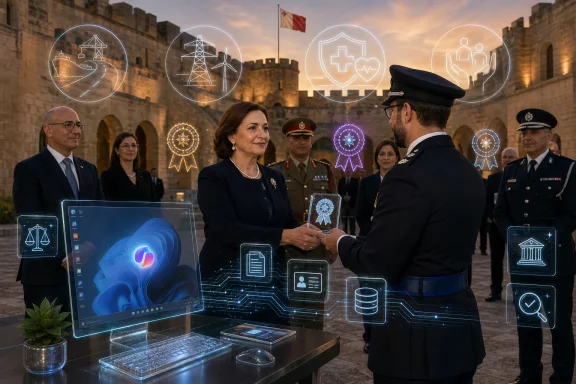 Malta Turns a Prize Ceremony Into a Map of the Modern State
Awards ceremonies are usually built to flatter institutions, and public-sector ceremonies are especially vulnerable to the warm bath of official language. There is always talk of dedication, service, professionalism, and citizens. Much of it is deserved, but much of it can also blur into a civic wallpaper that hides the machinery underneath.This event was different because of the range of work being recognised. The awards did not cluster around a single ministry, a single policy theme, or a single kind of public-sector success. They stretched from healthcare funding to transport governance, from public cleansing to social welfare, from school sport to energy distribution, from Gozo infrastructure to artificial intelligence on government devices.
That spread matters. It suggests a public service trying to define excellence not as one grand reform but as a portfolio of operational wins. In a small state such as Malta, where citizens encounter public administration at close range, that operational layer is where trust is either renewed or corroded.
Head of the Public Service Tony Sultana put the emphasis on officers who go beyond what is expected of them. President Myriam Spiteri Debono placed the same work inside a constitutional frame: competence, impartiality, loyalty to democratic principles, ethics, transparency, and accountability. The two messages belong together. A state that wants to move fast needs able people; a state that wants legitimacy needs those people to remain bounded by public duty.
The award list therefore reads less like a roll call and more like a diagnostic scan. It shows where government now feels pressure to perform: digital adoption, climate adaptation, social protection, inclusion, service quality, infrastructure delivery, and crisis response. That is the real news hidden inside a ceremonial story.
The Copilot Award Is the Signal Windows Administrators Should Notice
The Best Digital Solution Award went to the team responsible for rolling out Microsoft Copilot on devices used by public officers. That single line will catch the eye of anyone managing Windows endpoints, Microsoft 365 tenants, identity policy, data governance, or user training. It turns what might have been an internal IT project into a public symbol of administrative modernisation.Copilot deployments in government are not the same as giving staff a new browser or productivity app. They touch the nervous system of the organisation: identity, document permissions, retention, audit, sensitivity labels, search hygiene, and user behaviour. If the deployment is careless, the assistant becomes a mirror reflecting every over-permissioned SharePoint site and forgotten file share. If it is disciplined, it can become a controlled interface for reducing friction in day-to-day public work.
That is why the award is interesting. It does not necessarily prove that Malta has solved every governance challenge around generative AI. Awards rarely prove that. But it does indicate that the rollout has been significant enough, visible enough, and institutionally valued enough to be treated as a model of digital service delivery.
For IT pros, the phrasing “on devices used by public officers” is also telling. This is not just about a cloud service subscription. It points to the endpoint as the practical front door of AI adoption. Copilot may live across Microsoft 365, the web, Edge, Windows, Teams, Outlook, Word, and admin-controlled experiences, but users meet it through the machine in front of them. That makes device management, app pinning, policy configuration, browser controls, and identity enforcement part of the AI story.
The lesson is blunt: public-sector AI adoption is not a strategy deck. It is a managed Windows estate.
Generative AI Enters Government Through the Boring Door
The popular story of AI in government often imagines chatbots answering citizens, algorithms allocating services, or predictive systems changing policy. The safer and more plausible first wave is more mundane. It is staff using AI to summarize, draft, search, classify, compare, and navigate institutional knowledge.That may sound less dramatic, but it is precisely why it matters. Public administrations run on documents, meetings, correspondence, case notes, spreadsheets, minutes, policy drafts, and internal knowledge that is scattered across years of accumulated process. A tool that changes how officers handle that information changes the tempo of government.
The danger is that “efficiency” becomes a magic word. Governments are always tempted to describe technology as a way to do more with less, and vendors are always eager to supply the vocabulary. But in public service, the standard cannot be productivity alone. The standard is whether productivity gains preserve fairness, explainability, confidentiality, and the citizen’s right to be treated as more than a ticket in a queue.
That is why President Spiteri Debono’s emphasis on ethics and accountability is not ceremonial garnish. It is the governance boundary around the Copilot story. AI in public administration must be useful, but it must also be reviewable. It must accelerate work without creating untraceable authority.
Microsoft’s own enterprise positioning for Copilot leans heavily on existing Microsoft 365 protections, including identity, permissions, compliance, and data protection commitments. Those controls are necessary, but they are not self-executing. The admin has to configure them. The organisation has to clean up access. Managers have to decide where AI-generated content is acceptable, where human review is mandatory, and where the tool should not be used at all.
This is where the award points beyond Malta. Every government now considering Copilot faces the same problem: the technology is only as mature as the tenant it enters.
Transport Malta’s Two Awards Show Governance and Climate Are Now Operational Problems
Transport Malta appears twice in the award list. It received the Best Practice in Good Governance Award, and it was part of the Shore-to-Ship Project with Infrastructure Malta, which received the Climate Impact Award. That pairing is not accidental in any meaningful civic sense, even if the awards were selected independently.Transport is where citizens see the state in motion, sometimes literally stuck in traffic. It is also where governance, infrastructure, emissions, logistics, safety, planning, and enforcement collide. When a transport authority is recognised both for governance and for a climate-related infrastructure project, the message is that modern administration has to make policy real at street level and port level.
The Shore-to-Ship Project is particularly significant because it represents the less glamorous side of climate work. Climate policy is often discussed through targets, speeches, and national commitments. Shore-to-ship power is infrastructure: cables, berths, electrical capacity, port operations, ships, standards, and coordination. It is climate policy made physical.
That matters for IT and systems people because infrastructure projects increasingly depend on data and control systems. Energy supply, port management, emissions monitoring, scheduling, billing, compliance, and operational safety all require digital layers. The future of “green” public works is not just concrete and steel; it is software, telemetry, cybersecurity, and maintenance.
The governance award reinforces the same point from another angle. Good governance is not only about avoiding scandal. It is about building processes that survive scrutiny, scale with demand, and produce decisions that can be explained. In digital government, those processes increasingly live inside systems rather than binders.
Healthcare Funding Wins the Quality Argument
The Healthcare Funding Department received the Quality Award, a category that sounds modest until one remembers how much public confidence depends on healthcare administration. Funding is not the bedside face of medicine, but it shapes access, timeliness, reimbursement, procurement, eligibility, and planning. It is one of the places where bureaucracy can either support care or become another source of anxiety.Quality in that context is a hard achievement because it usually means fewer errors, clearer processes, better coordination, and more reliable outcomes. These are not easy wins to photograph. They rarely produce ribbon-cutting moments. But they are the kind of administrative gains citizens feel when a system works without forcing them to understand its internal wiring.
There is also a digital-government lesson here. Healthcare funding systems tend to be data-heavy, privacy-sensitive, and process-bound. They are exactly the sort of environment where automation and analytics can help, but also where mistakes can be consequential. Any modernisation in this area has to respect the difference between administrative speed and administrative justice.
That distinction will become sharper as AI tools move deeper into back-office functions. Summarising a policy document is one thing. Supporting decisions that affect care, payments, or eligibility is another. The quality award belongs in the same conversation as the Copilot award because both point to the same future: government work becoming more data-driven while the obligation to be fair remains stubbornly human.
Inclusion and Social Responsibility Keep the Human Case at the Centre
The Inclusion Award went to the Public Cleansing and Maintenance Division, while the Inspiring Social Responsibility Award was jointly awarded to the Foundation for Social Welfare Services and Aġenzija Appoġġ. These recognitions prevent the ceremony from becoming a narrow celebration of systems, platforms, and projects. They remind us that public service is judged most harshly where citizens are vulnerable, excluded, or dependent on the reliability of everyday services.Public cleansing and maintenance are among the most visible forms of government work. They are also easy to undervalue because their success is often noticed only when they fail. Clean public spaces, maintained facilities, and responsive field operations create the baseline conditions for dignity in shared civic life.
An inclusion award in that area hints at something broader than operational tidiness. It suggests attention to how public services are organised, who is employed, who is served, and whether the public realm is maintained in a way that includes rather than neglects. Inclusion is not only a social-programme word. It is a design principle for the state’s most ordinary functions.
The joint recognition for FSWS and Aġenzija Appoġġ moves the story into the realm of social care. Here, administrative systems are inseparable from trust. Citizens who seek support are often navigating stress, family breakdown, poverty, disability, abuse, or other forms of vulnerability. A responsive agency can be life-changing; a fragmented one can deepen harm.
This is where technology must be judged carefully. Digital tools can help social workers and agencies coordinate, record, triage, and follow up. They can also create distance if they are used to substitute process for judgment. The public service challenge is to let systems carry administrative weight while keeping empathy and professional discretion at the centre.
Role Models Make the Institution Personal
The Role Model Award was presented to Angele Cushieri and Rennie Tanti for their work and dedication to Puttinu Cares. In a list dominated by departments, authorities, divisions, agencies, and project teams, the individual recognition matters. Institutions need exemplars because culture does not move only through policy; it moves through people others can recognise and imitate.Public-service awards can sometimes over-personalise systemic work, implying that excellence depends on heroic individuals rather than well-designed organisations. That is a risk. A healthy public administration should not require heroism to function. Citizens should not have to hope their case lands on the desk of an unusually dedicated officer.
But role-model awards still have value when they illuminate the behaviours the institution wants to reproduce. Dedication, compassion, initiative, and voluntary public spirit are not easily captured in a dashboard. If the state wants those qualities, it has to name them and reward them.
The link to Puttinu Cares also broadens the boundary between public service and civil society. Modern governance rarely happens inside government alone. It depends on charities, volunteers, community organisations, professional networks, and informal systems of support. Recognising public officers for work connected to that ecosystem acknowledges that civic value often crosses institutional lines.
Gozo’s Pool and Malta’s School Games Make Infrastructure Social
The Project of the Year Award went to the Ministry for Gozo for the Gozo swimming pool project, while the Team Recognition Award went to the organisers of the Malta School Games. Both awards sit in the part of public administration that is easy to dismiss as “nice to have” until one considers what sport and shared facilities do for a community.A swimming pool is infrastructure, but it is also health policy, youth policy, accessibility policy, and regional equity policy. In Gozo, the project carries the added weight of geography. Island communities often experience public investment through the lens of whether services and facilities are concentrated elsewhere. A major sports facility can therefore become a statement about inclusion between regions, not just a recreational asset.
The Malta School Games recognition works at a different scale. Organising school sport is logistics-heavy work involving venues, transport, schools, schedules, safety, communication, and participation. When done well, it disappears into the experience of students competing, teachers coordinating, and families watching. When done badly, everyone notices.
These awards show public service as an enabling layer. The state is not only a regulator or payer; it is an organiser of common experiences. That function is deeply practical, and it increasingly depends on competent coordination across systems, teams, and calendars.
The digital angle is quieter here but still present. Any large school sports programme now relies on data management, communications platforms, scheduling tools, consent processes, and sometimes live results or media workflows. The civic experience may be physical, but the operational backbone is digital.
Enemalta’s Distribution Team Reminds Everyone That Resilience Is a Public Service
The Outstanding Effort Award went to Enemalta’s distribution team for exceptional contribution. This is the kind of recognition that usually follows difficult work under pressure, and energy distribution is one of those public-facing systems that becomes visible when it fails. Electricity is not simply a commodity in modern life; it is the prerequisite for everything else.For WindowsForum’s audience, there is a direct systems lesson here. Power distribution, like IT infrastructure, is judged by uptime, recovery, capacity planning, maintenance, and incident response. Nobody praises the network when it is stable. Everyone notices the outage.
The comparison is not superficial. Energy grids and digital networks are increasingly intertwined. Offices, hospitals, transport systems, schools, data centres, payment systems, home routers, mobile networks, and public services all depend on reliable electricity. At the same time, grid operations depend on communications, sensors, control systems, and cybersecurity.
Recognising a distribution team therefore reinforces a theme running through the entire ceremony: public service excellence is often operational resilience. It is the capacity to absorb stress, respond to incidents, and keep essential systems working. That is not glamorous, but it is foundational.
This is also why governments should be careful when they celebrate innovation. Innovation gets the headlines, but resilience keeps the country running. The best public administrations know they need both.
The Public Service Is Becoming a Platform, Whether It Says So or Not
The most useful way to read these awards is as evidence that the state is becoming a platform. Not in the Silicon Valley sense of extracting value from users, but in the administrative sense of providing shared capabilities on which public outcomes depend. Identity, devices, data, facilities, grants, transport systems, energy networks, social agencies, and project teams are the modules of that platform.The Copilot rollout makes this explicit. Once AI assistance is placed on public officers’ devices, it becomes part of the working environment. It shapes how information is found, how drafts are produced, how meetings are digested, how emails are handled, and how staff interact with institutional memory. That is a platform change, not a mere app launch.
But the same logic applies elsewhere. Shore-to-ship infrastructure turns ports into cleaner energy interfaces. Healthcare funding systems turn administrative quality into a condition of care. Social welfare coordination turns agency capacity into human support. School games and sports facilities turn public organisation into civic participation. Energy distribution turns maintenance and response into national resilience.
A platform state has advantages. It can reuse capabilities, standardise processes, improve measurement, and scale reforms across departments. It can make public service less dependent on heroic improvisation and more dependent on well-run systems. That is the optimistic view.
The risk is that platform thinking can become dehumanising if the citizen disappears into workflows. The ceremony’s language about dignity and respect is therefore not decorative. It is the necessary counterweight to administrative modernisation. A state can be digital, efficient, and still alienating if it forgets that the endpoint is not the device but the person seeking service.
Copilot Makes Data Hygiene a Civic Issue
The Copilot award deserves one more turn because it highlights a problem many organisations prefer not to discuss. AI assistants are only as safe and useful as the information environment around them. In Microsoft 365, that means permissions, labels, document lifecycle, group sprawl, Teams hygiene, SharePoint governance, and the difference between what a user should see and what a user technically can see.For years, many organisations tolerated messy collaboration environments because the consequences were manageable. Search results were annoying, old files lingered, access groups multiplied, and sensitive documents sometimes had broader permissions than intended. Generative AI changes the risk profile because it can surface, summarise, and recombine information faster than traditional search.
In a public service, that is not just an IT concern. It is a governance concern. If an officer receives an AI-generated answer based on stale guidance, excessive access, or poorly labelled material, the error can travel into real administrative work. If sensitive information is exposed to the wrong internal audience, the harm is not theoretical.
This does not mean governments should avoid Copilot. It means they should treat deployment as a forcing function for data governance. The hard work is not merely enabling the feature. The hard work is preparing the environment, training users, setting boundaries, monitoring use, and correcting the underlying information architecture.
The award recognises the rollout team, but the next phase is likely to be less visible and more important. Success will be measured by adoption, yes, but also by whether the public service can build a disciplined AI culture around the tool. In enterprise IT, the launch day is often the easy part.
The Ceremony’s Real Message Is That Competence Has Become Multidisciplinary
The ten awards together make a quiet argument about competence. A modern public officer may need constitutional awareness, technical literacy, ethical judgment, operational discipline, environmental awareness, and empathy. A modern public-sector team may need to coordinate across ministries, vendors, agencies, infrastructure providers, and civil-society partners.That is a heavy expectation. It also reflects the reality of government in 2026. Citizens do not experience public administration in neat categories. A family may need healthcare support, social services, transport access, school participation, clean public spaces, and reliable electricity in the same month. The quality of the state is the sum of those interactions.
This is why awards for public service are more than internal morale exercises. They signal what the institution thinks excellence looks like. In this case, excellence appears to mean practical delivery under public values: digital transformation without abandoning accountability, infrastructure with climate purpose, social support with dignity, and operations that hold under pressure.
There is a lesson here for larger countries too. Scale changes the politics but not the fundamentals. Whether a government serves hundreds of thousands or hundreds of millions, the credibility of reform rests on implementation. Citizens rarely judge transformation by strategy documents. They judge it by whether services work.
The Maltese ceremony therefore lands at an interesting moment. Governments everywhere are trying to absorb AI while coping with climate obligations, infrastructure demands, social pressure, and trust deficits. Malta’s award list is local, but the pattern is global.
The Verdala Castle List Has a Message for Every IT Department
The practical lessons from this ceremony are sharper than the ceremonial setting might suggest. The Copilot award will get the technology crowd’s attention, but it belongs beside the other nine awards rather than above them. AI is one tool in a public-service stack that still depends on people, process, infrastructure, and accountability.- Public-sector Copilot deployments should be treated as governance projects, not simple software rollouts.
- Device management, identity controls, permissions, audit, and user training are now part of the public administration reform agenda.
- Climate and infrastructure projects increasingly depend on digital systems, cybersecurity, and long-term operational maintenance.
- Social-service and inclusion work should use technology to reduce administrative burden without replacing professional judgment.
- Recognition of energy, cleansing, school sports, and healthcare funding teams shows that resilience and routine delivery remain as important as innovation.
- The most credible public-sector modernisation programmes will be those that connect technical competence with democratic accountability.
That is a useful signal, especially because government technology tends to be judged in extremes. Either it is sold as a revolution or condemned as another layer of bureaucracy. The truth is usually more incremental. A Copilot deployment here, a port electrification project there, a better funding department, a stronger distribution team, a more inclusive maintenance division: this is how the state actually changes.
The question for Malta’s Public Service after Verdala Castle is whether these awards become trophies on a shelf or templates for the next phase of reform. Copilot will test data discipline, climate projects will test execution, social agencies will test compassion under load, and essential-service teams will test resilience when conditions turn ugly. If the institution can connect those lessons rather than celebrate them in isolation, the 2026 awards may be remembered less as a ceremony than as an early snapshot of a public service learning how to operate in the AI-and-infrastructure age.
References
- Primary source: tvmnews.mt
Published: 2026-06-21T13:50:18.785954
Ten awards presented to public service teams and individuals for outstanding works
The Public Service has recognised the work of public officers who have excelled in theirtvmnews.mt