
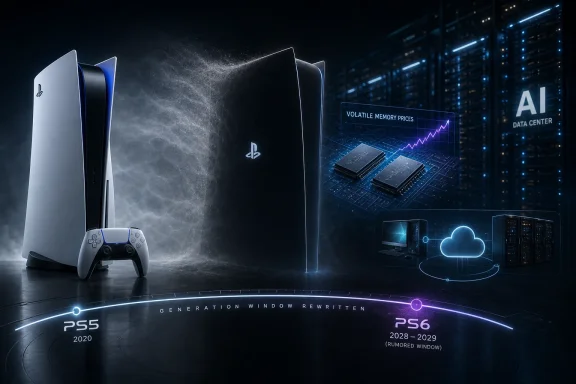
Sony has not announced a PlayStation 6 release date, but fresh reporting and analyst chatter in June 2026 now point to a possible 2028 or 2029 debut rather than the once-assumed 2027 window. The important part is not that Sony has “delayed” a console it never dated. The important part is that the old console-generation calendar is being rewritten by memory prices, AI infrastructure demand, longer game-development cycles, and a PS5 business that still has room to run.
The PS6 rumor cycle is therefore less a story about a secret launch slipping by a year and more a sign that consumer gaming hardware has become subordinate to forces outside gaming. Sony is no longer competing only with Microsoft and Nintendo for living-room attention. It is competing with hyperscalers, AI labs, smartphone vendors, automakers, and every other buyer chasing the same advanced memory and silicon supply.
That changes the logic of a console transition. A traditional generation jump asks players to spend hundreds of dollars for a clean break; a 2028 or 2029 PlayStation 6 would instead arrive after a decade in which the PS5 matured from a scarce pandemic machine into a large installed-base platform with higher software, subscription, and storefront value. Sony may still want new hardware. It just has fewer reasons to force it before the economics cooperate.
The latest round of speculation began with reports that Embracer Group’s annual commentary referenced analyst expectations that Sony could push the next PlayStation from 2027 into 2028 or even 2029. That aligns with earlier reporting that Sony was weighing a later launch because memory costs had become unusually volatile. In plain terms, the PlayStation 6 may be waiting not for a bigger GPU idea, but for the RAM market to calm down.
That sounds odd only if you think of consoles as self-contained entertainment boxes. They are not. A modern PlayStation is a dense bundle of CPU, GPU, memory, storage, networking, cooling, and power-delivery decisions, all negotiated years ahead of release and all sensitive to component pricing. If one of those pillars becomes unstable, the entire launch model gets harder.
DRAM is especially unforgiving because a console’s memory configuration is one of the pieces that defines the generation. Sony cannot easily launch a PS6 with a memory capacity that looks weak in 2028 and then fix the baseline later without fragmenting the platform. Developers build around the floor, not the deluxe configuration.
The AI boom has made that calculation nastier. High-bandwidth memory and server DRAM are being pulled toward data centers, where customers are willing to pay enormous premiums to feed accelerator clusters. Consumer electronics companies are left negotiating in a market where memory suppliers have better customers than console makers.
That does not mean Sony is powerless. It does mean the company has less incentive to lock a launch bill of materials while prices are inflated and supply commitments are distorted by AI demand. A console sold near cost is a brilliant business when component curves fall predictably. It is a dangerous one when the curve points the wrong way.
That expectation made sense for a long stretch. The PlayStation 3 arrived in 2006, the PlayStation 4 in 2013, and the PlayStation 5 in 2020. On paper, a 2027 PS6 looked like the next neat tick in the metronome.
But console history is not as tidy as the dates suggest. The PS3 and Xbox 360 generation stretched longer than many expected, partly because the post-2008 economy made expensive new hardware harder to justify and partly because developers spent years learning how to squeeze those machines. The later years of that generation produced games that looked and felt dramatically better than early software on the same boxes.
The PS5 generation has its own distortion: the first two years were warped by pandemic-era supply constraints. Millions of players could not easily buy the machine at launch-window prices, which meant the generation’s cultural and development momentum arrived later than the hardware did. In practical terms, the PS5’s “normal” life began well after November 2020.
That matters for both Sony and players. A 2028 PS6 would technically arrive eight years after PS5 launch, but emotionally and commercially it may feel less late than the calendar implies. Many households did not treat the PS5 as a settled mainstream console until 2022 or 2023.
The console cycle has always been a blend of technology, affordability, and software readiness. Right now, only one of those three clearly favors rushing forward.
That distinction matters because the PS5 business is not merely hardware volume. Sony’s games division depends on software sales, add-on content, PlayStation Plus, and the PlayStation Store. The bigger the PS5 installed base becomes, the more attractive it is to third-party publishers and the more valuable it is for Sony to keep that audience engaged.
This is where the calculus differs from the old model. In earlier generations, a new console was the cleanest way to sell new ambition. In the modern PlayStation economy, a large active user base is itself an asset that should not be disrupted casually.
A PS6 launch too soon could produce the worst of both worlds: expensive hardware for consumers and a split audience for developers. Sony would need to persuade publishers to support new capabilities while also serving tens of millions of PS5 owners who are not ready to move. That cross-generation drag was already visible in the early PS5 years, when many major games remained designed around PS4 realities.
If Sony waits, it can let the PS5 library deepen while allowing the eventual PS6 to arrive as a more obvious break. Waiting is not the same as complacency. It can be a way to avoid launching a “next generation” that spends its first three years apologizing for why it still looks cross-gen.
That is a profound inversion. Console makers once used hardware launches to summon new software. Now the development cycle for blockbuster games is so long, expensive, and risky that platform transitions must bend around it.
Naughty Dog’s Intergalactic: The Heretic Prophet is one obvious example of a game that can carry the PS5 brand without requiring new hardware. Insomniac’s Wolverine remains one of the most watched upcoming exclusives. Persistent rumors around future God of War activity, whether full sequel or related project, also keep the PS5 ecosystem culturally alive even when Sony’s release calendar appears uneven.
The larger point is that Sony’s first-party machine no longer produces generation-defining exclusives at PS2-era speed. Teams spend five, six, or seven years building games that are expected to carry cinematic presentation, global marketing, accessibility features, live patching, localization, and often PC-port planning. Those economics do not mesh neatly with a seven-year hardware drumbeat.
Sony also appears to have cooled from its most aggressive live-service ambitions after high-profile turbulence, including Bungie-related write-downs and broader industry layoffs. The strategic center of gravity is drifting back toward the thing PlayStation knows how to sell best: premium single-player games that make ownership of the platform feel justified.
That pivot supports a longer PS5 runway. If Sony believes several major single-player releases can still move hardware, subscriptions, and storefront spending, there is little reason to cut the generation short just to satisfy a historical pattern.
The cost of gaming has been creeping upward for years. Premium releases are testing higher price points, deluxe editions routinely push well beyond the old $60 mental anchor, and subscriptions have become part of the monthly entertainment budget. Add in inflation fatigue and broader household cost pressure, and a $600-plus console is no longer an easy mainstream ask.
The PlayStation 5 already demonstrated how fragile launch economics can be. Supply constraints turned early ownership into a lottery, scalping poisoned the first impression, and the eventual normalization of availability did not necessarily restore the old expectation that hardware gets cheaper over time. In several markets, console prices have held firm or risen rather than sliding into the comfortable discount phase that older generations enjoyed.
That is why a PS6 launch under high memory prices would be especially risky. Sony could absorb more cost and damage margins, pass more cost to buyers and slow adoption, or compromise the specification and risk a weaker generational leap. None of those choices is attractive.
Microsoft faces the same physics, even if its console strategy is increasingly entangled with Windows, Game Pass, cloud delivery, and third-party publishing. Nintendo is somewhat insulated by a different performance target, but it is not immune to memory, storage, and manufacturing pressure either. The whole hardware sector is being repriced by AI demand.
For WindowsForum readers, this should feel familiar. PC builders have already watched AI demand distort GPU availability, memory pricing, and data-center capital allocation. The PS6 rumor is simply the console version of a broader market reality: consumer hardware is no longer the priority customer for the most contested parts of the supply chain.
This is a strange development for an industry that spent decades treating console wars as a fight among entertainment companies. Sony, Microsoft, and Nintendo still compete, but their battlefield now sits underneath a larger semiconductor economy dominated by companies building AI servers. In that economy, console makers are disciplined buyers, while hyperscalers are strategic buyers with massive capital budgets.
Memory manufacturers respond rationally to that demand. If high-bandwidth memory for AI accelerators offers better margins and long-term commitments than commodity consumer memory, production priorities shift. Even when the exact memory in a console is not identical to the memory in an AI server, capacity, packaging, wafers, and investment attention are connected.
This is why the PS6 timeline cannot be understood as a simple product-choice story. Sony may want to launch earlier. Engineers may already know the rough architecture they want. Developers may be eager for more CPU headroom, more memory, stronger ray tracing, and better machine-learning acceleration.
But wanting a box and profitably mass-producing tens of millions of them are different problems. A console launch is not a boutique PC drop. It is a global supply-chain bet measured in years.
The irony is rich. AI may eventually enhance games through better upscaling, animation tools, NPC behavior, asset generation, and development workflows. In the short term, though, AI infrastructure is making it harder to ship the next generation of machines that would run those games.
That can be good news. A longer PS5 generation may help midrange PCs age more gracefully because developers keep optimizing around a fixed target rather than jumping abruptly to a higher baseline. PC players with modest hardware could see fewer sudden requirement spikes than they would if a powerful PS6 reset expectations in 2027.
It can also be frustrating. Ambitious PC hardware often waits for consoles to make certain techniques mainstream. The PS5’s SSD pushed fast-storage assumptions forward, but memory limits and CPU budgets still shape open-world design, simulation density, and asset streaming. A longer console plateau may slow the moment when developers fully target a more expansive baseline.
The PC market is also facing the same component pressures. If AI demand keeps DRAM and NAND expensive, a Windows gaming rig will not necessarily look like the cheaper escape hatch. Upgrading a GPU, system memory, and SSD may remain painful at the same time console makers are trying to avoid launching expensive boxes.
Microsoft sits awkwardly in the middle of this. Its Xbox strategy increasingly treats Windows PCs, cloud gaming, and consoles as overlapping endpoints. If Sony waits until 2028 or 2029, Microsoft could try to move first with new hardware, but doing so under the same component-cost pressure would be risky. The company’s stronger play may be to lean harder into platform flexibility rather than a conventional console leap.
For developers, the longer PS5 era would reinforce a familiar discipline: make games scale. The best studios will continue targeting consoles as fixed anchors while using PC to stretch resolution, frame rate, ray tracing, ultrawide support, modding, and input flexibility. The worst ports will continue to expose how fragile that scaling work can be.
Mid-generation machines are fundamentally conservative. They improve resolution, frame rate, image reconstruction, and ray-tracing headroom, but they do not let developers assume a new baseline. The standard PS5 remains the floor, which means the Pro can polish games rather than transform their design.
That makes the PS5 Pro a bridge product. It gives Sony more time, keeps high-spending customers engaged, and allows its engineering and developer-relations teams to refine technologies that may matter more in the next generation. But the Pro also reveals the dilemma: if the base PS5 is still the required target, the software revolution must wait.
A later PS6 would therefore put more weight on the Pro than Sony may originally have intended. Enthusiasts who want a cleaner 60 frames per second, better image quality, or more stable ray tracing may treat the Pro as their stopgap through the late 2020s. Budget-conscious players may simply keep their existing PS5.
That segmentation is not necessarily bad. It resembles the smartphone market more than the old console market, with users upgrading at different speeds inside a shared ecosystem. Sony can monetize both groups as long as the games keep coming.
The danger is message fatigue. If Sony spends too long selling incremental performance before unveiling a true generational leap, players may become harder to impress. A PS6 in 2029 must feel meaningfully different, not just like a PS5 Pro Pro.
Sony’s current position gives it that option. The PS5 has a large audience, a strong brand, a mature storefront, and enough announced or expected software to keep attention. Sony does not need to gamble on a new box simply to prove momentum.
Microsoft’s position is more complex. Xbox hardware has lost some of its old centrality as Microsoft expands across PC, cloud, and rival platforms. If Microsoft launches a next-generation console first, it could claim technical leadership, but it could also inherit the cost problem first.
Nintendo operates on its own cadence, but even Nintendo cannot ignore component pricing forever. The Switch model proved that clever design and software identity can matter more than brute force. Yet memory and storage still touch every modern device, even one built around efficiency rather than raw power.
The broader lesson is that the next generation may not arrive as a synchronized industry event. We may see staggered transitions, more cross-generation support, more premium interim hardware, and more emphasis on accounts and libraries rather than boxes. The “generation” becomes less a door slamming shut and more a long corridor.
That is already how many players behave. Digital libraries, subscriptions, cloud saves, backward compatibility, and PC releases have softened the old breakpoints. Sony can delay PS6 longer than it once could because the PlayStation ecosystem is stickier than the plastic box under the TV.
A new console does not automatically fix that. More power can improve visuals and performance, but it can also raise production expectations and budgets. If developers respond to PS6 by chasing even larger worlds, denser assets, and more expensive cinematics, the cycle-time problem may get worse.
This is why the comparison to the late PS3 and Xbox 360 era resonates. Those consoles produced beloved games not because they remained technically cutting-edge, but because developers learned the hardware and built confidently within its limits. Constraints can focus design when the market gives studios time to master them.
The PS5 still has room for that kind of maturation. We have seen technically impressive releases, but the generation has also been defined by remakes, remasters, cross-gen projects, live-service experiments, and long gaps between flagship first-party launches. It has not yet produced the dense run of exclusive identity that many players associate with PlayStation’s strongest eras.
If Sony uses extra time well, a later PS6 could be a benefit rather than a disappointment. The PS5 would get a fuller final act, and the PS6 could launch when software, price, and manufacturing conditions make the generational leap clearer.
If Sony uses the time poorly, delay becomes stagnation. The risk is not that players wait until 2029. The risk is that they spend the waiting years wondering why a platform with such a large audience is not producing more essential games.
The PS6 rumor cycle is therefore less a story about a secret launch slipping by a year and more a sign that consumer gaming hardware has become subordinate to forces outside gaming. Sony is no longer competing only with Microsoft and Nintendo for living-room attention. It is competing with hyperscalers, AI labs, smartphone vendors, automakers, and every other buyer chasing the same advanced memory and silicon supply.
That changes the logic of a console transition. A traditional generation jump asks players to spend hundreds of dollars for a clean break; a 2028 or 2029 PlayStation 6 would instead arrive after a decade in which the PS5 matured from a scarce pandemic machine into a large installed-base platform with higher software, subscription, and storefront value. Sony may still want new hardware. It just has fewer reasons to force it before the economics cooperate.
 The PS6 Delay Story Is Really a Memory Story
The latest round of speculation began with reports that Embracer Group’s annual commentary referenced analyst expectations that Sony could push the next PlayStation from 2027 into 2028 or even 2029. That aligns with earlier reporting that Sony was weighing a later launch because memory costs had become unusually volatile. In plain terms, the PlayStation 6 may be waiting not for a bigger GPU idea, but for the RAM market to calm down.That sounds odd only if you think of consoles as self-contained entertainment boxes. They are not. A modern PlayStation is a dense bundle of CPU, GPU, memory, storage, networking, cooling, and power-delivery decisions, all negotiated years ahead of release and all sensitive to component pricing. If one of those pillars becomes unstable, the entire launch model gets harder.
DRAM is especially unforgiving because a console’s memory configuration is one of the pieces that defines the generation. Sony cannot easily launch a PS6 with a memory capacity that looks weak in 2028 and then fix the baseline later without fragmenting the platform. Developers build around the floor, not the deluxe configuration.
The AI boom has made that calculation nastier. High-bandwidth memory and server DRAM are being pulled toward data centers, where customers are willing to pay enormous premiums to feed accelerator clusters. Consumer electronics companies are left negotiating in a market where memory suppliers have better customers than console makers.
That does not mean Sony is powerless. It does mean the company has less incentive to lock a launch bill of materials while prices are inflated and supply commitments are distorted by AI demand. A console sold near cost is a brilliant business when component curves fall predictably. It is a dangerous one when the curve points the wrong way.
Sony Never Promised 2027, but the Industry Did
There is a rhetorical trap in calling this a delay. Sony has not publicly announced the PlayStation 6, has not dated it, and has not priced it. What appears to be slipping is the industry’s inherited expectation that consoles arrive every six or seven years, as if the calendar itself were a product manager.That expectation made sense for a long stretch. The PlayStation 3 arrived in 2006, the PlayStation 4 in 2013, and the PlayStation 5 in 2020. On paper, a 2027 PS6 looked like the next neat tick in the metronome.
But console history is not as tidy as the dates suggest. The PS3 and Xbox 360 generation stretched longer than many expected, partly because the post-2008 economy made expensive new hardware harder to justify and partly because developers spent years learning how to squeeze those machines. The later years of that generation produced games that looked and felt dramatically better than early software on the same boxes.
The PS5 generation has its own distortion: the first two years were warped by pandemic-era supply constraints. Millions of players could not easily buy the machine at launch-window prices, which meant the generation’s cultural and development momentum arrived later than the hardware did. In practical terms, the PS5’s “normal” life began well after November 2020.
That matters for both Sony and players. A 2028 PS6 would technically arrive eight years after PS5 launch, but emotionally and commercially it may feel less late than the calendar implies. Many households did not treat the PS5 as a settled mainstream console until 2022 or 2023.
The console cycle has always been a blend of technology, affordability, and software readiness. Right now, only one of those three clearly favors rushing forward.
The PS5 Is Too Valuable to Abandon Early
The PS5 is not a stalled platform waiting for rescue. Sony’s own figures and reporting around its recent results put the system north of 90 million units shipped or sold through, depending on the reporting language and period. The “almost 100 million” claim now circulating is directionally plausible, though not yet the same as Sony formally announcing a 100 million milestone.That distinction matters because the PS5 business is not merely hardware volume. Sony’s games division depends on software sales, add-on content, PlayStation Plus, and the PlayStation Store. The bigger the PS5 installed base becomes, the more attractive it is to third-party publishers and the more valuable it is for Sony to keep that audience engaged.
This is where the calculus differs from the old model. In earlier generations, a new console was the cleanest way to sell new ambition. In the modern PlayStation economy, a large active user base is itself an asset that should not be disrupted casually.
A PS6 launch too soon could produce the worst of both worlds: expensive hardware for consumers and a split audience for developers. Sony would need to persuade publishers to support new capabilities while also serving tens of millions of PS5 owners who are not ready to move. That cross-generation drag was already visible in the early PS5 years, when many major games remained designed around PS4 realities.
If Sony waits, it can let the PS5 library deepen while allowing the eventual PS6 to arrive as a more obvious break. Waiting is not the same as complacency. It can be a way to avoid launching a “next generation” that spends its first three years apologizing for why it still looks cross-gen.
First-Party Games Are Now the Schedule, Not the Silicon
The strongest argument for extending the PS5 generation is not the hardware. It is the software pipeline. Sony’s biggest internal studios have not all delivered their defining PS5-era statements, and the most consequential PlayStation games now take so long to build that they increasingly set the hardware rhythm themselves.That is a profound inversion. Console makers once used hardware launches to summon new software. Now the development cycle for blockbuster games is so long, expensive, and risky that platform transitions must bend around it.
Naughty Dog’s Intergalactic: The Heretic Prophet is one obvious example of a game that can carry the PS5 brand without requiring new hardware. Insomniac’s Wolverine remains one of the most watched upcoming exclusives. Persistent rumors around future God of War activity, whether full sequel or related project, also keep the PS5 ecosystem culturally alive even when Sony’s release calendar appears uneven.
The larger point is that Sony’s first-party machine no longer produces generation-defining exclusives at PS2-era speed. Teams spend five, six, or seven years building games that are expected to carry cinematic presentation, global marketing, accessibility features, live patching, localization, and often PC-port planning. Those economics do not mesh neatly with a seven-year hardware drumbeat.
Sony also appears to have cooled from its most aggressive live-service ambitions after high-profile turbulence, including Bungie-related write-downs and broader industry layoffs. The strategic center of gravity is drifting back toward the thing PlayStation knows how to sell best: premium single-player games that make ownership of the platform feel justified.
That pivot supports a longer PS5 runway. If Sony believes several major single-player releases can still move hardware, subscriptions, and storefront spending, there is little reason to cut the generation short just to satisfy a historical pattern.
The Price Problem Is Bigger Than PlayStation
A new console generation is a consumer-confidence test. It asks families to believe that the next box is worth buying now, that the games will arrive soon, and that the price is not absurd. In 2026, every part of that pitch is harder.The cost of gaming has been creeping upward for years. Premium releases are testing higher price points, deluxe editions routinely push well beyond the old $60 mental anchor, and subscriptions have become part of the monthly entertainment budget. Add in inflation fatigue and broader household cost pressure, and a $600-plus console is no longer an easy mainstream ask.
The PlayStation 5 already demonstrated how fragile launch economics can be. Supply constraints turned early ownership into a lottery, scalping poisoned the first impression, and the eventual normalization of availability did not necessarily restore the old expectation that hardware gets cheaper over time. In several markets, console prices have held firm or risen rather than sliding into the comfortable discount phase that older generations enjoyed.
That is why a PS6 launch under high memory prices would be especially risky. Sony could absorb more cost and damage margins, pass more cost to buyers and slow adoption, or compromise the specification and risk a weaker generational leap. None of those choices is attractive.
Microsoft faces the same physics, even if its console strategy is increasingly entangled with Windows, Game Pass, cloud delivery, and third-party publishing. Nintendo is somewhat insulated by a different performance target, but it is not immune to memory, storage, and manufacturing pressure either. The whole hardware sector is being repriced by AI demand.
For WindowsForum readers, this should feel familiar. PC builders have already watched AI demand distort GPU availability, memory pricing, and data-center capital allocation. The PS6 rumor is simply the console version of a broader market reality: consumer hardware is no longer the priority customer for the most contested parts of the supply chain.
AI Has Become the Hidden Platform Holder
The most striking part of the PS6 debate is that the supposed villain is not Xbox. It is the AI data center. The same investment wave that is reshaping cloud infrastructure is now indirectly deciding when a mass-market games console can be built at an acceptable price.This is a strange development for an industry that spent decades treating console wars as a fight among entertainment companies. Sony, Microsoft, and Nintendo still compete, but their battlefield now sits underneath a larger semiconductor economy dominated by companies building AI servers. In that economy, console makers are disciplined buyers, while hyperscalers are strategic buyers with massive capital budgets.
Memory manufacturers respond rationally to that demand. If high-bandwidth memory for AI accelerators offers better margins and long-term commitments than commodity consumer memory, production priorities shift. Even when the exact memory in a console is not identical to the memory in an AI server, capacity, packaging, wafers, and investment attention are connected.
This is why the PS6 timeline cannot be understood as a simple product-choice story. Sony may want to launch earlier. Engineers may already know the rough architecture they want. Developers may be eager for more CPU headroom, more memory, stronger ray tracing, and better machine-learning acceleration.
But wanting a box and profitably mass-producing tens of millions of them are different problems. A console launch is not a boutique PC drop. It is a global supply-chain bet measured in years.
The irony is rich. AI may eventually enhance games through better upscaling, animation tools, NPC behavior, asset generation, and development workflows. In the short term, though, AI infrastructure is making it harder to ship the next generation of machines that would run those games.
Windows PCs May Benefit From a Longer Console Plateau
A delayed PS6 would not leave the PC untouched. Consoles set the baseline for multiplatform development, and Windows gaming has spent years living with the consequences of console memory budgets, CPU targets, and storage assumptions. If the PS5 remains the dominant performance floor into 2028 or 2029, PC games will continue to reflect that.That can be good news. A longer PS5 generation may help midrange PCs age more gracefully because developers keep optimizing around a fixed target rather than jumping abruptly to a higher baseline. PC players with modest hardware could see fewer sudden requirement spikes than they would if a powerful PS6 reset expectations in 2027.
It can also be frustrating. Ambitious PC hardware often waits for consoles to make certain techniques mainstream. The PS5’s SSD pushed fast-storage assumptions forward, but memory limits and CPU budgets still shape open-world design, simulation density, and asset streaming. A longer console plateau may slow the moment when developers fully target a more expansive baseline.
The PC market is also facing the same component pressures. If AI demand keeps DRAM and NAND expensive, a Windows gaming rig will not necessarily look like the cheaper escape hatch. Upgrading a GPU, system memory, and SSD may remain painful at the same time console makers are trying to avoid launching expensive boxes.
Microsoft sits awkwardly in the middle of this. Its Xbox strategy increasingly treats Windows PCs, cloud gaming, and consoles as overlapping endpoints. If Sony waits until 2028 or 2029, Microsoft could try to move first with new hardware, but doing so under the same component-cost pressure would be risky. The company’s stronger play may be to lean harder into platform flexibility rather than a conventional console leap.
For developers, the longer PS5 era would reinforce a familiar discipline: make games scale. The best studios will continue targeting consoles as fixed anchors while using PC to stretch resolution, frame rate, ray tracing, ultrawide support, modding, and input flexibility. The worst ports will continue to expose how fragile that scaling work can be.
The PS5 Pro Did Not Solve the Generational Question
The PS5 Pro complicates the story because it gives Sony a premium hardware step without forcing a full platform reset. It lets the company sell better performance to enthusiasts while keeping the same software base. That is useful, but it is not a substitute for a true PS6.Mid-generation machines are fundamentally conservative. They improve resolution, frame rate, image reconstruction, and ray-tracing headroom, but they do not let developers assume a new baseline. The standard PS5 remains the floor, which means the Pro can polish games rather than transform their design.
That makes the PS5 Pro a bridge product. It gives Sony more time, keeps high-spending customers engaged, and allows its engineering and developer-relations teams to refine technologies that may matter more in the next generation. But the Pro also reveals the dilemma: if the base PS5 is still the required target, the software revolution must wait.
A later PS6 would therefore put more weight on the Pro than Sony may originally have intended. Enthusiasts who want a cleaner 60 frames per second, better image quality, or more stable ray tracing may treat the Pro as their stopgap through the late 2020s. Budget-conscious players may simply keep their existing PS5.
That segmentation is not necessarily bad. It resembles the smartphone market more than the old console market, with users upgrading at different speeds inside a shared ecosystem. Sony can monetize both groups as long as the games keep coming.
The danger is message fatigue. If Sony spends too long selling incremental performance before unveiling a true generational leap, players may become harder to impress. A PS6 in 2029 must feel meaningfully different, not just like a PS5 Pro Pro.
The Old Console War Is Giving Way to a Waiting Game
A 2028 or 2029 PS6 would reshape how the next console war begins. The old model rewarded the company that arrived with the right combination of price, power, and launch software. The new model may reward the company that waits long enough to avoid punishing its customers for bad supply-chain timing.Sony’s current position gives it that option. The PS5 has a large audience, a strong brand, a mature storefront, and enough announced or expected software to keep attention. Sony does not need to gamble on a new box simply to prove momentum.
Microsoft’s position is more complex. Xbox hardware has lost some of its old centrality as Microsoft expands across PC, cloud, and rival platforms. If Microsoft launches a next-generation console first, it could claim technical leadership, but it could also inherit the cost problem first.
Nintendo operates on its own cadence, but even Nintendo cannot ignore component pricing forever. The Switch model proved that clever design and software identity can matter more than brute force. Yet memory and storage still touch every modern device, even one built around efficiency rather than raw power.
The broader lesson is that the next generation may not arrive as a synchronized industry event. We may see staggered transitions, more cross-generation support, more premium interim hardware, and more emphasis on accounts and libraries rather than boxes. The “generation” becomes less a door slamming shut and more a long corridor.
That is already how many players behave. Digital libraries, subscriptions, cloud saves, backward compatibility, and PC releases have softened the old breakpoints. Sony can delay PS6 longer than it once could because the PlayStation ecosystem is stickier than the plastic box under the TV.
Players Want Better Games More Than Another Spec Sheet
The public debate around PS6 often assumes that players are hungry for more power. Some are. But the louder frustration of this generation has not been that the PS5 is too weak; it has been that major games take too long, cost too much, and sometimes arrive unfinished.A new console does not automatically fix that. More power can improve visuals and performance, but it can also raise production expectations and budgets. If developers respond to PS6 by chasing even larger worlds, denser assets, and more expensive cinematics, the cycle-time problem may get worse.
This is why the comparison to the late PS3 and Xbox 360 era resonates. Those consoles produced beloved games not because they remained technically cutting-edge, but because developers learned the hardware and built confidently within its limits. Constraints can focus design when the market gives studios time to master them.
The PS5 still has room for that kind of maturation. We have seen technically impressive releases, but the generation has also been defined by remakes, remasters, cross-gen projects, live-service experiments, and long gaps between flagship first-party launches. It has not yet produced the dense run of exclusive identity that many players associate with PlayStation’s strongest eras.
If Sony uses extra time well, a later PS6 could be a benefit rather than a disappointment. The PS5 would get a fuller final act, and the PS6 could launch when software, price, and manufacturing conditions make the generational leap clearer.
If Sony uses the time poorly, delay becomes stagnation. The risk is not that players wait until 2029. The risk is that they spend the waiting years wondering why a platform with such a large audience is not producing more essential games.
The Practical Read for a PlayStation Generation Stretched by AI
The PS6 rumor mill will keep spinning because Sony has left the future undefined, but the most useful interpretation is already visible. The next PlayStation is likely being shaped by component economics as much as by game design ambition. That should reset expectations for buyers, developers, and anyone trying to forecast the console market.- Sony has not officially dated the PlayStation 6, so 2028 or 2029 should be treated as a reported possibility rather than a confirmed delay.
- The strongest reported reason for a later launch is the AI-driven memory crunch, which makes a cost-sensitive console launch harder to plan.
- The PS5’s large installed base gives Sony a financial reason to extend the generation instead of forcing an early transition.
- A longer PS5 cycle could benefit midrange PC players by keeping multiplatform baselines stable, but it may also slow design leaps that depend on more memory and CPU headroom.
- The PS5 Pro can stretch the current generation for enthusiasts, but it cannot replace a true next-generation baseline for developers.
- The decisive test for Sony is whether the extra years produce stronger games, not merely a more convenient hardware launch window.
References
- Primary source: NoobFeed
Published: 2026-06-20T19:30:12.387617
Loading…
www.noobfeed.com - Independent coverage: Daily Beirut
Published: 2026-06-20T19:30:12.387316
Loading…
dailybeirut.com - Related coverage: gamesradar.com
Loading…
www.gamesradar.com - Related coverage: pushsquare.com
Loading…
www.pushsquare.com - Related coverage: gamespot.com
Loading…
www.gamespot.com - Related coverage: tomshardware.com
Loading…
www.tomshardware.com
- Related coverage: pcgamer.com
Loading…
www.pcgamer.com - Related coverage: dotesports.com
Loading…
dotesports.com - Related coverage: gameluster.com
Loading…
gameluster.com - Related coverage: tweakers.net
Loading…
tweakers.net - Related coverage: semiconductors.org
Loading…
www.semiconductors.org - Related coverage: shacknews.com
Loading…
www.shacknews.com - Related coverage: techradar.com
Loading…
www.techradar.com - Related coverage: gizmochina.com
Loading…
www.gizmochina.com - Related coverage: gigazine.net
Loading…
gigazine.net - Related coverage: simulationdaily.com
Loading…
simulationdaily.com - Related coverage: tech-insider.org
Loading…
tech-insider.org - Related coverage: sony.com
Loading…
www.sony.com