
John Ternus is preparing to take over as Apple CEO on September 1, 2026, and recent reporting says he intends to reassert design as a central force inside Apple after years in which operations, finance, and supply-chain discipline defined the Tim Cook era. That sounds like a return to old Apple mythology, but the more interesting question is whether it is a correction or merely a change in executive language. Apple has not stopped making exquisitely engineered objects. It has, however, become a company whose biggest risks increasingly come from software, services, regulation, and ecosystem trust — places where “design” means much more than aluminum edges.
Tim Cook’s Apple was never the anti-design Apple. That caricature survives because it is useful: Steve Jobs and Jony Ive as the priests of product taste; Cook as the logistics man who made the machines arrive on time. But history is less tidy. Under Cook, Apple turned the iPhone into the center of a services empire, transitioned the Mac to Apple Silicon, built a wearables business around the Apple Watch and AirPods, and became one of the most valuable companies in the world.
The criticism is not that Cook failed. It is that Apple’s center of gravity shifted. The company became more cautious, more optimized, and more structurally dependent on yearly refresh cycles, supply-chain mastery, and ecosystem lock-in. For shareholders, that was a triumph. For people who remember Apple as a company that occasionally made the rest of the industry look embarrassed, it felt like a slow sanding-down of nerve.
That is the opening Ternus now occupies. He is not an outside savior arriving to rescue a broken institution. He is a hardware executive produced by the institution, elevated precisely because Apple wants continuity with enough visible change to mark a new chapter. His reported comments about design being core to Apple are therefore less a manifesto than a signal: the next CEO wants the market, employees, and rivals to see him as a product leader.
The signal matters because Apple’s leadership structure has been visibly different since Jony Ive’s departure. Design no longer appears to sit above the product roadmap in the way Jobs once arranged it. The design organization has been reorganized, senior roles have shifted, and Apple has lacked the singular public design authority it once had. Ternus spending significant time with industrial design is not a revolution by itself, but it is a useful tell about where he wants legitimacy to come from.
That is why a renewed design emphasis could be meaningful — if Ternus means design as product authority rather than surface polish. The distinction matters. Apple already knows how to make beautiful objects. What it has struggled with more recently is making every part of the experience feel as intentional as the object itself.
Windows users and administrators know this divide well. A laptop can have a gorgeous enclosure and still be annoying to manage. A phone can feel luxurious and still route too much of the user’s life through opaque cloud settings. A headset can be a feat of industrial engineering and still fail to explain why ordinary people should wear it.
Apple’s design problem, if it has one, is not that its hardware looks bad. It is that some of its most important products now live at the intersection of form, software policy, AI behavior, subscription economics, privacy claims, developer rules, and regulatory pressure. In that world, the “design team” cannot merely be the group that perfects the shell. It has to be the group that asks whether the whole product makes coherent sense.
That operating model rewarded discipline. It also made Apple more incremental. The company could afford to wait, refine, and enter markets only when its integration advantage was clear. That patience worked spectacularly with Apple Silicon. It has been less convincing in generative AI, where Apple has appeared cautious while competitors flood the zone with assistants, agents, cloud features, and dubious demos.
Ternus will not be able to design his way out of that merely by sitting closer to industrial design. The next Apple will have to make choices about what intelligence belongs on-device, what belongs in the cloud, and how much autonomy users should trust to a company that still sells privacy as a premium feature. Those are design questions, but they are also infrastructure questions, policy questions, and developer-platform questions.
This is where the Windows world should pay attention. Microsoft’s recent history shows what happens when a platform company tries to graft AI ambition onto a mature operating system used by hundreds of millions of people with very different tolerances for risk. Apple has a more controlled stack, but it is not immune to the same tension. The more personal computing becomes predictive and agentic, the more design becomes governance.
But big companies do not pivot because one executive has better taste. Apple’s product pipeline is measured in years, not quarters. The iPhone 18 family, expected around the time Ternus formally takes over, will not be a pure Ternus-era artifact. Nor will the rumored foldable iPhone or anniversary-era devices that have reportedly been in testing long before he occupies the CEO chair.
That lag is important. The first Ternus keynote may look like a coronation, but it will likely sell products conceived under the system he inherits. The real test will come later, when Apple ships devices and software that reflect decisions made after he has both formal authority and political capital.
Even then, the question will not be whether Apple can produce a more dramatic object. It will be whether Ternus can make the company more decisive without making it reckless. Apple’s great strength is that it says no more often than most companies. Its recent weakness is that some of those refusals have looked less like taste and more like institutional caution.
Apple’s old design mystique came from the belief that design could override all of them. Not always, not magically, but often enough that the company’s products felt unusually opinionated. If Ternus is indeed trying to restore some of that authority, the practical question is simple: when design and operations disagree, who wins?
That question has consequences beyond Apple Park. If design gains more power, Apple may accept more manufacturing complexity to produce devices that feel genuinely new. It may tolerate more short-term friction in the name of stronger long-term product identity. It may also make decisions that annoy pro users, developers, repair advocates, and enterprise buyers if those groups are judged to be outside the desired experience.
Apple has done that before. Sometimes it was right. Sometimes it mistook minimalism for wisdom. A more design-led Apple could be bolder, but bolder does not always mean better.
A foldable iPhone would also be a perfect test of Ternus’s design rhetoric. Foldables are engineering compromises made visible: crease, hinge, thickness, battery, durability, app layout, repair cost, and price all fight for priority. There is no pure solution. There is only a hierarchy of trade-offs.
If Apple ships one, the company will present those trade-offs as resolved. That is what Apple does. The more interesting read will be whether the device changes how people use iPhones or merely gives high-end buyers a more expensive version of the same grid of apps. A foldable that exists only to match Samsung is not a design triumph. A foldable that creates a credible new computing pattern might be.
For Windows users, the parallel is obvious. Microsoft and its OEM partners have spent years experimenting with dual-screen devices, foldables, detachable keyboards, pen-first workflows, and hybrid PCs. The lesson is that hardware novelty does not create a use case by itself. Software has to meet the hinge halfway.
These are not glamorous design problems, but they are central to the user experience. They also matter more as Apple asks customers to trust devices with increasingly intimate tasks. A camera in AirPods, if Apple ever ships such a thing, would not merely be a hardware feature. It would be a privacy interface, a social signal, a data pipeline, and a moderation problem.
This is where Apple’s old design language can become dangerous if taken too narrowly. “Beautifully designed” cannot just mean that the product looks inevitable in a press photo. It must mean that the product’s behavior is legible. Users should understand when sensors are active, where data goes, how AI-derived suggestions are produced, and how to disable features without spelunking through nested menus.
Microsoft has learned this lesson the hard way in Windows. Features that look clever in a controlled demo can become reputational liabilities when users believe the operating system is watching, nudging, advertising, or changing defaults without clear consent. Apple’s brand gives it more trust to spend, but not infinite trust.
Those customers care about design, but they define it differently. A sysadmin’s ideal design is not just a thin laptop with a great screen. It is a deployment workflow that does not break, a security model that can be audited, update behavior that can be planned, and hardware lifecycles that do not surprise the budget committee.
Ternus’s hardware background could help here. Apple Silicon made the Mac more compelling in enterprise environments by delivering performance, battery life, and consistency that Windows OEMs have had to chase. But the next phase will be less about raw silicon advantage and more about management clarity, identity integration, compliance, and AI controls.
This is another reason the design-team story is bigger than the design team. If Apple treats enterprise needs as mere checkboxes after consumer products are finished, it will leave room for Microsoft, Dell, Lenovo, HP, and the broader Windows ecosystem to argue that manageability is its own form of product quality. If Apple designs for administration as deliberately as it designs for unboxing, it becomes more dangerous in the workplace.
Apple’s leadership transition comes as the PC industry is trying to redefine itself around AI hardware, local acceleration, cloud-connected assistants, and new device forms. Microsoft wants Windows to become the natural home of AI-assisted work. Qualcomm, Intel, AMD, and Nvidia all want a piece of the next client-computing story. OEMs are looking for differentiation beyond thinner bezels and brighter OLED panels.
A more product-aggressive Apple could sharpen that fight. If Ternus pushes Apple to make the Mac, iPhone, Watch, AirPods, and future wearables feel like a more coherent personal-computing fabric, Windows vendors will not be competing with a single device. They will be competing with a tightly choreographed system.
That is not new, but it is becoming more important. The next platform war may be less about operating-system features than about which ecosystem can make AI, identity, sensors, payments, health data, and personal context feel useful without feeling invasive. Apple has advantages there, but also constraints. Its privacy promises limit some data-hungry AI models, and its App Store control invites regulatory scrutiny.
Windows has the opposite problem. Its openness and hardware diversity are strengths, but they make coherence harder. Microsoft can announce a vision; OEMs, silicon vendors, enterprise policies, legacy apps, and regional rules all get a vote. Apple can move with more unity — if Ternus can get the internal hierarchy aligned.
A CEO who tries to restore design by imitating old Apple risks confusing purity with relevance. The next great Apple product may not be the one with the fewest visible seams. It may be the one that best explains itself in a world where devices observe, infer, and act.
That requires humility as much as taste. Apple has often been at its best when it hides complexity. But AI and ambient sensing may require a different bargain: not hiding complexity entirely, but making the user’s relationship to it understandable. The design challenge is no longer just to make technology disappear. Sometimes it is to make technology accountable.
Ternus’s reported language about Apple customers owning the most beautifully designed object in their lives is classic Apple confidence. It is also a little revealing. The object still matters. But the future of Apple may depend less on whether the object is beautiful than on whether the system around it feels worthy of the same adjective.
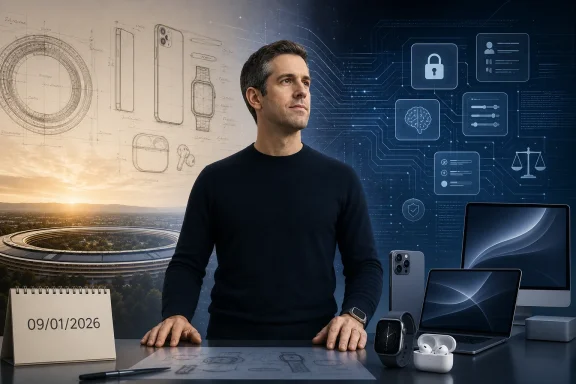 Ternus Inherits the House That Cook Fortified
Tim Cook’s Apple was never the anti-design Apple. That caricature survives because it is useful: Steve Jobs and Jony Ive as the priests of product taste; Cook as the logistics man who made the machines arrive on time. But history is less tidy. Under Cook, Apple turned the iPhone into the center of a services empire, transitioned the Mac to Apple Silicon, built a wearables business around the Apple Watch and AirPods, and became one of the most valuable companies in the world.The criticism is not that Cook failed. It is that Apple’s center of gravity shifted. The company became more cautious, more optimized, and more structurally dependent on yearly refresh cycles, supply-chain mastery, and ecosystem lock-in. For shareholders, that was a triumph. For people who remember Apple as a company that occasionally made the rest of the industry look embarrassed, it felt like a slow sanding-down of nerve.
That is the opening Ternus now occupies. He is not an outside savior arriving to rescue a broken institution. He is a hardware executive produced by the institution, elevated precisely because Apple wants continuity with enough visible change to mark a new chapter. His reported comments about design being core to Apple are therefore less a manifesto than a signal: the next CEO wants the market, employees, and rivals to see him as a product leader.
The signal matters because Apple’s leadership structure has been visibly different since Jony Ive’s departure. Design no longer appears to sit above the product roadmap in the way Jobs once arranged it. The design organization has been reorganized, senior roles have shifted, and Apple has lacked the singular public design authority it once had. Ternus spending significant time with industrial design is not a revolution by itself, but it is a useful tell about where he wants legitimacy to come from.
Design Was Never Just the Shape of the Thing
The easiest way to misunderstand this story is to reduce it to hardware aesthetics. Apple’s design culture was never only about thinner lids, smoother chamfers, or the precise radius of a phone corner. At its strongest, Apple used design as a way to decide what a product was allowed to be. It cut ports before customers were ready, removed drives before the market had finished mourning them, and fused hardware, software, and retail into experiences competitors struggled to copy.That is why a renewed design emphasis could be meaningful — if Ternus means design as product authority rather than surface polish. The distinction matters. Apple already knows how to make beautiful objects. What it has struggled with more recently is making every part of the experience feel as intentional as the object itself.
Windows users and administrators know this divide well. A laptop can have a gorgeous enclosure and still be annoying to manage. A phone can feel luxurious and still route too much of the user’s life through opaque cloud settings. A headset can be a feat of industrial engineering and still fail to explain why ordinary people should wear it.
Apple’s design problem, if it has one, is not that its hardware looks bad. It is that some of its most important products now live at the intersection of form, software policy, AI behavior, subscription economics, privacy claims, developer rules, and regulatory pressure. In that world, the “design team” cannot merely be the group that perfects the shell. It has to be the group that asks whether the whole product makes coherent sense.
The Cook Era Made Apple Safer, Richer, and Harder to Surprise
Cook’s Apple was built around operational excellence, and that changed the company’s risk profile. The iPhone became a yearly engine. The Mac became more efficient and more vertically integrated. The Apple Watch matured from curiosity into a category leader. Services turned installed devices into recurring revenue.That operating model rewarded discipline. It also made Apple more incremental. The company could afford to wait, refine, and enter markets only when its integration advantage was clear. That patience worked spectacularly with Apple Silicon. It has been less convincing in generative AI, where Apple has appeared cautious while competitors flood the zone with assistants, agents, cloud features, and dubious demos.
Ternus will not be able to design his way out of that merely by sitting closer to industrial design. The next Apple will have to make choices about what intelligence belongs on-device, what belongs in the cloud, and how much autonomy users should trust to a company that still sells privacy as a premium feature. Those are design questions, but they are also infrastructure questions, policy questions, and developer-platform questions.
This is where the Windows world should pay attention. Microsoft’s recent history shows what happens when a platform company tries to graft AI ambition onto a mature operating system used by hundreds of millions of people with very different tolerances for risk. Apple has a more controlled stack, but it is not immune to the same tension. The more personal computing becomes predictive and agentic, the more design becomes governance.
A Product CEO Does Not Automatically Mean a Product Renaissance
There is a seductive simplicity to the “product person replaces operations person” narrative. It flatters everyone who believes Apple lost something after Jobs. It gives investors a clean succession story. It gives fans permission to imagine that the next iPhone, Mac, or wearable will feel less constrained by the spreadsheet.But big companies do not pivot because one executive has better taste. Apple’s product pipeline is measured in years, not quarters. The iPhone 18 family, expected around the time Ternus formally takes over, will not be a pure Ternus-era artifact. Nor will the rumored foldable iPhone or anniversary-era devices that have reportedly been in testing long before he occupies the CEO chair.
That lag is important. The first Ternus keynote may look like a coronation, but it will likely sell products conceived under the system he inherits. The real test will come later, when Apple ships devices and software that reflect decisions made after he has both formal authority and political capital.
Even then, the question will not be whether Apple can produce a more dramatic object. It will be whether Ternus can make the company more decisive without making it reckless. Apple’s great strength is that it says no more often than most companies. Its recent weakness is that some of those refusals have looked less like taste and more like institutional caution.
The Design Team’s Authority Is Really a Fight Over Who Gets to Say No
Inside any large technology company, power is often measured by veto rights. Engineering can say something is impossible. Operations can say it cannot be built at scale. Finance can say the margin does not work. Legal can say regulators will object. Marketing can say the story will not land.Apple’s old design mystique came from the belief that design could override all of them. Not always, not magically, but often enough that the company’s products felt unusually opinionated. If Ternus is indeed trying to restore some of that authority, the practical question is simple: when design and operations disagree, who wins?
That question has consequences beyond Apple Park. If design gains more power, Apple may accept more manufacturing complexity to produce devices that feel genuinely new. It may tolerate more short-term friction in the name of stronger long-term product identity. It may also make decisions that annoy pro users, developers, repair advocates, and enterprise buyers if those groups are judged to be outside the desired experience.
Apple has done that before. Sometimes it was right. Sometimes it mistook minimalism for wisdom. A more design-led Apple could be bolder, but bolder does not always mean better.
The Foldable iPhone Will Be a Symbol Before It Is a Strategy
The rumored foldable iPhone looms over the Ternus transition because it is exactly the kind of product that invites symbolic reading. Apple entering foldables would be late by Android standards, but Apple has rarely cared about being first. It cares about arriving when it believes it can define the mainstream version of a category.A foldable iPhone would also be a perfect test of Ternus’s design rhetoric. Foldables are engineering compromises made visible: crease, hinge, thickness, battery, durability, app layout, repair cost, and price all fight for priority. There is no pure solution. There is only a hierarchy of trade-offs.
If Apple ships one, the company will present those trade-offs as resolved. That is what Apple does. The more interesting read will be whether the device changes how people use iPhones or merely gives high-end buyers a more expensive version of the same grid of apps. A foldable that exists only to match Samsung is not a design triumph. A foldable that creates a credible new computing pattern might be.
For Windows users, the parallel is obvious. Microsoft and its OEM partners have spent years experimenting with dual-screen devices, foldables, detachable keyboards, pen-first workflows, and hybrid PCs. The lesson is that hardware novelty does not create a use case by itself. Software has to meet the hinge halfway.
Apple’s Real Design Crisis Is Software Trust
If Ternus wants to make design Apple’s north star again, he should start with the places where users feel least in control. Settings sprawl. Notification management. iCloud confusion. App Store rules. AI permissions. Family controls. Cross-device handoff that is magical when it works and maddening when it does not.These are not glamorous design problems, but they are central to the user experience. They also matter more as Apple asks customers to trust devices with increasingly intimate tasks. A camera in AirPods, if Apple ever ships such a thing, would not merely be a hardware feature. It would be a privacy interface, a social signal, a data pipeline, and a moderation problem.
This is where Apple’s old design language can become dangerous if taken too narrowly. “Beautifully designed” cannot just mean that the product looks inevitable in a press photo. It must mean that the product’s behavior is legible. Users should understand when sensors are active, where data goes, how AI-derived suggestions are produced, and how to disable features without spelunking through nested menus.
Microsoft has learned this lesson the hard way in Windows. Features that look clever in a controlled demo can become reputational liabilities when users believe the operating system is watching, nudging, advertising, or changing defaults without clear consent. Apple’s brand gives it more trust to spend, but not infinite trust.
The Enterprise Will Measure Ternus by Manageability, Not Romance
Apple’s consumer mythology often obscures how much ground the company has gained in business environments. Macs are no longer exotic exceptions in many organizations. iPhones are default corporate endpoints. iPads, Apple Watches, and services sit inside fleets that IT departments must secure, update, inventory, and support.Those customers care about design, but they define it differently. A sysadmin’s ideal design is not just a thin laptop with a great screen. It is a deployment workflow that does not break, a security model that can be audited, update behavior that can be planned, and hardware lifecycles that do not surprise the budget committee.
Ternus’s hardware background could help here. Apple Silicon made the Mac more compelling in enterprise environments by delivering performance, battery life, and consistency that Windows OEMs have had to chase. But the next phase will be less about raw silicon advantage and more about management clarity, identity integration, compliance, and AI controls.
This is another reason the design-team story is bigger than the design team. If Apple treats enterprise needs as mere checkboxes after consumer products are finished, it will leave room for Microsoft, Dell, Lenovo, HP, and the broader Windows ecosystem to argue that manageability is its own form of product quality. If Apple designs for administration as deliberately as it designs for unboxing, it becomes more dangerous in the workplace.
The Windows Ecosystem Should Not Dismiss This as Apple Theater
It is tempting for Windows partisans to roll their eyes at another round of Apple introspection. Cupertino says “design,” the press says “Jony Ive,” and everyone performs the familiar ritual. But that would miss the competitive point.Apple’s leadership transition comes as the PC industry is trying to redefine itself around AI hardware, local acceleration, cloud-connected assistants, and new device forms. Microsoft wants Windows to become the natural home of AI-assisted work. Qualcomm, Intel, AMD, and Nvidia all want a piece of the next client-computing story. OEMs are looking for differentiation beyond thinner bezels and brighter OLED panels.
A more product-aggressive Apple could sharpen that fight. If Ternus pushes Apple to make the Mac, iPhone, Watch, AirPods, and future wearables feel like a more coherent personal-computing fabric, Windows vendors will not be competing with a single device. They will be competing with a tightly choreographed system.
That is not new, but it is becoming more important. The next platform war may be less about operating-system features than about which ecosystem can make AI, identity, sensors, payments, health data, and personal context feel useful without feeling invasive. Apple has advantages there, but also constraints. Its privacy promises limit some data-hungry AI models, and its App Store control invites regulatory scrutiny.
Windows has the opposite problem. Its openness and hardware diversity are strengths, but they make coherence harder. Microsoft can announce a vision; OEMs, silicon vendors, enterprise policies, legacy apps, and regional rules all get a vote. Apple can move with more unity — if Ternus can get the internal hierarchy aligned.
The Myth of the Old Apple Is a Trap for the New One
The most dangerous version of the Ternus story is nostalgia. Apple cannot simply recreate the Jobs-Ive era because the market that produced it no longer exists. The smartphone is mature. The laptop is mature. Regulators are more aggressive. Developers are more skeptical. Consumers are more privacy-aware and subscription-fatigued. AI has made software behavior feel less deterministic.A CEO who tries to restore design by imitating old Apple risks confusing purity with relevance. The next great Apple product may not be the one with the fewest visible seams. It may be the one that best explains itself in a world where devices observe, infer, and act.
That requires humility as much as taste. Apple has often been at its best when it hides complexity. But AI and ambient sensing may require a different bargain: not hiding complexity entirely, but making the user’s relationship to it understandable. The design challenge is no longer just to make technology disappear. Sometimes it is to make technology accountable.
Ternus’s reported language about Apple customers owning the most beautifully designed object in their lives is classic Apple confidence. It is also a little revealing. The object still matters. But the future of Apple may depend less on whether the object is beautiful than on whether the system around it feels worthy of the same adjective.
The Ternus Test Will Be Written in Trade-Offs
The next few years will tell us whether this is a real governance shift or a succession narrative dressed in brushed aluminum. Apple does not need to prove that it can design premium hardware. It needs to prove that design can still make hard decisions across the entire stack.- Ternus becomes Apple CEO on September 1, 2026, with Tim Cook moving into an executive chairman role rather than disappearing from the company’s power structure.
- Recent reporting says Ternus has been spending substantial time with Apple’s industrial design group and wants design to remain central to Apple’s identity.
- The earliest products announced under Ternus will largely reflect decisions made before his CEO tenure, so the real evidence of his influence may not appear for several product cycles.
- A foldable iPhone, if introduced, will test whether Apple can turn a mature rival category into a mainstream Apple experience rather than simply validate an existing Android form factor.
- For IT departments, the most important design improvements may come in deployment, security, update control, identity, and AI governance rather than in visible hardware changes.
- For the Windows ecosystem, a more design-led Apple would raise the competitive bar for coherence at precisely the moment PCs are trying to reinvent themselves around AI.
References
- Primary source: AppleInsider
Published: 2026-06-21T15:30:10.634031
John Ternus plans to shake up Apple's design work
John Ternus has been talking about focusing on Apple's core strength of design once he takes over as CEO, and a now a questionable report extrapolates that this means he'll shake up the design team.appleinsider.com - Independent coverage: 9to5Mac
Published: 2026-06-21T15:30:10.632967
John Ternus set to re-establish importance of Apple's design team when he takes over as CEO: report - 9to5Mac
Bloomberg’s Mark Gurman today posted the latest edition of his Power On newsletter, recapping the last ten years of Apple’s...9to5mac.com - Related coverage: techcrunch.com
Tim Cook stepping down as Apple CEO, John Ternus taking over | TechCrunch
The transition has been expected for some time and ends one of the longer and more impactful runs a CEO has had at any company. Cook had inherited a company that many industry watchers and enthusiasts struggled to separate from its famed founder. What he leaves behind is a $4 trillion business...techcrunch.com - Official source: apple.com
Tim Cook to become Apple Executive Chairman John Ternus to become Apple CEO - Apple (GQ)
Apple announced Tim Cook will become executive chairman of Apple’s board of directors and John Ternus will become Apple’s next CEO.www.apple.com - Related coverage: tomsguide.com
Apple's Tim Cook steps aside as John Ternus becomes the new CEO | Tom's Guide
After 15 years at the helm of Apple, Tim Cook is handing over the reins to John Ternus.www.tomsguide.com - Related coverage: businesswire.com
- Related coverage: investing.com
Tim Cook steps down as Apple CEO after 1,000% growth; John Ternus named successor By Investing.com
Tim Cook steps down as Apple CEO after 1,000% growth; John Ternus named successorwww.investing.com - Related coverage: arstechnica.com
John Ternus will replace Tim Cook as Apple CEO - Ars Technica
Cook will be executive chairman but will no longer run the company day to day.arstechnica.com - Related coverage: macrumors.com
Apple 'Shakes Up' Oversight of Product Design Ahead of CEO Change
In his new role as Chief Hardware Officer, Apple's longtime chipmaking chief Johny Srouji has reorganized the company's hardware development leadership "to speed up work on future devices," according to Bloomberg's Mark Gurman. The reshuffling is aimed at bringing chip and product development...www.macrumors.com - Related coverage: macworld.com
Tim Cook to step down as Apple CEO in shock announcement | Macworld
John Ternus will take over as CEO on September 1, while Cook will stay on as chairman of Apple’s board of directors.www.macworld.com - Related coverage: tomshardware.com
Apple CEO Tim Cook steps down, company names Ternus as incoming CEO | Tom's Hardware
Ternus has overseen many high-profile projects, including the recent MacBook Neo.www.tomshardware.com - Related coverage: digitalcameraworld.com
John Ternus takes over from Tim Cook at Apple. Finally, we have a CEO who understands cameras, probably! | Digital Camera World
Apple's new CEO, John Ternus, has been announced, and it's good news for those of us who prefer optical cameraswww.digitalcameraworld.com - Related coverage: elpais.com
Loading…
elpais.com - Related coverage: e24.no
Loading…
e24.no - Related coverage: static.poder360.com.br
Loading…
static.poder360.com.br - Related coverage: issuewire.com
Loading…
www.issuewire.com - Related coverage: goiam.org
Loading…
www.goiam.org