
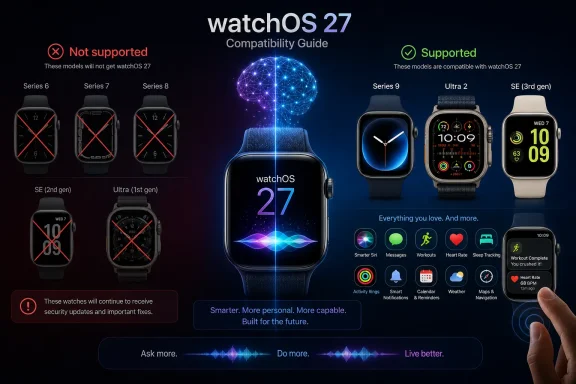
Apple’s watchOS 27 compatibility cutoff, announced at WWDC 2026, excludes Apple Watch Series 6, Series 7, Series 8, Apple Watch SE 2, and the original Apple Watch Ultra from the next major software release. The practical reason is Siri AI, but the deeper story is Apple redrawing the useful life of its wrist computer around on-device intelligence. For users, the watch will still tell time, track workouts, and pair with newer iPhones; for Apple, the watch has crossed into a phase where “supported” no longer means “included.”
The Apple Watch has always lived in the shadow of the iPhone’s unusually long software runway. An iPhone from 2019 getting another major iOS release feels normal now, because Apple trained the market to expect it. The watch, by contrast, has now been pushed into a sharper cadence: if your device predates the S9 generation, the watchOS 27 train is leaving without you.
That is a jarring break because the affected models are not all ancient. The Apple Watch Series 6 dates back to 2020, which makes its cutoff unsurprising by Apple standards. But the Series 8, second-generation SE, and original Ultra arrived in 2022, and the Ultra in particular was sold as a premium, rugged, long-haul device rather than a disposable accessory.
Apple’s explanation is technically plausible. watchOS 27’s headline features lean on Siri AI, new gesture handling, and a broader intelligence layer that benefits from newer silicon. The Series 9, Ultra 2, and SE 3 sit on the right side of that line; the S6, S7, and S8 generations do not.
But plausibility is not the same thing as satisfaction. Apple has spent years selling the Watch as a health and safety device, not simply as a tiny notification screen. When a product is positioned as part trainer, part medical-adjacent monitor, part emergency lifeline, a three- or four-year feature cutoff lands differently than it would on a fashion accessory.
That argument is stronger than the usual “we want the best experience” boilerplate. The Apple Watch is constrained by battery size, thermals, memory, and the realities of voice interaction in a form factor that cannot simply brute-force workloads the way a Mac or iPad can. If Apple wants Siri to feel instant, contextual, and useful on the wrist, older chips may be more than an inconvenience.
Still, the cutoff reveals how Apple is using AI as a new compatibility gate. For years, the dividing line in watchOS was often whether older hardware could run the interface, health APIs, and background services acceptably. With watchOS 27, the dividing line appears to be whether a device can participate in the next generation of Apple Intelligence.
That is a meaningful shift. A watch that can run the app grid, display widgets, monitor heart rate, track sleep, make payments, and call emergency services may still be excluded because it cannot deliver the new assistant experience Apple wants to make central. The operating system is no longer merely a platform for watch apps; it is becoming the delivery vehicle for ambient AI.
That is why its exclusion from watchOS 27 feels more symbolic than the loss of Series 6. The Ultra was supposed to be the watch you bought when you wanted more headroom. Less than four years later, it is being told that the next major software chapter is too demanding.
The technical explanation is that the original Ultra shares its underlying silicon generation with the Series 8 era, not the S9 generation that introduced a more meaningful jump for on-device Siri processing. In product-line terms, that makes the cutoff neat. In customer terms, it makes the Ultra’s premium promise look thinner.
Premium devices create premium expectations. A rugged watch that survives trails, saltwater, impacts, and long workouts can still be stranded by a software boundary it cannot physically show on its titanium case. That mismatch between durable hardware and fast-moving AI software is going to become one of the central tensions in consumer electronics.
Apple appears to have decided that the Watch is different. A fragmented watchOS 27, with some devices getting the shell but not the intelligence layer, may have been more trouble than it was worth. The Watch has a smaller screen, a tighter interaction model, and less room for disclaimers than the iPhone.
That may be sensible product management, but it is also a hard customer message. The owner of a Series 8 is not being told, “You can have watchOS 27 without Siri AI.” They are being told, “Your device remains on watchOS 26, aside from security maintenance.”
For sysadmins and fleet managers, the clean break has advantages. Compatibility lists are simpler. Testing matrices are smaller. The answer to “Which watches get watchOS 27?” is not buried under feature exceptions and regional caveats. But for individual users, especially those who bought a recent SE or Ultra, a clean break looks a lot like a cliff.
The iPhone is Apple’s anchor product, and its long update cycle is part of the company’s brand. It helps justify high prices, strengthens resale values, and reassures enterprise buyers that a deployment can survive several budget cycles. The Watch has benefited from that halo without always matching the same support pattern.
That difference may now become more visible. Consumers increasingly compare update commitments across categories, not just within them. Google and Samsung have pushed longer Android support windows, while Apple has relied on its historical reputation for longevity. A premium Apple Watch losing feature support after three to four years complicates that reputation.
Apple can argue, fairly, that watches are not phones. They have smaller batteries, smaller processors, and different thermal constraints. But customers do not experience product strategy as a semiconductor lecture. They experience it as a device they bought recently no longer getting the new software their phone will receive.
For many users, that will be enough. The watch will still show notifications, run existing apps, track fitness, handle Apple Pay, log sleep, and perform the daily rituals people actually bought it for. The absence of Siri AI may be annoying, but it does not remove the core watch experience overnight.
The security-update promise is especially important because wearables collect sensitive data. A watch knows when you sleep, where you exercise, how your heart behaves, and when you fall. Leaving such devices unpatched would be indefensible, so Apple’s continued security support is not a courtesy; it is the minimum acceptable standard.
But security maintenance is a very different thing from platform participation. Once a device stops receiving major watchOS releases, developers begin to move on. New APIs target the current OS. New complications, health features, app experiences, and automation hooks gradually assume the newer baseline. The watch keeps functioning, but the ecosystem starts drifting away.
That could matter for apps that use voice input, live coaching, health interpretation, and context-aware prompts. The Watch has often been a platform of good ideas constrained by weak interaction. Siri AI is Apple’s attempt to make the wrist less dependent on taps, swipes, and tiny lists.
The risk is that developers overestimate how fast the installed base will move. Apple Watch owners do not necessarily upgrade annually, and many users buy older or discounted models precisely because the Watch is an accessory to the iPhone rather than a primary device. If a large share of active watches remain on watchOS 26, developers will still need to support them.
That leaves the platform in a familiar split. The most exciting features target the newest hardware; the largest real-world audience may be one or two generations behind. Apple can push the future, but developers have to live in the present.
A watch that remains on watchOS 26 but pairs with an iPhone on iOS 27 creates a mixed-version environment. That may be fine for most organizations, but it complicates support documentation, help desk scripts, app compatibility testing, and security posture reporting. The more Apple Intelligence becomes a cross-device feature, the more those version mismatches matter.
There is also a privacy angle. Siri AI on the wrist will invite new questions about what data is processed locally, what is relayed through the paired iPhone, and what goes to Apple’s cloud infrastructure. Organizations that allow or encourage Apple Watch use will need to understand whether the new assistant changes the data boundary.
The immediate action for IT teams is mundane but necessary: know which watches are in use. If an organization has deployed Apple Watch SE 2 units for employee wellness or operational workflows, those devices are now on a different path from SE 3. If executives bought original Ultras expecting long support, support teams will be fielding uncomfortable questions.
That does not mean the cutoff is fake. Hardware constraints can be real while also serving a commercial purpose. The smartest platform decisions often sit at that intersection: technically defensible, operationally simplifying, and conveniently aligned with future sales.
The discomfort comes from Apple’s lack of granularity. The company is not saying that Series 8 could run some watchOS 27 features badly, or that the original Ultra lacks a specific neural engine threshold, or that battery life would fall below a defined target. It is saying the new features work best on newer watches, and that older watches therefore stay behind.
That kind of explanation is normal in consumer tech, but AI makes it less satisfying. As vendors increasingly use machine learning features to justify hardware cutoffs, users will want sharper answers. “Processing power” is a category, not an explanation.
AI gives Apple a new answer to that old limitation. If the watch cannot be a tiny iPhone, it can become a sensor-rich assistant that knows enough context to reduce friction. Siri AI is not just a voice feature in that framing; it is the interface Apple wanted for the Watch all along.
That explains why Apple may be unwilling to support watchOS 27 on devices that cannot run the assistant convincingly. A slow or inconsistent Siri on the wrist would be worse than no Siri AI at all. People forgive latency on a phone more readily than on a device they raise to their face for a two-second command.
But this also raises the stakes. If Apple is going to cut off expensive watches in the name of Siri AI, the feature has to be good. A compatibility cliff is easier to defend when the promised experience feels transformative. If Siri AI arrives late, limited, or uneven, the cutoff will look less like discipline and more like premature platform pruning.
The asterisk is not that Apple abandons watches overnight. It does not. The older models will continue working, and security updates are expected to keep them viable for some time. The asterisk is that major feature eligibility may now depend on AI-era silicon more than on the age or price tier of the device.
That changes the buying advice. If you are purchasing an Apple Watch in 2026, the minimum sensible target is no longer “anything Apple still sells at a discount.” It is a model with the newer silicon line that Apple has chosen as the watchOS 27 floor. Saving money on an older refurbished watch may still make sense, but only if you are comfortable living outside the next major software branch.
It also changes how we should read Apple’s product tiers. The SE is not just the cheaper watch; it is a support-risk calculation. The Ultra is not automatically the longest-lived watch; its underlying chip generation matters more than its case material, battery, or price.
That is the optimistic reading. The less generous reading is that Apple has found a new way to accelerate the watch upgrade cycle under the cover of AI. Both can be true. Platform transitions are rarely pure.
For users, the practical calculus is straightforward. If you own a Series 6, Series 7, Series 8, SE 2, or original Ultra, there is no immediate need to panic. Your watch remains useful, and if it still meets your needs, replacing it solely for watchOS 27 may be hard to justify until Siri AI proves itself.
But if you were already considering an upgrade, watchOS 27 gives you a clearer reason. The next software generation starts at Series 9 and Ultra 2, and that line is likely to shape developer assumptions for years. Buying below it now means buying into the past.
 Apple Just Made the Watch’s Upgrade Cycle Feel Much Shorter
The Apple Watch has always lived in the shadow of the iPhone’s unusually long software runway. An iPhone from 2019 getting another major iOS release feels normal now, because Apple trained the market to expect it. The watch, by contrast, has now been pushed into a sharper cadence: if your device predates the S9 generation, the watchOS 27 train is leaving without you.That is a jarring break because the affected models are not all ancient. The Apple Watch Series 6 dates back to 2020, which makes its cutoff unsurprising by Apple standards. But the Series 8, second-generation SE, and original Ultra arrived in 2022, and the Ultra in particular was sold as a premium, rugged, long-haul device rather than a disposable accessory.
Apple’s explanation is technically plausible. watchOS 27’s headline features lean on Siri AI, new gesture handling, and a broader intelligence layer that benefits from newer silicon. The Series 9, Ultra 2, and SE 3 sit on the right side of that line; the S6, S7, and S8 generations do not.
But plausibility is not the same thing as satisfaction. Apple has spent years selling the Watch as a health and safety device, not simply as a tiny notification screen. When a product is positioned as part trainer, part medical-adjacent monitor, part emergency lifeline, a three- or four-year feature cutoff lands differently than it would on a fashion accessory.
Siri AI Is the Explanation, but Silicon Is the Policy
Apple’s public framing is that watchOS 27 needs the processing power found in Apple Watch Series 9 and later, Ultra 2 and later, and SE 3. Cait Dooley, Apple’s Watch and Health product marketing manager, has tied the cutoff to the capabilities behind Siri AI and a new tap gesture. David Clark, Apple’s senior director of watchOS software engineering, has described the watch as a natural place for Apple’s broader intelligence strategy because it is on the wrist all day.That argument is stronger than the usual “we want the best experience” boilerplate. The Apple Watch is constrained by battery size, thermals, memory, and the realities of voice interaction in a form factor that cannot simply brute-force workloads the way a Mac or iPad can. If Apple wants Siri to feel instant, contextual, and useful on the wrist, older chips may be more than an inconvenience.
Still, the cutoff reveals how Apple is using AI as a new compatibility gate. For years, the dividing line in watchOS was often whether older hardware could run the interface, health APIs, and background services acceptably. With watchOS 27, the dividing line appears to be whether a device can participate in the next generation of Apple Intelligence.
That is a meaningful shift. A watch that can run the app grid, display widgets, monitor heart rate, track sleep, make payments, and call emergency services may still be excluded because it cannot deliver the new assistant experience Apple wants to make central. The operating system is no longer merely a platform for watch apps; it is becoming the delivery vehicle for ambient AI.
The Original Ultra Is the Cut That Hurts Apple’s Story
The first-generation Apple Watch Ultra is the most awkward casualty. It was introduced as Apple’s most capable watch, aimed at endurance athletes, divers, hikers, and people willing to pay a premium for durability and battery life. It was not marketed as an entry-level compromise.That is why its exclusion from watchOS 27 feels more symbolic than the loss of Series 6. The Ultra was supposed to be the watch you bought when you wanted more headroom. Less than four years later, it is being told that the next major software chapter is too demanding.
The technical explanation is that the original Ultra shares its underlying silicon generation with the Series 8 era, not the S9 generation that introduced a more meaningful jump for on-device Siri processing. In product-line terms, that makes the cutoff neat. In customer terms, it makes the Ultra’s premium promise look thinner.
Premium devices create premium expectations. A rugged watch that survives trails, saltwater, impacts, and long workouts can still be stranded by a software boundary it cannot physically show on its titanium case. That mismatch between durable hardware and fast-moving AI software is going to become one of the central tensions in consumer electronics.
Apple Chose a Clean Break Over a Messy Feature Matrix
The obvious alternative would have been watchOS 27 Lite: ship the visual changes, app updates, and non-AI improvements to older watches while withholding Siri AI and the new gesture features. Apple already does this elsewhere. iPhones can receive a major iOS version without receiving every Apple Intelligence feature, and Mac features have long varied by chip generation.Apple appears to have decided that the Watch is different. A fragmented watchOS 27, with some devices getting the shell but not the intelligence layer, may have been more trouble than it was worth. The Watch has a smaller screen, a tighter interaction model, and less room for disclaimers than the iPhone.
That may be sensible product management, but it is also a hard customer message. The owner of a Series 8 is not being told, “You can have watchOS 27 without Siri AI.” They are being told, “Your device remains on watchOS 26, aside from security maintenance.”
For sysadmins and fleet managers, the clean break has advantages. Compatibility lists are simpler. Testing matrices are smaller. The answer to “Which watches get watchOS 27?” is not buried under feature exceptions and regional caveats. But for individual users, especially those who bought a recent SE or Ultra, a clean break looks a lot like a cliff.
The iPhone Comparison Makes the Watch Look Disposable
The contrast with iOS 27 is hard to ignore. Apple is reportedly keeping iOS 27 support alive for iPhones as old as the iPhone 11, while watchOS 27 drops watch models released years later. Even accounting for different chips, batteries, and form factors, that gap will shape the reaction.The iPhone is Apple’s anchor product, and its long update cycle is part of the company’s brand. It helps justify high prices, strengthens resale values, and reassures enterprise buyers that a deployment can survive several budget cycles. The Watch has benefited from that halo without always matching the same support pattern.
That difference may now become more visible. Consumers increasingly compare update commitments across categories, not just within them. Google and Samsung have pushed longer Android support windows, while Apple has relied on its historical reputation for longevity. A premium Apple Watch losing feature support after three to four years complicates that reputation.
Apple can argue, fairly, that watches are not phones. They have smaller batteries, smaller processors, and different thermal constraints. But customers do not experience product strategy as a semiconductor lecture. They experience it as a device they bought recently no longer getting the new software their phone will receive.
Security Updates Are the Safety Net, Not the Feature Roadmap
Apple says older watches will continue to work with iPhones running the latest software and will receive security updates. That matters. A Series 7 or original Ultra is not suddenly useless when paired to an iPhone on iOS 27.For many users, that will be enough. The watch will still show notifications, run existing apps, track fitness, handle Apple Pay, log sleep, and perform the daily rituals people actually bought it for. The absence of Siri AI may be annoying, but it does not remove the core watch experience overnight.
The security-update promise is especially important because wearables collect sensitive data. A watch knows when you sleep, where you exercise, how your heart behaves, and when you fall. Leaving such devices unpatched would be indefensible, so Apple’s continued security support is not a courtesy; it is the minimum acceptable standard.
But security maintenance is a very different thing from platform participation. Once a device stops receiving major watchOS releases, developers begin to move on. New APIs target the current OS. New complications, health features, app experiences, and automation hooks gradually assume the newer baseline. The watch keeps functioning, but the ecosystem starts drifting away.
Developers Now Have a Smaller, Smarter Target
For developers, the watchOS 27 cutoff may be frustrating in the short term but clarifying in the long term. Supporting older Apple Watch hardware has always meant designing around limited performance, tiny batteries, and uncertain user patience. If watchOS 27 establishes S9-class hardware as the new floor, developers can assume more capability.That could matter for apps that use voice input, live coaching, health interpretation, and context-aware prompts. The Watch has often been a platform of good ideas constrained by weak interaction. Siri AI is Apple’s attempt to make the wrist less dependent on taps, swipes, and tiny lists.
The risk is that developers overestimate how fast the installed base will move. Apple Watch owners do not necessarily upgrade annually, and many users buy older or discounted models precisely because the Watch is an accessory to the iPhone rather than a primary device. If a large share of active watches remain on watchOS 26, developers will still need to support them.
That leaves the platform in a familiar split. The most exciting features target the newest hardware; the largest real-world audience may be one or two generations behind. Apple can push the future, but developers have to live in the present.
Enterprise IT Gets a New Reason to Inventory Wearables
Most enterprise conversations about Apple compatibility still revolve around Macs, iPhones, and iPads. Watches rarely sit at the center of endpoint management strategy, unless the organization has health, logistics, retail, or frontline-worker use cases. watchOS 27 is a reminder that wearables are endpoints too, even if they are not always treated as such.A watch that remains on watchOS 26 but pairs with an iPhone on iOS 27 creates a mixed-version environment. That may be fine for most organizations, but it complicates support documentation, help desk scripts, app compatibility testing, and security posture reporting. The more Apple Intelligence becomes a cross-device feature, the more those version mismatches matter.
There is also a privacy angle. Siri AI on the wrist will invite new questions about what data is processed locally, what is relayed through the paired iPhone, and what goes to Apple’s cloud infrastructure. Organizations that allow or encourage Apple Watch use will need to understand whether the new assistant changes the data boundary.
The immediate action for IT teams is mundane but necessary: know which watches are in use. If an organization has deployed Apple Watch SE 2 units for employee wellness or operational workflows, those devices are now on a different path from SE 3. If executives bought original Ultras expecting long support, support teams will be fielding uncomfortable questions.
The Upgrade Pitch Is Conveniently Timed
Apple’s cutoff also lands exactly where product strategy would want it to land. The Series 9 and Ultra 2 are the first accepted generation for watchOS 27, while newer Series 10, Series 11, Ultra 3, and SE 3 models form the obvious upgrade path. The company can now sell Siri AI not merely as a feature, but as a reason older-watch owners should move.That does not mean the cutoff is fake. Hardware constraints can be real while also serving a commercial purpose. The smartest platform decisions often sit at that intersection: technically defensible, operationally simplifying, and conveniently aligned with future sales.
The discomfort comes from Apple’s lack of granularity. The company is not saying that Series 8 could run some watchOS 27 features badly, or that the original Ultra lacks a specific neural engine threshold, or that battery life would fall below a defined target. It is saying the new features work best on newer watches, and that older watches therefore stay behind.
That kind of explanation is normal in consumer tech, but AI makes it less satisfying. As vendors increasingly use machine learning features to justify hardware cutoffs, users will want sharper answers. “Processing power” is a category, not an explanation.
The Watch Is Becoming an AI Endpoint Before It Becomes a Better Computer
The Apple Watch has always been a strange device. It is intimate, useful, and limited. It can summon help in an emergency, detect a workout, unlock a Mac, and remind you to stand, but it has never become the general-purpose wrist computer once imagined by early smartwatch hype.AI gives Apple a new answer to that old limitation. If the watch cannot be a tiny iPhone, it can become a sensor-rich assistant that knows enough context to reduce friction. Siri AI is not just a voice feature in that framing; it is the interface Apple wanted for the Watch all along.
That explains why Apple may be unwilling to support watchOS 27 on devices that cannot run the assistant convincingly. A slow or inconsistent Siri on the wrist would be worse than no Siri AI at all. People forgive latency on a phone more readily than on a device they raise to their face for a two-second command.
But this also raises the stakes. If Apple is going to cut off expensive watches in the name of Siri AI, the feature has to be good. A compatibility cliff is easier to defend when the promised experience feels transformative. If Siri AI arrives late, limited, or uneven, the cutoff will look less like discipline and more like premature platform pruning.
Apple’s Support Reputation Now Has an Asterisk on the Wrist
Apple still has one of the strongest update stories in the consumer electronics industry. That remains true even after watchOS 27. But the Watch now carries an asterisk that buyers should understand before they spend Ultra-level money.The asterisk is not that Apple abandons watches overnight. It does not. The older models will continue working, and security updates are expected to keep them viable for some time. The asterisk is that major feature eligibility may now depend on AI-era silicon more than on the age or price tier of the device.
That changes the buying advice. If you are purchasing an Apple Watch in 2026, the minimum sensible target is no longer “anything Apple still sells at a discount.” It is a model with the newer silicon line that Apple has chosen as the watchOS 27 floor. Saving money on an older refurbished watch may still make sense, but only if you are comfortable living outside the next major software branch.
It also changes how we should read Apple’s product tiers. The SE is not just the cheaper watch; it is a support-risk calculation. The Ultra is not automatically the longest-lived watch; its underlying chip generation matters more than its case material, battery, or price.
The Cutoff Is Less About This Year Than the Next Three
The watchOS 27 decision is best understood as a reset. Apple is establishing a new baseline for the Watch at the moment it wants Siri AI and gesture-driven interaction to become central. Once that baseline is set, future watchOS releases can build with fewer compromises.That is the optimistic reading. The less generous reading is that Apple has found a new way to accelerate the watch upgrade cycle under the cover of AI. Both can be true. Platform transitions are rarely pure.
For users, the practical calculus is straightforward. If you own a Series 6, Series 7, Series 8, SE 2, or original Ultra, there is no immediate need to panic. Your watch remains useful, and if it still meets your needs, replacing it solely for watchOS 27 may be hard to justify until Siri AI proves itself.
But if you were already considering an upgrade, watchOS 27 gives you a clearer reason. The next software generation starts at Series 9 and Ultra 2, and that line is likely to shape developer assumptions for years. Buying below it now means buying into the past.
The New Apple Watch Rule Is Hidden in the Chip Name
The shortest version of the watchOS 27 story is that Apple has moved the Watch into the AI-support era. The details matter, because this is not just a list of compatible devices; it is a preview of how Apple will manage older hardware when intelligence features become the platform.- Apple Watch Series 6, Series 7, Series 8, Apple Watch SE 2, and the original Apple Watch Ultra are excluded from watchOS 27.
- Apple Watch Series 9 and later, Apple Watch Ultra 2 and later, and Apple Watch SE 3 are on the supported side of the new cutoff.
- Older watches should continue pairing with iPhones running iOS 27 and should continue receiving security updates, but they will not get the new watchOS 27 feature set.
- Apple’s stated rationale centers on Siri AI, the new tap gesture, and the processing requirements of making intelligence features work well on the wrist.
- The original Apple Watch Ultra is the most controversial casualty because it was sold as a premium durable device but shares the older silicon generation.
- Buyers should now treat the Watch’s chip generation, not just its release date or product tier, as the best indicator of future software support.
References
- Primary source: iThinkDifferent
Published: 2026-06-21T11:30:10.643897
Why Won't Apple Watch Series 6 & Ultra 1 Get watchOS 27
Apple drops watchOS 27 support for five older Apple Watch models, marking the product line's most aggressive cutoff ever. Learn which devices are affected and why.www.ithinkdiff.com - Independent coverage: stuff.tv
Published: Fri, 19 Jun 2026 20:23:12 GMT
Five Apple Watch models are about to become obsolete and it's mostly due to Siri AI – read Apple's response | Stuff
Multiple Apple Watch models will miss out on watchOS 27 and it seems like Siri is the driving factor.www.stuff.tv - Related coverage: techradar.com
'It’s the most convenient way to interact with Siri': I asked Apple's senior watchOS team how to use the new Siri AI assistant on an Apple Watch, and why it's not coming to so many older models | TechRadar
It’s going to revolutionize your grocery lists and morewww.techradar.com - Related coverage: macrumors.com
No watchOS 27? No Problem. Your Apple Watch Still Works With iOS 27
Apple's decision to drop watchOS 27 support for five Apple Watch models – the Series 6, 7, 8, SE 2, and the original Ultra – likely caused some hand-wringing at this year's WWDC. The software's compatibility list cuts off three years of devices in one update. Fortunately, Apple...www.macrumors.com - Related coverage: fone.tips
watchOS 27 Compatible Apple Watch Models: 2026 List | Fone.tips
watchOS 27 runs on Apple Watch SE 3, Series 9, 10, 11, and Ultra 2 and 3, dropping Series 6 through 8. See the confirmed list and the S9 chip floor. fone.tips
- Related coverage: the5krunner.com
Apple watchOS 27: all the details, just the facts
What's new in watchOS 27: full compatibility list, AI requirements, sport and fitness features, workout zones, Siri AI, and release timeline from WWDC 2026.the5krunner.com
- Related coverage: appleinsider.com
Will my Apple Watch be compatible with watchOS 27?
Apple has hammered the Apple Watch compatibility list for watchOS 27, with just six models making the cut this year.appleinsider.com - Related coverage: infobae.com
- Related coverage: 9to5mac.com
Will your Apple Watch run watchOS 27? Here’s the full list of compatible models - 9to5Mac
watchOS 27 drops support for several older models of the Apple Watch. To check out whether your Apple Watch will run the new system, check out the full compatibility list below.9to5mac.com - Related coverage: t3.com
How will Siri AI improve my Apple Watch? | T3
And what other features are coming with watchOS 27?www.t3.com - Related coverage: tomshardware.com
Apple demonstrates cross-platform Siri upgrades in macOS 27 Golden Gate at WWDC — update brings Liquid Glass improvements and unifies AI strategy | Tom's Hardware
macOS 27 brings new AI features and, finally, matching corner radii.www.tomshardware.com - Related coverage: cincodias.elpais.com
- Related coverage: techpp.app
Will Your Apple Watch Get watchOS 27? The Full Supported Devices List | TechPP Insights
Apple announced watchOS 27 at WWDC 2026 with one of its biggest compatibility cuts ever. Check whether your Apple Watch is supported. watchOS 27 runs on the Series 9, 10, 11, Ultra 2, Ultra 3, and SE (3rd gen).techpp.app - Related coverage: idownloadblog.com
Full list of devices that support Apple’s new OS 27
Find out if your iPhone, iPad, Mac, Apple Watch, and Apple TV are compatible with iOS 27, iPadOS 27, macOS 27 Golden Gate, watchOS 27, etc. www.idownloadblog.com
- Related coverage: gizmodo.com
Confirmed: watchOS 27 Does in Fact Support Apple Watch Series 9
Gizmodo has confirmed that watchOS 27 works with Apple Watch Series 9 and later, contrary to an error on Apple's own preview website. gizmodo.com
- Related coverage: techrepublic.com
watchOS 27 Drops Support for Several Apple Watches, Affecting Millions of Users
watchOS 27 drops support for Apple Watch Series 8, Ultra 1, SE 2, and older models as Apple brings Siri AI to newer devices.www.techrepublic.com