
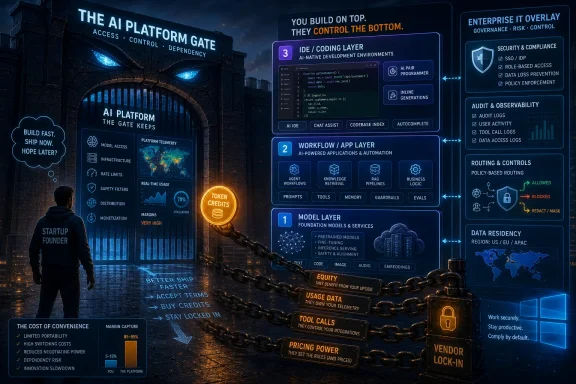
OpenAI’s alleged offer of free tokens to Y Combinator founders in exchange for equity, described by Jason Calacanis on This Week in Startups in June 2026, has become a flashpoint in the larger fight over who controls the next software platform. The claim remains Calacanis’s characterization, not a publicly documented transaction, but the warning lands because it describes a risk every AI startup already understands. If your supplier sees your usage, controls your margin structure, and can clone your workflow into its own product, it is not merely a supplier. It is the platform underneath your company.
The controversy is not really about a discount. It is about whether the AI industry has rebuilt the old cloud-platform bargain with sharper teeth: take the credits, ship faster, hand over telemetry, and hope the company selling you compute does not decide your business should be a feature.
Startup history is full of useful subsidies that later became strategic chokepoints. Cloud credits helped build a generation of SaaS companies, app-store distribution created mobile empires, and payment APIs let founders bolt financial infrastructure onto products in days rather than years. None of those bargains were neutral. They all moved the startup faster while placing the startup inside someone else’s map of the market.
AI tokens are more intimate than cloud credits. A cloud provider knows load, geography, instance type, and spend patterns. A frontier-model provider can potentially see prompts, agent workflows, tool calls, retrieval patterns, latency pressure, and which product behaviors are suddenly exploding. Even when contracts, privacy settings, or enterprise controls restrict training on customer data, metadata alone can be revealing.
That is the subtext of Calacanis’s warning to Y Combinator founders. A founder may see free tokens as oxygen. A platform company may see token consumption as a heat map of where the next application layer is forming.
The most dangerous part of the bargain is that it can look rational on both sides. A seed-stage company building an AI-native product needs inference capacity before revenue catches up. A model lab wants distribution, lock-in, and early access to emerging workloads. The problem appears only later, when the startup’s own usage becomes evidence that its category is worth absorbing.
That is an inflammatory way to phrase it, but not an irrational one. The AI application layer is still unstable, and many products are thin wrappers around a model, a prompt system, a user interface, and a workflow-specific data loop. The thinner the wrapper, the more exposed the company is to the model provider underneath it.
The phrase “studying every one of those Y Combinator companies” captures the founder nightmare. Your metrics prove product-market fit. Your supplier sees which workloads are sticky. Your margins depend on its pricing. Your roadmap is vulnerable to its next product launch.
OpenAI does not need to be uniquely villainous for this incentive to exist. Anthropic, Google, Microsoft, Meta, xAI, and any other serious platform operator face the same gravitational pull. If the model becomes good enough at a workflow, and if the workflow is broadly valuable, the platform has every reason to make it native.
A company trying to justify that kind of valuation must capture more of the value chain. It needs consumer subscriptions, enterprise contracts, developer tools, agent infrastructure, app distribution, maybe hardware, maybe advertising, and certainly a larger share of the workflows built on top of its models. The higher the valuation climbs, the less plausible it becomes that OpenAI can remain a neutral utility.
That is the uncomfortable point for founders. If a model lab is valued like the next operating system, it will behave less like a component vendor and more like an operating-system owner. It will bundle. It will prioritize. It will route demand toward its own surfaces. It will reinterpret “partner ecosystem” through the lens of platform control.
This is not a conspiracy theory; it is industrial logic. Microsoft did not build Windows and then politely avoid productivity software. Apple did not build iOS and then abstain from apps, payments, messaging, maps, and health. Amazon did not build AWS and then refuse to move up the stack. The AI labs are entering the same phase, only faster.
Coding has three properties that make it the perfect early battleground. The output is valuable, the work is measurable, and professionals already live inside tools that can be replaced or augmented. If an AI assistant can autocomplete, refactor, debug, explain, test, and eventually modify entire codebases, it is not a chatbot. It is a new developer environment.
That is why Cursor has become strategically interesting beyond its revenue. It owns attention inside the IDE-like layer where developers make decisions. It can observe how people ask for code changes, which models perform best for which tasks, and where friction remains in real engineering workflows. For a company like SpaceX, now publicly traded under the scenario described in recent reporting and tightly bound to Musk’s AI ambitions, that kind of workflow layer is not cosmetic. It is infrastructure.
The acquisition also makes Calacanis’s warning harder to cabin as an OpenAI-only critique. If SpaceX wants Cursor to give its AI stack a distribution channel into developers’ daily work, why would OpenAI not want the same kind of visibility through its API customers? If Anthropic’s Claude Code pressures standalone coding tools, why would founders assume any frontier lab will permanently respect application boundaries?
AI platforms are compressing that lifecycle. A startup can go from prototype to dependency in weeks. The model choice becomes embedded in prompt templates, evaluation harnesses, latency budgets, context-window assumptions, safety behavior, function-calling semantics, and cost models. Swapping from one provider to another is possible, but it is rarely free.
That makes “use open-source models” a more serious prescription than it sounded two years ago. Open-weight models do not magically solve performance, governance, or cost problems. They do, however, offer a different control surface. A company can host them, fine-tune them, inspect them more deeply, route workloads across them, and avoid feeding the same commercial platform that might later compete with it.
Calacanis’s prediction that startups will shift toward open models by 2027 is aggressive, but the pressure behind it is real. The more frontier labs monetize by bundling application features, the more founders will look for leverage outside those labs. Open weights become less about ideology and more about bargaining power.
For many startups, closed APIs remain the fastest path to market. The best proprietary models often lead on reasoning, coding, multimodal behavior, reliability, and tool use. Enterprise customers may also prefer vendors with recognizable compliance programs and contractual assurances. A founder who rejects frontier APIs too early can lose to a competitor that ships faster and performs better.
The better argument is not that every startup must abandon closed models tomorrow. It is that founders should treat model providers as strategic counterparties, not interchangeable utilities. If your company’s only moat is a prompt wrapped around someone else’s model, you do not have much leverage. If your data, workflow design, customer relationships, evaluations, and deployment flexibility remain yours, the platform’s power is less absolute.
That distinction matters. Open source is not a religion in this debate. It is one tool for preventing dependence from becoming destiny.
Usage patterns can show which categories have demand. Latency spikes can show where customers tolerate cost. Tool-call sequences can reveal workflow structure. Churn patterns can indicate where model performance fails. Even support tickets can become product intelligence.
That is why contractual language matters, but it is not enough. A vendor may promise not to train on your data and still learn that your category is lucrative. A platform may never copy your code and still ship a functionally similar feature. A lab may never violate a privacy clause and still use aggregate telemetry to decide where to expand.
This is the difference between data protection and strategic exposure. The first is a legal and security discipline. The second is a business-model problem.
That indirect exposure matters because it changes how investors should read application-layer AI. The easy narrative says the next wave of AI winners will be software companies that build clever products on top of frontier models. Calacanis’s warning says many of those companies may instead become margin-compressed tenants.
If the model labs absorb common workflows, application startups face two bad options. They can compete with the platform’s bundled product, or they can move into narrower enterprise niches where domain data and customer-specific integration matter more. Neither path is impossible. Both are harder than pitching “AI app growth” in a market that rewards speed over defensibility.
The picks-and-shovels layer looks more durable under this view. Compute demand rises whether the winner is OpenAI, Anthropic, SpaceXAI, Google, Meta, or a fleet of open-weight deployments. The firms selling chips, networking, memory, cloud capacity, inference optimization, observability, and security tooling benefit from the arms race even when the application winners rotate.
That makes Microsoft unusually well positioned and unusually conflicted. The company can sell AI tools directly, host competing models, partner with OpenAI, develop more of its own models, and package AI into products customers already buy. For IT departments, this is convenient. It is also the classic Microsoft bundling machine updated for the model era.
The Cursor episode underlines how valuable the developer endpoint has become. Developers are not just another user segment; they are the people who decide which APIs, frameworks, and platforms become embedded in future software. If an AI company owns the coding assistant, it influences not only code generation but architecture choices, dependencies, cloud defaults, and deployment patterns.
That is why the AI coding market will not remain a tidy collection of standalone tools. GitHub Copilot, Cursor, Claude Code, Codex-style agents, JetBrains integrations, Visual Studio, VS Code, and open-source coding agents are all fighting for the same strategic real estate: the place where software decisions are made before procurement even knows a decision happened.
That creates an opening for hybrid strategies. Some workloads will run on frontier APIs because the performance difference is worth it. Others will run on private deployments, open-weight models, or vendor-hosted models under stricter controls. The future is unlikely to be purely closed or purely open. It will be routed.
The routing layer may become one of the most important pieces of enterprise AI architecture. Companies will want to send sensitive code, customer records, or internal documents to controlled models while allowing less sensitive tasks to use the best available external model. They will want cost controls, audit logs, redaction, policy enforcement, and model benchmarking across providers.
That is where admins should focus. The question is not whether employees will use AI tools; they already do. The question is whether organizations can build enough governance to prevent every department from handing its workflow map to a different platform.
But founders should know exactly what they are trading. If a model provider receives equity, usage data, customer adjacency, and technical dependency, it may have more upside in your company than you realize. If it can later ship your category as a native feature, it may also have a cheaper way to capture the market than acquiring you.
Defensive architecture starts with portability. Keep evaluation suites independent. Abstract model calls where practical. Store your own customer data cleanly. Measure model performance across providers. Avoid hard-coding your product identity around one vendor’s temporary advantage. Build the part of the product that customers would miss if the model improved tomorrow.
The companies that survive platform absorption usually own something the platform cannot easily reproduce: distribution, trust, regulatory clearance, proprietary data, workflow depth, or a community that refuses to move. A wrapper can be copied. A business with embedded customer value is harder to erase.
Closed-model companies can squeeze the application layer from both ends. They can lower prices for their own bundled products while charging API customers enough to protect their infrastructure economics. They can also prioritize features that reduce the need for third-party tools. The more capable the base model becomes, the more application startups must justify why they exist.
Open models pressure the other side of the market. If open-weight systems become “good enough” for many enterprise workflows, closed labs must compete on performance, reliability, integrations, indemnity, and ecosystem rather than mystique. That is healthier for customers, but it does not guarantee easy profits for startups.
The likely result is segmentation. Frontier closed models dominate the hardest reasoning tasks and premium agent workflows. Open and smaller models handle cost-sensitive, private, or specialized deployments. Application companies survive where they own workflow depth rather than merely model access.
The key issue is not whether OpenAI, Anthropic, SpaceXAI, Microsoft, or any other platform is “trustworthy” in the moral sense. Large technology platforms optimize for strategic expansion. They may honor contracts and still become competitors. They may support ecosystems and still absorb the most valuable use cases. They may promote developers and still make the developer’s product redundant.
That is why the “final warning” frame resonates. It says the quiet part of platform strategy out loud. The customer building on the API is also a signal. The startup consuming the tokens is also a data point. The partner proving a category is also a possible acquisition target, competitor, or casualty.
The controversy is not really about a discount. It is about whether the AI industry has rebuilt the old cloud-platform bargain with sharper teeth: take the credits, ship faster, hand over telemetry, and hope the company selling you compute does not decide your business should be a feature.
 The Free Compute Was Never Free
Startup history is full of useful subsidies that later became strategic chokepoints. Cloud credits helped build a generation of SaaS companies, app-store distribution created mobile empires, and payment APIs let founders bolt financial infrastructure onto products in days rather than years. None of those bargains were neutral. They all moved the startup faster while placing the startup inside someone else’s map of the market.AI tokens are more intimate than cloud credits. A cloud provider knows load, geography, instance type, and spend patterns. A frontier-model provider can potentially see prompts, agent workflows, tool calls, retrieval patterns, latency pressure, and which product behaviors are suddenly exploding. Even when contracts, privacy settings, or enterprise controls restrict training on customer data, metadata alone can be revealing.
That is the subtext of Calacanis’s warning to Y Combinator founders. A founder may see free tokens as oxygen. A platform company may see token consumption as a heat map of where the next application layer is forming.
The most dangerous part of the bargain is that it can look rational on both sides. A seed-stage company building an AI-native product needs inference capacity before revenue catches up. A model lab wants distribution, lock-in, and early access to emerging workloads. The problem appears only later, when the startup’s own usage becomes evidence that its category is worth absorbing.
Calacanis Turns a Startup Perk Into a Platform-Risk Indictment
Calacanis’s charge was pointed because it named the old fear plainly: the platform watches, learns, and folds the winner into the base product. In his telling, a token-for-equity offer would not merely be a financing instrument. It would be a scouting mechanism.That is an inflammatory way to phrase it, but not an irrational one. The AI application layer is still unstable, and many products are thin wrappers around a model, a prompt system, a user interface, and a workflow-specific data loop. The thinner the wrapper, the more exposed the company is to the model provider underneath it.
The phrase “studying every one of those Y Combinator companies” captures the founder nightmare. Your metrics prove product-market fit. Your supplier sees which workloads are sticky. Your margins depend on its pricing. Your roadmap is vulnerable to its next product launch.
OpenAI does not need to be uniquely villainous for this incentive to exist. Anthropic, Google, Microsoft, Meta, xAI, and any other serious platform operator face the same gravitational pull. If the model becomes good enough at a workflow, and if the workflow is broadly valuable, the platform has every reason to make it native.
A Trillion-Dollar Valuation Changes the Moral Geometry
The debate becomes more combustible because OpenAI is no longer being judged like a research lab or even a fast-growing SaaS company. It is being discussed as a near-trillion-dollar platform candidate, with reports of confidential IPO preparation and massive private-market expectations. At that scale, “we sell API access” is not a sufficient story.A company trying to justify that kind of valuation must capture more of the value chain. It needs consumer subscriptions, enterprise contracts, developer tools, agent infrastructure, app distribution, maybe hardware, maybe advertising, and certainly a larger share of the workflows built on top of its models. The higher the valuation climbs, the less plausible it becomes that OpenAI can remain a neutral utility.
That is the uncomfortable point for founders. If a model lab is valued like the next operating system, it will behave less like a component vendor and more like an operating-system owner. It will bundle. It will prioritize. It will route demand toward its own surfaces. It will reinterpret “partner ecosystem” through the lens of platform control.
This is not a conspiracy theory; it is industrial logic. Microsoft did not build Windows and then politely avoid productivity software. Apple did not build iOS and then abstain from apps, payments, messaging, maps, and health. Amazon did not build AWS and then refuse to move up the stack. The AI labs are entering the same phase, only faster.
Cursor Shows Why Coding Is the First Battlefield
The timing of Calacanis’s warning matters because it landed in the shadow of SpaceX’s reported $60 billion move for Cursor parent Anysphere. Cursor is not just another AI app. It is one of the clearest examples of an AI-native workflow that users are willing to pay for today.Coding has three properties that make it the perfect early battleground. The output is valuable, the work is measurable, and professionals already live inside tools that can be replaced or augmented. If an AI assistant can autocomplete, refactor, debug, explain, test, and eventually modify entire codebases, it is not a chatbot. It is a new developer environment.
That is why Cursor has become strategically interesting beyond its revenue. It owns attention inside the IDE-like layer where developers make decisions. It can observe how people ask for code changes, which models perform best for which tasks, and where friction remains in real engineering workflows. For a company like SpaceX, now publicly traded under the scenario described in recent reporting and tightly bound to Musk’s AI ambitions, that kind of workflow layer is not cosmetic. It is infrastructure.
The acquisition also makes Calacanis’s warning harder to cabin as an OpenAI-only critique. If SpaceX wants Cursor to give its AI stack a distribution channel into developers’ daily work, why would OpenAI not want the same kind of visibility through its API customers? If Anthropic’s Claude Code pressures standalone coding tools, why would founders assume any frontier lab will permanently respect application boundaries?
The Closed-Model Bargain Is Starting to Look Like Vendor Lock-In With Better Demos
For WindowsForum readers, the analogy is obvious. Enterprise IT has spent decades learning that platform convenience always comes with exit costs. Active Directory, Exchange, SharePoint, Teams, Azure, Intune, and Microsoft 365 are powerful because they integrate. They are sticky for the same reason.AI platforms are compressing that lifecycle. A startup can go from prototype to dependency in weeks. The model choice becomes embedded in prompt templates, evaluation harnesses, latency budgets, context-window assumptions, safety behavior, function-calling semantics, and cost models. Swapping from one provider to another is possible, but it is rarely free.
That makes “use open-source models” a more serious prescription than it sounded two years ago. Open-weight models do not magically solve performance, governance, or cost problems. They do, however, offer a different control surface. A company can host them, fine-tune them, inspect them more deeply, route workloads across them, and avoid feeding the same commercial platform that might later compete with it.
Calacanis’s prediction that startups will shift toward open models by 2027 is aggressive, but the pressure behind it is real. The more frontier labs monetize by bundling application features, the more founders will look for leverage outside those labs. Open weights become less about ideology and more about bargaining power.
The Open-Source Prescription Has Its Own Costs
Still, the open-model answer should not be romanticized. Running your own inference stack is not a purity badge; it is an operational commitment. Teams need infrastructure, optimization, monitoring, security review, data governance, and enough engineering talent to keep the stack competitive.For many startups, closed APIs remain the fastest path to market. The best proprietary models often lead on reasoning, coding, multimodal behavior, reliability, and tool use. Enterprise customers may also prefer vendors with recognizable compliance programs and contractual assurances. A founder who rejects frontier APIs too early can lose to a competitor that ships faster and performs better.
The better argument is not that every startup must abandon closed models tomorrow. It is that founders should treat model providers as strategic counterparties, not interchangeable utilities. If your company’s only moat is a prompt wrapped around someone else’s model, you do not have much leverage. If your data, workflow design, customer relationships, evaluations, and deployment flexibility remain yours, the platform’s power is less absolute.
That distinction matters. Open source is not a religion in this debate. It is one tool for preventing dependence from becoming destiny.
The Data-Harvesting Fear Is Bigger Than Training Data
Much of the AI privacy debate focuses on whether customer prompts are used to train future models. That is important, but it is too narrow. A platform does not need to ingest your proprietary data into a training run to learn from you.Usage patterns can show which categories have demand. Latency spikes can show where customers tolerate cost. Tool-call sequences can reveal workflow structure. Churn patterns can indicate where model performance fails. Even support tickets can become product intelligence.
That is why contractual language matters, but it is not enough. A vendor may promise not to train on your data and still learn that your category is lucrative. A platform may never copy your code and still ship a functionally similar feature. A lab may never violate a privacy clause and still use aggregate telemetry to decide where to expand.
This is the difference between data protection and strategic exposure. The first is a legal and security discipline. The second is a business-model problem.
The SpaceX-Cursor Deal Makes Public Investors Part of the Story
The 24/7 Wall St. angle is investor-focused, and that is where the episode becomes broader than startup gossip. OpenAI, Anthropic, and Cursor’s pre-acquisition parent were private for most ordinary investors. The public-market exposure sits elsewhere: Nvidia, hyperscalers, cloud operators, chip supply chains, data-center builders, power infrastructure, and now public vehicles tied to major AI platform consolidation.That indirect exposure matters because it changes how investors should read application-layer AI. The easy narrative says the next wave of AI winners will be software companies that build clever products on top of frontier models. Calacanis’s warning says many of those companies may instead become margin-compressed tenants.
If the model labs absorb common workflows, application startups face two bad options. They can compete with the platform’s bundled product, or they can move into narrower enterprise niches where domain data and customer-specific integration matter more. Neither path is impossible. Both are harder than pitching “AI app growth” in a market that rewards speed over defensibility.
The picks-and-shovels layer looks more durable under this view. Compute demand rises whether the winner is OpenAI, Anthropic, SpaceXAI, Google, Meta, or a fleet of open-weight deployments. The firms selling chips, networking, memory, cloud capacity, inference optimization, observability, and security tooling benefit from the arms race even when the application winners rotate.
Microsoft’s Shadow Hangs Over the Whole Fight
Windows users and administrators should read this episode through Microsoft’s long platform history. Microsoft is both investor, partner, competitor, and distribution king in AI. It has GitHub Copilot in the developer workflow, Azure as a compute substrate, Windows as the desktop surface, Microsoft 365 Copilot in office work, and enterprise identity as the control plane.That makes Microsoft unusually well positioned and unusually conflicted. The company can sell AI tools directly, host competing models, partner with OpenAI, develop more of its own models, and package AI into products customers already buy. For IT departments, this is convenient. It is also the classic Microsoft bundling machine updated for the model era.
The Cursor episode underlines how valuable the developer endpoint has become. Developers are not just another user segment; they are the people who decide which APIs, frameworks, and platforms become embedded in future software. If an AI company owns the coding assistant, it influences not only code generation but architecture choices, dependencies, cloud defaults, and deployment patterns.
That is why the AI coding market will not remain a tidy collection of standalone tools. GitHub Copilot, Cursor, Claude Code, Codex-style agents, JetBrains integrations, Visual Studio, VS Code, and open-source coding agents are all fighting for the same strategic real estate: the place where software decisions are made before procurement even knows a decision happened.
Enterprise IT Will Not Accept a Black-Box Supply Chain Forever
The startup world can afford some chaos. Enterprise IT cannot. Regulated companies, government agencies, healthcare systems, banks, and critical infrastructure operators will eventually demand clearer answers about where AI work is processed, retained, inspected, and governed.That creates an opening for hybrid strategies. Some workloads will run on frontier APIs because the performance difference is worth it. Others will run on private deployments, open-weight models, or vendor-hosted models under stricter controls. The future is unlikely to be purely closed or purely open. It will be routed.
The routing layer may become one of the most important pieces of enterprise AI architecture. Companies will want to send sensitive code, customer records, or internal documents to controlled models while allowing less sensitive tasks to use the best available external model. They will want cost controls, audit logs, redaction, policy enforcement, and model benchmarking across providers.
That is where admins should focus. The question is not whether employees will use AI tools; they already do. The question is whether organizations can build enough governance to prevent every department from handing its workflow map to a different platform.
The Startup Lesson Is Defensive Architecture
For founders, the lesson is not simply “do not take free tokens.” That is too crude. Sometimes free credits are rational. Sometimes equity-for-services arrangements make sense. Sometimes the fastest way to learn is to build on the strongest available model and worry about leverage later.But founders should know exactly what they are trading. If a model provider receives equity, usage data, customer adjacency, and technical dependency, it may have more upside in your company than you realize. If it can later ship your category as a native feature, it may also have a cheaper way to capture the market than acquiring you.
Defensive architecture starts with portability. Keep evaluation suites independent. Abstract model calls where practical. Store your own customer data cleanly. Measure model performance across providers. Avoid hard-coding your product identity around one vendor’s temporary advantage. Build the part of the product that customers would miss if the model improved tomorrow.
The companies that survive platform absorption usually own something the platform cannot easily reproduce: distribution, trust, regulatory clearance, proprietary data, workflow depth, or a community that refuses to move. A wrapper can be copied. A business with embedded customer value is harder to erase.
The AI Platform War Is Becoming a Margin War
The financial story underneath all of this is margin. AI applications look attractive when model costs fall, user growth rises, and vendors can charge software-like prices. They look less attractive when the platform provider captures the premium layer or reprices inference.Closed-model companies can squeeze the application layer from both ends. They can lower prices for their own bundled products while charging API customers enough to protect their infrastructure economics. They can also prioritize features that reduce the need for third-party tools. The more capable the base model becomes, the more application startups must justify why they exist.
Open models pressure the other side of the market. If open-weight systems become “good enough” for many enterprise workflows, closed labs must compete on performance, reliability, integrations, indemnity, and ecosystem rather than mystique. That is healthier for customers, but it does not guarantee easy profits for startups.
The likely result is segmentation. Frontier closed models dominate the hardest reasoning tasks and premium agent workflows. Open and smaller models handle cost-sensitive, private, or specialized deployments. Application companies survive where they own workflow depth rather than merely model access.
The Warning Is Loud Because the Incentives Are Real
Calacanis’s rhetoric is characteristically dramatic, but the underlying incentive map is not. Founders are right to fear platform dependency. Investors are right to question whether application-layer AI margins can survive bundling. Enterprise buyers are right to demand more control over where their data and workflows go.The key issue is not whether OpenAI, Anthropic, SpaceXAI, Microsoft, or any other platform is “trustworthy” in the moral sense. Large technology platforms optimize for strategic expansion. They may honor contracts and still become competitors. They may support ecosystems and still absorb the most valuable use cases. They may promote developers and still make the developer’s product redundant.
That is why the “final warning” frame resonates. It says the quiet part of platform strategy out loud. The customer building on the API is also a signal. The startup consuming the tokens is also a data point. The partner proving a category is also a possible acquisition target, competitor, or casualty.
The Names Change, but the Power Map Does Not
The concrete readout from this episode is less about one alleged deal and more about how to behave in the new platform order. Founders, IT leaders, and investors should treat AI dependency as a first-order risk rather than a procurement footnote.- Free or subsidized AI tokens can be useful, but they should be evaluated as strategic financing rather than ordinary cloud credits.
- Startups building on closed models should assume their usage patterns may reveal which workflows are valuable, even when vendors restrict training on customer data.
- Open-weight models are becoming a bargaining tool for founders and enterprises, not merely an ideological alternative to proprietary AI.
- Coding tools are the first major AI application battlefield because they sit directly inside the workflow that creates all other software.
- Public investors mostly gain exposure to this platform war through compute, cloud, infrastructure, and consolidated public AI platforms rather than through the private labs themselves.
- Enterprise IT should prepare for a routed AI architecture in which different models handle different workloads based on sensitivity, cost, and performance.
References
- Primary source: 24/7 Wall St.
Published: Sun, 21 Jun 2026 12:37:42 GMT
Don't Trust OpenAI, "This Is Your Final Warning" - 24/7 Wall St.
Jason Calacanis used his perch on This Week in Startups to fire what he called a “final warning” at Y Combinator founders: do not take free OpenAI tokens in exchange for equity. The framing of the episode, “Why SpaceX Buying Cursor Changes Everything,” set up a wider...247wallst.com - Related coverage: content.spacex.com
- Related coverage: enterprisedna.co
OpenAI Files Confidential IPO at $1 Trillion Valuation — Enterprise DNA
OpenAI submitted a confidential S-1 to the SEC on June 8, targeting a $1 trillion-plus valuation and a public listing as early as September 2026.enterprisedna.co - Related coverage: investing.com
Nvidia’s Huang says will invest $30B in OpenAI, rules out $100B amid IPO By Investing.com
Nvidia’s Huang says will invest $30B in OpenAI, rules out $100B amid IPOwww.investing.com - Related coverage: saassentinel.com
OpenAI Files Confidential IPO Paperwork, Targets $1 Trillion Valuation - The SaaS Sentinel
OpenAI submitted confidential S-1 registration to SEC for IPO, following rival Anthropic's filing as AI giants race to public markets.saassentinel.com - Related coverage: forbes.com
Anthropic Is Now Worth More Than OpenAI—Exceeds $900 Billion Valuation
OpenAI’s valuation reached $730 billion in March following a massive $122 billion funding round.www.forbes.com
- Related coverage: witho2.com
OpenAI S-1 IPO Filing: Trillion Valuation & What Investors Need to Know
OpenAI filed a confidential S-1 with the SEC targeting a $1 trillion IPO valuation in September 2026. Here's what the filing reveals and what investors should know.witho2.com - Related coverage: bitsminds.com
OpenAI Files Confidential S-1 With the SEC, Targeting a September IPO at Up to $1 Trillion
OpenAI quietly handed Goldman Sachs and Morgan Stanley a draft prospectus on May 22, setting up a Q4 listing at a valuation between $852 billion and $1 trillion — even as the company lost $1.22 for every dollar it earned in Q1. www.bitsminds.com
- Related coverage: tomshardware.com
Anthropic surpasses biggest rival OpenAI in secondary market valuation — surges to $1 trillion amid frantic investor interest | Tom's Hardware
Investors are willing to pay almost three times the actual value for Anthropic shareswww.tomshardware.com - Related coverage: axios.com
- Related coverage: windowscentral.com
OpenAI in talks for funding at a $750 billion valuation | Windows Central
OpenAI is in talks to raise $100 billion from investors at $750 billion valuation.www.windowscentral.com - Related coverage: elpais.com
- Related coverage: pcgamer.com
OpenAI announces another $110 billion in investment funding including $30 billion from Nvidia, but says Microsoft is still its best friend forever | PC Gamer
Aww. Isn't it sweet when multi-billion, sometimes multi-trillion dollar businesses buddy up?www.pcgamer.com