
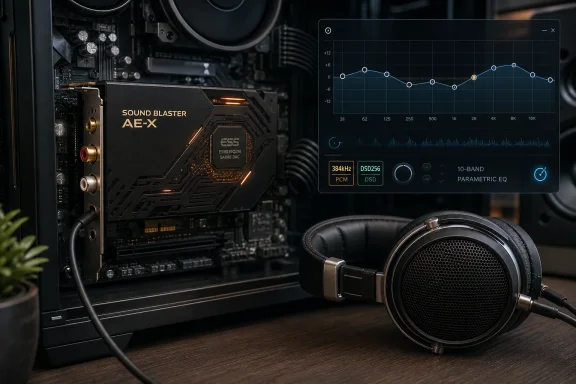
Creative’s Sound Blaster AE-X is a PCIe internal sound card launched in 2026 for Windows desktop users who want a high-spec stereo DAC, a serious wired-headphone amplifier, and Sound Blaster gaming processing inside the PC rather than on the desk. That makes it less a throwback to the 7.1 sound-card era than a bet that some enthusiasts still want their audio hardware bolted directly into the machine. The question is not whether the AE-X is technically ambitious; it is. The question is whether its internal form factor solves more problems than it creates.
The old Sound Blaster proposition was easy to understand. Motherboard audio was noisy or weak, games used hardware-accelerated effects, and a dedicated card promised cleaner output, better positional audio, and more ports than the green, blue, and pink jacks on the back of a beige tower. The AE-X arrives in a very different world.
Today, even mid-range motherboards often ship with perfectly usable audio codecs, external USB DACs are cheap and plentiful, and gamers with headsets may already be routing everything through USB, HDMI, wireless dongles, or a monitor. Creative therefore cannot simply sell the AE-X as “better than onboard audio” and call the argument finished. It has to sell the idea that an internal card still has a role in a market that has largely moved outward.
That is why the AE-X is built less like a traditional surround sound card and more like a hybrid of desktop DAC, headphone amp, and gaming signal processor. Its headline component is an ESS ES9039Q2M Sabre DAC, with support for PCM playback up to 32-bit/384kHz and native DSD playback up to DSD256. Creative quotes a 130dB dynamic range and very low distortion, numbers that place the card in the language of audiophile desktop gear rather than commodity PC audio.
But the more revealing decision is what Creative did not emphasize. The AE-X is not primarily a multi-jack analog surround card for people running six or eight separate speaker cables from the back of a tower. Its center of gravity is stereo analog output, wired headphones, digital I/O, and software-controlled processing. In other words, Creative has taken the Sound Blaster brand and pointed it at the kind of user who owns decent headphones, tweaks EQ curves, still plays competitive games, and does not necessarily want another aluminum box on the desk.
The AE-X’s ESS ES9039Q2M is still a serious choice. It gives Creative an instantly legible audiophile credential, and it lets the company market the card as something more refined than an ordinary gaming accessory. Support for high-resolution PCM and DSD256 reinforces that positioning, even if most buyers will spend more time in Spotify, YouTube, Discord, Steam, and game engines than in a library of native DSD files.
The headphone amplifier is arguably the more practical feature. Creative rates the rear headphone output for headphones from 8 to 600 ohms and claims up to 350mW into 32 ohms, with four selectable power levels. That means the AE-X is pitched not just at common gaming headsets but at full-size wired headphones from brands such as Beyerdynamic, Sennheiser, Audio-Technica, Audeze, and others that may benefit from more voltage or cleaner drive than a motherboard jack provides.
This is where the AE-X has its strongest identity. If a user has a good pair of wired headphones and wants a PC-integrated amplifier with Sound Blaster processing layered on top, the product makes immediate sense. The card is not merely converting bits into analog audio; it is trying to be the main headphone hub for a desktop gaming and media system.
That said, the presence of a capable headphone amp does not automatically make every output on the product equal. Creative’s rear output is the one that carries the serious rating. The case-front headphone connection is convenient, but it is rated far lower, at 40mW into 32 ohms, and it has a much higher output impedance. For sensitive in-ear monitors or demanding headphones, the convenient front-panel jack may be the wrong jack.
That detail matters because it cuts into one of the obvious benefits of an internal card. A user who installs an AE-X to reduce desk clutter may still end up running a headphone cable to the back of the tower to get the best performance. If the PC sits on the floor, under a desk, or against a wall, the internal elegance becomes a daily ergonomic compromise.
There is an appeal to that. A clean desk matters to many users, especially those already juggling monitors, keyboards, microphones, stream decks, controllers, chargers, and USB hubs. The AE-X moves the DAC and amplifier into the chassis, leaving only the cables that actually need to leave the machine. Stereo RCA outputs can feed powered speakers or an amplifier, and the card’s digital connections give it a more flexible role in a desktop audio chain.
Creative also leans on PCIe as a performance argument. A direct bus connection sounds inherently more serious than USB, and the company positions the AE-X as a low-latency path for playback and production-style use cases through ASIO 2.3 support. For certain audio workflows, ASIO support can matter, especially where predictable latency and direct application access are desirable.
The gaming-latency claim is harder to weigh. Modern USB DACs are not inherently laggy in any way that most players can identify during normal use, and gaming audio latency is affected by the whole chain: the engine, Windows audio stack, driver path, processing, buffering, DAC, amplifier, and transducer. Without clear side-by-side measurements against good USB devices, “PCIe is lower latency” remains more plausible marketing than proven advantage.
Internal installation also brings back an old concern: electrical noise. A PCIe sound card lives inside a metal box containing a graphics card, motherboard VRMs, memory, fans, storage, and a power supply. Good engineering can mitigate this, and there is no evidence at this stage that the AE-X has an interference problem. But it is reasonable for cautious buyers to ask whether moving the analog stage inside a gaming PC is an upgrade over placing it outside the chassis.
The answer will likely depend on the specific PC. A well-designed card in a clean system may be silent and excellent. A cramped build with a hot GPU, questionable grounding, messy cabling, and a noisy power environment may be less forgiving. The external DAC did not win the market by accident; physical separation is a simple and often effective engineering strategy.
That makes the AE-X more flexible than a conventional DAC that exposes only a volume control and perhaps a gain switch. A parametric EQ is a major step above crude bass and treble sliders because it allows more precise frequency selection, gain, and bandwidth adjustment. For users who understand headphone tuning, that can turn a good setup into a much more personalized one.
AutoEQ integration is particularly interesting because it brings a once-nerdy practice into the vendor’s own interface. The broader AutoEq ecosystem is built around measured headphone correction, letting users apply EQ profiles intended to bring specific models closer to a target response. Creative’s value is not that headphone correction is exclusive; it is that the feature is surfaced in the same app as the rest of the card’s controls.
This is useful for the kind of user who wants better sound but does not want to assemble a stack of community projects, Windows audio utilities, virtual devices, and startup scripts. Equalizer APO and related tools can do powerful things, but they can also become another maintenance chore. Creative is betting that integration has value even when the underlying idea is not unique.
The gaming features are the familiar Sound Blaster suite, and they will divide listeners as usual. Virtual surround can help some users perceive space more comfortably on headphones, while others prefer unprocessed stereo or game-native headphone modes. Scout Mode, which emphasizes positional cues such as footsteps and weapon sounds, may appeal to competitive players but can also distort the tonal balance in ways that make music and cinematic games less natural.
The important point is that the AE-X is not neutral by default in the cultural sense, even if it can be configured for clean playback. It is a tweakable gaming-audio workstation. Buyers who want a pure DAC with a knob may find the software emphasis excessive; buyers who enjoy shaping audio per game, per headphone, and per listening mode may find it central to the product’s appeal.
On paper, the two products share several headline traits. Both support playback up to 32-bit/384kHz. Both claim a 130dB dynamic range. Both support headphones rated up to 600 ohms. Both belong to the same broad Sound Blaster universe of gaming audio processing and headphone-focused desktop use.
The G8, however, is shaped around the realities of a modern gaming desk. It has a physical volume dial, a headphone gain switch, GameVoice Mix, accessible headset connections, two USB-C audio inputs, HDMI ARC, and support for computers, consoles, and mobile devices. It is not just a DAC; it is a control surface.
That matters more than spec sheets admit. A physical volume knob is not a luxury when switching between games, videos, voice chat, music, and system alerts. Hardware game-and-chat balance is not trivial for players who live in Discord or platform voice chat. Front-facing ports are not glamorous, but they determine whether plugging in a headset is a one-second motion or a crawl behind the tower.
The AE-X counters with the things internal cards do well. It disappears into the PC, offers stereo RCA outputs, supports DSD256, provides ASIO 2.3, and integrates a parametric EQ with headphone profiles. For a Windows desktop user who never touches consoles, dislikes desk clutter, and wants RCA into powered speakers, that may be a better fit than the G8.
But Creative has effectively created a philosophical split. The G8 is for users who want audio to be reachable. The AE-X is for users who want audio to be installed. Neither approach is universally superior, but the external device has the more obvious day-to-day convenience.
That is why its audience is narrower than the broad “every PC user” phrasing implies. A casual gamer using wireless headphones does not need it. A laptop user cannot install it. A console-first player is better served by an external device. A streamer who needs XLR microphone input and monitoring may prefer an audio interface. A purist who wants a standalone DAC and amp with no gaming processing may look elsewhere.
The AE-X starts to make sense when several conditions overlap. The buyer has a desktop PC with an available PCIe slot. The PC is the main listening and gaming machine. The user owns or plans to buy wired headphones that benefit from a competent amplifier. The user wants Sound Blaster processing and EQ. The desk is already crowded, or the user strongly prefers an internal build.
That is a real audience, but it is not the mass market that made sound cards feel mandatory decades ago. It is the enthusiast slice that still treats the desktop PC as a configurable machine rather than a sealed appliance. The AE-X is, in a way, a product for people who still enjoy the act of building a PC and assigning specific hardware to specific roles.
For WindowsForum readers, that distinction is important. This is not a required upgrade path for every Windows 11 machine with a Realtek codec. It is a deliberate choice for users who know what their current audio chain lacks: power, tuning, RCA output, cleaner headphone drive, integrated Sound Blaster effects, or simply the satisfaction of having a dedicated internal audio board.
High-resolution playback support also has a habit of becoming more symbolic than practical. Most game audio is not delivered as 32-bit/384kHz content, and most listeners do not own large DSD256 libraries. These formats matter to a subset of users, but the AE-X’s everyday value will more often come from its amplifier quality, output noise, EQ tools, driver stability, and ergonomics.
That last item should not be understated. PC audio products live or die by software. A great DAC attached to a frustrating driver stack becomes a support thread waiting to happen. Creative has decades of experience here, but the company also carries decades of user memory around driver packages, app transitions, and feature behavior that can vary across Windows versions.
The AE-X’s reliance on Nexus means Creative must keep the experience polished. If the app is stable, clear, and responsive, the card feels modern. If it is buggy, confusing, or slow to recognize modes, the lack of hardware controls becomes more painful. An external DAC with a knob can remain usable even when its companion app is ignored; an internal software-heavy card has fewer places to hide.
There is also the question of processing taste. Creative’s Acoustic Engine features can make games and movies more dramatic, but they can also pull the sound away from what a studio, game developer, or music producer intended. That is not necessarily bad. PC gaming has always embraced customization. But it means buyers should think of the AE-X as a configurable audio platform, not as a single “correct” sound.
It is harder to recommend to users who need physical controls. If volume adjustment, headset plugging, gain switching, and game-chat balancing happen constantly, the G8-style external format is simply more humane. Audio is not just signal quality; it is interaction design. The best-sounding device can still be the wrong one if it makes ordinary actions awkward.
It is also not the obvious choice for sensitive IEM users who want the front-panel jack to be the main connection. Output impedance matters with multi-driver in-ear monitors, and the front header’s lower power and higher impedance make it a convenience feature rather than the AE-X’s best listening path. The rear output is the serious one, and that means cable routing must be part of the purchase decision.
For users of high-impedance dynamic headphones, the picture is more favorable. A rear-mounted cable is not unusual for desktop headphone use, and the AE-X’s rated amplifier range suggests Creative expects it to handle models that motherboard audio can drive only weakly or noisily. Here, the internal format becomes less of a problem because the headphones may already be part of a fixed PC listening station.
The product also has a neat place in speaker setups. Stereo RCA outputs are more hi-fi-friendly than a single 3.5mm line-out, and they make sense for powered monitors or an integrated amplifier near the PC. The absence of a traditional bank of analog surround outputs will disappoint a smaller legacy audience, but it reflects where the market has gone: stereo speakers, headphones, soundbars, HDMI, and virtualized surround.
With the AE-X, Creative is selling a controlled environment: a known DAC, a specified headphone amplifier, a vendor-managed driver path, ASIO support, Sound Blaster processing, parametric EQ, AutoEQ profiles, and desktop-oriented outputs. The value is cumulative. Any single feature can be matched elsewhere; the combination is the product.
That also means the AE-X should be judged as an ecosystem, not as a DAC-chip carrier. If the rear output is quiet, the amplifier behaves well across different headphones, Nexus is stable, profiles are easy to manage, and switching between clean listening and gaming processing is painless, the card has a reason to exist. If any of those pieces falter, the external alternatives become more attractive very quickly.
This is the deeper tension behind the AE-X. Internal sound cards once won because they were the only serious way to improve PC audio. Now they must win by being more coherent than the modular alternatives. The AE-X does not have to defeat every USB DAC, every interface, and every gaming amp; it has to make a specific user’s Windows desktop simpler and better.
That is a harder sale, but also a more honest one. The modern PC audio market is mature enough that “higher spec” is not the same as “better fit.” The AE-X is a premium internal answer for a narrow set of problems, not a universal prescription.
That audience is disproportionately represented in enthusiast forums. These are users who notice whether a front-panel jack hisses, whether a USB device wakes properly after sleep, whether a driver exposes exclusive mode cleanly, and whether a game’s positional audio collapses under the wrong virtual surround setting. They are also users who may be skeptical of marketing numbers unless the practical experience matches.
Creative seems to understand this audience well enough to give the AE-X more than a fancy DAC. The card’s appeal rests on the messy overlap between music listening, Windows gaming, headphone correction, and old-fashioned PC-building satisfaction. It is a product for someone who wants the inside of the case to do more work, not less.
The risk is that the same audience will compare it ruthlessly against Creative’s own G8 and against the broader external DAC market. The G8’s knobs, dual USB inputs, HDMI ARC, and console support make it look more adaptable. Third-party DAC/amps may offer simpler operation, balanced outputs, or stronger measurements. Audio interfaces may serve creators better. The AE-X has to win on integration.
That integration may be exactly enough. Not every user wants a stack. Not every gamer owns a console. Not every headphone listener wants to learn separate EQ tools. For a Windows desktop tower that is already the center of the setup, a single internal card with serious stereo output and gaming processing is a coherent proposition.
If you want a physical volume knob, frequent headset access, easy gain switching, dual-device mixing, HDMI ARC, or console support, the external G8 is the more natural product. If you want the DAC off the desk, plan to use the rear headphone jack, value stereo RCA output, and live mostly inside a Windows desktop, the AE-X becomes much more persuasive.
This is the most concrete way to read the product:
 Creative Rebuilds the Sound Card Around Headphones, Not Speaker Jacks
The old Sound Blaster proposition was easy to understand. Motherboard audio was noisy or weak, games used hardware-accelerated effects, and a dedicated card promised cleaner output, better positional audio, and more ports than the green, blue, and pink jacks on the back of a beige tower. The AE-X arrives in a very different world.Today, even mid-range motherboards often ship with perfectly usable audio codecs, external USB DACs are cheap and plentiful, and gamers with headsets may already be routing everything through USB, HDMI, wireless dongles, or a monitor. Creative therefore cannot simply sell the AE-X as “better than onboard audio” and call the argument finished. It has to sell the idea that an internal card still has a role in a market that has largely moved outward.
That is why the AE-X is built less like a traditional surround sound card and more like a hybrid of desktop DAC, headphone amp, and gaming signal processor. Its headline component is an ESS ES9039Q2M Sabre DAC, with support for PCM playback up to 32-bit/384kHz and native DSD playback up to DSD256. Creative quotes a 130dB dynamic range and very low distortion, numbers that place the card in the language of audiophile desktop gear rather than commodity PC audio.
But the more revealing decision is what Creative did not emphasize. The AE-X is not primarily a multi-jack analog surround card for people running six or eight separate speaker cables from the back of a tower. Its center of gravity is stereo analog output, wired headphones, digital I/O, and software-controlled processing. In other words, Creative has taken the Sound Blaster brand and pointed it at the kind of user who owns decent headphones, tweaks EQ curves, still plays competitive games, and does not necessarily want another aluminum box on the desk.
The Sabre DAC Is the Hook, but the Amplifier Is the Product
DAC-chip branding has become one of the stranger rituals of enthusiast audio. ESS Sabre, Cirrus Logic, AKM, Burr-Brown: the names are treated almost like GPU silicon, as if the chip alone tells you how a product will sound. It does not. A DAC chip matters, but the implementation around it — clocking, power supply, analog stage, output impedance, gain structure, board layout, shielding, and software path — often matters more.The AE-X’s ESS ES9039Q2M is still a serious choice. It gives Creative an instantly legible audiophile credential, and it lets the company market the card as something more refined than an ordinary gaming accessory. Support for high-resolution PCM and DSD256 reinforces that positioning, even if most buyers will spend more time in Spotify, YouTube, Discord, Steam, and game engines than in a library of native DSD files.
The headphone amplifier is arguably the more practical feature. Creative rates the rear headphone output for headphones from 8 to 600 ohms and claims up to 350mW into 32 ohms, with four selectable power levels. That means the AE-X is pitched not just at common gaming headsets but at full-size wired headphones from brands such as Beyerdynamic, Sennheiser, Audio-Technica, Audeze, and others that may benefit from more voltage or cleaner drive than a motherboard jack provides.
This is where the AE-X has its strongest identity. If a user has a good pair of wired headphones and wants a PC-integrated amplifier with Sound Blaster processing layered on top, the product makes immediate sense. The card is not merely converting bits into analog audio; it is trying to be the main headphone hub for a desktop gaming and media system.
That said, the presence of a capable headphone amp does not automatically make every output on the product equal. Creative’s rear output is the one that carries the serious rating. The case-front headphone connection is convenient, but it is rated far lower, at 40mW into 32 ohms, and it has a much higher output impedance. For sensitive in-ear monitors or demanding headphones, the convenient front-panel jack may be the wrong jack.
That detail matters because it cuts into one of the obvious benefits of an internal card. A user who installs an AE-X to reduce desk clutter may still end up running a headphone cable to the back of the tower to get the best performance. If the PC sits on the floor, under a desk, or against a wall, the internal elegance becomes a daily ergonomic compromise.
The Internal Format Is Both the Pitch and the Problem
The AE-X exists because some PC users dislike external DACs. External boxes take up desk space, add a USB cable, consume a port, and create another device that must be positioned, powered, and routed. A PCIe card solves that in the most old-school PC way possible: install it once, close the case, and let the machine absorb the function.There is an appeal to that. A clean desk matters to many users, especially those already juggling monitors, keyboards, microphones, stream decks, controllers, chargers, and USB hubs. The AE-X moves the DAC and amplifier into the chassis, leaving only the cables that actually need to leave the machine. Stereo RCA outputs can feed powered speakers or an amplifier, and the card’s digital connections give it a more flexible role in a desktop audio chain.
Creative also leans on PCIe as a performance argument. A direct bus connection sounds inherently more serious than USB, and the company positions the AE-X as a low-latency path for playback and production-style use cases through ASIO 2.3 support. For certain audio workflows, ASIO support can matter, especially where predictable latency and direct application access are desirable.
The gaming-latency claim is harder to weigh. Modern USB DACs are not inherently laggy in any way that most players can identify during normal use, and gaming audio latency is affected by the whole chain: the engine, Windows audio stack, driver path, processing, buffering, DAC, amplifier, and transducer. Without clear side-by-side measurements against good USB devices, “PCIe is lower latency” remains more plausible marketing than proven advantage.
Internal installation also brings back an old concern: electrical noise. A PCIe sound card lives inside a metal box containing a graphics card, motherboard VRMs, memory, fans, storage, and a power supply. Good engineering can mitigate this, and there is no evidence at this stage that the AE-X has an interference problem. But it is reasonable for cautious buyers to ask whether moving the analog stage inside a gaming PC is an upgrade over placing it outside the chassis.
The answer will likely depend on the specific PC. A well-designed card in a clean system may be silent and excellent. A cramped build with a hot GPU, questionable grounding, messy cabling, and a noisy power environment may be less forgiving. The external DAC did not win the market by accident; physical separation is a simple and often effective engineering strategy.
Creative Nexus Turns the Card Into a Software Instrument
The AE-X is not a minimalist audiophile product. It is a Sound Blaster product, which means software is central to the bargain. Creative’s Nexus app provides the tuning and processing layer: a 10-band parametric equalizer, AutoEQ headphone profiles, virtual surround, Crystalizer, bass adjustment, Smart Volume, Dialog Plus, and Scout Mode.That makes the AE-X more flexible than a conventional DAC that exposes only a volume control and perhaps a gain switch. A parametric EQ is a major step above crude bass and treble sliders because it allows more precise frequency selection, gain, and bandwidth adjustment. For users who understand headphone tuning, that can turn a good setup into a much more personalized one.
AutoEQ integration is particularly interesting because it brings a once-nerdy practice into the vendor’s own interface. The broader AutoEq ecosystem is built around measured headphone correction, letting users apply EQ profiles intended to bring specific models closer to a target response. Creative’s value is not that headphone correction is exclusive; it is that the feature is surfaced in the same app as the rest of the card’s controls.
This is useful for the kind of user who wants better sound but does not want to assemble a stack of community projects, Windows audio utilities, virtual devices, and startup scripts. Equalizer APO and related tools can do powerful things, but they can also become another maintenance chore. Creative is betting that integration has value even when the underlying idea is not unique.
The gaming features are the familiar Sound Blaster suite, and they will divide listeners as usual. Virtual surround can help some users perceive space more comfortably on headphones, while others prefer unprocessed stereo or game-native headphone modes. Scout Mode, which emphasizes positional cues such as footsteps and weapon sounds, may appeal to competitive players but can also distort the tonal balance in ways that make music and cinematic games less natural.
The important point is that the AE-X is not neutral by default in the cultural sense, even if it can be configured for clean playback. It is a tweakable gaming-audio workstation. Buyers who want a pure DAC with a knob may find the software emphasis excessive; buyers who enjoy shaping audio per game, per headphone, and per listening mode may find it central to the product’s appeal.
The Sound Blaster G8 Makes the AE-X Defend Its Existence
The awkward comparison for the AE-X comes from inside Creative’s own catalog. The external Sound Blaster G8 sits close enough in price and performance to make the internal card’s trade-offs impossible to ignore. In some regions, the G8 is even cheaper.On paper, the two products share several headline traits. Both support playback up to 32-bit/384kHz. Both claim a 130dB dynamic range. Both support headphones rated up to 600 ohms. Both belong to the same broad Sound Blaster universe of gaming audio processing and headphone-focused desktop use.
The G8, however, is shaped around the realities of a modern gaming desk. It has a physical volume dial, a headphone gain switch, GameVoice Mix, accessible headset connections, two USB-C audio inputs, HDMI ARC, and support for computers, consoles, and mobile devices. It is not just a DAC; it is a control surface.
That matters more than spec sheets admit. A physical volume knob is not a luxury when switching between games, videos, voice chat, music, and system alerts. Hardware game-and-chat balance is not trivial for players who live in Discord or platform voice chat. Front-facing ports are not glamorous, but they determine whether plugging in a headset is a one-second motion or a crawl behind the tower.
The AE-X counters with the things internal cards do well. It disappears into the PC, offers stereo RCA outputs, supports DSD256, provides ASIO 2.3, and integrates a parametric EQ with headphone profiles. For a Windows desktop user who never touches consoles, dislikes desk clutter, and wants RCA into powered speakers, that may be a better fit than the G8.
But Creative has effectively created a philosophical split. The G8 is for users who want audio to be reachable. The AE-X is for users who want audio to be installed. Neither approach is universally superior, but the external device has the more obvious day-to-day convenience.
The AE-X Is Not Really Competing With Motherboard Audio Alone
Creative’s easiest marketing target is onboard audio, but that is not the only competition. The AE-X is also competing with USB DAC/amp stacks from hi-fi brands, gaming DACs from headset makers, audio interfaces from recording brands, HDMI audio paths through monitors and receivers, and software-only EQ setups layered over motherboard output.That is why its audience is narrower than the broad “every PC user” phrasing implies. A casual gamer using wireless headphones does not need it. A laptop user cannot install it. A console-first player is better served by an external device. A streamer who needs XLR microphone input and monitoring may prefer an audio interface. A purist who wants a standalone DAC and amp with no gaming processing may look elsewhere.
The AE-X starts to make sense when several conditions overlap. The buyer has a desktop PC with an available PCIe slot. The PC is the main listening and gaming machine. The user owns or plans to buy wired headphones that benefit from a competent amplifier. The user wants Sound Blaster processing and EQ. The desk is already crowded, or the user strongly prefers an internal build.
That is a real audience, but it is not the mass market that made sound cards feel mandatory decades ago. It is the enthusiast slice that still treats the desktop PC as a configurable machine rather than a sealed appliance. The AE-X is, in a way, a product for people who still enjoy the act of building a PC and assigning specific hardware to specific roles.
For WindowsForum readers, that distinction is important. This is not a required upgrade path for every Windows 11 machine with a Realtek codec. It is a deliberate choice for users who know what their current audio chain lacks: power, tuning, RCA output, cleaner headphone drive, integrated Sound Blaster effects, or simply the satisfaction of having a dedicated internal audio board.
Audiophile Ambition Runs Into Gaming Reality
The AE-X’s audiophile claims are real enough to take seriously, but they should not be mistaken for an automatic guarantee of audible superiority in every setup. A 130dB dynamic range is an impressive number, but human listening environments are messy. Room noise, headphone sensitivity, source quality, volume matching, and expectation bias all shape what a user perceives.High-resolution playback support also has a habit of becoming more symbolic than practical. Most game audio is not delivered as 32-bit/384kHz content, and most listeners do not own large DSD256 libraries. These formats matter to a subset of users, but the AE-X’s everyday value will more often come from its amplifier quality, output noise, EQ tools, driver stability, and ergonomics.
That last item should not be understated. PC audio products live or die by software. A great DAC attached to a frustrating driver stack becomes a support thread waiting to happen. Creative has decades of experience here, but the company also carries decades of user memory around driver packages, app transitions, and feature behavior that can vary across Windows versions.
The AE-X’s reliance on Nexus means Creative must keep the experience polished. If the app is stable, clear, and responsive, the card feels modern. If it is buggy, confusing, or slow to recognize modes, the lack of hardware controls becomes more painful. An external DAC with a knob can remain usable even when its companion app is ignored; an internal software-heavy card has fewer places to hide.
There is also the question of processing taste. Creative’s Acoustic Engine features can make games and movies more dramatic, but they can also pull the sound away from what a studio, game developer, or music producer intended. That is not necessarily bad. PC gaming has always embraced customization. But it means buyers should think of the AE-X as a configurable audio platform, not as a single “correct” sound.
The Buyer Creative Is Really Chasing Has a Very Specific Desk
The AE-X is easiest to recommend to the user who already knows why USB is annoying them. Maybe the desk is full. Maybe a USB DAC has cable clutter, sleep-state quirks, or port conflicts. Maybe the PC feeds powered speakers over RCA, and the user wants a single internal solution that can also drive serious headphones. Maybe the user values ASIO support and wants music playback, light production, and gaming features in one Windows-first device.It is harder to recommend to users who need physical controls. If volume adjustment, headset plugging, gain switching, and game-chat balancing happen constantly, the G8-style external format is simply more humane. Audio is not just signal quality; it is interaction design. The best-sounding device can still be the wrong one if it makes ordinary actions awkward.
It is also not the obvious choice for sensitive IEM users who want the front-panel jack to be the main connection. Output impedance matters with multi-driver in-ear monitors, and the front header’s lower power and higher impedance make it a convenience feature rather than the AE-X’s best listening path. The rear output is the serious one, and that means cable routing must be part of the purchase decision.
For users of high-impedance dynamic headphones, the picture is more favorable. A rear-mounted cable is not unusual for desktop headphone use, and the AE-X’s rated amplifier range suggests Creative expects it to handle models that motherboard audio can drive only weakly or noisily. Here, the internal format becomes less of a problem because the headphones may already be part of a fixed PC listening station.
The product also has a neat place in speaker setups. Stereo RCA outputs are more hi-fi-friendly than a single 3.5mm line-out, and they make sense for powered monitors or an integrated amplifier near the PC. The absence of a traditional bank of analog surround outputs will disappoint a smaller legacy audience, but it reflects where the market has gone: stereo speakers, headphones, soundbars, HDMI, and virtualized surround.
The Real Upgrade Is Control Over the Chain
The best argument for the AE-X is not that everyone needs a sound card again. They do not. The best argument is that Windows audio remains a chain of compromises, and some users want more explicit control over that chain than a motherboard jack or generic USB dongle provides.With the AE-X, Creative is selling a controlled environment: a known DAC, a specified headphone amplifier, a vendor-managed driver path, ASIO support, Sound Blaster processing, parametric EQ, AutoEQ profiles, and desktop-oriented outputs. The value is cumulative. Any single feature can be matched elsewhere; the combination is the product.
That also means the AE-X should be judged as an ecosystem, not as a DAC-chip carrier. If the rear output is quiet, the amplifier behaves well across different headphones, Nexus is stable, profiles are easy to manage, and switching between clean listening and gaming processing is painless, the card has a reason to exist. If any of those pieces falter, the external alternatives become more attractive very quickly.
This is the deeper tension behind the AE-X. Internal sound cards once won because they were the only serious way to improve PC audio. Now they must win by being more coherent than the modular alternatives. The AE-X does not have to defeat every USB DAC, every interface, and every gaming amp; it has to make a specific user’s Windows desktop simpler and better.
That is a harder sale, but also a more honest one. The modern PC audio market is mature enough that “higher spec” is not the same as “better fit.” The AE-X is a premium internal answer for a narrow set of problems, not a universal prescription.
The Sound Card Returns as a Niche, Not a Necessity
The AE-X says something interesting about where desktop PC hardware is going. Even as more functions move into external USB devices or onto motherboards, there remains a market for internal specialization. Capture cards, 10GbE NICs, Thunderbolt add-in cards, storage adapters, and now a renewed high-end Sound Blaster all appeal to users who still view PCIe slots as opportunities.That audience is disproportionately represented in enthusiast forums. These are users who notice whether a front-panel jack hisses, whether a USB device wakes properly after sleep, whether a driver exposes exclusive mode cleanly, and whether a game’s positional audio collapses under the wrong virtual surround setting. They are also users who may be skeptical of marketing numbers unless the practical experience matches.
Creative seems to understand this audience well enough to give the AE-X more than a fancy DAC. The card’s appeal rests on the messy overlap between music listening, Windows gaming, headphone correction, and old-fashioned PC-building satisfaction. It is a product for someone who wants the inside of the case to do more work, not less.
The risk is that the same audience will compare it ruthlessly against Creative’s own G8 and against the broader external DAC market. The G8’s knobs, dual USB inputs, HDMI ARC, and console support make it look more adaptable. Third-party DAC/amps may offer simpler operation, balanced outputs, or stronger measurements. Audio interfaces may serve creators better. The AE-X has to win on integration.
That integration may be exactly enough. Not every user wants a stack. Not every gamer owns a console. Not every headphone listener wants to learn separate EQ tools. For a Windows desktop tower that is already the center of the setup, a single internal card with serious stereo output and gaming processing is a coherent proposition.
The AE-X Makes Sense Only If Its Compromises Match Yours
The practical buying advice is therefore sharper than the marketing. The AE-X is not the best choice because it has an ESS Sabre DAC. It is the best choice only if the internal format, rear headphone output, RCA connectivity, Creative processing, and Nexus-based tuning match the way you actually use a PC.If you want a physical volume knob, frequent headset access, easy gain switching, dual-device mixing, HDMI ARC, or console support, the external G8 is the more natural product. If you want the DAC off the desk, plan to use the rear headphone jack, value stereo RCA output, and live mostly inside a Windows desktop, the AE-X becomes much more persuasive.
This is the most concrete way to read the product:
- The AE-X is primarily for desktop PC users who want a high-quality internal stereo DAC and headphone amplifier, not for people looking for a classic analog 7.1 sound card.
- The rear headphone output is the one that matters for demanding headphones, while the front-panel connection is better treated as a convenience jack.
- The ESS Sabre DAC and DSD256 support strengthen the audiophile pitch, but amplifier implementation, output behavior, software stability, and ergonomics will decide the real experience.
- Creative’s Nexus app gives the card much of its value through parametric EQ, AutoEQ profiles, and gaming processing, but that also makes software quality central.
- The Sound Blaster G8 remains the awkward alternative because it offers more physical control and broader device support, even if it lacks some of the AE-X’s internal-card advantages.
- The AE-X is a niche upgrade for users with a specific Windows desktop audio chain, not a mandatory replacement for every modern motherboard’s onboard sound.
References
- Primary source: potions.sg
Published: 2026-06-22T07:23:08.286529
Loading…
potions.sg - Related coverage: us.creative.com
Loading…
us.creative.com - Related coverage: techspot.com
Loading…
www.techspot.com - Related coverage: es.creative.com
Loading…
es.creative.com - Related coverage: cs.creative.com
Loading…
cs.creative.com - Related coverage: fr.creative.com
Loading…
fr.creative.com
- Related coverage: thefpsreview.com
Loading…
www.thefpsreview.com - Related coverage: jp.creative.com
Loading…
jp.creative.com - Related coverage: pl.creative.com
Loading…
pl.creative.com - Related coverage: ru.creative.com
Loading…
ru.creative.com - Related coverage: it.creative.com
Loading…
it.creative.com - Related coverage: manuals.plus
Loading…
manuals.plus - Related coverage: files.creative.com
Loading…
files.creative.com - Related coverage: download.creative.com
Loading…
download.creative.com