
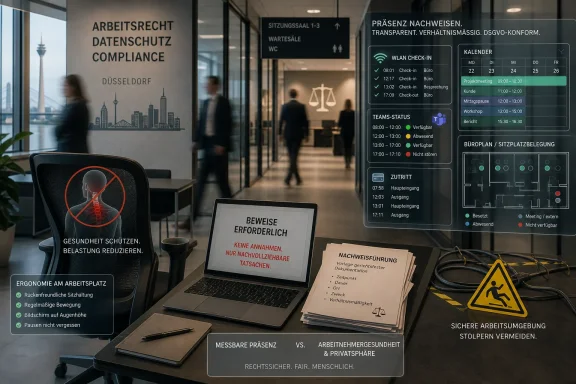
A German labor court in Düsseldorf ruled on February 11, 2026, that an employer could not impose a blanket four-day office mandate without a concrete justification, even though German workers still have no general right to a fixed home-office quota. The decision lands at an awkward moment for employers trying to pull staff back into buildings while also deploying software that can prove who is there. What looks like a narrow labor-law dispute is really a preview of the next workplace fight: the office is becoming more measurable at exactly the moment employees are asking whether it is healthy, necessary, or fair.
The Düsseldorf case matters because it punctures one of the lazier assumptions behind the post-pandemic return-to-office movement. Employers have often treated “collaboration,” “culture,” and “team cohesion” as magic words that can justify almost any presence requirement. The court’s message was more prosaic and more consequential: if management claims physical presence solves a business problem, it must be able to explain how.
That does not make Germany a home-office paradise. The court reportedly rejected the idea that the worker had a general entitlement to a fixed home-office share. In other words, the ruling is not a constitutional charter for working in slippers; it is a demand that employers exercise managerial authority with evidence, proportionality, and a visible balancing of interests.
That distinction is exactly why the case should make HR departments nervous. A company can still require attendance, but “because we said so” is a weaker position than many executives seem to believe. The employer’s right to direct work remains intact, but it is not a blank check when the directive disrupts established working arrangements.
For IT leaders, this is not just a legal department problem. Hybrid work policies are now implemented through calendars, Teams presence, access logs, Wi-Fi records, desk-booking systems, and analytics dashboards. The more granular the tooling becomes, the harder it is for an employer to pretend that a mandate is merely a broad cultural preference rather than an enforceable, monitorable rule.
The figures circulating with the Düsseldorf coverage are stark. Physiotherapist Sara Scheidegger is cited as saying roughly 80 percent of office employees report neck pain, with an estimated 12 percent productivity hit for companies. Those numbers should be treated carefully unless backed by a disclosed study, but they are directionally consistent with what every sysadmin, developer, accountant, and support engineer already knows: knowledge work is not physically neutral just because it happens at a desk.
The fixes are often mundane. Hips slightly higher than knees, forearms at a roughly 90-degree angle, and the top of the monitor near eye level are not lifestyle luxuries. They are the difference between a workstation and a daily low-grade injury machine.
The 20-20-20 rule for eye strain falls into the same category. Every 20 minutes, looking for 20 seconds at something about 20 feet away is not a cure-all, but it is a useful countermeasure against the way modern work traps attention at a fixed focal distance. It is also telling that one of the simplest interventions is behavioral rather than technological.
Standing desks and ergonomic chairs are often marketed as consumer upgrades, but in a legal workplace context they become risk controls. A €75 standing desk converter and a high-end chair with adjustable lumbar support sit on the same continuum: both are attempts to compensate for the fact that the standard desk setup was never designed for eight hours of uninterrupted screen labor.
That variability is exactly why blanket mandates are so vulnerable. The real workplace is not a single place; it is a chain of conditions. The same person can be productive and pain-free in one setup, then lose hours to neck strain in another.
Employers often want the administrative simplicity of a single office rule while retaining the legal language of individualized assessment. Those two instincts conflict. If the organization says attendance is mandatory, it inherits the burden of making the mandatory environment safe, suitable, and rationally connected to the work being done.
Coccyx pain, which social network reports in June 2026 put at around 60 percent of office workers, is a reminder that the chair is not a trivial object. Tailbone pressure is not solved by a motivational poster about collaboration. It is solved by seat design, posture changes, movement, and sometimes medical advice.
The ergonomic argument also complicates the moral politics of remote work. Home office is not automatically humane; plenty of workers have bad chairs, cramped flats, poor lighting, and blurred boundaries. But that cuts both ways. If neither the home nor the office is automatically safe, then the policy question becomes evidence-based design rather than managerial nostalgia.
The reported BAuA update dated June 22, 2026, states that roughly a quarter of work accidents are falls. Even if exact classifications vary by sector and reporting method, the practical lesson is not subtle. Employers obsessing over whether someone is present at 9:07 a.m. should also be asking whether the stair tread, entrance mat, cable route, loading dock, or wet floor is waiting to create the next incident report.
Slip resistance sounds like the dullest possible facilities topic until someone falls. Classifications such as R10/V4 for outdoor staircases and friction coefficients around 0.45 are not decorative compliance language. They are attempts to translate physics into purchasing and maintenance decisions.
The heat thresholds are equally concrete. Uncoated metal can become dangerous at temperatures that do not look spectacular on a spec sheet, and long exposure lowers the threshold at which materials become unsafe. A handrail, machine guard, outdoor surface, or equipment casing does not need to glow red to injure someone.
This is where the office-health debate escapes the ergonomic chair entirely. A modern workplace is a stack of risks: musculoskeletal strain, eye fatigue, slips, falls, heat, surveillance pressure, commute fatigue, and psychosocial stress. A return-to-office mandate that ignores that stack is not a strategy; it is a slogan.
That matters because hybrid-work debates can become absurdly white-collar. Office workers argue about Teams status and monitor height while warehouse, delivery, factory, maintenance, and facilities staff deal with impact protection, visibility, slips, thermal exposure, and repetitive strain in far less flexible environments. The return-to-office fight is only one piece of a larger revaluation of work conditions.
It is also a reminder that employers do understand physical risk when it is visible enough. A hard hat, safety shoe, or high-visibility jacket has a legitimacy that an ergonomic chair sometimes lacks. The challenge for office work is that the injuries are slower, less theatrical, and easier to individualize as “bad posture” rather than system design.
If PPE branding helps normalize safety investment, that is welcome. But the more important question is whether employers apply the same seriousness to the less marketable hazards of knowledge work. A workplace that buys premium protective gear for one team and leaves another team hunched over laptops on shared desks has not solved safety; it has sorted it by job category.
Microsoft has softened the feature’s posture after earlier backlash. Reporting and Microsoft’s own materials indicate that the capability is controlled by the organization and requires individual user enablement. It is framed less as secret tracking than as an opt-in workplace presence signal layered onto Teams, calendars, and Places.
That distinction matters technically, but it may not matter emotionally. Employees do not experience workplace software as a set of architectural diagrams. They experience it as the green dot, the idle timer, the read receipt, the meeting analytics page, the calendar visibility setting, and now potentially the office check-in state.
For administrators, the feature creates the usual double bind. It can genuinely help in a hybrid office where teams need to know who is on-site before booking rooms, planning whiteboard sessions, or arranging desk neighborhoods. It can also become one more metric in a managerial culture that mistakes visibility for output.
Germany makes that tension sharper. Works councils have strong co-determination rights around technical systems that can monitor employee behavior or performance. Even where the individual user has a consent toggle, employers should not assume that consent in an employment relationship is legally or practically frictionless.
That is why German employers need to be especially careful with Workplace Check-in. A worker may technically enable the feature, but the surrounding pressure matters. If the company has a four-day office expectation, managers monitor attendance, and team norms treat refusal as suspicious, the voluntariness of the toggle becomes less convincing.
Works council approval is not a bureaucratic nicety here. It is the institutional mechanism that forces employers to define purpose, scope, retention, access, and limits before a monitoring-capable system becomes part of daily work. The critical question is not whether Teams can infer presence; corporate networks have always produced logs. The question is whether that inference is surfaced, normalized, and made socially actionable.
Microsoft’s defensive framing is also understandable. Hybrid work really does need coordination infrastructure. The old alternative was often worse: endless “Are you in today?” chats, ghost-town offices, wasted commutes, and meeting rooms booked for people who never arrive.
But the product lands in a workplace culture already primed for suspicion. When the same companies that cut real estate costs during remote work now demand attendance, and when the same software suites that promise productivity also expose behavioral exhaust, employees are not paranoid for asking where the data goes.
The office is now a legal claim, a health environment, a data source, and a management ideology. Requiring attendance means asserting that the employer’s chosen location is necessary for the work. Measuring attendance means generating evidence that may later be used in performance, discipline, planning, or litigation.
That is a much higher-stakes model than the pre-pandemic office routine. Before 2020, attendance was often assumed because alternatives were less mature. In 2026, the employer must argue against a proven counterfactual: many organizations already know that large portions of knowledge work can happen elsewhere.
This is why vague appeals to culture are increasingly insufficient. Culture is real, but it is not self-proving. If a team needs in-person design sessions twice a week, say that. If a regulated process requires secure on-site systems, document it. If junior employees benefit from scheduled mentoring, build the mentoring program rather than pretending the badge swipe is the intervention.
The best return-to-office policies are likely to be narrower, clearer, and more operationally honest. They will distinguish between tasks that benefit from co-presence and tasks that simply require concentration. They will treat the office as a tool, not a shrine.
Technically, the answer is often yes, or close enough to tempt misuse. Enterprise networks generate abundant signals: SSIDs, access points, IP ranges, device identities, sign-in locations, conditional access events, badge systems, and application presence states. Correlating those signals is not science fiction.
The governance answer is more complicated. Just because a system can reveal presence does not mean it should be used for attendance enforcement. A tool deployed for coordination can become a monitoring system if the purpose changes, even if the code does not.
This is where documentation becomes a defensive technology. Admins should insist on written purpose statements, access controls, retention rules, audit logs, and works council agreements where applicable. If the business wants to use presence data for discipline, it should say so before deployment, not after the first dispute.
There is also a cybersecurity angle that should not be ignored. Location and presence data can help detect anomalous access, impossible travel, and suspicious sign-ins. But security uses require their own governance, especially when the same data can be attractive to managers for productivity policing.
That judgment will intensify as labor markets shift. Skilled employees may tolerate some office attendance if the office is genuinely useful, well-equipped, and socially coherent. They are less likely to tolerate a rigid mandate enforced by telemetry in a building that gives them neck pain.
Employers that understand this will stop treating ergonomics, privacy, and hybrid scheduling as separate departments. The same policy that says who must come in should also say why, how often, for which activities, with what equipment, under what data rules, and with what accommodations. Otherwise the organization is not managing hybrid work; it is improvising conflict.
The legal system will not provide a perfect template. German labor law, works council practice, GDPR obligations, occupational safety rules, and product-specific controls all overlap without merging into one clean answer. That complexity is frustrating, but it is also the point: work is not just a management preference encoded in software.
For WindowsForum readers, the practical takeaway is that workplace technology is no longer neutral plumbing. Teams, Microsoft Places, endpoint management, access control, and network identity are becoming part of labor relations. The admin console is now adjacent to the employment contract.
 The Office Mandate Now Has to Do More Than Sound Managerial
The Düsseldorf case matters because it punctures one of the lazier assumptions behind the post-pandemic return-to-office movement. Employers have often treated “collaboration,” “culture,” and “team cohesion” as magic words that can justify almost any presence requirement. The court’s message was more prosaic and more consequential: if management claims physical presence solves a business problem, it must be able to explain how.That does not make Germany a home-office paradise. The court reportedly rejected the idea that the worker had a general entitlement to a fixed home-office share. In other words, the ruling is not a constitutional charter for working in slippers; it is a demand that employers exercise managerial authority with evidence, proportionality, and a visible balancing of interests.
That distinction is exactly why the case should make HR departments nervous. A company can still require attendance, but “because we said so” is a weaker position than many executives seem to believe. The employer’s right to direct work remains intact, but it is not a blank check when the directive disrupts established working arrangements.
For IT leaders, this is not just a legal department problem. Hybrid work policies are now implemented through calendars, Teams presence, access logs, Wi-Fi records, desk-booking systems, and analytics dashboards. The more granular the tooling becomes, the harder it is for an employer to pretend that a mandate is merely a broad cultural preference rather than an enforceable, monitorable rule.
Ergonomics Is the Evidence Employers Prefer Not to Collect
The legal fight over office days would be simpler if the office were obviously better for workers. The ergonomic evidence points in the opposite direction: many employees are already carrying pain into the workday, and the line between office risk and home-office risk is blurrier than return-to-office rhetoric admits.The figures circulating with the Düsseldorf coverage are stark. Physiotherapist Sara Scheidegger is cited as saying roughly 80 percent of office employees report neck pain, with an estimated 12 percent productivity hit for companies. Those numbers should be treated carefully unless backed by a disclosed study, but they are directionally consistent with what every sysadmin, developer, accountant, and support engineer already knows: knowledge work is not physically neutral just because it happens at a desk.
The fixes are often mundane. Hips slightly higher than knees, forearms at a roughly 90-degree angle, and the top of the monitor near eye level are not lifestyle luxuries. They are the difference between a workstation and a daily low-grade injury machine.
The 20-20-20 rule for eye strain falls into the same category. Every 20 minutes, looking for 20 seconds at something about 20 feet away is not a cure-all, but it is a useful countermeasure against the way modern work traps attention at a fixed focal distance. It is also telling that one of the simplest interventions is behavioral rather than technological.
Standing desks and ergonomic chairs are often marketed as consumer upgrades, but in a legal workplace context they become risk controls. A €75 standing desk converter and a high-end chair with adjustable lumbar support sit on the same continuum: both are attempts to compensate for the fact that the standard desk setup was never designed for eight hours of uninterrupted screen labor.
Pain Makes Hybrid Work a Safety Policy, Not a Perk
Return-to-office mandates are usually framed as productivity decisions, but ergonomics turns them into occupational health decisions. A worker with a well-adjusted home setup may be worse off returning to a hot-desk environment with mismatched chairs, fixed monitor heights, and limited ability to personalize the space. Another worker may be safer in a properly equipped office than at a kitchen table.That variability is exactly why blanket mandates are so vulnerable. The real workplace is not a single place; it is a chain of conditions. The same person can be productive and pain-free in one setup, then lose hours to neck strain in another.
Employers often want the administrative simplicity of a single office rule while retaining the legal language of individualized assessment. Those two instincts conflict. If the organization says attendance is mandatory, it inherits the burden of making the mandatory environment safe, suitable, and rationally connected to the work being done.
Coccyx pain, which social network reports in June 2026 put at around 60 percent of office workers, is a reminder that the chair is not a trivial object. Tailbone pressure is not solved by a motivational poster about collaboration. It is solved by seat design, posture changes, movement, and sometimes medical advice.
The ergonomic argument also complicates the moral politics of remote work. Home office is not automatically humane; plenty of workers have bad chairs, cramped flats, poor lighting, and blurred boundaries. But that cuts both ways. If neither the home nor the office is automatically safe, then the policy question becomes evidence-based design rather than managerial nostalgia.
The Floor Is Still More Dangerous Than the Dashboard
The glamour in workplace technology is all sensors, AI assistants, presence graphs, and workplace analytics. The boring risk is still the one that breaks bones. Falls remain among the most important workplace hazards, and Germany’s Federal Institute for Occupational Safety and Health has continued to emphasize fall prevention as a core occupational safety issue.The reported BAuA update dated June 22, 2026, states that roughly a quarter of work accidents are falls. Even if exact classifications vary by sector and reporting method, the practical lesson is not subtle. Employers obsessing over whether someone is present at 9:07 a.m. should also be asking whether the stair tread, entrance mat, cable route, loading dock, or wet floor is waiting to create the next incident report.
Slip resistance sounds like the dullest possible facilities topic until someone falls. Classifications such as R10/V4 for outdoor staircases and friction coefficients around 0.45 are not decorative compliance language. They are attempts to translate physics into purchasing and maintenance decisions.
The heat thresholds are equally concrete. Uncoated metal can become dangerous at temperatures that do not look spectacular on a spec sheet, and long exposure lowers the threshold at which materials become unsafe. A handrail, machine guard, outdoor surface, or equipment casing does not need to glow red to injure someone.
This is where the office-health debate escapes the ergonomic chair entirely. A modern workplace is a stack of risks: musculoskeletal strain, eye fatigue, slips, falls, heat, surveillance pressure, commute fatigue, and psychosocial stress. A return-to-office mandate that ignores that stack is not a strategy; it is a slogan.
PPE Is Expanding Because the Office Is Not the Only Workplace
The reported move by adidas, with GLO Brands, into the “Adidas Pro Work” PPE line for Europe in August 2026 points to a different but related shift. Workplace safety is becoming a branded market, not just a compliance catalogue. Logistics and manufacturing workers may soon be buying, wearing, or being issued protective equipment shaped by consumer-sports design language.That matters because hybrid-work debates can become absurdly white-collar. Office workers argue about Teams status and monitor height while warehouse, delivery, factory, maintenance, and facilities staff deal with impact protection, visibility, slips, thermal exposure, and repetitive strain in far less flexible environments. The return-to-office fight is only one piece of a larger revaluation of work conditions.
It is also a reminder that employers do understand physical risk when it is visible enough. A hard hat, safety shoe, or high-visibility jacket has a legitimacy that an ergonomic chair sometimes lacks. The challenge for office work is that the injuries are slower, less theatrical, and easier to individualize as “bad posture” rather than system design.
If PPE branding helps normalize safety investment, that is welcome. But the more important question is whether employers apply the same seriousness to the less marketable hazards of knowledge work. A workplace that buys premium protective gear for one team and leaves another team hunched over laptops on shared desks has not solved safety; it has sorted it by job category.
Teams Turns Presence Into Infrastructure
Microsoft’s Workplace Check-in via Wi-Fi for Teams and Microsoft Places is the software counterpart to the Düsseldorf ruling. The feature is designed to update a user’s work location when a device connects to a configured corporate Wi-Fi network, with Microsoft describing it as a way to make in-person coordination easier. The controversy is obvious: a convenience feature for hybrid scheduling can look indistinguishable from attendance surveillance once managers start using it that way.Microsoft has softened the feature’s posture after earlier backlash. Reporting and Microsoft’s own materials indicate that the capability is controlled by the organization and requires individual user enablement. It is framed less as secret tracking than as an opt-in workplace presence signal layered onto Teams, calendars, and Places.
That distinction matters technically, but it may not matter emotionally. Employees do not experience workplace software as a set of architectural diagrams. They experience it as the green dot, the idle timer, the read receipt, the meeting analytics page, the calendar visibility setting, and now potentially the office check-in state.
For administrators, the feature creates the usual double bind. It can genuinely help in a hybrid office where teams need to know who is on-site before booking rooms, planning whiteboard sessions, or arranging desk neighborhoods. It can also become one more metric in a managerial culture that mistakes visibility for output.
Germany makes that tension sharper. Works councils have strong co-determination rights around technical systems that can monitor employee behavior or performance. Even where the individual user has a consent toggle, employers should not assume that consent in an employment relationship is legally or practically frictionless.
Consent Is Not a Magic Shield When the Boss Owns the Tenant
The phrase “opt-in” does a lot of work in software marketing. In consumer apps, it suggests a personal choice. In enterprise software, it often means the employee is choosing inside an environment designed, licensed, governed, logged, and culturally shaped by the employer.That is why German employers need to be especially careful with Workplace Check-in. A worker may technically enable the feature, but the surrounding pressure matters. If the company has a four-day office expectation, managers monitor attendance, and team norms treat refusal as suspicious, the voluntariness of the toggle becomes less convincing.
Works council approval is not a bureaucratic nicety here. It is the institutional mechanism that forces employers to define purpose, scope, retention, access, and limits before a monitoring-capable system becomes part of daily work. The critical question is not whether Teams can infer presence; corporate networks have always produced logs. The question is whether that inference is surfaced, normalized, and made socially actionable.
Microsoft’s defensive framing is also understandable. Hybrid work really does need coordination infrastructure. The old alternative was often worse: endless “Are you in today?” chats, ghost-town offices, wasted commutes, and meeting rooms booked for people who never arrive.
But the product lands in a workplace culture already primed for suspicion. When the same companies that cut real estate costs during remote work now demand attendance, and when the same software suites that promise productivity also expose behavioral exhaust, employees are not paranoid for asking where the data goes.
The Return-to-Office Debate Has Outgrown the Commute
The public argument over office mandates often gets trapped in commute math. Workers dislike lost time, employers want face time, and both sides trade anecdotes about collaboration or distraction. The Düsseldorf ruling and the Teams rollout show that the real debate has moved beyond the commute.The office is now a legal claim, a health environment, a data source, and a management ideology. Requiring attendance means asserting that the employer’s chosen location is necessary for the work. Measuring attendance means generating evidence that may later be used in performance, discipline, planning, or litigation.
That is a much higher-stakes model than the pre-pandemic office routine. Before 2020, attendance was often assumed because alternatives were less mature. In 2026, the employer must argue against a proven counterfactual: many organizations already know that large portions of knowledge work can happen elsewhere.
This is why vague appeals to culture are increasingly insufficient. Culture is real, but it is not self-proving. If a team needs in-person design sessions twice a week, say that. If a regulated process requires secure on-site systems, document it. If junior employees benefit from scheduled mentoring, build the mentoring program rather than pretending the badge swipe is the intervention.
The best return-to-office policies are likely to be narrower, clearer, and more operationally honest. They will distinguish between tasks that benefit from co-presence and tasks that simply require concentration. They will treat the office as a tool, not a shrine.
IT Will Be Asked to Enforce Policies It Did Not Write
No group is more exposed in this transition than IT. The board sets the attendance target, HR drafts the policy, legal checks the wording, and then IT is asked whether Teams, Wi-Fi, access control, VPN logs, endpoint telemetry, and desk-booking data can prove compliance. That request should make administrators pause.Technically, the answer is often yes, or close enough to tempt misuse. Enterprise networks generate abundant signals: SSIDs, access points, IP ranges, device identities, sign-in locations, conditional access events, badge systems, and application presence states. Correlating those signals is not science fiction.
The governance answer is more complicated. Just because a system can reveal presence does not mean it should be used for attendance enforcement. A tool deployed for coordination can become a monitoring system if the purpose changes, even if the code does not.
This is where documentation becomes a defensive technology. Admins should insist on written purpose statements, access controls, retention rules, audit logs, and works council agreements where applicable. If the business wants to use presence data for discipline, it should say so before deployment, not after the first dispute.
There is also a cybersecurity angle that should not be ignored. Location and presence data can help detect anomalous access, impossible travel, and suspicious sign-ins. But security uses require their own governance, especially when the same data can be attractive to managers for productivity policing.
Healthy Work Is Becoming a Competitive Signal
The DAK-Gesundheit workplace health innovation prize, accepting applications until July 4, 2026, is a useful counterpoint to the darker parts of this story. Its theme, “New Paths to Healthy Work,” captures the reality that employers are no longer being judged only on salary, devices, and flexibility. They are being judged on whether work itself is designed intelligently.That judgment will intensify as labor markets shift. Skilled employees may tolerate some office attendance if the office is genuinely useful, well-equipped, and socially coherent. They are less likely to tolerate a rigid mandate enforced by telemetry in a building that gives them neck pain.
Employers that understand this will stop treating ergonomics, privacy, and hybrid scheduling as separate departments. The same policy that says who must come in should also say why, how often, for which activities, with what equipment, under what data rules, and with what accommodations. Otherwise the organization is not managing hybrid work; it is improvising conflict.
The legal system will not provide a perfect template. German labor law, works council practice, GDPR obligations, occupational safety rules, and product-specific controls all overlap without merging into one clean answer. That complexity is frustrating, but it is also the point: work is not just a management preference encoded in software.
For WindowsForum readers, the practical takeaway is that workplace technology is no longer neutral plumbing. Teams, Microsoft Places, endpoint management, access control, and network identity are becoming part of labor relations. The admin console is now adjacent to the employment contract.
The Düsseldorf Lesson for Every Teams Tenant
The most important lesson from the Düsseldorf ruling is not that office mandates are dead. It is that they now need reasons strong enough to survive contact with facts. The most important lesson from Teams Workplace Check-in is not that Microsoft has built a dystopia. It is that even reasonable coordination features become risky when introduced into a low-trust workplace.- Employers in Germany should not treat a fixed office quota as self-justifying merely because management prefers it.
- Workers should not assume the Düsseldorf decision creates a general right to a guaranteed number of home-office days.
- IT teams should classify Wi-Fi-based workplace check-in as a governance-sensitive feature, not just another Teams setting.
- Works councils should focus on purpose limitation, access rights, retention periods, and whether presence data can be used for performance or discipline.
- Ergonomic risk assessments should cover both office and home workstations, because pain does not respect the policy boundary between remote and on-site work.
- Return-to-office policies will be more defensible when they are tied to specific collaborative tasks rather than broad claims about culture.
References
- Primary source: AD HOC NEWS
Published: 2026-06-22T08:26:07.128239
Office Ergonomics and Legal Limits: German Workers Grapple with Pain, Surveillance, and Return-to-Of
Düsseldorf court strikes down blanket office mandates; 80% of workers suffer neck pain. New ergonomic tips, BAuA safety updates, adidas PPE launch, and Microsoft’s Teams check-in feature.www.ad-hoc-news.de - Related coverage: windowslatest.com
Microsoft Teams will auto-detect when you're at the office via Wi-Fi, roll out confirmed, but you can opt-out
Microsoft Teams is moving ahead with the rollout of a controversial feature that lets organizations track when you're at the office via Wi-Fi. www.windowslatest.com