
Microsoft CEO Satya Nadella used a June 2026 interview to warn that artificial intelligence will lose public legitimacy if a few dominant companies demand vast infrastructure while predicting mass job disruption and security risks. The comment was not an abstract sermon from a neutral observer. It was a signal from the company that has spent the last three years trying to turn AI from a cloud arms race into a Microsoft 365 operating layer. Nadella is now arguing that the next phase of AI will be won less by owning the biggest model than by controlling the workplace system where models are selected, priced, audited, and swapped.
For much of the generative AI boom, Microsoft’s public posture was simple: OpenAI had the models, Azure had the cloud, and Copilot would carry both into the daily work of hundreds of millions of users. That story was powerful because it compressed strategy into a single chain. Better models would need more compute, more compute would mean more Azure, and more Azure would make Microsoft the indispensable infrastructure provider for AI.
Nadella’s latest remarks complicate that chain. His warning about AI companies asking for “all the power” to build data centers while also warning that white-collar jobs may disappear is a direct challenge to the industry’s moral accounting. If AI is both a social threat and an economic inevitability, then the public will eventually ask why the companies building it deserve unlimited capital, energy, land, and trust.
That is the phrase that matters: social permission. Nadella has used similar language before, but it lands differently now because AI has moved from novelty to utility bill. Data center construction is no longer a backstage technical matter; it is a local energy story, a water story, a ratepayer story, and increasingly a national-security story.
Microsoft’s own business gives Nadella little room to sound like an outsider. The company is one of the world’s largest buyers of AI compute, one of OpenAI’s most consequential partners, and one of the primary vendors asking enterprises to rebuild workflows around generative systems. The argument, then, is not that Microsoft is rejecting the AI buildout. It is that Microsoft wants to redefine the terms under which that buildout is considered acceptable.
For a while, this looked like the cleanest possible play. Microsoft did not need to beat DeepMind or Anthropic in foundational research if it could distribute OpenAI’s work through Windows, Office, GitHub, Teams, Azure, and Bing. It could be the front door, billing layer, security wrapper, and cloud landlord for the model revolution.
But exclusivity is a temporary advantage when the commodity underneath is changing quickly. OpenAI wants optionality. Anthropic wants enterprise reach. Google wants Gemini everywhere. Open-source and open-weight models keep narrowing some practical gaps. Meanwhile, enterprise buyers have learned that the “best” model is not always the right model for every task.
That last point is the wedge Microsoft is now driving into the market. The company is not saying frontier models are irrelevant. It is saying that an enterprise AI platform should not be architected as a shrine to one vendor’s leaderboard score.
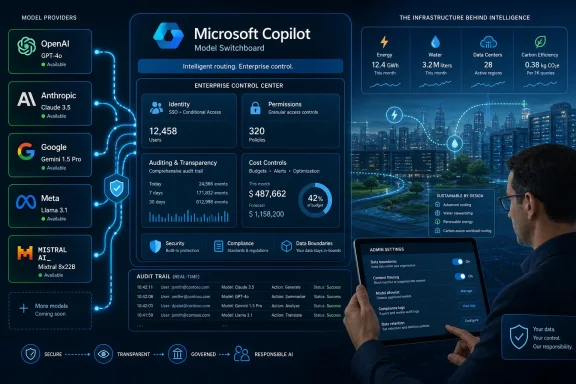
This is not altruism. Microsoft’s safest long-term position is not to be permanently dependent on OpenAI, Anthropic, Google, DeepSeek, or any other model provider. Its safest position is to make Copilot the switching fabric — the place where customers bring policy, identity, documents, workflows, governance, and cost controls, while models compete underneath.
That is why recent Copilot changes matter. Microsoft has been adding support for multiple model providers, including Anthropic models in parts of Microsoft 365 Copilot and Copilot Studio. Copilot Cowork, Microsoft’s enterprise agent for longer tasks, has been presented as a place where customers can choose between different engines depending on the job.
This is a subtle but major shift in product identity. Copilot began as Microsoft’s branded face for OpenAI-powered assistance. It is becoming an orchestration layer where OpenAI is one important supplier among several.
For WindowsForum readers who administer Microsoft environments, that distinction is practical, not philosophical. A multi-model Copilot raises questions about data processing, vendor subprocessors, audit logs, compliance boundaries, and cost attribution. If a user asks an agent to summarize a SharePoint folder, refactor a spreadsheet, draft a legal memo, or generate code, the model choice may affect both quality and risk.
Microsoft’s wager is that IT departments do not actually want a model religion. They want a policy-governed control plane. They want to decide which model can touch which class of data, which region can process which workload, and which agentic task is worth premium inference pricing.
For Microsoft, a cheaper model option is not merely a consumer-friendly gesture. It may be necessary for the business model. Agentic systems do not behave like simple chatbots. They can call models repeatedly, branch into subtasks, check their own work, search documents, generate drafts, and revise outputs. That makes them more useful, but it also makes them capable of burning through tokens at a speed that turns a productivity demo into an invoice problem.
Usage-based pricing for enterprise agents is an admission that the old subscription framing is strained. A flat monthly Copilot license can cover everyday assistance, but it may not comfortably cover a virtual coworker that spends hours grinding through documents, code, CRM records, or financial models. If premium models are used for every step of that process, Microsoft either eats the margin loss or passes the pain to customers.
DeepSeek offers a third option: route some work to a cheaper model, especially if Microsoft can host it inside its own cloud boundary. That does not erase the geopolitical or security issues. A Chinese-origin model in a Microsoft enterprise product will make many CISOs and policymakers uneasy, even if the weights are hosted on Azure and customer data is not sent to a foreign service.
The key phrase is “Microsoft-hosted.” Microsoft can argue that hosting, fine-tuning, monitoring, and policy enforcement change the risk profile. But they do not change the model’s origin, training opacity, or the political environment around Chinese AI. For regulated industries and government-adjacent customers, those details will matter.
A company can justify a premium model for a board presentation, a legal analysis, a critical software migration, or a complex incident response. It is harder to justify frontier-model pricing for every routine summarization, scheduling chain, spreadsheet cleanup, ticket triage, or low-risk draft. The future of enterprise AI depends on routing intelligence with the same pragmatism that cloud platforms route storage tiers.
Microsoft understands tiering better than almost anyone. Windows, Office, Azure, and Microsoft 365 are all exercises in packaging different capabilities for different buyers under a common administrative umbrella. The company’s AI strategy increasingly resembles that older software muscle: bundle the experience, abstract the complexity, and let customers pay more only where the value is obvious.
This is where Nadella’s monopoly critique becomes a pricing critique. If AI is locked inside a few expensive model providers, then the cost curve dictates adoption. If Copilot can dynamically use premium models, mid-tier models, small models, and open models, Microsoft can keep AI present in the workflow even when customers become more cost-sensitive.
That may also blunt the risk of customers defecting to Google Gemini, Claude, ChatGPT Enterprise, or specialized vertical tools. If Copilot becomes the place where those model families can be evaluated and governed, Microsoft can lose a model preference battle while still winning the platform war.
But “important” is not the same as “exclusive,” and “strategic” is not the same as “dependency.” Microsoft’s AI posture in 2026 looks like a deliberate effort to prevent any single lab from becoming the choke point for its enterprise future. That includes OpenAI.
The Anthropic partnership serves the same purpose from another angle. Claude’s reputation for reasoning, writing, and coding gives Microsoft another premium option for certain workloads. It also gives Microsoft negotiating leverage and a way to tell enterprise customers that Copilot is not simply a wrapper around one lab’s roadmap.
Meanwhile, Microsoft has been investing in its own models and internal AI leadership. The company does not need to own the absolute best frontier model to improve its bargaining position. It needs credible in-house models for enough workloads that external suppliers cannot dictate the economics of Copilot.
That is the classic Microsoft move: commoditize the layer beneath you, integrate the layer around you, and own the management surface above you.
This will matter inside Microsoft 365 tenants before it matters inside Windows itself. Admins will need to understand when Anthropic, OpenAI, Microsoft, or another provider is acting as the processor behind a feature. They will need to know whether a model can be blocked, whether logs expose the provider used, and whether user-level choice can override tenant policy.
The Windows endpoint is still part of the story because Copilot is being woven into the user experience across devices. But the real governance problem lives in identity, permissions, and data boundaries. A model is only as dangerous as the files, emails, chats, repositories, and business systems it can reach.
That is why Microsoft’s advantage is not merely that it has Copilot. It is that it controls Entra ID, Intune, Defender, Purview, SharePoint, Exchange, Teams, Office, Windows, and Azure. If the AI layer becomes a traffic cop for enterprise work, Microsoft already owns most of the intersections.
The danger for customers is lock-in by convenience. Multi-model choice sounds open, but if all choices are mediated through Microsoft’s licensing, telemetry, policy, and billing stack, the platform owner still gains power. Nadella can warn against an AI monopoly while building a more subtle one around orchestration.
It is not a complete answer. AI security is not only about where inference runs. It is about what the model learned, what behaviors were introduced during training, how it responds to adversarial prompts, whether its outputs are reliable, and whether its supply chain can be audited well enough for the customer’s risk appetite.
The DeepSeek possibility also lands in a policy environment where Chinese technology is treated with heightened suspicion. Even when the technical architecture is defensible, procurement teams may be forced to consider political risk, board optics, customer expectations, and future regulatory constraints. The lowest-cost model may not be the lowest-risk model.
This is where Microsoft’s multi-model pitch could become genuinely useful. Instead of arguing that one model is safe for everyone, Microsoft can let customers draw their own boundaries. A commercial design agency may accept a broader menu. A defense contractor may restrict models aggressively. A hospital may prioritize auditability and data guarantees over raw price.
That kind of configurability is valuable, but only if Microsoft makes it legible. If model routing becomes an opaque black box hidden behind Copilot branding, the trust problem returns in another form.
The phrase “white-collar jobs are gone” may thrill investors looking for automation upside, but it terrifies the organizations expected to deploy the tools. Boards do not want to explain that they bought software whose stated purpose is to hollow out their own workforce. HR leaders, legal teams, and line managers need a softer and more operational story.
Nadella’s alternative is that AI should restructure work rather than simply eliminate it. That is the “continuous learning system” framing: people, proprietary data, and models improving one another inside an organization. It is a more palatable argument because it suggests capability expansion instead of pure labor substitution.
Whether that is what happens is another matter. Some jobs will be changed. Some tasks will disappear. Some roles will shrink. Some organizations will use AI to avoid hiring, reduce contractors, or consolidate teams. Microsoft cannot promise otherwise.
But Microsoft can shape the interface through which those choices are made. A Copilot that routes across models, respects permissions, and embeds into existing workflows gives enterprises a way to adopt AI incrementally. That is more durable than selling a single revolutionary model and asking customers to rebuild everything around it.
Investors can tolerate huge capital expenditures if they believe AI will expand Microsoft’s moat. They will become less patient if AI merely raises infrastructure costs while customers resist higher prices. The multi-model strategy is therefore not just a customer feature. It is a margin defense mechanism.
Customers, meanwhile, need more than the assurance that choice exists. They need to see that Copilot produces reliable work, that agentic tasks can be bounded, that cheaper models do not degrade outcomes unpredictably, and that model selection does not become another hidden variable in compliance reviews.
This is where Microsoft’s enterprise discipline will be tested. The company is very good at selling platforms that become unavoidable. It is not always as good at making the resulting complexity pleasant. Copilot’s next phase will require clean admin controls, transparent billing, understandable model governance, and documentation that does not require a licensing archaeologist.
The winners in enterprise AI may not be the companies with the most cinematic demos. They may be the ones that make the boring parts work: procurement, audit, retention, permissions, regional compliance, cost limits, and incident response.
 Microsoft’s AI Message Has Shifted From Awe to Permission
For much of the generative AI boom, Microsoft’s public posture was simple: OpenAI had the models, Azure had the cloud, and Copilot would carry both into the daily work of hundreds of millions of users. That story was powerful because it compressed strategy into a single chain. Better models would need more compute, more compute would mean more Azure, and more Azure would make Microsoft the indispensable infrastructure provider for AI.Nadella’s latest remarks complicate that chain. His warning about AI companies asking for “all the power” to build data centers while also warning that white-collar jobs may disappear is a direct challenge to the industry’s moral accounting. If AI is both a social threat and an economic inevitability, then the public will eventually ask why the companies building it deserve unlimited capital, energy, land, and trust.
That is the phrase that matters: social permission. Nadella has used similar language before, but it lands differently now because AI has moved from novelty to utility bill. Data center construction is no longer a backstage technical matter; it is a local energy story, a water story, a ratepayer story, and increasingly a national-security story.
Microsoft’s own business gives Nadella little room to sound like an outsider. The company is one of the world’s largest buyers of AI compute, one of OpenAI’s most consequential partners, and one of the primary vendors asking enterprises to rebuild workflows around generative systems. The argument, then, is not that Microsoft is rejecting the AI buildout. It is that Microsoft wants to redefine the terms under which that buildout is considered acceptable.
The Monopoly Nadella Fears Is Also the Monopoly Microsoft Once Wanted to Rent
The irony is unavoidable. Microsoft helped make the current AI hierarchy possible by moving early and aggressively with OpenAI. Its multibillion-dollar investment turned OpenAI from a research lab with extraordinary models into the gravitational center of the enterprise AI market, and it gave Microsoft a first-mover story that Google, Amazon, Salesforce, and Oracle all had to answer.For a while, this looked like the cleanest possible play. Microsoft did not need to beat DeepMind or Anthropic in foundational research if it could distribute OpenAI’s work through Windows, Office, GitHub, Teams, Azure, and Bing. It could be the front door, billing layer, security wrapper, and cloud landlord for the model revolution.
But exclusivity is a temporary advantage when the commodity underneath is changing quickly. OpenAI wants optionality. Anthropic wants enterprise reach. Google wants Gemini everywhere. Open-source and open-weight models keep narrowing some practical gaps. Meanwhile, enterprise buyers have learned that the “best” model is not always the right model for every task.
That last point is the wedge Microsoft is now driving into the market. The company is not saying frontier models are irrelevant. It is saying that an enterprise AI platform should not be architected as a shrine to one vendor’s leaderboard score.
This is not altruism. Microsoft’s safest long-term position is not to be permanently dependent on OpenAI, Anthropic, Google, DeepSeek, or any other model provider. Its safest position is to make Copilot the switching fabric — the place where customers bring policy, identity, documents, workflows, governance, and cost controls, while models compete underneath.
Copilot Becomes a Marketplace Instead of a Mascot
The most important Microsoft AI product is no longer a chatbot icon in the Windows taskbar. It is the administrative and workflow substrate behind Microsoft 365 Copilot, Copilot Studio, GitHub Copilot, Azure AI Foundry, and the new generation of agentic tools aimed at doing longer-running work.That is why recent Copilot changes matter. Microsoft has been adding support for multiple model providers, including Anthropic models in parts of Microsoft 365 Copilot and Copilot Studio. Copilot Cowork, Microsoft’s enterprise agent for longer tasks, has been presented as a place where customers can choose between different engines depending on the job.
This is a subtle but major shift in product identity. Copilot began as Microsoft’s branded face for OpenAI-powered assistance. It is becoming an orchestration layer where OpenAI is one important supplier among several.
For WindowsForum readers who administer Microsoft environments, that distinction is practical, not philosophical. A multi-model Copilot raises questions about data processing, vendor subprocessors, audit logs, compliance boundaries, and cost attribution. If a user asks an agent to summarize a SharePoint folder, refactor a spreadsheet, draft a legal memo, or generate code, the model choice may affect both quality and risk.
Microsoft’s wager is that IT departments do not actually want a model religion. They want a policy-governed control plane. They want to decide which model can touch which class of data, which region can process which workload, and which agentic task is worth premium inference pricing.
DeepSeek Is the Cost Argument Microsoft Cannot Ignore
The reported consideration of a Microsoft-hosted DeepSeek model for Copilot Cowork is the sharpest example of this strategy. DeepSeek’s rise has been disruptive because it attacks the economic premise of the AI boom: that state-of-the-art or near-state-of-the-art performance must be bought with staggering capital intensity and premium per-token pricing.For Microsoft, a cheaper model option is not merely a consumer-friendly gesture. It may be necessary for the business model. Agentic systems do not behave like simple chatbots. They can call models repeatedly, branch into subtasks, check their own work, search documents, generate drafts, and revise outputs. That makes them more useful, but it also makes them capable of burning through tokens at a speed that turns a productivity demo into an invoice problem.
Usage-based pricing for enterprise agents is an admission that the old subscription framing is strained. A flat monthly Copilot license can cover everyday assistance, but it may not comfortably cover a virtual coworker that spends hours grinding through documents, code, CRM records, or financial models. If premium models are used for every step of that process, Microsoft either eats the margin loss or passes the pain to customers.
DeepSeek offers a third option: route some work to a cheaper model, especially if Microsoft can host it inside its own cloud boundary. That does not erase the geopolitical or security issues. A Chinese-origin model in a Microsoft enterprise product will make many CISOs and policymakers uneasy, even if the weights are hosted on Azure and customer data is not sent to a foreign service.
The key phrase is “Microsoft-hosted.” Microsoft can argue that hosting, fine-tuning, monitoring, and policy enforcement change the risk profile. But they do not change the model’s origin, training opacity, or the political environment around Chinese AI. For regulated industries and government-adjacent customers, those details will matter.
The Real Competition Is the Bill at the End of the Workflow
AI monopoly talk often sounds like a debate about abstract power: who owns intelligence, who controls the future, who gets to define acceptable automation. In the enterprise, the immediate fight is more prosaic. It is about who can make AI economically tolerable at scale.A company can justify a premium model for a board presentation, a legal analysis, a critical software migration, or a complex incident response. It is harder to justify frontier-model pricing for every routine summarization, scheduling chain, spreadsheet cleanup, ticket triage, or low-risk draft. The future of enterprise AI depends on routing intelligence with the same pragmatism that cloud platforms route storage tiers.
Microsoft understands tiering better than almost anyone. Windows, Office, Azure, and Microsoft 365 are all exercises in packaging different capabilities for different buyers under a common administrative umbrella. The company’s AI strategy increasingly resembles that older software muscle: bundle the experience, abstract the complexity, and let customers pay more only where the value is obvious.
This is where Nadella’s monopoly critique becomes a pricing critique. If AI is locked inside a few expensive model providers, then the cost curve dictates adoption. If Copilot can dynamically use premium models, mid-tier models, small models, and open models, Microsoft can keep AI present in the workflow even when customers become more cost-sensitive.
That may also blunt the risk of customers defecting to Google Gemini, Claude, ChatGPT Enterprise, or specialized vertical tools. If Copilot becomes the place where those model families can be evaluated and governed, Microsoft can lose a model preference battle while still winning the platform war.
OpenAI Remains Central, but No Longer Sufficient
None of this means Microsoft is walking away from OpenAI. The relationship remains deeply important, and Microsoft still benefits from OpenAI’s technical leadership, brand recognition, and developer mindshare. The companies have also adjusted their partnership to provide more flexibility while preserving long-term access to OpenAI intellectual property and revenue-sharing arrangements.But “important” is not the same as “exclusive,” and “strategic” is not the same as “dependency.” Microsoft’s AI posture in 2026 looks like a deliberate effort to prevent any single lab from becoming the choke point for its enterprise future. That includes OpenAI.
The Anthropic partnership serves the same purpose from another angle. Claude’s reputation for reasoning, writing, and coding gives Microsoft another premium option for certain workloads. It also gives Microsoft negotiating leverage and a way to tell enterprise customers that Copilot is not simply a wrapper around one lab’s roadmap.
Meanwhile, Microsoft has been investing in its own models and internal AI leadership. The company does not need to own the absolute best frontier model to improve its bargaining position. It needs credible in-house models for enough workloads that external suppliers cannot dictate the economics of Copilot.
That is the classic Microsoft move: commoditize the layer beneath you, integrate the layer around you, and own the management surface above you.
Windows Users Will Feel This Through Policy, Not Press Releases
For consumers, the model-switching story may appear as a better Copilot answer, a faster response, or a cheaper plan. For Windows power users and administrators, it will show up as a new kind of settings sprawl. The old question was whether Copilot was enabled. The new question is which Copilot, backed by which model, under which terms, with which access to organizational data.This will matter inside Microsoft 365 tenants before it matters inside Windows itself. Admins will need to understand when Anthropic, OpenAI, Microsoft, or another provider is acting as the processor behind a feature. They will need to know whether a model can be blocked, whether logs expose the provider used, and whether user-level choice can override tenant policy.
The Windows endpoint is still part of the story because Copilot is being woven into the user experience across devices. But the real governance problem lives in identity, permissions, and data boundaries. A model is only as dangerous as the files, emails, chats, repositories, and business systems it can reach.
That is why Microsoft’s advantage is not merely that it has Copilot. It is that it controls Entra ID, Intune, Defender, Purview, SharePoint, Exchange, Teams, Office, Windows, and Azure. If the AI layer becomes a traffic cop for enterprise work, Microsoft already owns most of the intersections.
The danger for customers is lock-in by convenience. Multi-model choice sounds open, but if all choices are mediated through Microsoft’s licensing, telemetry, policy, and billing stack, the platform owner still gains power. Nadella can warn against an AI monopoly while building a more subtle one around orchestration.
The Security Debate Will Not Be Settled by Hosting Alone
Microsoft will almost certainly frame any open or DeepSeek-derived model option in terms of containment. The model would be hosted by Microsoft, governed by Microsoft controls, and integrated into enterprise policy. That is a stronger proposition than sending sensitive business data to an unmanaged third-party endpoint.It is not a complete answer. AI security is not only about where inference runs. It is about what the model learned, what behaviors were introduced during training, how it responds to adversarial prompts, whether its outputs are reliable, and whether its supply chain can be audited well enough for the customer’s risk appetite.
The DeepSeek possibility also lands in a policy environment where Chinese technology is treated with heightened suspicion. Even when the technical architecture is defensible, procurement teams may be forced to consider political risk, board optics, customer expectations, and future regulatory constraints. The lowest-cost model may not be the lowest-risk model.
This is where Microsoft’s multi-model pitch could become genuinely useful. Instead of arguing that one model is safe for everyone, Microsoft can let customers draw their own boundaries. A commercial design agency may accept a broader menu. A defense contractor may restrict models aggressively. A hospital may prioritize auditability and data guarantees over raw price.
That kind of configurability is valuable, but only if Microsoft makes it legible. If model routing becomes an opaque black box hidden behind Copilot branding, the trust problem returns in another form.
Nadella’s Labor Argument Is Also a Product Argument
Nadella’s critique of AI companies predicting mass job loss while demanding infrastructure is politically astute, but it is also commercially necessary. Enterprises do not buy transformation simply because vendors describe the future as inevitable. They buy when the software helps them make change manageable.The phrase “white-collar jobs are gone” may thrill investors looking for automation upside, but it terrifies the organizations expected to deploy the tools. Boards do not want to explain that they bought software whose stated purpose is to hollow out their own workforce. HR leaders, legal teams, and line managers need a softer and more operational story.
Nadella’s alternative is that AI should restructure work rather than simply eliminate it. That is the “continuous learning system” framing: people, proprietary data, and models improving one another inside an organization. It is a more palatable argument because it suggests capability expansion instead of pure labor substitution.
Whether that is what happens is another matter. Some jobs will be changed. Some tasks will disappear. Some roles will shrink. Some organizations will use AI to avoid hiring, reduce contractors, or consolidate teams. Microsoft cannot promise otherwise.
But Microsoft can shape the interface through which those choices are made. A Copilot that routes across models, respects permissions, and embeds into existing workflows gives enterprises a way to adopt AI incrementally. That is more durable than selling a single revolutionary model and asking customers to rebuild everything around it.
The Market Loves Optionality, but Customers Need Proof
The stock-market framing in the source articles is familiar: analysts remain bullish, Microsoft shares moved modestly, and the price target math suggests Wall Street still sees upside. That is not meaningless, but it is less interesting than the operating challenge underneath. Microsoft’s AI strategy is moving from promise to margin management.Investors can tolerate huge capital expenditures if they believe AI will expand Microsoft’s moat. They will become less patient if AI merely raises infrastructure costs while customers resist higher prices. The multi-model strategy is therefore not just a customer feature. It is a margin defense mechanism.
Customers, meanwhile, need more than the assurance that choice exists. They need to see that Copilot produces reliable work, that agentic tasks can be bounded, that cheaper models do not degrade outcomes unpredictably, and that model selection does not become another hidden variable in compliance reviews.
This is where Microsoft’s enterprise discipline will be tested. The company is very good at selling platforms that become unavoidable. It is not always as good at making the resulting complexity pleasant. Copilot’s next phase will require clean admin controls, transparent billing, understandable model governance, and documentation that does not require a licensing archaeologist.
The winners in enterprise AI may not be the companies with the most cinematic demos. They may be the ones that make the boring parts work: procurement, audit, retention, permissions, regional compliance, cost limits, and incident response.
The Copilot Bet Now Runs Through the Model Switchboard
Microsoft’s message is not that AI consolidation is bad while Microsoft consolidation is good. It is that the center of gravity is moving away from the model lab and toward the enterprise control plane. That makes Nadella’s warning both a critique of the industry and a preview of Microsoft’s preferred future.- Microsoft is repositioning Copilot as a multi-model orchestration layer rather than a single-model showcase for OpenAI technology.
- Nadella’s warning about AI monopolies is inseparable from Microsoft’s need to reduce dependence on any one frontier model provider.
- DeepSeek’s possible role in Copilot Cowork shows that AI agent economics are forcing even the largest vendors to consider lower-cost model tiers.
- Enterprise customers should treat model choice as a governance issue involving data access, subprocessors, auditability, and regional or regulatory exposure.
- Microsoft’s strongest AI advantage may be its control of identity, productivity apps, endpoint management, security tooling, and cloud administration.
- The next phase of Copilot will be judged less by demos than by whether Microsoft can make AI costs, risks, and model routing transparent enough for real organizations.
References
- Primary source: parameter.io
Published: 2026-06-22T09:55:12.547639
Satya Nadella Warns Against AI Monopoly as Microsoft (MSFT) Shifts Strategy - Parameter
Microsoft CEO Satya Nadella challenges AI industry concentration, pushing for cheaper models and user choice. MSFT stock targets $557.64 amid strategy shift.parameter.io - Independent coverage: Blockonomi
Published: 2026-06-22T09:54:12.539046
Microsoft (MSFT) CEO Nadella Warns of AI Monopoly — Company's Strategy to Combat Concentration - Blockonomi
Microsoft CEO Satya Nadella calls out AI power concentration and reveals MSFT's strategy for affordable models, user choice, and DeepSeek hosting plans.blockonomi.com - Independent coverage: MoneyCheck
Published: 2026-06-22T09:50:12.549089
Microsoft (MSFT) CEO Warns Against AI Monopoly — Company's Strategy Revealed - MoneyCheck
Microsoft CEO Satya Nadella addresses AI power concentration concerns. MSFT rolls out cheaper models & considers DeepSeek hosting. Stock rated Strong Buy.moneycheck.com - Related coverage: axios.com
Microsoft explores DeepSeek for Copilot Cowork
Microsoft will also shift to usage-based pricing for the enterprise agent.www.axios.com
- Related coverage: techradar.com
'The last thing any of us want': Microsoft CEO Satya Nadella warns AI dominance could 'hollow out entire industries' | TechRadar
Satya Nadella says current AI transition is like early years of globalizationwww.techradar.com - Official source: blogs.microsoft.com
Announcing Copilot leadership update - The Official Microsoft Blog
Satya Nadella, Chairman and CEO, and Mustafa Suleyman, Executive Vice President and CEO of Microsoft AI, shared the below communications with Microsoft employees this morning. SATYA NADELLA MESSAGE I want to share two org changes we’re making to our Copilot org and superintelligence effort. It’s...blogs.microsoft.com
- Official source: learn.microsoft.com
Anthropic models in Microsoft Online Services | Microsoft Learn
Learn about Anthropic models in Microsoft Online Services.learn.microsoft.com - Related coverage: windowscentral.com
Microsoft’s latest AI hire frees Mustafa Suleyman to chase superintelligence and build in‑house AI models | Windows Central
Microsoft hires ex‑Allen Institute AI CEO, Ali Farhadi.www.windowscentral.com - Related coverage: tomshardware.com
Microsoft CEO says AI needs to have a wider impact or else it risks quickly losing ‘social permission’ — also says that the technology should benefit more people to avoid a bubble | Tom's Hardware
Satya Nadella talked about how AI should benefit people and how it can avoid a bubble.www.tomshardware.com - Related coverage: computerworld.com
Microsoft launches Copilot Cowork with usage-based pricing – Computerworld
Copilot Cowork customers can choose from Anthropic and OpenAI models to run the AI agent, while Microsoft reportedly plans to offer an open source model from DeepSeek to lower costs. www.computerworld.com
- Related coverage: itpro.com
Satya Nadella says “our multi-model approach goes beyond choice’ as Microsoft adds Claude AI models to 365 Copilot | IT Pro
Users can choose between both OpenAI and Anthropic models in Microsoft 365 Copilotwww.itpro.com - Related coverage: techtimes.com
Microsoft Eyes DeepSeek V4 for Copilot Cowork: What Azure Hosting Cannot Fix
Microsoft DeepSeek Copilot Cowork integration is under evaluation as Microsoft shifts to usage-based billing — the same day it disclosed it may power a cheaper tier with China’s DeepSeek V4. Azurewww.techtimes.com - Related coverage: vaasblock.com
Microsoft Paid $13B for OpenAI Exclusivity. OpenAI Sold the Same Models to Amazon the Next Day. | VaaSBlock
On April 27 2026 Microsoft and OpenAI ended their exclusivity deal. On April 28 GPT-5.5 appeared on AWS Bedrock. Here is what the restructuring means for Copilot's competitive position — and what the 3.3% penetration rate says about the window that just closed.www.vaasblock.com - Related coverage: forbes.com
Microsoft Builds Its Own AI Stack To Cut OpenAI Dependence
Microsoft used Build 2026 to launch seven in-house MAI models, new Cobalt 200 silicon and the Majorana 2 quantum chip, a clear move to depend less on OpenAI.www.forbes.com - Related coverage: theinformation.com
Microsoft Mulls Using DeepSeek for Copilot Cowork — The Information
Microsoft is considering adding Chinese AI developer DeepSeek’s V4 as a cheaper model option for powering the Copilot Cowork AI assistant, Axios reported. The U.S. tech giant is exploring a Microsoft-hosted version of DeepSeek V4, or another open-source model, as a cheaper alternative to...www.theinformation.com - Related coverage: techcrunch.com
Microsoft adds AI-powered deep research tools to Copilot | TechCrunch
Microsoft is introducing a "deep research" AI-powered tool in Microsoft 365 Copilot to compete with similar tools from OpenAI and Google.techcrunch.com - Official source: microsoft.com
- Related coverage: press.spglobal.com
S&P Global Launches AI-Ready Commodities Data Integrated With Microsoft 365 Copilot - Apr 21, 2025
PDF documentpress.spglobal.com