
Australia’s ABC chair Kim Williams reportedly respects the public broadcaster’s internal AI rules while personally maintaining a private collection of artificial intelligence apps, according to a Freedom of Information disclosure reported by The Australian on June 22, 2026. The detail matters less as gossip than as governance. Public institutions are trying to build guardrails around tools that their leaders, staff, audiences, and vendors are already using in private. That gap between formal policy and lived behavior is where the next fight over workplace AI will be won or lost.
On its face, the revelation sounds tailor-made for a culture-war headline: the chair of “Aunty,” Australia’s public broadcaster, has his own hidden stash of AI tools. But the more useful reading is not that Williams has been caught doing something exotic. It is that a senior media executive is behaving like much of the professional class in 2026: testing ChatGPT, Gemini, Perplexity, and their rivals while the institution around him tries to keep policy, copyright, privacy, and public trust from collapsing into improvisation.
That distinction matters. A private trove of AI apps is not the same thing as using confidential ABC material in an unapproved system, outsourcing editorial judgment, or smuggling machine-written copy into public service journalism. The available reporting does not establish those things. What it does expose is a familiar asymmetry: executives want literacy and experimentation, while compliance teams want boundaries and auditability.
The ABC is hardly alone. Across government, education, healthcare, law, journalism, and software development, the official position on generative AI is often more cautious than the actual behavior of employees and managers. Staff are told not to paste sensitive information into consumer AI tools, not to rely on generated output without verification, and not to let automated systems make decisions that should belong to accountable humans. Then they go home, open a browser, and test the same systems anyway.
That is not necessarily hypocrisy. It may be the unavoidable consequence of a technology that is simultaneously useful, immature, legally unsettled, and impossible to ignore.
That position is more coherent than it may look at first glance. A chair who refuses to touch AI would be badly placed to interrogate executives about AI strategy, licensing, newsroom use, platform deals, search displacement, synthetic media, or the reliability of automated summaries. Leaders do not need to be prompt engineers, but they do need enough practical familiarity to know when vendors are selling magic, when staff are laundering risk through convenience, and when opponents are using the technology faster than the institution can respond.
The ABC’s problem, like every public broadcaster’s problem, is that AI does not arrive as a single procurement decision. It arrives inside search engines, office suites, phones, editing tools, transcription services, analytics platforms, accessibility products, and cloud contracts. Blocking one chatbot does not block the technology. Nor does writing one acceptable-use memo create institutional competence.
In that context, Williams’ private experimentation is less surprising than the secrecy implied by the FOI frame. Senior leaders experimenting with AI should not be shocking. Senior leaders doing so without a transparent institutional account of how personal use, board oversight, official records, procurement, and editorial standards intersect is the part that deserves scrutiny.
A private AI app collection becomes politically interesting because the ABC is expected to model the standards it asks of others. If it warns about misinformation, synthetic content, opaque platforms, and the power of large technology companies, it cannot appear casual about the same tools internally. If it insists journalists adhere to high standards of objectivity and ethics, it must also show how those standards survive when research, drafting, summarization, translation, transcription, image handling, and audience analytics are increasingly mediated by machine-learning systems.
This is where “AI rules” become more than a compliance binder. A serious media AI policy needs to say what systems may be used, what data may be entered, which outputs require disclosure, how errors are corrected, how prompts and generated material are retained, and who is accountable when automated assistance changes the substance of work. It must also distinguish between low-risk uses and editorially sensitive ones.
That last distinction is often missing in the public debate. Using AI to summarize a public speech for personal preparation is not the same as using it to summarize leaked documents. Using a transcription tool on a public press conference is not the same as feeding confidential source material into a third-party model. Asking a chatbot to explain a technical concept is not the same as publishing its claims without independent verification.
A blanket ban is easy to announce and hard to enforce. A permission structure is harder to design but more honest about how people actually work.
Executives create institutional signals even when they are acting personally. If a chair is enthusiastic about AI, staff will read that as permission to experiment. If the same chair says the broadcaster respects strict rules, staff will ask where the boundary lies. If the tools are described as a private trove, critics will ask whether the experimentation is being governed or merely tolerated.
The sharper issue is records. Public institutions live in a world of retention obligations, disclosure regimes, and administrative accountability. AI tools blur those lines. A prompt may be a note, a search query, a draft instruction, a disclosure risk, or an official record depending on context. A chatbot response may influence a decision without appearing in the decision file. A browser-based AI service may become part of a public official’s workflow without ever passing through procurement review.
This is not a theoretical concern for IT departments. It is the practical nightmare of shadow AI, the generative-AI version of shadow IT. Workers once brought in unsanctioned file-sharing apps and messaging platforms because official tools were clunky. Now they bring in AI assistants because official policy cannot match the pace of consumer product releases.
The ABC story is therefore about more than one chair’s app habits. It is a warning that policy frameworks built for software procurement are being outflanked by individual accounts, browser extensions, mobile apps, and AI features embedded into services people already use.
That pitch can sound dull beside the consumer AI arms race. But stories like this make the dull parts look essential. The question for a broadcaster, council, hospital, school district, or government agency is not only which model gives the best answer. It is whether the organization can know who used it, what data was exposed, what retention rules apply, and whether the output entered an official workflow.
Microsoft, Google, OpenAI, Anthropic, and others are all trying to sell versions of this promise. The enterprise AI market is becoming a contest over trust wrappers as much as model capability. A system that is slightly less dazzling but properly governed may be more useful to a public institution than a brilliant consumer chatbot that leaves no acceptable audit trail.
That does not mean Microsoft automatically wins. Many organizations still struggle to understand what Copilot can access, how permissions inherited from Microsoft 365 shape AI responses, how sensitive documents are labeled, and whether old SharePoint sprawl will become a new discovery surface. Giving AI a managed home does not fix bad information architecture. It can expose it.
Still, the strategic direction is clear. The age of “just don’t use AI” is ending. The next phase is controlled use, monitored use, and role-based use. That is where Windows administrators, Microsoft 365 tenants, endpoint managers, and security teams become central players in what previously looked like an editorial or HR debate.
At the same time, newsrooms have obvious uses for AI. Transcription, translation, archive search, document clustering, accessibility, metadata generation, audience personalization, and production assistance can save time without replacing editorial judgment. Investigative reporters can use AI-assisted tools to sift large document dumps, provided the findings are verified. Editors can use automated systems to detect patterns, but not to assign truth.
The ABC’s balancing act is therefore the industry’s balancing act. It must experiment enough to remain competent but restrain itself enough to remain credible. The public broadcaster cannot afford to become an AI cargo cult, chasing every new tool because executives want to sound modern. Nor can it pretend AI is only a threat used by bad actors elsewhere.
Williams’ own rhetoric has reflected that tension. He has warned about misinformation, disinformation, and AI-enabled harms while also saying the technology could improve journalism. That may irritate absolutists on both sides, but it is probably the only sustainable position. The difficulty is translating that stance into enforceable newsroom practice.
The worst outcome would be a culture in which senior people privately experiment while junior staff fear discipline for doing the same. That breeds cynicism and drives usage further underground. The better outcome is a clear, tiered framework in which experimentation is expected, sensitive data is protected, editorial uses are disclosed where appropriate, and responsibility remains human.
The ABC has previously blocked OpenAI from scraping its content, while also indicating that conversations with AI companies may be possible. That is not inconsistent. It is leverage. Media organizations do not want their archives treated as free raw material, but they also know that AI systems may become major gateways through which audiences find information.
Public broadcasters face a special version of this dilemma. Their content is publicly funded, but not necessarily public-domain. Their mission is broad access, but their survival depends on maintaining a trusted relationship with audiences rather than becoming invisible training material for someone else’s product. If AI assistants answer public-interest questions by absorbing and paraphrasing broadcaster output, the broadcaster’s reach may increase while its brand, traffic, and civic role decline.
That problem is not confined to Australia. The same issue haunts every local newsroom watching search traffic change, every software documentation site summarized by chatbots, and every forum whose hard-won troubleshooting knowledge is vacuumed into AI systems. WindowsForum readers know this dynamic well: years of community fixes, registry discoveries, driver workarounds, and upgrade war stories are exactly the kind of material AI systems make useful while often detaching it from its source community.
So when a media executive keeps a personal array of AI apps, the politics are layered. He is not merely trying consumer software. He is testing the products of companies that may be competitors, partners, distributors, infrastructure providers, and copyright adversaries at the same time.
But curiosity needs discipline. Leaders should model the behavior they want normalized: no sensitive data in unmanaged tools, no undisclosed reliance on generated claims, no private experimentation that becomes de facto policy, and no procurement drift through personal preference. If executives want staff to treat AI as serious infrastructure, they must stop treating it as a private toy chest.
The phrase “secret trove” is doing a lot of rhetorical work. It implies concealment, perhaps more than the facts currently prove. Yet it resonates because many organizations really do have secret troves now: unofficial tool lists, private subscriptions, browser plug-ins, mobile AI apps, and experimental accounts that sit outside central governance.
For IT administrators, the lesson is blunt. If your organization has an AI policy but no discovery process, no sanctioned alternatives, no training, and no enforcement path, you do not have an AI policy. You have a PDF. Users will route around it the moment the approved workflow feels slower than the consumer tool in their pocket.
That is why the ABC episode should be read less as a gotcha and more as a governance stress test. The public will judge institutions not only by whether they use AI, but by whether they can explain how, why, and with what safeguards.
Generative AI is moving through that cycle faster because the utility is broader. It is not one app category. It is a general-purpose layer that can touch writing, coding, research, meetings, images, search, and decision support. That makes it harder to block and harder to classify.
For Windows and Microsoft 365 environments, the immediate work is not glamorous. Administrators need to know which AI tools are accessible from managed endpoints, what browser extensions are installed, how corporate data is labeled, which SaaS apps have AI features enabled, and whether users understand the difference between enterprise-protected prompts and consumer accounts. They need legal, HR, security, records management, and business units in the same room.
They also need to resist magical thinking. Deploying Copilot or another enterprise AI assistant does not automatically eliminate shadow AI. Users will still compare outputs. They will still reach for tools that feel faster or more capable. They will still use personal devices when the official path is blocked. Governance must compete on usability, not just authority.
That is where many institutions fail. They publish restrictions but do not provide a good sanctioned workflow. The result is predictable: the safest users are the least productive, and the most productive users become the least governed.
Transparency does not require dumping every prompt into public view. It does require a policy that ordinary viewers, staff, and critics can understand. It also requires consistency between leadership behavior and organizational rules. If the chair experiments, the framework should say how that experimentation is bounded.
The ABC could use this moment to clarify a broader standard for public-interest media. It could distinguish personal AI literacy from official ABC production. It could state whether board members and executives may use consumer AI services for preparation, correspondence, speechwriting, research, or document analysis. It could explain what data classifications are off-limits and how records are retained.
That kind of disclosure would not satisfy everyone. Critics hostile to the ABC will find another angle. AI maximalists will call the rules timid. Staff may worry about surveillance. But ambiguity is worse. In a trust business, the appearance of private exception is corrosive even when the underlying conduct is benign.
That changes what good governance looks like. Boards need AI literacy, but they also need conflict awareness. Executives need experimentation rights, but also logging and boundaries. IT needs security controls, but also enough flexibility that legitimate work does not migrate into private accounts. Editorial and professional standards need to be rewritten for a world where first drafts, summaries, translations, and search results may be machine-mediated.
The most practical takeaways are not especially ideological:
The ABC chair’s reported AI trove is not proof that public broadcasting has surrendered to the machines, nor is it a trivial curiosity about one executive’s software habits. It is a snapshot of the awkward middle period every serious institution is now entering: AI is too useful to ignore, too risky to leave unmanaged, and too embedded to treat as someone else’s problem. The organizations that survive this phase with trust intact will not be the ones that perform purity. They will be the ones that make experimentation visible, bounded, and accountable before the next FOI request does it for them.
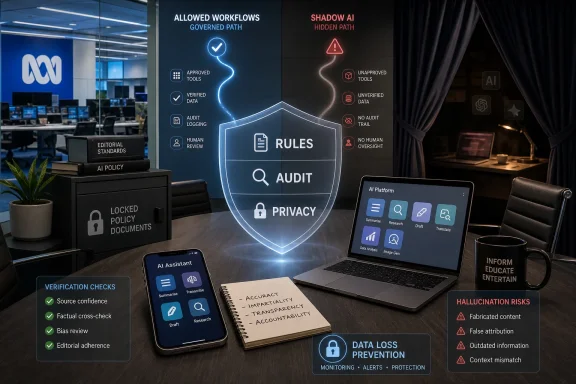 The Scandal Is Smaller Than the Signal
On its face, the revelation sounds tailor-made for a culture-war headline: the chair of “Aunty,” Australia’s public broadcaster, has his own hidden stash of AI tools. But the more useful reading is not that Williams has been caught doing something exotic. It is that a senior media executive is behaving like much of the professional class in 2026: testing ChatGPT, Gemini, Perplexity, and their rivals while the institution around him tries to keep policy, copyright, privacy, and public trust from collapsing into improvisation.That distinction matters. A private trove of AI apps is not the same thing as using confidential ABC material in an unapproved system, outsourcing editorial judgment, or smuggling machine-written copy into public service journalism. The available reporting does not establish those things. What it does expose is a familiar asymmetry: executives want literacy and experimentation, while compliance teams want boundaries and auditability.
The ABC is hardly alone. Across government, education, healthcare, law, journalism, and software development, the official position on generative AI is often more cautious than the actual behavior of employees and managers. Staff are told not to paste sensitive information into consumer AI tools, not to rely on generated output without verification, and not to let automated systems make decisions that should belong to accountable humans. Then they go home, open a browser, and test the same systems anyway.
That is not necessarily hypocrisy. It may be the unavoidable consequence of a technology that is simultaneously useful, immature, legally unsettled, and impossible to ignore.
Kim Williams Has Made AI Literacy Part of the Job
Williams has not presented himself as an AI refusenik. Since becoming ABC chair in March 2024, he has spoken repeatedly about artificial intelligence as both an opportunity and a danger for journalism, public broadcasting, and democratic culture. He has argued that media institutions need to understand the technology rather than pretend it can be kept outside the building.That position is more coherent than it may look at first glance. A chair who refuses to touch AI would be badly placed to interrogate executives about AI strategy, licensing, newsroom use, platform deals, search displacement, synthetic media, or the reliability of automated summaries. Leaders do not need to be prompt engineers, but they do need enough practical familiarity to know when vendors are selling magic, when staff are laundering risk through convenience, and when opponents are using the technology faster than the institution can respond.
The ABC’s problem, like every public broadcaster’s problem, is that AI does not arrive as a single procurement decision. It arrives inside search engines, office suites, phones, editing tools, transcription services, analytics platforms, accessibility products, and cloud contracts. Blocking one chatbot does not block the technology. Nor does writing one acceptable-use memo create institutional competence.
In that context, Williams’ private experimentation is less surprising than the secrecy implied by the FOI frame. Senior leaders experimenting with AI should not be shocking. Senior leaders doing so without a transparent institutional account of how personal use, board oversight, official records, procurement, and editorial standards intersect is the part that deserves scrutiny.
Public Broadcasters Cannot Treat AI Like a Gadget Drawer
The ABC is not a startup with a “move fast” slogan. It is a taxpayer-funded media institution whose legitimacy depends on independence, accuracy, and public trust. That makes its AI posture more complicated than a commercial newsroom’s, because the public broadcaster must be both technically current and procedurally conservative.A private AI app collection becomes politically interesting because the ABC is expected to model the standards it asks of others. If it warns about misinformation, synthetic content, opaque platforms, and the power of large technology companies, it cannot appear casual about the same tools internally. If it insists journalists adhere to high standards of objectivity and ethics, it must also show how those standards survive when research, drafting, summarization, translation, transcription, image handling, and audience analytics are increasingly mediated by machine-learning systems.
This is where “AI rules” become more than a compliance binder. A serious media AI policy needs to say what systems may be used, what data may be entered, which outputs require disclosure, how errors are corrected, how prompts and generated material are retained, and who is accountable when automated assistance changes the substance of work. It must also distinguish between low-risk uses and editorially sensitive ones.
That last distinction is often missing in the public debate. Using AI to summarize a public speech for personal preparation is not the same as using it to summarize leaked documents. Using a transcription tool on a public press conference is not the same as feeding confidential source material into a third-party model. Asking a chatbot to explain a technical concept is not the same as publishing its claims without independent verification.
A blanket ban is easy to announce and hard to enforce. A permission structure is harder to design but more honest about how people actually work.
The FOI Angle Turns Personal Use Into Institutional Evidence
Freedom of Information laws have a way of revealing not just documents, but organizational confusion. The disclosure trail around Williams’ AI use appears to have turned personal technology habits into a proxy for the ABC’s broader AI governance. That is an imperfect proxy, but it is not an unfair one.Executives create institutional signals even when they are acting personally. If a chair is enthusiastic about AI, staff will read that as permission to experiment. If the same chair says the broadcaster respects strict rules, staff will ask where the boundary lies. If the tools are described as a private trove, critics will ask whether the experimentation is being governed or merely tolerated.
The sharper issue is records. Public institutions live in a world of retention obligations, disclosure regimes, and administrative accountability. AI tools blur those lines. A prompt may be a note, a search query, a draft instruction, a disclosure risk, or an official record depending on context. A chatbot response may influence a decision without appearing in the decision file. A browser-based AI service may become part of a public official’s workflow without ever passing through procurement review.
This is not a theoretical concern for IT departments. It is the practical nightmare of shadow AI, the generative-AI version of shadow IT. Workers once brought in unsanctioned file-sharing apps and messaging platforms because official tools were clunky. Now they bring in AI assistants because official policy cannot match the pace of consumer product releases.
The ABC story is therefore about more than one chair’s app habits. It is a warning that policy frameworks built for software procurement are being outflanked by individual accounts, browser extensions, mobile apps, and AI features embedded into services people already use.
Microsoft’s Enterprise Pitch Suddenly Looks Less Boring
For WindowsForum readers, the obvious bridge is Microsoft Copilot. Microsoft’s argument to enterprises and public-sector customers has never been merely that Copilot is clever. It is that organizations need AI inside managed identity, data-loss prevention, compliance, retention, audit, and administrative control.That pitch can sound dull beside the consumer AI arms race. But stories like this make the dull parts look essential. The question for a broadcaster, council, hospital, school district, or government agency is not only which model gives the best answer. It is whether the organization can know who used it, what data was exposed, what retention rules apply, and whether the output entered an official workflow.
Microsoft, Google, OpenAI, Anthropic, and others are all trying to sell versions of this promise. The enterprise AI market is becoming a contest over trust wrappers as much as model capability. A system that is slightly less dazzling but properly governed may be more useful to a public institution than a brilliant consumer chatbot that leaves no acceptable audit trail.
That does not mean Microsoft automatically wins. Many organizations still struggle to understand what Copilot can access, how permissions inherited from Microsoft 365 shape AI responses, how sensitive documents are labeled, and whether old SharePoint sprawl will become a new discovery surface. Giving AI a managed home does not fix bad information architecture. It can expose it.
Still, the strategic direction is clear. The age of “just don’t use AI” is ending. The next phase is controlled use, monitored use, and role-based use. That is where Windows administrators, Microsoft 365 tenants, endpoint managers, and security teams become central players in what previously looked like an editorial or HR debate.
Newsrooms Are AI’s Hardest Test Case
Journalism is a particularly unforgiving environment for generative AI because the failure modes map directly onto professional sins. Hallucination becomes fabrication. Plausible paraphrase becomes distortion. Missing context becomes unfairness. Synthetic media becomes manipulation. A machine’s confident answer can create exactly the kind of false certainty that newsrooms exist to challenge.At the same time, newsrooms have obvious uses for AI. Transcription, translation, archive search, document clustering, accessibility, metadata generation, audience personalization, and production assistance can save time without replacing editorial judgment. Investigative reporters can use AI-assisted tools to sift large document dumps, provided the findings are verified. Editors can use automated systems to detect patterns, but not to assign truth.
The ABC’s balancing act is therefore the industry’s balancing act. It must experiment enough to remain competent but restrain itself enough to remain credible. The public broadcaster cannot afford to become an AI cargo cult, chasing every new tool because executives want to sound modern. Nor can it pretend AI is only a threat used by bad actors elsewhere.
Williams’ own rhetoric has reflected that tension. He has warned about misinformation, disinformation, and AI-enabled harms while also saying the technology could improve journalism. That may irritate absolutists on both sides, but it is probably the only sustainable position. The difficulty is translating that stance into enforceable newsroom practice.
The worst outcome would be a culture in which senior people privately experiment while junior staff fear discipline for doing the same. That breeds cynicism and drives usage further underground. The better outcome is a clear, tiered framework in which experimentation is expected, sensitive data is protected, editorial uses are disclosed where appropriate, and responsibility remains human.
The Copyright Fight Is Sitting Underneath Everything
AI in media is not just a workflow issue. It is also a copyright and bargaining fight. Large language models were trained on vast quantities of text, including journalism, books, code, public web pages, and other copyrighted material. Publishers and broadcasters are now trying to decide whether to sue, license, block, negotiate, or build their own tools on top of the very systems they criticize.The ABC has previously blocked OpenAI from scraping its content, while also indicating that conversations with AI companies may be possible. That is not inconsistent. It is leverage. Media organizations do not want their archives treated as free raw material, but they also know that AI systems may become major gateways through which audiences find information.
Public broadcasters face a special version of this dilemma. Their content is publicly funded, but not necessarily public-domain. Their mission is broad access, but their survival depends on maintaining a trusted relationship with audiences rather than becoming invisible training material for someone else’s product. If AI assistants answer public-interest questions by absorbing and paraphrasing broadcaster output, the broadcaster’s reach may increase while its brand, traffic, and civic role decline.
That problem is not confined to Australia. The same issue haunts every local newsroom watching search traffic change, every software documentation site summarized by chatbots, and every forum whose hard-won troubleshooting knowledge is vacuumed into AI systems. WindowsForum readers know this dynamic well: years of community fixes, registry discoveries, driver workarounds, and upgrade war stories are exactly the kind of material AI systems make useful while often detaching it from its source community.
So when a media executive keeps a personal array of AI apps, the politics are layered. He is not merely trying consumer software. He is testing the products of companies that may be competitors, partners, distributors, infrastructure providers, and copyright adversaries at the same time.
The Real Risk Is Not Curiosity, But Unequal Discipline
It would be a mistake to demand that leaders of public institutions abstain from AI experimentation. The technology is too consequential for ceremonial ignorance. A chair, chief executive, editor-in-chief, CIO, or board member who has never used these systems will struggle to ask useful questions about them.But curiosity needs discipline. Leaders should model the behavior they want normalized: no sensitive data in unmanaged tools, no undisclosed reliance on generated claims, no private experimentation that becomes de facto policy, and no procurement drift through personal preference. If executives want staff to treat AI as serious infrastructure, they must stop treating it as a private toy chest.
The phrase “secret trove” is doing a lot of rhetorical work. It implies concealment, perhaps more than the facts currently prove. Yet it resonates because many organizations really do have secret troves now: unofficial tool lists, private subscriptions, browser plug-ins, mobile AI apps, and experimental accounts that sit outside central governance.
For IT administrators, the lesson is blunt. If your organization has an AI policy but no discovery process, no sanctioned alternatives, no training, and no enforcement path, you do not have an AI policy. You have a PDF. Users will route around it the moment the approved workflow feels slower than the consumer tool in their pocket.
That is why the ABC episode should be read less as a gotcha and more as a governance stress test. The public will judge institutions not only by whether they use AI, but by whether they can explain how, why, and with what safeguards.
Windows Shops Have Seen This Movie Before
The pattern is familiar to anyone who managed the rise of cloud storage, smartphones, messaging apps, remote access tools, or bring-your-own-device culture. First comes denial. Then comes unsanctioned use. Then comes a breach, embarrassment, audit finding, or executive discovery. Finally, the organization creates a managed version of what users were already doing.Generative AI is moving through that cycle faster because the utility is broader. It is not one app category. It is a general-purpose layer that can touch writing, coding, research, meetings, images, search, and decision support. That makes it harder to block and harder to classify.
For Windows and Microsoft 365 environments, the immediate work is not glamorous. Administrators need to know which AI tools are accessible from managed endpoints, what browser extensions are installed, how corporate data is labeled, which SaaS apps have AI features enabled, and whether users understand the difference between enterprise-protected prompts and consumer accounts. They need legal, HR, security, records management, and business units in the same room.
They also need to resist magical thinking. Deploying Copilot or another enterprise AI assistant does not automatically eliminate shadow AI. Users will still compare outputs. They will still reach for tools that feel faster or more capable. They will still use personal devices when the official path is blocked. Governance must compete on usability, not just authority.
That is where many institutions fail. They publish restrictions but do not provide a good sanctioned workflow. The result is predictable: the safest users are the least productive, and the most productive users become the least governed.
The ABC Needs Transparency More Than Abstinence
A public broadcaster does not need to promise that no one inside its walls will use AI. That would be implausible and counterproductive. It needs to explain what uses are allowed, what uses are prohibited, how editorial output is protected, and how the public can know when AI has materially shaped what it sees or hears.Transparency does not require dumping every prompt into public view. It does require a policy that ordinary viewers, staff, and critics can understand. It also requires consistency between leadership behavior and organizational rules. If the chair experiments, the framework should say how that experimentation is bounded.
The ABC could use this moment to clarify a broader standard for public-interest media. It could distinguish personal AI literacy from official ABC production. It could state whether board members and executives may use consumer AI services for preparation, correspondence, speechwriting, research, or document analysis. It could explain what data classifications are off-limits and how records are retained.
That kind of disclosure would not satisfy everyone. Critics hostile to the ABC will find another angle. AI maximalists will call the rules timid. Staff may worry about surveillance. But ambiguity is worse. In a trust business, the appearance of private exception is corrosive even when the underlying conduct is benign.
The App Drawer Is Now a Board-Level Problem
The concrete lesson from the Williams disclosure is that AI governance has climbed from the help desk to the boardroom. It is no longer enough for organizations to delegate the issue to innovation teams or publish a staff memo. The people who set institutional direction are themselves users, beneficiaries, risks, and signals.That changes what good governance looks like. Boards need AI literacy, but they also need conflict awareness. Executives need experimentation rights, but also logging and boundaries. IT needs security controls, but also enough flexibility that legitimate work does not migrate into private accounts. Editorial and professional standards need to be rewritten for a world where first drafts, summaries, translations, and search results may be machine-mediated.
The most practical takeaways are not especially ideological:
- Public institutions should distinguish clearly between personal AI familiarization and official use of AI in institutional work.
- Sensitive, confidential, unpublished, or source-protected material should not be entered into unmanaged consumer AI tools.
- Organizations that ban AI without providing sanctioned alternatives should expect shadow AI to flourish.
- Enterprise AI deployments still require data hygiene, permission reviews, retention rules, and user training.
- Media organizations should disclose material AI involvement in editorial production when it affects what audiences receive.
- Senior leaders should be held to at least the same AI-use standards as the staff whose behavior they govern.
The ABC chair’s reported AI trove is not proof that public broadcasting has surrendered to the machines, nor is it a trivial curiosity about one executive’s software habits. It is a snapshot of the awkward middle period every serious institution is now entering: AI is too useful to ignore, too risky to leave unmanaged, and too embedded to treat as someone else’s problem. The organizations that survive this phase with trust intact will not be the ones that perform purity. They will be the ones that make experimentation visible, bounded, and accountable before the next FOI request does it for them.
References
- Primary source: The Australian
Published: 2026-06-22T10:38:12.545992
- Related coverage: theguardian.com
Some investors in AI ‘are extremely autocratic’, says ABC chair Kim Williams | Australian Broadcasting Corporation | The Guardian
<strong>Exclusive:</strong> While fearing the technology can be an ‘employment destroyer’ in other industries, Williams believes it won’t be as damaging for the mediawww.theguardian.com - Related coverage: inkl.com
Some investors in AI ‘are extremely autocratic’, says…
Exclusive: While fearing the technology can be an ‘employment destroyer’ in other industries, Williams believes it won’t be as damaging for the mediawww.inkl.com - Related coverage: abc.net.au
ABC chair Kim Williams says investment in national broadcaster the best counter to 'flood' of misinformation - ABC News
The ABC's chair Kim Williams calls for more investment in the public broadcaster as a counter to the "flood" of online misinformation and disinformation, days after the federal government's decision to abandon legislation that would have forced social media giants to tackle... www.abc.net.au
- Official source: podcasts.apple.com
ABC Chair Kim Williams on AI a… - Double Take - Apple Podcasts
As AI rapidly infiltrates every aspect of our lives, the news industry is facing another onslaught from the digital realm. AI companies with billion-dollar valu podcasts.apple.com
