
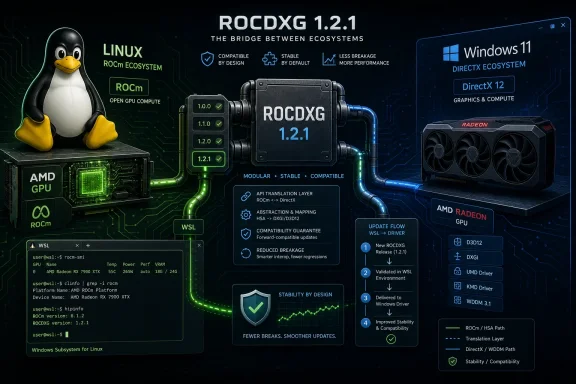
AMD’s ROCDXG 1.2.1 update, reported by Phoronix on June 22, 2026, refreshes the open-source bridge that lets AMD ROCm workloads run inside Windows Subsystem for Linux on Windows 11 systems. The release is small in the way plumbing releases are small: few users will install it for a headline feature, but many will feel it if it makes the stack less brittle. For Windows users trying to run Linux-first AI and GPU-compute software on Radeon or Ryzen AI hardware, that is exactly the point. AMD is not just updating a library; it is trying to make WSL feel like a credible ROCm target rather than a tolerated detour.
The interesting part of ROCDXG is not that it exists. The interesting part is that AMD has decided the translation layer between Linux ROCm user space and the Windows GPU driver stack deserves to be treated as a first-class component.
That is a notable shift because WSL GPU compute has always lived in a strange middle ground. Developers want Linux tooling, Windows users want to keep Windows as the host OS, and GPU vendors have to make the handoff work without forcing everyone into a full dual-boot workflow. In practice, that means a lot of sensitive machinery sits between an application and the silicon.
ROCDXG, also published as
AMD’s answer, increasingly, is that the WSL path must be maintained independently from both ROCm proper and the Windows graphics driver. That separation is the story behind these releases. It means AMD can revise the WSL bridge without waiting for the full ROCm train or tying every fix to a display-driver package.
For software development, that shift is already complete. For GPU compute, it has been slower and messier. CUDA on WSL established the pattern for NVIDIA users: keep Windows as the host, run Linux tooling in WSL, and let the GPU stack do just enough translation to make the arrangement practical. AMD has spent the last several years trying to make ROCm feel less like an HPC-only Linux stack and more like a general developer platform.
That effort matters more in 2026 than it did in 2020. Local AI workloads have turned consumer GPUs and high-end APUs into developer infrastructure. A user who once needed GPU compute only for Blender or scientific code may now want PyTorch, ComfyUI, Ollama-adjacent tooling, Triton experiments, image generation, transcription, and model fine-tuning on the same Windows machine used for games, Office, browser tabs, and remote administration.
The path of least resistance is not “install a pure Linux workstation.” For a large slice of the WindowsForum audience, the path of least resistance is “make WSL work.” ROCDXG is AMD acknowledging that this is not a fringe use case anymore.
That history colors every small ROCm announcement. A version bump can be technically useful and still be met with skepticism because users have learned to ask the practical questions first. Does my exact GPU work? Does my APU count? Which ROCm version? Which Windows driver? Which Linux distribution inside WSL? Which Python version? Which PyTorch wheel? What breaks if Windows Update touches the display driver?
ROCDXG does not magically erase those questions. It narrows one of the more irritating failure zones: the coupling between the Windows host driver and the Linux ROCm user space inside WSL. The more AMD can make that bridge modular, the less every update feels like a Jenga move.
That is why the open-source angle matters, even with the caveat that the stack still includes a binary thunk proxy component. Open source does not automatically equal easy, secure, or well-supported. But it does make the boundary more inspectable, and for a layer whose entire job is to sit between ecosystems, inspectability is not cosmetic.
Earlier ROCDXG releases this year established the shape of the project. Version 1.0.0 arrived as the base public implementation. Version 1.1.x brought Ryzen-related enablement and ABI compatibility work. Version 1.2.0 expanded support further, including additional Ryzen graphics targets, and updated the support matrix for ROCm 7.2.x. The 1.2.1 release fits into that cadence as AMD continues tightening the WSL bridge after declaring the ROCDXG path production-ready earlier in the year.
The strategic point is cadence. A GPU compute stack that only improves in big-bang releases is painful for developers. A WSL bridge that can receive targeted updates is more plausible as a day-to-day dependency. If AMD wants ROCm to be used by people who are not paid to nurse ROCm installations, this is the unglamorous work it must keep doing.
The change also lands in a Windows ecosystem where WSL is no longer a novelty. Microsoft has made WSL a standard part of the developer story, and Windows 11 users increasingly expect Linux workflows to coexist with Windows hardware management. AMD cannot afford for its answer to that world to be “use native Linux if you are serious.”
AMD’s official WSL support has centered on newer Radeon and Ryzen AI-class hardware, including recent Radeon RX 7000 and RX 9000 series GPUs and Ryzen AI parts in the Strix Point and Strix Halo families. That is sensible from an engineering perspective. Newer hardware targets have the most strategic value, the cleanest driver assumptions, and the clearest AI marketing story.
It is also where AMD risks frustrating some of its most enthusiastic users. The people most likely to experiment with ROCm on WSL are often the same people with slightly older RDNA cards, mini-PC APUs, handhelds, or workstation hand-me-downs. They know enough to try things AMD does not officially bless. They also know enough to be annoyed when the answer is “not supported” rather than “not fast.”
This is where AMD’s challenge differs from NVIDIA’s. NVIDIA’s CUDA advantage is not just performance or market share; it is the expectation that if you have a reasonably modern NVIDIA GPU, the software path will probably be documented, searched, and solved somewhere. AMD does not need perfect parity overnight, but it does need fewer moments where the first recommendation is to check a spreadsheet before writing code.
ROCDXG’s design is meant to reduce that tight coupling. By sitting between the ROCm runtime and Windows display driver components, it gives AMD a place to handle compatibility without forcing every piece of the stack to move together. In theory, that means a Windows driver update should be less likely to strand a Linux workload, and a ROCm user-space update should not require waiting for a matching display driver release.
In practice, IT pros will still want to treat these machines as coordinated systems. If a workstation is used for production AI, rendering, data science, or reproducible development, driver updates should be staged like any other dependency change. That may sound excessive for a desktop GPU, but it is not excessive for a machine whose value depends on deterministic compute behavior.
This is where WSL’s convenience can become a trap. Because the Linux environment feels local and lightweight, users may forget that it is leaning on a Windows host stack with its own update rhythm. The whole point of ROCDXG is to make that dependency less fragile. It does not make it disappear.
ROCDXG helps because it turns a historically opaque compatibility layer into a project that can be versioned and discussed directly. Even if not every component is source-available, the public repository gives AMD a venue to show work rather than merely publish driver packages. That is a healthier model for developer trust.
Still, AMD should be careful not to oversell the open-source framing. For Windows users, the practical test is not whether a repository exists. The practical test is whether a clean Windows 11 system with a supported Radeon or Ryzen AI device can install WSL, install ROCm components, run
That is the standard set by the market, not by reviewers. Developers do not compare AMD’s WSL experience with AMD’s old WSL experience. They compare it with the path that lets them get back to their model, benchmark, render, or customer deliverable fastest.
This does not mean every gaming PC is becoming a training cluster. Most users are not fine-tuning frontier models on a Radeon card under their desk. But a growing number of developers, students, hobbyists, artists, and IT teams want local inference, prototyping, quantized models, media generation, and GPU-accelerated Python workflows. They are not all buying Instinct accelerators. Many already have Radeon hardware.
For those users, WSL is the natural bridge because the AI software ecosystem remains heavily Linux-oriented. Windows-native tools exist and are improving, but the center of gravity for open-source AI development still lives in Linux packaging, Python environments, container assumptions, and shell-driven workflows. WSL lets Windows users participate without abandoning the desktop OS.
That makes ROCDXG more than a compatibility shim. It is part of AMD’s attempt to convert installed Radeon hardware into usable developer hardware. If AMD succeeds, it gives buyers another reason to choose Radeon beyond raster performance and VRAM per dollar. If it fails, Radeon remains a strong gaming option that many AI-curious users will mentally exclude from their compute shopping list.
A managed Windows 11 workstation running WSL, ROCm, Python packages, containers, GPU drivers, and AI workloads is not a simple endpoint. It is a hybrid development environment with a Windows security boundary, a Linux userland, GPU device exposure, and a fast-moving application stack. That can be perfectly legitimate. It also needs policy.
The best enterprise use of ROCm-on-WSL will probably start with constrained developer groups rather than broad deployment. Pin the Windows driver. Pin the ROCm version. Validate a known WSL distribution. Document the hardware list. Decide whether users can self-update Adrenalin. Decide how Python environments are created, backed up, and destroyed.
This is not unique to AMD. NVIDIA CUDA on WSL creates similar administrative questions. But AMD has less room for ambiguity because ROCm’s client story is still earning confidence. Every smoother ROCDXG release helps; every unexplained mismatch hurts disproportionately.
NVIDIA’s software moat is not one product. It is the combined weight of developer habit, framework defaults, documentation, Stack Overflow answers, Docker images, university examples, cloud parity, and the assumption that CUDA is the first-class path. AMD’s challenge is not just to make ROCm work. It has to make ROCm work in the places where developers already are.
WSL is one of those places. A Windows laptop with WSL is a mainstream developer machine. A gaming desktop with a large Radeon GPU is a plausible local AI box. A small office with Windows-first management may still want Linux-based tools. If ROCm is awkward in that environment, AMD loses mindshare before benchmarks begin.
ROCDXG is therefore a competitive infrastructure investment. It does not win the software war by itself, but it removes one excuse for not trying. In developer platforms, removing excuses is often the first step toward adoption.
AMD is not there yet, but the direction is healthier than the old pattern of opaque compatibility and delayed enablement. ROCDXG gives the company a smaller, more focused place to fix WSL issues. It gives developers a clearer artifact to track. It gives Windows users a better chance of treating ROCm as part of their normal workstation setup.
The hard part is consistency. One good release is useful. A year of boring releases is transformative.
 AMD Is Fixing the Layer Everyone Pretends Not to See
The interesting part of ROCDXG is not that it exists. The interesting part is that AMD has decided the translation layer between Linux ROCm user space and the Windows GPU driver stack deserves to be treated as a first-class component.That is a notable shift because WSL GPU compute has always lived in a strange middle ground. Developers want Linux tooling, Windows users want to keep Windows as the host OS, and GPU vendors have to make the handoff work without forcing everyone into a full dual-boot workflow. In practice, that means a lot of sensitive machinery sits between an application and the silicon.
ROCDXG, also published as
librocdxg, is AMD’s answer to that machinery. It sits in user space and helps ROCm talk to the Windows-side driver path exposed through WSL’s DirectX graphics device interface. If that sentence sounds like a compromise, it is. But modern developer workstations are built out of compromises, and the useful question is whether the compromise is stable enough to trust.AMD’s answer, increasingly, is that the WSL path must be maintained independently from both ROCm proper and the Windows graphics driver. That separation is the story behind these releases. It means AMD can revise the WSL bridge without waiting for the full ROCm train or tying every fix to a display-driver package.
WSL Has Become the Workstation Default for People Who Never Wanted a Workstation
The reason this matters is not merely that Windows users want to run Linux software. That has been true for decades, and it used to mean Cygwin, virtual machines, SSH into a server, or a second disk with Ubuntu on it. WSL changed the default assumption: the Linux environment could be local, fast enough, scriptable, and integrated into the Windows desktop.For software development, that shift is already complete. For GPU compute, it has been slower and messier. CUDA on WSL established the pattern for NVIDIA users: keep Windows as the host, run Linux tooling in WSL, and let the GPU stack do just enough translation to make the arrangement practical. AMD has spent the last several years trying to make ROCm feel less like an HPC-only Linux stack and more like a general developer platform.
That effort matters more in 2026 than it did in 2020. Local AI workloads have turned consumer GPUs and high-end APUs into developer infrastructure. A user who once needed GPU compute only for Blender or scientific code may now want PyTorch, ComfyUI, Ollama-adjacent tooling, Triton experiments, image generation, transcription, and model fine-tuning on the same Windows machine used for games, Office, browser tabs, and remote administration.
The path of least resistance is not “install a pure Linux workstation.” For a large slice of the WindowsForum audience, the path of least resistance is “make WSL work.” ROCDXG is AMD acknowledging that this is not a fringe use case anymore.
ROCm’s Windows Problem Was Never Just Windows
ROCm’s reputation problem has always been bigger than any single installer. AMD has impressive hardware, serious data-center ambitions, and a genuinely open software story in places where NVIDIA’s stack remains more tightly controlled. But for many client users, ROCm has also meant support matrices, caveats, package mismatches, unofficial builds, and forum archaeology.That history colors every small ROCm announcement. A version bump can be technically useful and still be met with skepticism because users have learned to ask the practical questions first. Does my exact GPU work? Does my APU count? Which ROCm version? Which Windows driver? Which Linux distribution inside WSL? Which Python version? Which PyTorch wheel? What breaks if Windows Update touches the display driver?
ROCDXG does not magically erase those questions. It narrows one of the more irritating failure zones: the coupling between the Windows host driver and the Linux ROCm user space inside WSL. The more AMD can make that bridge modular, the less every update feels like a Jenga move.
That is why the open-source angle matters, even with the caveat that the stack still includes a binary thunk proxy component. Open source does not automatically equal easy, secure, or well-supported. But it does make the boundary more inspectable, and for a layer whose entire job is to sit between ecosystems, inspectability is not cosmetic.
The 1.2.1 Update Is a Maintenance Release With Strategic Weight
The new ROCDXG 1.2.1 update appears to be a refinement release rather than a sweeping platform expansion. That is not a criticism. At this stage of ROCm-on-WSL maturity, reliability work is feature work.Earlier ROCDXG releases this year established the shape of the project. Version 1.0.0 arrived as the base public implementation. Version 1.1.x brought Ryzen-related enablement and ABI compatibility work. Version 1.2.0 expanded support further, including additional Ryzen graphics targets, and updated the support matrix for ROCm 7.2.x. The 1.2.1 release fits into that cadence as AMD continues tightening the WSL bridge after declaring the ROCDXG path production-ready earlier in the year.
The strategic point is cadence. A GPU compute stack that only improves in big-bang releases is painful for developers. A WSL bridge that can receive targeted updates is more plausible as a day-to-day dependency. If AMD wants ROCm to be used by people who are not paid to nurse ROCm installations, this is the unglamorous work it must keep doing.
The change also lands in a Windows ecosystem where WSL is no longer a novelty. Microsoft has made WSL a standard part of the developer story, and Windows 11 users increasingly expect Linux workflows to coexist with Windows hardware management. AMD cannot afford for its answer to that world to be “use native Linux if you are serious.”
The Support Matrix Still Decides Who Gets Invited
For all the promise, ROCm remains brutally dependent on supported hardware combinations. That is especially true on WSL, where the path is narrower than native Linux and where unsupported GPUs may fail in ways that look tantalizingly fixable until the user loses an evening to logs and GitHub issues.AMD’s official WSL support has centered on newer Radeon and Ryzen AI-class hardware, including recent Radeon RX 7000 and RX 9000 series GPUs and Ryzen AI parts in the Strix Point and Strix Halo families. That is sensible from an engineering perspective. Newer hardware targets have the most strategic value, the cleanest driver assumptions, and the clearest AI marketing story.
It is also where AMD risks frustrating some of its most enthusiastic users. The people most likely to experiment with ROCm on WSL are often the same people with slightly older RDNA cards, mini-PC APUs, handhelds, or workstation hand-me-downs. They know enough to try things AMD does not officially bless. They also know enough to be annoyed when the answer is “not supported” rather than “not fast.”
This is where AMD’s challenge differs from NVIDIA’s. NVIDIA’s CUDA advantage is not just performance or market share; it is the expectation that if you have a reasonably modern NVIDIA GPU, the software path will probably be documented, searched, and solved somewhere. AMD does not need perfect parity overnight, but it does need fewer moments where the first recommendation is to check a spreadsheet before writing code.
The Windows Driver Is Now Part of the AI Developer Stack
One of the stranger side effects of local AI development is that gaming driver packages have become part of the machine-learning toolchain. A Windows user may update Adrenalin for a game fix, a display issue, or a new GPU profile, and then discover that the change affects the ROCm path inside WSL. That overlap is not intuitive to users, but it is unavoidable.ROCDXG’s design is meant to reduce that tight coupling. By sitting between the ROCm runtime and Windows display driver components, it gives AMD a place to handle compatibility without forcing every piece of the stack to move together. In theory, that means a Windows driver update should be less likely to strand a Linux workload, and a ROCm user-space update should not require waiting for a matching display driver release.
In practice, IT pros will still want to treat these machines as coordinated systems. If a workstation is used for production AI, rendering, data science, or reproducible development, driver updates should be staged like any other dependency change. That may sound excessive for a desktop GPU, but it is not excessive for a machine whose value depends on deterministic compute behavior.
This is where WSL’s convenience can become a trap. Because the Linux environment feels local and lightweight, users may forget that it is leaning on a Windows host stack with its own update rhythm. The whole point of ROCDXG is to make that dependency less fragile. It does not make it disappear.
AMD’s Open-Source Pitch Has to Survive Contact With Installation
AMD has long had a better philosophical story than operational story in GPU compute. ROCm is open in ways CUDA is not, and that matters to researchers, platform builders, Linux distributions, and developers who dislike single-vendor lock-in. But philosophy is not an installer, and openness does not compensate for a broken wheel, a missing target, or a runtime that cannot see the GPU.ROCDXG helps because it turns a historically opaque compatibility layer into a project that can be versioned and discussed directly. Even if not every component is source-available, the public repository gives AMD a venue to show work rather than merely publish driver packages. That is a healthier model for developer trust.
Still, AMD should be careful not to oversell the open-source framing. For Windows users, the practical test is not whether a repository exists. The practical test is whether a clean Windows 11 system with a supported Radeon or Ryzen AI device can install WSL, install ROCm components, run
rocminfo, install a mainstream AI framework, and complete a real workload without undocumented handholding.That is the standard set by the market, not by reviewers. Developers do not compare AMD’s WSL experience with AMD’s old WSL experience. They compare it with the path that lets them get back to their model, benchmark, render, or customer deliverable fastest.
Local AI Is Forcing AMD to Care About Client ROCm
For years, AMD could treat ROCm primarily as a data-center and Linux HPC story, with client support improving slowly around the edges. That is no longer enough. The AI boom moved the center of gravity toward workstations, desktops, and laptops in a way that makes client GPU compute strategically visible.This does not mean every gaming PC is becoming a training cluster. Most users are not fine-tuning frontier models on a Radeon card under their desk. But a growing number of developers, students, hobbyists, artists, and IT teams want local inference, prototyping, quantized models, media generation, and GPU-accelerated Python workflows. They are not all buying Instinct accelerators. Many already have Radeon hardware.
For those users, WSL is the natural bridge because the AI software ecosystem remains heavily Linux-oriented. Windows-native tools exist and are improving, but the center of gravity for open-source AI development still lives in Linux packaging, Python environments, container assumptions, and shell-driven workflows. WSL lets Windows users participate without abandoning the desktop OS.
That makes ROCDXG more than a compatibility shim. It is part of AMD’s attempt to convert installed Radeon hardware into usable developer hardware. If AMD succeeds, it gives buyers another reason to choose Radeon beyond raster performance and VRAM per dollar. If it fails, Radeon remains a strong gaming option that many AI-curious users will mentally exclude from their compute shopping list.
Enterprise IT Will Like the Direction and Distrust the Surface Area
For sysadmins, the ROCDXG story is both attractive and unnerving. It is attractive because WSL can reduce the need for separate Linux workstations, developer VMs, or cloud GPU spend for some classes of work. It is unnerving because it adds another layered dependency chain to machines that may already be hard to standardize.A managed Windows 11 workstation running WSL, ROCm, Python packages, containers, GPU drivers, and AI workloads is not a simple endpoint. It is a hybrid development environment with a Windows security boundary, a Linux userland, GPU device exposure, and a fast-moving application stack. That can be perfectly legitimate. It also needs policy.
The best enterprise use of ROCm-on-WSL will probably start with constrained developer groups rather than broad deployment. Pin the Windows driver. Pin the ROCm version. Validate a known WSL distribution. Document the hardware list. Decide whether users can self-update Adrenalin. Decide how Python environments are created, backed up, and destroyed.
This is not unique to AMD. NVIDIA CUDA on WSL creates similar administrative questions. But AMD has less room for ambiguity because ROCm’s client story is still earning confidence. Every smoother ROCDXG release helps; every unexplained mismatch hurts disproportionately.
The Competitive Context Is CUDA, Not Linux
It is tempting to frame ROCDXG as part of a Windows-versus-Linux story. That misses the larger competitive reality. The actual opponent is CUDA’s gravity.NVIDIA’s software moat is not one product. It is the combined weight of developer habit, framework defaults, documentation, Stack Overflow answers, Docker images, university examples, cloud parity, and the assumption that CUDA is the first-class path. AMD’s challenge is not just to make ROCm work. It has to make ROCm work in the places where developers already are.
WSL is one of those places. A Windows laptop with WSL is a mainstream developer machine. A gaming desktop with a large Radeon GPU is a plausible local AI box. A small office with Windows-first management may still want Linux-based tools. If ROCm is awkward in that environment, AMD loses mindshare before benchmarks begin.
ROCDXG is therefore a competitive infrastructure investment. It does not win the software war by itself, but it removes one excuse for not trying. In developer platforms, removing excuses is often the first step toward adoption.
The Real Victory Would Be Boredom
The best future for ROCDXG is that nobody talks about it. Not because it is unimportant, but because successful platform plumbing disappears. Users should not have to know the name of the bridge that lets a ROCm workload reach the GPU from WSL. They should know that their supported AMD hardware shows up, the framework installs, and the workload runs.AMD is not there yet, but the direction is healthier than the old pattern of opaque compatibility and delayed enablement. ROCDXG gives the company a smaller, more focused place to fix WSL issues. It gives developers a clearer artifact to track. It gives Windows users a better chance of treating ROCm as part of their normal workstation setup.
The hard part is consistency. One good release is useful. A year of boring releases is transformative.
The ROCDXG 1.2.1 Signal Is Bigger Than the Patch
ROCDXG 1.2.1 is worth reading less as a feature drop and more as evidence that AMD is continuing to professionalize ROCm on Windows through WSL. The release sits in a broader 2026 pattern: production-ready ROCDXG, ROCm 7.2.x alignment, newer Radeon and Ryzen AI support, and a more modular relationship between Windows drivers and Linux compute user space.- AMD is treating WSL as a serious ROCm target rather than a side-channel for adventurous users.
- ROCDXG’s value is its role as a separately maintained bridge between Linux ROCm components and the Windows GPU driver stack.
- The update matters most for users running Linux-first AI, machine-learning, and HPC tools on Windows 11 systems with supported AMD hardware.
- Hardware support remains the practical gatekeeper, and users with older or unofficial GPUs should expect the support matrix to matter.
- IT teams should manage ROCm-on-WSL machines as coordinated driver, runtime, WSL, and Python environments rather than ordinary desktops.
- AMD’s competitive challenge is not merely making ROCm open, but making it predictable enough that developers stop reaching for CUDA by reflex.
References
- Primary source: Phoronix
Published: 2026-06-22T12:53:08.033434
AMD Updates ROCDXG To Deliver Better ROCm Experience On WSL - Phoronix
Back in March AMD introduced ROCDXG to improve their Windows Subsystem for Linux supportwww.phoronix.com
- Related coverage: rocm.docs.amd.com
WSL support matrices by ROCm version — Use ROCm on Radeon and Ryzen
rocm.docs.amd.com
- Official source: github.com
GitHub - ROCm/librocdxg: repo for AMD ROCDXG project
repo for AMD ROCDXG project. Contribute to ROCm/librocdxg development by creating an account on GitHub. github.com
- Related coverage: technetbooks.com
AMD Adrenalin 26.2.2 ROCDXG support for WSL adds Ryzen AI 300 series and critical game fixes | Technetbook
AMD Adrenalin 26.2.2 brings open source ROCDXG support to WSL and enables GPU compute on Ryzen AI 300 series plus game fixes for Resident Evil Requiemwww.technetbooks.com
- Related coverage: rocm.blogs.amd.com
Running ComfyUI in Windows with ROCm on WSL
Run ComfyUI on Windows with ROCm and WSL to harness Radeon GPU power for local AI tasks like Stable Diffusion—no dual-boot neededrocm.blogs.amd.com - Related coverage: amd.com
(AMD_P_Wh.eps)
Whatever your workload, the AMD ROCm open software platform opens doors to new levels of freedom and accessibility.www.amd.com
- Related coverage: rocmdocs.amd.com
xDiT diffusion inference — ROCm Documentation
Learn to validate diffusion model video generation on MI300X, MI350X and MI355X accelerators using prebuilt and optimized docker images. - Related coverage: rocm-handbook.amd.com
AMD ROCm Programming Guide — AMD ROCm Programming Guide 7.2.4
AMD ROCm programming guide - Related coverage: cgmb-rocm-docs.readthedocs.io