
AMD is publicly framing Radeon’s next act as a long campaign to recreate the disruptive effect Ryzen had on CPUs, with executive David McAfee saying in June 2026 that a “perfect” gaming GPU platform will take several generations to build. The remark matters because it lowers expectations for a single miracle launch while raising them for everything around the silicon. Radeon’s problem is no longer just frames per second; it is trust, software gravity, developer mindshare, and the uncomfortable fact that Nvidia has made the GPU feel like a platform instead of a part.
The phrase “Ryzen moment” does a lot of work for AMD because it compresses a decade of corporate rehabilitation into two words. Ryzen did not merely give AMD a competitive CPU; it gave buyers permission to believe AMD could lead again. It made Intel look slow, expensive, and complacent in a category where those three words had rarely stuck at the same time.
Radeon has never had that clean psychological reset. AMD has shipped excellent graphics cards, sometimes aggressively priced and occasionally beloved, but it has not made the gaming GPU market reorganize itself around Radeon in the way Ryzen reorganized desktop CPUs. The result is a strange asymmetry inside the same company: AMD’s CPUs are often treated as the default enthusiast recommendation, while its GPUs are still asked to prove they are not a compromise.
McAfee’s comment is interesting because it does not pretend otherwise. Saying the perfect Radeon platform will take generations is not launch-day bravado. It is an admission that AMD understands the battlefield has changed from the one where a faster chip and a lower price could do most of the talking.
That is the right starting point, but it is also a dangerous one. A long road map can sound disciplined to investors and patient enthusiasts. To a gamer choosing a card this summer, it can also sound like AMD is asking the market to wait for a future version of Radeon that has not arrived yet.
Graphics cards are messier. Raster performance still matters, but it is no longer the whole argument. A modern gaming GPU is judged across native rendering, ray tracing, upscaling quality, frame generation, latency, power behavior, creator workloads, streaming features, driver stability, and how often a given game treats the hardware as a first-class citizen.
That last point is where Radeon’s climb becomes steepest. Nvidia’s advantage is not only that GeForce cards are fast. It is that many games, engines, creators, reviewers, and PC builders instinctively map “premium GPU experience” onto Nvidia’s stack of technologies. DLSS, Reflex, CUDA, RTX branding, and years of developer relations have turned GeForce into a software ecosystem with a chip attached.
AMD can win individual benchmarks and still lose the buyer’s imagination. That is the gap McAfee is implicitly describing when he talks about Radeon as a platform built around value, FSR, game support, and community feedback. The company is no longer trying to win one chart; it is trying to win the habit of recommendation.
But value is a fragile identity when the competitor owns the premium vocabulary. If Nvidia sets the conversation around ray tracing, AI upscaling, creator acceleration, and software polish, AMD’s discount can be interpreted as a concession rather than a bargain. The buyer hears, “You can save money if you are willing to give something up.”
That is why the phrase “perfect Radeon platform” matters more than it first appears. AMD seems to understand that it cannot simply sell cheaper GeForce alternatives forever. It needs Radeon to feel complete on its own terms, not merely defensible after a spreadsheet comparison.
The risk is that value becomes a trap. Once a brand is trained to compete mostly on price, every improvement that raises cost becomes harder to sell. AMD has to make Radeon better without making it feel like Radeon has abandoned the practical buyers who kept it alive.
That is the power of defaults. Once a technology is widely integrated into games and normalized by reviewers, the burden shifts to the challenger. AMD does not merely have to offer an alternative; it has to convince users that the alternative will be there, will look good, and will keep improving across the games they buy next.
FSR’s open approach is philosophically attractive. It runs across a broader range of hardware than Nvidia’s proprietary stack, and that gives AMD a principled argument in a PC ecosystem that benefits from interoperability. But openness does not automatically win if the proprietary option is perceived as more reliable, more polished, or more frequently implemented at the highest quality level.
This is the uncomfortable lesson of modern PC graphics: the best technology does not always need to be closed, but the most trusted technology often behaves like infrastructure. Nvidia has spent years making its features feel infrastructural. AMD is still trying to make Radeon features feel inevitable.
The RX 9070 XT’s arrival in Steam survey breakdowns also gave Radeon fans something they have wanted for years: visible evidence that AMD’s newer cards are not ghosts in the gaming population. Steam survey data is imperfect, sometimes oddly categorized, and not a clean retail sales ledger, but it still shapes perception because it is one of the few public windows into what PC gamers are using.
Even so, a good midrange-to-high-midrange product is not a Ryzen moment. Ryzen’s early magic was not only that AMD had a good part; it was that the product line exposed a structural weakness in Intel’s approach. Radeon has not yet exposed that kind of structural weakness in Nvidia’s gaming business.
Nvidia’s weakness may eventually come from price, power, memory configurations, or an overemphasis on AI markets at the expense of gamers. But AMD cannot count on Nvidia stumbling. A competitor’s arrogance is not a strategy; it is only an opening if you have the product and ecosystem ready when buyers start looking for an alternative.
A Windows gamer does not experience a GPU as a die shot. They experience it as a driver package, a control panel, a game profile, a crash that does or does not happen, a shader compilation pause that does or does not ruin the first 20 minutes of a launch, and a setting menu where one upscaler appears before another. That is the layer where reputations are made sticky.
AMD’s driver reputation has improved considerably from its worst caricatures, but reputations do not reset when the code improves. They decay slowly, especially in communities where one bad experience is retold for years. Nvidia has driver problems too, and sometimes serious ones, but it benefits from a presumption of competence that AMD often has to earn again with every generation.
This is why McAfee’s emphasis on listening to the community is more than corporate warmth. If AMD wants Radeon to become a platform, feedback loops have to be visible. Users need to believe bug reports matter, game-specific issues are attacked quickly, and feature rollouts will not leave recent buyers stranded on the wrong side of an architecture line.
But answering DLSS is not the same as matching its market role. DLSS is a reason some users buy GeForce in the first place. FSR too often functions as reassurance after the Radeon purchase has already been made. That distinction is brutal, but it is central to AMD’s problem.
For FSR to become a buying reason, AMD needs consistency across image quality, latency, game availability, and naming. The average user should not have to track a family tree of versions and exceptions to know whether a feature will deliver the experience being marketed. If Radeon is to have its own moment, FSR has to feel less like a compatibility layer and more like a flagship capability.
The irony is that AMD’s open strategy could become more valuable as the market fragments. Handheld PCs, integrated GPUs, Windows gaming laptops, living-room PCs, and non-Nvidia systems all benefit from cross-vendor technology. But that future only helps AMD if openness is paired with excellence. The market rarely rewards almost as good, but more ethical at the high end.
That matters because handheld gaming teaches users to care about different GPU virtues. Efficiency, scaling, driver maturity, frame pacing, and upscaling quality become more important when every watt is negotiated against battery life and heat. AMD’s APU strength gives Radeon technology a route into gaming habits that does not require beating a GeForce desktop card head-to-head.
But the handheld category also exposes AMD’s software obligations. If users buy a modern AMD-powered handheld and then discover that the best new FSR features are unclear, delayed, or architecture-limited, the platform story weakens. The same company cannot sell the dream of unified Radeon gaming across devices while making feature support feel fragmented.
This is where WindowsForum readers should pay attention. The future of Radeon may not be decided only in tower PCs with 850-watt power supplies. It may be decided in the messy middle of Windows gaming: handhelds, compact desktops, OEM systems, laptops, and living-room machines where AMD already has silicon relationships and where Nvidia’s discrete GPU dominance is less absolute.
AMD’s answer cannot be only “our technology is open.” Developers still need tooling, documentation, engineering help, and confidence that an implementation will age well. If FSR integration varies too much from game to game, or if Radeon-specific performance issues linger in major releases, openness becomes a virtue in theory rather than a production advantage.
This is also why market share numbers can mislead. A small gain in visible Radeon share among enthusiasts may matter more than it looks if those users are vocal, review-conscious, and concentrated in new GPU generations. Conversely, a low add-in-board share can make developers hesitant even when AMD’s integrated graphics footprint is enormous.
The Ryzen analogy breaks here. CPU developers did not need to add a “Ryzen mode” to make AMD’s comeback meaningful. Games and applications mostly benefited from more cores, better IPC, and platform competition without users selecting vendor-specific features in a graphics menu. GPUs are different because the software stack is part of the product surface.
Competition keeps Nvidia honest. It pressures pricing, memory capacity, board partner behavior, and feature segmentation. It also gives Microsoft, game studios, and PC OEMs more reason to treat graphics features as cross-vendor Windows capabilities rather than extensions of a single vendor’s roadmap.
That matters as Windows gaming absorbs more AI-adjacent features. Upscaling, frame generation, denoising, local inference, content creation, and real-time effects are converging into a new layer of GPU-dependent user experience. If one vendor defines that layer alone, the PC becomes less open in practice even if the operating system remains open in name.
AMD’s challenge is to make Radeon a credible counterweight before those defaults harden further. A “perfect” Radeon platform several generations from now may arrive too late if today’s software assumptions become tomorrow’s minimum requirements. Platform wars are often won before users realize the platform has changed.
Ryzen benefited from Intel’s long stagnation, AMD’s clean architectural reset, and a market where reviewers could show huge productivity gains in straightforward charts. Radeon faces a competitor that is not stagnant, owns the premium feature narrative, dominates developer mindshare, and is funded by an AI business that has transformed Nvidia into one of the most strategically important companies in technology.
That does not make AMD’s ambition foolish. It makes the execution burden heavier. Radeon does not need one heroic launch; it needs five or six boringly excellent launches in a row, accompanied by software that improves without drama and features that arrive where gamers expect them.
The most useful version of the Ryzen comparison is not “Radeon will suddenly win.” It is “AMD knows how to rebuild credibility over time when it commits to architecture, platform, and value.” The least useful version is nostalgia disguised as strategy.
That kind of shift takes longer than a product cycle because it is cultural as much as technical. PC gamers have long memories, and the enthusiast market is unusually good at turning yesterday’s flaw into today’s brand identity. AMD has to overcome not only current product gaps but also the accumulated folklore of Radeon being the sensible-but-riskier choice.
There are reasons for optimism. AMD’s CPU success gives it retail credibility, OEM relationships, and a community of users already comfortable buying red-team hardware. Its APU footprint gives it a natural role in handheld and compact gaming devices. Its open graphics technologies can appeal to developers and users who do not want the future of PC gaming mediated entirely by one vendor.
There are also reasons to be skeptical. Nvidia’s lead is not only large; it is layered. It includes silicon, software, branding, developer relations, creator workflows, and the halo effect of AI leadership. AMD can close one layer and still find the next one waiting.
For buyers, that means the right Radeon question is changing. It is no longer enough to ask whether a card is faster than its nearest GeForce rival in a handful of games. The better question is whether AMD’s platform promises align with the games, displays, workloads, and upgrade cycle a user actually has.
That answer will vary. A value-focused gamer playing mostly raster-heavy titles may already find Radeon compelling. A ray tracing maximalist, streamer, CUDA-dependent creator, or early adopter of vendor-specific AI features may still find Nvidia’s ecosystem hard to leave. The point is not that one answer fits everyone; it is that AMD needs fewer buyers to feel as though choosing Radeon requires an apology.
For Windows enthusiasts and IT pros, the practical watchpoints are not mysterious:
The honest version of AMD’s Radeon pitch is that the company is no longer pretending the GPU war can be won by one great die, one aggressive price, or one clever acronym. That realism is welcome, but it also strips away the romance: a Radeon “Ryzen moment” will not arrive as a thunderclap at a keynote. It will arrive, if it arrives at all, when Windows gamers stop asking what they must give up to buy Radeon and start asking why they assumed GeForce was the default in the first place.
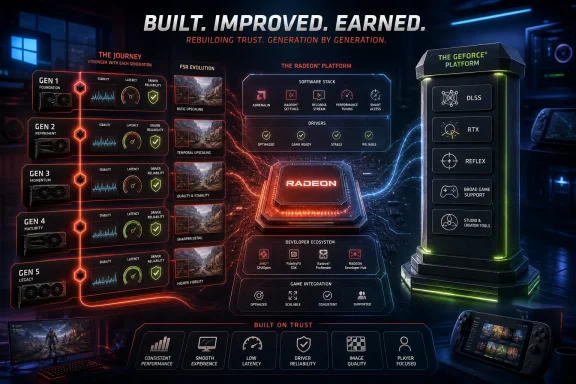 Radeon Is Chasing a Memory, Not Just a Market
The phrase “Ryzen moment” does a lot of work for AMD because it compresses a decade of corporate rehabilitation into two words. Ryzen did not merely give AMD a competitive CPU; it gave buyers permission to believe AMD could lead again. It made Intel look slow, expensive, and complacent in a category where those three words had rarely stuck at the same time.Radeon has never had that clean psychological reset. AMD has shipped excellent graphics cards, sometimes aggressively priced and occasionally beloved, but it has not made the gaming GPU market reorganize itself around Radeon in the way Ryzen reorganized desktop CPUs. The result is a strange asymmetry inside the same company: AMD’s CPUs are often treated as the default enthusiast recommendation, while its GPUs are still asked to prove they are not a compromise.
McAfee’s comment is interesting because it does not pretend otherwise. Saying the perfect Radeon platform will take generations is not launch-day bravado. It is an admission that AMD understands the battlefield has changed from the one where a faster chip and a lower price could do most of the talking.
That is the right starting point, but it is also a dangerous one. A long road map can sound disciplined to investors and patient enthusiasts. To a gamer choosing a card this summer, it can also sound like AMD is asking the market to wait for a future version of Radeon that has not arrived yet.
Ryzen Won Because the CPU Fight Was Legible
The CPU war of the late 2010s had complexities, but the consumer story was unusually easy to understand. AMD offered more cores, better platform longevity, competitive gaming performance, and prices that made Intel’s product stack look defensive. Review charts told the story in a language buyers already understood.Graphics cards are messier. Raster performance still matters, but it is no longer the whole argument. A modern gaming GPU is judged across native rendering, ray tracing, upscaling quality, frame generation, latency, power behavior, creator workloads, streaming features, driver stability, and how often a given game treats the hardware as a first-class citizen.
That last point is where Radeon’s climb becomes steepest. Nvidia’s advantage is not only that GeForce cards are fast. It is that many games, engines, creators, reviewers, and PC builders instinctively map “premium GPU experience” onto Nvidia’s stack of technologies. DLSS, Reflex, CUDA, RTX branding, and years of developer relations have turned GeForce into a software ecosystem with a chip attached.
AMD can win individual benchmarks and still lose the buyer’s imagination. That is the gap McAfee is implicitly describing when he talks about Radeon as a platform built around value, FSR, game support, and community feedback. The company is no longer trying to win one chart; it is trying to win the habit of recommendation.
The “Value” Argument Is Necessary, But It Is Not Enough
AMD’s safest Radeon pitch has long been value. If a Radeon card delivers similar raster performance for less money, the argument almost writes itself. That strategy works particularly well in the middle of the market, where buyers care about the games they actually play rather than owning the fastest object in a benchmark database.But value is a fragile identity when the competitor owns the premium vocabulary. If Nvidia sets the conversation around ray tracing, AI upscaling, creator acceleration, and software polish, AMD’s discount can be interpreted as a concession rather than a bargain. The buyer hears, “You can save money if you are willing to give something up.”
That is why the phrase “perfect Radeon platform” matters more than it first appears. AMD seems to understand that it cannot simply sell cheaper GeForce alternatives forever. It needs Radeon to feel complete on its own terms, not merely defensible after a spreadsheet comparison.
The risk is that value becomes a trap. Once a brand is trained to compete mostly on price, every improvement that raises cost becomes harder to sell. AMD has to make Radeon better without making it feel like Radeon has abandoned the practical buyers who kept it alive.
Nvidia Turned Features Into Defaults
The most punishing part of AMD’s GPU challenge is that Nvidia’s best features are no longer perceived as optional extras. For many PC gamers, upscaling is now part of how high-end graphics are expected to work. Ray tracing is not universally loved, but it shapes flagship marketing and technical ambition. Low-latency pipelines and frame generation have become part of the conversation around smoothness, not just speed.That is the power of defaults. Once a technology is widely integrated into games and normalized by reviewers, the burden shifts to the challenger. AMD does not merely have to offer an alternative; it has to convince users that the alternative will be there, will look good, and will keep improving across the games they buy next.
FSR’s open approach is philosophically attractive. It runs across a broader range of hardware than Nvidia’s proprietary stack, and that gives AMD a principled argument in a PC ecosystem that benefits from interoperability. But openness does not automatically win if the proprietary option is perceived as more reliable, more polished, or more frequently implemented at the highest quality level.
This is the uncomfortable lesson of modern PC graphics: the best technology does not always need to be closed, but the most trusted technology often behaves like infrastructure. Nvidia has spent years making its features feel infrastructural. AMD is still trying to make Radeon features feel inevitable.
RDNA 4 Looks Like a Correction, Not a Coronation
AMD’s recent Radeon strategy has been more grounded than the company’s old habit of promising a knockout blow at the top. RDNA 4 and the Radeon RX 9000 generation put renewed emphasis on mainstream and upper-midrange gaming, improved ray tracing, and a more coherent story around FSR. That is not a bad place to fight; it is where a huge number of Windows gamers actually buy.The RX 9070 XT’s arrival in Steam survey breakdowns also gave Radeon fans something they have wanted for years: visible evidence that AMD’s newer cards are not ghosts in the gaming population. Steam survey data is imperfect, sometimes oddly categorized, and not a clean retail sales ledger, but it still shapes perception because it is one of the few public windows into what PC gamers are using.
Even so, a good midrange-to-high-midrange product is not a Ryzen moment. Ryzen’s early magic was not only that AMD had a good part; it was that the product line exposed a structural weakness in Intel’s approach. Radeon has not yet exposed that kind of structural weakness in Nvidia’s gaming business.
Nvidia’s weakness may eventually come from price, power, memory configurations, or an overemphasis on AI markets at the expense of gamers. But AMD cannot count on Nvidia stumbling. A competitor’s arrogance is not a strategy; it is only an opening if you have the product and ecosystem ready when buyers start looking for an alternative.
The Software Gap Is the Real Architecture Problem
When enthusiasts talk about GPU architecture, they usually mean compute units, cache, memory buses, clocks, chiplets, and process nodes. Those things matter. But for Radeon, the bigger architectural problem is software architecture in the broadest sense: drivers, SDKs, game integrations, developer tools, quality assurance, update cadence, and user confidence.A Windows gamer does not experience a GPU as a die shot. They experience it as a driver package, a control panel, a game profile, a crash that does or does not happen, a shader compilation pause that does or does not ruin the first 20 minutes of a launch, and a setting menu where one upscaler appears before another. That is the layer where reputations are made sticky.
AMD’s driver reputation has improved considerably from its worst caricatures, but reputations do not reset when the code improves. They decay slowly, especially in communities where one bad experience is retold for years. Nvidia has driver problems too, and sometimes serious ones, but it benefits from a presumption of competence that AMD often has to earn again with every generation.
This is why McAfee’s emphasis on listening to the community is more than corporate warmth. If AMD wants Radeon to become a platform, feedback loops have to be visible. Users need to believe bug reports matter, game-specific issues are attacked quickly, and feature rollouts will not leave recent buyers stranded on the wrong side of an architecture line.
FSR Has to Become a Reason to Buy, Not a Reason Not to Worry
FSR began with a compelling promise: make upscaling broadly available, not locked to one vendor’s tensor hardware. That fit AMD’s identity as the more open player and gave developers a way to support a wide range of GPUs. It also gave Radeon owners an answer when DLSS appeared in a game’s settings menu.But answering DLSS is not the same as matching its market role. DLSS is a reason some users buy GeForce in the first place. FSR too often functions as reassurance after the Radeon purchase has already been made. That distinction is brutal, but it is central to AMD’s problem.
For FSR to become a buying reason, AMD needs consistency across image quality, latency, game availability, and naming. The average user should not have to track a family tree of versions and exceptions to know whether a feature will deliver the experience being marketed. If Radeon is to have its own moment, FSR has to feel less like a compatibility layer and more like a flagship capability.
The irony is that AMD’s open strategy could become more valuable as the market fragments. Handheld PCs, integrated GPUs, Windows gaming laptops, living-room PCs, and non-Nvidia systems all benefit from cross-vendor technology. But that future only helps AMD if openness is paired with excellence. The market rarely rewards almost as good, but more ethical at the high end.
The Handheld PC Boom Gives AMD Leverage, But Also Raises the Bar
AMD has one advantage Nvidia cannot easily copy: its central role in the modern Windows handheld boom. Ryzen Z-series chips and custom AMD silicon helped make devices like the Steam Deck and the broader handheld PC category feel viable. In that world, Radeon graphics are not an add-in board decision; they are part of the platform from day one.That matters because handheld gaming teaches users to care about different GPU virtues. Efficiency, scaling, driver maturity, frame pacing, and upscaling quality become more important when every watt is negotiated against battery life and heat. AMD’s APU strength gives Radeon technology a route into gaming habits that does not require beating a GeForce desktop card head-to-head.
But the handheld category also exposes AMD’s software obligations. If users buy a modern AMD-powered handheld and then discover that the best new FSR features are unclear, delayed, or architecture-limited, the platform story weakens. The same company cannot sell the dream of unified Radeon gaming across devices while making feature support feel fragmented.
This is where WindowsForum readers should pay attention. The future of Radeon may not be decided only in tower PCs with 850-watt power supplies. It may be decided in the messy middle of Windows gaming: handhelds, compact desktops, OEM systems, laptops, and living-room machines where AMD already has silicon relationships and where Nvidia’s discrete GPU dominance is less absolute.
Developers Follow Users, Users Follow Developers
The classic chicken-and-egg problem in graphics is developer support. Game studios optimize for the installed base, and the installed base buys what games showcase. Nvidia’s lead compounds because developers have strong incentives to support the features GeForce owners expect, while buyers see that support and treat it as another reason to stay with GeForce.AMD’s answer cannot be only “our technology is open.” Developers still need tooling, documentation, engineering help, and confidence that an implementation will age well. If FSR integration varies too much from game to game, or if Radeon-specific performance issues linger in major releases, openness becomes a virtue in theory rather than a production advantage.
This is also why market share numbers can mislead. A small gain in visible Radeon share among enthusiasts may matter more than it looks if those users are vocal, review-conscious, and concentrated in new GPU generations. Conversely, a low add-in-board share can make developers hesitant even when AMD’s integrated graphics footprint is enormous.
The Ryzen analogy breaks here. CPU developers did not need to add a “Ryzen mode” to make AMD’s comeback meaningful. Games and applications mostly benefited from more cores, better IPC, and platform competition without users selecting vendor-specific features in a graphics menu. GPUs are different because the software stack is part of the product surface.
The Windows Angle Is Bigger Than Driver Downloads
For Windows users, the Radeon question is not abstract brand warfare. It affects how games are tuned, how features land in drivers, how OEM systems are configured, and how long a PC feels modern after purchase. A healthier Radeon business would be good for the Windows ecosystem even for users who never buy AMD.Competition keeps Nvidia honest. It pressures pricing, memory capacity, board partner behavior, and feature segmentation. It also gives Microsoft, game studios, and PC OEMs more reason to treat graphics features as cross-vendor Windows capabilities rather than extensions of a single vendor’s roadmap.
That matters as Windows gaming absorbs more AI-adjacent features. Upscaling, frame generation, denoising, local inference, content creation, and real-time effects are converging into a new layer of GPU-dependent user experience. If one vendor defines that layer alone, the PC becomes less open in practice even if the operating system remains open in name.
AMD’s challenge is to make Radeon a credible counterweight before those defaults harden further. A “perfect” Radeon platform several generations from now may arrive too late if today’s software assumptions become tomorrow’s minimum requirements. Platform wars are often won before users realize the platform has changed.
AMD Must Resist the Temptation to Over-Narrate the Comeback
There is a danger in invoking Ryzen too often. The comparison flatters AMD, but it also invites buyers to expect a dramatic reversal that may not fit the GPU market. Not every comeback has the same shape, and not every product category allows the same kind of upset.Ryzen benefited from Intel’s long stagnation, AMD’s clean architectural reset, and a market where reviewers could show huge productivity gains in straightforward charts. Radeon faces a competitor that is not stagnant, owns the premium feature narrative, dominates developer mindshare, and is funded by an AI business that has transformed Nvidia into one of the most strategically important companies in technology.
That does not make AMD’s ambition foolish. It makes the execution burden heavier. Radeon does not need one heroic launch; it needs five or six boringly excellent launches in a row, accompanied by software that improves without drama and features that arrive where gamers expect them.
The most useful version of the Ryzen comparison is not “Radeon will suddenly win.” It is “AMD knows how to rebuild credibility over time when it commits to architecture, platform, and value.” The least useful version is nostalgia disguised as strategy.
The Radeon Comeback Will Be Measured in Habits, Not Headlines
The clearest sign of a Radeon turnaround will not be a single benchmark crown. It will be a change in buying habits. Reviewers will stop treating Radeon as the caveated recommendation. Builders will stop adding “if you don’t care about ray tracing” as a reflex. Game settings menus will make AMD’s features feel normal rather than secondary.That kind of shift takes longer than a product cycle because it is cultural as much as technical. PC gamers have long memories, and the enthusiast market is unusually good at turning yesterday’s flaw into today’s brand identity. AMD has to overcome not only current product gaps but also the accumulated folklore of Radeon being the sensible-but-riskier choice.
There are reasons for optimism. AMD’s CPU success gives it retail credibility, OEM relationships, and a community of users already comfortable buying red-team hardware. Its APU footprint gives it a natural role in handheld and compact gaming devices. Its open graphics technologies can appeal to developers and users who do not want the future of PC gaming mediated entirely by one vendor.
There are also reasons to be skeptical. Nvidia’s lead is not only large; it is layered. It includes silicon, software, branding, developer relations, creator workflows, and the halo effect of AI leadership. AMD can close one layer and still find the next one waiting.
What AMD’s “Generations” Comment Really Tells Radeon Buyers
McAfee’s remark should be read less as an excuse and more as a map of where AMD thinks the real work is. The company is not promising that one card will solve Radeon’s identity problem. It is arguing that the identity will be built through repeated delivery, with gaming experience and platform features treated as first-order goals.For buyers, that means the right Radeon question is changing. It is no longer enough to ask whether a card is faster than its nearest GeForce rival in a handful of games. The better question is whether AMD’s platform promises align with the games, displays, workloads, and upgrade cycle a user actually has.
That answer will vary. A value-focused gamer playing mostly raster-heavy titles may already find Radeon compelling. A ray tracing maximalist, streamer, CUDA-dependent creator, or early adopter of vendor-specific AI features may still find Nvidia’s ecosystem hard to leave. The point is not that one answer fits everyone; it is that AMD needs fewer buyers to feel as though choosing Radeon requires an apology.
The Next Radeon Test Is Trust
The next few generations of Radeon will test whether AMD can turn humility into momentum. Saying the perfect GPU platform will take time is credible only if each generation visibly closes a gap. Patience is earned by progress, not requested by marketing.For Windows enthusiasts and IT pros, the practical watchpoints are not mysterious:
- AMD needs Radeon launches that are available at sensible prices, not merely announced with attractive suggested pricing.
- AMD needs FSR to become consistently competitive in image quality, latency, and game support across the titles people actually play.
- AMD needs driver improvements to be felt as reliability, not just described in release notes.
- AMD needs handheld, laptop, and desktop Radeon features to feel like one platform rather than separate islands.
- AMD needs developers to treat Radeon optimization as normal work, not charity for a smaller audience.
- AMD needs to define value as a better overall experience for the money, not just lower performance-per-dollar arithmetic.
The honest version of AMD’s Radeon pitch is that the company is no longer pretending the GPU war can be won by one great die, one aggressive price, or one clever acronym. That realism is welcome, but it also strips away the romance: a Radeon “Ryzen moment” will not arrive as a thunderclap at a keynote. It will arrive, if it arrives at all, when Windows gamers stop asking what they must give up to buy Radeon and start asking why they assumed GeForce was the default in the first place.
References
- Primary source: eTeknix
Published: Mon, 22 Jun 2026 03:38:20 GMT
AMD Wants Its “Ryzen Moment” With Radeon, But Says the Perfect Gaming GPU Will Take Generations - eTeknix
In the chip industry, the launch of the Zen architecture in 2017 changed everything for AMD. Known as the “Ryzen moment,” it not only saved the company…www.eteknix.com - Related coverage: pcworld.com
AMD's David McAfee chats with us: Ryzen, Radeon, and the lessons of AM4 | PCWorld
PCWorld's Adam Patrick Murray sat down with AMD's CVP at Computex to talk Ryzen, Radeon, the RX 9070 GRE, and the lasting legacy of AM4.www.pcworld.com - Related coverage: profesionalreview.com
AMD busca su "momento Ryzen" con Radeon
En la industria de los semiconductores, el lanzamiento de la arquitectura Zen en 2017 marcó un antes y un después para AMD.www.profesionalreview.com - Related coverage: tomsguide.com
'I did not say it's coming': We spoke to AMD VP David McAfee about bringing FSR 4.1 to Ryzen handhelds to catch up to Intel Arc G3 | Tom's Guide
AMD needs to catch up, fastwww.tomsguide.com - Related coverage: hardwareanalytic.com
AMD’s Ambitious Plan, Can Radeon Capture a ‘Ryzen Moment’ in the GPU Market?
AMD is actively hunting for a "Ryzen moment" in the graphics card sector, aiming to replicate the massive market success it achieved against Intel in thehardwareanalytic.com - Related coverage: tomshardware.com
AMD RDNA 3 GPU Architecture Deep Dive: The Ryzen Moment for GPUs | Tom's Hardware
Swimming with the next generation GPUswww.tomshardware.com
- Related coverage: club386.com
AMD clarifies the situation regarding AM5 socket burning and Radeon RX 9060 OEM exclusivity | Club386
AMD bigwigs were questioned about the burning AM5 CPUs/sockets, RX 9060's absence from retail, and the future of Ryzen CPUs. www.club386.com
- Related coverage: en.gamegpu.com
AMD Reveals Plans: Ryzen 9800X3D, RDNA 4, and New Technologies
In an interview with HotHardware, AMD Vice President David McAfee discussed key aspects of Ryzen development and RadeonThe company is abouten.gamegpu.com
- Related coverage: wccftech.com
AMD Says RDNA 4 "Radeon RX 9070" Launch Has Been "Unprecedented", Talks Dual 3D V-Cache CCDs & Ryzen CPUs Beyond 16 Cores
AMD discussed its latest Ryzen & Radeon launches while shedding some light on potential future products within its product stack.wccftech.com - Related coverage: techspot.com
AMD talks Ryzen hard launch, lifespan, overclocking plans and more | TechSpot
AMD Chief Technology Officer Mark Papermaster at CES this week revealed a few additional details regarding the company's upcoming Ryzen series of CPUs such as the fact...www.techspot.com - Related coverage: pcgamesn.com
It's official, AMD is abandoning high-end Radeon gaming GPUs for now - PCGamesN
AMD VP says company is looking to grow its share of the graphics card market by focusing its RNDA 4 graphics cards away from enthusiasts.www.pcgamesn.com