
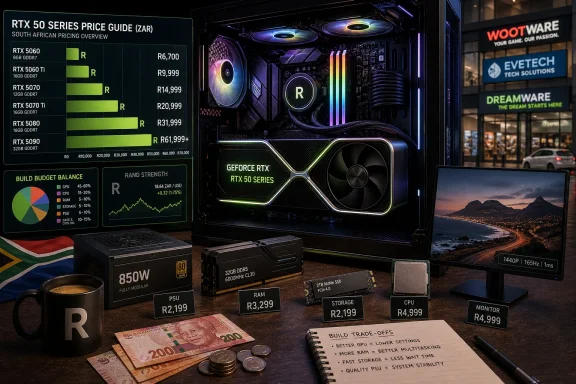
Nvidia’s RTX 50 Series graphics cards are selling in South Africa for roughly R6,700 at the low end and just over R60,000 at the top, according to a MyGaming comparison of prices from Wootware, Evetech, and Dreamware. That spread is not merely a product stack doing what product stacks do. It is a snapshot of a PC market where the graphics card remains the emotional centre of the build, but no longer has the budget to itself. For South African gamers, the RTX 50 generation is less a clean upgrade cycle than a negotiation with exchange rates, component inflation, and the increasingly awkward economics of “future-proofing.”
The RTX 50 Series is Nvidia’s current-generation GeForce gaming family, built around the company’s Blackwell architecture and sold on the usual promise: more frames, better ray tracing, smarter AI-assisted rendering, and a larger gap between the patient upgrader and the enthusiast who wants the best thing now. On paper, that is familiar territory. Every GPU generation arrives with a ladder of prices and performance tiers.
The South African pricing, however, gives the ladder sharper edges. MyGaming’s survey found the RTX 5060 starting at R6,709 from Dreamware, while the RTX 5090 starts at R60,369 from the same retailer. That means the cheapest flagship-class option costs about nine times as much as the entry RTX 50 card before the rest of the PC is considered.
That matters because GPUs do not exist in isolation. A gaming PC also needs memory, storage, power delivery, cooling, a case, and often a monitor capable of showing the frames the GPU can produce. When RAM and SSD prices rise, as South African distributors have warned, the GPU becomes less of a solitary indulgence and more of a line item competing with the rest of the machine.
This is the real pressure behind the RTX 50 pricing story. Nvidia has built a generation that stretches from attainable to absurd, but the rest of the component market has made the middle of that range feel thinner than it used to.
But “cheapest current-generation Nvidia GPU” is not the same thing as “cheap gaming upgrade.” A R6,700 graphics card still sits inside a broader build that can quickly turn expensive once memory, storage, motherboard, CPU, and power supply are added. For a first-time builder, the RTX 5060 may be the start of the budget conversation rather than the end of it.
The RTX 5060’s appeal is therefore defensive. It lets buyers stay current without crossing into the price brackets where a GPU begins to resemble a month’s rent, a used car deposit, or a serious work expense. It is the sensible option in the way entry-level current-generation cards often are: not because it offers the dream, but because it avoids the worst compromises of buying old hardware at new prices.
The danger is that Nvidia’s entry tier can become the default not because it is exciting, but because everything above it has moved out of reach. That is not a failure of the RTX 5060 specifically. It is the sign of a market where the enthusiast baseline has been pulled upward while household budgets have not followed.
That is where the RTX 5070 becomes the more psychologically important product. Evetech’s R11,899 price is a large jump from the 5060 Ti, but it also marks the point where many buyers expect a card to feel meaningfully more durable. The RTX 5070 is not merely “a bit more GPU”; it is the card many gamers will look at when they want a machine that can handle new titles without immediately feeling compromised.
This is the zone where Nvidia has historically made a lot of sense for mainstream enthusiasts. The high-end cards get the headlines, but the upper-midrange cards define the lived experience of PC gaming for people who care about performance and still have to justify the spend. In South Africa, that justification has become more difficult.
The price jump from R7,799 to R11,899 is not abstract. It is the difference between buying a GPU and having room left for more RAM, a bigger SSD, or a better monitor — and buying the GPU first while hoping the rest of the system can keep up. The RTX 5070 may be the more desirable card, but desirability is not the same as affordability.
That price tier is increasingly awkward. Buyers spending nearly R20,000 on a GPU usually expect longevity, high settings, and enough performance headroom to avoid buyer’s remorse two years later. But the rest of the market keeps moving too: games get heavier, monitors get faster, and PC hardware prices do not always fall in a tidy curve after launch.
The 5070 Ti may be the card that tempts the informed buyer who wants more than the RTX 5070 but cannot stomach RTX 5080 pricing. Yet it also sits close enough to the RTX 5080 to trigger the classic enthusiast dilemma. If the 5070 Ti already requires a major stretch, the argument for going one rung higher becomes both irrational and strangely compelling.
That is how GPU pricing has trained the market. Each tier is designed to make the next tier look attainable by comparison, until the buyer has talked themselves from a sensible upgrade into a financial event.
This is the card for the gamer who wants premium performance but still wants to sound sane when explaining the purchase. It is also the card most likely to be paired with high-refresh 1440p or 4K displays, larger power supplies, and systems that are already built around performance rather than price discipline. In that context, R24,199 is painful but coherent.
The RTX 5080 also benefits from the halo effect of the RTX 5090. Once the top card is north of R60,000, the second-best card begins to look restrained. That is the oldest trick in premium pricing: make the extreme option visible enough that the merely expensive option appears rational.
Still, the RTX 5080 is not an automatic recommendation. It only makes sense if the rest of the system, display, and gaming habits can take advantage of it. A flagship-class GPU attached to a modest monitor is not future-proofing; it is deferred value waiting for another expensive purchase.
There will always be buyers for this class of card. Some are affluent enthusiasts; some are creators who can justify the card against revenue-producing work; some simply want the fastest GeForce product available and have no interest in compromise. The RTX 5090 exists for them, and Nvidia knows it.
But for the average South African gamer, the RTX 5090 is mostly useful as a marker. It tells the market where the ceiling is, and by doing so it changes how every lower tier is perceived. When R60,000 becomes the top of the consumer gaming stack, R24,000 starts to look middle-class by contrast.
That does not mean the RTX 5090 is bad value for every buyer. It means “value” has fractured. For gaming alone, the card is hard to justify. For a workstation-gaming hybrid, the calculation may be different. For the market as a whole, it is a reminder that the enthusiast PC has become a luxury category with some mainstream parts still attached.
The same industry appetite for AI infrastructure that has made Nvidia one of the defining companies of the decade has also tightened demand for memory and high-performance silicon. MyGaming notes that RAM and SSD prices have been hit hard, with Syntech CEO Craig Nowitz warning earlier this year that pricing had already climbed sharply in the opening weeks of 2026. Even if GPUs have been affected to a lesser extent, they are not insulated from the same forces.
This is where the story stops being only about graphics cards. A gamer who might once have spent more on the GPU because RAM and storage were relatively forgiving now faces a more balanced pain. A 32GB memory kit, a decent NVMe SSD, and a quality power supply can no longer be treated as background noise in the budget.
The result is a strange inversion. Nvidia’s newest GPUs promise AI-powered performance improvements, but AI-driven demand elsewhere in the industry helps make the whole PC more expensive. The technology that sells the upgrade also contributes to the conditions that make the upgrade harder to afford.
That is why local comparisons like MyGaming’s matter. They cut through the international review ecosystem, where performance-per-dollar charts are often built around US pricing that South African buyers will never see. A card that looks like a reasonable step-up in an American review can become a very different proposition once it arrives in rand.
The retailer spread in the table is also telling. Dreamware has the lowest listed prices for the RTX 5060, RTX 5070 Ti, and RTX 5090; Wootware leads on the RTX 5060 Ti; and Evetech is cheapest on the RTX 5070 and RTX 5080. This is not a market where one retailer simply owns the RTX 50 value story across the board.
For buyers, that means shopping around is not optional. The differences range from modest to meaningful, and at these price levels even a few hundred rand can matter. The GPU may be the glamorous part of the build, but the practical work is still spreadsheet work.
Modern games are less forgiving of weak supporting hardware. RAM capacity matters. SSD speed and capacity matter. CPU performance still matters, especially in competitive games and simulation-heavy titles. Power supply quality matters when GPUs draw serious power and transient spikes can punish cheap components.
That makes the RTX 50 Series harder to evaluate as a pure GPU purchase. The right question is not simply “Which card can I afford?” It is “Which card can I afford without unbalancing the rest of the system?” A buyer who overspends on the GPU and underbuys RAM or storage may end up with a machine that benchmarks well in theory and frustrates in practice.
This is especially true at the lower end. Pairing an RTX 5060 with too little memory or cramped storage undermines the point of buying into a current-generation platform. Pairing an RTX 5080 with a dated CPU or display wastes money in the other direction. The modern gaming PC is a system, not a shrine to a single component.
That does not mean every player needs an RTX 5080 or RTX 5090. It does mean the cheapest acceptable build is becoming more complicated. A GPU that can “play most new titles” may still require careful settings choices, upscaling, and realistic expectations about resolution and frame rate.
Nvidia’s software stack helps here. DLSS and frame generation can extend the useful life of a card and make demanding games feel smoother than raw rendering alone would allow. But these features should not be treated as magic. They are tools that work best when the underlying performance is already adequate.
The danger for consumers is that marketing can blur that distinction. AI-assisted rendering can make a midrange card feel more capable, but it does not abolish memory limits, CPU bottlenecks, or bad PC ports. The promise of smarter frames does not remove the need for enough hardware.
The smallest move, from RTX 5060 to RTX 5060 Ti, is the easiest to defend. The move to RTX 5070 is where buyers start making trade-offs elsewhere. The move to RTX 5070 Ti is where the GPU becomes the centrepiece of the build. The move to RTX 5080 is where enthusiast ambition takes over. The move to RTX 5090 is where ordinary value language mostly stops working.
This is why the RTX 5080 may be the most consequential high-end card in the South African stack. It gives premium buyers a way to avoid the RTX 5090’s extreme pricing while still buying into a flagship-class experience. It is not cheap, but it remains connected to the rest of the consumer market in a way the 5090 does not.
The RTX 5070 may be the more important card for volume, though. If South African gamers can absorb the jump to roughly R12,000, it becomes the compromise that balances current-generation features with plausible longevity. If they cannot, the RTX 5060 and 5060 Ti become the de facto mainstream — not because they define the ideal experience, but because they are the only options left standing.
A buyer moving from an older midrange card to an RTX 5070 or better may need a stronger power supply. A buyer moving to 4K may need a new monitor to justify the GPU. A buyer choosing a high-end card may discover that an older CPU limits performance in the games they actually play. These secondary costs are not fine print; they are part of the upgrade.
There is also the opportunity cost. Spending R24,000 on an RTX 5080 instead of R12,000 on an RTX 5070 may deliver a better experience, but it also consumes money that could have gone into a monitor, storage, chair, backup drive, or even simply not being spent. Enthusiast PC culture often treats performance as the only metric, but household budgets are not benchmark charts.
This is where South African buyers need to be colder than the marketing. The best GPU is not the fastest one. It is the one that fits the system, the screen, the games, and the buyer’s tolerance for regret.
That hierarchy is simple. Living with it is not. The difficulty is that every tier now carries a stronger trade-off than it might have a few years ago. The entry card saves money but may age faster. The midrange card costs enough to hurt. The high-end card can distort the whole build budget. The flagship breaks the frame entirely.
The most disciplined buyers will start not with the GPU, but with the monitor. A 1080p gamer, a 1440p high-refresh player, and a 4K ray-tracing enthusiast do not need the same card. Once the target resolution and refresh rate are honest, the GPU choice becomes less vulnerable to upsell logic.
The second discipline is timing. GPU prices fluctuate, stock changes, and promotions can matter. MyGaming’s table is a snapshot, not a permanent law of nature. In a volatile component market, patience can be a performance feature.
 Nvidia’s New Stack Arrives in a Market That Has Already Spent the Upgrade Budget
The RTX 50 Series is Nvidia’s current-generation GeForce gaming family, built around the company’s Blackwell architecture and sold on the usual promise: more frames, better ray tracing, smarter AI-assisted rendering, and a larger gap between the patient upgrader and the enthusiast who wants the best thing now. On paper, that is familiar territory. Every GPU generation arrives with a ladder of prices and performance tiers.The South African pricing, however, gives the ladder sharper edges. MyGaming’s survey found the RTX 5060 starting at R6,709 from Dreamware, while the RTX 5090 starts at R60,369 from the same retailer. That means the cheapest flagship-class option costs about nine times as much as the entry RTX 50 card before the rest of the PC is considered.
That matters because GPUs do not exist in isolation. A gaming PC also needs memory, storage, power delivery, cooling, a case, and often a monitor capable of showing the frames the GPU can produce. When RAM and SSD prices rise, as South African distributors have warned, the GPU becomes less of a solitary indulgence and more of a line item competing with the rest of the machine.
This is the real pressure behind the RTX 50 pricing story. Nvidia has built a generation that stretches from attainable to absurd, but the rest of the component market has made the middle of that range feel thinner than it used to.
The RTX 5060 Is the New Floor, Not the New Bargain
At R6,709, the RTX 5060 is the least expensive RTX 50 Series card in MyGaming’s comparison. That makes it the obvious candidate for budget builds, especially for buyers who want access to Nvidia’s newer feature set without paying five figures for the GPU alone. It is the card that keeps the RTX 50 Series in the conversation for mainstream South African gamers.But “cheapest current-generation Nvidia GPU” is not the same thing as “cheap gaming upgrade.” A R6,700 graphics card still sits inside a broader build that can quickly turn expensive once memory, storage, motherboard, CPU, and power supply are added. For a first-time builder, the RTX 5060 may be the start of the budget conversation rather than the end of it.
The RTX 5060’s appeal is therefore defensive. It lets buyers stay current without crossing into the price brackets where a GPU begins to resemble a month’s rent, a used car deposit, or a serious work expense. It is the sensible option in the way entry-level current-generation cards often are: not because it offers the dream, but because it avoids the worst compromises of buying old hardware at new prices.
The danger is that Nvidia’s entry tier can become the default not because it is exciting, but because everything above it has moved out of reach. That is not a failure of the RTX 5060 specifically. It is the sign of a market where the enthusiast baseline has been pulled upward while household budgets have not followed.
The 5060 Ti and 5070 Form the Real Battleground
The RTX 5060 Ti, cheapest at Wootware for R7,799 in the comparison, is the natural step-up card. It is close enough to the RTX 5060 to remain plausible for budget-conscious buyers, but expensive enough to raise the inevitable question: if you are already stretching, should you stretch further?That is where the RTX 5070 becomes the more psychologically important product. Evetech’s R11,899 price is a large jump from the 5060 Ti, but it also marks the point where many buyers expect a card to feel meaningfully more durable. The RTX 5070 is not merely “a bit more GPU”; it is the card many gamers will look at when they want a machine that can handle new titles without immediately feeling compromised.
This is the zone where Nvidia has historically made a lot of sense for mainstream enthusiasts. The high-end cards get the headlines, but the upper-midrange cards define the lived experience of PC gaming for people who care about performance and still have to justify the spend. In South Africa, that justification has become more difficult.
The price jump from R7,799 to R11,899 is not abstract. It is the difference between buying a GPU and having room left for more RAM, a bigger SSD, or a better monitor — and buying the GPU first while hoping the rest of the system can keep up. The RTX 5070 may be the more desirable card, but desirability is not the same as affordability.
The RTX 5070 Ti Is Where Enthusiasm Starts to Hurt
The RTX 5070 Ti is listed as low as R18,359 from Dreamware, making it the first RTX 50 card in the comparison that clearly escapes the mainstream bracket. This is not yet halo-product pricing, but it is no longer casual enthusiast money. It is a serious upgrade for someone who already knows exactly why they are buying it.That price tier is increasingly awkward. Buyers spending nearly R20,000 on a GPU usually expect longevity, high settings, and enough performance headroom to avoid buyer’s remorse two years later. But the rest of the market keeps moving too: games get heavier, monitors get faster, and PC hardware prices do not always fall in a tidy curve after launch.
The 5070 Ti may be the card that tempts the informed buyer who wants more than the RTX 5070 but cannot stomach RTX 5080 pricing. Yet it also sits close enough to the RTX 5080 to trigger the classic enthusiast dilemma. If the 5070 Ti already requires a major stretch, the argument for going one rung higher becomes both irrational and strangely compelling.
That is how GPU pricing has trained the market. Each tier is designed to make the next tier look attainable by comparison, until the buyer has talked themselves from a sensible upgrade into a financial event.
The RTX 5080 Is the Flagship for People Who Still Need to Explain Themselves
Evetech’s R24,199 RTX 5080 price is the most interesting figure in the whole comparison because it sits at the border between extravagance and defensible enthusiast spending. It is expensive by any ordinary measure, but it is also less than half the cost of the cheapest RTX 5090 in the survey. For many serious Nvidia buyers, that makes it the practical flagship.This is the card for the gamer who wants premium performance but still wants to sound sane when explaining the purchase. It is also the card most likely to be paired with high-refresh 1440p or 4K displays, larger power supplies, and systems that are already built around performance rather than price discipline. In that context, R24,199 is painful but coherent.
The RTX 5080 also benefits from the halo effect of the RTX 5090. Once the top card is north of R60,000, the second-best card begins to look restrained. That is the oldest trick in premium pricing: make the extreme option visible enough that the merely expensive option appears rational.
Still, the RTX 5080 is not an automatic recommendation. It only makes sense if the rest of the system, display, and gaming habits can take advantage of it. A flagship-class GPU attached to a modest monitor is not future-proofing; it is deferred value waiting for another expensive purchase.
The RTX 5090 Is Less a Gaming Card Than a Statement of Intent
The RTX 5090 starts at R60,369 in MyGaming’s table, with the other two retailers listed at R64,999. That number changes the conversation. This is no longer a question of whether a gamer can save a little longer or choose a cheaper case. It is a GPU priced beyond the complete build budget of many competent gaming PCs.There will always be buyers for this class of card. Some are affluent enthusiasts; some are creators who can justify the card against revenue-producing work; some simply want the fastest GeForce product available and have no interest in compromise. The RTX 5090 exists for them, and Nvidia knows it.
But for the average South African gamer, the RTX 5090 is mostly useful as a marker. It tells the market where the ceiling is, and by doing so it changes how every lower tier is perceived. When R60,000 becomes the top of the consumer gaming stack, R24,000 starts to look middle-class by contrast.
That does not mean the RTX 5090 is bad value for every buyer. It means “value” has fractured. For gaming alone, the card is hard to justify. For a workstation-gaming hybrid, the calculation may be different. For the market as a whole, it is a reminder that the enthusiast PC has become a luxury category with some mainstream parts still attached.
AI Is No Longer Just a Feature — It Is a Force in the Supply Chain
Nvidia sells the RTX 50 Series partly through AI-assisted graphics features, including newer forms of frame generation and rendering enhancement. That is the consumer-facing version of the AI story. The less glamorous version is what AI demand has done to the hardware supply chain.The same industry appetite for AI infrastructure that has made Nvidia one of the defining companies of the decade has also tightened demand for memory and high-performance silicon. MyGaming notes that RAM and SSD prices have been hit hard, with Syntech CEO Craig Nowitz warning earlier this year that pricing had already climbed sharply in the opening weeks of 2026. Even if GPUs have been affected to a lesser extent, they are not insulated from the same forces.
This is where the story stops being only about graphics cards. A gamer who might once have spent more on the GPU because RAM and storage were relatively forgiving now faces a more balanced pain. A 32GB memory kit, a decent NVMe SSD, and a quality power supply can no longer be treated as background noise in the budget.
The result is a strange inversion. Nvidia’s newest GPUs promise AI-powered performance improvements, but AI-driven demand elsewhere in the industry helps make the whole PC more expensive. The technology that sells the upgrade also contributes to the conditions that make the upgrade harder to afford.
South African Buyers Face a Harsher Version of the Global GPU Problem
GPU pricing is a global complaint, but South African buyers experience it with extra layers of friction. Exchange rates, import costs, shipping, local distribution margins, and a smaller enthusiast market all shape the final shelf price. A dollar MSRP never lands in South Africa as a simple currency conversion.That is why local comparisons like MyGaming’s matter. They cut through the international review ecosystem, where performance-per-dollar charts are often built around US pricing that South African buyers will never see. A card that looks like a reasonable step-up in an American review can become a very different proposition once it arrives in rand.
The retailer spread in the table is also telling. Dreamware has the lowest listed prices for the RTX 5060, RTX 5070 Ti, and RTX 5090; Wootware leads on the RTX 5060 Ti; and Evetech is cheapest on the RTX 5070 and RTX 5080. This is not a market where one retailer simply owns the RTX 50 value story across the board.
For buyers, that means shopping around is not optional. The differences range from modest to meaningful, and at these price levels even a few hundred rand can matter. The GPU may be the glamorous part of the build, but the practical work is still spreadsheet work.
The Old Upgrade Logic Is Breaking Down
For years, a common PC gaming strategy was to spend heavily on the GPU and economise elsewhere. The argument was simple: the graphics card usually made the biggest difference to game performance, so it deserved the largest share of the budget. That logic is still partly true, but it is no longer sufficient.Modern games are less forgiving of weak supporting hardware. RAM capacity matters. SSD speed and capacity matter. CPU performance still matters, especially in competitive games and simulation-heavy titles. Power supply quality matters when GPUs draw serious power and transient spikes can punish cheap components.
That makes the RTX 50 Series harder to evaluate as a pure GPU purchase. The right question is not simply “Which card can I afford?” It is “Which card can I afford without unbalancing the rest of the system?” A buyer who overspends on the GPU and underbuys RAM or storage may end up with a machine that benchmarks well in theory and frustrates in practice.
This is especially true at the lower end. Pairing an RTX 5060 with too little memory or cramped storage undermines the point of buying into a current-generation platform. Pairing an RTX 5080 with a dated CPU or display wastes money in the other direction. The modern gaming PC is a system, not a shrine to a single component.
Developers Keep Raising the Floor Beneath Gamers’ Feet
The pressure from game developers is not imaginary. Big-budget releases continue to chase denser worlds, heavier texture packs, more advanced lighting, and larger storage footprints. Even when optimisation is good, the baseline expectations for a comfortable experience keep rising.That does not mean every player needs an RTX 5080 or RTX 5090. It does mean the cheapest acceptable build is becoming more complicated. A GPU that can “play most new titles” may still require careful settings choices, upscaling, and realistic expectations about resolution and frame rate.
Nvidia’s software stack helps here. DLSS and frame generation can extend the useful life of a card and make demanding games feel smoother than raw rendering alone would allow. But these features should not be treated as magic. They are tools that work best when the underlying performance is already adequate.
The danger for consumers is that marketing can blur that distinction. AI-assisted rendering can make a midrange card feel more capable, but it does not abolish memory limits, CPU bottlenecks, or bad PC ports. The promise of smarter frames does not remove the need for enough hardware.
The Retail Table Tells a Story About Compromise
The numbers in MyGaming’s comparison form a clean staircase. RTX 5060 at R6,709. RTX 5060 Ti at R7,799. RTX 5070 at R11,899. RTX 5070 Ti at R18,359. RTX 5080 at R24,199. RTX 5090 at R60,369. Each step has a logic, but the gaps between the steps reveal the market’s pain points.The smallest move, from RTX 5060 to RTX 5060 Ti, is the easiest to defend. The move to RTX 5070 is where buyers start making trade-offs elsewhere. The move to RTX 5070 Ti is where the GPU becomes the centrepiece of the build. The move to RTX 5080 is where enthusiast ambition takes over. The move to RTX 5090 is where ordinary value language mostly stops working.
This is why the RTX 5080 may be the most consequential high-end card in the South African stack. It gives premium buyers a way to avoid the RTX 5090’s extreme pricing while still buying into a flagship-class experience. It is not cheap, but it remains connected to the rest of the consumer market in a way the 5090 does not.
The RTX 5070 may be the more important card for volume, though. If South African gamers can absorb the jump to roughly R12,000, it becomes the compromise that balances current-generation features with plausible longevity. If they cannot, the RTX 5060 and 5060 Ti become the de facto mainstream — not because they define the ideal experience, but because they are the only options left standing.
The Rand Price Is Only the First Invoice
The RTX 50 Series comparison is useful because it gives buyers a starting price. But the real cost of ownership begins after the card is selected. Power supply requirements, case airflow, monitor resolution, and upgrade timing can all shift the final bill.A buyer moving from an older midrange card to an RTX 5070 or better may need a stronger power supply. A buyer moving to 4K may need a new monitor to justify the GPU. A buyer choosing a high-end card may discover that an older CPU limits performance in the games they actually play. These secondary costs are not fine print; they are part of the upgrade.
There is also the opportunity cost. Spending R24,000 on an RTX 5080 instead of R12,000 on an RTX 5070 may deliver a better experience, but it also consumes money that could have gone into a monitor, storage, chair, backup drive, or even simply not being spent. Enthusiast PC culture often treats performance as the only metric, but household budgets are not benchmark charts.
This is where South African buyers need to be colder than the marketing. The best GPU is not the fastest one. It is the one that fits the system, the screen, the games, and the buyer’s tolerance for regret.
The RTX 50 Decision Tree Has Fewer Comfortable Branches
The practical buying advice is less dramatic than the pricing, but more useful. The RTX 5060 is the budget entry point. The RTX 5060 Ti is the reasonable stretch for buyers who can find it near the Wootware price. The RTX 5070 is the likely sweet spot for those who want a current-generation Nvidia card with more staying power. The RTX 5070 Ti is for enthusiasts who know they need the extra headroom. The RTX 5080 is the premium card that still has a rational audience. The RTX 5090 is for buyers whose needs or wallets make ordinary advice irrelevant.That hierarchy is simple. Living with it is not. The difficulty is that every tier now carries a stronger trade-off than it might have a few years ago. The entry card saves money but may age faster. The midrange card costs enough to hurt. The high-end card can distort the whole build budget. The flagship breaks the frame entirely.
The most disciplined buyers will start not with the GPU, but with the monitor. A 1080p gamer, a 1440p high-refresh player, and a 4K ray-tracing enthusiast do not need the same card. Once the target resolution and refresh rate are honest, the GPU choice becomes less vulnerable to upsell logic.
The second discipline is timing. GPU prices fluctuate, stock changes, and promotions can matter. MyGaming’s table is a snapshot, not a permanent law of nature. In a volatile component market, patience can be a performance feature.
The Price Tags Draw the New Map for South African PC Gaming
The RTX 50 Series does not make PC gaming unaffordable in South Africa, but it does make careless PC gaming more expensive. The old habit of buying the biggest GPU one can almost afford is increasingly risky when memory and storage are also climbing. The smartest build is the one that leaves enough money for the rest of the machine.- The RTX 5060 is the lowest-cost RTX 50 Series option in the comparison, with Dreamware listing it at R6,709.
- The RTX 5060 Ti is the cheapest meaningful step-up, with Wootware listing the lowest surveyed price at R7,799.
- The RTX 5070 marks the start of the more serious midrange, with Evetech listing it at R11,899.
- The RTX 5070 Ti pushes the build into enthusiast territory, with Dreamware listing the lowest surveyed price at R18,359.
- The RTX 5080 is the most plausible premium option for many high-end Nvidia gamers, with Evetech listing it at R24,199.
- The RTX 5090 sits in a separate luxury class, with Dreamware listing the lowest surveyed price at R60,369.
References
- Primary source: mygaming.co.za
Published: Mon, 22 Jun 2026 15:19:23 GMT
How much an RTX 50 Series graphics card costs in South Africa
Nvidia RTX 50 Series graphics cards are available from under R7,000 to over R60,000. mygaming.co.za
- Related coverage: pcgamer.com
Graphics card price watch: We're tracking the lowest prices and the best GPU deals for Nvidia, AMD, and Intel cards | PC Gamer
We've done the hard yards sourcing the best graphics card deals for the GPUs worth putting in your gaming PC.www.pcgamer.com - Related coverage: nvidia.com
NVIDIA GeForce RTX 50 Series Graphics Cards
Powered by NVIDIA Blackwell, GeForce RTX 50 Series GPUs bring game-changing capabilities to gamers and creators. Equipped with a massive level of AI horsepower.www.nvidia.com - Related coverage: investor.nvidia.com
NVIDIA Corporation - NVIDIA Blackwell GeForce RTX 50 Series Opens New World of AI Computer Graphics
Next Generation of GeForce RTX GPUs Deliver Stunning Visual Realism and 2x Performance Increase, Made Possible by AI, Neural Shaders and DLSS 4 LAS VEGAS, Jan. 06, 2025 (GLOBE NEWSWIRE) - CES - NVIDIA today unveiled the most advanced consumer GPUs for gamers, creators and developers — the...investor.nvidia.com - Related coverage: nvidianews.nvidia.com
NVIDIA Blackwell GeForce RTX 50 Series Opens New World of AI Computer Graphics | NVIDIA Newsroom
NVIDIA today unveiled the most advanced consumer GPUs for gamers, creators and developers — the GeForce RTX™ 50 Series Desktop and Laptop GPUs.nvidianews.nvidia.com - Related coverage: tomshardware.com
Nvidia Blackwell and GeForce RTX 50-Series GPUs: Specifications, release dates, pricing, and everything we know (updated) | Tom's Hardware
Here's what we know and expect from Nvidia's next generation Blackwell GPU architecture.www.tomshardware.com
- Related coverage: nvidia.cn
GeForce RTX 50 系列显卡
GeForce RTX 50 系列 GPU 由 NVIDIA Blackwell 提供支持,为游戏玩家和创作者带来颠覆性功能。配备强大的 AI 能力。www.nvidia.cn - Related coverage: asus.com
ASUS GeForce RTX 50 Series | The best GeForce RTX 50 Series graphics cards | ASUS US
ASUS harnesses full power of Blackwell architecture and next-level AI performance on NVIDIA GeForce RTX™ 5090, 5080, 5070 Ti, 5070 GPUs to deliver unparalleled performance and cooling for top-notch gaming experience. www.asus.com
- Related coverage: computersonly.co.za
RTX 50 Series Graphics Cards - Computersonly
Equipped with a massive level of AI horsepower, the RTX 50 Series enables new experiences and next-level graphics fidelity. Available at Computersonly. computersonly.co.za