
OpenAI announced in June 2026 that GPT-5.5 Instant, the default fast ChatGPT model available to free users worldwide, has reached health-answering performance comparable to its frontier “Thinking” models on internal medical benchmarks, including HealthBench and HealthBench Professional. The claim is not merely that ChatGPT is getting better at explaining symptoms or lab values. It is that OpenAI wants the everyday, no-cost version of its assistant to become a safer first stop for health questions at massive scale. That is both an access story and a risk story, because the model now sits closer than ever to the front door of medical decision-making.
The most important word in OpenAI’s announcement is not health. It is Instant. The company is saying that the lightweight, widely available ChatGPT experience — not just the slower, more expensive reasoning tier — can now deliver medical-answering behavior that looks much closer to its best models.
That matters because most people do not experience AI as a benchmark chart or a model card. They experience it as the thing that answers at 11:40 p.m. when a child has a rash, a parent’s lab result looks alarming, or an insurance letter reads like it was written by a committee of hostile lawyers. If the default model is weak, the mass-market product is weak, no matter how impressive the frontier model looks in a demo.
OpenAI says more than 230 million people each week use ChatGPT for health and wellness questions. That number, if taken at face value, makes ChatGPT one of the largest health-information interfaces in the world. It also reframes the usual debate about AI in medicine: this is no longer a future-tense question about whether patients will ask chatbots for help. They already are.
The company’s argument is straightforward. If people are already using ChatGPT to understand lab results, prepare for doctor visits, navigate insurance, and sort through symptoms, then improving the default model is a public safety measure as much as a product upgrade. The uncomfortable counterargument is just as straightforward: when an AI assistant becomes this convenient, improvements can increase trust faster than they increase accountability.
The company says GPT-5.5 Instant now performs similarly to more advanced “Thinking” models on these evaluations and improves substantially over GPT-5.3 Instant. It also says physician reviewers rated GPT-5.5 Instant responses higher than older AI models and, in some categories, physician-written responses. Those categories reportedly include clarity, completeness, accuracy, instruction-following, and support for health decisions.
That last comparison deserves careful handling. A model can outperform a physician-written answer in a controlled evaluation without being a better doctor. Doctors operate with incomplete records, legal obligations, institutional constraints, patient histories, and real consequences. A chatbot operates in a text box.
Still, the comparison is not meaningless. Much of ordinary health communication is not diagnosis in the dramatic television sense; it is translation. It is explaining why a lab value may be high, what questions to ask a specialist, when a side effect sounds routine, and when a symptom deserves urgent attention. Those are precisely the moments where a clear, patient, context-sensitive system can be useful.
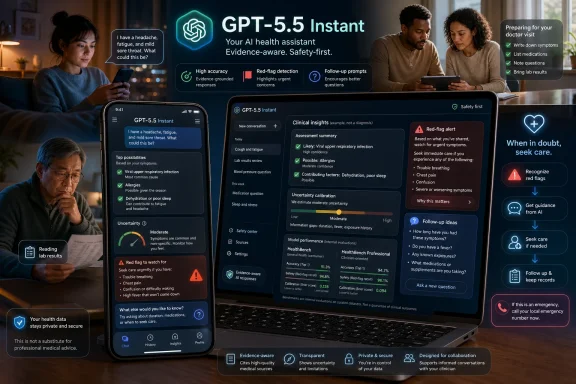
The trust problem is that users rarely separate “this explained my blood test well” from “this can safely guide my next medical decision.” OpenAI knows this, which is why the announcement emphasizes uncertainty, follow-up questions, and red-flag detection. The company is not selling GPT-5.5 Instant as a doctor, but it is plainly trying to make ChatGPT feel less like a search engine and more like a health navigator.
That is the right axis of improvement. The failure mode of consumer health AI is not only hallucination; it is overconfident smoothness. A bad health answer can be grammatically perfect, emotionally reassuring, and clinically wrong. In medicine, the difference between “this may be benign” and “this needs urgent evaluation” can be the entire ballgame.
Asking follow-up questions is also more than a conversational nicety. A symptom without age, duration, severity, pregnancy status, medications, comorbidities, location, and recent changes is often barely a medical fact at all. A model that asks, “How long has this been happening?” before offering an explanation is behaving more like a triage intake script and less like a content farm.
But hesitation cuts both ways. A model that escalates too often becomes useless noise, sending anxious users to urgent care for ordinary headaches. A model that escalates too rarely becomes dangerous. The art is calibration, and calibration in health is not just a technical challenge; it is a values challenge about acceptable risk, patient autonomy, and the cost of false reassurance.
OpenAI’s framing suggests it understands this tension. The company’s announcement repeatedly returns to red flags, context, and uncertainty, rather than promising diagnostic omniscience. That restraint is welcome. Whether it survives competitive pressure is another matter.
This is not the same thing as clinical validation in a hospital system, but it is still significant. Large language models improve when their failure cases are seen, labeled, debated, and fed back into training and evaluation. In healthcare, the people doing that work need to understand not just textbook medicine but the messy ways patients describe problems.
The international and multilingual scope also matters. ChatGPT is not being used only by English-speaking patients with private insurance and easy access to specialists. It is being used by people trying to interpret unfamiliar medical terms, second opinions, discharge instructions, public health guidance, and local healthcare pathways. A model that handles health well in English but poorly in other languages will reproduce the same access gaps it claims to reduce.
There is, however, a ceiling to this approach. A reviewer network can improve outputs, but it cannot turn a general-purpose chatbot into a regulated care team. It cannot verify whether the user’s thermometer is accurate, whether the uploaded lab result belongs to the user, whether a symptom is being understated, or whether a patient will act on the advice. The human spine helps, but the product still walks on consumer-software legs.
That distinction will become more important as OpenAI pushes into clinician-facing tools. ChatGPT for Clinicians and OpenAI for Healthcare point toward documentation, research, and care-delivery workflows. The same model behavior that helps a patient understand a lab result may eventually shape how a doctor drafts a note or reviews a chart. At that point, the quality bar is not “better than WebMD.” It is “safe inside a professional system with audit trails, liability, and institutional governance.”
It is also a metric that raises follow-up questions. What qualifies as a flagged factuality issue? How are health conversations identified? How are edge cases sampled? What kinds of mistakes remain? A 71 percent reduction can be an important improvement and still leave a large absolute number of errors when the denominator is hundreds of millions of users.
This is the core math of consumer AI safety. At small scale, rare failures are anecdotes. At ChatGPT scale, rare failures are product realities. If even a tiny fraction of health answers are materially wrong, the number of affected people can still be substantial.
The right comparison is not perfection. Human clinicians make mistakes, health websites contain outdated information, and patients routinely misunderstand medical instructions. The right comparison is whether ChatGPT reduces confusion without creating new kinds of misplaced confidence.
OpenAI’s best case is that GPT-5.5 Instant can sit between panic-searching and professional care: a tool that helps users organize symptoms, understand terminology, prepare questions, and recognize warning signs. Its worst case is that it becomes a soothing authority for people who should be calling a doctor. The difference will depend less on one benchmark score than on how the product behaves in the million ambiguous cases between “obvious emergency” and “probably fine.”
That is the noble version of the story. The commercial version is that health is a high-frequency, emotionally sticky use case. If ChatGPT becomes the place people go when they are scared, confused, or preparing for a doctor visit, OpenAI gains a deep role in daily life that few consumer apps can match.
This is where WindowsForum readers should see the broader platform pattern. The AI assistant is becoming the new shell around information. On Windows PCs, in browsers, in productivity suites, and eventually inside healthcare portals, users will increasingly ask an assistant to interpret rather than browse. The company that controls that interpretation layer controls which facts are surfaced, which risks are emphasized, and which next steps feel reasonable.
For IT administrators, this is no longer a niche consumer story. Employees will paste benefit letters, lab snippets, medical leave questions, and personal health details into AI tools whether policy approves or not. Healthcare organizations will face pressure from clinicians who want documentation assistance and from patients who arrive with AI-generated summaries. Security teams will need to think about data handling, retention, and access boundaries long before the legal department finishes its AI governance framework.
For ordinary users, the practical advice remains boring but essential. Do not treat a chatbot as a clinician. Do use it to prepare better questions, translate jargon, organize timelines, and identify when something might require urgent care. The safest use of AI health advice is as a bridge to better human decision-making, not a replacement for it.
Microsoft’s deep partnership with OpenAI makes the connection obvious. As AI features spread through Windows, Edge, Microsoft 365, and cloud services, the distinction between “ChatGPT health advice” and “AI-assisted computing” will blur. A user may not care whether the answer comes from a standalone chatbot, a browser sidebar, an embedded Copilot-like interface, or a health system’s portal assistant.
That creates a new enterprise problem. Health data is among the most sensitive information users handle, but it often appears in ordinary formats: screenshots, PDFs, emails, spreadsheets, appointment notes, and message threads. If AI tools can read and summarize all of it, administrators need policies that understand content sensitivity, not just application names.
It also creates an accessibility opportunity. A better AI health explainer could help users with low health literacy, language barriers, disabilities, or complicated care plans. For older Windows users managing multiple specialists and prescriptions, a patient assistant that can explain instructions plainly and help prepare questions could be genuinely valuable.
The danger is ambient normalization. Once AI summaries become a default part of the desktop, users may stop noticing when sensitive data leaves one trust boundary and enters another. The more helpful the assistant becomes, the more invisible the transaction feels.
That is why the most credible part of OpenAI’s announcement is not the AGI framing. It is the mundane claim that ChatGPT can explain complex medical information more clearly, ask better follow-up questions, and escalate more appropriately. Those are incremental improvements with immediate value.
The less credible temptation is to treat benchmark parity with frontier models as a proxy for healthcare readiness. HealthBench may be well designed, and physician review may be meaningful, but medicine is not a static test set. Real users omit facts, misunderstand answers, ask leading questions, upload messy documents, and return days later with changed symptoms.
A serious health AI must therefore be judged not just by what it answers, but by what it refuses, what it qualifies, what it asks, and what it remembers. It must know when to be useful and when to get out of the way. That is a higher standard than “the model got more accurate.”
OpenAI appears to be moving in that direction. The company’s emphasis on uncertainty and escalation is a sign that the old chatbot habit of answering everything is being sanded down. The question is whether the product design, user interface, and business incentives will reinforce that humility or slowly erode it.
The concrete takeaways are less dramatic than the marketing, but more useful:
 OpenAI Is Moving the Health Assistant From Premium Feature to Public Utility
The most important word in OpenAI’s announcement is not health. It is Instant. The company is saying that the lightweight, widely available ChatGPT experience — not just the slower, more expensive reasoning tier — can now deliver medical-answering behavior that looks much closer to its best models.That matters because most people do not experience AI as a benchmark chart or a model card. They experience it as the thing that answers at 11:40 p.m. when a child has a rash, a parent’s lab result looks alarming, or an insurance letter reads like it was written by a committee of hostile lawyers. If the default model is weak, the mass-market product is weak, no matter how impressive the frontier model looks in a demo.
OpenAI says more than 230 million people each week use ChatGPT for health and wellness questions. That number, if taken at face value, makes ChatGPT one of the largest health-information interfaces in the world. It also reframes the usual debate about AI in medicine: this is no longer a future-tense question about whether patients will ask chatbots for help. They already are.
The company’s argument is straightforward. If people are already using ChatGPT to understand lab results, prepare for doctor visits, navigate insurance, and sort through symptoms, then improving the default model is a public safety measure as much as a product upgrade. The uncomfortable counterargument is just as straightforward: when an AI assistant becomes this convenient, improvements can increase trust faster than they increase accountability.
The Benchmark Story Is Really a Trust Story
OpenAI is leaning heavily on HealthBench and HealthBench Professional, its health-focused evaluations designed to judge model answers across accuracy, safety, context awareness, communication, completeness, and escalation to care. These are not trivial categories. A medical assistant that is technically accurate but fails to tell a user to seek urgent help can still be dangerous.The company says GPT-5.5 Instant now performs similarly to more advanced “Thinking” models on these evaluations and improves substantially over GPT-5.3 Instant. It also says physician reviewers rated GPT-5.5 Instant responses higher than older AI models and, in some categories, physician-written responses. Those categories reportedly include clarity, completeness, accuracy, instruction-following, and support for health decisions.
That last comparison deserves careful handling. A model can outperform a physician-written answer in a controlled evaluation without being a better doctor. Doctors operate with incomplete records, legal obligations, institutional constraints, patient histories, and real consequences. A chatbot operates in a text box.
Still, the comparison is not meaningless. Much of ordinary health communication is not diagnosis in the dramatic television sense; it is translation. It is explaining why a lab value may be high, what questions to ask a specialist, when a side effect sounds routine, and when a symptom deserves urgent attention. Those are precisely the moments where a clear, patient, context-sensitive system can be useful.
The trust problem is that users rarely separate “this explained my blood test well” from “this can safely guide my next medical decision.” OpenAI knows this, which is why the announcement emphasizes uncertainty, follow-up questions, and red-flag detection. The company is not selling GPT-5.5 Instant as a doctor, but it is plainly trying to make ChatGPT feel less like a search engine and more like a health navigator.
The New Model Is Being Trained to Hesitate, Not Just Answer
The most interesting claimed improvement is not raw accuracy. It is the model’s behavior around uncertainty. OpenAI says GPT-5.5 Instant is better at asking for additional context before giving guidance, explaining uncertainty, and recognizing when urgent medical attention may be necessary.That is the right axis of improvement. The failure mode of consumer health AI is not only hallucination; it is overconfident smoothness. A bad health answer can be grammatically perfect, emotionally reassuring, and clinically wrong. In medicine, the difference between “this may be benign” and “this needs urgent evaluation” can be the entire ballgame.
Asking follow-up questions is also more than a conversational nicety. A symptom without age, duration, severity, pregnancy status, medications, comorbidities, location, and recent changes is often barely a medical fact at all. A model that asks, “How long has this been happening?” before offering an explanation is behaving more like a triage intake script and less like a content farm.
But hesitation cuts both ways. A model that escalates too often becomes useless noise, sending anxious users to urgent care for ordinary headaches. A model that escalates too rarely becomes dangerous. The art is calibration, and calibration in health is not just a technical challenge; it is a values challenge about acceptable risk, patient autonomy, and the cost of false reassurance.
OpenAI’s framing suggests it understands this tension. The company’s announcement repeatedly returns to red flags, context, and uncertainty, rather than promising diagnostic omniscience. That restraint is welcome. Whether it survives competitive pressure is another matter.
The Physician Network Gives the System a Human Spine
OpenAI says its health work is shaped by a network of more than 260 physicians across 60 countries, 49 languages, and 26 specialties. Those physicians have reportedly reviewed more than 700,000 example model responses, identifying shortcomings and helping set standards for future development.This is not the same thing as clinical validation in a hospital system, but it is still significant. Large language models improve when their failure cases are seen, labeled, debated, and fed back into training and evaluation. In healthcare, the people doing that work need to understand not just textbook medicine but the messy ways patients describe problems.
The international and multilingual scope also matters. ChatGPT is not being used only by English-speaking patients with private insurance and easy access to specialists. It is being used by people trying to interpret unfamiliar medical terms, second opinions, discharge instructions, public health guidance, and local healthcare pathways. A model that handles health well in English but poorly in other languages will reproduce the same access gaps it claims to reduce.
There is, however, a ceiling to this approach. A reviewer network can improve outputs, but it cannot turn a general-purpose chatbot into a regulated care team. It cannot verify whether the user’s thermometer is accurate, whether the uploaded lab result belongs to the user, whether a symptom is being understated, or whether a patient will act on the advice. The human spine helps, but the product still walks on consumer-software legs.
That distinction will become more important as OpenAI pushes into clinician-facing tools. ChatGPT for Clinicians and OpenAI for Healthcare point toward documentation, research, and care-delivery workflows. The same model behavior that helps a patient understand a lab result may eventually shape how a doctor drafts a note or reviews a chart. At that point, the quality bar is not “better than WebMD.” It is “safe inside a professional system with audit trails, liability, and institutional governance.”
A 71 Percent Drop in Flagged Factuality Issues Is Impressive, but Not a Warranty
OpenAI says privacy-preserving monitoring of health-related conversations across billions of weekly interactions shows a 71 percent decline over the past two months in responses containing at least one flagged factuality issue. That is the kind of metric any AI company wants to show: concrete, recent, and large.It is also a metric that raises follow-up questions. What qualifies as a flagged factuality issue? How are health conversations identified? How are edge cases sampled? What kinds of mistakes remain? A 71 percent reduction can be an important improvement and still leave a large absolute number of errors when the denominator is hundreds of millions of users.
This is the core math of consumer AI safety. At small scale, rare failures are anecdotes. At ChatGPT scale, rare failures are product realities. If even a tiny fraction of health answers are materially wrong, the number of affected people can still be substantial.
The right comparison is not perfection. Human clinicians make mistakes, health websites contain outdated information, and patients routinely misunderstand medical instructions. The right comparison is whether ChatGPT reduces confusion without creating new kinds of misplaced confidence.
OpenAI’s best case is that GPT-5.5 Instant can sit between panic-searching and professional care: a tool that helps users organize symptoms, understand terminology, prepare questions, and recognize warning signs. Its worst case is that it becomes a soothing authority for people who should be calling a doctor. The difference will depend less on one benchmark score than on how the product behaves in the million ambiguous cases between “obvious emergency” and “probably fine.”
Free Access Changes the Ethics of the Upgrade
Making the improved health behavior available to free users worldwide is a strong product move and a complicated ethical one. It means the benefits are not locked behind a subscription, which matters for the very users most likely to rely on ChatGPT when healthcare is expensive, slow, or inaccessible.That is the noble version of the story. The commercial version is that health is a high-frequency, emotionally sticky use case. If ChatGPT becomes the place people go when they are scared, confused, or preparing for a doctor visit, OpenAI gains a deep role in daily life that few consumer apps can match.
This is where WindowsForum readers should see the broader platform pattern. The AI assistant is becoming the new shell around information. On Windows PCs, in browsers, in productivity suites, and eventually inside healthcare portals, users will increasingly ask an assistant to interpret rather than browse. The company that controls that interpretation layer controls which facts are surfaced, which risks are emphasized, and which next steps feel reasonable.
For IT administrators, this is no longer a niche consumer story. Employees will paste benefit letters, lab snippets, medical leave questions, and personal health details into AI tools whether policy approves or not. Healthcare organizations will face pressure from clinicians who want documentation assistance and from patients who arrive with AI-generated summaries. Security teams will need to think about data handling, retention, and access boundaries long before the legal department finishes its AI governance framework.
For ordinary users, the practical advice remains boring but essential. Do not treat a chatbot as a clinician. Do use it to prepare better questions, translate jargon, organize timelines, and identify when something might require urgent care. The safest use of AI health advice is as a bridge to better human decision-making, not a replacement for it.
The Windows Angle Is the Local AI Future
This announcement is not directly about Windows, but it belongs in the Windows conversation because the PC is becoming a health-information workstation by accident. People already use their laptops to access patient portals, download lab PDFs, search symptoms, schedule telehealth appointments, and manage insurance. Adding a more capable AI assistant to that workflow changes the center of gravity.Microsoft’s deep partnership with OpenAI makes the connection obvious. As AI features spread through Windows, Edge, Microsoft 365, and cloud services, the distinction between “ChatGPT health advice” and “AI-assisted computing” will blur. A user may not care whether the answer comes from a standalone chatbot, a browser sidebar, an embedded Copilot-like interface, or a health system’s portal assistant.
That creates a new enterprise problem. Health data is among the most sensitive information users handle, but it often appears in ordinary formats: screenshots, PDFs, emails, spreadsheets, appointment notes, and message threads. If AI tools can read and summarize all of it, administrators need policies that understand content sensitivity, not just application names.
It also creates an accessibility opportunity. A better AI health explainer could help users with low health literacy, language barriers, disabilities, or complicated care plans. For older Windows users managing multiple specialists and prescriptions, a patient assistant that can explain instructions plainly and help prepare questions could be genuinely valuable.
The danger is ambient normalization. Once AI summaries become a default part of the desktop, users may stop noticing when sensitive data leaves one trust boundary and enters another. The more helpful the assistant becomes, the more invisible the transaction feels.
The Hype Is Loudest Where Medicine Is Quietest
OpenAI’s phrase about improving human health as one of the most personal, tangible impacts of AGI is the kind of line that sounds visionary in a launch post and slightly grandiose in a clinic. Medicine is full of boring bottlenecks: unavailable appointments, fragmented records, prior authorizations, language barriers, rushed visits, and opaque billing. AI can help with some of these. It cannot wish them away.That is why the most credible part of OpenAI’s announcement is not the AGI framing. It is the mundane claim that ChatGPT can explain complex medical information more clearly, ask better follow-up questions, and escalate more appropriately. Those are incremental improvements with immediate value.
The less credible temptation is to treat benchmark parity with frontier models as a proxy for healthcare readiness. HealthBench may be well designed, and physician review may be meaningful, but medicine is not a static test set. Real users omit facts, misunderstand answers, ask leading questions, upload messy documents, and return days later with changed symptoms.
A serious health AI must therefore be judged not just by what it answers, but by what it refuses, what it qualifies, what it asks, and what it remembers. It must know when to be useful and when to get out of the way. That is a higher standard than “the model got more accurate.”
OpenAI appears to be moving in that direction. The company’s emphasis on uncertainty and escalation is a sign that the old chatbot habit of answering everything is being sanded down. The question is whether the product design, user interface, and business incentives will reinforce that humility or slowly erode it.
The Practical Lesson Is That ChatGPT Health Is Already Here
OpenAI’s GPT-5.5 Instant announcement should be read less as a moonshot and more as a normalization event. Health AI is no longer a special-purpose device waiting for regulatory blessing before anyone touches it. It is already inside the general-purpose assistant that hundreds of millions of people use.The concrete takeaways are less dramatic than the marketing, but more useful:
- GPT-5.5 Instant is now positioned as the mass-market health-capable ChatGPT model, not merely a faster fallback beneath premium reasoning systems.
- OpenAI says health and wellness questions are already a weekly habit for more than 230 million ChatGPT users worldwide.
- The company’s claimed improvements focus on red-flag recognition, uncertainty, follow-up questions, clarity, and factuality rather than diagnosis alone.
- Physician review and health-specific benchmarks make the model more credible, but they do not turn ChatGPT into a licensed clinician or a regulated care pathway.
- IT teams should assume users will bring health documents, insurance questions, and medical-adjacent data into AI tools unless clear policies and safer workflows exist.
- The best consumer use case is preparation and comprehension: organizing information, translating jargon, and knowing when to seek professional care.
References
- Primary source: citybiz
Published: Mon, 22 Jun 2026 09:30:23 GMT
Loading…
www.citybiz.co - Related coverage: techcrunch.com
Loading…
techcrunch.com - Official source: openai.com
Loading…
openai.com - Related coverage: logicity.in
Loading…
logicity.in - Related coverage: techjournal.org
Loading…
techjournal.org - Related coverage: tech.yahoo.com
Loading…
tech.yahoo.com
- Related coverage: unite.ai
Loading…
www.unite.ai - Official source: deploymentsafety.openai.com
Loading…
deploymentsafety.openai.com - Related coverage: ad-hoc-news.de
Loading…
www.ad-hoc-news.de - Related coverage: techradar.com
Loading…
www.techradar.com - Official source: cdn.openai.com
Loading…
cdn.openai.com