
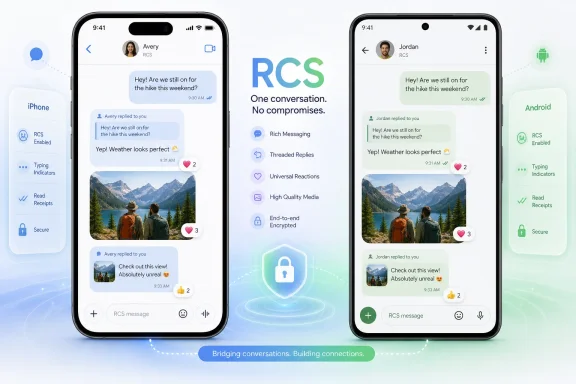
Apple’s iOS 27 beta 2, released to developers on June 22, 2026, adds inline replies and improved photo reactions to RCS conversations between iPhone and Android users, bringing another iMessage-style behavior to the once-brittle green-bubble experience. The change is small enough to look like interface polish, but it marks a larger shift in Apple’s reluctant normalization of cross-platform messaging. After years of treating Android interoperability as a concession, Apple is now rebuilding the edges of Messages around a standard it no longer controls. For users, administrators, and anyone who has had to explain why a family group chat broke, the important story is not that replies now work; it is that Apple is slowly making RCS feel less like a fallback.
The first version of iPhone RCS support answered the obvious complaint: photos were less mangled, typing indicators appeared, read receipts could work, and Android conversations no longer had to live entirely in SMS’s ruins. That was a practical improvement, but not an emotional one. The green bubble still felt like a lesser room inside Apple’s messaging house.
Inline replies change that in a subtle but important way. Threaded responses are not a power-user flourish anymore; they are a basic survival tool in busy chats. When a half-dozen people are discussing logistics, jokes, screenshots, and side comments at once, the ability to respond to a specific message is what keeps a chat from becoming a junk drawer.
The same is true of photo reactions. A reaction rendered as a text description is technically interoperable, but socially clumsy. It tells users that the two platforms are translating each other rather than conversing natively. Replacing that description with the expected emoji reaction is not just cleaner; it removes one more visible seam between ecosystems.
This is where Apple’s current posture is most interesting. The company is not opening iMessage, and it is not surrendering the blue-bubble identity that has become one of the iPhone’s stickiest network effects. But with iOS 27, Apple appears to be conceding that green-bubble chats cannot remain theatrically worse forever.
Apple’s implementation is therefore not a moonshot. It is a catch-up release. That does not make it irrelevant; in the messaging world, implementation matters more than specification. A feature sitting in a standards document is trivia until it appears in the app people actually use.
The lag, however, matters because it reveals the shape of Apple’s RCS strategy. Apple is not racing to implement every current Universal Profile feature the moment it exists. It is adding pieces in phases, likely balancing carrier support, Messages app behavior, privacy requirements, and the company’s own product hierarchy.
That pacing is frustrating for Android users and standards advocates, but it is also predictable. Apple’s first priority is not to make Google Messages look good. It is to ensure that the iPhone experience remains coherent, controlled, and defensible to its own customers.
On iPhone, the reported behavior is familiar: long-press a message in the Messages app and choose a reply option. On Android, Google Messages displays the reply with the original message included above it. That is exactly the kind of translation layer cross-platform RCS needs to succeed — not identical interfaces, but shared meaning.
The important distinction is between feature parity and conversation parity. Apple does not need Google Messages and Messages to look the same. It needs the intent of a reply, reaction, edit, or deletion to survive the trip across platforms without becoming weird text debris.
For years, the iPhone-Android divide created moments where the technology interrupted the social exchange. “Liked an image” became a punchline because it exposed the plumbing. Inline replies and proper reactions are part of a broader effort to hide the plumbing again.
The move from text descriptions to emoji reactions for photos is a perfect example. A text rendering is functional, but it changes the tone of the exchange. It makes a lightweight gesture feel formal and oddly robotic, as if a human reaction had been run through a fax machine.
This is also why Google spent years attacking Apple’s SMS fallback in public campaigns. The complaint was never only about compression or encryption, though both mattered. It was about the daily embarrassment of mixed-platform chats behaving worse than either platform’s native messaging experience.
Apple resisted that framing for as long as it could. Now, under a mix of regulatory pressure, market reality, standards maturity, and user fatigue, the company is gradually removing the most visible annoyances. That is not the same as embracing openness, but it is a meaningful tactical retreat.
Until then, Apple had a credible criticism of baseline RCS: unlike iMessage, it did not universally provide end-to-end encryption. Apple could argue that supporting the standard too aggressively would mean normalizing a less private communication channel. That argument became harder to sustain once Apple and Google participated in a cross-industry effort to bring encrypted RCS to iPhone-Android messaging.
The carrier dependency still complicates the rollout. RCS on iPhone remains more entangled with mobile operators than many users realize, while Google Messages has spent years abstracting much of that complexity away for Android users. The result is a feature that can be “available” in the operating system but uneven in the field.
That unevenness matters for IT pros and security-minded users. A lock icon, a beta label, a carrier compatibility matrix, and a standards version are not interchangeable. The existence of encrypted RCS does not mean every iPhone-Android chat is encrypted in every market, on every carrier, or in every group configuration.
But the strategic shift is still large. Once encryption is part of the cross-platform path, Apple has less reason to let the rest of the RCS experience remain awkward. Security was the foundation. Usability is now the next battleground.
That distinction is important because Apple can improve RCS while still preserving iMessage as the best version of Messages. The company can offer enough interoperability to satisfy users, regulators, and carriers while keeping exclusive features, tighter ecosystem integration, and platform identity intact. This is not capitulation. It is controlled interoperability.
The politics of messaging also differ by region. In the United States, SMS and iMessage have historically carried more social weight than in markets where WhatsApp, Telegram, WeChat, Line, or other over-the-top messaging apps dominate. That makes RCS improvements especially visible to U.S. users, even if much of the world solved cross-platform chat socially by leaving default texting behind.
For WindowsForum readers, the analogy is familiar. Microsoft spent decades learning that default apps, file formats, identity systems, and protocol choices can become strategic terrain. Messaging is Apple’s version of that terrain, and RCS is the negotiated corridor through it.
Early beta reports should be treated carefully. A screenshot from Reddit and coverage from enthusiast publications can accurately reveal a feature while still leaving open questions about regional availability, group-chat behavior, carrier support, failure modes, and whether Apple changes the interface before release. Beta software is not policy carved in stone.
Still, Apple rarely adds Messages behavior by accident. If inline RCS replies are present in a developer beta, they are probably part of a deliberate compatibility track. Apple knows that millions of mixed-platform conversations will test these features the moment iOS 27 leaves beta.
That makes the September window important. If iOS 27 launches publicly with polished RCS replies and reactions, Apple can tell users that the cross-platform experience is steadily improving without promising that iMessage and RCS are equivalent. That is the narrow line Apple has chosen to walk.
Editing and deleting messages are not merely conveniences. They change the record of a conversation. Platforms have to decide whether recipients see edit history, whether deleted messages leave markers, how long the window remains open, and what happens when one client supports the feature and another does not.
Apple already supports editing and unsending within iMessage under its own rules. Extending similar behavior across RCS would require mapping Apple’s user expectations onto a broader standard that includes Google’s client, carrier infrastructure, and potentially other RCS implementations. That is doable, but it is not trivial.
This is where the next phase of RCS will become more contentious. Replies and reactions improve the flow of a chat. Editing, recall, and deletion affect accountability. If Apple brings those features to Android-iPhone RCS, it will need to do so in a way that feels predictable rather than magical.
On Android, Google pushed RCS forward by making Google Messages the practical center of gravity. That move gave Android users a more consistent experience, but it also meant the “standard” often arrived in the market through Google’s implementation. Apple, by contrast, has historically tied RCS support on iPhone to carrier support in a way that can make availability feel less uniform.
For users, this distinction is maddening because the app surface looks simple. A message is either blue, green, encrypted, reacted to, or not. Behind that surface sits a chain of dependencies most people never asked to understand.
For administrators managing fleets, support desks, or regulated communications, those dependencies matter. A feature that works in one carrier/device/client combination but not another is a documentation burden. It creates the kind of ambiguity that leads to bad assumptions, especially around encryption.
That is why Apple’s incremental RCS work should be welcomed without being oversold. The direction is positive. The implementation reality will remain uneven until the ecosystem underneath it is less fragmented.
Messaging is especially sensitive because it combines consumer lock-in, social pressure, privacy, and default-app power. If a platform can make conversations with outsiders feel worse, it can turn social friction into retention. Regulators understand that dynamic even if they do not always understand the protocol details.
Apple’s defense has always had several layers. It can argue that iMessage is a proprietary service, that SMS fallback existed for universal reach, that privacy standards matter, and that opening too much too quickly can degrade security. Some of those arguments are stronger than critics admit.
But the arrival of encrypted RCS weakens the old stalemate. Once a more secure cross-platform standard exists, continuing to withhold basic usability features looks less like prudence and more like product strategy. Inline replies and photo reactions are therefore small signs of a larger accommodation.
But Google did not get iMessage on Android. It did not make blue bubbles irrelevant. It did not turn Messages into a neutral commons where Apple and Google participate as equals. What it got is a better baseline protocol inside Apple’s app.
That is still valuable. Google Messages becomes more useful when iPhone users can participate in richer RCS behavior. Android users suffer less from Apple’s historic fallback choices. Mixed households, friend groups, classrooms, and workplaces benefit immediately from fewer broken interactions.
The win is also reputational. Google can point to standards progress and say that pressure worked. Apple can point to careful implementation and say that it improved interoperability responsibly. Users get a better chat experience while both companies preserve their preferred narratives.
This is often how platform conflicts resolve. Not through a dramatic surrender, but through a series of small compatibility concessions that slowly make the old pain points less defensible.
Windows users live in mixed ecosystems by default. A Windows laptop may sit beside an iPhone, a Pixel, a work-managed Android device, a Teams account, a personal Google account, and a Microsoft 365 identity. The fantasy of a single-vendor life is increasingly rare outside corporate procurement decks.
That makes improvements to Android-iPhone messaging relevant even for people who do not care about bubble colors. Better RCS means fewer SMS fallbacks, fewer mangled media files, clearer group coordination, and potentially stronger privacy for default texting. Those are practical gains in households and workplaces where Windows remains the productivity center but phones drive the communication layer.
Microsoft has also learned how hard it is to bridge phone ecosystems from the desktop. Phone Link, iCloud integration, cross-device notifications, and passkey flows all depend on Apple and Google exposing enough surface area to make the experience feel coherent. RCS is part of that same interoperability weather system.
But the default app still matters because defaults are where ordinary users live. They are where grandparents send photos, where contractors confirm appointments, where two-factor codes arrive, where neighbors coordinate, and where a surprising amount of real life still happens. A degraded default experience is not a nerd problem.
The old fallback behaviors became increasingly embarrassing as messaging apps elsewhere normalized high-resolution media, reactions, replies, edits, deletion, encryption, and group controls. SMS looked ancient. MMS looked worse. The gap between what users expected and what cross-platform texting delivered became impossible to explain without blaming someone.
Apple can now reduce that embarrassment without admitting that critics were right all along. It can say the standard matured, encryption arrived, carriers are ready, and iOS 27 adds the next layer of support. That may be corporate choreography, but users do not need Apple to confess. They need the chat to work.
If iOS 27 delivers inline replies and improved photo reactions cleanly in September, the feature will disappear into daily use within weeks. That is success. Standards are healthiest when users stop thinking about them.
The risk is that beta enthusiasm outruns real-world deployment. Carrier differences, client version gaps, unsupported group scenarios, and inconsistent encryption indicators could all turn a promising feature into another round of “works for me” confusion. RCS has lived with that problem for years.
Apple has a particular responsibility here because iPhone users tend to treat Messages as an Apple product, not a carrier-mediated standards client. If something fails, they will not blame Universal Profile versions. They will blame the iPhone, the Android user, or both.
That is why polish matters. Apple does not have to be first, but when it implements a mainstream communication feature, it has to make the edge cases legible.
That boundary will remain visible. Blue bubbles will still signal Apple’s private messaging layer. Green bubbles will still signal conversations outside that layer. The difference is that green bubbles are becoming less punitive.
That is a healthier equilibrium than the one users endured for years. It lets Apple preserve its ecosystem while making the basic act of texting across platforms less broken. It lets Google keep pushing RCS without needing Apple to adopt Google’s entire worldview.
The question now is not whether Apple will support RCS. That question is settled. The question is how much of modern messaging Apple is willing to make universal before the remaining gaps start to look intentional again.
 Apple Is No Longer Just Supporting RCS — It Is Sanding Down the Social Friction
The first version of iPhone RCS support answered the obvious complaint: photos were less mangled, typing indicators appeared, read receipts could work, and Android conversations no longer had to live entirely in SMS’s ruins. That was a practical improvement, but not an emotional one. The green bubble still felt like a lesser room inside Apple’s messaging house.Inline replies change that in a subtle but important way. Threaded responses are not a power-user flourish anymore; they are a basic survival tool in busy chats. When a half-dozen people are discussing logistics, jokes, screenshots, and side comments at once, the ability to respond to a specific message is what keeps a chat from becoming a junk drawer.
The same is true of photo reactions. A reaction rendered as a text description is technically interoperable, but socially clumsy. It tells users that the two platforms are translating each other rather than conversing natively. Replacing that description with the expected emoji reaction is not just cleaner; it removes one more visible seam between ecosystems.
This is where Apple’s current posture is most interesting. The company is not opening iMessage, and it is not surrendering the blue-bubble identity that has become one of the iPhone’s stickiest network effects. But with iOS 27, Apple appears to be conceding that green-bubble chats cannot remain theatrically worse forever.
The Standard Moved First, and Apple Is Still Catching Up
The awkward part for Apple is that these features are not new to the RCS roadmap. RCS Universal Profile 2.7, finalized in June 2024, added support for replies and reactions, including custom reactions, along with message editing, recall, and deletion capabilities. The industry standard had already decided that modern messaging needed these behaviors.Apple’s implementation is therefore not a moonshot. It is a catch-up release. That does not make it irrelevant; in the messaging world, implementation matters more than specification. A feature sitting in a standards document is trivia until it appears in the app people actually use.
The lag, however, matters because it reveals the shape of Apple’s RCS strategy. Apple is not racing to implement every current Universal Profile feature the moment it exists. It is adding pieces in phases, likely balancing carrier support, Messages app behavior, privacy requirements, and the company’s own product hierarchy.
That pacing is frustrating for Android users and standards advocates, but it is also predictable. Apple’s first priority is not to make Google Messages look good. It is to ensure that the iPhone experience remains coherent, controlled, and defensible to its own customers.
Inline Replies Are a Small Feature With Outsized Real-World Value
For people who live inside one-to-one texting, inline replies may look like a minor convenience. In group chats, they are infrastructure. The original message gives the reply its context, which prevents a conversation from turning into a pile of disconnected fragments.On iPhone, the reported behavior is familiar: long-press a message in the Messages app and choose a reply option. On Android, Google Messages displays the reply with the original message included above it. That is exactly the kind of translation layer cross-platform RCS needs to succeed — not identical interfaces, but shared meaning.
The important distinction is between feature parity and conversation parity. Apple does not need Google Messages and Messages to look the same. It needs the intent of a reply, reaction, edit, or deletion to survive the trip across platforms without becoming weird text debris.
For years, the iPhone-Android divide created moments where the technology interrupted the social exchange. “Liked an image” became a punchline because it exposed the plumbing. Inline replies and proper reactions are part of a broader effort to hide the plumbing again.
Photo Reactions Show Why Messaging Standards Are Really About Tone
Messaging is an emotional interface masquerading as a technical one. Users do not think in terms of protocol capabilities; they notice whether a heart reaction lands like a heart reaction or arrives as a sentence explaining that someone liked something. That gap is where irritation accumulates.The move from text descriptions to emoji reactions for photos is a perfect example. A text rendering is functional, but it changes the tone of the exchange. It makes a lightweight gesture feel formal and oddly robotic, as if a human reaction had been run through a fax machine.
This is also why Google spent years attacking Apple’s SMS fallback in public campaigns. The complaint was never only about compression or encryption, though both mattered. It was about the daily embarrassment of mixed-platform chats behaving worse than either platform’s native messaging experience.
Apple resisted that framing for as long as it could. Now, under a mix of regulatory pressure, market reality, standards maturity, and user fatigue, the company is gradually removing the most visible annoyances. That is not the same as embracing openness, but it is a meaningful tactical retreat.
Encryption Changed the Stakes Before iOS 27 Changed the Interface
The more consequential recent shift came before inline replies. In May 2026, Apple began rolling out end-to-end encrypted RCS messaging in beta through iOS 26.5, with support depending on carrier readiness and Android users running a compatible version of Google Messages. That development changed the RCS story from convenience to trust.Until then, Apple had a credible criticism of baseline RCS: unlike iMessage, it did not universally provide end-to-end encryption. Apple could argue that supporting the standard too aggressively would mean normalizing a less private communication channel. That argument became harder to sustain once Apple and Google participated in a cross-industry effort to bring encrypted RCS to iPhone-Android messaging.
The carrier dependency still complicates the rollout. RCS on iPhone remains more entangled with mobile operators than many users realize, while Google Messages has spent years abstracting much of that complexity away for Android users. The result is a feature that can be “available” in the operating system but uneven in the field.
That unevenness matters for IT pros and security-minded users. A lock icon, a beta label, a carrier compatibility matrix, and a standards version are not interchangeable. The existence of encrypted RCS does not mean every iPhone-Android chat is encrypted in every market, on every carrier, or in every group configuration.
But the strategic shift is still large. Once encryption is part of the cross-platform path, Apple has less reason to let the rest of the RCS experience remain awkward. Security was the foundation. Usability is now the next battleground.
The Green Bubble Is Becoming Less Broken, Not Less Political
No one should confuse these updates with the end of Apple’s messaging moat. iMessage remains the premium layer, deeply integrated into Apple’s ecosystem and culturally coded in markets where the iPhone is dominant. RCS improves the baseline; it does not erase the hierarchy.That distinction is important because Apple can improve RCS while still preserving iMessage as the best version of Messages. The company can offer enough interoperability to satisfy users, regulators, and carriers while keeping exclusive features, tighter ecosystem integration, and platform identity intact. This is not capitulation. It is controlled interoperability.
The politics of messaging also differ by region. In the United States, SMS and iMessage have historically carried more social weight than in markets where WhatsApp, Telegram, WeChat, Line, or other over-the-top messaging apps dominate. That makes RCS improvements especially visible to U.S. users, even if much of the world solved cross-platform chat socially by leaving default texting behind.
For WindowsForum readers, the analogy is familiar. Microsoft spent decades learning that default apps, file formats, identity systems, and protocol choices can become strategic terrain. Messaging is Apple’s version of that terrain, and RCS is the negotiated corridor through it.
Apple’s Beta Timing Tells Us This Is a Platform Story, Not a Patch Note
The reported arrival in iOS 27 beta 2 matters because Apple is placing this work in the main annual OS cycle, not burying it as an emergency fix. The public beta is expected in July, and the general release is expected in September alongside the usual iPhone software rollout. That gives Apple time to test, refine, and decide how much of the experience it wants to expose to mainstream users.Early beta reports should be treated carefully. A screenshot from Reddit and coverage from enthusiast publications can accurately reveal a feature while still leaving open questions about regional availability, group-chat behavior, carrier support, failure modes, and whether Apple changes the interface before release. Beta software is not policy carved in stone.
Still, Apple rarely adds Messages behavior by accident. If inline RCS replies are present in a developer beta, they are probably part of a deliberate compatibility track. Apple knows that millions of mixed-platform conversations will test these features the moment iOS 27 leaves beta.
That makes the September window important. If iOS 27 launches publicly with polished RCS replies and reactions, Apple can tell users that the cross-platform experience is steadily improving without promising that iMessage and RCS are equivalent. That is the narrow line Apple has chosen to walk.
The Missing Features Now Stand Out More Clearly
Once inline replies and better reactions arrive, attention naturally shifts to what is still absent or uneven. RCS Universal Profile 2.7 also covered message editing, recall, and deletion for all parties. Those features are more complicated than reactions because they require trust, timing rules, visible history decisions, and consistent behavior across clients.Editing and deleting messages are not merely conveniences. They change the record of a conversation. Platforms have to decide whether recipients see edit history, whether deleted messages leave markers, how long the window remains open, and what happens when one client supports the feature and another does not.
Apple already supports editing and unsending within iMessage under its own rules. Extending similar behavior across RCS would require mapping Apple’s user expectations onto a broader standard that includes Google’s client, carrier infrastructure, and potentially other RCS implementations. That is doable, but it is not trivial.
This is where the next phase of RCS will become more contentious. Replies and reactions improve the flow of a chat. Editing, recall, and deletion affect accountability. If Apple brings those features to Android-iPhone RCS, it will need to do so in a way that feels predictable rather than magical.
Carrier Reality Remains the Unsexy Constraint
The easiest version of the RCS story is Apple versus Google. The real version includes carriers, standards bodies, device vendors, regional policies, and client software updates. That messiness is why RCS has always felt simultaneously inevitable and delayed.On Android, Google pushed RCS forward by making Google Messages the practical center of gravity. That move gave Android users a more consistent experience, but it also meant the “standard” often arrived in the market through Google’s implementation. Apple, by contrast, has historically tied RCS support on iPhone to carrier support in a way that can make availability feel less uniform.
For users, this distinction is maddening because the app surface looks simple. A message is either blue, green, encrypted, reacted to, or not. Behind that surface sits a chain of dependencies most people never asked to understand.
For administrators managing fleets, support desks, or regulated communications, those dependencies matter. A feature that works in one carrier/device/client combination but not another is a documentation burden. It creates the kind of ambiguity that leads to bad assumptions, especially around encryption.
That is why Apple’s incremental RCS work should be welcomed without being oversold. The direction is positive. The implementation reality will remain uneven until the ecosystem underneath it is less fragmented.
The Regulatory Shadow Is Impossible to Ignore
Apple’s RCS shift did not happen in a vacuum. The company announced its original intention to support RCS after years of pressure from Google, scrutiny from regulators, and a broader global debate over gatekeeper platforms. Even if Apple frames its work in terms of standards and user experience, the timing belongs to a larger antitrust era.Messaging is especially sensitive because it combines consumer lock-in, social pressure, privacy, and default-app power. If a platform can make conversations with outsiders feel worse, it can turn social friction into retention. Regulators understand that dynamic even if they do not always understand the protocol details.
Apple’s defense has always had several layers. It can argue that iMessage is a proprietary service, that SMS fallback existed for universal reach, that privacy standards matter, and that opening too much too quickly can degrade security. Some of those arguments are stronger than critics admit.
But the arrival of encrypted RCS weakens the old stalemate. Once a more secure cross-platform standard exists, continuing to withhold basic usability features looks less like prudence and more like product strategy. Inline replies and photo reactions are therefore small signs of a larger accommodation.
Google Gets a Win, but Not the One It Wanted
Google can fairly claim that its long RCS campaign is bearing fruit. The company spent years positioning RCS as the successor to SMS and publicly shaming Apple for degrading Android-iPhone chats. With iOS 27, another piece of that argument becomes reality.But Google did not get iMessage on Android. It did not make blue bubbles irrelevant. It did not turn Messages into a neutral commons where Apple and Google participate as equals. What it got is a better baseline protocol inside Apple’s app.
That is still valuable. Google Messages becomes more useful when iPhone users can participate in richer RCS behavior. Android users suffer less from Apple’s historic fallback choices. Mixed households, friend groups, classrooms, and workplaces benefit immediately from fewer broken interactions.
The win is also reputational. Google can point to standards progress and say that pressure worked. Apple can point to careful implementation and say that it improved interoperability responsibly. Users get a better chat experience while both companies preserve their preferred narratives.
This is often how platform conflicts resolve. Not through a dramatic surrender, but through a series of small compatibility concessions that slowly make the old pain points less defensible.
For Windows Users, This Is Another Reminder That the Phone Is the New Default Desktop
WindowsForum readers may reasonably ask why an iOS messaging update belongs in a Windows community. The answer is that messaging interoperability now affects identity, authentication, endpoint management, family support, and workplace communications. The phone is not a peripheral anymore; it is the user’s most intimate computer.Windows users live in mixed ecosystems by default. A Windows laptop may sit beside an iPhone, a Pixel, a work-managed Android device, a Teams account, a personal Google account, and a Microsoft 365 identity. The fantasy of a single-vendor life is increasingly rare outside corporate procurement decks.
That makes improvements to Android-iPhone messaging relevant even for people who do not care about bubble colors. Better RCS means fewer SMS fallbacks, fewer mangled media files, clearer group coordination, and potentially stronger privacy for default texting. Those are practical gains in households and workplaces where Windows remains the productivity center but phones drive the communication layer.
Microsoft has also learned how hard it is to bridge phone ecosystems from the desktop. Phone Link, iCloud integration, cross-device notifications, and passkey flows all depend on Apple and Google exposing enough surface area to make the experience feel coherent. RCS is part of that same interoperability weather system.
The User Experience Is Improving Because the Old One Became Embarrassing
The long-running iPhone-Android messaging mess survived because it was tolerable enough. People complained, but they adapted. They moved sensitive chats to Signal, family groups to WhatsApp, school coordination to whatever app the organizer preferred, and casual texting to the default app.But the default app still matters because defaults are where ordinary users live. They are where grandparents send photos, where contractors confirm appointments, where two-factor codes arrive, where neighbors coordinate, and where a surprising amount of real life still happens. A degraded default experience is not a nerd problem.
The old fallback behaviors became increasingly embarrassing as messaging apps elsewhere normalized high-resolution media, reactions, replies, edits, deletion, encryption, and group controls. SMS looked ancient. MMS looked worse. The gap between what users expected and what cross-platform texting delivered became impossible to explain without blaming someone.
Apple can now reduce that embarrassment without admitting that critics were right all along. It can say the standard matured, encryption arrived, carriers are ready, and iOS 27 adds the next layer of support. That may be corporate choreography, but users do not need Apple to confess. They need the chat to work.
The September Release Will Test Whether RCS Can Feel Boring
The best outcome for RCS is not excitement. It is boredom. A reply should reply, a reaction should react, a photo should send clearly, and a secure conversation should indicate its security without requiring a forum thread to decode it.If iOS 27 delivers inline replies and improved photo reactions cleanly in September, the feature will disappear into daily use within weeks. That is success. Standards are healthiest when users stop thinking about them.
The risk is that beta enthusiasm outruns real-world deployment. Carrier differences, client version gaps, unsupported group scenarios, and inconsistent encryption indicators could all turn a promising feature into another round of “works for me” confusion. RCS has lived with that problem for years.
Apple has a particular responsibility here because iPhone users tend to treat Messages as an Apple product, not a carrier-mediated standards client. If something fails, they will not blame Universal Profile versions. They will blame the iPhone, the Android user, or both.
That is why polish matters. Apple does not have to be first, but when it implements a mainstream communication feature, it has to make the edge cases legible.
The Green-Bubble Truce Has Terms and Conditions
The clearest lesson from iOS 27 beta 2 is that Apple’s RCS support is becoming more serious, but not more sentimental. The company is improving the experience because the technical, regulatory, and user-pressure landscape has changed. It is not trying to dissolve the boundary between iMessage and RCS.That boundary will remain visible. Blue bubbles will still signal Apple’s private messaging layer. Green bubbles will still signal conversations outside that layer. The difference is that green bubbles are becoming less punitive.
That is a healthier equilibrium than the one users endured for years. It lets Apple preserve its ecosystem while making the basic act of texting across platforms less broken. It lets Google keep pushing RCS without needing Apple to adopt Google’s entire worldview.
The question now is not whether Apple will support RCS. That question is settled. The question is how much of modern messaging Apple is willing to make universal before the remaining gaps start to look intentional again.
Apple’s Next RCS Test Is Whether Normal People Stop Noticing
The practical readout from iOS 27 beta 2 is refreshingly concrete: mixed iPhone-Android chats are getting closer to the behavior users already expect from modern messaging. The strategic readout is more complicated: Apple is participating in interoperability while carefully preserving the value of its own stack.- Inline replies in iOS 27 beta 2 make mixed RCS conversations easier to follow, especially in busy group chats.
- Improved photo reactions reduce one of the most visible reminders that iPhone and Android users are communicating through a translation layer.
- RCS Universal Profile support remains a moving target, with the standard ahead of what every major client fully implements.
- End-to-end encrypted RCS in iOS 26.5 made the protocol harder for Apple to dismiss as a privacy downgrade, even though carrier and client support still matter.
- The next major pressure point will be whether Apple brings editing, recall, and deletion to cross-platform RCS with predictable behavior.
- For Windows users and IT pros, the update matters because phone messaging is now part of the broader identity, security, and productivity environment.
References
- Primary source: 9to5Google
Published: Mon, 22 Jun 2026 20:32:00 GMT
iOS 27 will add replies and photo reactions to Android-iPhone RCS
iOS 27 will introduce the next big update to Android-iPhone messaging with support for inline replies and photo reactions.9to5google.com - Related coverage: androidcentral.com
It's happening: Apple's iOS 26.5 prepares RCS encryption with Android | Android Central
The update is almost here, as Apple sheds light on its final test build.www.androidcentral.com - Related coverage: apple.gadgethacks.com
Encrypted RCS Chats on iPhone Arrive in iOS 26.5 — If Your Carrier Supports It << Apple :: Gadget Hacks
Apple has begun rolling out end-to-end encrypted RCS chats on iPhone in iOS 26.5, closing a major privacy gap in cross-platform messaging. The catch is... apple.gadgethacks.com
- Related coverage: t3.com
iPhone finally supports encrypted RCS for better Android messaging – here's why that matters | T3
The RCS dance between iPhone and Android is finally falling into stepwww.t3.com