
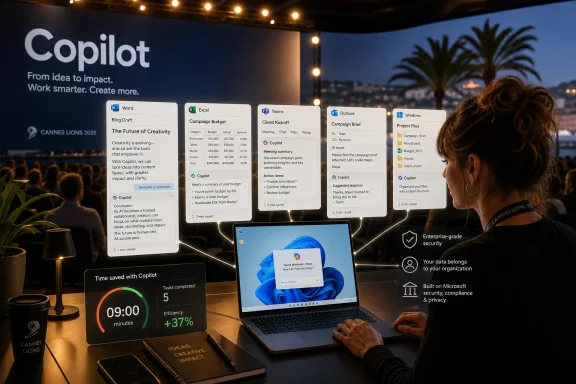
Microsoft used Cannes Lions on June 22, 2026, to describe a more product-led advertising strategy for Copilot, with marketing executive Ciaran McCarthy framing the AI assistant less as a futuristic brand promise and more as a tool creators can fold into daily work. That sounds like a modest positioning tweak. It is not. For Microsoft, it is an admission that Copilot’s next phase will be won or lost not by how often the company says “AI,” but by whether people can see themselves using it.
For the past three years, the AI industry has marketed itself in superlatives. Every assistant was revolutionary, every model a breakthrough, every product launch a new platform shift. Microsoft was hardly alone in that language, but it had more surface area than most companies on which to paste the message: Windows, Office, Bing, Edge, Teams, GitHub, security tools, developer products, and the partner ecosystem all became Copilot territory.
That breadth was strategically useful and rhetorically exhausting. The name “Copilot” became both a product and a promise, a button and a brand, a subscription tier and an operating-system ambition. For IT pros and Windows users, the result has often been less a clean product story than a scavenger hunt through licensing tables, admin controls, hardware requirements, app integrations, and preview features.
The Cannes message suggests Microsoft understands the risk. A product-focused ad strategy is not just a creative preference; it is a defensive move against AI fatigue. If the audience has stopped responding to abstract claims about productivity, the marketer’s job is to show the actual moment where a user saves time, generates a draft, edits an image, prepares a pitch, summarizes a meeting, or turns a folder of raw material into something usable.
That is why creators matter. They are not merely another demographic for Microsoft to court. They are a test case for whether Copilot can move from enterprise procurement decks into visible, repeated, culturally legible use.
Generative AI complicates that formula because the product is probabilistic. Copilot does not always return the same answer, and its value depends heavily on context, permissions, data quality, prompting skill, and user expectation. A thirty-second spot can make AI look effortless; an administrator rollout can make it look like governance homework with a monthly invoice attached.
Creators help bridge that gap because their work is demonstrable. A video editor can show how a concept became a storyboard. A designer can show alternatives generated before a final cut. A writer can show outlines, captions, scripts, and revisions. A small-business owner can show Copilot turning customer notes into campaign copy or product descriptions.
That visibility is valuable because it shifts the conversation from “AI will change everything” to “this tool changed this piece of work.” For Microsoft, that is the difference between selling a category and selling a habit.
There is Copilot in Microsoft 365, Copilot in Windows, Copilot Studio, Security Copilot, GitHub Copilot, Copilot+ PCs, and a widening field of agents and connectors. Some of these are mature products. Some are bundles. Some are experiences. Some are platform capabilities with branding wrapped around them. To a CIO, that may be manageable with the right licensing guide. To a normal user, it can feel like Microsoft has renamed the furniture.
A product-led ad strategy can impose discipline. Instead of asking the audience to care about the Copilot universe, Microsoft can ask them to care about a specific outcome: a deck built faster, a campaign adapted for multiple markets, a support ticket resolved, a video concept explored, a meeting turned into action items.
That is a smaller story, but a stronger one. AI marketing is entering the phase where usefulness beats grandeur.
For Copilot, that audience is important because AI assistants are not only enterprise tools. They are becoming creative infrastructure. Agencies are experimenting with AI for campaign ideation, audience segmentation, media planning, production workflows, and performance analysis. Brands are asking whether AI can shorten the distance between insight and execution. Creators are deciding which tools become part of their public workflow and which tools remain corporate software with better demos than daily appeal.
Microsoft’s pitch at Cannes appears to be that Copilot should be understood through use, not ideology. That is a sharper argument than simply saying the company is “all in on AI.” Everyone in the sector says that. Fewer companies can show how AI threads through documents, meetings, email, files, identity, device management, security posture, and creative production.
The risk is that Cannes audiences are allergic to obvious corporate theater. Creators can make software look alive, but they can also expose when a tool is clumsy, overmanaged, or unconvincing. The more Microsoft leans on creator credibility, the less room it has for vague claims.
When a creator shows Copilot producing a finished asset in seconds, a marketing director may ask why the internal team is not doing the same. When Microsoft shows AI summarizing meetings, employees may assume every Teams call can be indexed and mined. When Copilot is advertised as a creative partner, legal and compliance teams will want to know what data it used, where prompts were processed, and whether generated content can be audited.
That is the burden of making AI feel accessible. The more natural the experience looks, the more invisible the underlying controls become. Microsoft’s enterprise credibility depends on making those controls real without making the product feel like a compliance seminar.
This is where Microsoft has an advantage over many AI-first rivals. Entra identity, Purview, Defender, Intune, Microsoft 365 admin controls, and the broader security stack give Microsoft a governance story that consumer AI tools often lack. But that story must remain connected to the product promise. If Copilot’s ads sell magic while its deployment requires months of permissions cleanup, the gap will be noticed.
A creator using Copilot in public does something a Microsoft product page cannot. They make the software part of a recognizable routine. They show taste, hesitation, shortcuts, failure, revision, and judgment. In the best cases, they turn AI from a corporate abstraction into an instrument.
This matters because Copilot is competing not just with Google Gemini, OpenAI’s ChatGPT, Anthropic’s Claude, Adobe Firefly, Canva, Notion AI, and dozens of specialist tools. It is competing with muscle memory. People already have ways to draft, search, edit, summarize, and brainstorm. The incumbent workflow is not always elegant, but it is familiar.
Creators can make a new workflow feel less foreign. They can also highlight where Copilot fits better as an assistant than as a replacement. That distinction is important. The most credible AI demonstrations are rarely the ones where the machine does everything. They are the ones where the human remains visibly in charge.
The creator strategy could help clarify the Windows story. A PC is still the place where many creators assemble their work: browser tabs, Office files, Adobe apps, cloud storage, chat threads, screenshots, local folders, peripheral devices, and collaboration tools all converge there. If Copilot can operate across that messy reality, then Windows becomes more than a shell for AI branding. It becomes the workbench.
But Microsoft must be careful not to oversell what is currently available. Some AI features depend on specific hardware. Some depend on cloud services. Some depend on commercial licensing. Some are rolling out gradually by region, account type, or app version. A product-led campaign only works if the product a user sees in the ad resembles the product they can actually use.
That is especially true for Copilot+ PCs. Microsoft and its hardware partners have invested heavily in the idea that local neural processing will make Windows feel more intelligent, responsive, and private. Yet the value proposition is still uneven for buyers who want to know which features work today, which are coming later, and which require a particular chip generation. Creators can make these devices aspirational, but sysadmins and power users will still ask the sharper question: what does this machine do that last year’s laptop cannot?
That may require Microsoft to resist its own platform instincts. The company loves extensibility, bundles, partner motions, admin configurability, and cross-product integration. Those are strengths in enterprise software, but they can create fog in mass-market communication. A creator does not want to explain tenant permissions before showing a workflow. A small business does not want to decode whether the feature in the ad is included in its plan. A Windows user does not want to discover that the advertised AI experience depends on an account type they do not use.
Microsoft’s best Copilot ads will therefore be the ones that narrow the frame. Show the app. Show the input. Show the output. Show the human edit. Show where the file goes. Show what plan or device class enables it, even if only indirectly through clear product naming.
That is not glamorous advertising. It is honest advertising. For AI, honesty may become the premium creative strategy.
Microsoft’s Copilot strategy is built around moments of use. The company does not need every user to believe Copilot is the most charming standalone chatbot. It needs Copilot to be present when the user is already writing in Word, reviewing numbers in Excel, triaging email in Outlook, joining a Teams call, building a workflow, checking a security incident, or configuring a PC.
That is a different competitive theory from the pure AI labs. Microsoft is betting that proximity to work can matter as much as raw model prestige. The creator strategy extends that logic into culture: if Copilot appears inside the act of making, then it becomes part of the creative moment rather than a destination app users must remember to visit.
The danger is that users will compare Copilot not with Microsoft’s previous software but with the best AI experience they have used anywhere. If ChatGPT, Claude, Gemini, or a specialist creative tool feels faster, more flexible, or more imaginative, Copilot’s embedded advantage may not be enough. Distribution gets Microsoft into the room. Product quality keeps it there.
Microsoft’s product-focused approach has to acknowledge that tension, even if implicitly. Creators do not want to be told that AI will replace taste. They want tools that remove drudgery, widen exploration, and preserve authorship. Agencies do not want another generic content engine. They want leverage without surrendering judgment.
This is where Copilot’s name remains useful. A copilot is not the pilot. The metaphor still works when Microsoft remembers it. The best creator-led campaigns will show Copilot as a collaborator that helps with options, structure, retrieval, and polish, while the human makes the call.
That framing may also help Microsoft avoid the backlash that follows more aggressive AI messaging. The public is increasingly sensitive to claims that creative work can be automated away. A practical, assistive, product-led pitch is less likely to trigger resistance than a triumphalist one.
That does not mean a Cannes campaign will close enterprise deals by itself. The buying decision for Microsoft 365 Copilot still involves licensing costs, data readiness, security posture, change management, measurable ROI, and training. But advertising can soften the ground. It can make the product feel inevitable before procurement has finished the spreadsheet.
This is especially important because Copilot is not a one-time software upgrade. It is a behavioral change. Users must learn when to ask, how to verify, how to revise, and when not to delegate. Organizations must decide which tasks are appropriate, which data should be accessible, and how to measure productivity without reducing knowledge work to theatrical prompt demos.
Creators can help with the behavior part. They can model the habit of using AI as a first draft, research assistant, remix engine, or production accelerator. But the enterprise still has to translate that habit into policy.
That is a difficult standard because AI is still marketed as spectacle. Every impressive demo invites the audience to clap for the machine. But durable software does not live on applause. It lives on repeated use after the novelty fades.
Microsoft’s product-focused advertising strategy is, in that sense, a move toward ordinariness. It asks Copilot to prove itself in the small loops of work rather than the grand narrative of technological destiny. For creators, that could mean faster drafts, richer exploration, and fewer blank-page moments. For IT, it means another layer of software that must be licensed, governed, secured, and explained.
The company’s challenge is to make both sides of that equation true at once. Copilot must feel simple enough for a creator to adopt and controlled enough for an enterprise to trust. That is the kind of tension Microsoft knows well, but AI raises the stakes because the tool is not merely storing or formatting human work. It is participating in its creation.
 Microsoft Stops Selling the Moonshot and Starts Selling the Workflow
For the past three years, the AI industry has marketed itself in superlatives. Every assistant was revolutionary, every model a breakthrough, every product launch a new platform shift. Microsoft was hardly alone in that language, but it had more surface area than most companies on which to paste the message: Windows, Office, Bing, Edge, Teams, GitHub, security tools, developer products, and the partner ecosystem all became Copilot territory.That breadth was strategically useful and rhetorically exhausting. The name “Copilot” became both a product and a promise, a button and a brand, a subscription tier and an operating-system ambition. For IT pros and Windows users, the result has often been less a clean product story than a scavenger hunt through licensing tables, admin controls, hardware requirements, app integrations, and preview features.
The Cannes message suggests Microsoft understands the risk. A product-focused ad strategy is not just a creative preference; it is a defensive move against AI fatigue. If the audience has stopped responding to abstract claims about productivity, the marketer’s job is to show the actual moment where a user saves time, generates a draft, edits an image, prepares a pitch, summarizes a meeting, or turns a folder of raw material into something usable.
That is why creators matter. They are not merely another demographic for Microsoft to court. They are a test case for whether Copilot can move from enterprise procurement decks into visible, repeated, culturally legible use.
Creators Are the New Demo Floor
Microsoft has traditionally been strongest when the product demonstration is obvious. Excel recalculates the spreadsheet. PowerPoint turns a document into slides. Teams records and summarizes the meeting. Windows boots, updates, connects, and runs the business. The most persuasive Microsoft marketing has always been boring in the best possible way: here is the problem, here is the software, here is the thing you can now do.Generative AI complicates that formula because the product is probabilistic. Copilot does not always return the same answer, and its value depends heavily on context, permissions, data quality, prompting skill, and user expectation. A thirty-second spot can make AI look effortless; an administrator rollout can make it look like governance homework with a monthly invoice attached.
Creators help bridge that gap because their work is demonstrable. A video editor can show how a concept became a storyboard. A designer can show alternatives generated before a final cut. A writer can show outlines, captions, scripts, and revisions. A small-business owner can show Copilot turning customer notes into campaign copy or product descriptions.
That visibility is valuable because it shifts the conversation from “AI will change everything” to “this tool changed this piece of work.” For Microsoft, that is the difference between selling a category and selling a habit.
The Copilot Brand Needed a Smaller Story
The irony of Copilot is that Microsoft’s biggest advantage has also been its biggest communications problem. The company can place AI directly inside the software where work already happens. But when everything becomes Copilot, the word risks meaning nothing.There is Copilot in Microsoft 365, Copilot in Windows, Copilot Studio, Security Copilot, GitHub Copilot, Copilot+ PCs, and a widening field of agents and connectors. Some of these are mature products. Some are bundles. Some are experiences. Some are platform capabilities with branding wrapped around them. To a CIO, that may be manageable with the right licensing guide. To a normal user, it can feel like Microsoft has renamed the furniture.
A product-led ad strategy can impose discipline. Instead of asking the audience to care about the Copilot universe, Microsoft can ask them to care about a specific outcome: a deck built faster, a campaign adapted for multiple markets, a support ticket resolved, a video concept explored, a meeting turned into action items.
That is a smaller story, but a stronger one. AI marketing is entering the phase where usefulness beats grandeur.
Cannes Is the Right Stage for a More Practical Microsoft
Cannes Lions is not a developer conference, and that is precisely why the message matters. Microsoft has Build for developers, Ignite for IT, and partner events for the channel. Cannes is where technology companies go when they want to influence the people who shape taste, media budgets, brand strategy, and consumer perception.For Copilot, that audience is important because AI assistants are not only enterprise tools. They are becoming creative infrastructure. Agencies are experimenting with AI for campaign ideation, audience segmentation, media planning, production workflows, and performance analysis. Brands are asking whether AI can shorten the distance between insight and execution. Creators are deciding which tools become part of their public workflow and which tools remain corporate software with better demos than daily appeal.
Microsoft’s pitch at Cannes appears to be that Copilot should be understood through use, not ideology. That is a sharper argument than simply saying the company is “all in on AI.” Everyone in the sector says that. Fewer companies can show how AI threads through documents, meetings, email, files, identity, device management, security posture, and creative production.
The risk is that Cannes audiences are allergic to obvious corporate theater. Creators can make software look alive, but they can also expose when a tool is clumsy, overmanaged, or unconvincing. The more Microsoft leans on creator credibility, the less room it has for vague claims.
Product-Led Advertising Is Also a Governance Message
For WindowsForum readers, the creator angle may sound like a consumer-marketing story. It is also an enterprise story hiding in plain sight. Product-led advertising tells users what to expect, and expectations eventually become help-desk tickets, procurement questions, security reviews, and executive mandates.When a creator shows Copilot producing a finished asset in seconds, a marketing director may ask why the internal team is not doing the same. When Microsoft shows AI summarizing meetings, employees may assume every Teams call can be indexed and mined. When Copilot is advertised as a creative partner, legal and compliance teams will want to know what data it used, where prompts were processed, and whether generated content can be audited.
That is the burden of making AI feel accessible. The more natural the experience looks, the more invisible the underlying controls become. Microsoft’s enterprise credibility depends on making those controls real without making the product feel like a compliance seminar.
This is where Microsoft has an advantage over many AI-first rivals. Entra identity, Purview, Defender, Intune, Microsoft 365 admin controls, and the broader security stack give Microsoft a governance story that consumer AI tools often lack. But that story must remain connected to the product promise. If Copilot’s ads sell magic while its deployment requires months of permissions cleanup, the gap will be noticed.
The Creator Economy Gives Microsoft Something It Cannot Build Alone
Microsoft can buy media, sponsor festivals, brief analysts, and ship features. What it cannot manufacture by itself is cultural proof. That is what creators offer.A creator using Copilot in public does something a Microsoft product page cannot. They make the software part of a recognizable routine. They show taste, hesitation, shortcuts, failure, revision, and judgment. In the best cases, they turn AI from a corporate abstraction into an instrument.
This matters because Copilot is competing not just with Google Gemini, OpenAI’s ChatGPT, Anthropic’s Claude, Adobe Firefly, Canva, Notion AI, and dozens of specialist tools. It is competing with muscle memory. People already have ways to draft, search, edit, summarize, and brainstorm. The incumbent workflow is not always elegant, but it is familiar.
Creators can make a new workflow feel less foreign. They can also highlight where Copilot fits better as an assistant than as a replacement. That distinction is important. The most credible AI demonstrations are rarely the ones where the machine does everything. They are the ones where the human remains visibly in charge.
The Windows Angle Is Bigger Than a Button on the Taskbar
For Windows users, Copilot has had an awkward journey. Microsoft has treated Windows as both a distribution channel for AI and a proving ground for what an agentic operating system might become. That has produced moments of genuine promise and moments of branding confusion, especially around Copilot+ PCs and local AI features.The creator strategy could help clarify the Windows story. A PC is still the place where many creators assemble their work: browser tabs, Office files, Adobe apps, cloud storage, chat threads, screenshots, local folders, peripheral devices, and collaboration tools all converge there. If Copilot can operate across that messy reality, then Windows becomes more than a shell for AI branding. It becomes the workbench.
But Microsoft must be careful not to oversell what is currently available. Some AI features depend on specific hardware. Some depend on cloud services. Some depend on commercial licensing. Some are rolling out gradually by region, account type, or app version. A product-led campaign only works if the product a user sees in the ad resembles the product they can actually use.
That is especially true for Copilot+ PCs. Microsoft and its hardware partners have invested heavily in the idea that local neural processing will make Windows feel more intelligent, responsive, and private. Yet the value proposition is still uneven for buyers who want to know which features work today, which are coming later, and which require a particular chip generation. Creators can make these devices aspirational, but sysadmins and power users will still ask the sharper question: what does this machine do that last year’s laptop cannot?
Advertising Cannot Fix Product Ambiguity
The hardest truth for Microsoft is that no campaign can compensate for a product family that users cannot understand. If Copilot means a chat window in one context, an agent builder in another, a paid Microsoft 365 SKU in another, and a Windows experience somewhere else, product-led storytelling has to do more than showcase benefits. It has to reduce ambiguity.That may require Microsoft to resist its own platform instincts. The company loves extensibility, bundles, partner motions, admin configurability, and cross-product integration. Those are strengths in enterprise software, but they can create fog in mass-market communication. A creator does not want to explain tenant permissions before showing a workflow. A small business does not want to decode whether the feature in the ad is included in its plan. A Windows user does not want to discover that the advertised AI experience depends on an account type they do not use.
Microsoft’s best Copilot ads will therefore be the ones that narrow the frame. Show the app. Show the input. Show the output. Show the human edit. Show where the file goes. Show what plan or device class enables it, even if only indirectly through clear product naming.
That is not glamorous advertising. It is honest advertising. For AI, honesty may become the premium creative strategy.
The Competitive Fight Is Moving From Models to Moments
The AI industry spent its first consumer phase arguing over model capability. Which chatbot reasoned better? Which generated better images? Which wrote better code? Which had the larger context window? Those comparisons still matter, but they are no longer the whole fight.Microsoft’s Copilot strategy is built around moments of use. The company does not need every user to believe Copilot is the most charming standalone chatbot. It needs Copilot to be present when the user is already writing in Word, reviewing numbers in Excel, triaging email in Outlook, joining a Teams call, building a workflow, checking a security incident, or configuring a PC.
That is a different competitive theory from the pure AI labs. Microsoft is betting that proximity to work can matter as much as raw model prestige. The creator strategy extends that logic into culture: if Copilot appears inside the act of making, then it becomes part of the creative moment rather than a destination app users must remember to visit.
The danger is that users will compare Copilot not with Microsoft’s previous software but with the best AI experience they have used anywhere. If ChatGPT, Claude, Gemini, or a specialist creative tool feels faster, more flexible, or more imaginative, Copilot’s embedded advantage may not be enough. Distribution gets Microsoft into the room. Product quality keeps it there.
Agencies Will Love the Efficiency and Fear the Sameness
Cannes is full of people whose businesses depend on creative differentiation. That makes the Copilot pitch both attractive and threatening. AI can accelerate versioning, research, ideation, localization, and production. It can also flatten style, reward convention, and make every deck sound like it was drafted by the same confident committee.Microsoft’s product-focused approach has to acknowledge that tension, even if implicitly. Creators do not want to be told that AI will replace taste. They want tools that remove drudgery, widen exploration, and preserve authorship. Agencies do not want another generic content engine. They want leverage without surrendering judgment.
This is where Copilot’s name remains useful. A copilot is not the pilot. The metaphor still works when Microsoft remembers it. The best creator-led campaigns will show Copilot as a collaborator that helps with options, structure, retrieval, and polish, while the human makes the call.
That framing may also help Microsoft avoid the backlash that follows more aggressive AI messaging. The public is increasingly sensitive to claims that creative work can be automated away. A practical, assistive, product-led pitch is less likely to trigger resistance than a triumphalist one.
The Enterprise Buyer Is Watching the Consumer Story
Microsoft’s Copilot ambitions depend heavily on commercial adoption, but consumer perception still matters. Executives read the same headlines as everyone else. Employees bring expectations from home into work. Creators shape the language people use to describe tools. A product that feels culturally relevant can become easier to champion internally.That does not mean a Cannes campaign will close enterprise deals by itself. The buying decision for Microsoft 365 Copilot still involves licensing costs, data readiness, security posture, change management, measurable ROI, and training. But advertising can soften the ground. It can make the product feel inevitable before procurement has finished the spreadsheet.
This is especially important because Copilot is not a one-time software upgrade. It is a behavioral change. Users must learn when to ask, how to verify, how to revise, and when not to delegate. Organizations must decide which tasks are appropriate, which data should be accessible, and how to measure productivity without reducing knowledge work to theatrical prompt demos.
Creators can help with the behavior part. They can model the habit of using AI as a first draft, research assistant, remix engine, or production accelerator. But the enterprise still has to translate that habit into policy.
The Real Test Is Whether Copilot Becomes Ordinary
The most successful Microsoft products eventually disappear into routine. Nobody marvels that Outlook sends email, Excel recalculates formulas, or Windows manages multiple displays. They become infrastructure. Copilot will have succeeded when using AI in a document, meeting, inbox, or creative workflow feels similarly unremarkable.That is a difficult standard because AI is still marketed as spectacle. Every impressive demo invites the audience to clap for the machine. But durable software does not live on applause. It lives on repeated use after the novelty fades.
Microsoft’s product-focused advertising strategy is, in that sense, a move toward ordinariness. It asks Copilot to prove itself in the small loops of work rather than the grand narrative of technological destiny. For creators, that could mean faster drafts, richer exploration, and fewer blank-page moments. For IT, it means another layer of software that must be licensed, governed, secured, and explained.
The company’s challenge is to make both sides of that equation true at once. Copilot must feel simple enough for a creator to adopt and controlled enough for an enterprise to trust. That is the kind of tension Microsoft knows well, but AI raises the stakes because the tool is not merely storing or formatting human work. It is participating in its creation.
The Copilot Pitch Now Has to Survive Contact With Real Work
Microsoft’s Cannes message is notable because it pulls Copilot out of the abstract AI race and places it inside visible workflows. That is the right direction, but it also makes the product easier to judge. Once the promise becomes concrete, users can test it.- Microsoft is shifting Copilot marketing toward specific product use cases rather than broad claims about AI transformation.
- Creator partnerships give Copilot cultural proof, but they also raise the standard for authenticity and practical usefulness.
- Windows users should watch whether advertised Copilot experiences clearly map to available features, hardware, accounts, and licenses.
- Enterprise IT will need to reconcile creator-friendly messaging with governance, data access, compliance, and support realities.
- Copilot’s strongest pitch is not that it replaces creative judgment, but that it reduces the friction around drafting, organizing, summarizing, and iterating.
- The brand’s biggest risk remains confusion, because “Copilot” still spans too many products, surfaces, and licensing contexts for casual users to parse easily.
References
- Primary source: Ad Age
Published: 2026-06-22T20:50:24.857610
Microsoft’s Ciaran McCarthy on Copilot, creators and Cannes - Ad Age
Microsoft’s Ciaran McCarthy dishes on the tech giant’s plans at Cannes Lions 2026.adage.com - Related coverage: techradar.com
Microsoft makes Copilot Cowork open to everyone, and wants to help you tackle even the trickiest work tasks | TechRadar
Copilot Cowork gets an upgrade as it opens to all userswww.techradar.com - Official source: news.microsoft.com
- Related coverage: windowscentral.com
Microsoft’s Copilot marketing chief is leaving, but not before defining a radical ‘Agentic’ future for Windows | Windows Central
Yusuf Mehdi will depart Microsoft next year after helping reimagine Windows into its agentic phase.www.windowscentral.com - Official source: partner.microsoft.com
Copilot & Agents at Work
partner.microsoft.com
- Official source: microsoft.com
The Ad Council helps navigate nuanced conversations about youth firearm injury prevention using Copilot Studio and Microsoft Azure | Microsoft Customer Stories
AI agent on Copilot Studio increases engagement with campaign materials for more effective conversations about firearm safety.www.microsoft.com

- Related coverage: lbbonline.com
- Official source: about.ads.microsoft.com
Building a new AI economy that creates value for everyone | Microsoft Advertising
As we head into Cannes Lions, we’re excited to share new AI solutions to help businesses of all kinds accelerate growth.about.ads.microsoft.com - Related coverage: tomshardware.com
Xbox CEO Asha Sharma kills Copilot for Gaming — overhauls leadership with CoreAI veterans | Tom's Hardware
Xbox seeks to reverse a revenue slump.www.tomshardware.com - Related coverage: adweek.com
7 New Things at Cannes Lions 2026
Stricter entry rules, a new AI award, PMG takes over WPP’s beach space, and more www.adweek.com
- Related coverage: pcgamer.com
Microsoft ends Copilot AI on Xbox to help 'get the business back on track,' as new CEO simultaneously welcomes AI executives into the fold | PC Gamer
Asha Sharma has appointed a number of her former fellows from Microsoft's CoreAI division to leadership positions at Xbox.www.pcgamer.com - Official source: blogs.microsoft.com
Accelerating Frontier Transformation with Microsoft partners - The Official Microsoft Blog
AI has moved quickly from experimentation to production. Customers want measurable business outcomes, along with security, governance and responsible AI built in from day one. Microsoft partners are a meaningful differentiator to deliver these objectives. They turn ideas into deployable...blogs.microsoft.com - Related coverage: rdcgroup.co
AI Agents Go Production: Microsoft Copilot + Google Ads = The End of Manual Campaign Management (March 2026)
Microsoft Copilot for Google Ads launched Feb 2026. AI agents now handle bid management, budget allocation, creative optimization autonomously. Here's what actually works.www.rdcgroup.co - Official source: adoption.microsoft.com
Using Copilot in Marketing (Copilot Scenario Library) – Microsoft Adoption
It's getting harder than ever to create leads with marketing content. The platforms and modalities to deliver marketing messages and splintering the audience. Marketing teams must overcome the traditional communications gap between marketing and sales and marketing and product teams to...adoption.microsoft.com - Related coverage: tomsguide.com
Biggest Microsoft Build 2026 announcements — agentic AI, RTX Spark Dev Box, GitHub Copilot app, new MAI models, and more | Tom's Guide
All the big news from Microsoft's AI-focused eventwww.tomsguide.com - Official source: dmc.partner.microsoft.com
- Related coverage: networksplus.com