
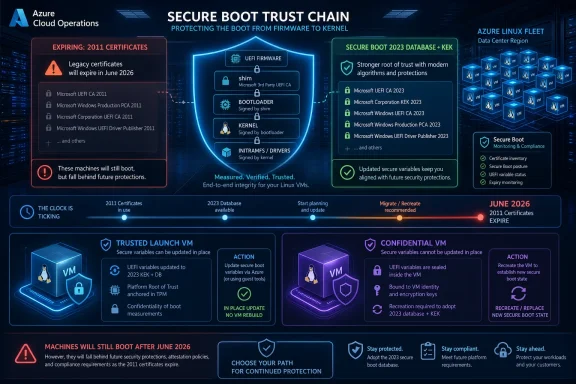
Microsoft has told Azure customers that Linux virtual machines using Trusted Launch must receive Secure Boot 2023 database and KEK certificate updates before 2011-era Microsoft Secure Boot certificates begin expiring in June 2026, while affected Linux Confidential VMs with old certificates must be recreated. The immediate operational point is simple: most VMs will not suddenly refuse to boot. The larger security point is more uncomfortable: a VM that keeps booting on the old trust chain may quietly fall out of the path for future bootloader protections, shim updates, and revocations.
Secure Boot has always depended on a promise that sounds cleaner than it is in practice: firmware should only start code signed by trusted authorities. In Azure, that promise is virtualized, wrapped into UEFI firmware variables, and then exposed to Linux guests running under security features such as Trusted Launch and Confidential VMs. The expiring Microsoft certificates from 2011 are the old roots of that trust model.
That makes this more than an obscure PKI housekeeping exercise. The certificate rollover affects the earliest software a VM executes: shim, bootloaders, kernels, and related components that sit before the operating system’s normal defenses can help. If that layer stops receiving new protections, the VM may still be alive, reachable, and apparently healthy, but its boot security posture has begun to decay.
Microsoft’s guidance draws a sharp line between two Azure security models. Trusted Launch Linux VMs can be updated in place by refreshing Secure Boot variables from inside the guest OS. Confidential Linux VMs that still have the old certificates are not being offered the same simple remediation path; Microsoft says they must be recreated.
That difference matters because administrators tend to hear “certificate expiration” and think renewal. In this case, the practical answer may be update, rebuild, test, or retire, depending on the VM type and how it was provisioned.
A hard boot failure would be noisy, painful, and quickly triaged. A degraded Secure Boot state is subtler. The workload starts, monitoring may stay green, users may never notice, and yet the machine is no longer positioned to consume the next wave of protections for boot components.
This is why the issue should not be treated as a June 2026 break-fix event. Microsoft is warning customers that future shim updates, future certificate additions, and future revocations depend on having the newer Secure Boot 2023 material installed. If the firmware trust database is stuck in 2011, the machine is not merely old-fashioned; it may be unable to follow the security ecosystem forward.
Linux makes that especially relevant because of shim. For many distributions, shim is the signed intermediary that lets Linux participate in Secure Boot on platforms whose firmware trusts Microsoft’s UEFI CA. When that trust path changes, the boot stack must keep up. The VM may not care today, but the next bootloader vulnerability, revoked component, or distribution update may care very much.
The awkward part is ownership. Azure provides the virtualized platform, but Microsoft’s Linux guidance says Secure Boot certificate updates for these Azure VMs are initiated from inside the guest operating system. In other words, cloud firmware is not always “someone else’s computer” in the comforting sense. Sometimes it is someone else’s hypervisor exposing variables that your automation now has to manage.
That is a subtle but significant shift for infrastructure teams. Many Azure administrators are used to patching the guest OS, rotating keys, updating agents, and rebuilding images. Fewer have a mature process for auditing UEFI Secure Boot variables across Linux fleets, especially when those fleets span marketplace images, custom images, scale sets, old Gen2 migrations, and hand-built appliances.
The danger is not that competent teams cannot handle the update. The danger is that the work falls between organizational seams. Linux administrators may assume Azure owns virtual firmware. Cloud platform teams may assume OS teams own the guest. Security teams may only see a compliance drift signal after the window has narrowed.
For affected Confidential Linux VMs without the newer Secure Boot certificates, Microsoft’s answer is recreation. That is more disruptive than an in-guest variable update, but it is also consistent with the nature of confidential computing. When the security boundary is built into how the VM is instantiated and measured, retrofitting foundational firmware trust may not be something Microsoft wants customers attempting piecemeal.
This will be irritating for organizations that treated Confidential VMs as long-lived pets rather than replaceable cattle. A confidential workload often sounds mission-critical by definition; databases, regulated workloads, key-handling systems, and high-sensitivity compute jobs are the obvious candidates. Recreating those VMs requires planning around identity, storage, networking, secrets, policy assignments, backups, and application cutover.
The lesson is blunt: the stronger the platform security promise, the more disciplined the lifecycle management has to be. Confidential computing does not eliminate maintenance. It can make maintenance more formal, more constrained, and less forgiving of improvisation.
Long-lived roots of trust create a peculiar kind of technical debt. They are not forgotten because nobody cares. They are forgotten because they worked. They disappear into images, firmware defaults, templates, documentation, compliance checkboxes, and assumptions passed from one generation of admins to the next.
The Azure angle is important because cloud has trained buyers to expect hidden maintenance to be absorbed by the provider. Disks replicate, hosts live-migrate, hypervisors patch, and hardware generations roll underneath the abstraction. Secure Boot certificates are different because they sit at the boundary between provider-controlled virtual firmware and customer-controlled boot content.
That boundary is where many cloud security stories get complicated. Azure can expose Secure Boot and vTPM as platform features, but Linux distributions, shim signing, guest configuration, VM generation, image provenance, and customer update practices all affect whether the feature remains healthy over time.
That distinction will matter for enterprises using Azure Policy, Defender for Cloud recommendations, custom compliance dashboards, or third-party posture tools. A binary Secure Boot enabled flag may not be enough. Administrators need to know whether the relevant 2023 certificates are actually present in the Secure Boot database and whether the old trust chain has been handled according to vendor guidance.
There is also a timing problem. Certificate expiration begins in June 2026, but large organizations do not move at certificate-expiration speed. Testing windows, change freezes, image factory updates, disaster recovery validation, and application owner sign-offs can consume months. Anyone waiting for a dashboard to turn red is already late.
The most mature response is to treat this as a fleet inventory and image hygiene issue, not a VM-by-VM emergency. If golden images, scale-set models, and provisioning pipelines are corrected, the fleet can converge. If teams rely on manual remediation, the long tail will be ugly.
That means Azure customers should resist the temptation to write one universal runbook and declare victory. Ubuntu, Red Hat Enterprise Linux, SUSE, Debian-derived images, custom appliances, and marketplace solutions may not behave identically. Even where the underlying Microsoft certificate requirement is common, the safe operational path can vary by distribution and support channel.
This is especially true for custom kernels and unsigned kernel modules. Trusted Launch with Secure Boot is designed to reject untrusted early boot components. That is the point. But organizations that have accumulated vendor drivers, monitoring hooks, storage components, or custom security agents may discover that “turn on the stronger boot chain” is also a compatibility test.
Azure’s SBInfo tooling and related Linux security package guidance are useful here because they help identify unsigned modules, kernels, and bootloaders before administrators flip changes in production. The painful failures should happen in staging, not during a maintenance window on a revenue system.
That is less glamorous than a security alert, but far more effective. A fleet remediated manually today can drift back tomorrow if old images remain approved. A rebuilt Confidential VM can reintroduce the same problem if its source image lineage was never fixed. A Trusted Launch migration can pass a project checklist and still fail the broader governance test if nobody updates the templates.
This is also where asset classification becomes useful. Not every VM deserves the same urgency, but every VM needs a known state. Internet-facing Linux servers, identity infrastructure, security tooling, package repositories, Kubernetes nodes, and regulated workloads should move early. Lab machines and disposable dev boxes can follow a broader refresh cycle, but they should not be allowed to remain invisible.
The smart play is to combine inventory, vendor guidance, and deployment pipeline changes. First determine which Linux VMs use Trusted Launch or Confidential VM features and whether they already carry the 2023 Secure Boot material. Then update supported Trusted Launch systems, recreate affected Confidential systems, and prevent old images from creating new exceptions.
Microsoft appears to be trying to avoid the worst version of that story by emphasizing that systems will continue to boot. That is accurate and calming, but it may also reduce urgency among teams that respond only to outage risk. The better framing is that June 2026 marks the beginning of a degraded security era for systems left behind, not necessarily the day they fail.
The company’s broader Secure Boot certificate refresh also affects Windows devices, servers, Azure Local, Azure Stack Hub, and hardware ecosystems. Azure Linux VMs are one slice of a much larger rollover from 2011-era authorities to 2023-era authorities. The cloud-specific wrinkle is that customers may have assumed these virtual machines were insulated from firmware lifecycle chores.
They are not. Secure Boot is a chain, and every chain has links that must be maintained.
Organizationally, it is messier. Recreating a Confidential VM may require application teams to bless downtime. Updating Secure Boot variables may require Linux admins and cloud teams to agree on ownership. Modifying image factories may require platform engineering to prioritize work that has no visible feature payoff. Security may have to explain why “it still boots” is not the same as “it is still protected.”
This is where the June 2026 timeline should be used as leverage. Not panic, but leverage. The work is finite, understandable, and tied to a well-defined cryptographic lifecycle. It is exactly the kind of maintenance that should be scheduled before it becomes an incident.
The worst outcome would be a fleet of technically functioning Linux VMs that quietly aged out of Secure Boot servicing because nobody owned the firmware variables. In cloud security, ambiguity is often more dangerous than complexity.
The Secure Boot certificate rollover is a reminder that cloud abstractions do not erase old security promises; they preserve them, virtualize them, and eventually force customers to renew them. Azure’s Linux guidance is not dramatic because the machines will mostly keep running, and that is precisely why administrators should act early. The next phase of boot security will belong to fleets whose owners know what their virtual firmware trusts, not just whether their workloads answered a ping.
 Microsoft’s Secure Boot Deadline Is a Cloud Maintenance Problem Disguised as a Certificate Story
Secure Boot has always depended on a promise that sounds cleaner than it is in practice: firmware should only start code signed by trusted authorities. In Azure, that promise is virtualized, wrapped into UEFI firmware variables, and then exposed to Linux guests running under security features such as Trusted Launch and Confidential VMs. The expiring Microsoft certificates from 2011 are the old roots of that trust model.That makes this more than an obscure PKI housekeeping exercise. The certificate rollover affects the earliest software a VM executes: shim, bootloaders, kernels, and related components that sit before the operating system’s normal defenses can help. If that layer stops receiving new protections, the VM may still be alive, reachable, and apparently healthy, but its boot security posture has begun to decay.
Microsoft’s guidance draws a sharp line between two Azure security models. Trusted Launch Linux VMs can be updated in place by refreshing Secure Boot variables from inside the guest OS. Confidential Linux VMs that still have the old certificates are not being offered the same simple remediation path; Microsoft says they must be recreated.
That difference matters because administrators tend to hear “certificate expiration” and think renewal. In this case, the practical answer may be update, rebuild, test, or retire, depending on the VM type and how it was provisioned.
The Machines Will Boot, Which Is Exactly Why This Is Risky
The most important sentence in Microsoft’s notice may also be the most easily misunderstood: VMs relying on the 2011 certificates after expiration will continue to boot. For operations teams, that sounds like good news. For security teams, it is the kind of good news that creates future incidents.A hard boot failure would be noisy, painful, and quickly triaged. A degraded Secure Boot state is subtler. The workload starts, monitoring may stay green, users may never notice, and yet the machine is no longer positioned to consume the next wave of protections for boot components.
This is why the issue should not be treated as a June 2026 break-fix event. Microsoft is warning customers that future shim updates, future certificate additions, and future revocations depend on having the newer Secure Boot 2023 material installed. If the firmware trust database is stuck in 2011, the machine is not merely old-fashioned; it may be unable to follow the security ecosystem forward.
Linux makes that especially relevant because of shim. For many distributions, shim is the signed intermediary that lets Linux participate in Secure Boot on platforms whose firmware trusts Microsoft’s UEFI CA. When that trust path changes, the boot stack must keep up. The VM may not care today, but the next bootloader vulnerability, revoked component, or distribution update may care very much.
Trusted Launch Turns Firmware Drift Into a Customer Task
Azure Trusted Launch combines Secure Boot, virtual TPM, and boot integrity monitoring to harden Generation 2 VMs against bootkits and rootkits. Microsoft has increasingly positioned it as the default security posture for new supported Gen2 Azure VMs and scale sets, not as an exotic premium option. That defaulting trend is the right direction, but it also widens the blast radius of maintenance events like this.The awkward part is ownership. Azure provides the virtualized platform, but Microsoft’s Linux guidance says Secure Boot certificate updates for these Azure VMs are initiated from inside the guest operating system. In other words, cloud firmware is not always “someone else’s computer” in the comforting sense. Sometimes it is someone else’s hypervisor exposing variables that your automation now has to manage.
That is a subtle but significant shift for infrastructure teams. Many Azure administrators are used to patching the guest OS, rotating keys, updating agents, and rebuilding images. Fewer have a mature process for auditing UEFI Secure Boot variables across Linux fleets, especially when those fleets span marketplace images, custom images, scale sets, old Gen2 migrations, and hand-built appliances.
The danger is not that competent teams cannot handle the update. The danger is that the work falls between organizational seams. Linux administrators may assume Azure owns virtual firmware. Cloud platform teams may assume OS teams own the guest. Security teams may only see a compliance drift signal after the window has narrowed.
Confidential VMs Get the Harsher Lesson
The guidance for Linux Confidential VMs is the clearest sign that Azure’s security features are not interchangeable labels. Confidential VMs are designed to protect data in use by relying on hardware-backed trusted execution environments and stronger isolation assumptions. That design changes the operational contract.For affected Confidential Linux VMs without the newer Secure Boot certificates, Microsoft’s answer is recreation. That is more disruptive than an in-guest variable update, but it is also consistent with the nature of confidential computing. When the security boundary is built into how the VM is instantiated and measured, retrofitting foundational firmware trust may not be something Microsoft wants customers attempting piecemeal.
This will be irritating for organizations that treated Confidential VMs as long-lived pets rather than replaceable cattle. A confidential workload often sounds mission-critical by definition; databases, regulated workloads, key-handling systems, and high-sensitivity compute jobs are the obvious candidates. Recreating those VMs requires planning around identity, storage, networking, secrets, policy assignments, backups, and application cutover.
The lesson is blunt: the stronger the platform security promise, the more disciplined the lifecycle management has to be. Confidential computing does not eliminate maintenance. It can make maintenance more formal, more constrained, and less forgiving of improvisation.
The 2011 Trust Chain Lasted Long Enough to Become Infrastructure
Secure Boot arrived in the Windows 8 era, when UEFI was still a transition story for many PC and server administrators. The Microsoft certificates issued in 2011 became part of the plumbing not only for Windows devices but also for Linux boot on a vast number of systems that depended on Microsoft’s third-party UEFI signing path. Fifteen years later, that plumbing is expiring.Long-lived roots of trust create a peculiar kind of technical debt. They are not forgotten because nobody cares. They are forgotten because they worked. They disappear into images, firmware defaults, templates, documentation, compliance checkboxes, and assumptions passed from one generation of admins to the next.
The Azure angle is important because cloud has trained buyers to expect hidden maintenance to be absorbed by the provider. Disks replicate, hosts live-migrate, hypervisors patch, and hardware generations roll underneath the abstraction. Secure Boot certificates are different because they sit at the boundary between provider-controlled virtual firmware and customer-controlled boot content.
That boundary is where many cloud security stories get complicated. Azure can expose Secure Boot and vTPM as platform features, but Linux distributions, shim signing, guest configuration, VM generation, image provenance, and customer update practices all affect whether the feature remains healthy over time.
The Compliance Risk Is Quieter Than the Boot Risk
For heavily regulated environments, the operational question is not only “Will the VM boot?” It is “Can we still claim the control is effective?” A Linux VM that continues to start but cannot receive future Secure Boot protections may be hard to defend in an audit if the organization’s baseline says Secure Boot must be current and enforced.That distinction will matter for enterprises using Azure Policy, Defender for Cloud recommendations, custom compliance dashboards, or third-party posture tools. A binary Secure Boot enabled flag may not be enough. Administrators need to know whether the relevant 2023 certificates are actually present in the Secure Boot database and whether the old trust chain has been handled according to vendor guidance.
There is also a timing problem. Certificate expiration begins in June 2026, but large organizations do not move at certificate-expiration speed. Testing windows, change freezes, image factory updates, disaster recovery validation, and application owner sign-offs can consume months. Anyone waiting for a dashboard to turn red is already late.
The most mature response is to treat this as a fleet inventory and image hygiene issue, not a VM-by-VM emergency. If golden images, scale-set models, and provisioning pipelines are corrected, the fleet can converge. If teams rely on manual remediation, the long tail will be ugly.
Linux Vendors Are Part of the Story, Not Bystanders
Microsoft’s notice points customers toward Linux OS vendor recommendations, and that is not a courtesy link. In the Secure Boot chain, distributions matter. They ship shim packages, bootloaders, kernels, signed modules, and tooling that interact with the firmware trust database.That means Azure customers should resist the temptation to write one universal runbook and declare victory. Ubuntu, Red Hat Enterprise Linux, SUSE, Debian-derived images, custom appliances, and marketplace solutions may not behave identically. Even where the underlying Microsoft certificate requirement is common, the safe operational path can vary by distribution and support channel.
This is especially true for custom kernels and unsigned kernel modules. Trusted Launch with Secure Boot is designed to reject untrusted early boot components. That is the point. But organizations that have accumulated vendor drivers, monitoring hooks, storage components, or custom security agents may discover that “turn on the stronger boot chain” is also a compatibility test.
Azure’s SBInfo tooling and related Linux security package guidance are useful here because they help identify unsigned modules, kernels, and bootloaders before administrators flip changes in production. The painful failures should happen in staging, not during a maintenance window on a revenue system.
Image Factories Need to Move Before Individual VMs Do
The cleanest place to solve this is not on a running VM. It is in the image supply chain. If an organization builds its own Azure images, publishes through Azure Compute Gallery, deploys via Terraform or Bicep, and stamps out scale sets from versioned artifacts, the certificate update should become part of that factory process.That is less glamorous than a security alert, but far more effective. A fleet remediated manually today can drift back tomorrow if old images remain approved. A rebuilt Confidential VM can reintroduce the same problem if its source image lineage was never fixed. A Trusted Launch migration can pass a project checklist and still fail the broader governance test if nobody updates the templates.
This is also where asset classification becomes useful. Not every VM deserves the same urgency, but every VM needs a known state. Internet-facing Linux servers, identity infrastructure, security tooling, package repositories, Kubernetes nodes, and regulated workloads should move early. Lab machines and disposable dev boxes can follow a broader refresh cycle, but they should not be allowed to remain invisible.
The smart play is to combine inventory, vendor guidance, and deployment pipeline changes. First determine which Linux VMs use Trusted Launch or Confidential VM features and whether they already carry the 2023 Secure Boot material. Then update supported Trusted Launch systems, recreate affected Confidential systems, and prevent old images from creating new exceptions.
Microsoft Is Trying to Avoid Another Trust-Anchor Cliff
The broader industry has lived through enough certificate and root-of-trust deadlines to know the pattern. A date is announced years in advance. Most systems are updated quietly. A stubborn minority remains because of old hardware, unsupported software, brittle dependencies, unclear ownership, or simple neglect. Then the deadline arrives and the long tail becomes everyone’s problem.Microsoft appears to be trying to avoid the worst version of that story by emphasizing that systems will continue to boot. That is accurate and calming, but it may also reduce urgency among teams that respond only to outage risk. The better framing is that June 2026 marks the beginning of a degraded security era for systems left behind, not necessarily the day they fail.
The company’s broader Secure Boot certificate refresh also affects Windows devices, servers, Azure Local, Azure Stack Hub, and hardware ecosystems. Azure Linux VMs are one slice of a much larger rollover from 2011-era authorities to 2023-era authorities. The cloud-specific wrinkle is that customers may have assumed these virtual machines were insulated from firmware lifecycle chores.
They are not. Secure Boot is a chain, and every chain has links that must be maintained.
The Azure Runbook Writes Itself, but the Politics Do Not
Technically, the path is straightforward enough. Inventory the fleet. Identify Linux Trusted Launch VMs and Linux Confidential VMs. Check whether the 2023 Secure Boot database and KEK certificates are present. Follow distribution and Microsoft guidance for in-guest updates where supported. Recreate Confidential VMs where required. Validate boot, attestation, monitoring, backup, and rollback.Organizationally, it is messier. Recreating a Confidential VM may require application teams to bless downtime. Updating Secure Boot variables may require Linux admins and cloud teams to agree on ownership. Modifying image factories may require platform engineering to prioritize work that has no visible feature payoff. Security may have to explain why “it still boots” is not the same as “it is still protected.”
This is where the June 2026 timeline should be used as leverage. Not panic, but leverage. The work is finite, understandable, and tied to a well-defined cryptographic lifecycle. It is exactly the kind of maintenance that should be scheduled before it becomes an incident.
The worst outcome would be a fleet of technically functioning Linux VMs that quietly aged out of Secure Boot servicing because nobody owned the firmware variables. In cloud security, ambiguity is often more dangerous than complexity.
The Fine Print That Should Drive the Change Calendar
Microsoft’s Azure Linux Secure Boot guidance should land on change boards as a lifecycle event, not a curiosity. The practical conclusions are concrete enough to turn into tickets now.- Azure Linux Trusted Launch VMs that still rely on 2011 Microsoft Secure Boot certificates need the 2023 Secure Boot database and KEK certificates added to virtual UEFI firmware.
- Azure Linux Confidential VMs with old Secure Boot certificates should be planned for recreation rather than treated as simple in-place update candidates.
- VMs left on the 2011 certificates are expected to continue booting, but they may stop receiving future shim updates, certificate additions, and revocations needed to preserve Secure Boot protection.
- Image pipelines, scale-set models, and Azure Compute Gallery artifacts should be updated so newly deployed machines do not recreate the same certificate problem.
- Linux distribution guidance matters because shim, bootloader packages, kernels, and signed module behavior vary across supported operating systems.
- Administrators should test Secure Boot compatibility and unsigned boot components before applying changes broadly to production fleets.
The Secure Boot certificate rollover is a reminder that cloud abstractions do not erase old security promises; they preserve them, virtualize them, and eventually force customers to renew them. Azure’s Linux guidance is not dramatic because the machines will mostly keep running, and that is precisely why administrators should act early. The next phase of boot security will belong to fleets whose owners know what their virtual firmware trusts, not just whether their workloads answered a ping.
References
- Primary source: Microsoft - Message Center
Published: 2026-06-22 17:00 PT
Loading…
support.microsoft.com - Official source: microsoft.com
Prepare your servers for Secure Boot certificate updates | Microsoft Windows Server Blog
The original Secure Boot certificates introduced in 2011 are approaching the end of their planned lifecycle, with expirations beginning in late June 2026.www.microsoft.com - Official source: learn.microsoft.com
Loading…
learn.microsoft.com - Related coverage: windowscentral.com
Microsoft warns Secure Boot certificates will expire in 2026 | Windows Central
After 15 years, the original Secure Boot certificates that keep your PC secure during boot are expiring. Here's what you need to know.www.windowscentral.com - Related coverage: tomshardware.com
Microsoft is refreshing Secure Boot certificates to plug security holes before they happen — if you bought a PC last year, you should be set | Tom's Hardware
Be sure to keep Windows 11 systems updated to get refreshed security certificates.www.tomshardware.com - Related coverage: pcgamer.com
Secure Boot certificates used by anti-cheat software are set to expire in June but new ones are already in the mail | PC Gamer
You shouldn't have to worry about expired certificates if you keep your PC up-to-date.www.pcgamer.com
- Related coverage: cisco.com