
Microsoft released Malaysia-specific findings from its 2026 Work Trend Index on June 23, 2026, saying Malaysian knowledge workers are adopting AI faster than their organizations are redesigning work to support it. The report is less a celebration of Copilot usage than a warning about institutional lag. Microsoft’s pitch is that employees are ready for agents, judgment, and higher-value work; the harder truth is that most companies still manage AI as a tool rollout rather than an operating-model change.
The striking number in Microsoft’s Malaysia release is not merely that workers are using AI. It is that 24 percent of Malaysian workers in the study qualify as what Microsoft calls Frontier Professionals, compared with 16 percent globally. In plain English, Malaysia appears to have a larger-than-average cohort of employees who are not just prompting a chatbot occasionally, but weaving AI into analysis, planning, evaluation, and creative work.
That matters because the old enterprise assumption was that AI readiness would start at the top. Leaders would buy licenses, IT would configure access, HR would publish guidelines, and employees would gradually come along. Microsoft’s data suggests the opposite dynamic is taking hold: workers are already experimenting their way into new habits, while the formal machinery of the company remains built for pre-agent work.
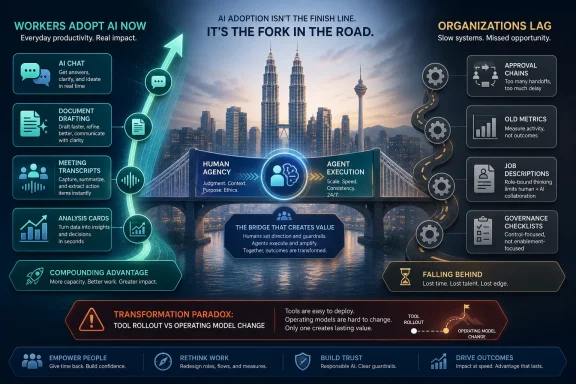
This is why the Malaysia findings read less like a regional workforce story and more like a case study in the wider AI management problem. The employee is changing faster than the institution. The individual has discovered acceleration; the organization still has approval chains, quarterly metrics, job descriptions, and performance systems designed for a slower era.
Microsoft is, of course, selling into that gap. But vendor motive does not make the gap imaginary. Anyone who has watched Teams meetings turn into transcript summaries, inboxes become triage queues, or PowerPoint decks emerge from rough prompts has seen the same pattern: the tools are already changing the texture of office work before management has decided what kind of office it now runs.
The Malaysian numbers support a more nuanced view than the usual “AI will replace workers” panic. Microsoft says 92 percent of AI users in Malaysia treat AI output as a starting point rather than a final answer, while still holding themselves responsible for the thinking. That is an important distinction. These employees are not describing themselves as clerks outsourcing judgment to a machine; they are describing AI as a drafting, structuring, and reasoning aid that still requires human ownership.
This is where the word agency becomes more than corporate poetry. If an employee can delegate summary, comparison, first-pass synthesis, scheduling, drafting, and data extraction to AI, the employee’s role shifts toward intent-setting and verification. The value moves from typing the work into existence to deciding what work should exist, what standard it must meet, and what risks it carries.
The danger is that organizations may misread the productivity dividend as simply “same job, faster output.” If a proposal that once took three days now takes one, the obvious managerial temptation is to demand three proposals. But that interpretation wastes the deeper change. The better question is whether the worker can now spend more time on customer insight, better options, sharper decisions, and fewer pointless deliverables.
That runs against a common caricature of heavy AI users as automation maximalists. The more mature pattern looks like selective delegation. The question is not “Can AI do this?” but “Should AI do this, and what must I still understand myself?”
For IT departments and security teams, that distinction matters. Shadow AI flourishes when organizations issue blanket warnings but fail to provide practical workflows. Mature AI use requires boundaries, but it also requires sanctioned capability. If employees are already making work-design decisions at the task level, the enterprise needs to give them a vocabulary and governance model for doing that safely.
This is also where training often goes wrong. Too many AI enablement programs teach prompt syntax as if the workplace were a command-line interface. The more valuable training teaches task decomposition, source validation, confidentiality judgment, auditability, and escalation. In other words, the skill is not merely how to ask the model for an answer; it is how to manage the model as a fallible participant in a work system.
The Malaysia data makes that disconnect concrete. Only 32 percent of AI users in Malaysia say their leadership is clearly and consistently aligned on AI. Just 19 percent say they are rewarded for reinventing how work gets done when those efforts do not immediately produce results. That is not a technology adoption problem. That is a governance and incentive problem.
If employees are told to “use AI” but rewarded only for old-style throughput, they will use AI to produce more of the same artifacts. If managers praise experimentation but penalize short-term dips, experimentation becomes theater. If legal, compliance, IT, and business leadership send mixed signals, workers will either avoid AI or use it quietly.
This is the least glamorous part of the AI transition, which is why it is likely to matter most. The companies that benefit from agents will not simply be the ones that bought the most licenses. They will be the ones that change review processes, data access rules, manager expectations, job architectures, and definitions of quality around the assumption that AI is now part of the workstream.
Microsoft wants customers to see isolated AI use as the problem and Microsoft 365 Copilot as the connective tissue. That is why the release pivots from workforce readiness to Copilot Cowork, which Microsoft says is now generally available worldwide and has seen adoption across more than half of the Fortune 500. The implicit argument is clear: workers are already improvising with AI, so organizations should standardize that improvisation inside Microsoft’s stack.
For WindowsForum readers, the product angle is worth watching closely. Microsoft is no longer positioning Copilot merely as a chat pane next to Office. The company is pushing toward agents that can act across documents, meetings, workflows, files, and third-party tools. That moves Copilot from “assistant” toward execution layer.
Copilot Cowork is especially interesting because it reflects Microsoft’s recognition that enterprise AI cannot be a single-model story. The Malaysia announcement says customers can run Cowork on Anthropic Opus 4.8 and Sonnet 4.6, with GPT 5.5 available in Frontier and Microsoft’s optimized Cowork 1 model coming soon. That is a very 2026 version of platform strategy: Microsoft wants to own the work surface, even when the intelligence underneath comes from multiple model providers.
The usage-based pricing model also deserves attention. Microsoft says Cowork requires a Microsoft 365 Copilot license and is billed through Copilot Credits based on model usage, context retrieval, tool calls, and runtime. That is a long way from the simplicity of per-seat software. It also means IT and finance teams will need to learn a new discipline: not just who has access to AI, but which workflows consume expensive reasoning, which agents call which tools, and whether the output justifies the bill.
The challenge is that agents are more consequential than unsanctioned file sync. An AI agent does not merely store data; it interprets it, combines it, summarizes it, and may act on it. When connected to email, SharePoint, OneDrive, Teams, CRM systems, HR platforms, or ticketing tools, it becomes a new kind of privileged user: one that operates at machine speed and may be difficult to reason about after the fact.
That makes governance less optional than it sounded during the chatbot phase. Enterprises will need policies for data boundaries, logging, retention, model selection, approval workflows, and human review. They will also need practical defaults, because a governance regime that requires every employee to understand model internals will fail on contact with Monday morning.
Microsoft’s advantage is that much of the work graph already lives inside its ecosystem. Its risk is that the same concentration makes mistakes more expensive. A badly scoped agent in a Microsoft 365 tenant could touch the documents, conversations, calendars, and business records that define the organization’s day-to-day operation. That is why “organizational readiness” must mean more than enthusiasm from the CIO.
That creates an opportunity for Malaysian firms, especially in services, finance, technology, shared services, education, and public-sector modernization. If workers are already using AI to create work they could not have produced a year ago, the next gains may come from coordination rather than awareness. The question becomes how to convert individual experimentation into repeatable organizational capability.
Microsoft uses the term Owned Intelligence for this idea: the institutional knowledge, processes, and standards that accumulate when AI-enabled work is captured and reused. The phrase is predictably branded, but the concept is sound. A company that lets every employee reinvent prompts and workflows alone gets scattered productivity. A company that turns good workflows into shared practice gets compounding advantage.
This is where Malaysia’s opportunity and risk are the same thing. A workforce that is ready before leadership is a source of momentum, but also a source of fragmentation. If every department creates its own AI habits without common standards, the organization may get speed without coherence. If leaders move too slowly, the best AI users may conclude that the company itself is the bottleneck.
A manager in an AI-enabled organization has to answer new questions. Which tasks should disappear? Which reviews need a human signature? Which outputs are good enough for internal use but not customer use? Which employees are becoming more capable with AI, and which are quietly being left behind?
This is a different skill set from approving timesheets and running status meetings. It requires managers to understand work as a system: inputs, decisions, handoffs, risks, and learning loops. The best managers will become translators between AI capability and business judgment. The worst will become latency.
The Malaysia data point about leadership alignment is therefore more than a complaint about executives. If only 32 percent of AI users see consistent leadership alignment, managers are likely receiving mixed signals too. They may be told to encourage AI adoption while lacking clear rules on data use, measurement, procurement, cost control, and accountability.
That ambiguity flows downward. Employees will not reinvent work in a vacuum if their manager cannot explain what counts as a good reinvention. Nor will they admit failed experiments if every failure is treated as a productivity miss. The companies that win will make AI experimentation legible, governable, and career-positive.
The obvious failure mode is overtrust. A polished summary can hide missing context. A plausible analysis can smuggle in outdated assumptions. A generated proposal can sound more complete than it is. The more fluent the model, the more disciplined the human review must become.
The less obvious failure mode is skill erosion. Microsoft’s finding that Frontier Professionals deliberately do some work without AI is a useful warning. If junior staff never learn to structure an argument, analyze a spreadsheet, write a memo, or interrogate evidence without AI, they may become faster but shallower. That is not a reason to ban AI; it is a reason to design apprenticeship differently.
Organizations will need to decide which skills must remain embodied in humans and which can safely be offloaded. That decision will vary by industry and role. A marketing draft, a legal clause, a security incident summary, and a financial forecast do not carry the same risk. Treating all AI use as one category is already obsolete.
That will change behavior. A lightweight summary and a long-running multi-step agent workflow are not the same economic object. A model that is excellent for complex reasoning may be overkill for routine formatting. A workflow that calls multiple tools and retrieves large context may produce excellent output while quietly burning budget.
For IT administrators, this creates a new layer of FinOps inside productivity software. Tenant admins will need reporting, quotas, policy controls, and guidance on which models are appropriate for which classes of work. Procurement teams will need to understand not just license counts but usage curves. Business leaders will need to justify agents as process investments, not novelty features.
This also creates a governance opportunity. Cost visibility can force organizations to ask whether AI workflows are genuinely valuable. If an agent saves executive time, reduces customer churn, improves compliance review, or accelerates software delivery, the bill may be easy to justify. If it mostly generates longer documents nobody reads, the meter will make waste harder to ignore.
That shifts the burden from adoption evangelism to organizational design. Leaders must stop asking only how many people have used Copilot this month and start asking whether work has changed in a measurable, safe, and useful way. A dashboard of active users is not a transformation strategy.
There is also a talent implication. If Frontier Professionals are producing work they could not have created a year ago, they will become increasingly intolerant of organizations that trap them in old processes. The best AI users may not want another training webinar. They may want permission to redesign the workflow, document the pattern, share it with peers, and be rewarded for the attempt.
This is where the Malaysia story becomes sharper than a normal Microsoft regional announcement. The report is effectively telling leaders that their employees are no longer the slowest part of the AI transition. The slowest part may be the company itself.
 Malaysia’s AI Workers Have Moved Ahead of the Org Chart
The striking number in Microsoft’s Malaysia release is not merely that workers are using AI. It is that 24 percent of Malaysian workers in the study qualify as what Microsoft calls Frontier Professionals, compared with 16 percent globally. In plain English, Malaysia appears to have a larger-than-average cohort of employees who are not just prompting a chatbot occasionally, but weaving AI into analysis, planning, evaluation, and creative work.That matters because the old enterprise assumption was that AI readiness would start at the top. Leaders would buy licenses, IT would configure access, HR would publish guidelines, and employees would gradually come along. Microsoft’s data suggests the opposite dynamic is taking hold: workers are already experimenting their way into new habits, while the formal machinery of the company remains built for pre-agent work.
This is why the Malaysia findings read less like a regional workforce story and more like a case study in the wider AI management problem. The employee is changing faster than the institution. The individual has discovered acceleration; the organization still has approval chains, quarterly metrics, job descriptions, and performance systems designed for a slower era.
Microsoft is, of course, selling into that gap. But vendor motive does not make the gap imaginary. Anyone who has watched Teams meetings turn into transcript summaries, inboxes become triage queues, or PowerPoint decks emerge from rough prompts has seen the same pattern: the tools are already changing the texture of office work before management has decided what kind of office it now runs.
The Real Story Is Not Productivity, It Is Agency
Microsoft frames the 2026 Work Trend Index around a neat formulation: as AI agents take on execution, human agency expands. That is a cleaner slogan than most enterprise AI messaging, but it points to a real shift. The first phase of workplace AI was about making existing tasks faster; the next phase is about changing who—or what—does the first draft of work.The Malaysian numbers support a more nuanced view than the usual “AI will replace workers” panic. Microsoft says 92 percent of AI users in Malaysia treat AI output as a starting point rather than a final answer, while still holding themselves responsible for the thinking. That is an important distinction. These employees are not describing themselves as clerks outsourcing judgment to a machine; they are describing AI as a drafting, structuring, and reasoning aid that still requires human ownership.
This is where the word agency becomes more than corporate poetry. If an employee can delegate summary, comparison, first-pass synthesis, scheduling, drafting, and data extraction to AI, the employee’s role shifts toward intent-setting and verification. The value moves from typing the work into existence to deciding what work should exist, what standard it must meet, and what risks it carries.
The danger is that organizations may misread the productivity dividend as simply “same job, faster output.” If a proposal that once took three days now takes one, the obvious managerial temptation is to demand three proposals. But that interpretation wastes the deeper change. The better question is whether the worker can now spend more time on customer insight, better options, sharper decisions, and fewer pointless deliverables.
Frontier Professionals Are Not the Reckless Ones
One of the more useful findings in the Malaysia release is that advanced AI users appear more deliberate, not less. Microsoft says Frontier Professionals in Malaysia are more likely than non-Frontier Professionals to do some work without AI to keep their skills sharp. They are also more likely to pause before beginning work to decide which parts should be handled by a human and which by AI.That runs against a common caricature of heavy AI users as automation maximalists. The more mature pattern looks like selective delegation. The question is not “Can AI do this?” but “Should AI do this, and what must I still understand myself?”
For IT departments and security teams, that distinction matters. Shadow AI flourishes when organizations issue blanket warnings but fail to provide practical workflows. Mature AI use requires boundaries, but it also requires sanctioned capability. If employees are already making work-design decisions at the task level, the enterprise needs to give them a vocabulary and governance model for doing that safely.
This is also where training often goes wrong. Too many AI enablement programs teach prompt syntax as if the workplace were a command-line interface. The more valuable training teaches task decomposition, source validation, confidentiality judgment, auditability, and escalation. In other words, the skill is not merely how to ask the model for an answer; it is how to manage the model as a fallible participant in a work system.
The Transformation Paradox Is a Management Failure With Better Branding
Microsoft calls the tension the “Transformation Paradox”: employees feel pressure to adopt AI quickly, while company metrics, incentives, and norms continue to reinforce old ways of working. The phrase is polished, but the underlying problem is familiar. Enterprises often buy transformational technology and then measure employees as if nothing transformed.The Malaysia data makes that disconnect concrete. Only 32 percent of AI users in Malaysia say their leadership is clearly and consistently aligned on AI. Just 19 percent say they are rewarded for reinventing how work gets done when those efforts do not immediately produce results. That is not a technology adoption problem. That is a governance and incentive problem.
If employees are told to “use AI” but rewarded only for old-style throughput, they will use AI to produce more of the same artifacts. If managers praise experimentation but penalize short-term dips, experimentation becomes theater. If legal, compliance, IT, and business leadership send mixed signals, workers will either avoid AI or use it quietly.
This is the least glamorous part of the AI transition, which is why it is likely to matter most. The companies that benefit from agents will not simply be the ones that bought the most licenses. They will be the ones that change review processes, data access rules, manager expectations, job architectures, and definitions of quality around the assumption that AI is now part of the workstream.
Microsoft’s Malaysia Pitch Is Also a Copilot Sales Argument
The Malaysia release is not neutral social science. It is Microsoft research, attached to Microsoft 365 productivity signals, Microsoft 365 Copilot, and the broader push toward agentic workplace software. That does not invalidate the findings, but it does shape the frame.Microsoft wants customers to see isolated AI use as the problem and Microsoft 365 Copilot as the connective tissue. That is why the release pivots from workforce readiness to Copilot Cowork, which Microsoft says is now generally available worldwide and has seen adoption across more than half of the Fortune 500. The implicit argument is clear: workers are already improvising with AI, so organizations should standardize that improvisation inside Microsoft’s stack.
For WindowsForum readers, the product angle is worth watching closely. Microsoft is no longer positioning Copilot merely as a chat pane next to Office. The company is pushing toward agents that can act across documents, meetings, workflows, files, and third-party tools. That moves Copilot from “assistant” toward execution layer.
Copilot Cowork is especially interesting because it reflects Microsoft’s recognition that enterprise AI cannot be a single-model story. The Malaysia announcement says customers can run Cowork on Anthropic Opus 4.8 and Sonnet 4.6, with GPT 5.5 available in Frontier and Microsoft’s optimized Cowork 1 model coming soon. That is a very 2026 version of platform strategy: Microsoft wants to own the work surface, even when the intelligence underneath comes from multiple model providers.
The usage-based pricing model also deserves attention. Microsoft says Cowork requires a Microsoft 365 Copilot license and is billed through Copilot Credits based on model usage, context retrieval, tool calls, and runtime. That is a long way from the simplicity of per-seat software. It also means IT and finance teams will need to learn a new discipline: not just who has access to AI, but which workflows consume expensive reasoning, which agents call which tools, and whether the output justifies the bill.
The Old Windows Admin Problem Returns in AI Form
There is a familiar pattern here for anyone who has managed Windows estates, Microsoft 365 tenants, or endpoint security: users find the quickest path to get work done, and IT later has to turn that path into something supportable. In the 2000s it was personal devices and consumer cloud storage. In the 2010s it was SaaS sprawl. In the 2020s it is AI agents.The challenge is that agents are more consequential than unsanctioned file sync. An AI agent does not merely store data; it interprets it, combines it, summarizes it, and may act on it. When connected to email, SharePoint, OneDrive, Teams, CRM systems, HR platforms, or ticketing tools, it becomes a new kind of privileged user: one that operates at machine speed and may be difficult to reason about after the fact.
That makes governance less optional than it sounded during the chatbot phase. Enterprises will need policies for data boundaries, logging, retention, model selection, approval workflows, and human review. They will also need practical defaults, because a governance regime that requires every employee to understand model internals will fail on contact with Monday morning.
Microsoft’s advantage is that much of the work graph already lives inside its ecosystem. Its risk is that the same concentration makes mistakes more expensive. A badly scoped agent in a Microsoft 365 tenant could touch the documents, conversations, calendars, and business records that define the organization’s day-to-day operation. That is why “organizational readiness” must mean more than enthusiasm from the CIO.
Malaysia’s Numbers Hint at a Regional Leapfrog Moment
The Malaysia findings should not be treated as a universal proxy for Southeast Asia, but they do fit a broader regional pattern: younger, digitally fluent workforces are often willing to adopt new tools quickly when the productivity payoff is obvious. Malaysia’s 24 percent Frontier Professional figure suggests a meaningful group of workers is already beyond basic AI literacy.That creates an opportunity for Malaysian firms, especially in services, finance, technology, shared services, education, and public-sector modernization. If workers are already using AI to create work they could not have produced a year ago, the next gains may come from coordination rather than awareness. The question becomes how to convert individual experimentation into repeatable organizational capability.
Microsoft uses the term Owned Intelligence for this idea: the institutional knowledge, processes, and standards that accumulate when AI-enabled work is captured and reused. The phrase is predictably branded, but the concept is sound. A company that lets every employee reinvent prompts and workflows alone gets scattered productivity. A company that turns good workflows into shared practice gets compounding advantage.
This is where Malaysia’s opportunity and risk are the same thing. A workforce that is ready before leadership is a source of momentum, but also a source of fragmentation. If every department creates its own AI habits without common standards, the organization may get speed without coherence. If leaders move too slowly, the best AI users may conclude that the company itself is the bottleneck.
The Manager Becomes the Bottleneck—or the Multiplier
Microsoft’s report emphasizes that culture, manager support, and talent practices account for more than twice the AI impact of individual mindset and usage. That should make middle management nervous, but not for the usual reason. AI is not simply coming for the manager’s job; it is exposing whether managers actually design work or merely monitor it.A manager in an AI-enabled organization has to answer new questions. Which tasks should disappear? Which reviews need a human signature? Which outputs are good enough for internal use but not customer use? Which employees are becoming more capable with AI, and which are quietly being left behind?
This is a different skill set from approving timesheets and running status meetings. It requires managers to understand work as a system: inputs, decisions, handoffs, risks, and learning loops. The best managers will become translators between AI capability and business judgment. The worst will become latency.
The Malaysia data point about leadership alignment is therefore more than a complaint about executives. If only 32 percent of AI users see consistent leadership alignment, managers are likely receiving mixed signals too. They may be told to encourage AI adoption while lacking clear rules on data use, measurement, procurement, cost control, and accountability.
That ambiguity flows downward. Employees will not reinvent work in a vacuum if their manager cannot explain what counts as a good reinvention. Nor will they admit failed experiments if every failure is treated as a productivity miss. The companies that win will make AI experimentation legible, governable, and career-positive.
The Human Judgment Story Cuts Both Ways
Microsoft is right to emphasize that Malaysian AI users still see themselves as responsible for the thinking. That is reassuring, but it also raises the bar. Once AI is involved in drafting, analysis, and decision support, “I reviewed it” cannot be a ritual phrase. It has to mean something.The obvious failure mode is overtrust. A polished summary can hide missing context. A plausible analysis can smuggle in outdated assumptions. A generated proposal can sound more complete than it is. The more fluent the model, the more disciplined the human review must become.
The less obvious failure mode is skill erosion. Microsoft’s finding that Frontier Professionals deliberately do some work without AI is a useful warning. If junior staff never learn to structure an argument, analyze a spreadsheet, write a memo, or interrogate evidence without AI, they may become faster but shallower. That is not a reason to ban AI; it is a reason to design apprenticeship differently.
Organizations will need to decide which skills must remain embodied in humans and which can safely be offloaded. That decision will vary by industry and role. A marketing draft, a legal clause, a security incident summary, and a financial forecast do not carry the same risk. Treating all AI use as one category is already obsolete.
The Copilot Credit Era Will Make AI Cost Visible
The announcement’s pricing details may look secondary beside the workforce findings, but they could become one of the most important operational issues. Usage-based billing through Copilot Credits means AI work will have a meter attached to it. In the traditional Microsoft 365 world, a seat license made cost predictable. In the agentic world, cost depends on what the agent does.That will change behavior. A lightweight summary and a long-running multi-step agent workflow are not the same economic object. A model that is excellent for complex reasoning may be overkill for routine formatting. A workflow that calls multiple tools and retrieves large context may produce excellent output while quietly burning budget.
For IT administrators, this creates a new layer of FinOps inside productivity software. Tenant admins will need reporting, quotas, policy controls, and guidance on which models are appropriate for which classes of work. Procurement teams will need to understand not just license counts but usage curves. Business leaders will need to justify agents as process investments, not novelty features.
This also creates a governance opportunity. Cost visibility can force organizations to ask whether AI workflows are genuinely valuable. If an agent saves executive time, reduces customer churn, improves compliance review, or accelerates software delivery, the bill may be easy to justify. If it mostly generates longer documents nobody reads, the meter will make waste harder to ignore.
The Malaysia Findings Put the Burden Back on Leaders
The cleanest reading of Microsoft’s Malaysia release is that workers have already crossed the psychological barrier. They are not waiting to be convinced that AI can help. They are trying to use it responsibly, and many of the most advanced users are explicitly preserving human judgment rather than abandoning it.That shifts the burden from adoption evangelism to organizational design. Leaders must stop asking only how many people have used Copilot this month and start asking whether work has changed in a measurable, safe, and useful way. A dashboard of active users is not a transformation strategy.
There is also a talent implication. If Frontier Professionals are producing work they could not have created a year ago, they will become increasingly intolerant of organizations that trap them in old processes. The best AI users may not want another training webinar. They may want permission to redesign the workflow, document the pattern, share it with peers, and be rewarded for the attempt.
This is where the Malaysia story becomes sharper than a normal Microsoft regional announcement. The report is effectively telling leaders that their employees are no longer the slowest part of the AI transition. The slowest part may be the company itself.
The Companies That Learn Fastest Will Keep the Advantage
The most concrete lesson from the 2026 Work Trend Index is that AI advantage compounds only when individual practice becomes organizational memory. Malaysia’s workers may be ready, but readiness is perishable if it is not turned into systems, incentives, and governance.- Malaysian workers in Microsoft’s study are ahead of the global average in advanced AI use, with 24 percent classified as Frontier Professionals versus 16 percent globally.
- Most Malaysian AI users in the report treat AI output as a draft or starting point, not as a substitute for human responsibility.
- The biggest blocker is organizational readiness, including leadership alignment, manager support, incentives, and repeatable workflows.
- Copilot Cowork’s general availability pushes Microsoft 365 Copilot further from chat assistance toward agentic work execution across enterprise systems.
- Usage-based Copilot Credits will make AI governance a cost-management issue as well as a security and productivity issue.
- The practical advantage will go to organizations that convert scattered employee experiments into documented, governed, and reusable ways of working.
References
- Primary source: Microsoft Source
Published: 2026-06-23T03:42:12.411545
Loading…
news.microsoft.com - Related coverage: techradar.com
Microsoft makes Copilot Cowork open to everyone, and wants to help you tackle even the trickiest work tasks | TechRadar
Copilot Cowork gets an upgrade as it opens to all userswww.techradar.com - Official source: microsoft.com
Work Trend Index: Microsoft’s latest research on the ways we work.
The Work Trend Index provides data-driven insights to help people and organizations thrive amid ongoing change and disruption.www.microsoft.com - Official source: techcommunity.microsoft.com
Available today: Anthropic Claude Opus 4.8 in Microsoft 365 Copilot | Microsoft Community Hub
Expanding model choice in Microsoft 365 Copilot: Anthropic's Claude Opus 4.8 is rolling out today in Copilot Cowork. techcommunity.microsoft.com
- Related coverage: metaintro.com
Microsoft 2026 Work Trend Index: 67% Say... | Metaintro
Microsoft's 2026 Work Trend Index of 20,000 workers finds 67% rank organizational readiness — not tools — as the biggest factor in AI pilot success globally.www.metaintro.com - Related coverage: forbes.com
Microsoft Work Trend Index 2026 Shows AI Productivity Is Not Enough
The 2026 Work Trend Index shows that marginal AI productivity gains are outpacing organizational redesign that might harness AI for durable strategic advantage.www.forbes.com
- Related coverage: itdeskuk.com
Loading…
www.itdeskuk.com - Related coverage: rcpmag.com
Microsoft Announces General Availability of Copilot Cowork Following Successful Preview -- Redmond Channel Partner
Microsoft has officially launched Copilot Cowork for organizations worldwide.rcpmag.com - Related coverage: assets-c4akfrf5b4d3f4b7.z01.azurefd.net
Microsoft 2026 Work Trend Index Annual Report
Agents, human agency, and the opportunity for every organizationassets-c4akfrf5b4d3f4b7.z01.azurefd.net