
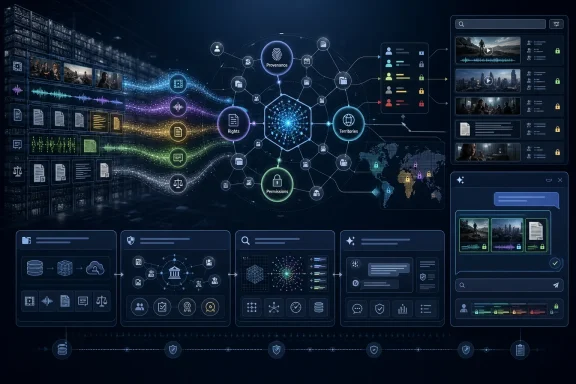
Media companies can turn archives into revenue-ready GenAI systems by ingesting assets with provenance, enriching them with multimodal metadata, connecting them to rights data through a knowledge graph, and exposing governed discovery through tools such as Microsoft Fabric, Purview, Azure AI Search, and Copilot. The pitch is simple, but the operational implication is not: the archive stops being a warehouse and becomes a control plane. In an industry that has spent decades treating finished content as a static afterlife of production, the next advantage belongs to companies that make old material computable. The companies that fail will not merely search more slowly; they will train, prompt, and commercialize from a foundation they cannot fully trust.
The media archive has always looked richer from the outside than it feels from the inside. Streaming platforms, studios, broadcasters, sports leagues, publishers, and production houses sit on decades of footage, scripts, transcripts, artwork, edits, trailers, alternates, marketing cuts, localization files, and licensing paperwork. The problem is not that the material disappeared. The problem is that it became discoverable only to people who already knew where to look.
That is a brutal constraint in a business built on reuse. A researcher looking for a nighttime city establishing shot should not need to remember the episode number, production codename, or filename conventions used by a post-production vendor in 2014. A development executive should not approve a “fresh” concept without being able to see that the company already produced a similar arc, theme, or visual treatment in a dormant franchise. A licensing team should not need three spreadsheets, two deal memos, and a senior lawyer’s memory to work out whether a 90-second clip can be sold into a new territory.
Yet that is still how too many media companies operate. Their archives were designed for storage, preservation, and handoff, not reasoning. Search usually reflects the mechanics of ingestion: file names, folders, production IDs, and whatever manual tags survived deadline pressure. Those fields are useful, but they describe the container more than the content.
Generative AI has made that old weakness impossible to ignore. A human can sometimes compensate for a bad archive through institutional memory. A model cannot. If the underlying corpus is unstructured, ungoverned, and disconnected from rights data, the AI layer will be little more than a confident interface over uncertainty.
Those are attractive workflows because they reflect how creative and commercial teams actually think. People do not search in filenames. They search in story, mood, character, format, market, and rights.
But the demo version of that experience hides the hard part. A system that can find a visually similar scene is not necessarily a system that can tell whether the scene is usable. A transcript match is not a clearance decision. A vector search result is not a rights opinion. The archive has to answer not only “what is this?” but “who owns it, who can see it, where can it go, and under what terms?”
That is where unstructured archives become liabilities. If a GenAI assistant summarizes a clip without knowing its source version, it may recommend the wrong asset. If it retrieves an image without respecting territory restrictions, it may expose content that should not be used. If it blends production notes, scripts, and rights memos without lineage, it may produce an answer no one can audit.
In a rights-heavy industry, plausibility is not enough. Media organizations do not need AI systems that merely sound knowledgeable. They need systems that can be challenged, traced, permissioned, and corrected.
Fabric is positioned as the unified data foundation: a place to bring metadata, enrichment outputs, operational data, and analytics into a common environment. Azure AI Search provides hybrid retrieval, combining keyword and vector approaches so users can search both exact metadata and semantic meaning. Purview supplies the governance layer, including lineage, labels, and access controls. Copilot becomes the conversational interface sitting above the governed foundation.
The architecture reflects a broader shift in enterprise AI. The interface is no longer the hard part to show. Every vendor can produce a chat box. The hard part is whether the chat box has permission to retrieve the right material, whether its answer is grounded in trusted data, and whether the organization can reconstruct how the answer was produced.
That is especially important in media, where the most valuable assets often carry the most complicated obligations. A clip may be cleared for domestic broadcast but not international streaming. A piece of music may have a term limit. A performer’s contract may restrict use in advertising. A co-production agreement may divide rights by territory, platform, or window. A sports archive may include athlete, league, sponsor, and broadcaster restrictions in the same piece of footage.
The value of the stack is therefore not that it makes the archive searchable in a generic sense. The value is that it can make search conditional. The system should not merely retrieve the best match. It should retrieve the best match the user is allowed to see, understand, reuse, and commercialize.
Media companies often underestimate this step because they have lived with ambiguity for years. A folder tree can feel like an archive if the right people know how to navigate it. But AI systems do not inherit tribal knowledge unless that knowledge is encoded, governed, and maintained.
Provenance is the antidote. An ingest pipeline should capture the chain of custody for video files, scripts, subtitles, production documents, stills, audio stems, edits, and legal records. It should distinguish raw footage from broadcast masters, rough cuts from final cuts, subtitles from transcripts, and marketing derivatives from source assets. It should also preserve the difference between what a system inferred and what a human verified.
That last distinction is critical. AI enrichment is probabilistic. Scene segmentation can be wrong. Character identification can confuse actors in similar lighting. Entity extraction can misread a contract clause. Dialogue transcription can stumble over names, accents, overlapping speech, or industry shorthand. If those errors become authoritative metadata, the archive becomes faster but not safer.
The goal is not to eliminate automation. The goal is to design review points where mistakes are expensive. Character identity, contractual flags, rights signals, embargoes, union restrictions, and sensitive content labels deserve human-in-the-loop governance. The archive should know the confidence level of its own metadata.
But search alone is not enough. Search is good at finding candidates. It is weaker at explaining relationships, constraints, and consequences. That is where the knowledge graph becomes the more interesting part of the architecture.
A knowledge graph gives the archive a model of relationships. A character connects to scenes, scenes to episodes, episodes to seasons, seasons to distribution agreements, agreements to territories, territories to windows, windows to platforms, and platforms to monetization opportunities. The same graph can connect storylines, visual motifs, production entities, music cues, talent agreements, and franchise history.
That structure changes the archive from a retrieval system into a reuse engine. A researcher can find a clip. A rights analyst can see whether it is usable. A commercial team can identify licensing candidates. A development team can compare proposed ideas against the existing catalog. A marketing team can assemble assets that are cleared for a campaign without waiting for a manual rights expedition.
The graph is also where GenAI gets grounded. A Copilot-style interface can summarize, recommend, and compare, but the claims need to map back to specific nodes and relationships. If the assistant says a clip is cleared for Western Europe through 2027, that answer should not be a model’s best guess. It should be derived from a rights record with lineage.
Rights-aware discovery changes the economics of reuse because it reduces the friction between discovery and action. Today, a researcher may find a clip and then wait for a separate clearance process. A licensing executive may identify market demand but lack an easy way to assemble available inventory. A producer may recreate footage because checking the archive costs more time than reshooting or rebuilding.
Those are not just inefficiencies. They shape creative behavior. When archives are difficult to search and harder to clear, teams learn to ignore them. The catalog becomes a sunk cost instead of a source of leverage.
A governed graph reverses that incentive. If teams can query for assets that are both creatively relevant and commercially available, reuse becomes faster than reinvention. That matters in an industry under pressure from shrinking production budgets, fragmented distribution windows, and constant demand for platform-specific content.
The most valuable query is rarely “what do we have?” It is “what can we use now?” That is why rights metadata cannot remain a parallel workflow. It has to be part of the search experience itself.
Consider the difference between a passive catalog and an active one. A passive catalog waits for someone to request an asset. An active catalog can surface clips whose rights are about to expire, packages that are cleared for underexploited territories, thematically relevant footage for advertisers, or dormant franchise material that aligns with current audience interest.
That opens the door to new licensing workflows. A catalog manager could ask for franchise clips cleared for North American streaming through 2028 that have not been licensed in 18 months. A sports broadcaster could identify athlete-specific highlight packages available for short-form distribution. A studio could find unused behind-the-scenes footage cleared for fan engagement campaigns. A publisher could connect archival interviews to newly relevant news cycles.
The practical magic is not that AI “creates” value from old content. It reveals latent value by reducing the cost of knowing what exists and what can be done with it.
That is a meaningful distinction. Media companies should be wary of language that implies GenAI alone monetizes the archive. The money comes from rights, packaging, sales, distribution, and audience demand. AI accelerates the matching process. Governance determines whether the match is usable.
But the interface must not become the authority. In a production system, Copilot should be the doorway into governed data, not the source of truth itself. Every answer should be grounded in retrievable assets, graph relationships, rights records, and lineage. If the system cannot show why it gave an answer, the answer should be treated as advisory at best.
This is where many AI strategies get the order wrong. Executives want the conversational experience because it is visible. Infrastructure teams know the value sits beneath it. If the data layer is weak, the interface will amplify weaknesses at conversational speed.
That does not mean organizations should wait for perfection. It means they should scope the interface to the maturity of the underlying corpus. A pilot can support discovery within one well-governed series. It should not imply that the whole archive is ready for automated reuse decisions. Trust expands corpus by corpus, workflow by workflow.
The best AI interfaces will be humble about uncertainty. They will distinguish between verified rights and inferred metadata. They will flag gaps. They will ask for review when stakes are high. That kind of friction is not a failure of automation. It is what makes automation deployable.
The pilot corpus is not just a technical sample. It is the political unit of change. It brings together the people who understand production assets, rights records, metadata standards, legal constraints, and commercial goals. It gives the organization a bounded place to define what “good” looks like before trying to impose a model across decades of inconsistent archive practice.
A 90- to 120-day pilot is plausible if the ambition is disciplined. The goal should be provenance ingestion, baseline enrichment, natural-language search, and a measured set of rights-aware queries. It should not be a universal media brain. The pilot should prove that users can find assets they previously could not find, that rights context appears with results, and that high-risk metadata can be reviewed and corrected.
The second phase, expanding governance with labels, access tiers, and reuse reporting, is where the system becomes enterprise infrastructure. This is also where friction appears. Teams will discover inconsistent rights terminology, missing records, ambiguous ownership, duplicated assets, and permissions that reflect organizational history rather than current need.
That mess is not a reason to abandon the project. It is the project. The knowledge graph does not merely reveal the archive. It reveals the organization’s assumptions about the archive.
New assets will arrive. Rights will expire. Deals will be amended. Talent agreements will change. Distribution windows will open and close. Takedowns will happen. New franchise relationships will matter. Old metadata will be corrected. AI models will improve, and enrichment pipelines will need recalibration.
If no one owns that lifecycle, the graph will drift from reality. Once users lose confidence, they will return to side channels: spreadsheets, email chains, personal folders, and the one person who “knows where everything is.” That is how the old archive reappears inside the new one.
Ownership should not sit entirely with IT, because the graph encodes business meaning. It should not sit entirely with legal, because it is also a retrieval and productization layer. It should not sit entirely with production, because commercial reuse and governance are central. The right model is cross-functional stewardship with a clear accountable owner.
That owner needs metrics beyond uptime. Search success, clearance cycle time, reuse rate, metadata correction rate, rights confidence, and monetization outcomes are all better indicators of whether the graph is working. The archive is not transformed when the data is loaded. It is transformed when business behavior changes.
The pattern is universal. Content sprawls faster than taxonomy. Permissions accrete rather than design themselves. People create local copies because official systems are slow. Metadata reflects the moment of upload, not the future moment of reuse. Then a new executive asks why AI cannot simply “use everything we already have.”
The answer is that “everything” is not a data strategy. It is a liability until it is classified, permissioned, indexed, and connected to business rules.
Microsoft’s advantage in this conversation is that many enterprises already live in its identity, productivity, compliance, and data platforms. Purview’s governance story, Fabric’s data consolidation pitch, Azure AI Search’s retrieval capabilities, and Copilot’s interface strategy are designed to meet organizations where they already are. That does not make implementation automatic. It does mean the archive modernization conversation is increasingly tied to the broader Microsoft estate rather than a standalone media asset management purchase.
For sysadmins and IT pros, the warning is straightforward: AI projects that appear to be creative tools quickly become identity, access, data governance, retention, and audit projects. If those disciplines are missing, the demo will outrun the controls.
 The Archive Was Never Empty, It Was Illegible
The media archive has always looked richer from the outside than it feels from the inside. Streaming platforms, studios, broadcasters, sports leagues, publishers, and production houses sit on decades of footage, scripts, transcripts, artwork, edits, trailers, alternates, marketing cuts, localization files, and licensing paperwork. The problem is not that the material disappeared. The problem is that it became discoverable only to people who already knew where to look.That is a brutal constraint in a business built on reuse. A researcher looking for a nighttime city establishing shot should not need to remember the episode number, production codename, or filename conventions used by a post-production vendor in 2014. A development executive should not approve a “fresh” concept without being able to see that the company already produced a similar arc, theme, or visual treatment in a dormant franchise. A licensing team should not need three spreadsheets, two deal memos, and a senior lawyer’s memory to work out whether a 90-second clip can be sold into a new territory.
Yet that is still how too many media companies operate. Their archives were designed for storage, preservation, and handoff, not reasoning. Search usually reflects the mechanics of ingestion: file names, folders, production IDs, and whatever manual tags survived deadline pressure. Those fields are useful, but they describe the container more than the content.
Generative AI has made that old weakness impossible to ignore. A human can sometimes compensate for a bad archive through institutional memory. A model cannot. If the underlying corpus is unstructured, ungoverned, and disconnected from rights data, the AI layer will be little more than a confident interface over uncertainty.
GenAI Turns Bad Metadata Into Business Risk
The first wave of enterprise GenAI demos encouraged executives to imagine a conversational layer over everything. Ask for “all scenes where the protagonist feels isolated,” and the system would retrieve clips. Ask for “unused footage from a coastal location cleared for social media,” and it would produce options. Ask for “storylines similar to our new pitch,” and it would map the catalog.Those are attractive workflows because they reflect how creative and commercial teams actually think. People do not search in filenames. They search in story, mood, character, format, market, and rights.
But the demo version of that experience hides the hard part. A system that can find a visually similar scene is not necessarily a system that can tell whether the scene is usable. A transcript match is not a clearance decision. A vector search result is not a rights opinion. The archive has to answer not only “what is this?” but “who owns it, who can see it, where can it go, and under what terms?”
That is where unstructured archives become liabilities. If a GenAI assistant summarizes a clip without knowing its source version, it may recommend the wrong asset. If it retrieves an image without respecting territory restrictions, it may expose content that should not be used. If it blends production notes, scripts, and rights memos without lineage, it may produce an answer no one can audit.
In a rights-heavy industry, plausibility is not enough. Media organizations do not need AI systems that merely sound knowledgeable. They need systems that can be challenged, traced, permissioned, and corrected.
Microsoft’s Stack Is Really a Governance Argument
The sponsored piece behind this proposal frames Microsoft Fabric, Azure AI Search, Microsoft Purview, and Copilot as components in a rights-aware discovery system. That framing matters because Microsoft is not simply selling “better search” here. It is making a governance argument about AI adoption.Fabric is positioned as the unified data foundation: a place to bring metadata, enrichment outputs, operational data, and analytics into a common environment. Azure AI Search provides hybrid retrieval, combining keyword and vector approaches so users can search both exact metadata and semantic meaning. Purview supplies the governance layer, including lineage, labels, and access controls. Copilot becomes the conversational interface sitting above the governed foundation.
The architecture reflects a broader shift in enterprise AI. The interface is no longer the hard part to show. Every vendor can produce a chat box. The hard part is whether the chat box has permission to retrieve the right material, whether its answer is grounded in trusted data, and whether the organization can reconstruct how the answer was produced.
That is especially important in media, where the most valuable assets often carry the most complicated obligations. A clip may be cleared for domestic broadcast but not international streaming. A piece of music may have a term limit. A performer’s contract may restrict use in advertising. A co-production agreement may divide rights by territory, platform, or window. A sports archive may include athlete, league, sponsor, and broadcaster restrictions in the same piece of footage.
The value of the stack is therefore not that it makes the archive searchable in a generic sense. The value is that it can make search conditional. The system should not merely retrieve the best match. It should retrieve the best match the user is allowed to see, understand, reuse, and commercialize.
Ingest Is Where Trust Is Won or Lost
The proposal correctly begins with ingestion, because every glamorous AI capability downstream depends on boring discipline upstream. If an asset enters the system without provenance, the organization has already created future ambiguity. Where did it come from? Which version is it? Who approved it? Which rights record applies? Which production, episode, territory, window, or campaign does it belong to?Media companies often underestimate this step because they have lived with ambiguity for years. A folder tree can feel like an archive if the right people know how to navigate it. But AI systems do not inherit tribal knowledge unless that knowledge is encoded, governed, and maintained.
Provenance is the antidote. An ingest pipeline should capture the chain of custody for video files, scripts, subtitles, production documents, stills, audio stems, edits, and legal records. It should distinguish raw footage from broadcast masters, rough cuts from final cuts, subtitles from transcripts, and marketing derivatives from source assets. It should also preserve the difference between what a system inferred and what a human verified.
That last distinction is critical. AI enrichment is probabilistic. Scene segmentation can be wrong. Character identification can confuse actors in similar lighting. Entity extraction can misread a contract clause. Dialogue transcription can stumble over names, accents, overlapping speech, or industry shorthand. If those errors become authoritative metadata, the archive becomes faster but not safer.
The goal is not to eliminate automation. The goal is to design review points where mistakes are expensive. Character identity, contractual flags, rights signals, embargoes, union restrictions, and sensitive content labels deserve human-in-the-loop governance. The archive should know the confidence level of its own metadata.
Search Finds the Scene, the Graph Explains the Stakes
Semantic enrichment is what lets a user ask for “a tense reunion in a hospital corridor” rather than “S02E07_corridor_take3_final.mov.” That is a real advance. Multimodal analysis can segment scenes, classify shots, identify objects, extract dialogue, recognize locations, and connect scripts or subtitle tracks to video. Hybrid search then combines the precision of metadata with the flexibility of embeddings.But search alone is not enough. Search is good at finding candidates. It is weaker at explaining relationships, constraints, and consequences. That is where the knowledge graph becomes the more interesting part of the architecture.
A knowledge graph gives the archive a model of relationships. A character connects to scenes, scenes to episodes, episodes to seasons, seasons to distribution agreements, agreements to territories, territories to windows, windows to platforms, and platforms to monetization opportunities. The same graph can connect storylines, visual motifs, production entities, music cues, talent agreements, and franchise history.
That structure changes the archive from a retrieval system into a reuse engine. A researcher can find a clip. A rights analyst can see whether it is usable. A commercial team can identify licensing candidates. A development team can compare proposed ideas against the existing catalog. A marketing team can assemble assets that are cleared for a campaign without waiting for a manual rights expedition.
The graph is also where GenAI gets grounded. A Copilot-style interface can summarize, recommend, and compare, but the claims need to map back to specific nodes and relationships. If the assistant says a clip is cleared for Western Europe through 2027, that answer should not be a model’s best guess. It should be derived from a rights record with lineage.
Rights-Aware Search Is the Difference Between a Toy and a Tool
The media industry has seen plenty of promising technology pilots that never escape the innovation lab. The common failure mode is that they solve a creative problem while ignoring an operational constraint. A system that finds the perfect shot but cannot verify usage rights is a novelty. A system that finds a slightly less perfect shot that is immediately cleared may be a business tool.Rights-aware discovery changes the economics of reuse because it reduces the friction between discovery and action. Today, a researcher may find a clip and then wait for a separate clearance process. A licensing executive may identify market demand but lack an easy way to assemble available inventory. A producer may recreate footage because checking the archive costs more time than reshooting or rebuilding.
Those are not just inefficiencies. They shape creative behavior. When archives are difficult to search and harder to clear, teams learn to ignore them. The catalog becomes a sunk cost instead of a source of leverage.
A governed graph reverses that incentive. If teams can query for assets that are both creatively relevant and commercially available, reuse becomes faster than reinvention. That matters in an industry under pressure from shrinking production budgets, fragmented distribution windows, and constant demand for platform-specific content.
The most valuable query is rarely “what do we have?” It is “what can we use now?” That is why rights metadata cannot remain a parallel workflow. It has to be part of the search experience itself.
The Commercial Upside Is Bigger Than Cost Avoidance
Much of the archive conversation begins with efficiency: fewer duplicated shoots, less manual research, faster clearance. Those savings are real, but they undersell the larger opportunity. A rights-aware archive can expose inventory the business did not know it had.Consider the difference between a passive catalog and an active one. A passive catalog waits for someone to request an asset. An active catalog can surface clips whose rights are about to expire, packages that are cleared for underexploited territories, thematically relevant footage for advertisers, or dormant franchise material that aligns with current audience interest.
That opens the door to new licensing workflows. A catalog manager could ask for franchise clips cleared for North American streaming through 2028 that have not been licensed in 18 months. A sports broadcaster could identify athlete-specific highlight packages available for short-form distribution. A studio could find unused behind-the-scenes footage cleared for fan engagement campaigns. A publisher could connect archival interviews to newly relevant news cycles.
The practical magic is not that AI “creates” value from old content. It reveals latent value by reducing the cost of knowing what exists and what can be done with it.
That is a meaningful distinction. Media companies should be wary of language that implies GenAI alone monetizes the archive. The money comes from rights, packaging, sales, distribution, and audience demand. AI accelerates the matching process. Governance determines whether the match is usable.
Copilot Should Be the Doorway, Not the Authority
The natural-language interface is where most users will experience the system, and Microsoft’s Copilot branding gives the story an enterprise-friendly surface. A producer, researcher, lawyer, or sales executive should not need to learn query syntax to navigate the archive. They should be able to ask for material in their own language and receive results shaped by their permissions and business context.But the interface must not become the authority. In a production system, Copilot should be the doorway into governed data, not the source of truth itself. Every answer should be grounded in retrievable assets, graph relationships, rights records, and lineage. If the system cannot show why it gave an answer, the answer should be treated as advisory at best.
This is where many AI strategies get the order wrong. Executives want the conversational experience because it is visible. Infrastructure teams know the value sits beneath it. If the data layer is weak, the interface will amplify weaknesses at conversational speed.
That does not mean organizations should wait for perfection. It means they should scope the interface to the maturity of the underlying corpus. A pilot can support discovery within one well-governed series. It should not imply that the whole archive is ready for automated reuse decisions. Trust expands corpus by corpus, workflow by workflow.
The best AI interfaces will be humble about uncertainty. They will distinguish between verified rights and inferred metadata. They will flag gaps. They will ask for review when stakes are high. That kind of friction is not a failure of automation. It is what makes automation deployable.
The Pilot Corpus Is the Political Unit of Transformation
The proposed sequencing plan wisely avoids the fantasy of full-catalog transformation on day one. Media archives are too large, too uneven, and too politically distributed for that. A flagship series, franchise, sports season, documentary library, or thematically coherent catalog segment is a much better starting point.The pilot corpus is not just a technical sample. It is the political unit of change. It brings together the people who understand production assets, rights records, metadata standards, legal constraints, and commercial goals. It gives the organization a bounded place to define what “good” looks like before trying to impose a model across decades of inconsistent archive practice.
A 90- to 120-day pilot is plausible if the ambition is disciplined. The goal should be provenance ingestion, baseline enrichment, natural-language search, and a measured set of rights-aware queries. It should not be a universal media brain. The pilot should prove that users can find assets they previously could not find, that rights context appears with results, and that high-risk metadata can be reviewed and corrected.
The second phase, expanding governance with labels, access tiers, and reuse reporting, is where the system becomes enterprise infrastructure. This is also where friction appears. Teams will discover inconsistent rights terminology, missing records, ambiguous ownership, duplicated assets, and permissions that reflect organizational history rather than current need.
That mess is not a reason to abandon the project. It is the project. The knowledge graph does not merely reveal the archive. It reveals the organization’s assumptions about the archive.
The Knowledge Graph Needs an Owner, Not Just a Launch Date
The most dangerous misconception in this architecture is that the knowledge graph is a one-time implementation. It is not. It is a living data product that will decay without ownership.New assets will arrive. Rights will expire. Deals will be amended. Talent agreements will change. Distribution windows will open and close. Takedowns will happen. New franchise relationships will matter. Old metadata will be corrected. AI models will improve, and enrichment pipelines will need recalibration.
If no one owns that lifecycle, the graph will drift from reality. Once users lose confidence, they will return to side channels: spreadsheets, email chains, personal folders, and the one person who “knows where everything is.” That is how the old archive reappears inside the new one.
Ownership should not sit entirely with IT, because the graph encodes business meaning. It should not sit entirely with legal, because it is also a retrieval and productization layer. It should not sit entirely with production, because commercial reuse and governance are central. The right model is cross-functional stewardship with a clear accountable owner.
That owner needs metrics beyond uptime. Search success, clearance cycle time, reuse rate, metadata correction rate, rights confidence, and monetization outcomes are all better indicators of whether the graph is working. The archive is not transformed when the data is loaded. It is transformed when business behavior changes.
Windows Shops Will Recognize the Real Challenge
For WindowsForum readers, the technology names may sound cloud-first, but the underlying problem will be familiar to anyone who has managed enterprise content. The media archive resembles every overgrown file share, SharePoint site, DAM, MAM, NAS, and departmental database that became business-critical without becoming well-governed.The pattern is universal. Content sprawls faster than taxonomy. Permissions accrete rather than design themselves. People create local copies because official systems are slow. Metadata reflects the moment of upload, not the future moment of reuse. Then a new executive asks why AI cannot simply “use everything we already have.”
The answer is that “everything” is not a data strategy. It is a liability until it is classified, permissioned, indexed, and connected to business rules.
Microsoft’s advantage in this conversation is that many enterprises already live in its identity, productivity, compliance, and data platforms. Purview’s governance story, Fabric’s data consolidation pitch, Azure AI Search’s retrieval capabilities, and Copilot’s interface strategy are designed to meet organizations where they already are. That does not make implementation automatic. It does mean the archive modernization conversation is increasingly tied to the broader Microsoft estate rather than a standalone media asset management purchase.
For sysadmins and IT pros, the warning is straightforward: AI projects that appear to be creative tools quickly become identity, access, data governance, retention, and audit projects. If those disciplines are missing, the demo will outrun the controls.
The Archive Advantage Belongs to the Governed
The core lesson is that media companies do not need bigger archives. They need archives that can answer better questions. The difference between a dormant library and a strategic asset is the ability to connect meaning, rights, provenance, and permissions at the moment of discovery.- Media archives fail when they are searchable only by storage conventions instead of story, scene, entity, and rights context.
- GenAI increases the value of archive modernization, but it also increases the risk of exposing ungoverned or uncleared material.
- Semantic search can identify relevant assets, but a knowledge graph is what connects those assets to rights, relationships, and business action.
- Microsoft Fabric, Purview, Azure AI Search, and Copilot form a plausible enterprise pattern only if governed data remains the source of truth.
- The right starting point is a bounded pilot corpus with clear provenance, reviewed enrichment, and measurable reuse outcomes.
- The long-term advantage comes from treating the knowledge graph as a maintained data product rather than a one-off implementation project.