
Microsoft will retire Azure Maps Gen1 pricing for Standard S0 and Standard S1 accounts on September 15, 2026, automatically moving remaining customers to Gen2 pricing across Azure, with some common geocoding workloads facing list-price increases of roughly five to nine times. That is not merely another Azure retirement notice buried in the service lifecycle churn. It is a reminder that cloud pricing changes can behave like architectural decisions after the fact. The application may keep running, but the business case underneath it may not.
The immediate warning comes from OnTerra Systems, a Denver-based reseller and geospatial services firm, which is urging customers to model their Azure Maps usage before the migration date arrives. The company’s message is naturally commercial; OnTerra sells consulting and migration services. But the underlying calendar is Microsoft’s, and the most important fact for IT teams is starkly simple: in September 2026, doing nothing becomes a billing decision.
Azure Maps Gen1 has been living on borrowed time since 2023. Microsoft stopped offering the Gen1 tier for new Azure Maps accounts through the Azure Portal in September 2023 and through Azure Resource Manager templates in October 2023. Existing customers were allowed to keep running, but the reprieve came with a hard stop: September 15, 2026.
That long runway is typical of Microsoft’s better-managed cloud retirements. Customers have had three years to notice, plan, and migrate. But long warnings can create a strange kind of complacency, especially for services that are not treated as strategic infrastructure.
Maps APIs often sit in the background. They power address lookup boxes, delivery dashboards, store locators, logistics tools, field-service apps, asset-tracking screens, and Power BI-adjacent reporting workflows. They may not attract the same internal scrutiny as compute, storage, identity, or security tooling, but they can generate large numbers of billable transactions precisely because they are embedded in everyday business processes.
That is why this retirement matters. A VM family retirement can force a migration project; a pricing-tier retirement can produce the same urgency without changing a line of application code. The service continues, the endpoint still responds, and the first clear sign of trouble may be a larger-than-expected Azure bill.
But cloud pricing is never judged in the abstract. It is judged against a workload.
OnTerra’s example focuses on geocoding, one of the most common Azure Maps use cases. Under the old Gen1 S0 tier, geocoding transactions were priced at $0.50 per 1,000. Under Gen2 list pricing, comparable search/geocoding transactions can be $4.50 per 1,000 before any applicable free monthly allowance or volume discount is applied. That turns a $50 monthly workload at 100,000 transactions into something closer to $450 at list rates, and a $500 monthly workload at 1 million transactions into something closer to $4,500.
There are caveats, and they matter. Azure’s public pricing page includes free monthly transaction allowances for certain meters, and enterprise customers may have negotiated terms that differ from public list pricing. Gen2 also applies discounts at higher monthly usage levels, and not every Azure Maps workload maps neatly to a single geocoding price comparison.
Still, the headline risk is real. The customers most exposed are likely to be the ones who chose Gen1 S0 because it was cheap, simple, and adequate. They may not need every Azure Maps feature. They may not generate enough volume to meaningfully offset the increase. They may only discover the new economics after automatic migration.
A geocoding call seems portable until it is not. Different providers return different confidence scores, address formats, rate-limit behavior, coordinate precision, licensing terms, caching rules, routing assumptions, map styles, and data coverage. A migration that looks like a simple endpoint swap can become a messy audit of user experience, legal constraints, and downstream data expectations.
That is especially true in regulated or operationally sensitive environments. A healthcare network locating facilities, a municipal agency routing field crews, a retailer maintaining store search, or a logistics company estimating routes cannot treat map results as decorative UI. Location data becomes part of business logic.
This is where the real switching cost lives. It is not only in the SDK. It is in the accumulated assumptions around what a “good” address match looks like, whether results can be stored, how frequently coordinates are refreshed, how tiles are styled, how maps perform at peak, and which teams know how to debug failures.
Microsoft has not turned Azure Maps off. It has not pulled the rug out from under customers without notice. But it is retiring an economic model that some customers built around. That is enough to force a vendor decision.
Every Azure Maps account still on Gen1 needs to be identified. Every application consuming that account needs an owner. Every high-volume meter needs a cost model. The uncomfortable part is that many organizations will not have a clean map of their map usage.
That irony is common in cloud estates. A service added for one application gets reused by another. A test key becomes a production dependency. A dashboard created by one team becomes a daily workflow for another. Years later, finance sees a line item, engineering sees an API key, and no one can immediately say what would break if the service changed.
Azure gives administrators tools to review usage and cost analysis, but this is still a human governance problem. The most useful question is not simply, “How many Azure Maps transactions did we use last month?” It is, “Which business process created them, and what would we do if that cost multiplied?”
That distinction matters because usage alone can mislead. A public-facing store locator with bursty seasonal traffic has a different risk profile from a nightly batch geocoding process. A fleet-management app with strict routing requirements is different from an internal dashboard that could be redesigned around cached coordinates. A workload that appears expensive may be easy to optimize, while a smaller workload may be politically impossible to change.
The mapping market is mature, competitive, and deeply segmented. Google is a strong default for consumer-facing map experiences, places data, and developer familiarity. HERE has long-standing credibility in automotive, logistics, routing, and enterprise location services. Esri, Mapbox, TomTom, OpenStreetMap-based providers, and specialized geocoding vendors all have their own strengths.
They also have their own billing traps. Some providers price by request, some by session, some by asset, some by route element, some by tile, and some by a blended SKU that looks simple until usage changes. Caching and storage rights can matter as much as request pricing. Display restrictions can matter more than the API response.
That is why the correct response to Azure Maps Gen1 retirement is not a panic migration. It is a workload-by-workload comparison. The cheapest geocoder may not be the right routing engine. The best map tile provider may not be the right places database. The platform with the lowest public list price may become expensive under the wrong usage pattern.
Microsoft’s advantage is integration. Azure Maps sits naturally inside Azure governance, identity, billing, networking, and procurement workflows. For organizations standardized on Azure, staying put may be worth paying more than a theoretical cheaper alternative. But that premium should be explicit, not accidental.
This is a familiar cloud pattern. Vendors rationalize older tiers, consolidate SKUs, and push customers toward newer models that align better with the current platform strategy. Sometimes customers gain capabilities. Sometimes they pay more for capabilities they do not need.
Neither side is acting irrationally. Microsoft does not want to maintain legacy pricing structures indefinitely. Customers do not want a stable workload to become more expensive because a pricing abstraction changed. The conflict is not technical; it is economic.
For WindowsForum readers who manage Microsoft-heavy environments, the lesson is broader than Azure Maps. Azure retirements increasingly require FinOps review, not just engineering review. A service replacement, tier migration, or SKU consolidation can be safe from an uptime perspective and still be disruptive from a budget perspective.
A serious review should start with current usage, not vendor preference. Pull Azure Maps transaction data, separate billable meters, identify spikes, and distinguish production usage from development noise. Then model the same usage under Gen2 list pricing, enterprise agreement pricing, and realistic growth assumptions.
Only after that should teams evaluate alternatives. A migration assessment should include API compatibility, data licensing, address-quality testing, routing behavior, latency, authentication, key management, monitoring, and incident response. It should also include the unglamorous work of finding every place where map data is cached, transformed, exported, or embedded in reports.
The worst answer is to wait for the first post-migration invoice and then declare an emergency. Emergency migrations are where teams overpay twice: once for the new bill, and again for rushed engineering.
FinOps has often focused on compute waste, idle disks, reserved instances, savings plans, and rightsizing. Those remain important. But API-metered services deserve the same discipline because they can scale invisibly with user behavior.
Mapping is a perfect example. A small UI change can increase autocomplete calls. A dashboard refresh interval can multiply tile requests. A batch process can geocode the same records repeatedly because no one implemented caching or deduplication. A public API key can be abused. A business expansion into new regions can change both volume and accuracy requirements.
The pricing-tier migration should therefore trigger not only a vendor review but also a usage review. Some customers may discover they can reduce Azure Maps spend even if they stay on Gen2. Others may find that their application architecture was quietly wasteful under Gen1, and the cheaper tier merely hid it.
Organizations that treat the retirement as a procurement issue alone will miss technical risk. Organizations that treat it as a developer issue alone will miss commercial risk. The right owner is probably a small cross-functional group: cloud operations, application engineering, finance, security, and the business unit that depends on the map-enabled workflow.
The work does not have to be dramatic. For many customers, the answer may be to accept Gen2 and budget for it. For others, the answer may be to optimize calls, cache permitted results, or split workloads across providers. For some, especially high-volume but simple geocoding users, a move away from Azure Maps may make economic sense.
The point is to decide before Microsoft decides for you.
The immediate warning comes from OnTerra Systems, a Denver-based reseller and geospatial services firm, which is urging customers to model their Azure Maps usage before the migration date arrives. The company’s message is naturally commercial; OnTerra sells consulting and migration services. But the underlying calendar is Microsoft’s, and the most important fact for IT teams is starkly simple: in September 2026, doing nothing becomes a billing decision.
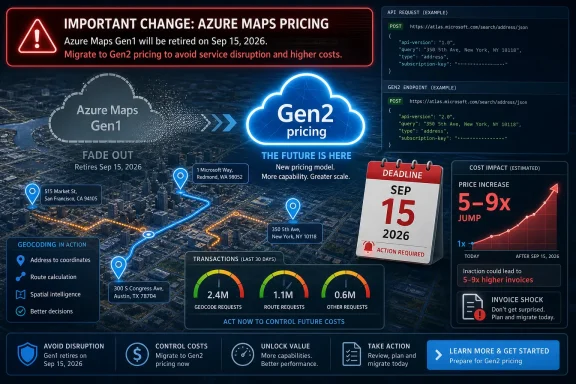 Microsoft’s Maps Retirement Turns a Legacy Discount Into a Budget Event
Azure Maps Gen1 has been living on borrowed time since 2023. Microsoft stopped offering the Gen1 tier for new Azure Maps accounts through the Azure Portal in September 2023 and through Azure Resource Manager templates in October 2023. Existing customers were allowed to keep running, but the reprieve came with a hard stop: September 15, 2026.That long runway is typical of Microsoft’s better-managed cloud retirements. Customers have had three years to notice, plan, and migrate. But long warnings can create a strange kind of complacency, especially for services that are not treated as strategic infrastructure.
Maps APIs often sit in the background. They power address lookup boxes, delivery dashboards, store locators, logistics tools, field-service apps, asset-tracking screens, and Power BI-adjacent reporting workflows. They may not attract the same internal scrutiny as compute, storage, identity, or security tooling, but they can generate large numbers of billable transactions precisely because they are embedded in everyday business processes.
That is why this retirement matters. A VM family retirement can force a migration project; a pricing-tier retirement can produce the same urgency without changing a line of application code. The service continues, the endpoint still responds, and the first clear sign of trouble may be a larger-than-expected Azure bill.
Gen2 Is Not Just a Price Hike, but It Can Behave Like One
Microsoft’s argument for Gen2 is not absurd. Gen2 simplifies the Azure Maps pricing structure, unlocks access to all Azure Maps features, adds volume-based discounts, and removes some of the constraints associated with older tiers. For customers using a broad set of Azure Maps capabilities, especially at scale, Gen2 may be cleaner and more flexible than the Gen1 model it replaces.But cloud pricing is never judged in the abstract. It is judged against a workload.
OnTerra’s example focuses on geocoding, one of the most common Azure Maps use cases. Under the old Gen1 S0 tier, geocoding transactions were priced at $0.50 per 1,000. Under Gen2 list pricing, comparable search/geocoding transactions can be $4.50 per 1,000 before any applicable free monthly allowance or volume discount is applied. That turns a $50 monthly workload at 100,000 transactions into something closer to $450 at list rates, and a $500 monthly workload at 1 million transactions into something closer to $4,500.
There are caveats, and they matter. Azure’s public pricing page includes free monthly transaction allowances for certain meters, and enterprise customers may have negotiated terms that differ from public list pricing. Gen2 also applies discounts at higher monthly usage levels, and not every Azure Maps workload maps neatly to a single geocoding price comparison.
Still, the headline risk is real. The customers most exposed are likely to be the ones who chose Gen1 S0 because it was cheap, simple, and adequate. They may not need every Azure Maps feature. They may not generate enough volume to meaningfully offset the increase. They may only discover the new economics after automatic migration.
The Cloud’s Quietest Lock-In Is Often a Small API
When people talk about cloud lock-in, they usually mean databases, identity systems, proprietary serverless runtimes, or massive data gravity. Those are real. But the Azure Maps retirement illustrates a subtler form of dependency: the small API that becomes operationally indispensable.A geocoding call seems portable until it is not. Different providers return different confidence scores, address formats, rate-limit behavior, coordinate precision, licensing terms, caching rules, routing assumptions, map styles, and data coverage. A migration that looks like a simple endpoint swap can become a messy audit of user experience, legal constraints, and downstream data expectations.
That is especially true in regulated or operationally sensitive environments. A healthcare network locating facilities, a municipal agency routing field crews, a retailer maintaining store search, or a logistics company estimating routes cannot treat map results as decorative UI. Location data becomes part of business logic.
This is where the real switching cost lives. It is not only in the SDK. It is in the accumulated assumptions around what a “good” address match looks like, whether results can be stored, how frequently coordinates are refreshed, how tiles are styled, how maps perform at peak, and which teams know how to debug failures.
Microsoft has not turned Azure Maps off. It has not pulled the rug out from under customers without notice. But it is retiring an economic model that some customers built around. That is enough to force a vendor decision.
The September Date Is a Governance Test
For sysadmins and cloud administrators, the first task is not philosophical. It is inventory.Every Azure Maps account still on Gen1 needs to be identified. Every application consuming that account needs an owner. Every high-volume meter needs a cost model. The uncomfortable part is that many organizations will not have a clean map of their map usage.
That irony is common in cloud estates. A service added for one application gets reused by another. A test key becomes a production dependency. A dashboard created by one team becomes a daily workflow for another. Years later, finance sees a line item, engineering sees an API key, and no one can immediately say what would break if the service changed.
Azure gives administrators tools to review usage and cost analysis, but this is still a human governance problem. The most useful question is not simply, “How many Azure Maps transactions did we use last month?” It is, “Which business process created them, and what would we do if that cost multiplied?”
That distinction matters because usage alone can mislead. A public-facing store locator with bursty seasonal traffic has a different risk profile from a nightly batch geocoding process. A fleet-management app with strict routing requirements is different from an internal dashboard that could be redesigned around cached coordinates. A workload that appears expensive may be easy to optimize, while a smaller workload may be politically impossible to change.
The Competitors Are Not Automatically Cheaper
OnTerra points customers toward alternatives including Google Maps Platform, HERE Technologies, and other geospatial providers. That is sensible advice, but it should not be mistaken for a guarantee that migration equals savings.The mapping market is mature, competitive, and deeply segmented. Google is a strong default for consumer-facing map experiences, places data, and developer familiarity. HERE has long-standing credibility in automotive, logistics, routing, and enterprise location services. Esri, Mapbox, TomTom, OpenStreetMap-based providers, and specialized geocoding vendors all have their own strengths.
They also have their own billing traps. Some providers price by request, some by session, some by asset, some by route element, some by tile, and some by a blended SKU that looks simple until usage changes. Caching and storage rights can matter as much as request pricing. Display restrictions can matter more than the API response.
That is why the correct response to Azure Maps Gen1 retirement is not a panic migration. It is a workload-by-workload comparison. The cheapest geocoder may not be the right routing engine. The best map tile provider may not be the right places database. The platform with the lowest public list price may become expensive under the wrong usage pattern.
Microsoft’s advantage is integration. Azure Maps sits naturally inside Azure governance, identity, billing, networking, and procurement workflows. For organizations standardized on Azure, staying put may be worth paying more than a theoretical cheaper alternative. But that premium should be explicit, not accidental.
Microsoft’s Framing Leaves Out the Smaller Customer’s Pain
Microsoft’s public positioning around Gen2 emphasizes simplicity, feature access, higher query-per-second limits, and cost savings as transaction volumes increase. That framing makes sense for customers who were constrained by Gen1 or who need the wider Azure Maps portfolio. It is less comforting for customers who used Gen1 S0 because they wanted basic mapping at a low predictable cost.This is a familiar cloud pattern. Vendors rationalize older tiers, consolidate SKUs, and push customers toward newer models that align better with the current platform strategy. Sometimes customers gain capabilities. Sometimes they pay more for capabilities they do not need.
Neither side is acting irrationally. Microsoft does not want to maintain legacy pricing structures indefinitely. Customers do not want a stable workload to become more expensive because a pricing abstraction changed. The conflict is not technical; it is economic.
For WindowsForum readers who manage Microsoft-heavy environments, the lesson is broader than Azure Maps. Azure retirements increasingly require FinOps review, not just engineering review. A service replacement, tier migration, or SKU consolidation can be safe from an uptime perspective and still be disruptive from a budget perspective.
The Invoice Shock Is Preventable, Which Makes It Less Forgivable
There is still time. September 15, 2026 is not tomorrow. But in enterprise IT terms, it is close enough that procurement cycles, legal review, application testing, and budget planning can easily consume the remaining runway.A serious review should start with current usage, not vendor preference. Pull Azure Maps transaction data, separate billable meters, identify spikes, and distinguish production usage from development noise. Then model the same usage under Gen2 list pricing, enterprise agreement pricing, and realistic growth assumptions.
Only after that should teams evaluate alternatives. A migration assessment should include API compatibility, data licensing, address-quality testing, routing behavior, latency, authentication, key management, monitoring, and incident response. It should also include the unglamorous work of finding every place where map data is cached, transformed, exported, or embedded in reports.
The worst answer is to wait for the first post-migration invoice and then declare an emergency. Emergency migrations are where teams overpay twice: once for the new bill, and again for rushed engineering.
This Is a Maps Story, but It Is Really a FinOps Story
The Azure Maps Gen1 retirement lands at a moment when IT departments are already under pressure to explain cloud spend with more precision. AI workloads are raising infrastructure expectations. Security tooling keeps expanding. SaaS renewals are under scrutiny. In that environment, a ninefold increase on a quiet API is not just annoying; it is politically visible.FinOps has often focused on compute waste, idle disks, reserved instances, savings plans, and rightsizing. Those remain important. But API-metered services deserve the same discipline because they can scale invisibly with user behavior.
Mapping is a perfect example. A small UI change can increase autocomplete calls. A dashboard refresh interval can multiply tile requests. A batch process can geocode the same records repeatedly because no one implemented caching or deduplication. A public API key can be abused. A business expansion into new regions can change both volume and accuracy requirements.
The pricing-tier migration should therefore trigger not only a vendor review but also a usage review. Some customers may discover they can reduce Azure Maps spend even if they stay on Gen2. Others may find that their application architecture was quietly wasteful under Gen1, and the cheaper tier merely hid it.
The Practical Calendar for Azure Maps Customers Has Already Started
The critical date is September 15, 2026, but the practical deadline is earlier. Budget owners need numbers before annual planning closes. Developers need time to test provider changes. Security teams need to approve new keys, domains, and data flows. Legal teams need to understand whether location data can be stored, cached, or combined with customer records.Organizations that treat the retirement as a procurement issue alone will miss technical risk. Organizations that treat it as a developer issue alone will miss commercial risk. The right owner is probably a small cross-functional group: cloud operations, application engineering, finance, security, and the business unit that depends on the map-enabled workflow.
The work does not have to be dramatic. For many customers, the answer may be to accept Gen2 and budget for it. For others, the answer may be to optimize calls, cache permitted results, or split workloads across providers. For some, especially high-volume but simple geocoding users, a move away from Azure Maps may make economic sense.
The point is to decide before Microsoft decides for you.
The Bill Comes Due Before the Migration Does
The most concrete lesson from OnTerra’s warning is that Azure Maps customers should not confuse service continuity with cost continuity. The application may survive September 15 unchanged. The budget may not.- Organizations still using Azure Maps Standard S0 or Standard S1 should identify those accounts now and assign an application owner to each one.
- Teams should model Gen2 costs using real transaction history rather than relying on average monthly Azure Maps spend.
- Customers should account for free monthly allowances, negotiated Azure pricing, and Gen2 volume discounts before assuming the worst-case public list price.
- Workloads built around high-volume geocoding, search, routing, tiles, traffic, or weather calls should be reviewed separately because each meter can behave differently.
- Alternative providers should be evaluated against technical fit and licensing rules, not just the apparent price per 1,000 requests.
- Any migration plan should leave time for address-quality testing, routing comparison, monitoring changes, procurement review, and user acceptance testing.
References
- Primary source: GlobeNewswire
Published: Mon, 22 Jun 2026 12:00:00 GMT
Azure Maps Gen1 Pricing Customers To Be Migrated To Gen2
OnTerra Systems reminds Azure Maps Gen1 customers that pricing will be automatically switched to Gen2 pricing on Sept. 15 2026 - with much higher costs....www.globenewswire.com - Official source: learn.microsoft.com
Retirement Announcement -- Azure Maps Gen1 Price Tier - Microsoft Q&A
Azure Maps Gen1 (Standard S0 and Standard S1) Price Tier will be retired on 15 September 2026, please transition to Azure Maps Gen2 Price Tier by that date. Gen2 Price Tier, which offers simplified pricing, better flexibility in accessing all Azure…learn.microsoft.com - Official source: azure.microsoft.com
- Related coverage: epcgroup.net
Azure Maps Pricing 2026: Free Tier Limits + PAYG Real Costs
Azure Maps pricing, features, real-time mapping, geospatial services, route + traffic + weather APIs — enterprise decision guide.www.epcgroup.net - Related coverage: acom-sandbox.azure.net
Azure Maps – Geospatial Mapping APIs | Microsoft Azure
Add location intelligence, maps, traffic, and mobility capabilities to your apps with Microsoft Azure Maps, geospatial mapping APIs for IoT and enterprise systems.acom-sandbox.azure.net - Official source: techcommunity.microsoft.com
- Related coverage: assets.applytosupply.digitalmarketplace.service.gov.uk
G-Cloud 14 Google Maps Pricing 2024
PDF documentassets.applytosupply.digitalmarketplace.service.gov.uk
- Related coverage: ospi.k12.wa.us
</rdf:Alt> </dc:title> <dc:description> <rdf:Alt> <rdf:li xml:lang="x-default"/> </rdf:Alt> </dc:description> <dc:creator> <rdf:Seq> <rdf:li>Kris Hi
</rdf:Alt> </dc:description> <dc:creator> <rdf:Seq> <rdf:li>Kris Hicks-Greenospi.k12.wa.us