
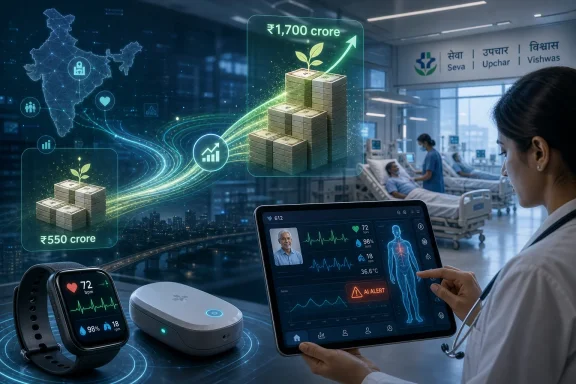
HealthQuad announced on June 19, 2026, that its third fund has reached a first close of ₹550 crore, giving the Quadria-backed healthcare investor enough committed capital to begin backing roughly 13 to 15 Indian healthtech and healthcare startups. The larger target is ₹1,700 crore, which makes this not merely another fundraise but a bet that India’s next healthcare winners will need specialist capital, not just growth-stage enthusiasm. The first cheque has already gone to Lifesigns, an AI-powered remote patient-monitoring company, and that choice says plenty about where HealthQuad believes the market is moving. In a year when startup capital is still being rationed carefully, the announcement lands as a vote for healthcare infrastructure disguised as a venture-capital headline.
The easy version of healthtech was always seductive: put consultations on phones, digitise appointments, move medicine ordering into apps, and let scale do the rest. India’s first digital-health wave produced some durable companies, but it also exposed a harsher truth. Healthcare is not e-commerce with a stethoscope attached.
The sector is regulated, trust-heavy, outcome-sensitive, and operationally messy. A consumer app can acquire users with discounts and clever onboarding; a healthcare company has to earn the confidence of doctors, hospitals, patients, insurers, regulators, and sometimes families making decisions under stress. That makes venture investing in the sector both more difficult and more consequential.
HealthQuad’s Fund III is therefore interesting less because of the headline ₹550 crore and more because of the implied thesis. The firm is not presenting this as a scattershot fund for fashionable wellness apps. It is talking about AI-led care, digital therapeutics, ambulatory models, enterprise software for healthcare providers, and point-of-care devices — areas where software meets clinical workflow and where execution tends to be slower than pitch decks admit.
That is also why the first close matters. A first close is not the final pile of money; it is the threshold at which a fund has enough committed capital to start investing. HealthQuad has crossed that threshold at more than a third of its target corpus, which gives it dry powder and credibility while it continues raising toward ₹1,700 crore.
In venture capital terms, the first close is the moment the fund stops being a plan and becomes a buyer. In healthcare, that distinction matters because the best companies often need patient investors who understand long sales cycles, compliance burdens, hospital procurement, clinical validation, and the uncomfortable gap between “technology works” and “health system adopts it.”
HealthQuad is targeting ₹1,700 crore for Fund III, or roughly $180 million depending on exchange-rate assumptions. The first close, at about ₹550 crore, is meaningful because it allows the firm to begin deployment while continuing to bring in limited partners. It also gives prospective LPs a useful signal: other investors have already committed enough capital for the vehicle to operate.
That matters in a market where limited partners have become more selective. The 2020–2022 startup cycle left many allocators with a clearer memory of excess than of innovation. Valuations ran ahead of fundamentals, digital adoption was pulled forward by the pandemic, and some business models that looked inevitable in lockdown conditions later struggled to prove durable demand.
Healthcare was not immune. Telemedicine, diagnostics platforms, digital pharmacies, and wellness apps all benefited from heightened urgency during the pandemic years. But the post-pandemic market separated companies that solved entrenched healthcare problems from those that merely captured temporary behaviour shifts. HealthQuad’s new fund is being raised into that more discriminating landscape.
The first close therefore functions as a market readout. Existing investors returning and new local and global LPs joining suggest that institutional capital still sees Indian healthcare as investable, provided the investor has a specialist lens. Generalist growth capital may be cautious, but sector-focused funds can still raise if they can argue that they understand the terrain better than tourists.
This is where HealthQuad’s positioning matters. A healthcare-focused investor can bring domain networks, regulatory familiarity, hospital relationships, and a more realistic sense of adoption timelines. That does not guarantee success, but it can reduce the odds of backing a company that looks like software and behaves like infrastructure.
The firm’s earlier Fund II closed at $162 million in 2022, giving HealthQuad a track record to point to as it raises its third vehicle. Its portfolio has included companies such as Qure.ai, Wysa, Redcliffe Labs, GoApptiv, and Cureskin — names that span diagnostics, AI, mental health, distribution, and consumer-facing care. That spread is useful because it shows the firm is not locked into a single interpretation of healthtech.
Fund III appears to sharpen that approach. The planned 13 to 15 investments imply meaningful cheque sizes rather than a spray-and-pray portfolio. The emphasis on early-growth-stage companies also suggests HealthQuad is looking for startups that have moved beyond proof of concept but still need capital and institutional help to scale.
That is a narrow and difficult window. Seed-stage healthtech is full of technical promise but high mortality. Late-stage healthtech can be capital intensive and valuation-sensitive. Early growth is where a company may have product-market evidence but still needs to prove repeatable sales, clinical reliability, and operational scale. It is also where specialist investors can matter most.
Patient monitoring is not glamorous in the consumer-app sense. It is plumbing. It involves devices, data streams, alerts, dashboards, clinical escalation, and integration with care teams that are already overloaded. If it works, it can help clinicians detect deterioration earlier, manage patients beyond the ward, and extend care into homes or lower-acuity settings.
That is precisely the kind of problem Indian healthcare needs solved. India has world-class hospital systems in major cities, but access remains uneven, clinical staff are stretched, and the burden of chronic disease continues to rise. A platform that can monitor patients continuously and intelligently could help redistribute scarce medical attention — but only if it is trusted, accurate, and operationally usable.
AI gives the category its current market heat, but AI is not the product by itself. In healthcare, an algorithm is only valuable if it reduces noise rather than adding more of it. False alarms exhaust clinicians; missed signals can be dangerous. The real challenge for companies like Lifesigns is to convert streams of patient data into timely, actionable intelligence that medical teams will actually use.
HealthQuad’s decision to begin Fund III here suggests it sees remote monitoring as more than a pandemic-era convenience. It is a bet on the hospital of the future becoming more distributed, more data-rich, and more dependent on tools that can extend clinical oversight beyond beds and walls.
The more serious opportunity is not in replacing doctors with software. It is in compressing the time between observation and action. In radiology, that may mean helping identify suspicious findings faster. In patient monitoring, it may mean prioritising alerts. In operations, it may mean forecasting demand, reducing no-shows, or improving resource utilisation. In therapeutics, it may mean personalising interventions or tracking adherence.
For India, the AI argument is especially powerful because healthcare capacity is constrained. The country does not have the luxury of solving every access problem by adding equivalent numbers of clinicians, specialists, beds, and laboratories. Technology that improves productivity without compromising care quality can have outsized impact.
But healthcare AI must survive a higher burden of proof than ordinary enterprise software. It has to be explainable enough for clinicians, robust enough across populations, and reliable enough in messy real-world settings. It must also navigate data privacy, consent, interoperability, and the practical reality that many healthcare institutions still run on fragmented systems.
That is why investor discipline matters. If Fund III simply chases anything with “AI” in the deck, it will inherit the same overpromising problem seen across the broader AI economy. If it backs companies where AI is embedded in a clinically necessary workflow, it has a better chance of producing businesses that endure after the hype cycle cools.
The best healthcare AI, in other words, may eventually become invisible. It will not be sold as magic. It will be sold as fewer missed warnings, faster diagnosis, better triage, lower administrative load, and care teams that can do more with the capacity they already have.
But market size is not the same as market readiness. Healthcare demand is vast, but willingness and ability to pay vary sharply. Hospitals may need software but delay procurement. Patients may want convenience but resist recurring costs. Doctors may appreciate tools that help them but reject tools that interfere with judgment or add administrative friction.
This is where Fund III’s listed focus areas fit together. Ambulatory care reflects the movement of treatment away from expensive inpatient settings. Digital therapeutics try to turn software into measurable clinical intervention. Enterprise SaaS addresses the provider side of healthcare, where digitisation remains incomplete. Point-of-care devices aim to bring testing and diagnosis closer to patients. AI sits across all of these categories as an enabling layer.
Taken together, these are not merely startup categories. They are pressure points in the Indian healthcare system. They suggest HealthQuad is looking for companies that make care more accessible, more affordable, more measurable, or more efficient — the four claims every healthtech startup makes, but only a minority can prove.
The Southeast Asia option adds another wrinkle. HealthQuad says the fund may invest selectively beyond India, and that makes strategic sense. Many Southeast Asian markets share similar healthcare constraints: fragmented delivery, urban-rural gaps, mixed public-private systems, and rising demand for digital infrastructure. A company that solves a real problem in India may find adjacent markets, though expansion in healthcare is rarely as simple as translating an app.
The real prize is not regional branding. It is the possibility that Indian healthcare companies can become exportable infrastructure businesses. If a startup builds a monitoring platform, diagnostic AI tool, hospital workflow system, or point-of-care device that works in India’s cost-sensitive and operationally complex environment, it may have credibility in other emerging markets.
During the pandemic and its immediate aftermath, investors were willing to underwrite aggressive assumptions about digital adoption. In healthcare, some of those assumptions were valid. Patients did become more comfortable with virtual consultations. Providers did accelerate digitisation. Diagnostics, pharmacy, mental health, and chronic-care models received new attention.
But not every pandemic habit became a permanent market. As physical clinics reopened and consumers returned to older patterns, some digital-first models had to rework their economics. Discounts faded. Acquisition costs mattered again. Investors began asking whether startups were expanding access or simply intermediating existing demand at a loss.
HealthQuad’s Fund III enters after that correction. That timing is important because the best vintages in venture are often raised when markets are less euphoric. Founders are more realistic. Valuations are less inflated. Customers are less dazzled by novelty and more focused on measurable value. Investors, if disciplined, can buy into better companies at saner prices.
The challenge is that healthcare transformation still requires long-duration capital. A startup selling into hospitals may need years to build trust and distribution. A medical-device company may face manufacturing, certification, and clinical validation hurdles. A digital therapeutic may need evidence of outcomes, not just engagement metrics. These are not businesses that always fit neatly into venture’s impatience.
That is why the size and concentration of Fund III matter. Backing 13 to 15 companies from a ₹1,700 crore target corpus implies HealthQuad is not trying to win by owning tiny pieces of dozens of experiments. It is positioning itself to make more committed bets in companies it believes can scale through complexity.
Quadria is a healthcare-focused private equity firm with a broader Asia strategy, while HealthQuad operates in the venture and early-growth segment. That creates a potentially useful continuum. A company backed early by HealthQuad could, in theory, mature into the type of healthcare asset that larger specialist capital understands. At minimum, the shared domain focus helps distinguish the platform from generalist funds experimenting with healthcare exposure.
There is a risk, too. When a venture brand is tied closely to a larger investment group, founders may wonder whether strategic alignment comes with strategic constraints. The best venture investors help founders navigate choices rather than steering them into predetermined lanes. HealthQuad’s success will depend on whether its ownership structure strengthens its networks without narrowing its imagination.
For LPs, however, a cleaner ownership structure can be reassuring. Healthcare investing requires reputation, continuity, and deep relationships. A fragmented sponsor base can complicate governance. A single controlling platform can make accountability sharper.
That accountability will matter as Fund III deploys. Raising the money is the visible achievement. Returning it, with venture-level performance in a difficult sector, is the harder one.
In enterprise healthcare, adoption is not just a signed contract. It is usage by clinicians, administrators, patients, and care teams. A hospital may buy software that staff barely use. A patient app may show downloads without adherence. A monitoring product may generate data without improving decisions. In healthcare, vanity metrics are not merely misleading; they can be dangerous.
The best Fund III companies will likely have a few traits in common. They will solve painful workflow problems, not imagined ones. They will fit into existing behaviour before trying to transform it. They will generate evidence that customers value. They will understand who pays, who uses, who benefits, and who carries risk.
That last point is critical. Healthcare startups often confuse the patient, the user, the buyer, and the beneficiary. A tool may help a patient but be purchased by a hospital. It may reduce insurer costs but require physician adoption. It may create public-health value but lack a direct revenue model. Companies that do not map these incentives accurately struggle to scale.
HealthQuad’s specialist pitch is that it can identify these traps earlier than generalist capital. Fund III will test that claim. If the portfolio produces durable companies, the first close will look like an early sign of institutional conviction. If not, it will become another reminder that healthcare’s problems are obvious but not easily monetised.
AI inference, edge devices, secure data exchange, identity, endpoint management, cloud compliance, observability, and enterprise SaaS reliability all show up in modern healthcare. A remote-monitoring platform is not just a medical product; it is a distributed computing problem with human consequences. A hospital SaaS system is not just a dashboard; it is part of an operational environment where downtime and bad data have real costs.
For IT professionals, the healthcare sector is a preview of the broader enterprise future. More devices will sit near users and patients. More data will be generated continuously. More decisions will be assisted by algorithms. More systems will need to interoperate across vendors, regulators, and legacy infrastructure. The attack surface will grow as care moves beyond hospital walls.
India’s scale makes this especially important. If healthtech companies can build reliable, low-cost, secure systems for Indian conditions, they may produce architectures and practices relevant far beyond the domestic market. Conversely, if they cut corners on privacy, security, or clinical validation, the damage could be equally instructive.
That is where venture funding has a public dimension. Capital does not merely accelerate companies; it shapes what they optimise for. A fund that rewards defensible clinical value and robust infrastructure can nudge the market in one direction. A fund that rewards superficial AI branding and fast but fragile growth nudges it in another.
HealthQuad’s Fund III will therefore be worth watching not just as a startup-financing story but as a signal of what kind of healthtech India’s specialist investors want to build.
Remote monitoring can extend oversight. Point-of-care diagnostics can reduce delays. Enterprise software can improve throughput and coordination. Digital therapeutics can support patients between doctor visits. AI can prioritise attention where it is scarce. None of these ideas is new, but all of them become more valuable when healthcare systems are under strain.
The risk is that venture capital prefers scalable abstractions while healthcare demands grounded execution. A pitch deck can say “democratise access”; a district hospital needs a device that works in heat, dust, patchy connectivity, and busy wards. A founder can promise AI-powered care; a doctor needs a tool that does not bury useful signals under false positives. A fund can talk about affordability; patients still need pricing that works in real life.
HealthQuad’s new fund sits exactly at that tension. It is designed to profit from companies that improve healthcare, but improvement must be demonstrated in systems that are difficult to change. The firm’s advantage, if it has one, is that it appears to understand healthcare as a sector of constraints rather than a market waiting passively for software.
The broader Indian startup ecosystem could use more of that realism. The funding winter punished excess, but it also created room for investors who can tell the difference between hard problems and bad businesses. Healthcare has plenty of the former. HealthQuad is betting that enough founders can avoid the latter.
 HealthQuad Is Buying Into the Hard Part of Indian Healthtech
The easy version of healthtech was always seductive: put consultations on phones, digitise appointments, move medicine ordering into apps, and let scale do the rest. India’s first digital-health wave produced some durable companies, but it also exposed a harsher truth. Healthcare is not e-commerce with a stethoscope attached.The sector is regulated, trust-heavy, outcome-sensitive, and operationally messy. A consumer app can acquire users with discounts and clever onboarding; a healthcare company has to earn the confidence of doctors, hospitals, patients, insurers, regulators, and sometimes families making decisions under stress. That makes venture investing in the sector both more difficult and more consequential.
HealthQuad’s Fund III is therefore interesting less because of the headline ₹550 crore and more because of the implied thesis. The firm is not presenting this as a scattershot fund for fashionable wellness apps. It is talking about AI-led care, digital therapeutics, ambulatory models, enterprise software for healthcare providers, and point-of-care devices — areas where software meets clinical workflow and where execution tends to be slower than pitch decks admit.
That is also why the first close matters. A first close is not the final pile of money; it is the threshold at which a fund has enough committed capital to start investing. HealthQuad has crossed that threshold at more than a third of its target corpus, which gives it dry powder and credibility while it continues raising toward ₹1,700 crore.
In venture capital terms, the first close is the moment the fund stops being a plan and becomes a buyer. In healthcare, that distinction matters because the best companies often need patient investors who understand long sales cycles, compliance burdens, hospital procurement, clinical validation, and the uncomfortable gap between “technology works” and “health system adopts it.”
The ₹550 Crore First Close Is a Signal, Not a Finish Line
The temptation is to treat ₹550 crore as the story. It is a large number, particularly in a funding environment where founders have become more accustomed to tighter diligence, smaller rounds, and tougher questions about profitability. But in fund mechanics, this is only the opening act.HealthQuad is targeting ₹1,700 crore for Fund III, or roughly $180 million depending on exchange-rate assumptions. The first close, at about ₹550 crore, is meaningful because it allows the firm to begin deployment while continuing to bring in limited partners. It also gives prospective LPs a useful signal: other investors have already committed enough capital for the vehicle to operate.
That matters in a market where limited partners have become more selective. The 2020–2022 startup cycle left many allocators with a clearer memory of excess than of innovation. Valuations ran ahead of fundamentals, digital adoption was pulled forward by the pandemic, and some business models that looked inevitable in lockdown conditions later struggled to prove durable demand.
Healthcare was not immune. Telemedicine, diagnostics platforms, digital pharmacies, and wellness apps all benefited from heightened urgency during the pandemic years. But the post-pandemic market separated companies that solved entrenched healthcare problems from those that merely captured temporary behaviour shifts. HealthQuad’s new fund is being raised into that more discriminating landscape.
The first close therefore functions as a market readout. Existing investors returning and new local and global LPs joining suggest that institutional capital still sees Indian healthcare as investable, provided the investor has a specialist lens. Generalist growth capital may be cautious, but sector-focused funds can still raise if they can argue that they understand the terrain better than tourists.
Specialist Capital Has Become Healthcare’s Quiet Advantage
Healthcare startups often fail in ways that generalist investors underestimate. They do not always fail because the product is bad. They fail because the product cannot be integrated into clinical routines, because hospitals do not change procurement easily, because doctors do not trust black-box systems, because reimbursement is unclear, or because distribution costs overwhelm unit economics.This is where HealthQuad’s positioning matters. A healthcare-focused investor can bring domain networks, regulatory familiarity, hospital relationships, and a more realistic sense of adoption timelines. That does not guarantee success, but it can reduce the odds of backing a company that looks like software and behaves like infrastructure.
The firm’s earlier Fund II closed at $162 million in 2022, giving HealthQuad a track record to point to as it raises its third vehicle. Its portfolio has included companies such as Qure.ai, Wysa, Redcliffe Labs, GoApptiv, and Cureskin — names that span diagnostics, AI, mental health, distribution, and consumer-facing care. That spread is useful because it shows the firm is not locked into a single interpretation of healthtech.
Fund III appears to sharpen that approach. The planned 13 to 15 investments imply meaningful cheque sizes rather than a spray-and-pray portfolio. The emphasis on early-growth-stage companies also suggests HealthQuad is looking for startups that have moved beyond proof of concept but still need capital and institutional help to scale.
That is a narrow and difficult window. Seed-stage healthtech is full of technical promise but high mortality. Late-stage healthtech can be capital intensive and valuation-sensitive. Early growth is where a company may have product-market evidence but still needs to prove repeatable sales, clinical reliability, and operational scale. It is also where specialist investors can matter most.
Lifesigns Shows Where the Fund’s Conviction Begins
HealthQuad’s first disclosed Fund III investment is Lifesigns, an AI-powered remote patient-monitoring platform. The investment amount has not been publicly disclosed, but the choice is revealing. Remote monitoring sits at the intersection of hospital pressure, chronic-disease management, clinician shortages, and the broader push to move more care outside traditional inpatient settings.Patient monitoring is not glamorous in the consumer-app sense. It is plumbing. It involves devices, data streams, alerts, dashboards, clinical escalation, and integration with care teams that are already overloaded. If it works, it can help clinicians detect deterioration earlier, manage patients beyond the ward, and extend care into homes or lower-acuity settings.
That is precisely the kind of problem Indian healthcare needs solved. India has world-class hospital systems in major cities, but access remains uneven, clinical staff are stretched, and the burden of chronic disease continues to rise. A platform that can monitor patients continuously and intelligently could help redistribute scarce medical attention — but only if it is trusted, accurate, and operationally usable.
AI gives the category its current market heat, but AI is not the product by itself. In healthcare, an algorithm is only valuable if it reduces noise rather than adding more of it. False alarms exhaust clinicians; missed signals can be dangerous. The real challenge for companies like Lifesigns is to convert streams of patient data into timely, actionable intelligence that medical teams will actually use.
HealthQuad’s decision to begin Fund III here suggests it sees remote monitoring as more than a pandemic-era convenience. It is a bet on the hospital of the future becoming more distributed, more data-rich, and more dependent on tools that can extend clinical oversight beyond beds and walls.
AI in Healthcare Is Useful Only When It Becomes Boring
The phrase “AI-driven healthcare” now appears in almost every investor presentation, corporate strategy note, and startup announcement. That ubiquity is both exciting and dangerous. AI is real, but the market’s language around it is often vague enough to make every analytics dashboard sound revolutionary.The more serious opportunity is not in replacing doctors with software. It is in compressing the time between observation and action. In radiology, that may mean helping identify suspicious findings faster. In patient monitoring, it may mean prioritising alerts. In operations, it may mean forecasting demand, reducing no-shows, or improving resource utilisation. In therapeutics, it may mean personalising interventions or tracking adherence.
For India, the AI argument is especially powerful because healthcare capacity is constrained. The country does not have the luxury of solving every access problem by adding equivalent numbers of clinicians, specialists, beds, and laboratories. Technology that improves productivity without compromising care quality can have outsized impact.
But healthcare AI must survive a higher burden of proof than ordinary enterprise software. It has to be explainable enough for clinicians, robust enough across populations, and reliable enough in messy real-world settings. It must also navigate data privacy, consent, interoperability, and the practical reality that many healthcare institutions still run on fragmented systems.
That is why investor discipline matters. If Fund III simply chases anything with “AI” in the deck, it will inherit the same overpromising problem seen across the broader AI economy. If it backs companies where AI is embedded in a clinically necessary workflow, it has a better chance of producing businesses that endure after the hype cycle cools.
The best healthcare AI, in other words, may eventually become invisible. It will not be sold as magic. It will be sold as fewer missed warnings, faster diagnosis, better triage, lower administrative load, and care teams that can do more with the capacity they already have.
India’s Healthcare Gap Is Also a Market Map
The structural case for Indian healthtech is not hard to make. India has a large population, rising incomes, uneven access to quality care, high out-of-pocket spending, growing chronic-disease burdens, and increasing digital adoption. Those conditions create both social need and commercial opportunity.But market size is not the same as market readiness. Healthcare demand is vast, but willingness and ability to pay vary sharply. Hospitals may need software but delay procurement. Patients may want convenience but resist recurring costs. Doctors may appreciate tools that help them but reject tools that interfere with judgment or add administrative friction.
This is where Fund III’s listed focus areas fit together. Ambulatory care reflects the movement of treatment away from expensive inpatient settings. Digital therapeutics try to turn software into measurable clinical intervention. Enterprise SaaS addresses the provider side of healthcare, where digitisation remains incomplete. Point-of-care devices aim to bring testing and diagnosis closer to patients. AI sits across all of these categories as an enabling layer.
Taken together, these are not merely startup categories. They are pressure points in the Indian healthcare system. They suggest HealthQuad is looking for companies that make care more accessible, more affordable, more measurable, or more efficient — the four claims every healthtech startup makes, but only a minority can prove.
The Southeast Asia option adds another wrinkle. HealthQuad says the fund may invest selectively beyond India, and that makes strategic sense. Many Southeast Asian markets share similar healthcare constraints: fragmented delivery, urban-rural gaps, mixed public-private systems, and rising demand for digital infrastructure. A company that solves a real problem in India may find adjacent markets, though expansion in healthcare is rarely as simple as translating an app.
The real prize is not regional branding. It is the possibility that Indian healthcare companies can become exportable infrastructure businesses. If a startup builds a monitoring platform, diagnostic AI tool, hospital workflow system, or point-of-care device that works in India’s cost-sensitive and operationally complex environment, it may have credibility in other emerging markets.
The Post-Pandemic Funding Reset Has Made Healthtech More Serious
The user-growth era rewarded speed. The current era rewards proof. That shift has been painful for many startups, but it may be healthy for healthcare.During the pandemic and its immediate aftermath, investors were willing to underwrite aggressive assumptions about digital adoption. In healthcare, some of those assumptions were valid. Patients did become more comfortable with virtual consultations. Providers did accelerate digitisation. Diagnostics, pharmacy, mental health, and chronic-care models received new attention.
But not every pandemic habit became a permanent market. As physical clinics reopened and consumers returned to older patterns, some digital-first models had to rework their economics. Discounts faded. Acquisition costs mattered again. Investors began asking whether startups were expanding access or simply intermediating existing demand at a loss.
HealthQuad’s Fund III enters after that correction. That timing is important because the best vintages in venture are often raised when markets are less euphoric. Founders are more realistic. Valuations are less inflated. Customers are less dazzled by novelty and more focused on measurable value. Investors, if disciplined, can buy into better companies at saner prices.
The challenge is that healthcare transformation still requires long-duration capital. A startup selling into hospitals may need years to build trust and distribution. A medical-device company may face manufacturing, certification, and clinical validation hurdles. A digital therapeutic may need evidence of outcomes, not just engagement metrics. These are not businesses that always fit neatly into venture’s impatience.
That is why the size and concentration of Fund III matter. Backing 13 to 15 companies from a ₹1,700 crore target corpus implies HealthQuad is not trying to win by owning tiny pieces of dozens of experiments. It is positioning itself to make more committed bets in companies it believes can scale through complexity.
Quadria’s Full Control Makes the Platform Cleaner, and More Accountable
HealthQuad is now fully owned by Quadria Group through HealthQuad Advisors, following the reported split with Belgium-based KIOS in 2025. Corporate-control details can sound like inside baseball, but they matter in fund management. LPs want clarity about who owns the platform, who makes decisions, and how investment strategy aligns with the broader parent group.Quadria is a healthcare-focused private equity firm with a broader Asia strategy, while HealthQuad operates in the venture and early-growth segment. That creates a potentially useful continuum. A company backed early by HealthQuad could, in theory, mature into the type of healthcare asset that larger specialist capital understands. At minimum, the shared domain focus helps distinguish the platform from generalist funds experimenting with healthcare exposure.
There is a risk, too. When a venture brand is tied closely to a larger investment group, founders may wonder whether strategic alignment comes with strategic constraints. The best venture investors help founders navigate choices rather than steering them into predetermined lanes. HealthQuad’s success will depend on whether its ownership structure strengthens its networks without narrowing its imagination.
For LPs, however, a cleaner ownership structure can be reassuring. Healthcare investing requires reputation, continuity, and deep relationships. A fragmented sponsor base can complicate governance. A single controlling platform can make accountability sharper.
That accountability will matter as Fund III deploys. Raising the money is the visible achievement. Returning it, with venture-level performance in a difficult sector, is the harder one.
The Portfolio Will Be Judged by Adoption, Not Announcements
The next few years will bring the usual rhythm of venture news: seed extensions, Series A rounds, hospital partnerships, regulatory milestones, and product launches. Some will sound impressive. Many will be strategically framed. The more important question is whether HealthQuad’s companies can become embedded in the healthcare system rather than orbiting around it.In enterprise healthcare, adoption is not just a signed contract. It is usage by clinicians, administrators, patients, and care teams. A hospital may buy software that staff barely use. A patient app may show downloads without adherence. A monitoring product may generate data without improving decisions. In healthcare, vanity metrics are not merely misleading; they can be dangerous.
The best Fund III companies will likely have a few traits in common. They will solve painful workflow problems, not imagined ones. They will fit into existing behaviour before trying to transform it. They will generate evidence that customers value. They will understand who pays, who uses, who benefits, and who carries risk.
That last point is critical. Healthcare startups often confuse the patient, the user, the buyer, and the beneficiary. A tool may help a patient but be purchased by a hospital. It may reduce insurer costs but require physician adoption. It may create public-health value but lack a direct revenue model. Companies that do not map these incentives accurately struggle to scale.
HealthQuad’s specialist pitch is that it can identify these traps earlier than generalist capital. Fund III will test that claim. If the portfolio produces durable companies, the first close will look like an early sign of institutional conviction. If not, it will become another reminder that healthcare’s problems are obvious but not easily monetised.
Why This Matters to Technologists Beyond India
At first glance, a healthcare VC fund in India may seem distant from the concerns of Windows administrators, enterprise developers, and infrastructure-minded readers. It is not. Healthcare is one of the sectors where the next decade of computing will be most visibly tested.AI inference, edge devices, secure data exchange, identity, endpoint management, cloud compliance, observability, and enterprise SaaS reliability all show up in modern healthcare. A remote-monitoring platform is not just a medical product; it is a distributed computing problem with human consequences. A hospital SaaS system is not just a dashboard; it is part of an operational environment where downtime and bad data have real costs.
For IT professionals, the healthcare sector is a preview of the broader enterprise future. More devices will sit near users and patients. More data will be generated continuously. More decisions will be assisted by algorithms. More systems will need to interoperate across vendors, regulators, and legacy infrastructure. The attack surface will grow as care moves beyond hospital walls.
India’s scale makes this especially important. If healthtech companies can build reliable, low-cost, secure systems for Indian conditions, they may produce architectures and practices relevant far beyond the domestic market. Conversely, if they cut corners on privacy, security, or clinical validation, the damage could be equally instructive.
That is where venture funding has a public dimension. Capital does not merely accelerate companies; it shapes what they optimise for. A fund that rewards defensible clinical value and robust infrastructure can nudge the market in one direction. A fund that rewards superficial AI branding and fast but fragile growth nudges it in another.
HealthQuad’s Fund III will therefore be worth watching not just as a startup-financing story but as a signal of what kind of healthtech India’s specialist investors want to build.
The Real Test Is Whether Capital Can Become Capacity
The healthcare story in India is often told in terms of gaps: too few specialists, uneven rural access, crowded hospitals, high patient costs, and inconsistent quality. Technology cannot erase those problems by itself. But it can change the leverage of existing capacity.Remote monitoring can extend oversight. Point-of-care diagnostics can reduce delays. Enterprise software can improve throughput and coordination. Digital therapeutics can support patients between doctor visits. AI can prioritise attention where it is scarce. None of these ideas is new, but all of them become more valuable when healthcare systems are under strain.
The risk is that venture capital prefers scalable abstractions while healthcare demands grounded execution. A pitch deck can say “democratise access”; a district hospital needs a device that works in heat, dust, patchy connectivity, and busy wards. A founder can promise AI-powered care; a doctor needs a tool that does not bury useful signals under false positives. A fund can talk about affordability; patients still need pricing that works in real life.
HealthQuad’s new fund sits exactly at that tension. It is designed to profit from companies that improve healthcare, but improvement must be demonstrated in systems that are difficult to change. The firm’s advantage, if it has one, is that it appears to understand healthcare as a sector of constraints rather than a market waiting passively for software.
The broader Indian startup ecosystem could use more of that realism. The funding winter punished excess, but it also created room for investors who can tell the difference between hard problems and bad businesses. Healthcare has plenty of the former. HealthQuad is betting that enough founders can avoid the latter.
The ₹550 Crore Bet Narrows the Field of Hype
The most concrete reading of HealthQuad Fund III is also the most useful one: specialist capital is still available for Indian healthtech, but it is likely to flow toward companies that can prove operational and clinical relevance. The first close does not guarantee a boom. It raises the standard for what the next boom should look like.- HealthQuad has reached a ₹550 crore first close for Fund III, allowing it to begin investing while it continues raising toward a ₹1,700 crore target.
- The fund plans to back roughly 13 to 15 companies, which points to a concentrated early-growth strategy rather than a broad portfolio of tiny experiments.
- Lifesigns, an AI-powered remote patient-monitoring platform, is the first disclosed investment and signals a focus on infrastructure-like healthcare technology.
- Fund III’s stated areas — AI healthcare, digital therapeutics, ambulatory care, enterprise SaaS, and point-of-care devices — align with pressure points in India’s healthcare system.
- The fundraise arrives after a tougher funding cycle, making proof of adoption, unit economics, and clinical value more important than pandemic-era growth narratives.
- HealthQuad’s specialist model will be judged less by fundraising headlines than by whether its portfolio companies become trusted parts of real care delivery.
References
- Primary source: Lapaas Voice
Published: 2026-06-23T09:55:16.298555
Loading…
voice.lapaas.com - Related coverage: startup.economictimes.indiatimes.com
Loading…
startup.economictimes.indiatimes.com - Related coverage: indianweb2.com
Loading…
www.indianweb2.com - Related coverage: moneycontrol.com
Loading…
www.moneycontrol.com - Related coverage: business-standard.com
Loading…
www.business-standard.com - Related coverage: prnewswire.com
Loading…
www.prnewswire.com
- Related coverage: inc42.com
Loading…
inc42.com - Related coverage: healthquad.in
Loading…
www.healthquad.in - Related coverage: dealstreetasia.com
Loading…
www.dealstreetasia.com - Related coverage: financetom.com
Loading…
www.financetom.com - Related coverage: livemint.com
Loading…
www.livemint.com - Related coverage: inkl.com
Loading…
www.inkl.com