
Norway said in June 2026 that it would sharply limit generative AI in schools, keep it largely away from younger pupils, and require better access to printed textbooks as part of a broader retreat from uncritical classroom digitalisation. The move is not a rejection of technology so much as a public admission that the first wave of school digitisation was sold with more confidence than evidence. For India, where edtech platforms and AI tutors are expanding into homes and classrooms at remarkable speed, Norway’s reversal is less a curiosity from northern Europe than a warning flare. Even a rich, digitally mature country is now asking whether children learned to use screens before they learned to read deeply.
The most important thing about Norway’s school AI policy is not that it is restrictive. It is that it is deliberate. After years in which tablets, learning apps, cloud platforms, and now chatbots were often treated as inevitable classroom upgrades, Oslo is trying to restore the idea that education policy should choose technology rather than simply absorb it.
The reported plan draws a clear line between younger and older students. Primary school pupils are expected to face the strictest limits, with generative AI generally kept out of ordinary use. Older students may be allowed to use AI more gradually, but under teacher guidance and with more attention to when the tool helps learning rather than replaces it.
That distinction matters. Norway is not saying that a 17-year-old writing a research paper and a seven-year-old learning sentence structure have the same needs. It is saying the opposite: developmental stage matters, and a tool that may help one student can short-circuit another student’s learning.
This is the part of the debate that often gets lost when AI is discussed as either magic or menace. Schools are not just workplaces with smaller chairs. They are institutions designed around the slow construction of memory, attention, judgment, and confidence. A productivity tool that saves an adult time may deprive a child of the very friction through which competence is formed.
The return of books is also a quiet rebuke to a common assumption in edtech: that digitisation is automatically modernisation. A digital worksheet is not necessarily better than a paper one. A searchable online text is not necessarily better for a child learning sustained attention. A platform dashboard is not necessarily a better signal of understanding than a teacher watching a student wrestle with a paragraph.
Printed books make fewer promises. They do not personalise the lesson, gamify the task, or generate instant feedback. But their limitations are part of their usefulness. They create a learning environment in which the student must stay with the text, not with the interface.
This is why the “books versus screens” framing is too simple. Norway is not trying to recreate a pre-internet schoolhouse. It is trying to recover forms of attention that were weakened when screens became the default surface for nearly every activity. The book is returning not as a museum object, but as a tool for slowing the classroom down.
A tablet can distract a child from reading. A chatbot can go further: it can perform parts of the reading and writing process for the child. It can summarise the chapter, draft the paragraph, solve the equation, explain the poem, and produce the homework answer. In the hands of a mature learner, that can be a support. In the hands of a beginner, it can become a bypass.
That is the heart of Norway’s worry. Learning is not simply the arrival at a correct answer. It is the mental route taken to get there. If students skip the route often enough, they may still submit polished work while developing less of the underlying skill.
This is especially true in early education. Children learning to read, write, calculate, and reason need repetition, failure, correction, and effort. These are not bugs in the system. They are the system. AI’s great virtue — reducing effort — becomes educationally dangerous when the effort itself is the lesson.
AI can explain a concept in multiple ways without impatience. It can generate practice problems, simplify a difficult passage, translate instructions, and help students with disabilities access material that would otherwise be harder to use. For teachers, it can reduce some administrative burden and help prepare lesson materials more quickly.
In India, this promise is particularly powerful. A well-designed AI tutor could help a student in a small town get extra practice in maths or English outside school hours. It could help bridge language gaps. It could give teachers in crowded classrooms another support layer when individual attention is scarce.
But that best case depends on design, supervision, and restraint. AI helps when it scaffolds learning; it harms when it substitutes for learning. The difference is not always visible in a finished assignment. A fluent paragraph may represent a student’s improved understanding, or it may represent a machine’s ability to imitate understanding.
That ambiguity is why teachers are uneasy. The old cheating problem was episodic: a copied essay, a shared answer sheet, a parent doing homework. Generative AI makes outsourcing easy, private, and ordinary. It turns academic integrity from a disciplinary issue into a design problem embedded in everyday schoolwork.
But Norway’s pivot suggests a different lesson: digitisation can also make schooling more fragmented, more distracted, and more dependent on vendors whose incentives do not always match a child’s developmental needs. Once a school system builds lessons, homework, assessment, and communication around platforms, the platform becomes part of the pedagogy whether policymakers admit it or not.
AI intensifies that dependency. It is not merely another app sitting on a tablet. It changes the nature of the task. A writing assignment becomes partly a prompt-engineering assignment. A research task becomes partly an exercise in evaluating machine-generated text. A homework problem becomes partly a question of whether the student or the chatbot did the thinking.
For adults, these are workplace skills. For children, they are advanced skills layered on top of foundational ones. Norway is effectively saying that the layering came too early.
That matters because edtech vendors tend to describe AI literacy as a reason to introduce AI quickly. The counterargument is that literacy in any powerful tool requires prior literacy in the domain itself. A child who cannot yet evaluate a paragraph cannot reliably evaluate an AI-generated paragraph. A student who lacks number sense cannot easily spot a confident mathematical error. Critical use of AI requires the very skills that premature AI use may weaken.
That difference cuts both ways. India cannot simply reject edtech, because technology can expand access where human capacity is limited. But India also cannot afford a careless AI rush, because mistakes at scale would affect hundreds of millions of learners.
The Indian edtech boom has already shown both promise and fragility. Learning apps can help motivated students revise, practise, and prepare for exams. They can also increase screen dependency, encourage passive consumption, and turn education into a subscription treadmill. AI tutors raise the stakes because they feel more personal, more responsive, and more authoritative than earlier apps.
Parents may see a chatbot giving instant answers and interpret that as learning. Schools may see AI-generated performance data and interpret that as insight. Companies may see every child as a user. The risk is that the appearance of educational activity becomes easier to produce than the reality of educational growth.
Norway’s move should therefore push India toward a harder question: not whether AI belongs in education, but where it belongs, for whom, at what age, under whose supervision, and with what evidence. The answer should not be left to marketing decks.
Students who can stay with long texts are better positioned to understand contracts, laws, scientific explanations, manuals, histories, and arguments. They are less dependent on summaries produced by others. In an AI-saturated information environment, the ability to read slowly may become more valuable, not less.
This is especially important for India, where education is often tied to social mobility. If affluent students get books, quiet study, and carefully supervised technology while poorer students get cheap AI substitutes and screen-based content, digitisation could deepen inequality while claiming to solve it.
The danger is not that AI will make children lazy in some vague moral sense. The danger is that it will create a two-tier education system. One tier learns to think, read, write, and then use AI as leverage. The other tier learns to ask AI for answers.
That is why Norway’s book policy has symbolic force. It says foundational learning deserves protected space. It says not every educational activity should be optimised for speed. And it says the child’s attention is not just another resource to be captured by software.
A teacher can see when a student has used AI to clarify an idea and when the student has used it to evade the task. A teacher can decide that one class is ready for a chatbot-assisted debate while another still needs handwritten outlining. A teacher can slow down a lesson when the room is confused, even if the software says the module is complete.
But this assumes teachers are trained, trusted, and given time. If AI is dropped into classrooms without professional development, it becomes another burden. Teachers must police misuse, redesign assignments, evaluate AI-shaped work, and reassure parents — all while vendors promise that the tool will save time eventually.
Norway’s reported approach, with stricter limits for younger pupils and more cautious use for older students, implicitly recognises this. AI in schools cannot be governed only by age gates and platform settings. It needs professional judgment. The problem is that many education systems have spent years undermining teacher autonomy while buying tools that claim to automate it.
For India, the teacher question is unavoidable. Any national or state-level AI policy that ignores teacher training will fail in practice. A chatbot cannot compensate for weak pedagogy if the classroom has no coherent plan for how the chatbot should be used.
AI is different from smartphones, but the political pattern is similar. First, schools are told that young people must adapt to the digital world. Then devices enter classrooms faster than norms can form. Then teachers and parents report distraction, dependency, or weakened basics. Finally, governments step in with restrictions that look abrupt only because the earlier adoption was so permissive.
The lesson is not that every technology must be banned until proven innocent. It is that schools need a higher threshold than the consumer market. Children are not beta testers for educational inevitability.
This is where the debate becomes uncomfortable for the tech industry. A product can be useful and still inappropriate for a six-year-old. A tool can be transformative and still require delayed introduction. A platform can have educational features and still be designed primarily around engagement, data capture, or market expansion.
Norway’s policy pushes back against the idea that technological exposure is itself preparation for the future. Preparation also requires self-control, literacy, memory, and reasoning. Those are not anti-digital skills. They are preconditions for using digital tools well.
That sequence may sound conservative, but it is how education has always handled powerful tools. We do not hand children advanced instruments before they understand the basics of the task. We teach the mental model first, then the shortcut.
AI challenges this because the shortcut is so broad. It does not merely calculate faster or search faster. It produces language, explanations, plans, and plausible reasoning. It can imitate the surface of learning across many subjects at once.
That is why schools cannot treat AI like just another digital resource. A video explains. A quiz app tests. A search engine retrieves. A generative model composes. It can therefore interfere with assessment, practice, and confidence in subtler ways.
The policy challenge is to preserve productive struggle without pretending students live in a world without AI. Older students should learn how generative systems work, where they fail, how bias and hallucination appear, and why private data should not be casually entered into commercial tools. But younger students need enough cognitive foundation to make that instruction meaningful.
A sensible Indian approach would not begin with a dramatic ban. It would begin with age-appropriate rules. Early grades should prioritise books, handwriting, oral explanation, numeracy, play, and teacher-led interaction. AI should be absent or tightly mediated. Middle grades could introduce limited AI demonstrations focused on verification, not answer production. Older students could use AI more directly, but with transparent rules for assignments and exams.
The state also needs to distinguish between AI for teachers and AI for students. A teacher using AI to draft a worksheet is not the same as a child using AI to write an essay. Administrative use, accessibility support, translation, remedial practice, and direct answer generation each deserve different rules.
There is also a privacy dimension. Children’s learning data is sensitive. AI tools that collect prompts, performance records, voice samples, or behavioural signals should face strict procurement standards. India’s edtech market cannot be governed only by parental consent buried in terms of service.
Norway’s experience points toward a simple principle: the more foundational the skill, the more cautious the technology policy should be. That principle travels well, even if the specific Norwegian rules do not.
That aura is fading. Parents have watched children bounce between tabs, videos, games, messages, and homework. Teachers have watched assignments become harder to authenticate. Policymakers have watched learning outcomes fail to match the promises made by the digital transformation industry.
The printed book is not returning because it is perfect. It is returning because it is legible. A parent understands what a child is reading. A teacher can see where the class is. A student cannot instantly summon a machine-written answer from the margin of the page.
There is a reason this feels almost radical now. The book imposes boundaries. It does not update itself, interrupt itself, or recommend something else. In an attention economy, that makes it strangely powerful.
AI companies will argue, with some justification, that better tools and better controls can solve many of these problems. They may be right in part. But Norway’s response suggests that schools should not wait for the next product cycle to protect basic learning.
Norway’s retreat from classroom AI excess may look like a small northern policy correction, but it captures a global turn in the digital education story. The first phase asked how quickly schools could get children onto screens; the next will ask how deliberately schools can get them off screens when attention, literacy, and judgment are at stake. India does not need to follow Norway in every detail, but it should take the signal seriously: the future classroom will need AI, but it may need books even more.
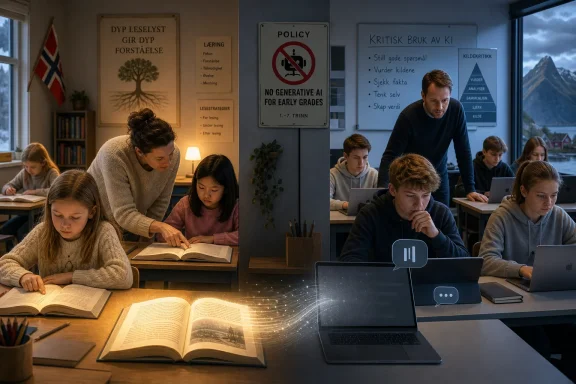 Norway’s U-Turn Is Really a Vote Against Educational Autopilot
The most important thing about Norway’s school AI policy is not that it is restrictive. It is that it is deliberate. After years in which tablets, learning apps, cloud platforms, and now chatbots were often treated as inevitable classroom upgrades, Oslo is trying to restore the idea that education policy should choose technology rather than simply absorb it.The reported plan draws a clear line between younger and older students. Primary school pupils are expected to face the strictest limits, with generative AI generally kept out of ordinary use. Older students may be allowed to use AI more gradually, but under teacher guidance and with more attention to when the tool helps learning rather than replaces it.
That distinction matters. Norway is not saying that a 17-year-old writing a research paper and a seven-year-old learning sentence structure have the same needs. It is saying the opposite: developmental stage matters, and a tool that may help one student can short-circuit another student’s learning.
This is the part of the debate that often gets lost when AI is discussed as either magic or menace. Schools are not just workplaces with smaller chairs. They are institutions designed around the slow construction of memory, attention, judgment, and confidence. A productivity tool that saves an adult time may deprive a child of the very friction through which competence is formed.
The Printed Book Has Become a Policy Instrument Again
Norway’s renewed interest in printed books can look quaint if seen only through the lens of nostalgia. It is not. A physical textbook is now being treated as a stabilising technology: predictable, durable, distraction-resistant, and easier for teachers to control.The return of books is also a quiet rebuke to a common assumption in edtech: that digitisation is automatically modernisation. A digital worksheet is not necessarily better than a paper one. A searchable online text is not necessarily better for a child learning sustained attention. A platform dashboard is not necessarily a better signal of understanding than a teacher watching a student wrestle with a paragraph.
Printed books make fewer promises. They do not personalise the lesson, gamify the task, or generate instant feedback. But their limitations are part of their usefulness. They create a learning environment in which the student must stay with the text, not with the interface.
This is why the “books versus screens” framing is too simple. Norway is not trying to recreate a pre-internet schoolhouse. It is trying to recover forms of attention that were weakened when screens became the default surface for nearly every activity. The book is returning not as a museum object, but as a tool for slowing the classroom down.
AI Did Not Create the Reading Problem, but It Makes It Harder to Ignore
The concern behind Norway’s move predates ChatGPT. Many school systems were already anxious about declining reading performance, shorter attention spans, and the difficulty of maintaining focus in device-heavy classrooms. Generative AI did not invent those problems. It made them harder to manage.A tablet can distract a child from reading. A chatbot can go further: it can perform parts of the reading and writing process for the child. It can summarise the chapter, draft the paragraph, solve the equation, explain the poem, and produce the homework answer. In the hands of a mature learner, that can be a support. In the hands of a beginner, it can become a bypass.
That is the heart of Norway’s worry. Learning is not simply the arrival at a correct answer. It is the mental route taken to get there. If students skip the route often enough, they may still submit polished work while developing less of the underlying skill.
This is especially true in early education. Children learning to read, write, calculate, and reason need repetition, failure, correction, and effort. These are not bugs in the system. They are the system. AI’s great virtue — reducing effort — becomes educationally dangerous when the effort itself is the lesson.
The Best Case for AI in Schools Still Deserves to Be Taken Seriously
A balanced debate cannot pretend that AI has no place in education. The strongest arguments for classroom AI are real, especially in countries where teachers are overworked, class sizes are large, and students arrive with widely different levels of preparation.AI can explain a concept in multiple ways without impatience. It can generate practice problems, simplify a difficult passage, translate instructions, and help students with disabilities access material that would otherwise be harder to use. For teachers, it can reduce some administrative burden and help prepare lesson materials more quickly.
In India, this promise is particularly powerful. A well-designed AI tutor could help a student in a small town get extra practice in maths or English outside school hours. It could help bridge language gaps. It could give teachers in crowded classrooms another support layer when individual attention is scarce.
But that best case depends on design, supervision, and restraint. AI helps when it scaffolds learning; it harms when it substitutes for learning. The difference is not always visible in a finished assignment. A fluent paragraph may represent a student’s improved understanding, or it may represent a machine’s ability to imitate understanding.
That ambiguity is why teachers are uneasy. The old cheating problem was episodic: a copied essay, a shared answer sheet, a parent doing homework. Generative AI makes outsourcing easy, private, and ordinary. It turns academic integrity from a disciplinary issue into a design problem embedded in everyday schoolwork.
Norway Is Exposing the Weakness in the Edtech Sales Pitch
The commercial story of edtech has long been that schools are inefficient because they are insufficiently digitised. More devices, more platforms, more analytics, and more adaptive software would supposedly make learning more personalised, measurable, and engaging. The pandemic accelerated that story dramatically.But Norway’s pivot suggests a different lesson: digitisation can also make schooling more fragmented, more distracted, and more dependent on vendors whose incentives do not always match a child’s developmental needs. Once a school system builds lessons, homework, assessment, and communication around platforms, the platform becomes part of the pedagogy whether policymakers admit it or not.
AI intensifies that dependency. It is not merely another app sitting on a tablet. It changes the nature of the task. A writing assignment becomes partly a prompt-engineering assignment. A research task becomes partly an exercise in evaluating machine-generated text. A homework problem becomes partly a question of whether the student or the chatbot did the thinking.
For adults, these are workplace skills. For children, they are advanced skills layered on top of foundational ones. Norway is effectively saying that the layering came too early.
That matters because edtech vendors tend to describe AI literacy as a reason to introduce AI quickly. The counterargument is that literacy in any powerful tool requires prior literacy in the domain itself. A child who cannot yet evaluate a paragraph cannot reliably evaluate an AI-generated paragraph. A student who lacks number sense cannot easily spot a confident mathematical error. Critical use of AI requires the very skills that premature AI use may weaken.
The Indian Classroom Should Read Norway as a Warning, Not a Template
India’s education system is too different from Norway’s for copy-and-paste policy. Norway is wealthy, sparsely populated, and institutionally capable in ways that many Indian states are not. India’s classrooms range from elite private schools with tablets and smartboards to government schools where basic infrastructure remains uneven.That difference cuts both ways. India cannot simply reject edtech, because technology can expand access where human capacity is limited. But India also cannot afford a careless AI rush, because mistakes at scale would affect hundreds of millions of learners.
The Indian edtech boom has already shown both promise and fragility. Learning apps can help motivated students revise, practise, and prepare for exams. They can also increase screen dependency, encourage passive consumption, and turn education into a subscription treadmill. AI tutors raise the stakes because they feel more personal, more responsive, and more authoritative than earlier apps.
Parents may see a chatbot giving instant answers and interpret that as learning. Schools may see AI-generated performance data and interpret that as insight. Companies may see every child as a user. The risk is that the appearance of educational activity becomes easier to produce than the reality of educational growth.
Norway’s move should therefore push India toward a harder question: not whether AI belongs in education, but where it belongs, for whom, at what age, under whose supervision, and with what evidence. The answer should not be left to marketing decks.
Deep Reading Is Not an Elite Luxury
One danger in the debate is that printed books and deep reading get framed as middle-class anxieties for privileged school systems. That would be a mistake. Deep reading is not ornamental. It is a civic and economic skill.Students who can stay with long texts are better positioned to understand contracts, laws, scientific explanations, manuals, histories, and arguments. They are less dependent on summaries produced by others. In an AI-saturated information environment, the ability to read slowly may become more valuable, not less.
This is especially important for India, where education is often tied to social mobility. If affluent students get books, quiet study, and carefully supervised technology while poorer students get cheap AI substitutes and screen-based content, digitisation could deepen inequality while claiming to solve it.
The danger is not that AI will make children lazy in some vague moral sense. The danger is that it will create a two-tier education system. One tier learns to think, read, write, and then use AI as leverage. The other tier learns to ask AI for answers.
That is why Norway’s book policy has symbolic force. It says foundational learning deserves protected space. It says not every educational activity should be optimised for speed. And it says the child’s attention is not just another resource to be captured by software.
Teachers Are the Control Layer Policymakers Keep Rediscovering
Every serious version of school AI policy eventually returns to the teacher. Not because teachers are anti-technology, but because they understand the difference between assistance and avoidance better than a procurement committee does.A teacher can see when a student has used AI to clarify an idea and when the student has used it to evade the task. A teacher can decide that one class is ready for a chatbot-assisted debate while another still needs handwritten outlining. A teacher can slow down a lesson when the room is confused, even if the software says the module is complete.
But this assumes teachers are trained, trusted, and given time. If AI is dropped into classrooms without professional development, it becomes another burden. Teachers must police misuse, redesign assignments, evaluate AI-shaped work, and reassure parents — all while vendors promise that the tool will save time eventually.
Norway’s reported approach, with stricter limits for younger pupils and more cautious use for older students, implicitly recognises this. AI in schools cannot be governed only by age gates and platform settings. It needs professional judgment. The problem is that many education systems have spent years undermining teacher autonomy while buying tools that claim to automate it.
For India, the teacher question is unavoidable. Any national or state-level AI policy that ignores teacher training will fail in practice. A chatbot cannot compensate for weak pedagogy if the classroom has no coherent plan for how the chatbot should be used.
The Smartphone Fight Was the Rehearsal
Norway’s AI move sits within a wider backlash against phones and screens in schools. Several countries have tightened rules on student phone use, and the reason is not hard to understand. Teachers have spent years competing with devices designed by some of the world’s most sophisticated attention engineers.AI is different from smartphones, but the political pattern is similar. First, schools are told that young people must adapt to the digital world. Then devices enter classrooms faster than norms can form. Then teachers and parents report distraction, dependency, or weakened basics. Finally, governments step in with restrictions that look abrupt only because the earlier adoption was so permissive.
The lesson is not that every technology must be banned until proven innocent. It is that schools need a higher threshold than the consumer market. Children are not beta testers for educational inevitability.
This is where the debate becomes uncomfortable for the tech industry. A product can be useful and still inappropriate for a six-year-old. A tool can be transformative and still require delayed introduction. A platform can have educational features and still be designed primarily around engagement, data capture, or market expansion.
Norway’s policy pushes back against the idea that technological exposure is itself preparation for the future. Preparation also requires self-control, literacy, memory, and reasoning. Those are not anti-digital skills. They are preconditions for using digital tools well.
The Real Choice Is Sequencing
The most useful way to understand Norway’s position is through sequencing. Books first, AI later. Reading first, summarisation later. Arithmetic first, calculator later. Writing first, automated drafting later. Judgment first, augmentation later.That sequence may sound conservative, but it is how education has always handled powerful tools. We do not hand children advanced instruments before they understand the basics of the task. We teach the mental model first, then the shortcut.
AI challenges this because the shortcut is so broad. It does not merely calculate faster or search faster. It produces language, explanations, plans, and plausible reasoning. It can imitate the surface of learning across many subjects at once.
That is why schools cannot treat AI like just another digital resource. A video explains. A quiz app tests. A search engine retrieves. A generative model composes. It can therefore interfere with assessment, practice, and confidence in subtler ways.
The policy challenge is to preserve productive struggle without pretending students live in a world without AI. Older students should learn how generative systems work, where they fail, how bias and hallucination appear, and why private data should not be casually entered into commercial tools. But younger students need enough cognitive foundation to make that instruction meaningful.
India’s AI-in-Education Debate Needs Rules Before Scale
India has a habit of discovering governance problems after scale has already arrived. That would be risky in school AI. Once a platform becomes embedded in homework, tuition, exam preparation, and school administration, reversing course becomes politically and commercially harder.A sensible Indian approach would not begin with a dramatic ban. It would begin with age-appropriate rules. Early grades should prioritise books, handwriting, oral explanation, numeracy, play, and teacher-led interaction. AI should be absent or tightly mediated. Middle grades could introduce limited AI demonstrations focused on verification, not answer production. Older students could use AI more directly, but with transparent rules for assignments and exams.
The state also needs to distinguish between AI for teachers and AI for students. A teacher using AI to draft a worksheet is not the same as a child using AI to write an essay. Administrative use, accessibility support, translation, remedial practice, and direct answer generation each deserve different rules.
There is also a privacy dimension. Children’s learning data is sensitive. AI tools that collect prompts, performance records, voice samples, or behavioural signals should face strict procurement standards. India’s edtech market cannot be governed only by parental consent buried in terms of service.
Norway’s experience points toward a simple principle: the more foundational the skill, the more cautious the technology policy should be. That principle travels well, even if the specific Norwegian rules do not.
The Book Is Back Because Trust in the Screen Has Fallen
The cultural meaning of Norway’s move is larger than school procurement. For a generation, the screen carried an aura of progress. If a classroom had devices, it looked modern. If a school had dashboards, it looked accountable. If a child used an app, it looked personalised.That aura is fading. Parents have watched children bounce between tabs, videos, games, messages, and homework. Teachers have watched assignments become harder to authenticate. Policymakers have watched learning outcomes fail to match the promises made by the digital transformation industry.
The printed book is not returning because it is perfect. It is returning because it is legible. A parent understands what a child is reading. A teacher can see where the class is. A student cannot instantly summon a machine-written answer from the margin of the page.
There is a reason this feels almost radical now. The book imposes boundaries. It does not update itself, interrupt itself, or recommend something else. In an attention economy, that makes it strangely powerful.
AI companies will argue, with some justification, that better tools and better controls can solve many of these problems. They may be right in part. But Norway’s response suggests that schools should not wait for the next product cycle to protect basic learning.
Norway’s Lesson for India Fits on the Classroom Desk
Norway’s shift is not a universal model, but it clarifies the choices that every education system now faces. The most concrete lessons are practical rather than ideological.- Norway is not banning all technology from schools; it is trying to set age-sensitive limits on generative AI and restore printed learning materials where screens have crowded them out.
- The central concern is not that AI gives wrong answers, but that it may let younger students skip the mental work needed to build reading, writing, maths, and judgment.
- AI can still help older students, teachers, disabled learners, and multilingual classrooms when it is supervised and used as support rather than substitution.
- India should not treat AI tutors as a shortcut around teacher shortages, weak reading habits, or uneven school quality.
- The safest policy sequence is to protect foundational learning first, then introduce AI literacy once students can question what the machine produces.
- Printed books matter not because they are old, but because they create a low-distraction environment for the kind of attention that screens often erode.
Norway’s retreat from classroom AI excess may look like a small northern policy correction, but it captures a global turn in the digital education story. The first phase asked how quickly schools could get children onto screens; the next will ask how deliberately schools can get them off screens when attention, literacy, and judgment are at stake. India does not need to follow Norway in every detail, but it should take the signal seriously: the future classroom will need AI, but it may need books even more.
References
- Primary source: Lapaas Voice
Published: 2026-06-23T04:51:16.298088
Loading…
voice.lapaas.com - Related coverage: techradar.com
Loading…
www.techradar.com - Related coverage: dailymanagementreview.com
Loading…
www.dailymanagementreview.com - Related coverage: all-things-nordic.com
Loading…
all-things-nordic.com - Related coverage: thelogicalindian.com
Loading…
thelogicalindian.com - Related coverage: ground.news
Loading…
ground.news
- Related coverage: gentic.news
Loading…
gentic.news