
Microsoft plans to change Microsoft Purview Data Lifecycle Management billing for non-Microsoft 365 generative AI prompts and responses in August 2026, moving Roadmap ID 560324 from a retained-data-volume meter to a managed-text-message meter in Worldwide standard multi-tenant cloud environments. The change sounds narrow, but it is really about how Microsoft wants enterprises to account for the compliance cost of AI conversations. A gigabyte is an intuitive storage unit; a “message” is an operational unit. That shift matters because prompts and responses are not files, mailboxes, or SharePoint documents — they are conversational records, and Microsoft is preparing Purview to treat them that way.
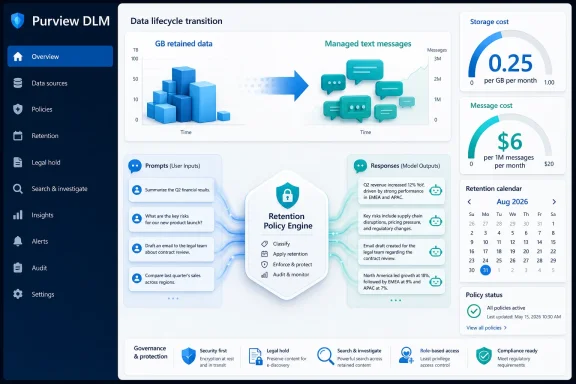
The old meter described in Microsoft’s roadmap language is easy to understand: retained data is billed by volume. If a customer keeps 1 GB of covered non-Microsoft 365 generative AI prompts and responses, the charge is $0.25 per GB per month, or roughly $0.0082 per GB per day. That maps compliance billing to storage consumption, which is how many administrators already think about retention, archiving, and lifecycle policy.
The new model changes the mental unit. Instead of asking how many gigabytes of AI prompt-and-response data are retained, Microsoft will bill based on the total volume of text messages managed by a DLM policy. Each prompt and each response is treated as an individual text message, retained or deleted according to configured Purview settings, and charged at an equivalent rate of $6 per one million text messages per month.
That is not merely a pricing footnote. It is Microsoft defining the compliance object for generative AI as a message rather than a blob of data. In traditional Microsoft 365 retention, the object has usually been a document, an email, a Teams chat, or some other recognizable work artifact. With AI, the artifact is smaller, more numerous, and often context-dependent. Billing by message acknowledges the shape of that data.
Microsoft says current analysis suggests the overall customer cost impact should be cost-neutral or lower under the new billing model. That is reassuring as far as it goes, but “cost-neutral” at fleet scale depends on usage patterns, prompt lengths, retention scopes, and how aggressively organizations keep AI interaction logs. A tenant with long, document-heavy prompts may experience the old and new meters differently from a tenant with millions of short, transactional AI exchanges.
Prompts and responses do not behave like traditional enterprise documents. They can be terse, repetitive, personally revealing, operationally sensitive, or legally discoverable. A two-line prompt asking an AI assistant to summarize a confidential acquisition memo may matter more than its byte count suggests. Conversely, a verbose generated answer may consume more storage without carrying proportionally more compliance risk.
A message meter is a crude instrument too, but it is crude in a way that better resembles the workload. Compliance systems need to count and govern events. Each prompt or response is an event in a record trail: who asked, what was asked, what was returned, and how long it must be kept. The meter follows that trail more directly than a gigabyte counter does.
This is the kind of change that administrators may initially file under licensing housekeeping, only to discover that it affects governance design. Once billing is attached to messages managed by a DLM policy, the scope and precision of those policies become cost levers. Retention architecture is no longer just a legal or records-management discussion. It becomes a financial control plane.
Generative AI complicates that promise because it creates data at the point of interaction. The user is no longer only saving a Word document, sending an email, or posting in Teams. The user is asking systems to transform, summarize, classify, rewrite, and infer. Each interaction can create a new compliance-relevant record even if no human thinks of it as a document.
The roadmap entry is specifically framed around non-Microsoft 365 generative AI prompts and responses. That detail is important. Microsoft is not only thinking about Copilot interactions inside the Microsoft 365 boundary; it is also preparing Purview to manage AI text records that originate outside the familiar productivity suite. The administrative challenge is no longer “retain Exchange and SharePoint correctly.” It is “retain conversational AI evidence wherever the organization has decided Purview should govern it.”
That is where data gravity shows up. Once AI interaction records are inside a Purview retention policy, they become part of the same lifecycle machinery as other regulated content. They can be retained, deleted, searched, and potentially surfaced in investigations. The billing meter is the visible commercial change, but the deeper technical story is that AI conversations are becoming first-class managed records.
For small environments with limited AI retention policies, the move may be little more than a licensing update and a budget note. For larger organizations, especially those with regulated business units, the change should trigger a review of which AI sources are being managed, how prompts and responses are classified, and which retention policies apply. The question is not only whether the bill changes. It is whether the organization understands what is being counted.
The August 2026 general availability target gives customers time, but that time can disappear quickly in compliance organizations. Legal, records management, security operations, finance, procurement, and platform engineering may all have a stake in the answer. If internal reporting still thinks in gigabytes while the vendor invoice moves to messages, confusion is guaranteed.
The obvious administrative move is to establish a baseline before the meter changes. Organizations should understand how much retained AI prompt-and-response data they have today, how many prompt and response objects that represents, which policies manage them, and which departments are generating the largest share. Without that baseline, “cost-neutral or lower” becomes a vendor forecast rather than an enterprise-specific expectation.
Under a gigabyte meter, long outputs and large retained text bodies dominate attention. Under a message meter, frequency becomes the key variable. That means high-volume AI automation, support workflows, developer tooling, and business-process assistants may show up more clearly than occasional users generating long answers. The unit economics will favor some workloads and penalize others.
This could be healthy. Many organizations still lack a mature inventory of where generative AI is used outside sanctioned Microsoft 365 experiences. If Purview DLM policies are managing non-Microsoft 365 AI prompts and responses, the resulting message counts can become a governance signal. They can show where AI is becoming business infrastructure rather than experimentation.
But there is also a risk of false comfort. A million tiny messages may be cheap to retain, yet still risky if they include customer identifiers, employee data, confidential strategy, authentication fragments, or regulated content. Billing does not measure sensitivity. It only measures the unit Microsoft has chosen to charge for managing the record.
Governance is about obligations attached to information. A retention system cares whether an item must be preserved, whether it can be deleted, whether it is subject to legal hold, whether it is discoverable, and whether policy has been applied consistently. Those obligations attach to records, not just to their byte size.
By pricing DLM for these AI records as managed text messages, Microsoft is nudging customers toward a governance-first model. The bill is tied to the number of discrete conversational objects under policy control. That is closer to how legal and compliance teams think about records, even if finance teams still prefer storage math.
This is also consistent with the broader direction of enterprise AI. As generative systems become embedded in workflows, organizations will need an audit trail of interactions rather than a pile of exported transcripts. The compliance perimeter will be defined by policy-managed events. The storage footprint will still matter, but it will not be the only meaningful measure.
This is where Purview can either help or frustrate customers. A well-designed retention program maps data types to business, legal, and regulatory requirements. A poorly designed one uses default policies as a substitute for decisions. Message-based billing will not fix that problem, but it will make some consequences more visible.
The best outcome is that customers use the migration to clean up policy sprawl. AI prompts and responses should not automatically inherit the same lifecycle simply because they are text. Some interactions may be transient operational records. Others may be part of regulated advice, customer support, software development, HR decision support, or legal work. Those categories do not carry the same retention obligation.
The worst outcome is that organizations respond only to the meter. If the conversation becomes “how do we reduce message count?” rather than “which AI records must we govern?”, the billing change could encourage shallow optimization. Compliance programs that chase cost without understanding risk tend to create both legal exposure and operational confusion.
For WindowsForum.com readers, that matters because Windows and Microsoft 365 administrators are increasingly asked to govern systems they do not own in the old sense. The identity may be Entra ID, the endpoint may be Windows, the records policy may live in Purview, but the AI interaction may occur in a third-party application. The compliance boundary is becoming a federation of services.
That is both an opportunity and a burden for Microsoft. Purview’s value rises if it can govern AI records beyond the Microsoft 365 garden. At the same time, customers will expect consistent metering, policy behavior, and reporting across sources that may not produce identical records. A “text message” sounds simple until every connector, app, and AI platform has its own way of representing a prompt, a response, a thread, or a system-generated action.
Administrators should watch the implementation details closely as general availability approaches. The practical questions will be mundane but important: how messages are counted, how retries and edits are handled, how multi-turn conversations are represented, how attachments or embedded context are treated, and how reporting maps message counts to policies and sources. The roadmap entry gives the commercial outline; operations teams will need the fine print.
The comparison with the old model is less straightforward. Under the legacy rate, 1 GB of retained data costs $0.25 per month. Under the new rate, the same cost relationship depends on how many messages fit into that gigabyte. Short messages can make the new meter more expensive per gigabyte; long messages can make it cheaper. That is the point: the new meter breaks the direct relationship between bytes and bill.
Microsoft’s example says any number of prompts and responses collectively amounting to 1 GB would be billed at the storage rate in the old model. In the updated model, the same body of activity is priced by message count instead. That means customers cannot simply compare last month’s retained gigabytes to next month’s invoice. They need a translation layer.
This is where internal observability becomes essential. Admins should not wait until August 2026 to discover whether their AI usage is dominated by short conversational bursts or large document-grounded prompts. The financial impact will come from the distribution, not the average. Averages conceal the difference between a few power users and a production AI workflow generating millions of messages.
If a business unit suddenly generates a large number of managed AI prompt-and-response records, the message count may indicate a new workflow, an unsanctioned tool, a customer-facing automation, or an internal process that has quietly moved into production. Security and governance teams can use that signal to ask better questions. What data is being sent? Who owns the workflow? Which retention requirement applies? Is the content also covered by data loss prevention, sensitivity labels, or insider risk controls?
There is a danger, of course, in overreading billing data. Message counts do not explain intent, sensitivity, or business value. They can, however, point to places where the organization should look. In a mature environment, billing telemetry, audit data, DLP alerts, endpoint signals, and identity context should reinforce one another.
This is why Purview’s direction matters to Windows and Microsoft 365 professionals who do not carry a records-management title. The governance stack is becoming part of the operating model for AI. Admins who once focused on mailboxes, file shares, endpoints, and update rings now need to understand how conversational data is retained, metered, and eventually deleted.
The risk is that customers treat the change as a minor billing migration. In compliance systems, meters shape behavior. If the organization does not understand what a managed text message represents, which systems generate them, and how policies apply, the new model can create both cost ambiguity and governance ambiguity.
There is also a trust angle. Microsoft is asking customers to accept a new unit of measure in an area where the vendor controls the platform, the reporting, the retention engine, and the invoice. That puts pressure on Microsoft to make the reporting legible. Customers will need to see message counts by policy, source, workload, and time period, not just a blended monthly total.
Transparent metering will be especially important because the roadmap item says customers must migrate from the legacy meter. Optionality matters less when the old model is going away. The smoother Microsoft makes the transition, the more likely admins will view this as a rational modernization rather than another opaque cloud-billing reshuffle.
The first practical step is ownership. Someone must be accountable for DLM billing, and that person or team may not be the same group that owns Purview policy design. In many companies, compliance defines retention, IT implements it, finance pays for it, and security investigates the consequences. AI records cut across all four.
The second step is inventory. Customers should identify which non-Microsoft 365 generative AI sources are currently feeding retention policies or are expected to do so before August 2026. This includes sanctioned AI tools, internal applications, external services, and any integration layer that normalizes prompts and responses into Purview-managed records.
The third step is modeling. A message-based meter invites straightforward forecasting, but only if the organization can count messages. Teams should compare retained data volume, prompt counts, response counts, retention duration, and policy scope. The goal is not to produce a perfect invoice prediction. It is to identify where the new meter may materially change incentives.
The concrete implications are already visible:
 Microsoft Is Turning AI Retention Into a Message Economy
The old meter described in Microsoft’s roadmap language is easy to understand: retained data is billed by volume. If a customer keeps 1 GB of covered non-Microsoft 365 generative AI prompts and responses, the charge is $0.25 per GB per month, or roughly $0.0082 per GB per day. That maps compliance billing to storage consumption, which is how many administrators already think about retention, archiving, and lifecycle policy.The new model changes the mental unit. Instead of asking how many gigabytes of AI prompt-and-response data are retained, Microsoft will bill based on the total volume of text messages managed by a DLM policy. Each prompt and each response is treated as an individual text message, retained or deleted according to configured Purview settings, and charged at an equivalent rate of $6 per one million text messages per month.
That is not merely a pricing footnote. It is Microsoft defining the compliance object for generative AI as a message rather than a blob of data. In traditional Microsoft 365 retention, the object has usually been a document, an email, a Teams chat, or some other recognizable work artifact. With AI, the artifact is smaller, more numerous, and often context-dependent. Billing by message acknowledges the shape of that data.
Microsoft says current analysis suggests the overall customer cost impact should be cost-neutral or lower under the new billing model. That is reassuring as far as it goes, but “cost-neutral” at fleet scale depends on usage patterns, prompt lengths, retention scopes, and how aggressively organizations keep AI interaction logs. A tenant with long, document-heavy prompts may experience the old and new meters differently from a tenant with millions of short, transactional AI exchanges.
The Gigabyte Was Too Blunt for Prompt Sprawl
Billing AI compliance retention by the gigabyte has an appealing simplicity, but simplicity can become distortion. A small number of very large prompts can look expensive under a storage-based model, while enormous numbers of short interactions can look cheap. That may have been acceptable while AI retention was an edge case. It becomes harder to defend as generative AI moves from pilots to daily workflow.Prompts and responses do not behave like traditional enterprise documents. They can be terse, repetitive, personally revealing, operationally sensitive, or legally discoverable. A two-line prompt asking an AI assistant to summarize a confidential acquisition memo may matter more than its byte count suggests. Conversely, a verbose generated answer may consume more storage without carrying proportionally more compliance risk.
A message meter is a crude instrument too, but it is crude in a way that better resembles the workload. Compliance systems need to count and govern events. Each prompt or response is an event in a record trail: who asked, what was asked, what was returned, and how long it must be kept. The meter follows that trail more directly than a gigabyte counter does.
This is the kind of change that administrators may initially file under licensing housekeeping, only to discover that it affects governance design. Once billing is attached to messages managed by a DLM policy, the scope and precision of those policies become cost levers. Retention architecture is no longer just a legal or records-management discussion. It becomes a financial control plane.
Purview’s AI Problem Is Really a Data Gravity Problem
Microsoft Purview has spent the last several years becoming the umbrella for Microsoft’s compliance, governance, risk, retention, and discovery ambitions. Data Lifecycle Management is one piece of that portfolio, focused on retaining content organizations need and deleting content they do not. The product’s value proposition is familiar: reduce risk, satisfy retention requirements, and avoid keeping everything forever.Generative AI complicates that promise because it creates data at the point of interaction. The user is no longer only saving a Word document, sending an email, or posting in Teams. The user is asking systems to transform, summarize, classify, rewrite, and infer. Each interaction can create a new compliance-relevant record even if no human thinks of it as a document.
The roadmap entry is specifically framed around non-Microsoft 365 generative AI prompts and responses. That detail is important. Microsoft is not only thinking about Copilot interactions inside the Microsoft 365 boundary; it is also preparing Purview to manage AI text records that originate outside the familiar productivity suite. The administrative challenge is no longer “retain Exchange and SharePoint correctly.” It is “retain conversational AI evidence wherever the organization has decided Purview should govern it.”
That is where data gravity shows up. Once AI interaction records are inside a Purview retention policy, they become part of the same lifecycle machinery as other regulated content. They can be retained, deleted, searched, and potentially surfaced in investigations. The billing meter is the visible commercial change, but the deeper technical story is that AI conversations are becoming first-class managed records.
The Migration Requirement Is the Real Admin Work
Microsoft’s customer impact note is blunt: customers will need to migrate from the legacy meter to the new meter. That line deserves more attention than the price comparison because migrations are where compliance programs reveal their assumptions. A billing meter migration sounds like back-office plumbing until someone has to reconcile policy scopes, retention volumes, message counts, chargeback models, and internal owner expectations.For small environments with limited AI retention policies, the move may be little more than a licensing update and a budget note. For larger organizations, especially those with regulated business units, the change should trigger a review of which AI sources are being managed, how prompts and responses are classified, and which retention policies apply. The question is not only whether the bill changes. It is whether the organization understands what is being counted.
The August 2026 general availability target gives customers time, but that time can disappear quickly in compliance organizations. Legal, records management, security operations, finance, procurement, and platform engineering may all have a stake in the answer. If internal reporting still thinks in gigabytes while the vendor invoice moves to messages, confusion is guaranteed.
The obvious administrative move is to establish a baseline before the meter changes. Organizations should understand how much retained AI prompt-and-response data they have today, how many prompt and response objects that represents, which policies manage them, and which departments are generating the largest share. Without that baseline, “cost-neutral or lower” becomes a vendor forecast rather than an enterprise-specific expectation.
A Lower Bill Can Still Expose a Messier Estate
Microsoft’s claim that the new model is expected to be cost-neutral or lower will be welcomed by customers already fatigued by cloud billing surprises. But a lower bill is not the same thing as a simpler estate. In fact, message-based billing may make visible patterns that storage-based billing hid.Under a gigabyte meter, long outputs and large retained text bodies dominate attention. Under a message meter, frequency becomes the key variable. That means high-volume AI automation, support workflows, developer tooling, and business-process assistants may show up more clearly than occasional users generating long answers. The unit economics will favor some workloads and penalize others.
This could be healthy. Many organizations still lack a mature inventory of where generative AI is used outside sanctioned Microsoft 365 experiences. If Purview DLM policies are managing non-Microsoft 365 AI prompts and responses, the resulting message counts can become a governance signal. They can show where AI is becoming business infrastructure rather than experimentation.
But there is also a risk of false comfort. A million tiny messages may be cheap to retain, yet still risky if they include customer identifiers, employee data, confidential strategy, authentication fragments, or regulated content. Billing does not measure sensitivity. It only measures the unit Microsoft has chosen to charge for managing the record.
Microsoft Is Separating Governance From Storage
The most interesting part of this change is philosophical. Cloud platforms originally trained customers to think of data costs in storage terms: gigabytes at rest, gigabytes transferred, gigabytes scanned. That model works well enough for infrastructure. It works less well for governance.Governance is about obligations attached to information. A retention system cares whether an item must be preserved, whether it can be deleted, whether it is subject to legal hold, whether it is discoverable, and whether policy has been applied consistently. Those obligations attach to records, not just to their byte size.
By pricing DLM for these AI records as managed text messages, Microsoft is nudging customers toward a governance-first model. The bill is tied to the number of discrete conversational objects under policy control. That is closer to how legal and compliance teams think about records, even if finance teams still prefer storage math.
This is also consistent with the broader direction of enterprise AI. As generative systems become embedded in workflows, organizations will need an audit trail of interactions rather than a pile of exported transcripts. The compliance perimeter will be defined by policy-managed events. The storage footprint will still matter, but it will not be the only meaningful measure.
The New Meter Rewards Policy Precision
The new model should push administrators to become more precise about retention scope. If every non-Microsoft 365 AI prompt and response managed by a DLM policy is billable as an individual text message, then broad “keep everything” policies become easier to cost and harder to justify. That does not mean organizations should under-retain. It means they should be able to explain why each category of AI record is being retained.This is where Purview can either help or frustrate customers. A well-designed retention program maps data types to business, legal, and regulatory requirements. A poorly designed one uses default policies as a substitute for decisions. Message-based billing will not fix that problem, but it will make some consequences more visible.
The best outcome is that customers use the migration to clean up policy sprawl. AI prompts and responses should not automatically inherit the same lifecycle simply because they are text. Some interactions may be transient operational records. Others may be part of regulated advice, customer support, software development, HR decision support, or legal work. Those categories do not carry the same retention obligation.
The worst outcome is that organizations respond only to the meter. If the conversation becomes “how do we reduce message count?” rather than “which AI records must we govern?”, the billing change could encourage shallow optimization. Compliance programs that chase cost without understanding risk tend to create both legal exposure and operational confusion.
Non-Microsoft 365 AI Is the Quietly Explosive Scope
The roadmap wording’s reference to non-Microsoft 365 generative AI prompts and responses is easy to skim past, but it is arguably the most strategic phrase in the announcement. Microsoft is acknowledging that the AI data estate is not confined to Microsoft 365. Enterprises are using copilots, chatbots, coding assistants, customer-service agents, workflow tools, and internal AI applications from many vendors.For WindowsForum.com readers, that matters because Windows and Microsoft 365 administrators are increasingly asked to govern systems they do not own in the old sense. The identity may be Entra ID, the endpoint may be Windows, the records policy may live in Purview, but the AI interaction may occur in a third-party application. The compliance boundary is becoming a federation of services.
That is both an opportunity and a burden for Microsoft. Purview’s value rises if it can govern AI records beyond the Microsoft 365 garden. At the same time, customers will expect consistent metering, policy behavior, and reporting across sources that may not produce identical records. A “text message” sounds simple until every connector, app, and AI platform has its own way of representing a prompt, a response, a thread, or a system-generated action.
Administrators should watch the implementation details closely as general availability approaches. The practical questions will be mundane but important: how messages are counted, how retries and edits are handled, how multi-turn conversations are represented, how attachments or embedded context are treated, and how reporting maps message counts to policies and sources. The roadmap entry gives the commercial outline; operations teams will need the fine print.
Cost Neutrality Depends on the Shape of the Conversation
Microsoft’s cost-neutral-or-lower expectation is plausible for many customers, especially if retained AI text tends to be compact but numerous within predictable limits. The stated equivalence of $6 per million text messages per month gives organizations a clean unit for forecasting. If an environment retains 10 million managed AI text messages, the rough monthly charge under the new meter is easy to estimate.The comparison with the old model is less straightforward. Under the legacy rate, 1 GB of retained data costs $0.25 per month. Under the new rate, the same cost relationship depends on how many messages fit into that gigabyte. Short messages can make the new meter more expensive per gigabyte; long messages can make it cheaper. That is the point: the new meter breaks the direct relationship between bytes and bill.
Microsoft’s example says any number of prompts and responses collectively amounting to 1 GB would be billed at the storage rate in the old model. In the updated model, the same body of activity is priced by message count instead. That means customers cannot simply compare last month’s retained gigabytes to next month’s invoice. They need a translation layer.
This is where internal observability becomes essential. Admins should not wait until August 2026 to discover whether their AI usage is dominated by short conversational bursts or large document-grounded prompts. The financial impact will come from the distribution, not the average. Averages conceal the difference between a few power users and a production AI workflow generating millions of messages.
Compliance Billing Is Becoming a Behavioral Signal
One underappreciated effect of usage-based compliance billing is that it can reveal behavior. A storage meter shows accumulation. A message meter shows activity. That makes the DLM meter change potentially useful for more than finance.If a business unit suddenly generates a large number of managed AI prompt-and-response records, the message count may indicate a new workflow, an unsanctioned tool, a customer-facing automation, or an internal process that has quietly moved into production. Security and governance teams can use that signal to ask better questions. What data is being sent? Who owns the workflow? Which retention requirement applies? Is the content also covered by data loss prevention, sensitivity labels, or insider risk controls?
There is a danger, of course, in overreading billing data. Message counts do not explain intent, sensitivity, or business value. They can, however, point to places where the organization should look. In a mature environment, billing telemetry, audit data, DLP alerts, endpoint signals, and identity context should reinforce one another.
This is why Purview’s direction matters to Windows and Microsoft 365 professionals who do not carry a records-management title. The governance stack is becoming part of the operating model for AI. Admins who once focused on mailboxes, file shares, endpoints, and update rings now need to understand how conversational data is retained, metered, and eventually deleted.
The Risk Is Not the Price, It Is the Assumption
The safest reading of Roadmap ID 560324 is that Microsoft is rationalizing a billing model before AI retention volume becomes too large and too weird for the old meter. That is sensible product management. It is better to adjust the unit now than after customers have built years of budgets and chargeback models around a metric that no longer fits the workload.The risk is that customers treat the change as a minor billing migration. In compliance systems, meters shape behavior. If the organization does not understand what a managed text message represents, which systems generate them, and how policies apply, the new model can create both cost ambiguity and governance ambiguity.
There is also a trust angle. Microsoft is asking customers to accept a new unit of measure in an area where the vendor controls the platform, the reporting, the retention engine, and the invoice. That puts pressure on Microsoft to make the reporting legible. Customers will need to see message counts by policy, source, workload, and time period, not just a blended monthly total.
Transparent metering will be especially important because the roadmap item says customers must migrate from the legacy meter. Optionality matters less when the old model is going away. The smoother Microsoft makes the transition, the more likely admins will view this as a rational modernization rather than another opaque cloud-billing reshuffle.
August 2026 Is Close Enough to Budget Around
The general availability target of August 2026 places this change in the planning window for many enterprises. It is not tomorrow, but it is close enough to affect budget cycles, renewal discussions, and AI governance projects already underway. Organizations that wait for GA before modeling impact will be behind.The first practical step is ownership. Someone must be accountable for DLM billing, and that person or team may not be the same group that owns Purview policy design. In many companies, compliance defines retention, IT implements it, finance pays for it, and security investigates the consequences. AI records cut across all four.
The second step is inventory. Customers should identify which non-Microsoft 365 generative AI sources are currently feeding retention policies or are expected to do so before August 2026. This includes sanctioned AI tools, internal applications, external services, and any integration layer that normalizes prompts and responses into Purview-managed records.
The third step is modeling. A message-based meter invites straightforward forecasting, but only if the organization can count messages. Teams should compare retained data volume, prompt counts, response counts, retention duration, and policy scope. The goal is not to produce a perfect invoice prediction. It is to identify where the new meter may materially change incentives.
The DLM Meter Change Gives Admins a Deadline for AI Hygiene
This roadmap entry is not dramatic in the way a Windows version launch or a security incident is dramatic. There is no emergency patch, no exploit chain, no user-interface overhaul. But it creates a deadline for a kind of administrative hygiene that many organizations have postponed: deciding what AI conversations are worth keeping, for how long, and at what cost.The concrete implications are already visible:
- Microsoft plans to make the DLM billing change generally available in August 2026 for Microsoft Purview on the web in Worldwide standard multi-tenant environments.
- The legacy meter bills retained non-Microsoft 365 generative AI prompt-and-response data by volume, while the new meter bills managed text messages under DLM policy.
- Each non-Microsoft 365 generative AI prompt and each response is treated as an individual text message for retention and deletion under configured Purview settings.
- The new stated rate is equivalent to $6 per one million text messages per month, replacing the example legacy rate of $0.25 per retained GB per month for the covered data.
- Microsoft says current analysis points to cost-neutral or lower impact overall, but individual tenants will depend on message volume, prompt size, response size, policy scope, and retention duration.
- Customers should baseline current retained AI data and message counts before migration, because gigabytes alone will not explain the new bill.
References
- Primary source: Microsoft 365 Roadmap
Published: 2026-06-22T23:00:47.0315291Z
Loading…
www.microsoft.com - Official source: learn.microsoft.com
Loading…
learn.microsoft.com - Official source: techcommunity.microsoft.com
Loading…
techcommunity.microsoft.com - Official source: cdn-dynmedia-1.microsoft.com
Loading…
cdn-dynmedia-1.microsoft.com