
Valve is expanding SteamOS 3.8 beyond the Steam Deck with better desktop hardware compatibility, early Steam Machine support, Wayland-based desktop improvements, and ongoing Nvidia collaboration, but full Nvidia support is not expected this year and Windows 11 remains overwhelmingly dominant among Steam gamers.
That single sentence is the reality check underneath the week’s most excitable Linux-gaming chatter. Valve is not merely polishing a handheld operating system anymore; it is trying to turn SteamOS into a plausible living-room and desktop PC platform. But the “mass exodus” from Windows will not arrive because Reddit is annoyed with Windows 11. It will arrive, if it arrives at all, because Valve makes leaving Windows feel boringly safe.
SteamOS began its modern life as the invisible trick behind the Steam Deck. Valve did not need to persuade PC gamers to install Linux; it sold them a device where Linux was already installed, already configured, and already wrapped in the Steam interface. The genius of that strategy was that users experienced Proton, shader pre-caching, controller integration, suspend-resume, and console-like updates before they had to care what distribution they were running.
SteamOS 3.8 changes the center of gravity. The release is still important for Steam Deck owners, but its most interesting work is aimed at hardware Valve does not fully control. The update adds initial support for upcoming Steam Machine hardware, improves compatibility with newer Intel and AMD platforms, and expands the foundation for machines that look less like handhelds and more like ordinary PCs.
That is why Pierre-Loup Griffais’ comments matter. Valve saying it is “rolling out improvements” for desktop hardware and “collaborating with Nvidia very closely” is not a throwaway line for Linux hobbyists. It is Valve acknowledging that SteamOS cannot become a real Windows alternative while behaving like a boutique OS tuned around one AMD APU.
The phrase that should make Microsoft pay attention is not “Nvidia support.” It is “whatever PC parts you want.” That is the promise Windows has owned for three decades: assemble a box from commodity parts, install the OS, and expect games to run. If Valve can make that promise credible for SteamOS, the competitive question stops being whether Linux gaming is possible and becomes whether Windows is still necessary.
That is why the Reddit quote circulating through the TechRadar piece lands so cleanly: “The minute SteamOS gets Nvidia support” is the moment many Windows skeptics imagine the dam breaking. The sentiment is overstated, but the dependency is real. For a huge slice of the gaming audience, Nvidia compatibility is not a feature request; it is the admission ticket.
Valve’s caution is just as important as its ambition. Griffais reportedly made clear that Nvidia support is not coming this year, even as work continues in the background. That caveat drains some oxygen from the “exodus” narrative, because the gamers most ready to flee Windows are often the same people running RTX cards, high-refresh monitors, VR setups, capture workflows, and peripheral stacks that punish half-finished platform transitions.
Linux has made enormous progress as a gaming environment, but Nvidia has historically been the awkward variable. Driver quality, Wayland behavior, VRR, multi-monitor edge cases, frame pacing, power management, and game-specific quirks all become platform trust issues. A gamer might tolerate one evening of tinkering for curiosity. They will not tolerate it as the operating principle of a $2,000 gaming PC.
Valve knows this. SteamOS does not need Nvidia support that is technically impressive in a forum thread. It needs Nvidia support that disappears into the background.
This matters because desktop SteamOS has always had to fight two expectations at once. Console users want it to disappear. PC users want it to be flexible. Valve’s challenge is to make the same OS feel appliance-like from the couch and competent from a keyboard and mouse.
Wayland is especially symbolic. For years, Linux desktop modernity has been trapped in a transitional state: better display architecture on paper, messy compatibility in practice. Valve’s move to Wayland by default is a bet that the Linux graphics stack is ready enough for mainstream gaming hardware, or at least ready enough for Valve to impose discipline on it through SteamOS.
The desktop work also narrows one of Windows’ quiet advantages. Windows does not merely run games; it handles the boring surrounding rituals. It wakes displays, manages audio devices, obeys weird monitor arrangements, launches Discord, accepts controller dongles, handles streaming apps, and usually survives whatever USB accessory a gamer bought at 2 a.m. SteamOS has to compete there too, not just in average frame rates.
The second attempt arrives in a different world. Proton has turned a large portion of the Windows game library into something that can run on Linux without developers making native ports. The Steam Deck has created a large installed base of users who do not think of Linux gaming as a science project. AMD’s open driver stack has given Valve a friendlier hardware foundation than the old Steam Machine era enjoyed.
SteamOS 3.8’s “initial support” for upcoming Steam Machine hardware is therefore both literal and strategic. Valve is preparing its own box, but it is also making the OS less dependent on that box. If users can install the same software on a living-room PC built from standard components, the Steam Machine becomes the cleanest expression of SteamOS rather than the only legitimate vessel for it.
That is the clever part. Valve does not need every gamer to buy Valve hardware. It needs SteamOS to become the natural choice for a certain class of gaming PC: the living-room machine, the handheld-like desktop, the spare rig under the TV, the Windows 10 refugee box, the console replacement for someone whose library already lives on Steam.
Microsoft should be less worried about one Steam Machine SKU than about the category Valve is trying to normalize.
Yet dislike is not the same as migration. Windows remains dominant on Steam by an absurd margin. Recent Steam Hardware Survey results still show Windows with well over 90 percent of the platform, while Linux sits in the low single digits even after the Steam Deck’s success. Windows 11 itself has continued to climb among Steam users as Windows 10 ages out and unsupported hardware gradually leaves the center of the market.
That is the paradox Microsoft can still exploit. Gamers may grumble about Windows 11, but Windows is where everything works first, where launchers assume they belong, where anti-cheat vendors spend their attention, where peripheral utilities are written, and where troubleshooting advice is abundant. The Windows moat is not affection. It is accumulated default behavior.
Valve’s opportunity is that defaults can change at the edges before they change at the center. Steam Deck did not need to dethrone Windows on desktops to make Linux gaming normal to millions of players. SteamOS on DIY hardware does not need to win the entire PC market to become a meaningful threat. It needs to peel off the users for whom Windows is tolerated rather than chosen.
That is a smaller claim than “mass exodus,” but it is a more dangerous one for Microsoft because it is plausible.
This is where SteamOS still feels less like a universal Windows replacement and more like a powerful filter. If your library is heavy on Steam-native, verified, single-player, indie, emulation, older multiplayer, or Linux-friendly titles, the switch can feel liberating. If your week revolves around a competitive shooter with unsupported anti-cheat, the conversation ends before the installer boots.
Valve can solve parts of this problem through engineering, documentation, developer outreach, and platform pressure. It cannot solve all of it unilaterally. Anti-cheat vendors, publishers, esports operators, and security teams have their own incentives, and they are often conservative for reasons that are not simply anti-Linux bias.
That matters because gamers do not evaluate operating systems game by game in a spreadsheet. They remember the one title that would not launch. They remember the one tournament client that failed. They remember the one friend who had to reboot into Windows to join the party.
For SteamOS to trigger a serious migration, “most of my games work” has to become “the games that define my routine work.” Those are different thresholds.
Microsoft has spent the past year trying to address this with gaming-focused interface work and Xbox-branded Windows experiences on handheld hardware. The reported memory savings from more console-like Windows modes are useful. But performance tweaks alone do not answer the core problem: Windows still feels like Windows when a gaming appliance wants to feel like an appliance.
Valve’s advantage is coherence. SteamOS can boot into the experience gamers actually bought the device for. It can treat the Steam library as the home screen, controller navigation as the primary input, suspend-resume as a first-class feature, and system updates as part of a gaming workflow. Windows can imitate pieces of that, but it has to do so while preserving the vast, messy inheritance of the Windows desktop.
That inheritance is also why Windows is hard to kill. The same sprawl that makes Windows awkward on a handheld makes it indispensable on a desktop. Mod managers, launchers, RGB utilities, VR tools, streaming software, capture cards, racing wheels, HOTAS setups, old games, obscure installers, and productivity apps all assume Windows is the ground floor.
SteamOS is strongest where the PC becomes more console-like. Windows is strongest where the PC remains proudly chaotic.
Proton changed the emotional contract. Linux gaming stopped being a moral appeal and became a product experience. The question was no longer whether users wanted to support open platforms; it was whether their game launched, ran smoothly, and accepted their controller.
Steam Deck proved that this product-first approach works. Its owners were not required to become Linux people. They became Steam Deck people. That distinction is why SteamOS has a chance on desktops where traditional Linux distributions have struggled with mainstream gamers.
But the same lesson also limits the romance. SteamOS will not win because users want freedom in the abstract. It will win where Valve removes enough friction that Windows feels unnecessary. If the installer is awkward, if Nvidia behavior is inconsistent, if anti-cheat breaks favorites, if desktop hardware support is uneven, the ideological energy will collapse into dual-boot pragmatism.
The future of Linux gaming is not purity. It is convenience.
That pattern still matters. Platform migrations rarely begin as clean breaks. They begin when users stop assuming the incumbent is mandatory. A gamer who boots SteamOS for indie games, emulation, and controller-first couch play may still keep Windows for anti-cheat titles and work apps. But once part of the routine moves, the monopoly of habit weakens.
Valve’s smartest move is to avoid asking users for a leap of faith. SteamOS 3.8 is not being presented as a manifesto. It is being presented as a practical path: here is the same codebase as the Steam Machine, here are broader hardware improvements, here is a better desktop, here is ongoing Nvidia work, here is a way to build your own box.
That incrementalism is easy to underestimate because it lacks the drama of a platform war. But it is exactly how Windows loses cultural inevitability. Not all at once. One second machine, one living-room box, one unsupported Windows 10 PC, one annoyed Windows 11 user at a time.
That inversion is the strategic threat. If the most important application on a gaming PC can become the operating environment itself, Windows is demoted. It becomes one possible substrate for Steam rather than the natural home of PC gaming.
This is why Microsoft’s response cannot be limited to shaving RAM usage or adding a controller-friendly shell. It has to address trust. Gamers need to believe Windows is serving the gaming experience rather than using gaming as a retention mechanism for a broader Microsoft account, services, AI, and advertising strategy. The more Windows feels like an agenda, the easier it is for Valve to sell SteamOS as relief.
Valve is hardly a charity. SteamOS strengthens Valve’s own platform lock-in, protects Steam from Windows Store ambitions, and gives the company leverage over hardware categories where Microsoft might otherwise define the rules. But Valve’s self-interest happens to align with a desire many gamers already have: make the PC feel less encumbered.
That alignment is powerful. It does not have to be noble to be effective.
That is the future Microsoft should worry about: not a single dramatic exit, but a thousand ordinary decisions where SteamOS is good enough, Windows 11 is annoying enough, and Valve’s ecosystem is familiar enough that the old default finally starts to look optional.
That single sentence is the reality check underneath the week’s most excitable Linux-gaming chatter. Valve is not merely polishing a handheld operating system anymore; it is trying to turn SteamOS into a plausible living-room and desktop PC platform. But the “mass exodus” from Windows will not arrive because Reddit is annoyed with Windows 11. It will arrive, if it arrives at all, because Valve makes leaving Windows feel boringly safe.
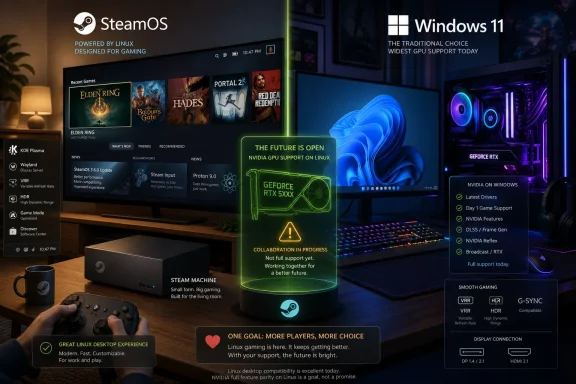 Valve Is No Longer Pretending SteamOS Is Just for the Deck
SteamOS began its modern life as the invisible trick behind the Steam Deck. Valve did not need to persuade PC gamers to install Linux; it sold them a device where Linux was already installed, already configured, and already wrapped in the Steam interface. The genius of that strategy was that users experienced Proton, shader pre-caching, controller integration, suspend-resume, and console-like updates before they had to care what distribution they were running.SteamOS 3.8 changes the center of gravity. The release is still important for Steam Deck owners, but its most interesting work is aimed at hardware Valve does not fully control. The update adds initial support for upcoming Steam Machine hardware, improves compatibility with newer Intel and AMD platforms, and expands the foundation for machines that look less like handhelds and more like ordinary PCs.
That is why Pierre-Loup Griffais’ comments matter. Valve saying it is “rolling out improvements” for desktop hardware and “collaborating with Nvidia very closely” is not a throwaway line for Linux hobbyists. It is Valve acknowledging that SteamOS cannot become a real Windows alternative while behaving like a boutique OS tuned around one AMD APU.
The phrase that should make Microsoft pay attention is not “Nvidia support.” It is “whatever PC parts you want.” That is the promise Windows has owned for three decades: assemble a box from commodity parts, install the OS, and expect games to run. If Valve can make that promise credible for SteamOS, the competitive question stops being whether Linux gaming is possible and becomes whether Windows is still necessary.
Nvidia Is the Gatekeeper to the Windows Escape Hatch
The problem is that “whatever PC parts you want” still runs into one large green wall. Nvidia remains a defining force in PC gaming, especially among enthusiasts who are most likely to build desktop rigs, upgrade GPUs, and complain loudly when an operating system gets in the way. SteamOS can be excellent on Steam Deck and promising on AMD-based desktops, but without strong Nvidia support it cannot credibly pitch itself as the default Windows replacement for the wider DIY market.That is why the Reddit quote circulating through the TechRadar piece lands so cleanly: “The minute SteamOS gets Nvidia support” is the moment many Windows skeptics imagine the dam breaking. The sentiment is overstated, but the dependency is real. For a huge slice of the gaming audience, Nvidia compatibility is not a feature request; it is the admission ticket.
Valve’s caution is just as important as its ambition. Griffais reportedly made clear that Nvidia support is not coming this year, even as work continues in the background. That caveat drains some oxygen from the “exodus” narrative, because the gamers most ready to flee Windows are often the same people running RTX cards, high-refresh monitors, VR setups, capture workflows, and peripheral stacks that punish half-finished platform transitions.
Linux has made enormous progress as a gaming environment, but Nvidia has historically been the awkward variable. Driver quality, Wayland behavior, VRR, multi-monitor edge cases, frame pacing, power management, and game-specific quirks all become platform trust issues. A gamer might tolerate one evening of tinkering for curiosity. They will not tolerate it as the operating principle of a $2,000 gaming PC.
Valve knows this. SteamOS does not need Nvidia support that is technically impressive in a forum thread. It needs Nvidia support that disappears into the background.
SteamOS 3.8 Is a Desktop Update Wearing a Console Jacket
The Steam Machine hook is easy to understand because hardware announcements give everyone something to point at. But the more durable story in SteamOS 3.8 is that Valve is sanding down the operating system’s desktop edges. KDE Plasma 6.4.3, Wayland by default, improved external display support, better scaling on TVs, HDR improvements, and VRR support are not glamorous bullet points. They are the connective tissue between a console-like launcher and a PC that users can actually live with.This matters because desktop SteamOS has always had to fight two expectations at once. Console users want it to disappear. PC users want it to be flexible. Valve’s challenge is to make the same OS feel appliance-like from the couch and competent from a keyboard and mouse.
Wayland is especially symbolic. For years, Linux desktop modernity has been trapped in a transitional state: better display architecture on paper, messy compatibility in practice. Valve’s move to Wayland by default is a bet that the Linux graphics stack is ready enough for mainstream gaming hardware, or at least ready enough for Valve to impose discipline on it through SteamOS.
The desktop work also narrows one of Windows’ quiet advantages. Windows does not merely run games; it handles the boring surrounding rituals. It wakes displays, manages audio devices, obeys weird monitor arrangements, launches Discord, accepts controller dongles, handles streaming apps, and usually survives whatever USB accessory a gamer bought at 2 a.m. SteamOS has to compete there too, not just in average frame rates.
The Steam Machine Is a Trojan Horse for the DIY PC
Valve’s new Steam Machine is not just a product. It is a reference implementation. The company tried the Steam Machine idea once before, in the mid-2010s, and the result was a scattered ecosystem of boxes that asked consumers to believe in Linux gaming before Linux gaming had earned the trust. That earlier effort had hardware partners, branding, and ambition. It lacked the software inevitability that the Steam Deck later supplied.The second attempt arrives in a different world. Proton has turned a large portion of the Windows game library into something that can run on Linux without developers making native ports. The Steam Deck has created a large installed base of users who do not think of Linux gaming as a science project. AMD’s open driver stack has given Valve a friendlier hardware foundation than the old Steam Machine era enjoyed.
SteamOS 3.8’s “initial support” for upcoming Steam Machine hardware is therefore both literal and strategic. Valve is preparing its own box, but it is also making the OS less dependent on that box. If users can install the same software on a living-room PC built from standard components, the Steam Machine becomes the cleanest expression of SteamOS rather than the only legitimate vessel for it.
That is the clever part. Valve does not need every gamer to buy Valve hardware. It needs SteamOS to become the natural choice for a certain class of gaming PC: the living-room machine, the handheld-like desktop, the spare rig under the TV, the Windows 10 refugee box, the console replacement for someone whose library already lives on Steam.
Microsoft should be less worried about one Steam Machine SKU than about the category Valve is trying to normalize.
Windows 11 Is Still Winning by Default, Not by Love
The loudest SteamOS enthusiasm is inseparable from Windows 11 fatigue. Gamers have spent the Windows 11 era complaining about hardware requirements, account nudges, telemetry anxieties, Start menu changes, advertising-like surfaces, Copilot integration, update behavior, and the general sense that Microsoft’s consumer OS is optimized around Microsoft’s priorities before the user’s. Some of that frustration is exaggerated. Some of it is earned.Yet dislike is not the same as migration. Windows remains dominant on Steam by an absurd margin. Recent Steam Hardware Survey results still show Windows with well over 90 percent of the platform, while Linux sits in the low single digits even after the Steam Deck’s success. Windows 11 itself has continued to climb among Steam users as Windows 10 ages out and unsupported hardware gradually leaves the center of the market.
That is the paradox Microsoft can still exploit. Gamers may grumble about Windows 11, but Windows is where everything works first, where launchers assume they belong, where anti-cheat vendors spend their attention, where peripheral utilities are written, and where troubleshooting advice is abundant. The Windows moat is not affection. It is accumulated default behavior.
Valve’s opportunity is that defaults can change at the edges before they change at the center. Steam Deck did not need to dethrone Windows on desktops to make Linux gaming normal to millions of players. SteamOS on DIY hardware does not need to win the entire PC market to become a meaningful threat. It needs to peel off the users for whom Windows is tolerated rather than chosen.
That is a smaller claim than “mass exodus,” but it is a more dangerous one for Microsoft because it is plausible.
Anti-Cheat Remains the Line Between Hobby and Platform
If Nvidia is the hardware gatekeeper, anti-cheat is the software gatekeeper. Many single-player games and plenty of multiplayer titles now run impressively well through Proton. But the most socially sticky games—the ones friend groups organize around, the ones that turn an OS choice into a group compatibility issue—often rely on anti-cheat systems that may not support Linux or may support it only when developers enable the right configuration.This is where SteamOS still feels less like a universal Windows replacement and more like a powerful filter. If your library is heavy on Steam-native, verified, single-player, indie, emulation, older multiplayer, or Linux-friendly titles, the switch can feel liberating. If your week revolves around a competitive shooter with unsupported anti-cheat, the conversation ends before the installer boots.
Valve can solve parts of this problem through engineering, documentation, developer outreach, and platform pressure. It cannot solve all of it unilaterally. Anti-cheat vendors, publishers, esports operators, and security teams have their own incentives, and they are often conservative for reasons that are not simply anti-Linux bias.
That matters because gamers do not evaluate operating systems game by game in a spreadsheet. They remember the one title that would not launch. They remember the one tournament client that failed. They remember the one friend who had to reboot into Windows to join the party.
For SteamOS to trigger a serious migration, “most of my games work” has to become “the games that define my routine work.” Those are different thresholds.
Microsoft’s Handheld Problem Is Really a Windows Problem
The SteamOS push also exposes an uncomfortable truth about Windows on gaming handhelds and living-room PCs. Windows is extraordinarily compatible, but it was not designed as a console shell. On devices without a traditional keyboard and mouse, the operating system’s strengths can become irritants: update prompts, desktop dialogs, small touch targets, background services, and vendor utilities fighting for control.Microsoft has spent the past year trying to address this with gaming-focused interface work and Xbox-branded Windows experiences on handheld hardware. The reported memory savings from more console-like Windows modes are useful. But performance tweaks alone do not answer the core problem: Windows still feels like Windows when a gaming appliance wants to feel like an appliance.
Valve’s advantage is coherence. SteamOS can boot into the experience gamers actually bought the device for. It can treat the Steam library as the home screen, controller navigation as the primary input, suspend-resume as a first-class feature, and system updates as part of a gaming workflow. Windows can imitate pieces of that, but it has to do so while preserving the vast, messy inheritance of the Windows desktop.
That inheritance is also why Windows is hard to kill. The same sprawl that makes Windows awkward on a handheld makes it indispensable on a desktop. Mod managers, launchers, RGB utilities, VR tools, streaming software, capture cards, racing wheels, HOTAS setups, old games, obscure installers, and productivity apps all assume Windows is the ground floor.
SteamOS is strongest where the PC becomes more console-like. Windows is strongest where the PC remains proudly chaotic.
The Linux Gaming Victory Is Already Here, Just Not the One People Imagined
The old dream of Linux gaming was a desktop revolution: users would replace Windows, developers would ship native Linux builds, and Microsoft’s gaming monopoly would weaken from below. That did not happen. The actual Linux gaming victory was stranger and more pragmatic. Valve built a compatibility layer so good that many users could play Windows games without caring whether developers had formally embraced Linux.Proton changed the emotional contract. Linux gaming stopped being a moral appeal and became a product experience. The question was no longer whether users wanted to support open platforms; it was whether their game launched, ran smoothly, and accepted their controller.
Steam Deck proved that this product-first approach works. Its owners were not required to become Linux people. They became Steam Deck people. That distinction is why SteamOS has a chance on desktops where traditional Linux distributions have struggled with mainstream gamers.
But the same lesson also limits the romance. SteamOS will not win because users want freedom in the abstract. It will win where Valve removes enough friction that Windows feels unnecessary. If the installer is awkward, if Nvidia behavior is inconsistent, if anti-cheat breaks favorites, if desktop hardware support is uneven, the ideological energy will collapse into dual-boot pragmatism.
The future of Linux gaming is not purity. It is convenience.
The “Mass Exodus” Will Start as a Dual-Boot Drip
The most likely near-term outcome is not a wave of gamers wiping Windows 11 from their main drives. It is experimentation. Enthusiasts will install SteamOS on spare SSDs, repurpose aging rigs, build couch PCs around AMD GPUs, and test whether their personal libraries survive the jump. Some will stay. Some will retreat. Many will dual-boot and quietly shift more playtime to SteamOS if the experience keeps improving.That pattern still matters. Platform migrations rarely begin as clean breaks. They begin when users stop assuming the incumbent is mandatory. A gamer who boots SteamOS for indie games, emulation, and controller-first couch play may still keep Windows for anti-cheat titles and work apps. But once part of the routine moves, the monopoly of habit weakens.
Valve’s smartest move is to avoid asking users for a leap of faith. SteamOS 3.8 is not being presented as a manifesto. It is being presented as a practical path: here is the same codebase as the Steam Machine, here are broader hardware improvements, here is a better desktop, here is ongoing Nvidia work, here is a way to build your own box.
That incrementalism is easy to underestimate because it lacks the drama of a platform war. But it is exactly how Windows loses cultural inevitability. Not all at once. One second machine, one living-room box, one unsupported Windows 10 PC, one annoyed Windows 11 user at a time.
Valve’s Real Leverage Is the Storefront, Not the Kernel
SteamOS is an operating system, but Valve’s power comes from Steam. The company controls the library, the launcher, the compatibility metadata, the community reviews, the sales funnel, the cloud saves, the input layer, and the user’s sense of where PC gaming lives. Microsoft controls Windows, but Valve controls the place many Windows gamers go immediately after boot.That inversion is the strategic threat. If the most important application on a gaming PC can become the operating environment itself, Windows is demoted. It becomes one possible substrate for Steam rather than the natural home of PC gaming.
This is why Microsoft’s response cannot be limited to shaving RAM usage or adding a controller-friendly shell. It has to address trust. Gamers need to believe Windows is serving the gaming experience rather than using gaming as a retention mechanism for a broader Microsoft account, services, AI, and advertising strategy. The more Windows feels like an agenda, the easier it is for Valve to sell SteamOS as relief.
Valve is hardly a charity. SteamOS strengthens Valve’s own platform lock-in, protects Steam from Windows Store ambitions, and gives the company leverage over hardware categories where Microsoft might otherwise define the rules. But Valve’s self-interest happens to align with a desire many gamers already have: make the PC feel less encumbered.
That alignment is powerful. It does not have to be noble to be effective.
The Exodus Valve Wants Is Smaller, Slower, and More Dangerous
The practical read on SteamOS 3.8 is less explosive than the social-media version, but more strategically interesting.- SteamOS 3.8 makes Valve’s operating system more credible on ordinary PC hardware, not just on the Steam Deck.
- Nvidia support remains the missing piece for a large share of enthusiast desktops, and Valve has signaled collaboration without promising a near-term release.
- Wayland, KDE Plasma 6.4.3, external display improvements, VRR, HDR, and better discrete GPU memory handling are the kinds of boring desktop fixes that determine whether users stay.
- Windows 11 still dominates Steam usage, so talk of an imminent mass migration is more mood than measurement.
- Anti-cheat compatibility remains one of the hardest barriers for players whose gaming lives revolve around competitive multiplayer titles.
- Microsoft’s risk is not that SteamOS replaces Windows overnight, but that gamers slowly stop treating Windows as the only serious place PC gaming can happen.
That is the future Microsoft should worry about: not a single dramatic exit, but a thousand ordinary decisions where SteamOS is good enough, Windows 11 is annoying enough, and Valve’s ecosystem is familiar enough that the old default finally starts to look optional.
References
- Primary source: TechRadar
Published: Tue, 23 Jun 2026 13:10:36 GMT
'Going to make myself stick with SteamOS instead of slithering back to Windows': gamers get ready to abandon Windows 11, as Valve focuses on boosting SteamOS on the desktop | TechRadar
Is the latest version of SteamOS a turning point for Windows 11 defectors?www.techradar.com - Related coverage: pcgamer.com
Valve's latest SteamOS is out with 'initial support for upcoming Steam Machine hardware' | PC Gamer
And the OLED charging LED works like it should now.www.pcgamer.com - Related coverage: windowscentral.com
Linux is losing ground on Steam as Windows 11 continues its rise among PC gamers — is Microsoft repairing its reputation? | Windows Central
Steam's latest hardware survey shows Windows 11 continuing to grow while Linux loses ground after reaching a high point earlier this year.www.windowscentral.com - Related coverage: arstechnica.com
Major SteamOS update adds support for Steam Machine, even more third-party hardware - Ars Technica
Both AMD- and Intel-based hardware is getting better support in SteamOS 3.8.arstechnica.com - Related coverage: windowsreport.com
- Related coverage: tweakers.net
Loading…
tweakers.net
- Related coverage: tomshardware.com
AMD reaches almost 45% CPU share in the latest Steam Hardware Survey for Windows gaming PCs — Ryzen is steadily gaining ground against Intel's legacy domination | Tom's Hardware
The CPU market has never been this fierce.www.tomshardware.com - Related coverage: notebookcheck.net
Windows 11 continues to grow among Steam users as Linux pulls back
The latest Steam Hardware & Software Survey results are here, and among all, there's an interesting shift happening in the operating system segment. In April 2026, Windows 11 saw another growth, while Linux lost a fair share of the user base. www.notebookcheck.net
- Related coverage: techtimes.com
SteamOS Reaches Intel Arc: MSI Claw 8 AI+ Runs Valve OS, B580 Desktop Support Starts
SteamOS Intel Arc support arrived this week as Valve’s 3.8.7 beta officially covers MSI Claw 8 AI+ and community testing confirms the Arc B580 desktop GPU runs SteamOS. Mesa Xe driver immaturitywww.techtimes.com - Related coverage: donweb.news
SteamOS 3.8: soporte Steam Machine y hardware ampliado
¿Pregunta qué? No, esperá — SteamOS 3.8: Valve suma soporte para más placas y equipos. Conocé la actualización SteamOS 3.8 y qué hardware nuevo es compatibledonweb.news - Related coverage: pcgameshardware.de
- Related coverage: overclock3d.net
SteamOS is Steam Machine ready with version 3.8 - OC3D
Valve has confirmed that SteamOS now officially supports Valve's Steam Machine, hinting at a launch in the near future.overclock3d.net - Related coverage: hwupgrade.it
SteamOS 3.8 esce dalla beta: supporto preliminare alle future Steam Machine e tanto altro | Hardware Upgrade
Valve ha pubblicato la versione stabile di SteamOS 3.8.10, introducendo il supporto preliminare alle future Steam Machine, il passaggio a Wayland come ambiente desktop predefinito e numerosi miglioramenti per Steam Deck e console portatili di terze parti. Aggiornati kernel Linux, driver grafici...www.hwupgrade.it - Related coverage: notebookcheck.info
O SteamOS 3.8 traz novas dicas sobre o Steam Machine e prepara o sistema operacional da Valve para mais dispositivos portáteis - NotebookCheck.info News
A Valve lançou o SteamOS 3.8, uma das atualizações mais significativas do seu sistema operacional nos últimos anos. Além de um novo kernel do Linux, drivers gráficos atualizados e um modo de área de trabalho modernizado, um detalhe em particular está alimentando especulações: o SteamOS 3.8... www.notebookcheck.info
- Related coverage: phoronix.com
SteamOS 3.8 Preview Preps For Steam Machine, KDE Plasma Desktop With Wayland By Default - Phoronix
In addition to last night's Steam client beta with Steam Runtime container support for the client and that SteamRT3 client now a 64-bit build, Valve also released a big preview update to the forthcoming SteamOS 3.8www.phoronix.com
- Related coverage: notebookcheck.org
SteamOS 3.8 ofrece nuevas pistas sobre las Steam Machines y prepara el sistema operativo de Valve para más dispositivos portátiles - NotebookCheck.org News
Valve ha lanzado SteamOS 3.8, una de las actualizaciones más importantes de su sistema operativo en los últimos años. Además de un nuevo núcleo de Linux, controladores gráficos actualizados y un modo de escritorio modernizado, hay un detalle en particular que está alimentando las especulaciones... www.notebookcheck.org
- Related coverage: itc.ua
Valve выпустила полноценную версию SteamOS 3.8 с поддержкой Steam Machine
Valve выпустила стабильную версию SteamOS 3.8.10 с поддержкой Steam Machine и более новой системной базой Arch.itc.ua - Related coverage: t3.com
Valve's new SteamOS update adds much-requested features to Steam Deck and Lenovo Legion Go S – sets the stall for Steam Machine, too | T3
Your SteamOS handheld just got the enhancements and fixes it neededwww.t3.com