
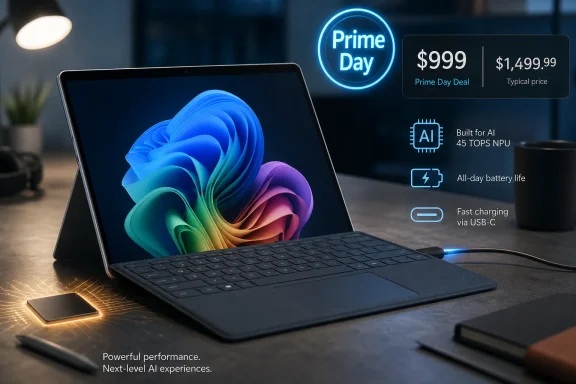
Microsoft’s Surface Pro 11th Edition with a Snapdragon X Plus 10-core chip, 16GB of RAM, and 512GB of storage has reportedly fallen to $999 on Amazon for Prime Day on June 23, 2026, undercutting Microsoft’s own $1,499.99 configuration price. The discount is not merely a shopping blip; it is a market signal. Microsoft’s first serious Copilot+ PC wave is moving from halo hardware into price warfare, and that changes how Windows on Arm should be judged.
The Surface Pro 11 launched as a statement machine. It was the device Microsoft wanted reviewers, developers, and enterprise buyers to associate with the Copilot+ PC era: thin, fanless-feeling in everyday work, long-lasting, and finally powered by Arm silicon that could plausibly compete with Apple’s laptop chips.
A $500 discount changes the tone. The same device that was sold as the premium proof point for Windows on Arm is now being pushed at a price closer to a high-end tablet, a midrange ultrabook, or an older Intel Surface bundle. That does not make it a failure. It does mean the early-adopter tax is shrinking faster than Microsoft’s marketing would prefer.
The timing matters because Surface has always served two roles. It is both a product line and a reference design, a way for Microsoft to show OEMs what Windows hardware can look like when Redmond controls the whole stack. When that reference design hits a record low while newer Snapdragon X2 machines are entering the conversation, the message to the market is blunt: the first Copilot+ PC generation has to earn volume now.
The weight is also part of the appeal. At roughly 1.97 pounds without a keyboard, the Surface Pro is still unusually easy to carry for something that can become a full Windows workstation with the right accessories. The kickstand remains Microsoft’s great hardware constant: inelegant on a lap, excellent on a desk, and still more flexible than most convertible hinges.
But the deal price should not be read as “$999 for a complete laptop” without qualification. The keyboard and pen are sold separately, and the Surface Pro experience is substantially less compelling without at least a keyboard. Microsoft’s device-only pricing has always made Surface Pro discounts look cleaner than the real cost of ownership.
That is the first practical caveat for buyers. A $999 Surface Pro can become a more expensive machine quickly once a Surface Pro Flex Keyboard, Slim Pen, or dock enters the cart. The discount is meaningful, but it does not repeal the Surface tax.
The 45 TOPS NPU is the hardware hook for Copilot+ PC branding. It enables local AI features such as Live Captions, Cocreator-style image tools, and the controversial Recall feature when available and enabled. Microsoft’s pitch is that this kind of on-device AI acceleration will become as normal as a GPU, quietly supporting features that would otherwise need the cloud.
That argument is plausible, but it remains ahead of daily reality for many users. The biggest wins today are not “AI magic” so much as battery life, quiet operation, instant resume, and a machine that does not feel like it is cooking itself during routine browser and Office work. Those are real improvements, but they are more evolutionary than Microsoft’s Copilot+ branding suggests.
The exposed problem is compatibility. Windows on Arm is dramatically better than it used to be, but “better” is not the same as invisible. Most mainstream apps run well, many native Arm64 apps now exist, and emulation covers a large amount of legacy software. Still, driver-dependent tools, niche enterprise clients, VPN packages, security agents, hardware utilities, and older creative workflows can make Arm Windows feel like a compatibility audit rather than a clean upgrade.
For enthusiasts, that may be manageable. For sysadmins, it is the entire story.
A benchmark win does not settle the question of platform maturity. Apple controls the silicon, operating system, app distribution expectations, and developer narrative around Apple Silicon. Microsoft controls Windows but not the broader Windows app ecosystem in the same way, and that difference matters whenever a user leaves the browser.
The Surface Pro has another complication: it is not really a MacBook Air competitor in shape. It is a detachable tablet that becomes a laptop-like device. That makes it more flexible in meetings, classrooms, labs, and travel, but less comfortable in some laptop scenarios. Anyone who writes for hours on a couch or works in cramped economy seats knows the Surface kickstand is not a universal replacement for a clamshell.
The better comparison may be with an iPad Pro plus keyboard, a premium Windows detachable, or a lightweight business ultrabook. Against those categories, the $999 price is more aggressive. It puts the Surface Pro in a zone where buyers can justify its compromises as the cost of flexibility rather than the premium demanded by a flagship.
That distinction matters because deal write-ups often flatten battery claims into a single headline number. Video playback at controlled brightness is a useful industry comparison, but it does not represent a day of Teams calls, browser tabs, cloud sync, endpoint protection, and a few x86 apps running through emulation. In real life, the Snapdragon X platform can still be excellent, but it is not magic.
For enterprise users, battery predictability matters as much as battery length. A device that lasts eight to ten real working hours without heat spikes can change how field teams, consultants, and executives use Windows hardware. The Surface Pro 11 is credible there in a way that older Intel Surface Pros often were not.
The 65W fast-charging support is also worth noting, especially because USB-C charging has made travel kits simpler. The Surface Connect era is not entirely gone, but the modern Surface buyer can increasingly live in a USB-C world. That is a practical win for anyone who carries one charger for a laptop, phone, tablet, and accessories.
That is exactly where Microsoft needs the category to be tested. Copilot+ PCs will not become mainstream because of NPU demos alone. They will become mainstream if they show up at prices where normal buyers choose them without feeling like they are funding Microsoft’s platform experiment.
The $999 Surface Pro deal is therefore strategically important even if it is temporary. It lowers the psychological barrier for Windows on Arm while still preserving enough premium positioning for Microsoft to avoid looking desperate. A $500 cut is large, but it does not put the device in bargain-bin territory.
It also helps Microsoft compete with its own history. Surface buyers are trained to wait for discounts. Black Friday, back-to-school promos, student offers, and Microsoft Store bundles have conditioned the market to view list price as a starting point rather than a final price. Prime Day simply makes that dynamic louder.
That shift is healthier and more honest. A student living in Edge, Office, OneNote, Teams, Spotify, and web apps may never care about the processor architecture. A developer using WSL, containers, device SDKs, local databases, and obscure tooling should pause. A sysadmin whose environment depends on legacy VPN clients or endpoint tools should test before buying.
The Windows ecosystem is too broad for a single compatibility verdict. That is both Microsoft’s strength and its curse. Windows wins because it runs almost everything; Windows on Arm gets judged harshly whenever it does not.
The situation is improving because the incentives are finally aligned. Qualcomm has credible chips, Microsoft has a flagship Windows feature set that requires modern NPUs, and OEMs are shipping enough Arm systems for developers to care. But ecosystems move slower than silicon roadmaps. The Surface Pro discount does not erase that lag; it makes the lag cheaper to tolerate.
For a Surface Pro buyer, the practical point is simple. The hardware has the NPU required for Microsoft’s AI roadmap, but the value of that roadmap is still emerging. Some features will be useful. Some will be ignored. Some will be disabled by enterprise policy before users ever see them.
That is why the discount matters more than the AI branding. At $1,499.99, the buyer is paying a premium for Microsoft’s vision of the future. At $999, the buyer can justify the machine on the fundamentals and treat the AI features as optional upside.
This may be the more successful route for Copilot+ PCs anyway. Most platform transitions do not win because users fall in love with the abstract architecture. They win because the new machines are thinner, cooler, faster, longer-lasting, and eventually cheaper enough that the old machines feel stale.
The first question is not whether the Snapdragon X Plus is fast. It is whether the organization’s actual management stack behaves correctly. Endpoint detection and response, print drivers, VPN clients, smart card workflows, line-of-business apps, browser extensions, and accessibility tools all matter more than synthetic CPU charts.
The second question is lifecycle. Surface devices are attractive in managed environments because firmware, drivers, and support channels are relatively coherent compared with a random mix of OEM models. But Arm systems introduce another layer of certification and help-desk scripts. If a user hits an architecture-specific problem, the support team needs to know before the deployment hits 500 seats.
The third question is accessories. A fleet price that omits keyboards, pens, docks, spare chargers, cases, and warranty coverage is incomplete. Surface Pro can be cost-effective in the right role, but it is rarely as cheap as the device-only sticker makes it look.
For that person, the Surface Pro 11 at $999 is a far better proposition than it was at launch. The display is sharp, the chassis is light, the webcam setup is better than many laptops, and the form factor is genuinely useful for reading, note-taking, travel, and couch computing. Windows tablets have never had the app ecosystem elegance of the iPad, but they have one enormous advantage: they are still Windows PCs.
That advantage is especially clear for people who want a tablet sometimes and a real desktop browser, file system, windowing model, and peripheral support the rest of the time. The Surface Pro remains imperfect as a tablet and imperfect as a laptop. Its value comes from being good enough at both.
At $999, “good enough at both” becomes much more persuasive.
That has been true for years, and it remains true here. The Surface Pro Flex Keyboard is a clever accessory, especially because it can be used detached from the tablet. It is also expensive. Add a Slim Pen and the total price can climb back toward the territory the Amazon discount seemed to escape.
This is where shoppers need to resist the headline. The right comparison is not simply discounted Surface Pro versus list-price MacBook Air. It is discounted Surface Pro plus the keyboard you actually want versus the laptop, tablet, or 2-in-1 you would otherwise buy. The Surface may still win, but the arithmetic should be honest.
There is also the repairability and upgradeability angle. The SSD is marketed as removable, which is welcome, but this is not a traditional service-friendly laptop. Buyers should choose the RAM configuration carefully because 16GB is sensible today but not expandable tomorrow. For a Copilot+ PC expected to last several years, 16GB is the floor, not a luxury.
The broader PC market is also in transition. Microsoft and Qualcomm need Windows on Arm to feel normal before Intel and AMD fully answer with their own NPU-heavy platforms. Intel’s Lunar Lake and newer AMD Ryzen AI systems already complicate the story, offering x86 compatibility with stronger efficiency than older PC designs. That means Surface Pro 11 is competing not only with Apple, but with the next generation of Windows laptops that do not ask users to think about Arm at all.
That is the real pressure. If x86 laptops can deliver excellent battery life, quiet operation, and enough NPU performance for Microsoft’s AI features, the argument for Arm becomes narrower. Snapdragon systems must win on total experience, not just efficiency claims.
Surface Pro has one defense: form factor. There are many excellent clamshell laptops. There are fewer premium detachable Windows PCs that feel this polished. The Amazon deal leans into that uniqueness while making the architecture risk easier to swallow.
For Windows enthusiasts, this is often the best moment to buy. Early firmware issues have had time to settle. App compatibility has improved. Retailers are motivated. The device is still modern enough to receive the features Microsoft is building around Copilot+ PCs, but no longer priced as if the category has no competition.
There is a familiar rhythm here. The first wave establishes the story. The second wave improves the silicon and gives reviewers something new to benchmark. The discounted first wave then becomes the machine ordinary buyers actually purchase in meaningful numbers.
If Microsoft is lucky, that is how Windows on Arm stops being a curiosity. Not by winning every benchmark, not by forcing AI into every workflow, but by landing in shopping carts because the value equation finally makes sense.
 Microsoft’s AI PC Finally Meets the Clearance Aisle
The Surface Pro 11 launched as a statement machine. It was the device Microsoft wanted reviewers, developers, and enterprise buyers to associate with the Copilot+ PC era: thin, fanless-feeling in everyday work, long-lasting, and finally powered by Arm silicon that could plausibly compete with Apple’s laptop chips.A $500 discount changes the tone. The same device that was sold as the premium proof point for Windows on Arm is now being pushed at a price closer to a high-end tablet, a midrange ultrabook, or an older Intel Surface bundle. That does not make it a failure. It does mean the early-adopter tax is shrinking faster than Microsoft’s marketing would prefer.
The timing matters because Surface has always served two roles. It is both a product line and a reference design, a way for Microsoft to show OEMs what Windows hardware can look like when Redmond controls the whole stack. When that reference design hits a record low while newer Snapdragon X2 machines are entering the conversation, the message to the market is blunt: the first Copilot+ PC generation has to earn volume now.
The Spec Sheet Was Never the Weak Part
On paper, the discounted configuration is the one most WindowsForum readers would actually consider. The Snapdragon X Plus 10-core processor is paired with 16GB of LPDDR5x memory and a 512GB SSD, avoiding the under-specced trap that has haunted too many entry-level Windows machines. The 13-inch PixelSense Flow display keeps the familiar Surface 3:2 aspect ratio and 2880×1920 resolution, which remains one of the best productivity shapes in portable computing.The weight is also part of the appeal. At roughly 1.97 pounds without a keyboard, the Surface Pro is still unusually easy to carry for something that can become a full Windows workstation with the right accessories. The kickstand remains Microsoft’s great hardware constant: inelegant on a lap, excellent on a desk, and still more flexible than most convertible hinges.
But the deal price should not be read as “$999 for a complete laptop” without qualification. The keyboard and pen are sold separately, and the Surface Pro experience is substantially less compelling without at least a keyboard. Microsoft’s device-only pricing has always made Surface Pro discounts look cleaner than the real cost of ownership.
That is the first practical caveat for buyers. A $999 Surface Pro can become a more expensive machine quickly once a Surface Pro Flex Keyboard, Slim Pen, or dock enters the cart. The discount is meaningful, but it does not repeal the Surface tax.
Snapdragon X Plus Solved One Old Surface Problem and Exposed Another
The Snapdragon X generation was Microsoft’s best answer yet to a decade of uneven Windows on Arm attempts. Previous Arm-based Surface devices asked users to tolerate too many compromises for the privilege of better standby time and battery life. The Surface Pro 11 is different because it can feel fast in ordinary Windows work rather than merely efficient.The 45 TOPS NPU is the hardware hook for Copilot+ PC branding. It enables local AI features such as Live Captions, Cocreator-style image tools, and the controversial Recall feature when available and enabled. Microsoft’s pitch is that this kind of on-device AI acceleration will become as normal as a GPU, quietly supporting features that would otherwise need the cloud.
That argument is plausible, but it remains ahead of daily reality for many users. The biggest wins today are not “AI magic” so much as battery life, quiet operation, instant resume, and a machine that does not feel like it is cooking itself during routine browser and Office work. Those are real improvements, but they are more evolutionary than Microsoft’s Copilot+ branding suggests.
The exposed problem is compatibility. Windows on Arm is dramatically better than it used to be, but “better” is not the same as invisible. Most mainstream apps run well, many native Arm64 apps now exist, and emulation covers a large amount of legacy software. Still, driver-dependent tools, niche enterprise clients, VPN packages, security agents, hardware utilities, and older creative workflows can make Arm Windows feel like a compatibility audit rather than a clean upgrade.
For enthusiasts, that may be manageable. For sysadmins, it is the entire story.
The MacBook Air Comparison Is Useful and Misleading
Gizmodo’s source material repeats Microsoft’s claim that this Surface Pro configuration can outperform the MacBook Air M3 in CPU benchmarks. That comparison is useful because Apple remains the company Microsoft is chasing in thin, efficient client hardware. It is also misleading if treated as a complete buying guide.A benchmark win does not settle the question of platform maturity. Apple controls the silicon, operating system, app distribution expectations, and developer narrative around Apple Silicon. Microsoft controls Windows but not the broader Windows app ecosystem in the same way, and that difference matters whenever a user leaves the browser.
The Surface Pro has another complication: it is not really a MacBook Air competitor in shape. It is a detachable tablet that becomes a laptop-like device. That makes it more flexible in meetings, classrooms, labs, and travel, but less comfortable in some laptop scenarios. Anyone who writes for hours on a couch or works in cramped economy seats knows the Surface kickstand is not a universal replacement for a clamshell.
The better comparison may be with an iPad Pro plus keyboard, a premium Windows detachable, or a lightweight business ultrabook. Against those categories, the $999 price is more aggressive. It puts the Surface Pro in a zone where buyers can justify its compromises as the cost of flexibility rather than the premium demanded by a flagship.
The Battery Claim Needs the Fine Print
The Surface Pro 11’s battery story is one of its strongest selling points, but the exact number depends on the workload. Microsoft lists up to 14 hours of local video playback for Wi-Fi models and up to 10 hours of active web usage. Those are not the same thing, and shoppers should treat the web figure as the more relevant one for ordinary work.That distinction matters because deal write-ups often flatten battery claims into a single headline number. Video playback at controlled brightness is a useful industry comparison, but it does not represent a day of Teams calls, browser tabs, cloud sync, endpoint protection, and a few x86 apps running through emulation. In real life, the Snapdragon X platform can still be excellent, but it is not magic.
For enterprise users, battery predictability matters as much as battery length. A device that lasts eight to ten real working hours without heat spikes can change how field teams, consultants, and executives use Windows hardware. The Surface Pro 11 is credible there in a way that older Intel Surface Pros often were not.
The 65W fast-charging support is also worth noting, especially because USB-C charging has made travel kits simpler. The Surface Connect era is not entirely gone, but the modern Surface buyer can increasingly live in a USB-C world. That is a practical win for anyone who carries one charger for a laptop, phone, tablet, and accessories.
Prime Day Turns Copilot+ From Strategy Into Inventory
Retail discounts have a way of stripping away keynote language. “Copilot+ PC” sounds like a platform transition when Panos-style stage lighting is involved. On Amazon during Prime Day, it becomes a question of whether a shopper believes this Windows device is worth more than an iPad, less than a MacBook, and safer than a discounted Intel ultrabook.That is exactly where Microsoft needs the category to be tested. Copilot+ PCs will not become mainstream because of NPU demos alone. They will become mainstream if they show up at prices where normal buyers choose them without feeling like they are funding Microsoft’s platform experiment.
The $999 Surface Pro deal is therefore strategically important even if it is temporary. It lowers the psychological barrier for Windows on Arm while still preserving enough premium positioning for Microsoft to avoid looking desperate. A $500 cut is large, but it does not put the device in bargain-bin territory.
It also helps Microsoft compete with its own history. Surface buyers are trained to wait for discounts. Black Friday, back-to-school promos, student offers, and Microsoft Store bundles have conditioned the market to view list price as a starting point rather than a final price. Prime Day simply makes that dynamic louder.
Windows on Arm Is No Longer a Curiosity, but It Is Still a Bet
The Surface Pro 11 is arguably the first Arm Surface that many Windows enthusiasts can recommend without a paragraph of apologies. That is a major milestone. It means the conversation has moved from “does Windows on Arm work?” to “does it work for your stack?”That shift is healthier and more honest. A student living in Edge, Office, OneNote, Teams, Spotify, and web apps may never care about the processor architecture. A developer using WSL, containers, device SDKs, local databases, and obscure tooling should pause. A sysadmin whose environment depends on legacy VPN clients or endpoint tools should test before buying.
The Windows ecosystem is too broad for a single compatibility verdict. That is both Microsoft’s strength and its curse. Windows wins because it runs almost everything; Windows on Arm gets judged harshly whenever it does not.
The situation is improving because the incentives are finally aligned. Qualcomm has credible chips, Microsoft has a flagship Windows feature set that requires modern NPUs, and OEMs are shipping enough Arm systems for developers to care. But ecosystems move slower than silicon roadmaps. The Surface Pro discount does not erase that lag; it makes the lag cheaper to tolerate.
Recall Still Hangs Over the Copilot+ Pitch
No discussion of Copilot+ PCs can avoid Recall. Microsoft’s original plan for a searchable timeline of user activity triggered immediate privacy and security concerns, forcing the company to delay, rework, and harden the feature. Even after changes, Recall remains a symbol of the tension at the heart of AI PCs: local processing can be more private than cloud processing, but only if the feature design earns trust.For a Surface Pro buyer, the practical point is simple. The hardware has the NPU required for Microsoft’s AI roadmap, but the value of that roadmap is still emerging. Some features will be useful. Some will be ignored. Some will be disabled by enterprise policy before users ever see them.
That is why the discount matters more than the AI branding. At $1,499.99, the buyer is paying a premium for Microsoft’s vision of the future. At $999, the buyer can justify the machine on the fundamentals and treat the AI features as optional upside.
This may be the more successful route for Copilot+ PCs anyway. Most platform transitions do not win because users fall in love with the abstract architecture. They win because the new machines are thinner, cooler, faster, longer-lasting, and eventually cheaper enough that the old machines feel stale.
The Enterprise Buyer Sees a Pilot Device, Not a Fleet Standard
For IT departments, the Surface Pro 11 at $999 is tempting but not automatically transformative. The price makes pilot programs easier to justify, especially for mobile workers, executives, healthcare users, education staff, and field teams that benefit from pen and tablet modes. It does not eliminate the need for app validation.The first question is not whether the Snapdragon X Plus is fast. It is whether the organization’s actual management stack behaves correctly. Endpoint detection and response, print drivers, VPN clients, smart card workflows, line-of-business apps, browser extensions, and accessibility tools all matter more than synthetic CPU charts.
The second question is lifecycle. Surface devices are attractive in managed environments because firmware, drivers, and support channels are relatively coherent compared with a random mix of OEM models. But Arm systems introduce another layer of certification and help-desk scripts. If a user hits an architecture-specific problem, the support team needs to know before the deployment hits 500 seats.
The third question is accessories. A fleet price that omits keyboards, pens, docks, spare chargers, cases, and warranty coverage is incomplete. Surface Pro can be cost-effective in the right role, but it is rarely as cheap as the device-only sticker makes it look.
The Consumer Buyer Gets the Better End of the Deal
Consumers can afford to be more opportunistic. If the apps are known, the risk is smaller. A user who spends most of the day in a browser, Microsoft 365, streaming apps, messaging tools, and light creative software is exactly the buyer Microsoft had in mind.For that person, the Surface Pro 11 at $999 is a far better proposition than it was at launch. The display is sharp, the chassis is light, the webcam setup is better than many laptops, and the form factor is genuinely useful for reading, note-taking, travel, and couch computing. Windows tablets have never had the app ecosystem elegance of the iPad, but they have one enormous advantage: they are still Windows PCs.
That advantage is especially clear for people who want a tablet sometimes and a real desktop browser, file system, windowing model, and peripheral support the rest of the time. The Surface Pro remains imperfect as a tablet and imperfect as a laptop. Its value comes from being good enough at both.
At $999, “good enough at both” becomes much more persuasive.
The Accessory Math Is Where the Deal Gets Messy
The Surface Pro’s biggest weakness is not the processor, display, or battery. It is the way Microsoft sells the product. A detachable Windows PC without a keyboard is technically complete, but practically unfinished for most buyers.That has been true for years, and it remains true here. The Surface Pro Flex Keyboard is a clever accessory, especially because it can be used detached from the tablet. It is also expensive. Add a Slim Pen and the total price can climb back toward the territory the Amazon discount seemed to escape.
This is where shoppers need to resist the headline. The right comparison is not simply discounted Surface Pro versus list-price MacBook Air. It is discounted Surface Pro plus the keyboard you actually want versus the laptop, tablet, or 2-in-1 you would otherwise buy. The Surface may still win, but the arithmetic should be honest.
There is also the repairability and upgradeability angle. The SSD is marketed as removable, which is welcome, but this is not a traditional service-friendly laptop. Buyers should choose the RAM configuration carefully because 16GB is sensible today but not expandable tomorrow. For a Copilot+ PC expected to last several years, 16GB is the floor, not a luxury.
The Discount Says More About the Market Than the Machine
It would be easy to frame the price cut as evidence that Surface Pro demand is weak. That may be partly true, but it is too simple. Hardware discounts are driven by inventory, new model timing, retail events, competitive pressure, and the need to seed platforms.The broader PC market is also in transition. Microsoft and Qualcomm need Windows on Arm to feel normal before Intel and AMD fully answer with their own NPU-heavy platforms. Intel’s Lunar Lake and newer AMD Ryzen AI systems already complicate the story, offering x86 compatibility with stronger efficiency than older PC designs. That means Surface Pro 11 is competing not only with Apple, but with the next generation of Windows laptops that do not ask users to think about Arm at all.
That is the real pressure. If x86 laptops can deliver excellent battery life, quiet operation, and enough NPU performance for Microsoft’s AI features, the argument for Arm becomes narrower. Snapdragon systems must win on total experience, not just efficiency claims.
Surface Pro has one defense: form factor. There are many excellent clamshell laptops. There are fewer premium detachable Windows PCs that feel this polished. The Amazon deal leans into that uniqueness while making the architecture risk easier to swallow.
The First Copilot+ Generation Is Becoming the Value Generation
The arrival of newer Snapdragon X2-based Surface hardware changes the role of the Surface Pro 11. Yesterday’s flagship becomes today’s value play. That is not a bad fate for a device whose core hardware remains strong.For Windows enthusiasts, this is often the best moment to buy. Early firmware issues have had time to settle. App compatibility has improved. Retailers are motivated. The device is still modern enough to receive the features Microsoft is building around Copilot+ PCs, but no longer priced as if the category has no competition.
There is a familiar rhythm here. The first wave establishes the story. The second wave improves the silicon and gives reviewers something new to benchmark. The discounted first wave then becomes the machine ordinary buyers actually purchase in meaningful numbers.
If Microsoft is lucky, that is how Windows on Arm stops being a curiosity. Not by winning every benchmark, not by forcing AI into every workflow, but by landing in shopping carts because the value equation finally makes sense.
Where the $999 Surface Pro Deal Becomes a Real Windows Decision
The Surface Pro 11 discount is best understood as a practical buying moment rather than a referendum on Microsoft’s entire AI strategy. It is a strong price for a premium detachable, but it rewards buyers who know their software needs and punishes those who assume all Windows PCs are interchangeable.- The $999 price is meaningful because Microsoft still lists the Snapdragon X Plus, 16GB RAM, 512GB SSD configuration at $1,499.99 in its own store.
- The device is strongest for users who want a light Windows tablet-laptop hybrid for web work, Microsoft 365, video calls, note-taking, travel, and media.
- The keyboard and pen costs must be included in any honest comparison, because most buyers will not want to use the Surface Pro as a slate alone.
- The Snapdragon X Plus platform is credible for mainstream Windows work, but specialized apps, drivers, VPNs, and enterprise tools still need compatibility checks.
- The advertised 14-hour battery figure refers to local video playback, while Microsoft’s active web usage claim is lower and more relevant to daily productivity.
- The Copilot+ features are a future-facing bonus, but the better reason to buy this device today is the combination of display quality, battery life, portability, and price.
References
- Primary source: Gizmodo
Published: Tue, 23 Jun 2026 15:05:24 GMT
Microsoft Crashes the Surface Pro (Snapdragon X Plus, 16GB RAM, 512GB) to Its Record Low on Amazon
A 1.97-pound 2-in-1 with a 2880x1920 PixelSense display, 14-hour battery, Snapdragon X Plus, and Copilot+ AI built in. gizmodo.com
- Official source: learn.microsoft.com
Tech specs—Surface Pro for Business, Copilot+ PC, Snapdragon X Series processor, 11th Edition - Surface | Microsoft Learn
See technical specifications for Surface Pro 11th Edition with Snapdragon processors, including display, battery life, and ports.learn.microsoft.com - Official source: microsoft.com
- Related coverage: us.smartprix.com
Microsoft Surface Laptop 7th Edition ZGM-00026 (Snapdragon X Plus/ 16GB/ 512GB SSD/ Win11) - Price in United States (Jun 2026), Specs, Reviews | Smartprix
Microsoft Surface Laptop 7th Edition ZGM-00026 is a Windows Business Laptop powered by Qualcomm Snapdragon X Plus with 16 GB... Price starts at $1,699.49 in United States. us.smartprix.com
- Related coverage: bestbuy.com
- Related coverage: surfacetip.com
Surface Pro 11 specs, features, and tips - SurfaceTip
Surface Pro 11 launched on May 20, 2024, with the new Snapdragon X processors, significantly improving performance, battery life, and more.surfacetip.com
- Related coverage: tomshardware.com
Microsoft debuts Surface Pro and Surface Laptop with new jade green color and Qualcomm Snapdragon X2 chips — refreshed devices start at $1,499 with 16GB of RAM | Tom's Hardware
The Laptop features Microsoft's new haptic touchpad.www.tomshardware.com - Related coverage: windowscentral.com
Surface Pro for Business (12th Edition) vs Surface Pro 11 | Windows Central
Microsoft's two-stage Surface Pro launch is confusing. Let me clear things up.www.windowscentral.com - Related coverage: insight.com
- Official source: news.microsoft.com
</rdf:Alt> </dc:title> <dc:description><rdf:Alt><rdf:li xml:lang="x-default"/> </rdf:Alt> </dc:description> <dc:creator><rdf:Seq><rdf:li>Joseph Galbraith (MBO Partners, Inc.)
</rdf:Alt> </dc:description> <dc:creator><rdf:Seq><rdf:li>Joseph Galbraith (MBO Partners, Inc.)news.microsoft.com